
Revision Notes
Edexcel IGCSE Accounting: Application of accounting concepts (4AC1) – Revision Notes
Condensed Edexcel IGCSE Accounting revision notes on applying consistency, prudence, accruals, materiality, money measurement and business entity.
- Subject
- Accounting
- Level
- IGCSE
- Topic
- Accounting for end of period adjustments
- Author
- Marlbridge Academic Team
- Updated
- Reviewed by
- Javaid Iqbal Sabri (what this means)
Aligned to Pearson Edexcel IGCSE Accounting (4AC1), Issue 1, October 2016. Official specification .
Syllabus page (what it covers and how it is assessed): Pearson Edexcel IGCSE Accounting.
Syllabus points this page covers
4AC1
- 5 Accounting for end of period adjustments (whole topic)
- 5.1 Application of accounting concepts
Found an error? Report a correction.
Want a teacher for this? Marlbridge teaches Accounting online. Request a free trial class.
These notes condense section 5.1, Application of accounting concepts, from Topic 5 of the Pearson Edexcel International GCSE in Accounting (4AC1) specification, Issue 1, October 2016. For full explanations and worked examples, use the application of accounting concepts study guide. The specification wording is “apply”, so every note below ends with what to do and what changes in the accounts. Amounts are in dollars, written without a currency sign.
Links: 4AC1 Accounting course hub, printable 4AC1 checklist, free 10-minute diagnostics. For exam-style questions, use the practice questions.
The six concepts at a glance
| Concept | One-line meaning | Typical year-end use | Effect to state |
|---|---|---|---|
| Consistency | Same method each period for like items | Keep the depreciation method and inventory method | Profits stay comparable |
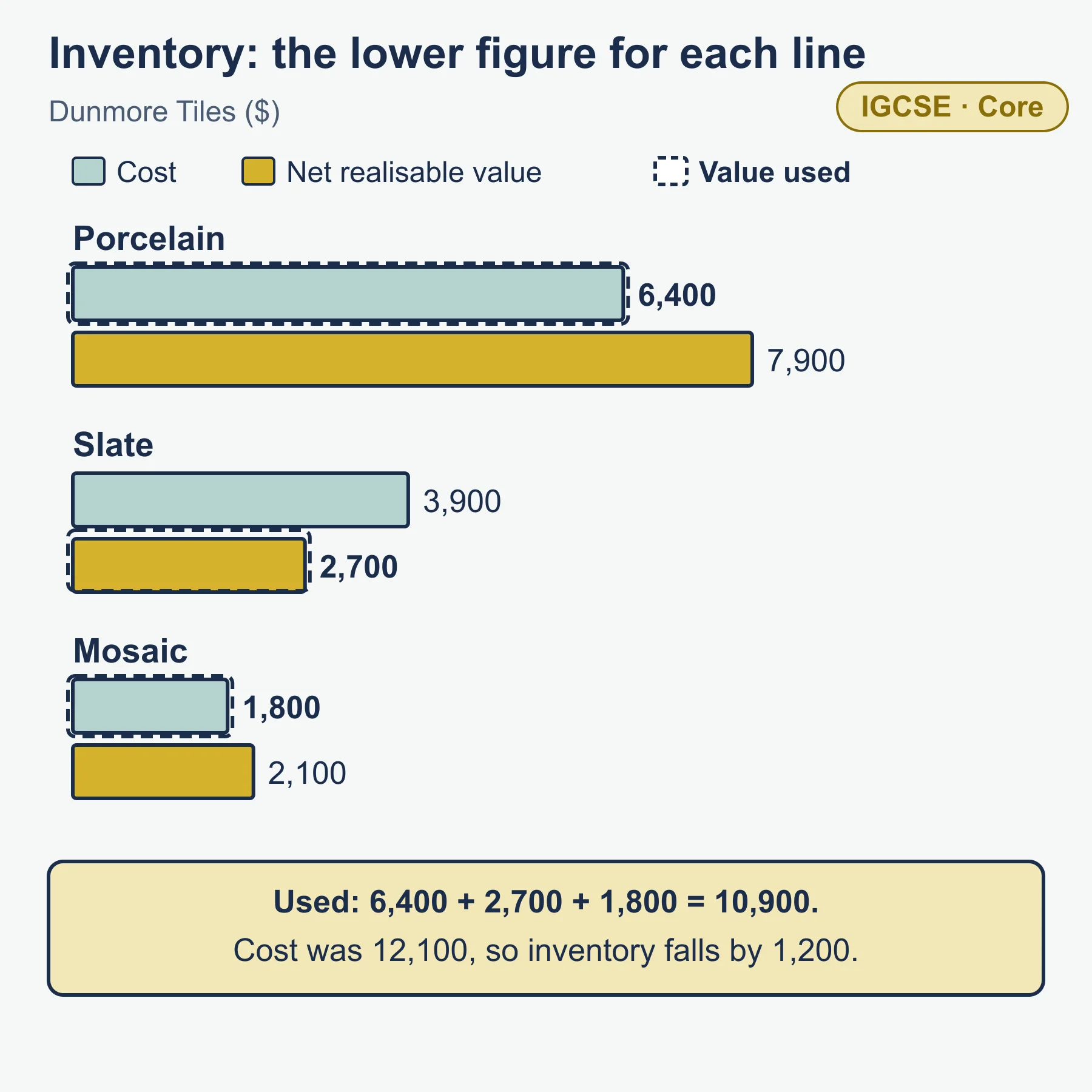
| Prudence | Do not overstate profit or assets | Inventory at lower of cost and net realisable value; provision for irrecoverable debts | Lower profit or lower asset |
| Accruals | Match to the period of use or earning | Expenses owed, expenses paid in advance, revenue earned but not received | Profit adjusted up or down |
| Materiality | Is it big enough to change a decision? | Small purchases expensed; trivial differences left | Simpler records |
| Money measurement | Only what has a money value | Assets at cost; staff skill and reputation absent | Statements are incomplete |
| Business entity | Business is separate from owner | Private items go to drawings | Profit up, drawings up |
Terms to use
- Other payable: an expense owed at the year end (an accrual). Adds to the expense, reduces profit.
- Other receivable: an expense paid in advance (a prepayment). Removed from the expense, increases profit.
- Carrying value: cost less accumulated depreciation.
- Drawings: assets taken by the owner for private use.
- Net realisable value: expected selling price less costs to sell.
- Statement of profit or loss, statement of financial position, inventory, trade receivables, non-current assets: use these names, not older ones.
Consistency
Method in steps:
- Spot that a method (depreciation, inventory valuation) has been changed or may be.
- Say it breaks consistency and makes years hard to compare.
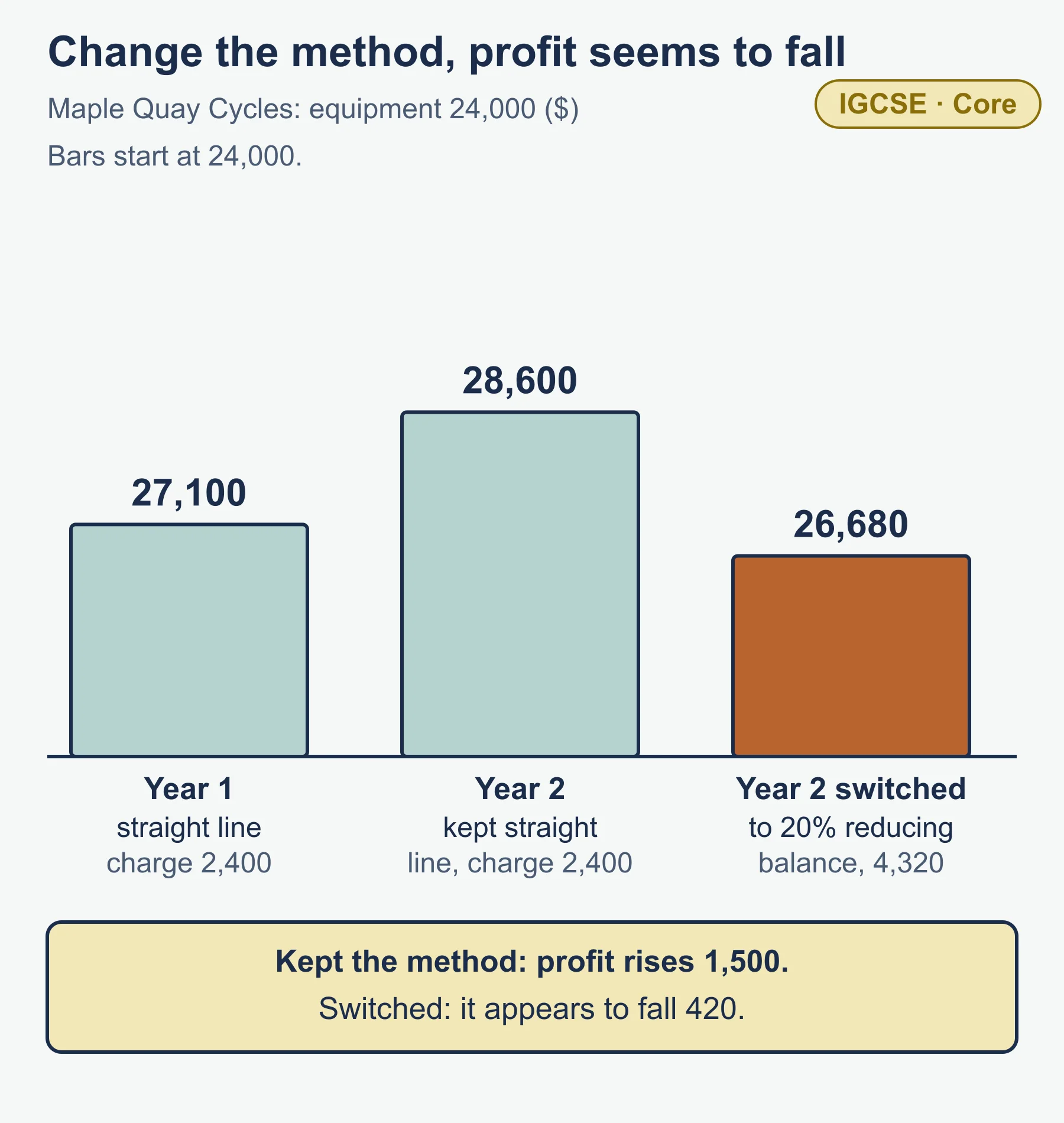
- Quantify if figures are given: compute the charge both ways and compare profit.
- Say a change needs a good reason and disclosure.
Reminder example. Wren Lane Pottery buys a kiln for 10,000 with a five-year life and nil residual. Straight line gives 10,000 / 5 = 2,000 each year. Reducing balance at 40% gives 4,000 in year 1 and (10,000 − 4,000) × 40% = 2,400 in year 2. Profit differs by 2,000 in year 1 and 400 in year 2 depending on the method. Choosing a method each year to suit the profit wanted is the failure to avoid.
Prudence
Method in steps:
- Decide if there is a possible loss, an uncertain gain or a doubtful asset.
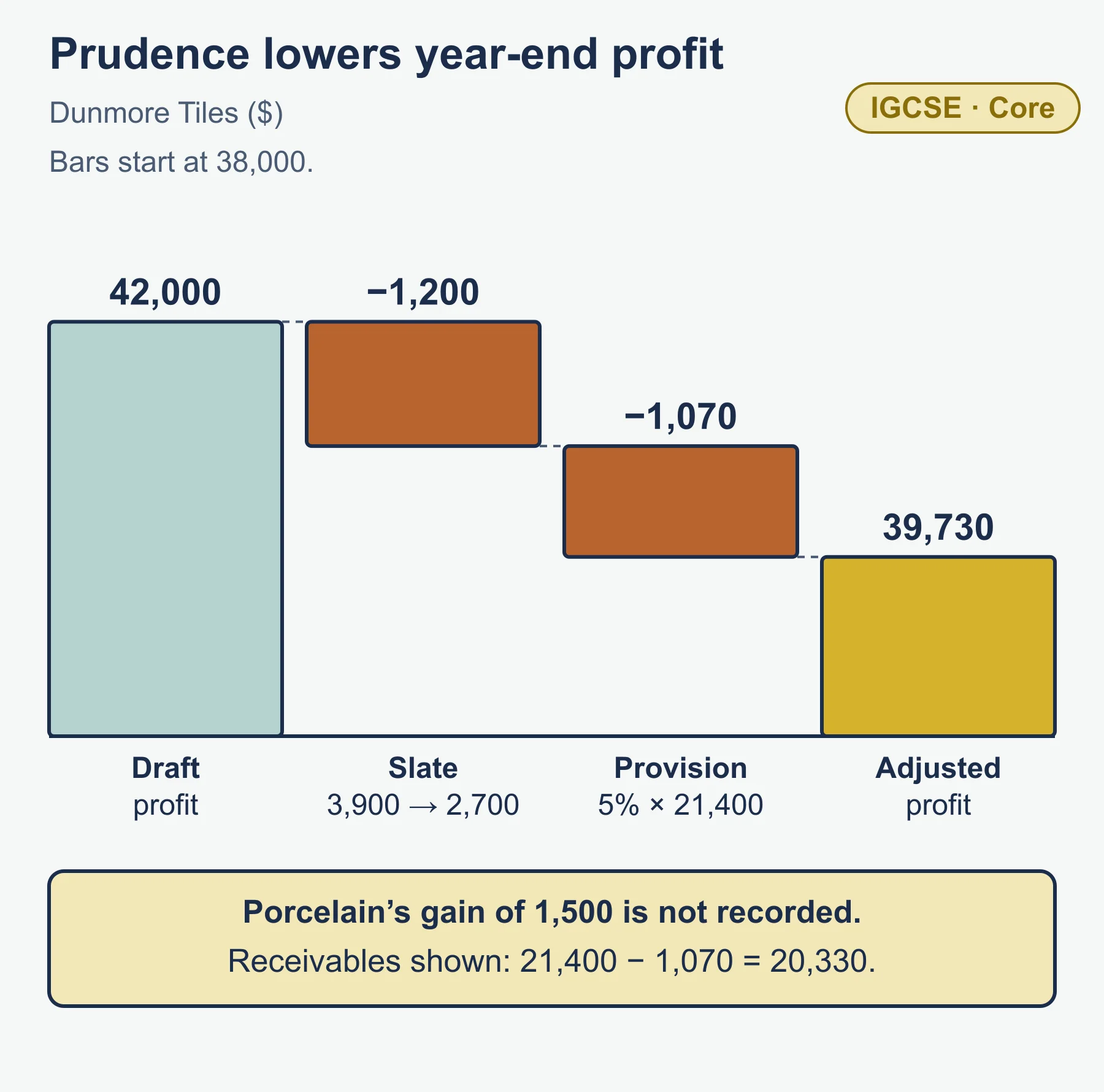
- Recognise the loss or lower the asset now; do not recognise the gain until it is earned.
- Show the effect: profit falls, or an asset is reduced.
Reminders:
- Inventory: cost 540, net realisable value 410, so use 410. Loss of 130 hits profit this year.
- Provision: receivables 8,000 at 3% gives a provision of 240 and a carrying figure of 7,760.
- A hoped-for order of 5,000 not yet signed is not revenue.
Limit: prudence allows careful estimates. It does not allow hidden reserves or inventing losses.
Accruals
Method in steps:
- Work out the period the cost or revenue belongs to.
- Compare it with the cash paid or received.
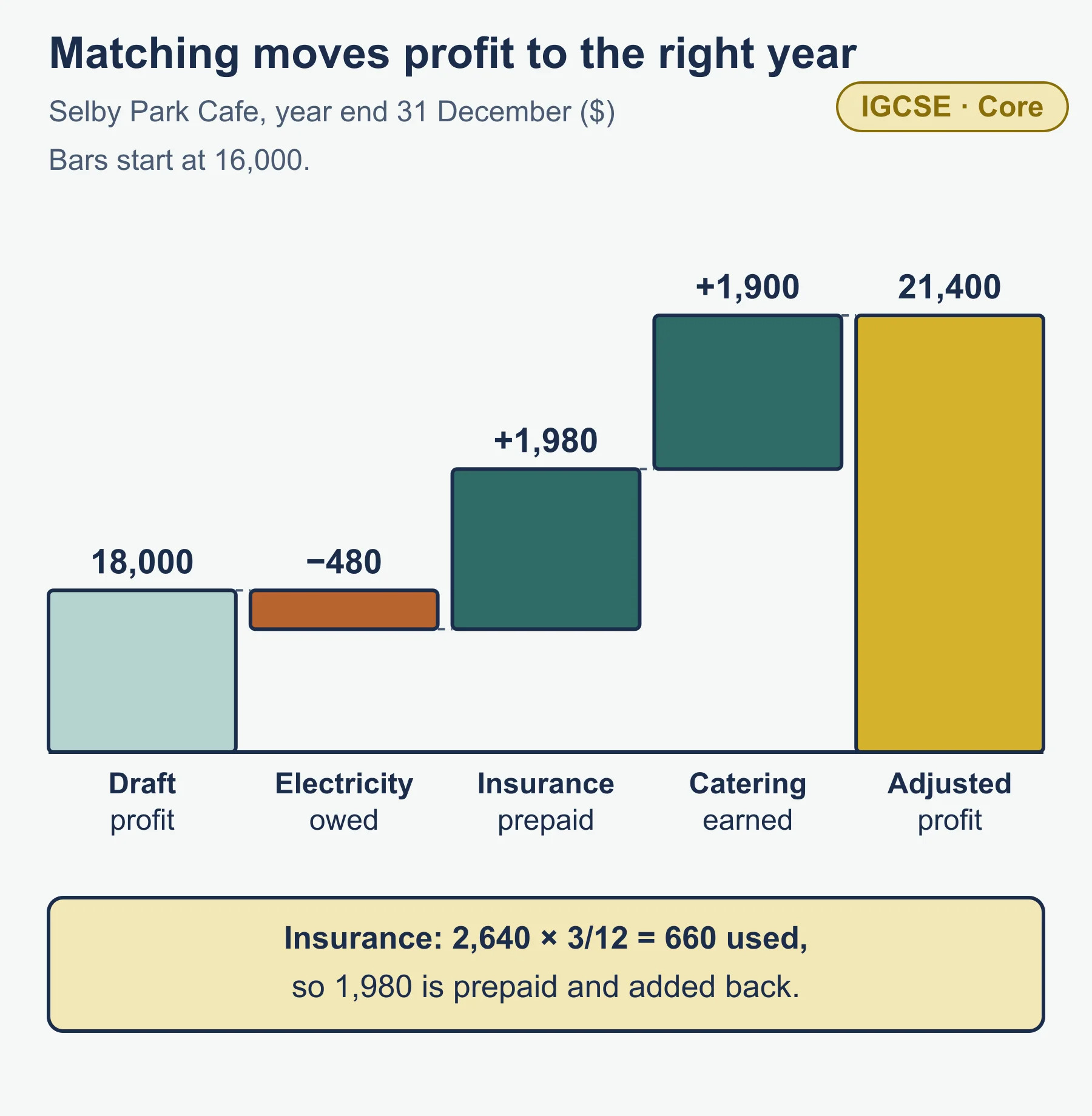
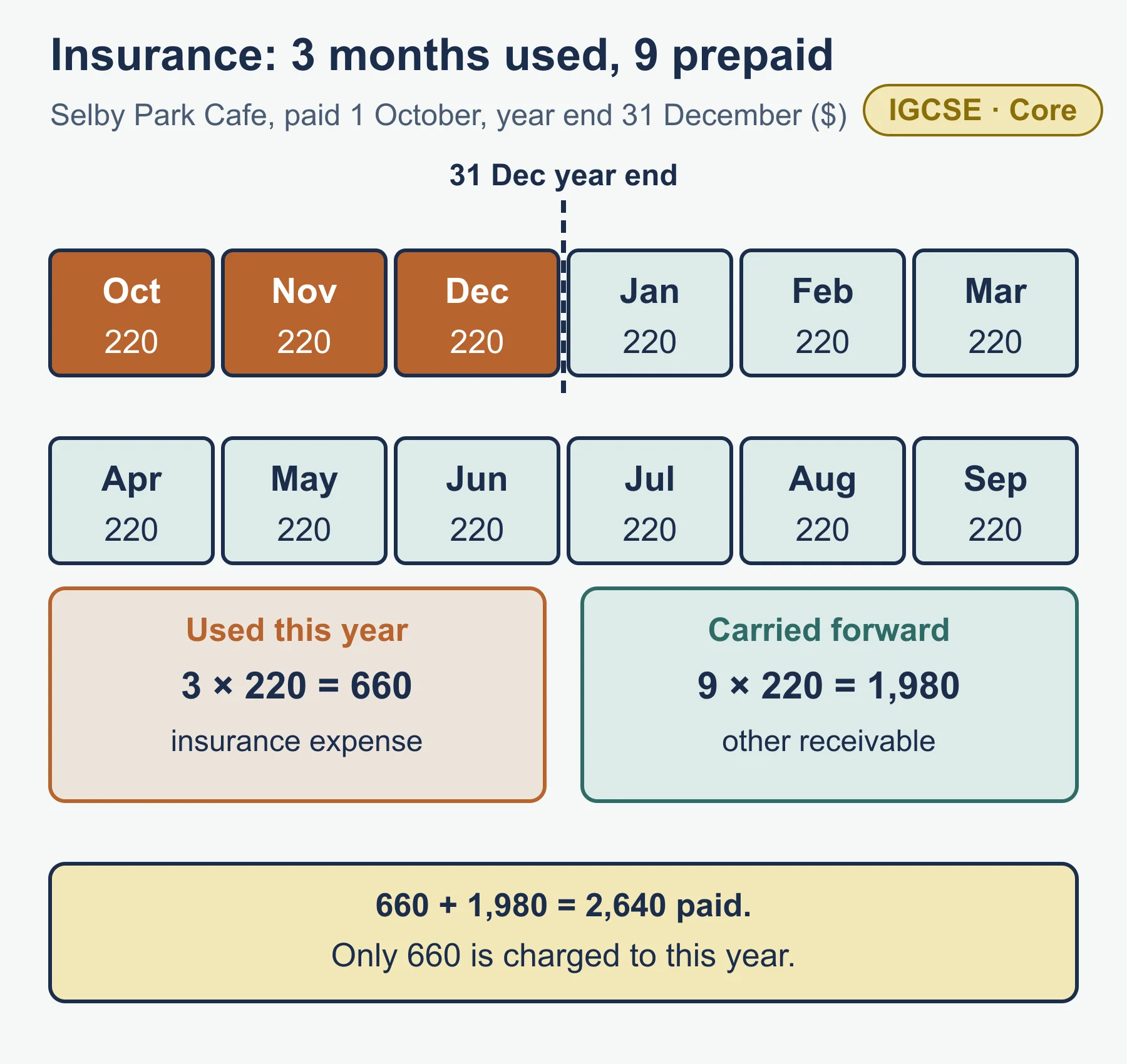
- Expense owed: add to the expense, other payable on the statement of financial position.
- Expense paid in advance: remove from the expense, other receivable on the statement of financial position.
- Revenue earned but not yet received: include it in revenue.
Reminders:
| Case | Working | Expense in statement of profit or loss | Statement of financial position |
|---|---|---|---|
| Wages paid 18,200, 650 owed | 18,200 + 650 | 18,850 | Other payable 650 |
| Insurance 1,200 paid 1 July for 12 months, year end 31 December | 6/12 used | 600 | Other receivable 600 |
The accruals concept is the reason a bill arriving after the year end can still be a cost of this year.
Materiality
Method in steps:
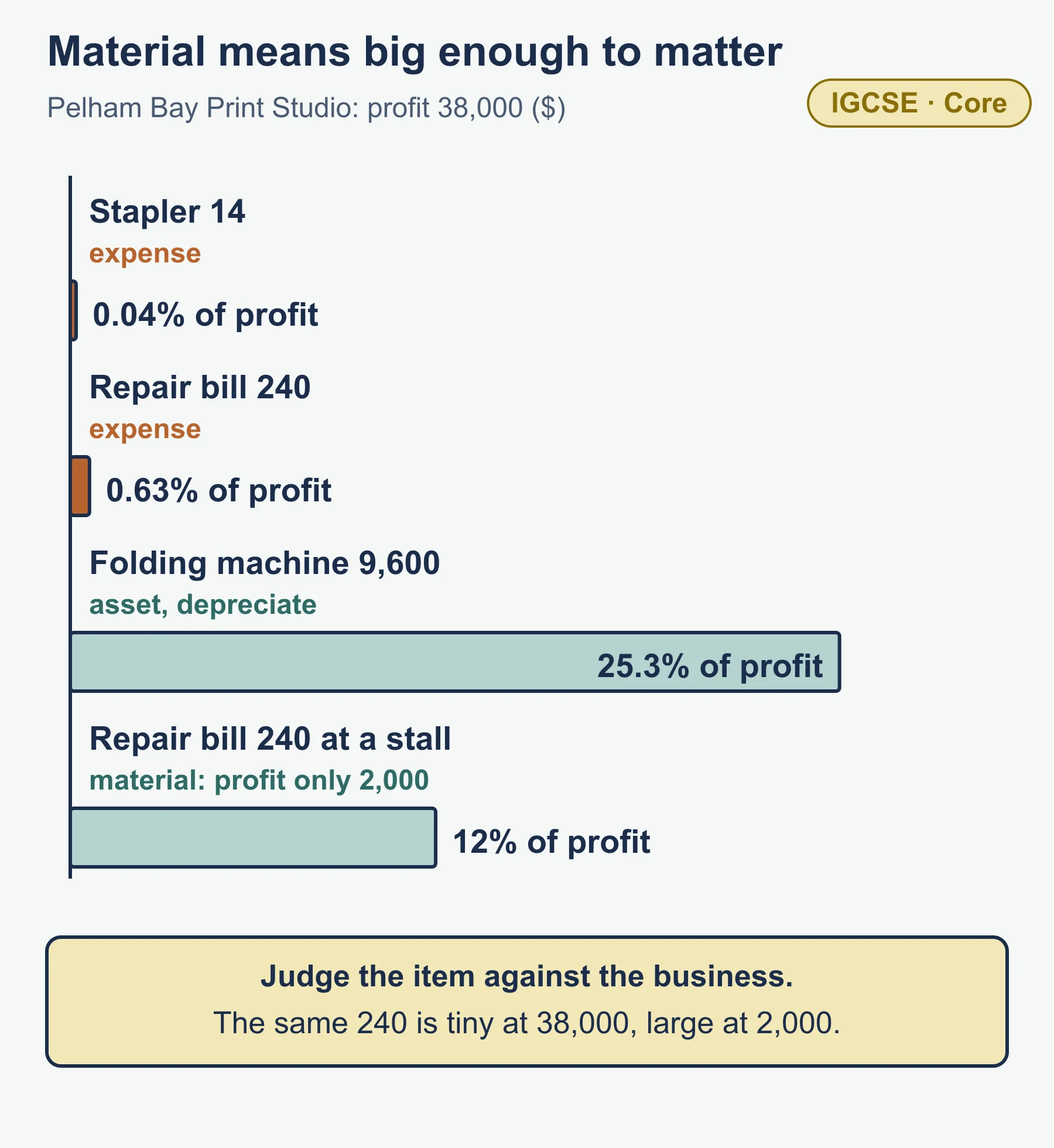
- Compare the item with profit, revenue or total assets.
- If small, treat it in the simplest way: expense it, do not depreciate it, do not chase a tiny error.
- If large, give full treatment: record it, depreciate it, correct it.
- Say the answer depends on the size of the business.
Reminder: an item of 90 against profit of 12,000 is 90 / 12,000 × 100 = 0.75%, so it is unlikely to be material. A policy line such as “expense purchases under a set amount” is fine when applied consistently.
Money measurement
Method in steps:
- Ask whether the item can be given a reliable money value.
- If yes, record it, usually at cost.
- If no, leave it out, and say the statements are incomplete as a result.
Limits to know:
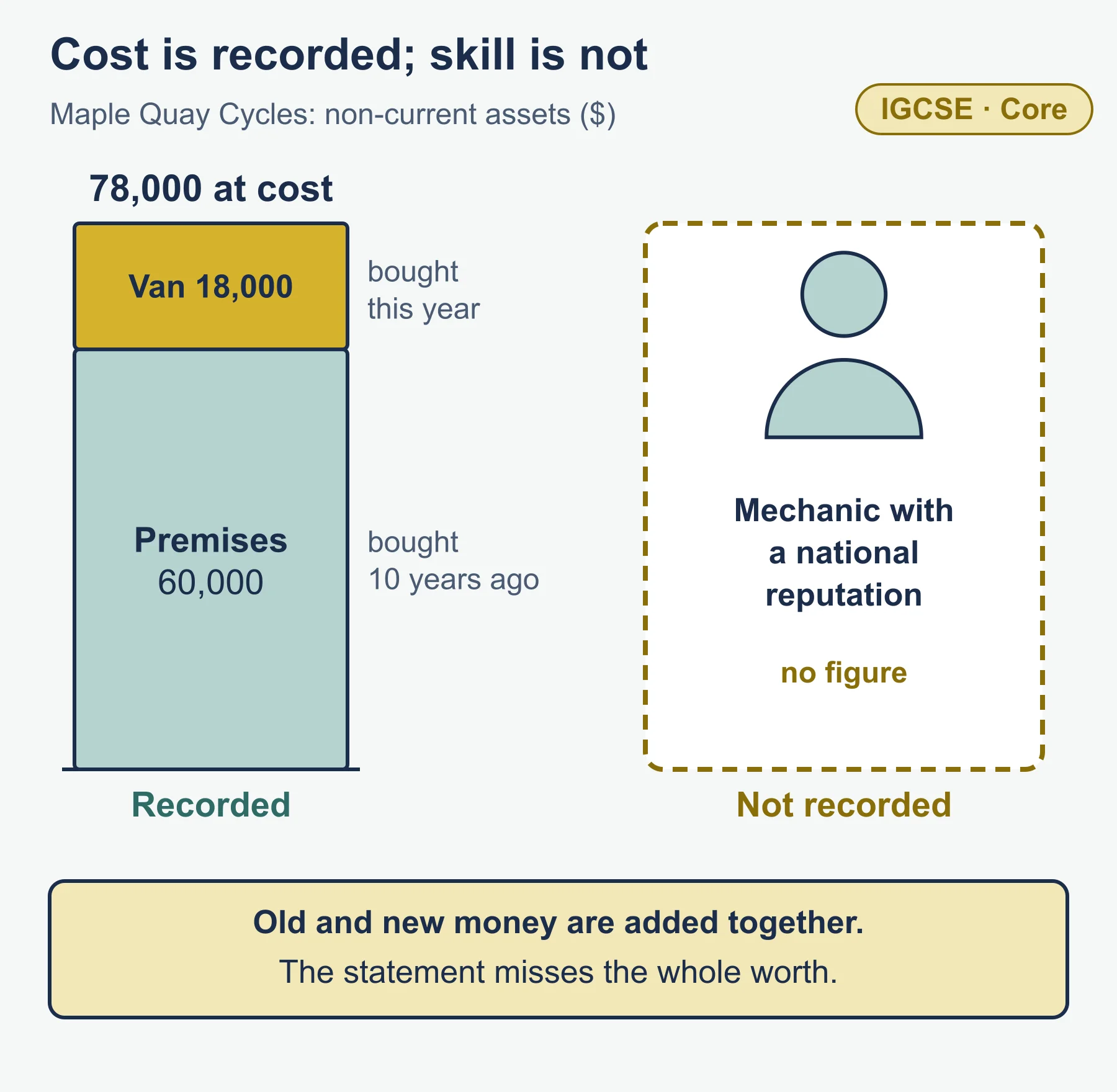
- Staff skill, reputation and customer loyalty are not recorded.
- Money changes in value over time, so old and new costs are added together.
- Disputed or uncertain values cannot be stated exactly.
Business entity
Method in steps:
- Ask whether the transaction belongs to the business or to the owner.
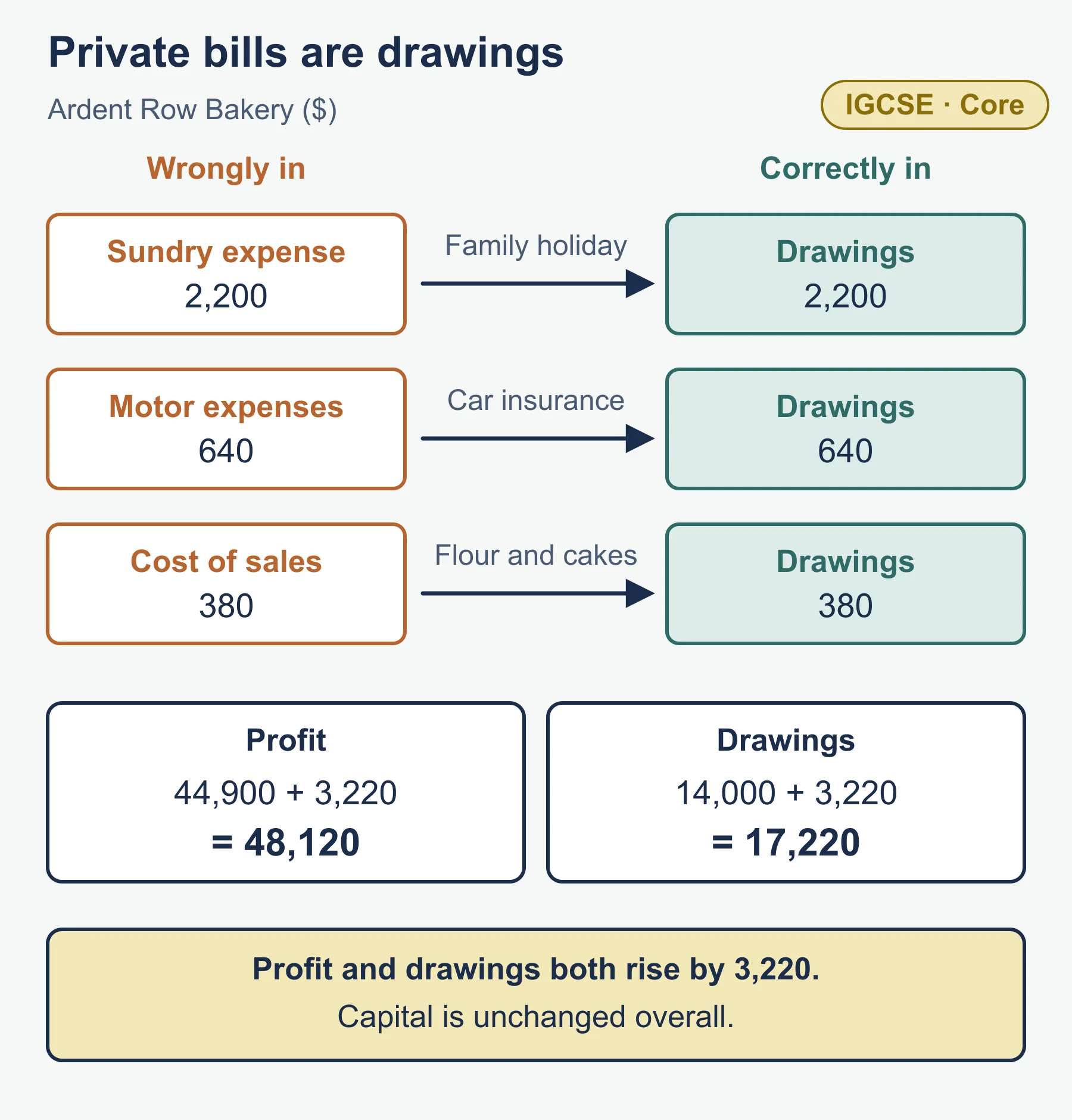
- Private payments and goods taken: record as drawings.
- Remove them from expenses or cost of sales if they were put there.
- Profit goes up by the amount removed; drawings go up by the same amount, so capital is unchanged overall.
Reminder: 150 of owner’s personal phone bill charged to telephone expense adds 150 to profit and 150 to drawings.
Must-know distinctions
| Pair | Difference |
|---|---|
| Prudence and accruals | Prudence is caution about uncertain gains and losses. Accruals is placing items in the right period. |
| Accrued and prepaid | Accrued means owed at the year end. Prepaid means paid for a future period. |
| Expense and drawings | Expense earns revenue for the business. Drawings are private use. |
| Materiality and money measurement | Materiality is about size. Money measurement is about whether a money value exists. |
| Consistency and prudence | Consistency is same method each year. Prudence is choosing a cautious value. |
Quick self-test
- List the six concepts named in section 5.1.
- Inventory cost is 1,350 and net realisable value is 1,100. What value is used?
- Electricity paid in the year is 2,700 and 360 is owed. What is the expense?
- A payment of 3,000 covers 15 months from 1 October. The business closes its books on 31 December. What is the expense for the year, and what is the other receivable?
- The owner takes goods that cost 250 for home use. Which concept applies, and where is the 250 recorded?
- An item of 45 is bought when profit is 9,000. Express it as a percentage of profit and name the concept.
- A business changes from straight line to reducing balance for one year only. Which concept is broken and why does it matter?
- Give two things that the money measurement concept keeps out of the statement of financial position.
- Trade receivables are 8,000. A provision of 3% is made. State the provision and the amount shown.
- A business records a profit on a sale before the goods are delivered. Which concept is ignored?
Answers
- Consistency, prudence, accruals, materiality, money measurement, business entity.
- 1,100, the lower figure (prudence).
- 2,700 + 360 = 3,060.
- 3,000 / 15 = 200 a month. October to December is 3 months, so the expense is 600. The other 12 months are prepaid: other receivable 2,400.
- Business entity. It is recorded as drawings, not as an expense.
- 45 / 9,000 × 100 = 0.5%. Materiality: it is too small to matter, so expense it.
- Consistency. Profit for the two years is not comparable.
- Any two from: staff skill, reputation, customer loyalty, items with no reliable money value.
- Provision 8,000 × 3% = 240; the amount shown is 8,000 − 240 = 7,760.
- Prudence (and accruals, as the sale has not been earned yet).
Where marks are usually lost
- Stating a concept’s name but never linking it to the case or to a change in profit.
- Saying “prudence” when the real issue is the period an item belongs to, which is accruals.
- Adding an accrued expense to profit instead of taking it away.
- Forgetting that a prepayment is removed from the expense, then also showing it as an expense.
- Charging the proprietor’s household payments to expenses when they are drawings.
- Answering materiality with a fixed percentage rule that the specification does not give.
- Writing that money measurement shows assets at their current market price.
- Using older names such as stock or debtors when the specification wording is inventory and trade receivables.
Frequently asked questions
What is the consistency concept? Consistency means that once a business chooses an accounting method, such as a depreciation or inventory valuation method, it keeps using it from period to period. This makes results comparable, so a change in profit comes from trading rather than from a change of method.
What is the accruals concept? The accruals or matching concept says revenue is recorded when it is earned and expenses when they are incurred, whatever the date of the cash movement. An expense owed at the year end is an other payable and an expense paid in advance is an other receivable.
What is the difference between prudence and accruals? Prudence is about avoiding overstatement when a value is uncertain, such as inventory or doubtful receivables. Accruals is about which period an item belongs to, so a question about timing points to accruals rather than prudence.
Which terms should be used in Edexcel IGCSE Accounting answers? Use the specification’s wording, such as inventory, trade receivables, other payables and other receivables. Older names such as stock or debtors should be avoided.
Official syllabus
Pearson Edexcel International GCSE in Accounting (4AC1) specification, Issue 1, October 2016, published by Pearson Education Limited – Topic 5 Accounting for end of period adjustments, section 5.1 Application of accounting concepts.
Get free revision emails (optional)
Occasional emails with practice questions, worked explanations and links to free resources for the qualification and subjects you choose. No spam, and you can unsubscribe from any email. The free tools on this site never need an email.
Related resources
-
Study guides
Edexcel IGCSE Accounting: End-of-period adjustments (4AC1)
Study guide to Edexcel IGCSE Accounting 4AC1 end-of-period adjustments: depreciation, disposals, irrecoverable debts, provisions, accruals and prepayments.
Accounting · Pearson Edexcel · IGCSE
Read guide -
Practice questions
Edexcel IGCSE Accounting: End-of-period adjustments (4AC1) – Practice Questions
Original Edexcel IGCSE Accounting 4AC1 practice questions on depreciation, disposals, irrecoverable debts, accruals and prepayments, with worked answers.
Accounting · Pearson Edexcel · IGCSE
Try questions -
Revision notes
Edexcel IGCSE Accounting: End-of-period adjustments (4AC1) – Revision Notes
Condensed Edexcel IGCSE Accounting 4AC1 notes on depreciation, disposals, irrecoverable debts, provisions, accruals and prepayments, with a self-test.
Accounting · Pearson Edexcel · IGCSE
Revise topic
Related articles
-
teaching
A Level tuition in Dubai: Cambridge or Pearson Edexcel International A Level?
Schools in Dubai and Abu Dhabi teach either Cambridge International AS & A Level or Pearson Edexcel International A Level. How the two are structured, why it matters for tuition, and how online classes from Lahore work.
9 October 2026
-
curriculum guides
Choosing subjects at IGCSE and A Level
How subject choices at 14 and 16 affect university options later, and how to keep pathways open without overloading a timetable.
28 July 2026
Studying this with a teacher
Working through Accounting IGCSE?
This page is free and stays free. If you would rather be taught it, Marlbridge runs Accounting classes one-to-one and in small groups of up to 15, online in your own time zone. The first trial class is free. WhatsApp replies within an hour (8am–11pm Pakistan time, every day); email the same day.
Pearson Edexcel Accounting teachers at Marlbridge

