
Study Guides
Edexcel IGCSE Accounting: Business documentation and books of original entry (4AC1)
Study guide to Edexcel IGCSE Accounting 4AC1 business documents, day books, cash book, petty cash book and journal, with five worked examples.
- Subject
- Accounting
- Level
- IGCSE
- Topic
- Introduction to bookkeeping
- Author
- Marlbridge Academic Team
- Updated
- Reviewed by
- Javaid Iqbal Sabri (what this means)
Aligned to Pearson Edexcel IGCSE Accounting (4AC1), Issue 1, October 2016. Official specification .
Syllabus page (what it covers and how it is assessed): Pearson Edexcel IGCSE Accounting.
Syllabus points this page covers
4AC1
- 2 Introduction to bookkeeping (whole topic)
- 2.1 Business documentation
- 2.2 Books of original entry
Found an error? Report a correction.
Want a teacher for this? Marlbridge teaches Accounting online. Request a free trial class.
This guide teaches sections 2.1 Business documentation and 2.2 Books of original entry of Topic 2, Introduction to bookkeeping, in the Pearson Edexcel International GCSE in Accounting (4AC1) specification, Issue 1, October 2016. Paper 1 draws on topics 1 to 3, so this content sits in that paper. All businesses and figures are invented, and all amounts are in dollars ($). For condensed recall use the revision notes, and for exam-style questions use the practice set.
Links: Accounting course hub, printable checklist, free 10-minute diagnostics.
What the specification asks for
| Section | You must be able to |
|---|---|
| 2.1 a) | Explain the purpose of business documents |
| 2.1 b) | Prepare a purchase order, purchase invoice, sales invoice, credit note, statement of account, remittance advice and petty cash voucher |
| 2.1 c) | Cash receipt |
| 2.2 a) | Explain the purpose of books of original entry |
| 2.2 b) | Prepare the purchases day book, sales day book, purchases returns book, sales returns book, three-column cash book, petty cash book and the journal |
The specification lists “cash receipt” in 2.1 c) without a verb, so this guide explains it and shows how to prepare one.
Note on wording: the specification names only the documents and books in the table. Terms and practices used below to explain them, such as the imprest system, contra entries, trade and cash discount, analysis columns, narratives and the typical uses of the journal, are standard bookkeeping practice added to help you prepare the books. They are not wording from the specification.
The trail of documents
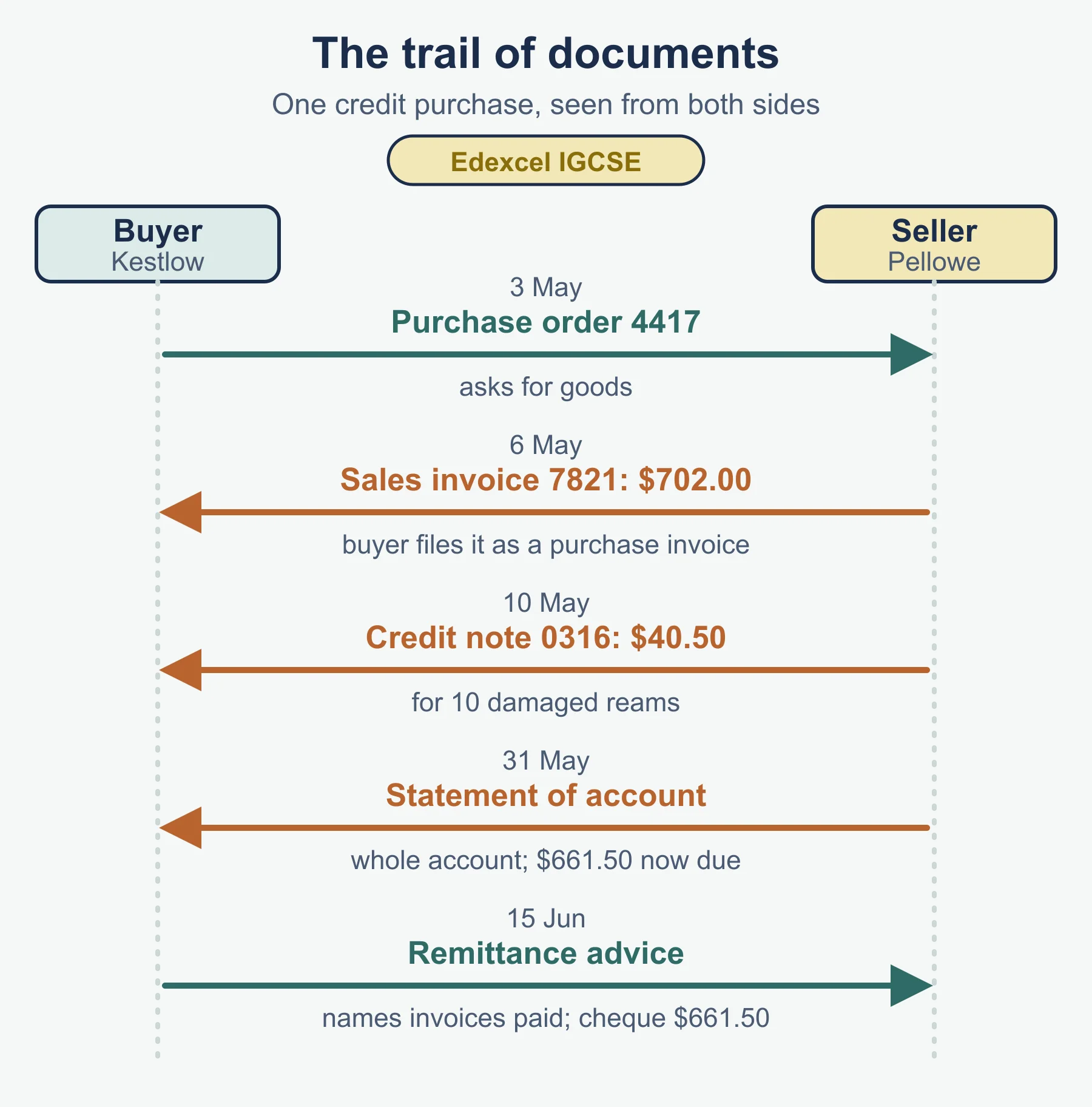
Every credit purchase leaves a trail of paper. The same trail is seen from two sides: what the buyer calls a purchase invoice, the seller calls a sales invoice.
| Document | Prepared by | Sent to | Purpose |
|---|---|---|---|
| Purchase order | Buyer | Seller | Requests goods, with quantity, description and agreed price |
| Sales invoice | Seller | Buyer | Bills the buyer: what was supplied, price, discount and payment terms |
| Purchase invoice | The same invoice, kept by the buyer | Evidence of what the buyer owes, checked against the order | |
| Credit note | Seller | Buyer | Reduces the amount owed, for returns or an overcharge |
| Statement of account | Seller | Buyer | Summary of the account for a period, ending with the balance due |
| Remittance advice | Buyer | Seller | Tells the seller which invoices a payment covers |
| Cash receipt | Person receiving money | Person paying | Proof that cash was received |
| Petty cash voucher | Person spending | Petty cashier | Authorises and records a small cash payment |
Documents are the evidence behind every entry. They let a business check amounts, settle disputes and prove a transaction took place. Each is numbered so that none can go missing unnoticed.
Worked example 1: order, invoice, credit note
Kestlow Stationers orders from Pellowe Paper Mills on 3 May 2027.
PURCHASE ORDER No. 4417            3 May 2027
From: Kestlow Stationers   To: Pellowe Paper Mills
120 reams A4 paper      @ 4.50 per ream
 40 boxes envelopes     @ 6.00 per box
Authorised: Office Manager
Pellowe despatches the goods and issues an invoice on 6 May. Trade discount is 10% and is deducted on the invoice.
INVOICE No. 7821                   6 May 2027
Pellowe Paper Mills to Kestlow Stationers
Ref: order 4417    Terms: 30 days
120 reams A4 paper   @ 4.50    540.00
 40 boxes envelopes  @ 6.00    240.00
Goods at list price             780.00
Less trade discount 10%          78.00
Amount due                      702.00
On 10 May Kestlow returns 10 damaged reams. Pellowe issues a credit note for 10 x 4.50 = 45.00, less 10% = 4.50, so 40.50. The credit note must use the same price and discount as the invoice, or the buyer and seller will disagree about the balance.
Statement, remittance advice, cash receipt, petty cash voucher
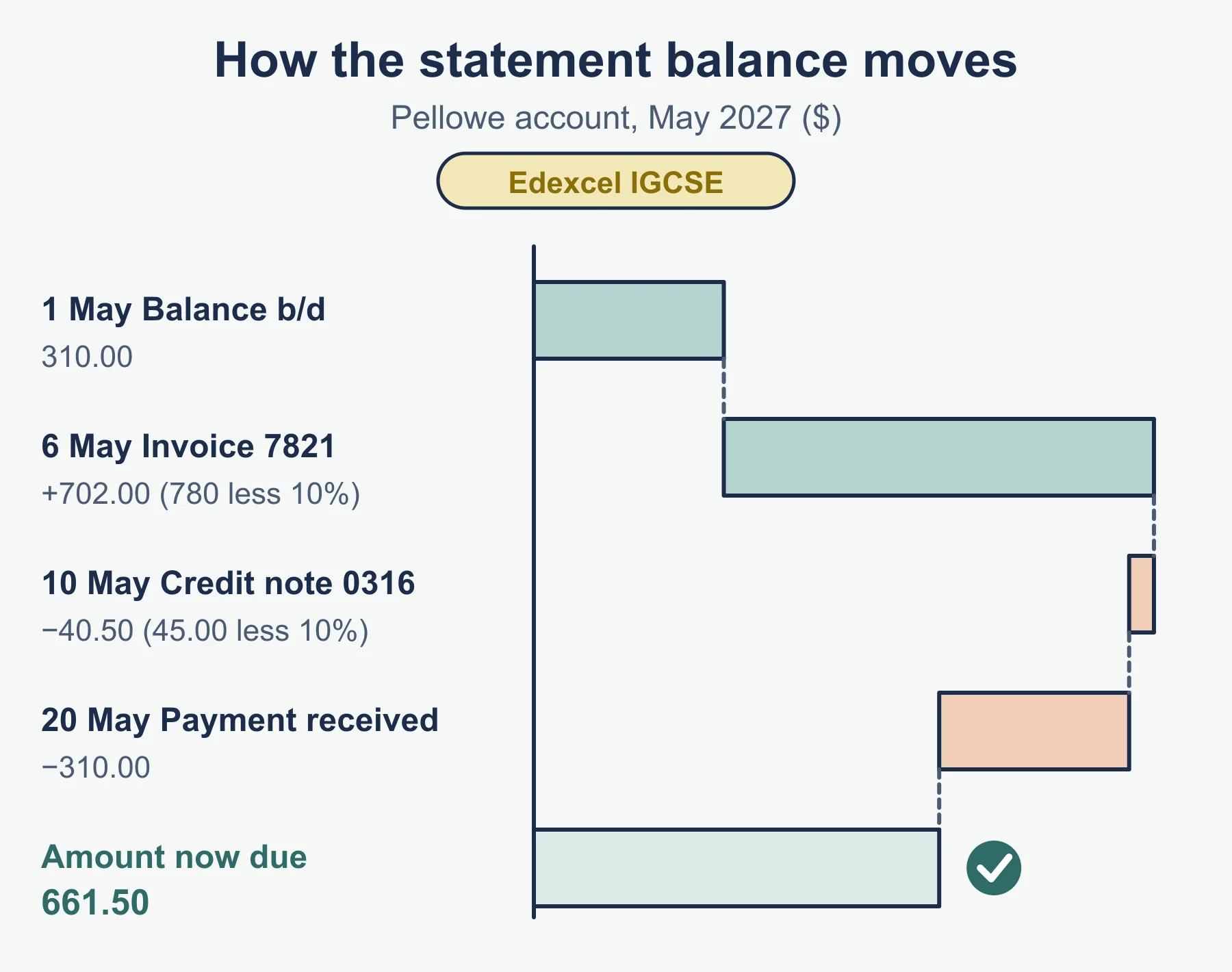
The statement lists the account in date order and ends with the balance still due.
STATEMENT OF ACCOUNT  Pellowe Paper Mills to Kestlow Stationers
31 May 2027                  Debit     Credit    Balance
1 May  Balance b/d                               310.00
6 May  Invoice 7821          702.00             1,012.00
10 May Credit note 0316                 40.50     971.50
20 May Payment received                310.00     661.50
Amount now due                                    661.50
On 15 June Kestlow pays the whole balance and sends a remittance advice:
REMITTANCE ADVICE  Kestlow Stationers to Pellowe Paper Mills
Invoice 7821                    702.00
Less credit note 0316            40.50
Cheque enclosed                 661.50
A cash receipt is issued when cash is received, for example 85.00 from Mr Pell for goods bought over the counter. It shows the date, the amount, what it was for and who received it, and Kestlow keeps a copy. A petty cash voucher records one small payment and is signed by the person authorising it and the person paid.
PETTY CASH VOUCHER No. 23          3 May 2027
Postage stamps                      12.80
Authorised: Office Manager   Received: J. Quayle
Common errors: treating a credit note as if it increased the amount owed, forgetting that a statement shows the whole account while an invoice shows one transaction, and sending a remittance advice that does not name the invoices paid.
Why we need books of original entry
Transactions happen in a stream. Entering each one straight into the ledger would bury the ledger in detail and make mistakes easy. Instead each transaction is first recorded in a book of original entry, in date order, from the source document. These books:
- keep similar transactions together, so totals can be posted to the ledger in one entry
- give a first, permanent record from which the ledger can be rebuilt
- split the work among staff and make errors easier to trace
- record only one type of transaction each, apart from the journal, which handles everything else.
Entries are then posted to the ledgers (covered in the ledger accounting pages of this series).
Worked example 2: the day books and returns books
Kestlow’s invoices and credit notes for May 2027, all shown at net amounts after trade discount.
Purchases day book (source: purchase invoices)
| Date | Supplier | Invoice | Net |
|---|---|---|---|
| 6 May | Pellowe Paper Mills | 7821 | 702.00 |
| 9 May | Pritchett Pens | D55 | 215.00 |
| 16 May | Cwm Ink Supplies | 301 | 128.40 |
| 24 May | Cwm Ink Supplies | 302 | 380.00 |
| Total | 1,425.40 |
Purchases returns book (source: credit notes received)
| Date | Supplier | Credit note | |
|---|---|---|---|
| 10 May | Pellowe Paper Mills | 0316 | 40.50 |
| 19 May | Cwm Ink Supplies | 088 | 18.40 |
| Total | 58.90 |
Sales day book (source: sales invoices issued)
| Date | Customer | Invoice | Net |
|---|---|---|---|
| 4 May | Harrow Bay Offices | 1 | 400.00 |
| 12 May | Sedley School | 2 | 265.50 |
| 20 May | Harrow Bay Offices | 3 | 120.00 |
| 28 May | Brae Law | 4 | 332.25 |
| Total | 1,117.75 |
Sales returns book (source: credit notes issued): 18 May, Sedley School, credit note 1, 31.50.
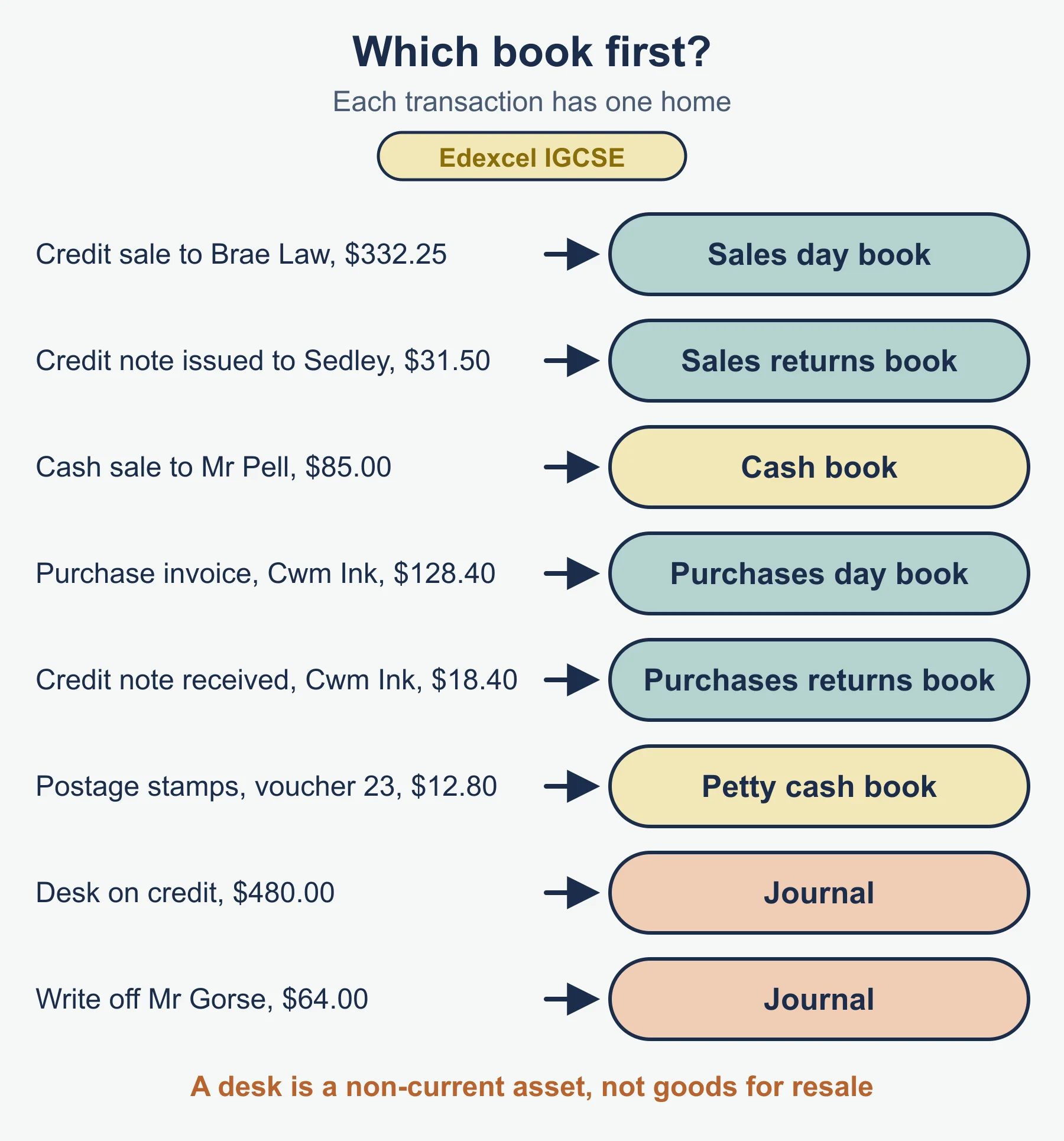
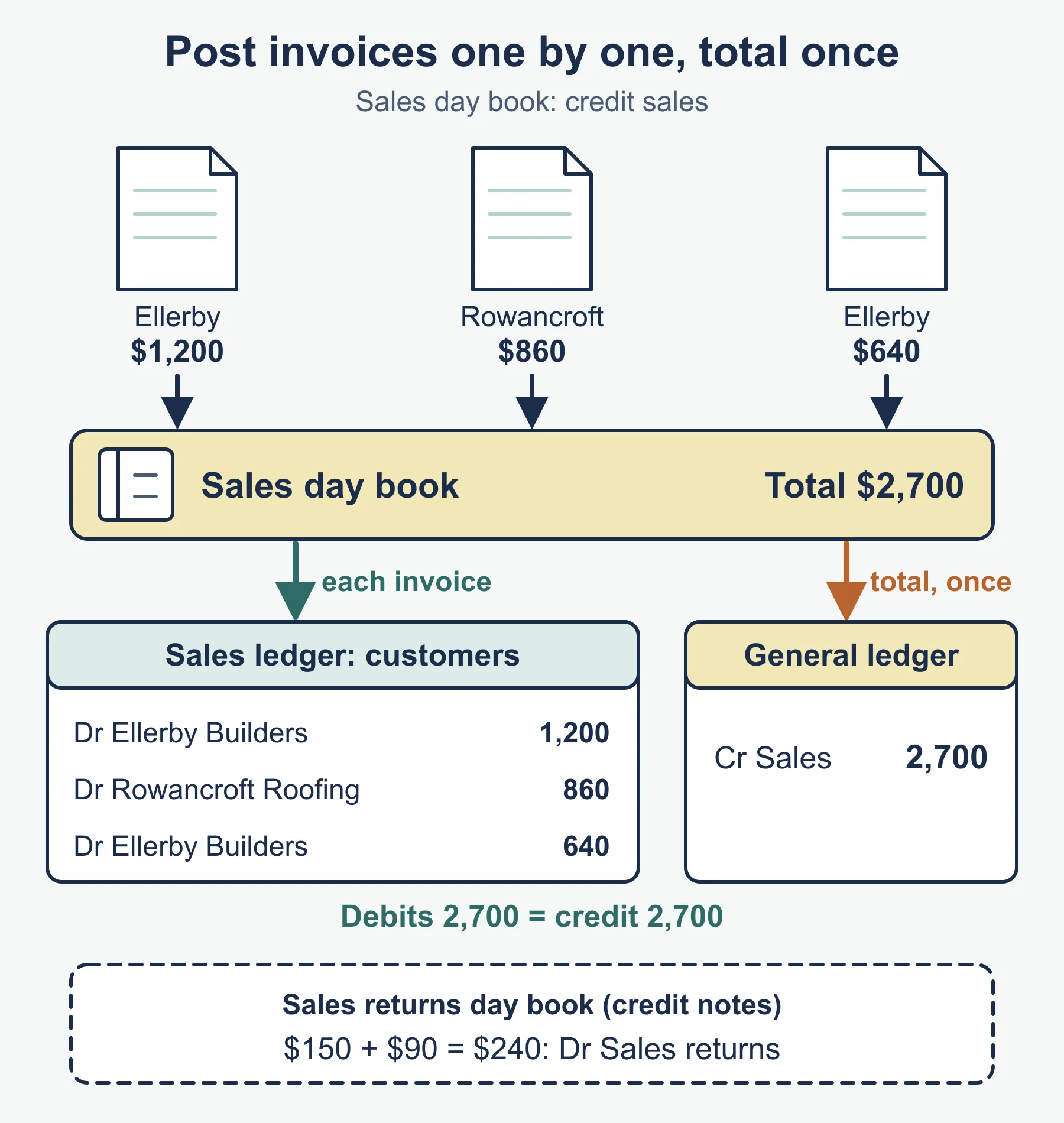
Only credit transactions appear here. Cash purchases and sales go in the cash book. Each total is posted to one ledger account (purchases, sales, purchases returns, sales returns), while each line is posted to the supplier’s or customer’s own account.
The three-column cash book
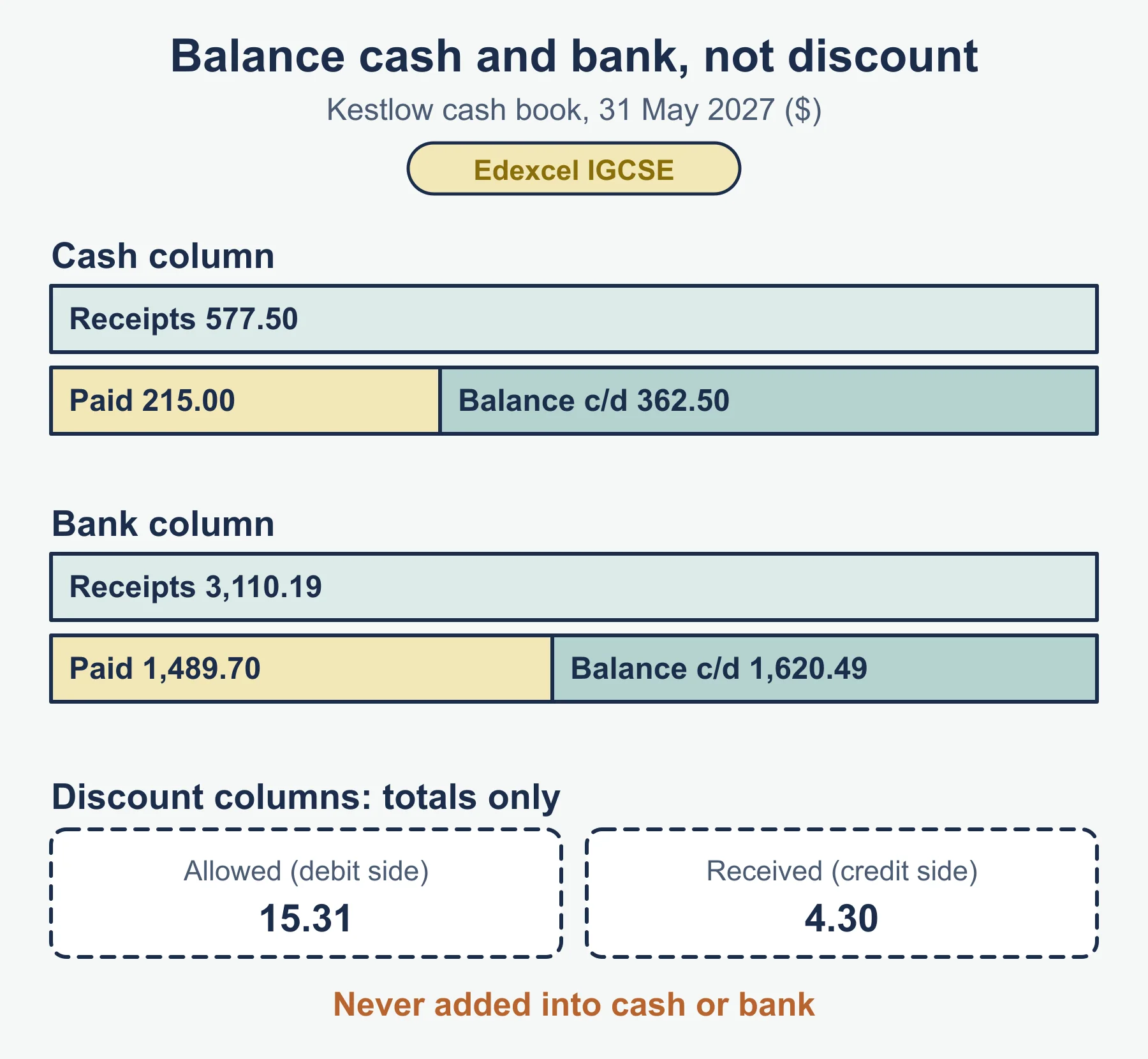
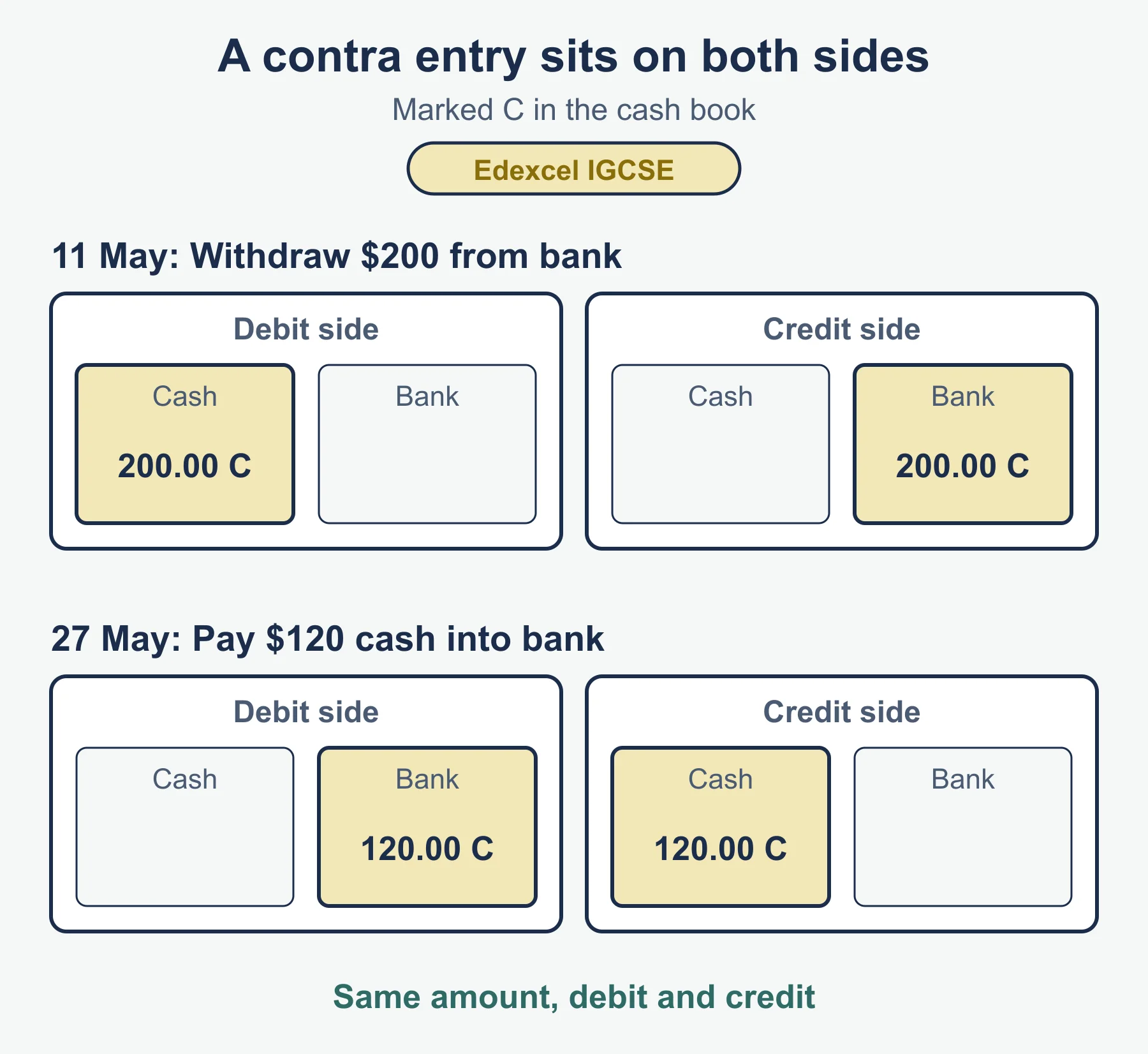
The cash book has a debit side for receipts and a credit side for payments, with columns for discount, cash and bank on each side. The discount column is not part of the balance. It records discount allowed to customers (debit side) and discount received from suppliers (credit side). A cheque paid in goes in the bank column. A contra entry, marked C, appears on both sides of the book, for example cash paid into the bank.
Worked example 3: Kestlow’s cash book
Opening balances on 1 May: cash 150.00, bank 2,340.00.
DEBIT                          Disc      Cash      Bank
1 May  Balance b/d                     150.00  2,340.00
2 May  Sales (Mr Pell)                  85.00
5 May  Harrow Bay Offices     10.00              390.00
11 May Bank (C)                        200.00
17 May Sales                           142.50
25 May Sedley School           5.31              260.19
27 May Cash (C)                                  120.00
                              15.31    577.50  3,110.19
1 Jun  Balance b/d                     362.50  1,620.49

CREDIT                         Disc      Cash      Bank
1 May  Petty cash                                100.00
11 May Cash (C)                                  200.00
14 May Rent                                      600.00
20 May Pellowe Paper Mills                       310.00
21 May Wages                            95.00
22 May Pritchett Pens          4.30              210.70
27 May Bank (C)                        120.00
29 May Petty cash                                 69.00
                               4.30    215.00  1,489.70
31 May Balance c/d                     362.50  1,620.49
                               4.30    577.50  3,110.19
Check the working. Harrow Bay owed 400.00 and paid 390.00 after 10.00 discount. Sedley owed 265.50 and 2% is 5.31, so the cheque is 260.19. Pritchett owed 215.00 and 2% is 4.30, so the cheque is 210.70. Balance each column separately: cash 577.50 - 215.00 = 362.50 and bank 3,110.19 - 1,489.70 = 1,620.49.
The Pellowe payment of 310.00 appears in the bank column, because it was a cheque; the statement above shows it received on 20 May.
The petty cash book
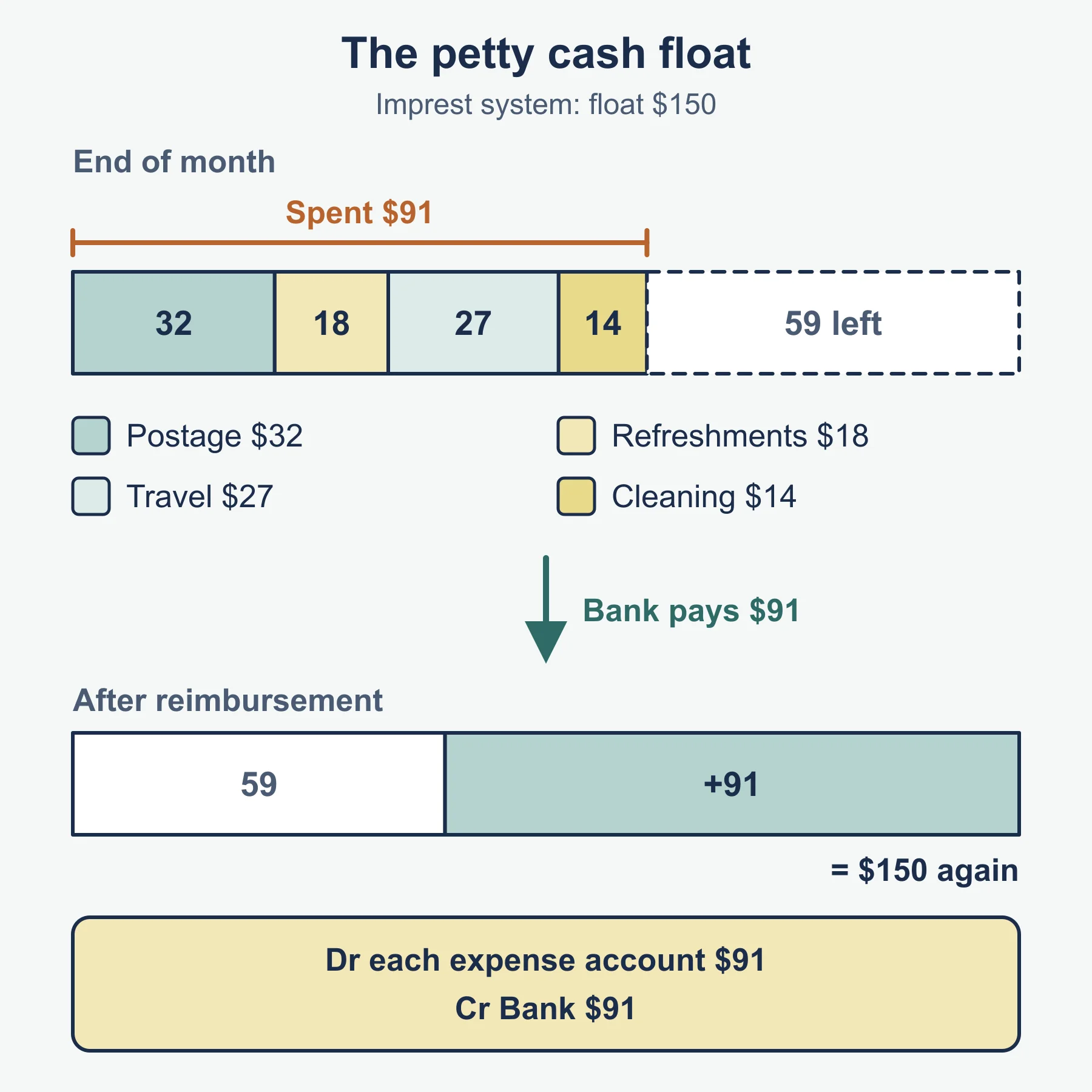
Small payments are handled by a petty cashier. A common way to run this, called the imprest system, is to give the cashier a fixed float at the start and, at the end of each period, to reimburse exactly what was spent, restoring the float. The book has a receipts column, a date, details, a voucher number, a total payments column and analysis columns for types of expense.
Worked example 4: Kestlow’s petty cash book, float 100.00
Receipts Date   Details           Vch  Total  Postage Travel Cleaning Sundries
100.00  1 May   Cash book
         3 May  Postage stamps    23   12.80  12.80
         7 May  Taxi fare         24    9.50          9.50
        10 May  Window cleaning   25   15.00                 15.00
        14 May  Tea and milk      26    6.20                           6.20
        18 May  Postage stamps    27    8.40   8.40
        22 May  Bus fares         28    5.75          5.75
        27 May  Cleaning items    29   11.35                 11.35
                                       69.00  21.20  15.25   26.35    6.20
 69.00  29 May  Cash book
        29 May  Balance c/d           100.00
169.00                                169.00
100.00  30 May  Balance b/d
The analysis columns add to the total: 21.20 + 15.25 + 26.35 + 6.20 = 69.00. Before the reimbursement the balance was 31.00 (100.00 - 69.00). The reimbursement of 69.00 is the same sum that appears on the credit side of the cash book on 29 May, and it restores the float to 100.00. Each analysis total is later posted to its own expense account.
The journal
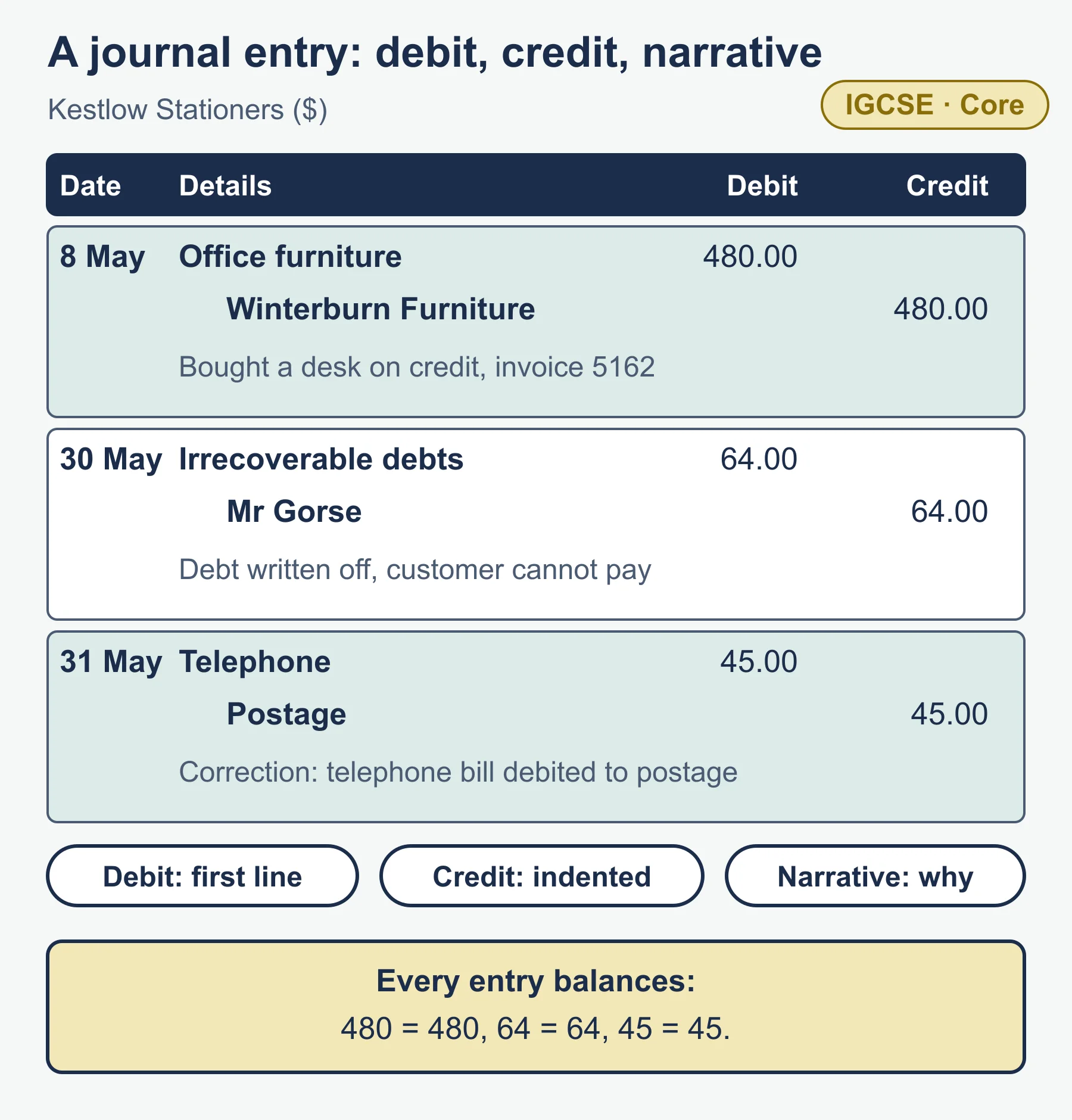
The journal is the book where you first record any transaction that fits none of the other books. It is used for non-routine items: buying non-current assets on credit, opening entries for a new business, writing off irrecoverable debts, and correcting errors. Each entry shows the date, the accounts to debit and credit, the amounts and a narrative explaining why.
Worked example 5: three journal entries
                                         Debit    Credit
8 May   Office furniture                 480.00
          Winterburn Furniture                       480.00
        Bought a desk on credit, invoice 5162

30 May  Irrecoverable debts               64.00
          Mr Gorse                                 64.00
        Debt written off, customer cannot pay

31 May  Telephone                         45.00
          Postage                                  45.00
        Correction: telephone bill debited to postage
Every entry balances: debits equal credits. The first entry is not in the purchases day book because the item is a non-current asset, not goods for resale.
Common errors
- Putting a cash sale in the sales day book. It belongs in the cash book.
- Entering gross rather than net amounts after trade discount in the day books.
- Adding the discount column into the cash or bank balance.
- Showing a contra entry on one side only.
- Forgetting to restore the float, or reimbursing a different amount from the total spent.
- Leaving the narrative out of a journal entry.
Frequently asked questions
What is the difference between an invoice and a statement of account? An invoice shows one transaction, while a statement lists the whole account in date order and ends with the balance still due. The same invoice is a purchase invoice to the buyer and a sales invoice to the seller.
Why do businesses use books of original entry in Edexcel IGCSE Accounting? Books of original entry record each transaction first, in date order, from its source document. They keep similar transactions together so totals can be posted to the ledger in one entry, give a permanent first record and make errors easier to trace.
Does a cash sale go in the sales day book? No. Only credit transactions go in the day books; cash sales and cash purchases are recorded in the cash book. Putting a cash sale in the sales day book is a common error.
Is trade discount shown in the day books? No. Trade discount is deducted on the invoice, so day books record the net amount after trade discount. A credit note for returns must use the same price and discount as the original invoice.
What is the journal used for? The journal records any transaction that fits none of the other books, such as buying non-current assets on credit, opening entries, writing off irrecoverable debts and correcting errors. Each entry shows the date, the accounts debited and credited, the amounts and a narrative.
Official syllabus
Pearson Edexcel International GCSE in Accounting (4AC1) specification, Issue 1, October 2016, published by Pearson Education Limited – Topic 2 Introduction to bookkeeping, sections 2.1 Business documentation and 2.2 Books of original entry.
Get free revision emails (optional)
Occasional emails with practice questions, worked explanations and links to free resources for the qualification and subjects you choose. No spam, and you can unsubscribe from any email. The free tools on this site never need an email.
Related resources
-
Practice questions
Edexcel IGCSE Accounting: Business documentation and books of original entry (4AC1) – Practice Questions
Eleven original questions with worked answers on Edexcel IGCSE Accounting 4AC1 documents, day books, cash book, petty cash book and journal.
Accounting · Pearson Edexcel · IGCSE
Try questions -
Revision notes
Edexcel IGCSE Accounting: Business documentation and books of original entry (4AC1) – Revision Notes
Condensed Edexcel IGCSE Accounting 4AC1 revision notes on business documents, day books, cash book, petty cash and journal, with a self-test.
Accounting · Pearson Edexcel · IGCSE
Revise topic -
Study guides
Edexcel IGCSE Accounting: Capital and revenue expenditure and depreciation (4AC1)
Study guide to capital and revenue expenditure, depreciation methods, ledger entries and disposal profit or loss for Edexcel IGCSE Accounting 4AC1.
Accounting · Pearson Edexcel · IGCSE
Read guide
Related articles
-
teaching
A Level tuition in Dubai: Cambridge or Pearson Edexcel International A Level?
Schools in Dubai and Abu Dhabi teach either Cambridge International AS & A Level or Pearson Edexcel International A Level. How the two are structured, why it matters for tuition, and how online classes from Lahore work.
9 October 2026
-
curriculum guides
Choosing subjects at IGCSE and A Level
How subject choices at 14 and 16 affect university options later, and how to keep pathways open without overloading a timetable.
28 July 2026
Studying this with a teacher
Working through Accounting IGCSE?
This page is free and stays free. If you would rather be taught it, Marlbridge runs Accounting classes one-to-one and in small groups of up to 15, online in your own time zone. The first trial class is free. WhatsApp replies within an hour (8am–11pm Pakistan time, every day); email the same day.
Pearson Edexcel Accounting teachers at Marlbridge

