
Revision Notes
Edexcel IGCSE Accounting: Business documentation and books of original entry (4AC1) – Revision Notes
Condensed Edexcel IGCSE Accounting 4AC1 revision notes on business documents, day books, cash book, petty cash and journal, with a self-test.
- Subject
- Accounting
- Level
- IGCSE
- Topic
- Introduction to bookkeeping
- Author
- Marlbridge Academic Team
- Updated
- Reviewed by
- Javaid Iqbal Sabri (what this means)
Aligned to Pearson Edexcel IGCSE Accounting (4AC1), Issue 1, October 2016. Official specification .
Syllabus page (what it covers and how it is assessed): Pearson Edexcel IGCSE Accounting.
Syllabus points this page covers
4AC1
- 2 Introduction to bookkeeping (whole topic)
- 2.1 Business documentation
- 2.2 Books of original entry
Found an error? Report a correction.
Want a teacher for this? Marlbridge teaches Accounting online. Request a free trial class.
These notes condense sections 2.1 Business documentation and 2.2 Books of original entry of Topic 2, Introduction to bookkeeping, in the Pearson Edexcel International GCSE in Accounting (4AC1) specification, Issue 1, October 2016. Paper 1 draws on topics 1 to 3. For full explanations and worked examples, use the study guide. All businesses and figures are invented, and amounts are in dollars ($).
Links: Accounting course hub, printable checklist, free 10-minute diagnostics. For exam-style questions, use the practice set.
Note: the specification names only the documents and books listed under 2.1 and 2.2. Terms such as imprest system, contra entry, trade and cash discount, analysis columns and narrative are standard practice added here to help you prepare them, not specification wording.
2.1 a) Why businesses use documents
Documents give evidence for every entry, let the two parties check amounts, help settle disputes, give each transaction a reference number and support the audit trail from the first record to the final accounts.
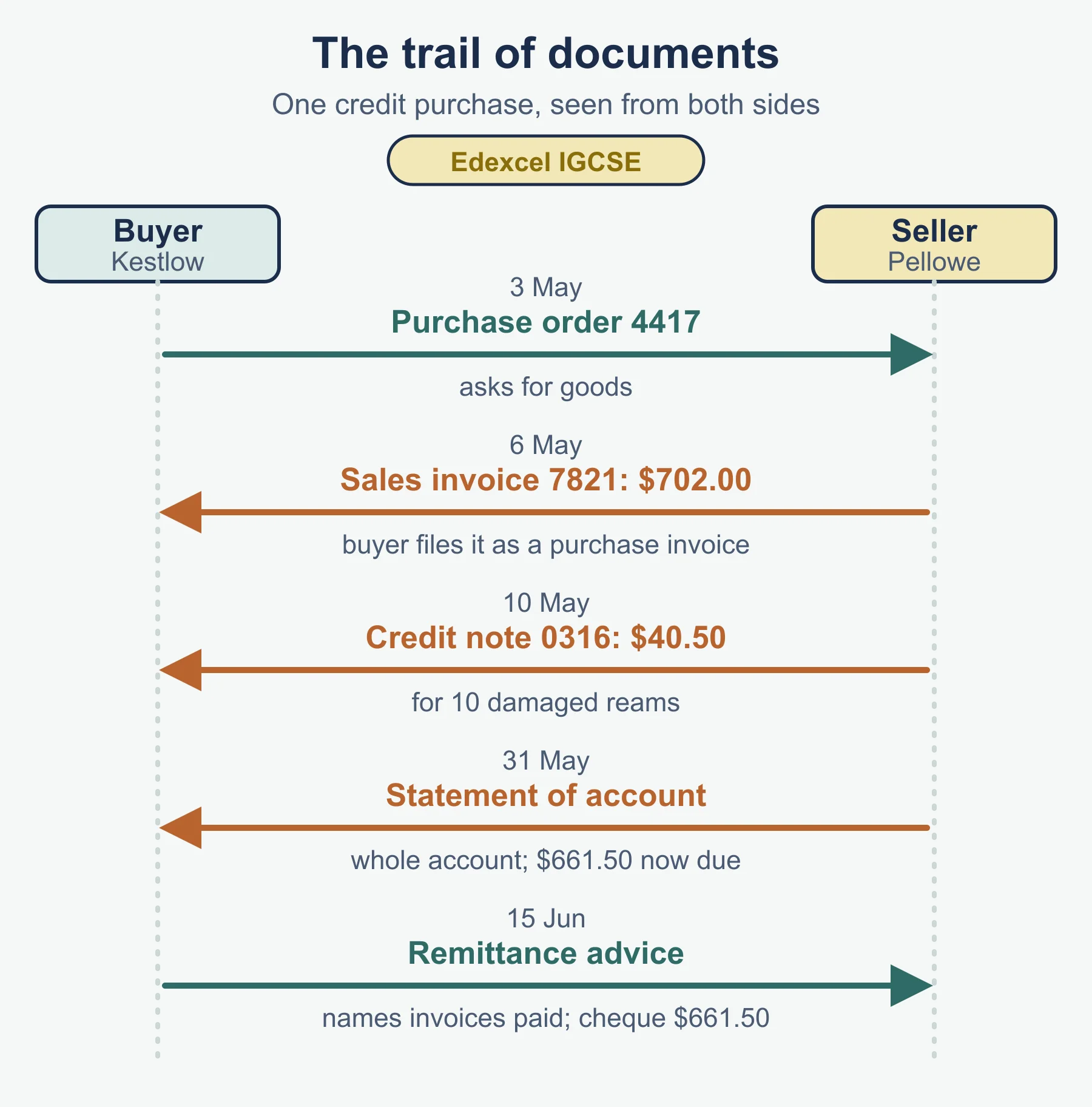
2.1 b) and c) The documents at a glance
| Document | Who issues it | Key contents | Trigger |
|---|---|---|---|
| Purchase order | Buyer | Order number, quantity, description, agreed price, delivery details, authorisation | Buyer wants goods |
| Sales invoice | Seller | Invoice number, items, list price, trade discount, amount due, terms | Goods sold on credit |
| Purchase invoice | Same invoice, as received by the buyer | As above | Goods bought on credit |
| Credit note | Seller | Credit note number, invoice reference, goods returned or overcharge, amount | Returns or error |
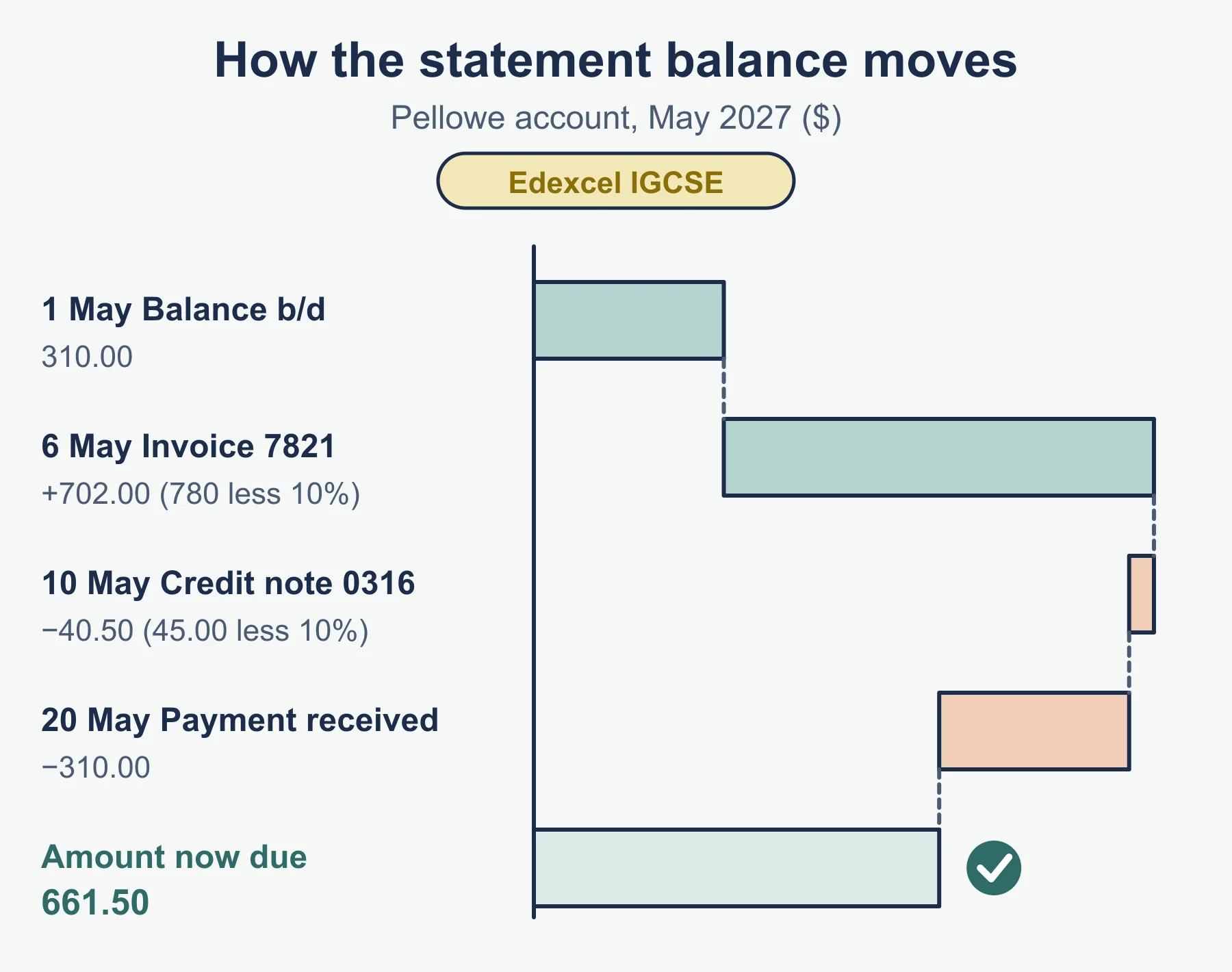
| Statement of account | Seller | Opening balance, invoices, credit notes, payments, closing balance | End of period |
| Remittance advice | Buyer | Invoices paid, credit notes deducted, amount sent | Buyer pays |
| Cash receipt | Receiver of money | Date, amount, reason, signature | Cash received |
| Petty cash voucher | Spender | Voucher number, date, item, amount, authorisation, signature | Small cash payment |
Must-know distinctions
- Sales invoice and purchase invoice are the same piece of paper seen from two sides.
- An invoice shows one transaction. A statement shows the whole account for a period.
- A credit note reduces what the buyer owes. It does not raise it.
- A remittance advice comes from the buyer. A statement comes from the seller.
- Trade discount is deducted on the invoice before any entry is made. Cash discount is given for early payment and appears in the cash book.
Method in steps: preparing an invoice
1. Quantity x price for each line.
2. Add the lines: goods at list price.
3. Deduct trade discount (percentage of list price).
4. The result is the amount due.
Mini example: 50 units at 8.00 is 400.00. Trade discount 25% is 100.00. Amount due 300.00.
Method in steps: preparing a statement of account
1. Opening balance.
2. Add each invoice.
3. Deduct each credit note and each payment.
4. Closing balance = amount now due.
2.2 a) Purpose of books of original entry
A book of original entry is where a transaction is first recorded, in date order, from its source document. Reasons:
- one type of transaction per book keeps the records organised
- totals can be posted to the ledger, not every line
- staff can share the work, and errors are easier to find
- a permanent first record exists if a ledger entry goes missing.
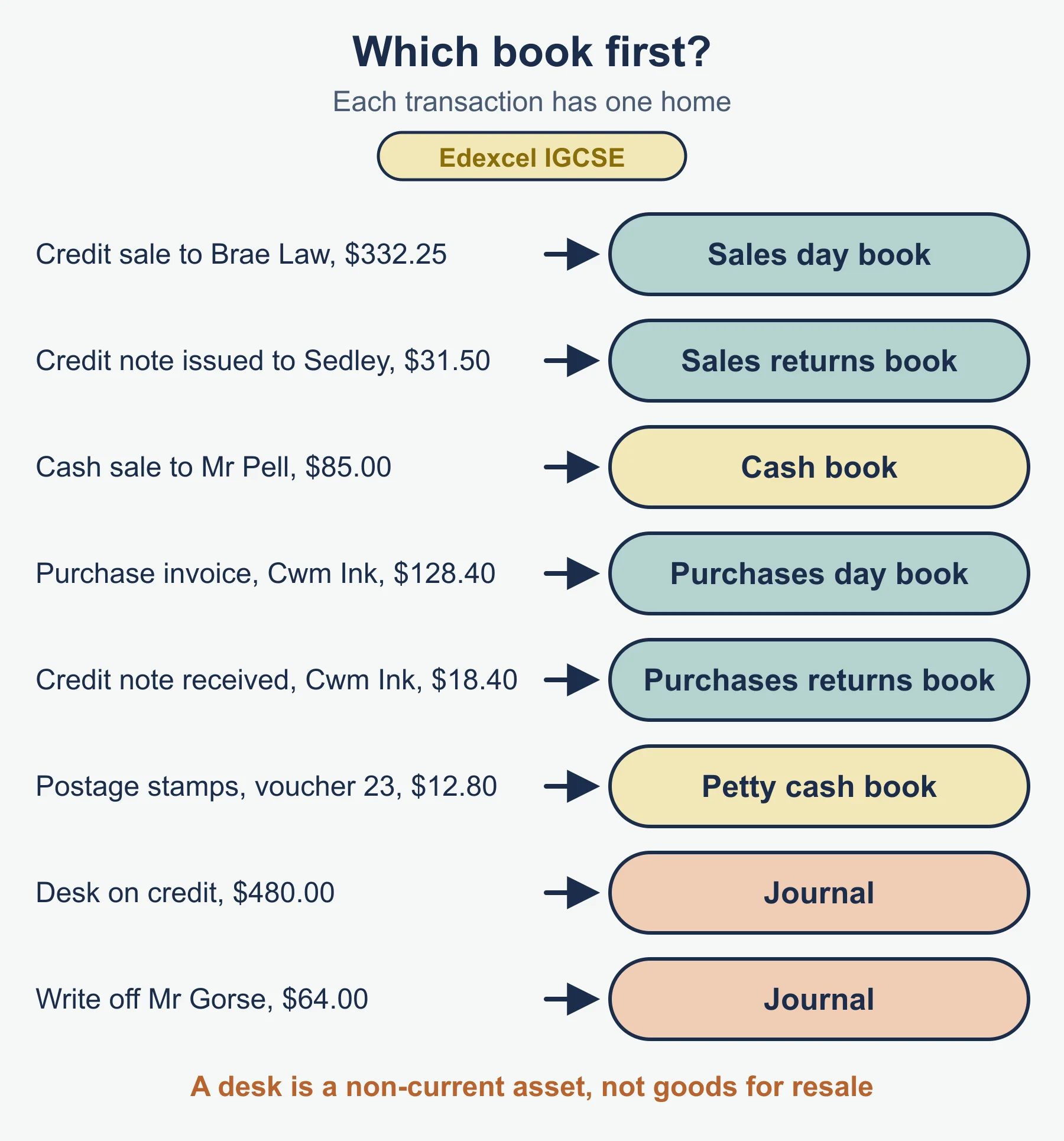
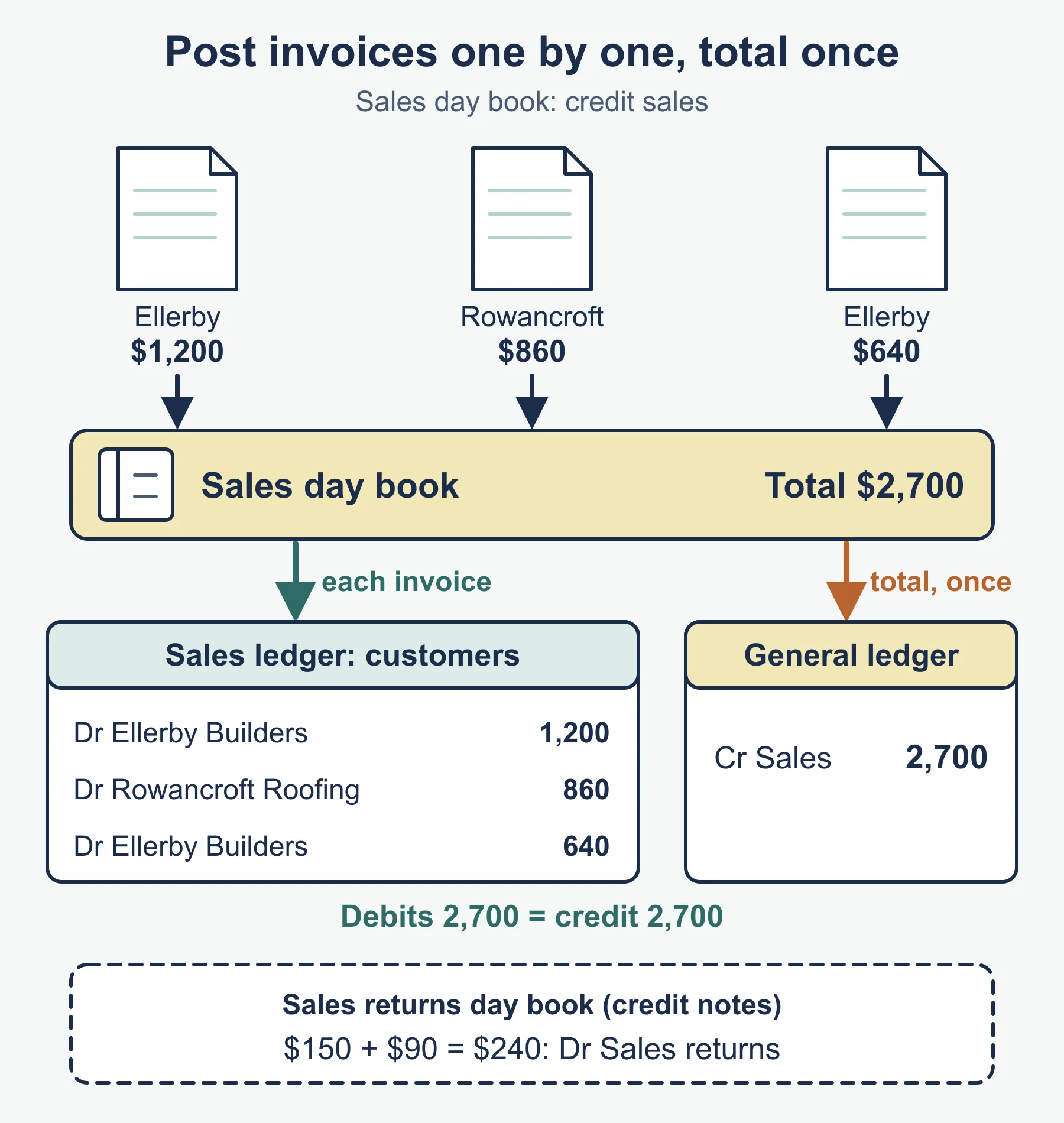
2.2 b) The books and their source documents
| Book | Records | Source document |
|---|---|---|
| Purchases day book | Goods bought on credit | Purchase invoices |
| Sales day book | Goods sold on credit | Sales invoices |
| Purchases returns book | Goods returned to suppliers | Credit notes received |
| Sales returns book | Goods returned by customers | Credit notes issued |
| Three-column cash book | Cash, bank and discount | Cash receipts, cheques, bank paying-in slips |
| Petty cash book | Small cash payments | Petty cash vouchers |
| Journal | Everything else | Journal vouchers and the evidence for the item |
Day books and returns books use the amount after trade discount. A cash purchase or cash sale never goes in a day book.
Returns and where the totals go
Mini example: the buyer returns 10 of the 50 units, listed at 8.00 with the same 25% trade discount. The credit note is 10 x 8.00 = 80.00, less 25% = 20.00, so 60.00. Its source is the credit note, and it is recorded in the purchases returns book by the buyer and the sales returns book by the seller.
| Book | Total is later posted to | Each line is later posted to |
|---|---|---|
| Purchases day book | Purchases account | Supplier’s account |
| Sales day book | Sales account | Customer’s account |
| Purchases returns book | Purchases returns account | Supplier’s account |
| Sales returns book | Sales returns account | Customer’s account |
| Petty cash book | Each analysis total to its expense account | Not applicable |
The posting itself is part of ledger accounting, which has its own pages in this series. Here the skill is to prepare the book correctly and total it accurately.
The three-column cash book
| Side | Discount column | Cash column | Bank column |
|---|---|---|---|
| Debit (receipts) | Discount allowed | Cash received | Cheques received, money paid in |
| Credit (payments) | Discount received | Cash paid | Cheques paid |
Method in steps
1. Enter opening balances on the debit side.
2. Enter each item in date order on the correct side.
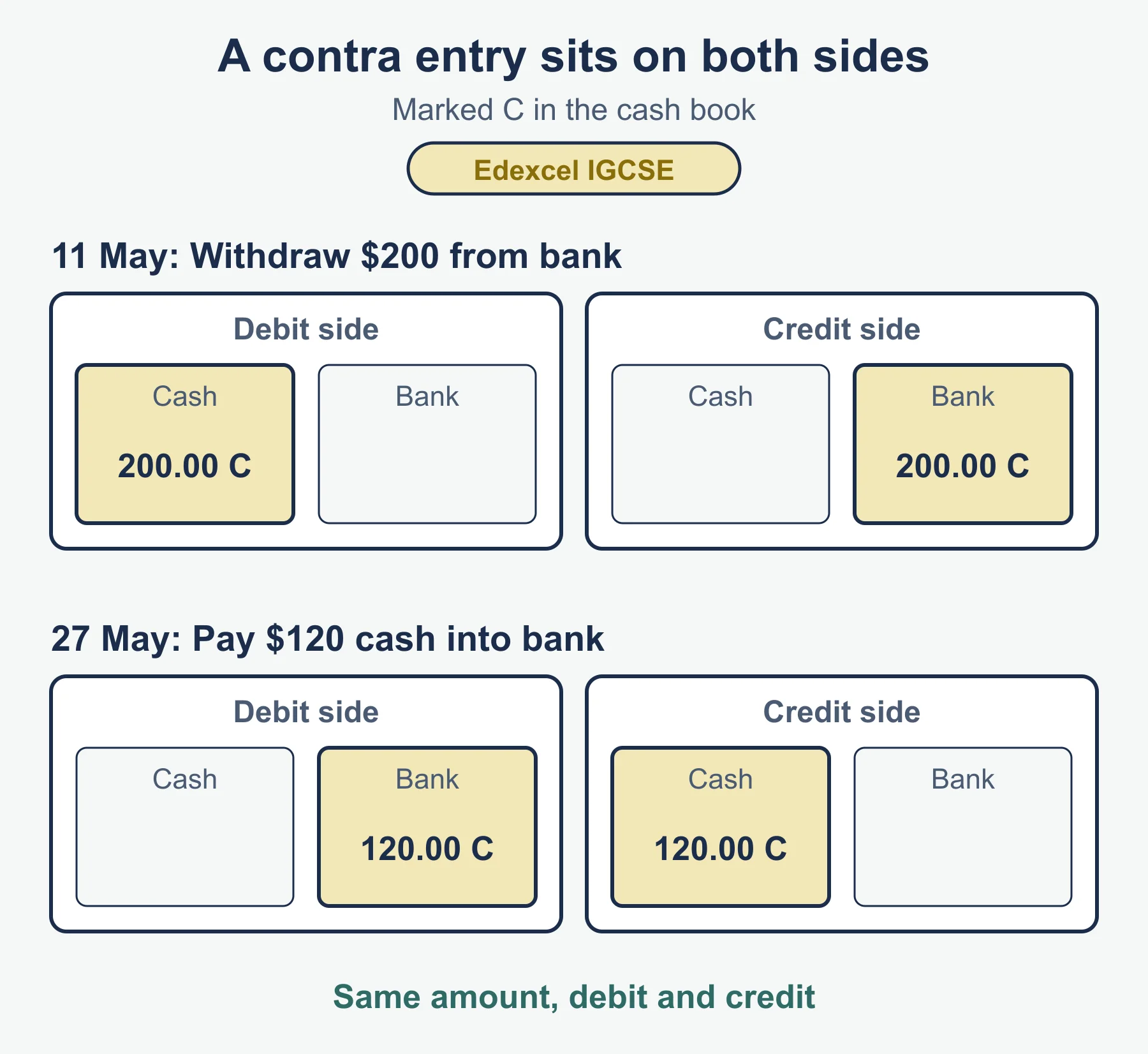
3. Put a contra entry (C) on both sides of the book.
4. Total the discount columns but do not carry them into the balances.
5. Balance cash and bank separately.
6. Bring the balances down on the debit side.
Mini example: cash 40.00 and bank 500.00 at the start. Cash sale 60.00. Customer owing 200.00 pays by cheque after 2% discount, so 196.00 in the bank column and 4.00 discount allowed. Supplier owed 150.00 is paid by cheque after 2% discount, so 147.00 and 3.00 discount received. Cash of 70.00 is paid into the bank (contra).
DEBIT                  Disc   Cash   Bank
Balance b/d                   40.00 500.00
Sales                         60.00
Customer (cheque)      4.00         196.00
Cash (C)                             70.00
                       4.00  100.00 766.00
Balance b/d                   30.00 619.00

CREDIT                 Disc   Cash   Bank
Bank (C)                      70.00
Supplier (cheque)      3.00         147.00
Balance c/d                   30.00 619.00
                       3.00  100.00 766.00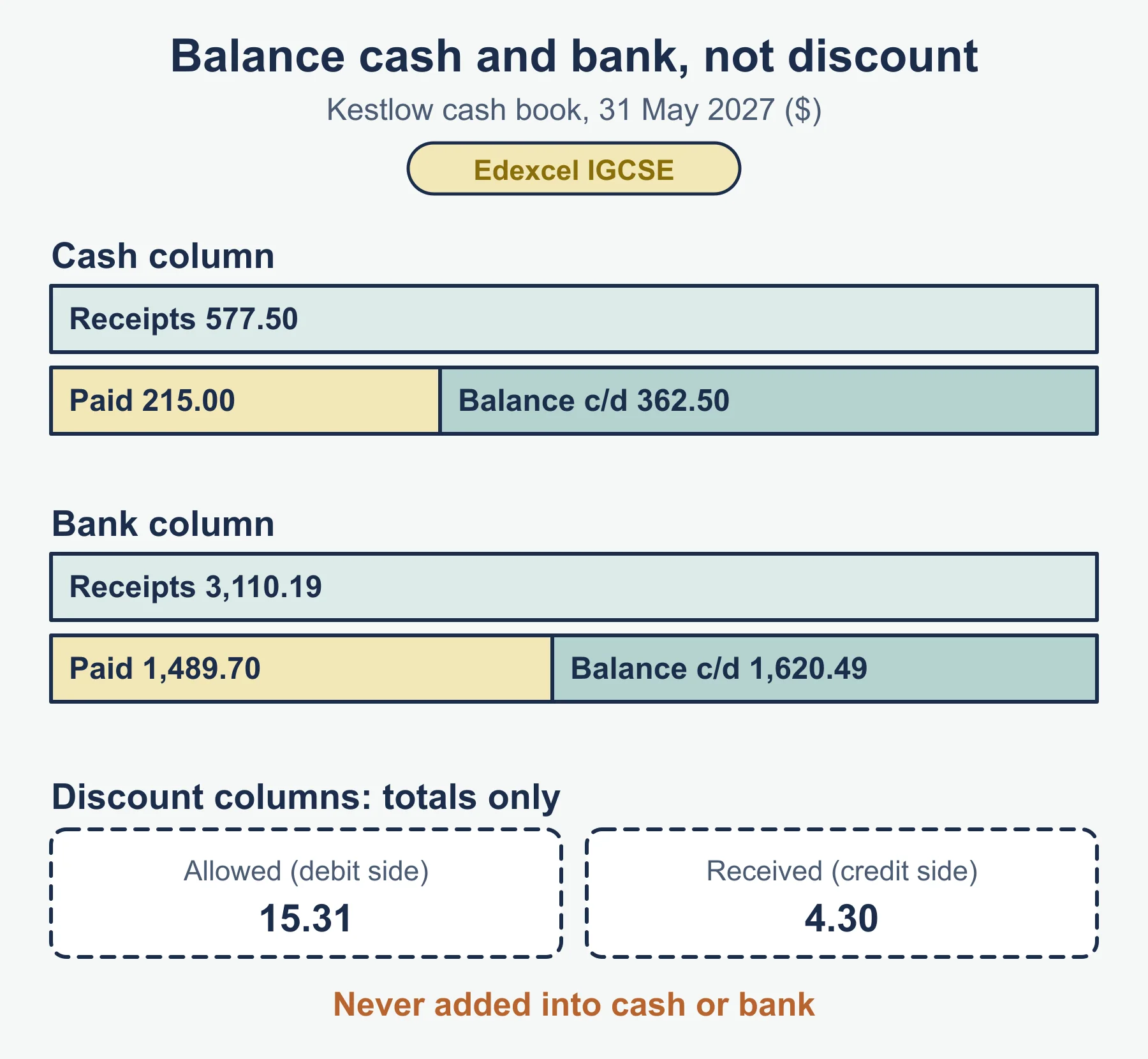
The petty cash book
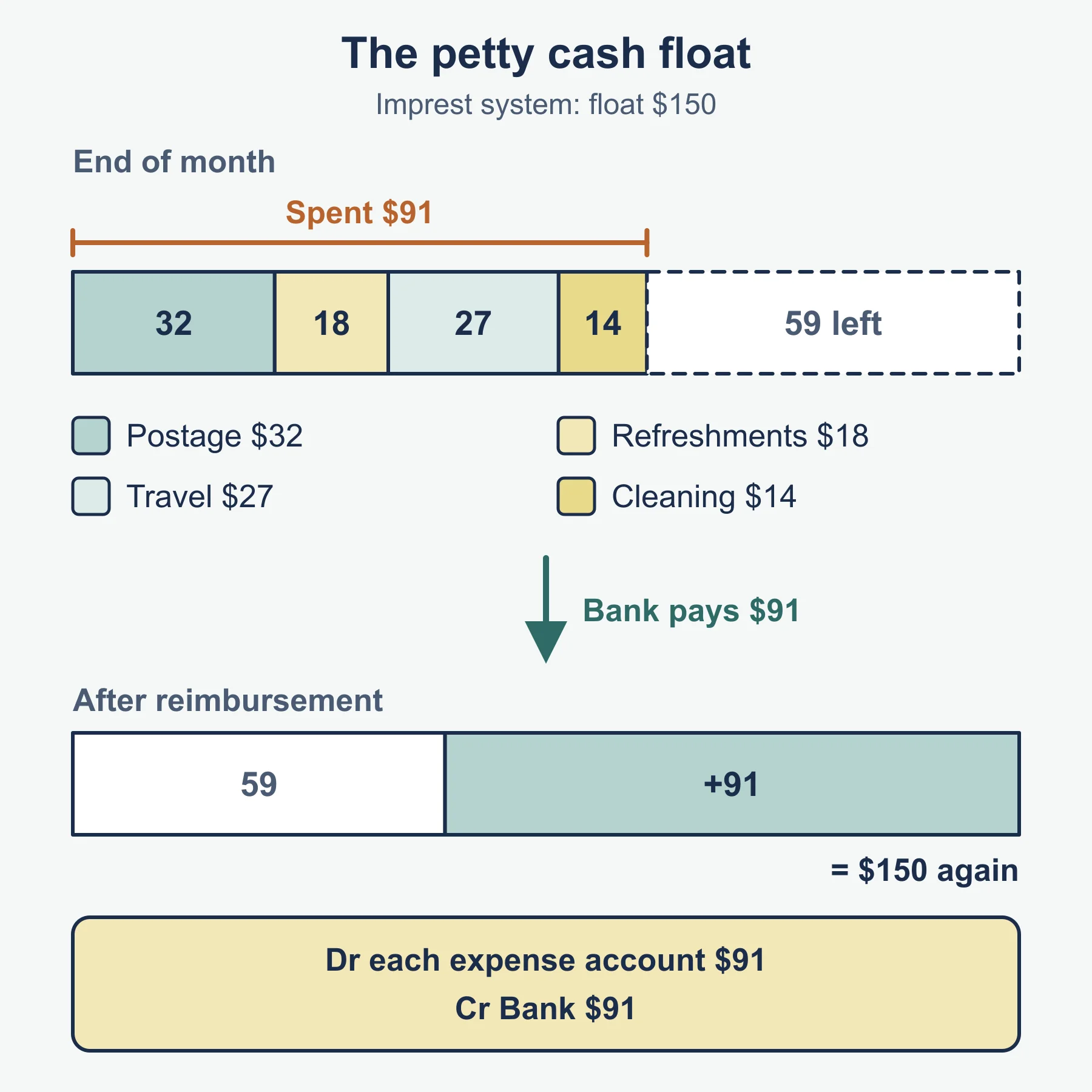
- Imprest system (a common method, not a term in the specification): a fixed float is paid out first. Spending is reimbursed in full at the end of the period.
- Each payment needs a numbered voucher.
- Columns: receipts, date, details, voucher number, total, then analysis columns.
- Total column = sum of analysis columns. Check this before posting.
- Reimbursement = total spent. It is a payment in the cash book (usually bank) and a receipt in the petty cash book.
Mini example: float 80.00. Payments are 22.40, 18.60 and 9.00. Total spent 50.00. Balance before reimbursement 30.00. Reimbursement 50.00 restores the float to 80.00.
The journal
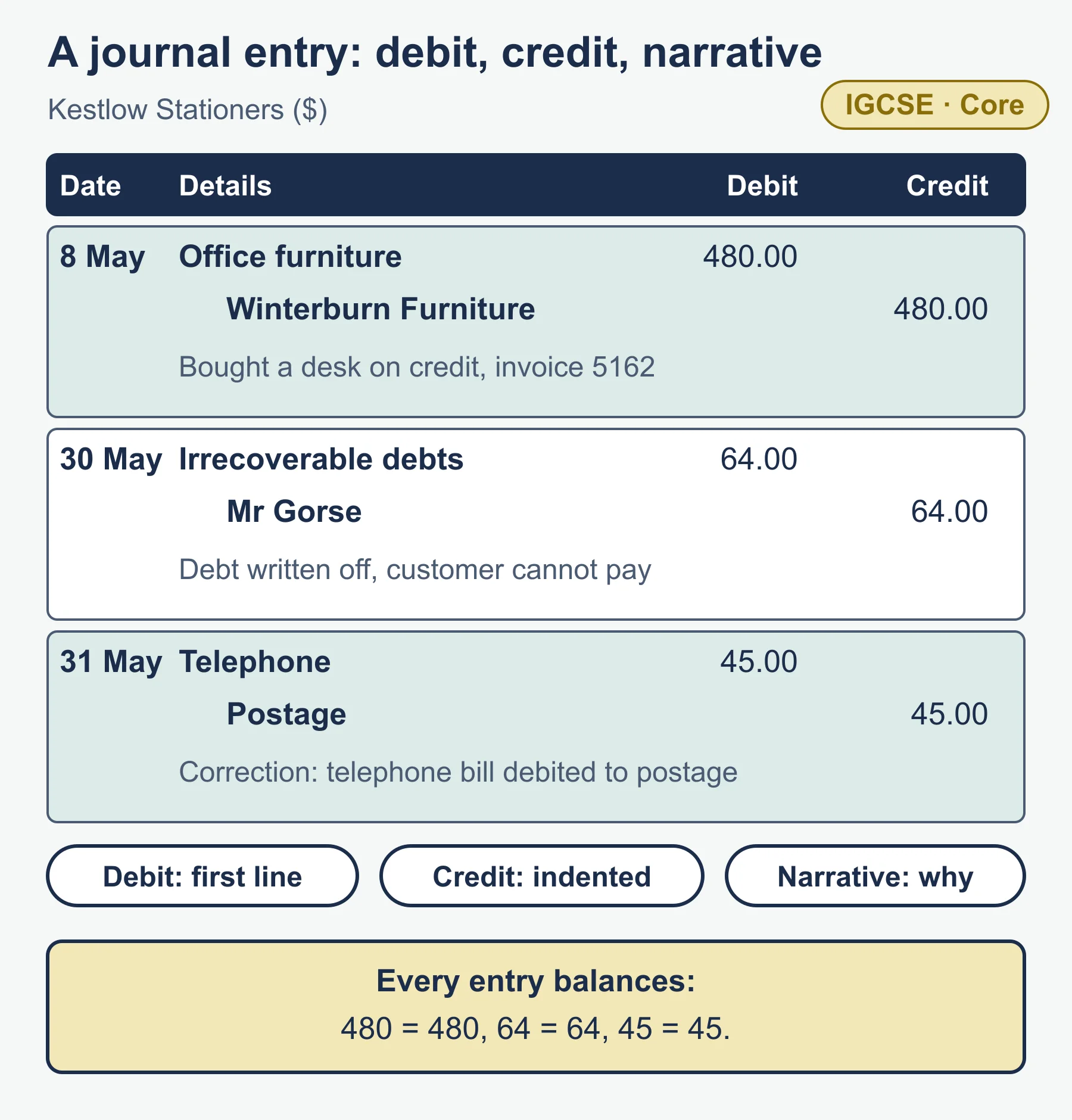
Used for non-routine transactions. Layout: date, account to debit, account to credit, amounts, narrative.
| Typical use | Debit | Credit |
|---|---|---|
| Buying a non-current asset on credit | Asset account | Supplier |
| Writing off an irrecoverable debt | Irrecoverable debts | Customer |
| Correcting an error | Account that should have been charged | Account wrongly charged |
| Opening entries for a new business | Assets | Liabilities and capital |
Mini example, opening journal: bank 5,000.00, motor van 7,500.00 and inventory 1,500.00 are debited (total 14,000.00). Loan 3,000.00 and capital 11,000.00 are credited (total 14,000.00). Totals agree.
Quick self-test
- Name the document a buyer sends to ask a seller for goods.
- Goods are listed at 30 items at 12.00 each, with 20% trade discount. What is the invoice total?
- Which document tells a seller which invoices a cheque settles?
- A statement opens at 420.00, which is then paid in full. During the month there is an invoice for 640.00 and a credit note for 55.00. What is the closing balance?
- A customer owing 240.00 earns 5% cash discount. What cheque is received, and which column records the discount?
- In which book is a credit sale first recorded?
- A petty cash float of 150.00 is used to pay out 112.50. What is the reimbursement, and what is the balance before reimbursement?
- Which book records the purchase of office equipment on credit?
- Why are the discount columns not balanced like cash and bank?
- Cash is paid into the bank. How is it recorded?
Answers
- Purchase order.
- 30 x 12.00 = 360.00. Less 20% (72.00) = 288.00.
- Remittance advice.
- 420.00 + 640.00 - 55.00 - 420.00 = 585.00.
- Discount 12.00, so the cheque is 228.00. Discount allowed, debit side.
- Sales day book.
- Reimbursement 112.50. Balance before it 37.50.
- The journal.
- They are totalled and posted to the discount accounts. They are not money in hand.
- A contra entry: debit bank column, credit cash column, marked C on both sides.
Where marks are usually lost
- Using list price in a day book instead of the amount after trade discount.
- Putting a cash sale or cash purchase in a day book.
- Forgetting that a credit note reduces the amount owed.
- Showing a contra entry on one side only.
- Adding the discount column into the cash or bank balance.
- Mixing up discount allowed (debit side) and discount received (credit side).
- Reimbursing the petty cashier a different sum from the total spent.
- Omitting the narrative in a journal entry, or making debits and credits unequal.
- Writing totals without checking them against the source documents.
Frequently asked questions
What is a credit note? A credit note is issued by a seller when goods are returned or overcharged, and it reduces the amount the buyer owes. It is the source document for the returns books.
What is a remittance advice? A remittance advice is sent by a buyer with a payment to show which invoices are being paid. One that does not name the invoices paid makes it hard for the seller to match the payment.
Which side of the cash book is discount allowed on? Discount allowed to customers is recorded on the debit (receipts) side of the three-column cash book, and discount received from suppliers on the credit (payments) side. Mixing up the two sides is a common error.
What is a petty cash voucher? A petty cash voucher records one small payment from petty cash and is signed by the person authorising it. Vouchers are numbered and entered in the petty cash book, with each payment placed in the right analysis column.
Official syllabus
Pearson Edexcel International GCSE in Accounting (4AC1) specification, Issue 1, October 2016, published by Pearson Education Limited – Topic 2 Introduction to bookkeeping, sections 2.1 Business documentation and 2.2 Books of original entry.
Get free revision emails (optional)
Occasional emails with practice questions, worked explanations and links to free resources for the qualification and subjects you choose. No spam, and you can unsubscribe from any email. The free tools on this site never need an email.
Related resources
-
Study guides
Edexcel IGCSE Accounting: Capital and revenue expenditure and depreciation (4AC1)
Study guide to capital and revenue expenditure, depreciation methods, ledger entries and disposal profit or loss for Edexcel IGCSE Accounting 4AC1.
Accounting · Pearson Edexcel · IGCSE
Read guide -
Practice questions
Edexcel IGCSE Accounting: Capital and revenue expenditure and depreciation (4AC1) – Practice Questions
Eleven original practice questions with worked answers on capital and revenue expenditure, depreciation and disposals for Edexcel IGCSE Accounting 4AC1.
Accounting · Pearson Edexcel · IGCSE
Try questions -
Revision notes
Edexcel IGCSE Accounting: Capital and revenue expenditure and depreciation (4AC1) – Revision Notes
Revision notes on capital and revenue expenditure, depreciation methods, ledger entries and disposals for Edexcel IGCSE Accounting 4AC1, with a self-test.
Accounting · Pearson Edexcel · IGCSE
Revise topic
Related articles
-
teaching
A Level tuition in Dubai: Cambridge or Pearson Edexcel International A Level?
Schools in Dubai and Abu Dhabi teach either Cambridge International AS & A Level or Pearson Edexcel International A Level. How the two are structured, why it matters for tuition, and how online classes from Lahore work.
9 October 2026
-
curriculum guides
Choosing subjects at IGCSE and A Level
How subject choices at 14 and 16 affect university options later, and how to keep pathways open without overloading a timetable.
28 July 2026
Studying this with a teacher
Working through Accounting IGCSE?
This page is free and stays free. If you would rather be taught it, Marlbridge runs Accounting classes one-to-one and in small groups of up to 15, online in your own time zone. The first trial class is free. WhatsApp replies within an hour (8am–11pm Pakistan time, every day); email the same day.
Pearson Edexcel Accounting teachers at Marlbridge

