
Study Guides
Edexcel IGCSE Accounting: Capital and revenue expenditure and depreciation (4AC1)
Study guide to capital and revenue expenditure, depreciation methods, ledger entries and disposal profit or loss for Edexcel IGCSE Accounting 4AC1.
- Subject
- Accounting
- Level
- IGCSE
- Topic
- Introduction to bookkeeping
- Author
- Marlbridge Academic Team
- Updated
- Reviewed by
- Javaid Iqbal Sabri (what this means)
Aligned to Pearson Edexcel IGCSE Accounting (4AC1), Issue 1, October 2016. Official specification .
Syllabus page (what it covers and how it is assessed): Pearson Edexcel IGCSE Accounting.
Syllabus points this page covers
4AC1
- 2 Introduction to bookkeeping (whole topic)
- 2.4 Capital expenditure and revenue expenditure
- 2.5 Depreciation
Found an error? Report a correction.
Want a teacher for this? Marlbridge teaches Accounting online. Request a free trial class.
This guide covers sections 2.4 (Capital expenditure and revenue expenditure) and 2.5 (Depreciation) of Topic 2, Introduction to bookkeeping, in the Pearson Edexcel International GCSE in Accounting (4AC1) specification, Issue 1, October 2016. The specification does not divide content into tiers. Paper 1 draws exclusively from topics 1 to 3, so both sections can be examined there. Depreciation also appears again in Topic 5 (Accounting for end of period adjustments), which belongs to Paper 2, with the same four outcomes.
Quick links: Edexcel IGCSE Accounting hub, printable checklist, free 10-minute diagnostics. Companion pages: revision notes and practice questions. All businesses and figures below are invented. Amounts are in dollars (shown without the dollar sign).
What the specification asks for
| Section | Outcome | Where it is taught below |
|---|---|---|
| 2.4 a | Explain the terms capital expenditure and revenue expenditure | Section 1 |
| 2.4 b | Explain the importance of the correct treatment of the two | Section 2 |
| 2.5 a | Explain the causes of depreciation | Section 3 |
| 2.5 b | Distinguish between straight line and reducing balance methods | Section 4 |
| 2.5 c | Calculate and record depreciation in the books of account | Sections 4 and 5 |
| 2.5 d | Calculate and record profit or loss of disposal of non-current assets | Section 6 |
1. Capital expenditure and revenue expenditure
Capital expenditure is spending to buy, add to or improve a non-current asset: something the business keeps and uses for more than one year to earn income, not to resell. Its cost is debited to an asset account, so it is shown among the assets in the statement of financial position.
Revenue expenditure pays for the ordinary daily running of the business, or for keeping a non-current asset in its present working order. It is debited to an expense account and set against the year’s income in the income statement.
The cost of a non-current asset covers everything needed to acquire it and prepare it for use: the price paid, carriage to the premises, installation, and legal fees when property is bought. Repairs and routine maintenance only keep the asset as it was, so they are revenue expenditure. An improvement that makes the asset more capable is capital expenditure.
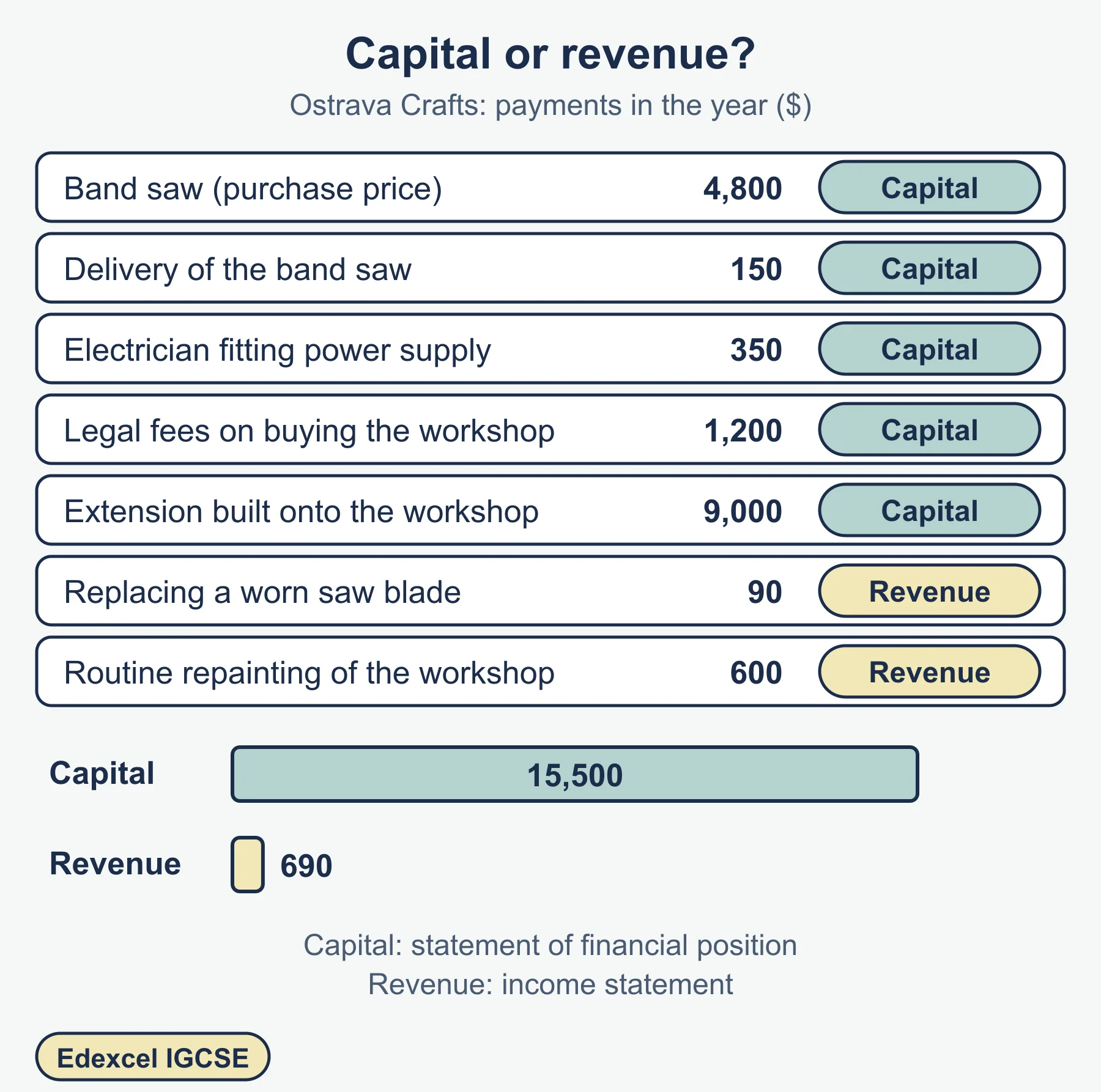
Worked example 1. Ostrava Crafts, a joinery business, had these payments in the year. Classify each.
| Payment | Amount | Type | Reason |
|---|---|---|---|
| Band saw (purchase price) | 4,800 | Capital | New non-current asset |
| Delivery of the band saw | 150 | Capital | Needed to bring it to the workshop |
| Electrician fitting power supply for the saw | 350 | Capital | Installation, so it can be used |
| Legal fees on buying the workshop | 1,200 | Capital | Cost of acquiring property |
| Extension built onto the workshop | 9,000 | Capital | Adds to the asset |
| Replacing a worn saw blade | 90 | Revenue | Keeps the machine working |
| Routine repainting of the workshop | 600 | Revenue | Maintenance only |
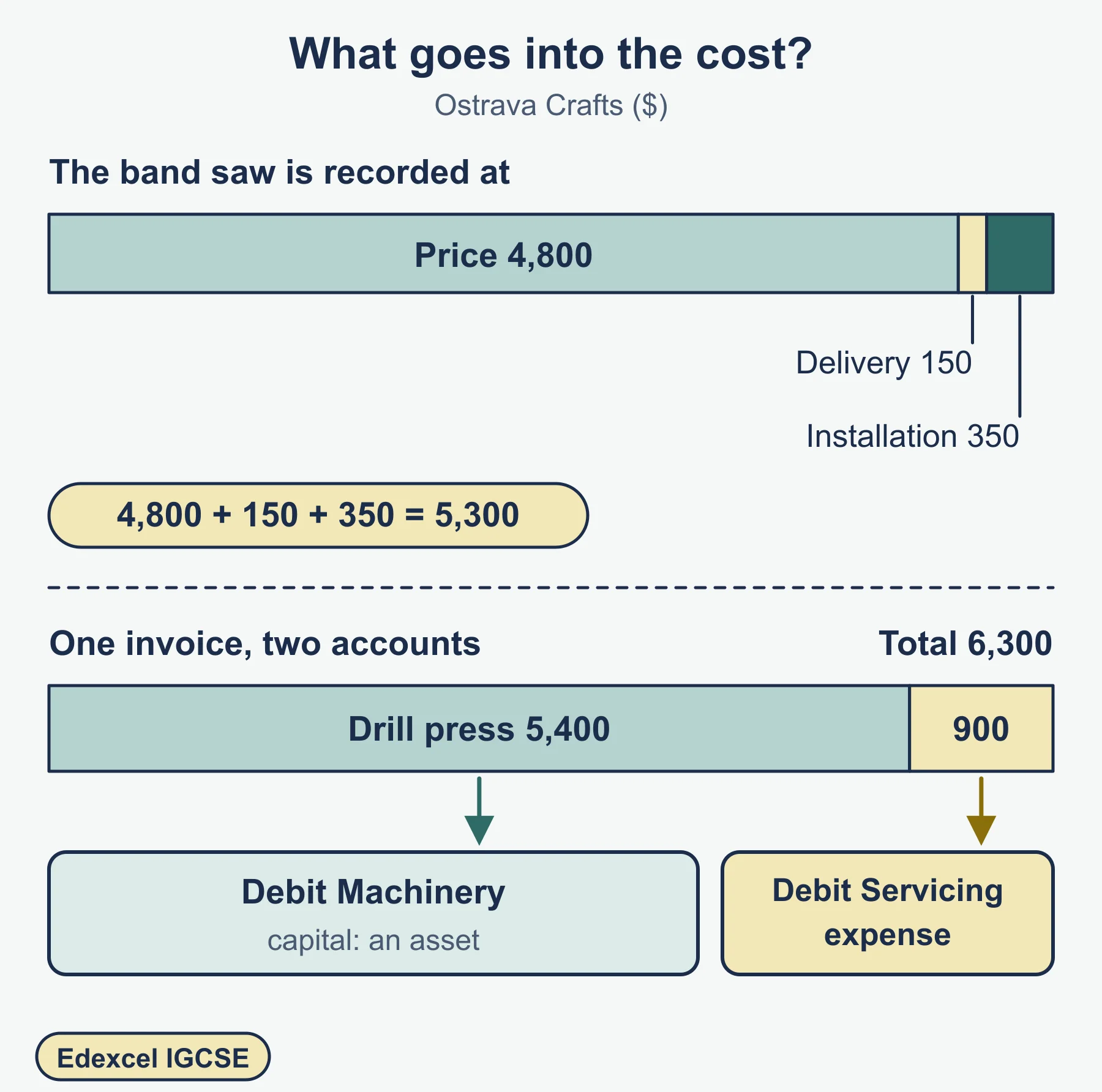
Capital expenditure is 4,800 + 150 + 350 + 1,200 + 9,000 = 15,500. Revenue expenditure is 90 + 600 = 690. The saw is recorded at 4,800 + 150 + 350 = 5,300, not at its purchase price alone.
Mixed invoices. A single bill can contain both types. Ostrava Crafts receives one invoice for 6,300: a drill press at 5,400 and an annual service of the press at 900. The 5,400 is debited to the machinery account and the 900 to a machinery servicing expense account.
2. Why correct treatment matters
Treating an item in the wrong category changes profit and the value of assets. The effect is on the current year and on later years, because depreciation follows the asset.
- Capital expenditure treated as revenue: the asset is missing from the statement of financial position, so assets and capital are understated. The full cost is charged as an expense, so profit for the year is understated.
- Revenue expenditure treated as capital: an expense is not charged, so profit is overstated. A repair is carried as if it were an asset, so non-current assets are overstated and depreciation is then charged on it.
Owners, lenders and tax authorities use these statements, so a business should not show a profit that is higher or lower than the facts support.
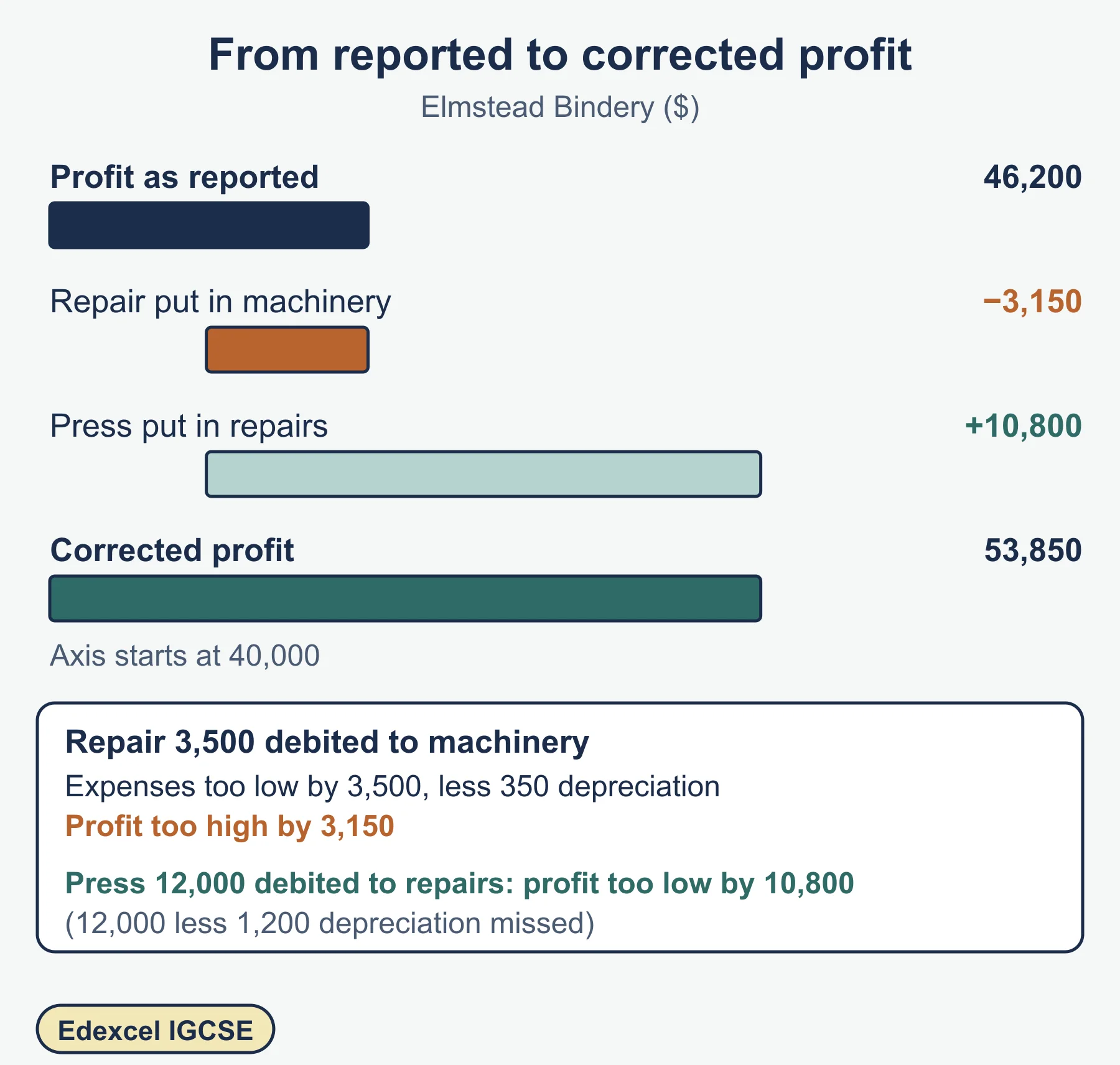
Worked example 2. Elmstead Bindery reports profit for the year of 46,200. Machinery is depreciated at 10% of cost a year, and an asset bought during the year bears a whole year’s charge. Two errors are found:
- A repair costing 3,500 was debited to the machinery account. Depreciation of 10% was charged on it.
- A new press costing 12,000 was debited to repairs expense. No depreciation was charged on it.
Error 1: expenses were understated by 3,500, but depreciation was overcharged by 350. Profit was overstated by 3,500 − 350 = 3,150.
Error 2: expenses were overstated by 12,000, but depreciation of 1,200 should have been charged. Profit was understated by 12,000 − 1,200 = 10,800.
Corrected profit = 46,200 − 3,150 + 10,800 = 53,850.
In the statement of financial position, machinery was overstated by 3,500 − 350 = 3,150 for the repair, and understated by 12,000 − 1,200 = 10,800 for the press (carrying values).
3. Causes of depreciation
A non-current asset does not last for ever. Depreciation is the allocation of its cost over the years in which the business uses it. It is not a payment of cash: the cash left the business when the asset was bought. The usual causes are:
- Wear and tear: physical use, so machines and vehicles deteriorate.
- Obsolescence: better or cheaper equipment appears, so the asset is outdated although it may still run.
- Passage of time: some assets lose value as time runs out, such as a lease with a fixed number of years.
- Inadequacy or change in demand: the asset becomes too small, or the product it makes is no longer wanted.
Charging depreciation spreads cost across the years that benefit, so profit each year is not distorted by a single large purchase. This follows the accruals concept from Topic 1.
4. Straight line and reducing balance
Three terms are used in both methods:
- Cost: purchase price plus delivery and installation.
- Residual value: the amount expected when the business finishes with the asset.
- Carrying value: cost less accumulated depreciation to date. The glossary in the specification uses this term for net book value.
Straight line: the same charge every year.
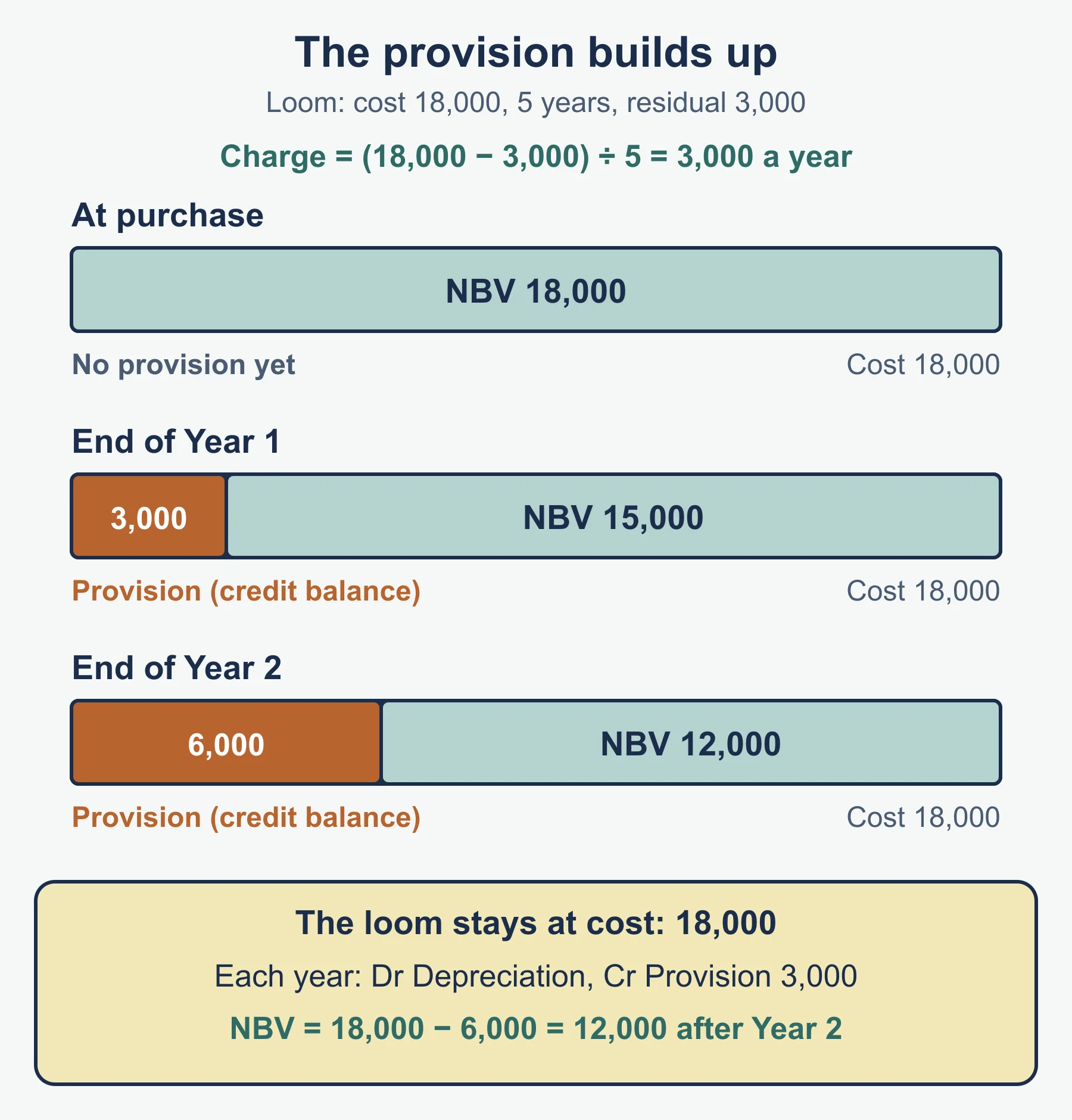
Annual depreciation = (cost − residual value) ÷ number of years of expected life. A question may instead give a percentage of cost.
Reducing balance: one fixed percentage applied to the carrying value at the beginning of each year. The base shrinks, so the first charge is the biggest and every later charge is smaller. Residual value is not subtracted before applying the percentage.
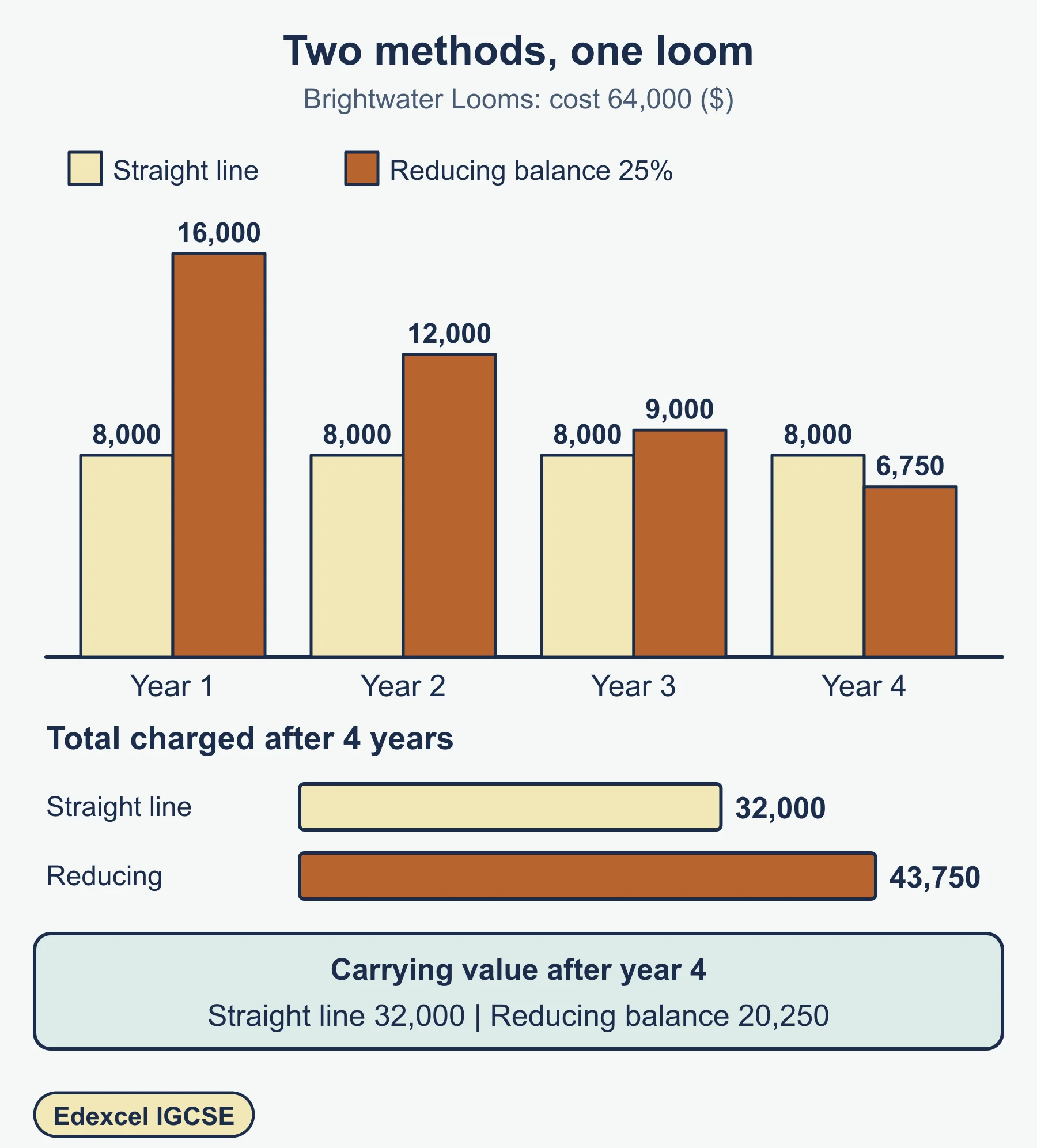
Worked example 3. Brightwater Looms buys a loom for 64,000. Expected life is 7 years and residual value is 8,000.
Straight line: (64,000 − 8,000) ÷ 7 = 8,000 a year.
Reducing balance at 25%:
| Year | Opening carrying value | Charge (25%) | Closing carrying value |
|---|---|---|---|
| 1 | 64,000 | 16,000 | 48,000 |
| 2 | 48,000 | 12,000 | 36,000 |
| 3 | 36,000 | 9,000 | 27,000 |
| 4 | 27,000 | 6,750 | 20,250 |
After four years, reducing balance has charged 16,000 + 12,000 + 9,000 + 6,750 = 43,750, against 32,000 under straight line. Reducing balance gives heavy early charges, which suits assets that lose most of their usefulness early. Straight line gives an even charge, which suits assets used evenly. When a question tells you the method, rate and any policy on part years, follow it exactly.
5. Recording depreciation in the books
Two entries are made each year:
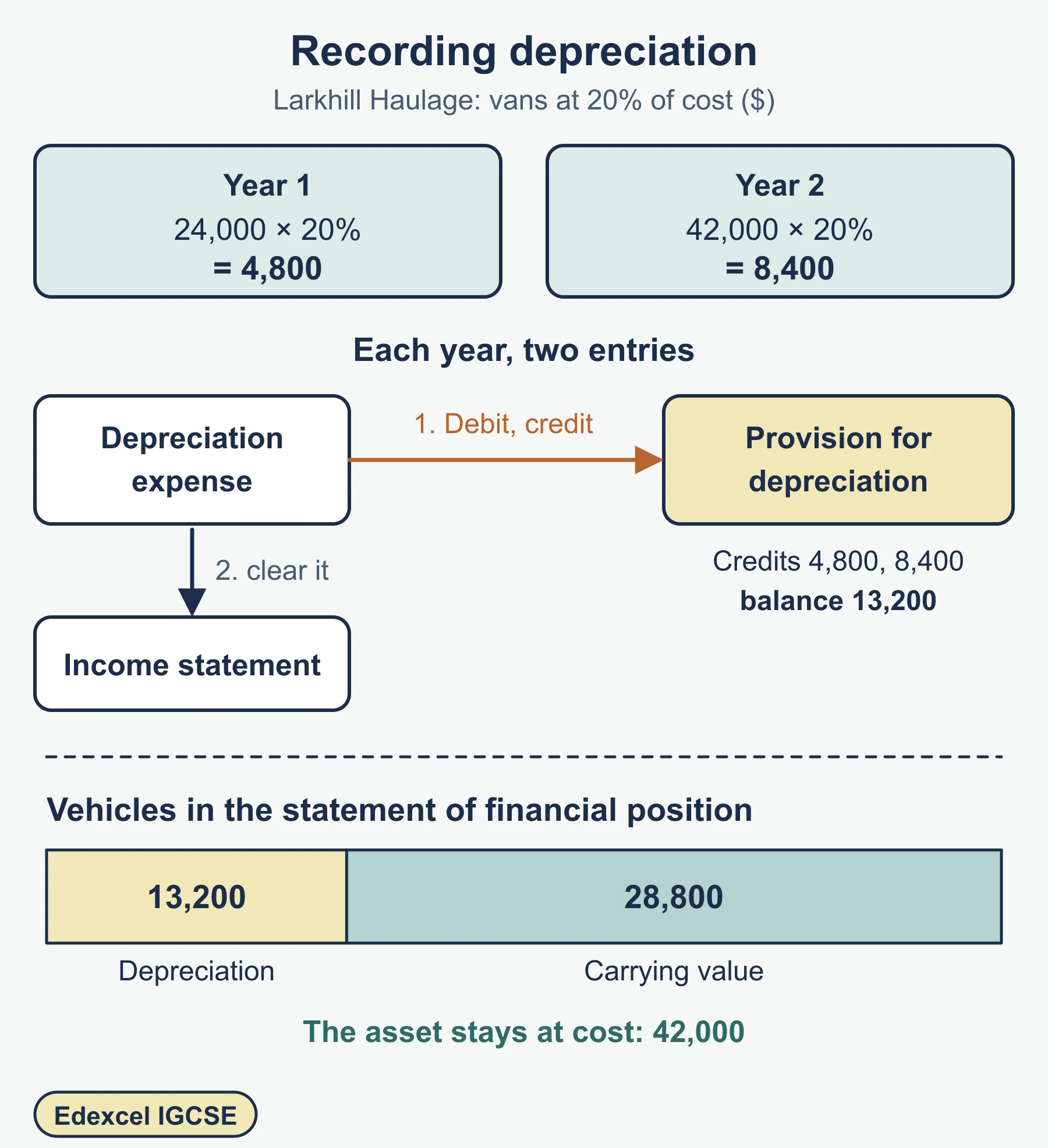
- Debit the Depreciation expense account and credit the Provision for depreciation account with that year’s charge.
- Clear the expense by moving it to the income statement (debit income statement, credit depreciation expense).
The asset account stays at cost. The provision account collects the accumulated depreciation. In the statement of financial position, the asset is shown at cost, less accumulated depreciation, giving carrying value.
Worked example 4. Larkhill Haulage depreciates vehicles at 20% of cost each year, with no residual value, charging a whole year on any vehicle it holds at the year end. It buys a van for 24,000 on 1 January of Year 1 and a second for 18,000 on 1 January of Year 2. Both are paid from the bank.
Year 1 charge: 24,000 × 20% = 4,800. Year 2 charge: (24,000 + 18,000) × 20% = 8,400.
Vehicles at cost
| Debit | Amount | Credit | Amount |
|---|---|---|---|
| Y1 Bank | 24,000 | Y2 Balance c/d | 42,000 |
| Y2 Bank | 18,000 | ||
| Total | 42,000 | Total | 42,000 |
Provision for depreciation of vehicles (end of Year 1, then Year 2)
| Debit | Amount | Credit | Amount |
|---|---|---|---|
| Y1 Balance c/d | 4,800 | Y1 Depreciation | 4,800 |
| Total | 4,800 | Total | 4,800 |
| Y2 Balance c/d | 13,200 | Y2 Balance b/d | 4,800 |
| Y2 Depreciation | 8,400 | ||
| Total | 13,200 | Total | 13,200 |
Depreciation of vehicles (Year 2)
| Debit | Amount | Credit | Amount |
|---|---|---|---|
| Provision for depreciation | 8,400 | Income statement | 8,400 |
| Total | 8,400 | Total | 8,400 |
Statement of financial position, vehicles line, at the close of Year 2:
| Non-current assets | Cost | Depreciation to date | Carrying value |
|---|---|---|---|
| Vehicles | 42,000 | 13,200 | 28,800 |
6. Selling a non-current asset
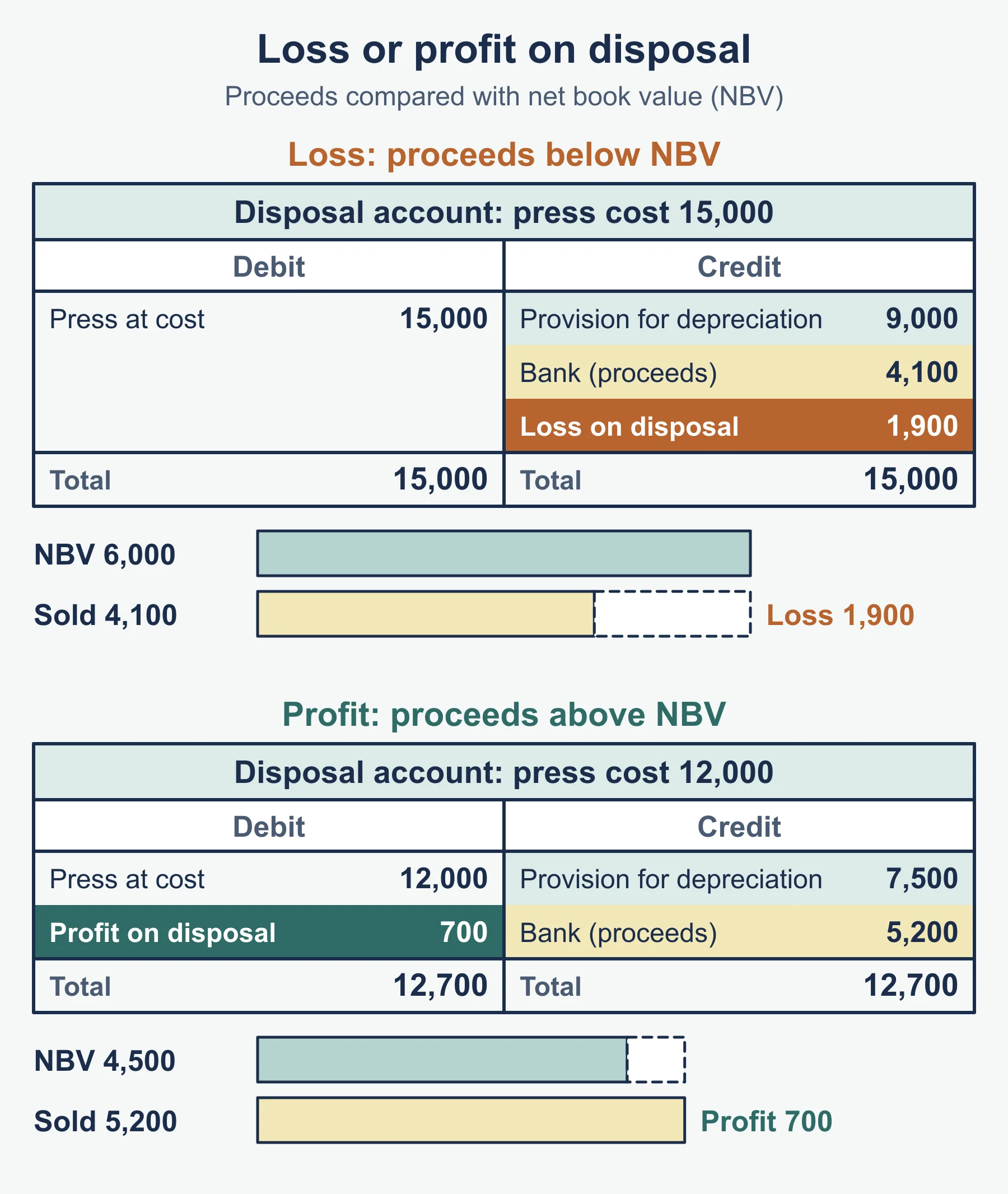
When an asset is sold, a disposal account is used to take out its cost and the depreciation built up on it. Whatever is needed to balance that account is the profit or loss on disposal.
- Debit Disposal, credit Asset at cost (removes cost).
- Debit Provision for depreciation, credit Disposal (removes depreciation to date).
- Debit Bank, credit Disposal (the sale proceeds).
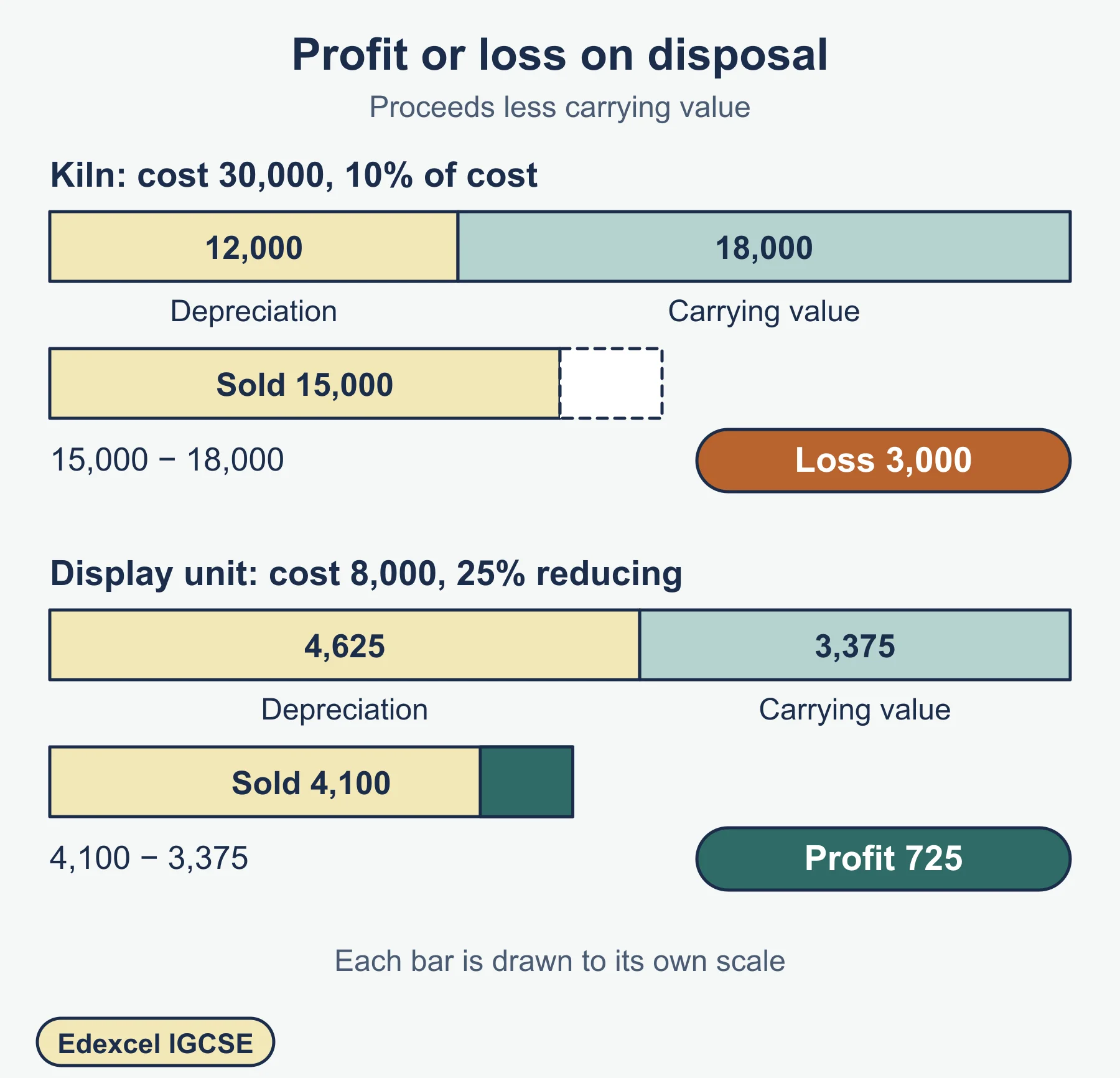
Profit or loss = proceeds − carrying value. If proceeds are more than carrying value, there is a profit. A profit is added in the income statement as income; a loss is shown as an expense.
Worked example 5 (loss). Maddox Kilns buys a kiln for 30,000 and depreciates it at 10% a year on cost. It is sold at the end of Year 4, after that year’s charge, for 15,000. Accumulated depreciation is 30,000 × 10% × 4 = 12,000, so carrying value is 18,000. Loss = 15,000 − 18,000 = 3,000 loss.
Disposal of kiln
| Debit | Amount | Credit | Amount |
|---|---|---|---|
| Kiln at cost | 30,000 | Provision for depreciation | 12,000 |
| Bank | 15,000 | ||
| Income statement (loss) | 3,000 | ||
| Total | 30,000 | Total | 30,000 |
Worked example 6 (profit). Maddox Kilns also owns a display unit that cost 8,000, depreciated at 25% reducing balance, and sells it at the end of Year 3 for 4,100. The charges are 2,000, 1,500 and 1,125, so accumulated depreciation is 4,625 and carrying value is 3,375. Profit = 4,100 − 3,375 = 725.
Disposal of display unit
| Debit | Amount | Credit | Amount |
|---|---|---|---|
| Display unit at cost | 8,000 | Provision for depreciation | 4,625 |
| Income statement (profit) | 725 | Bank | 4,100 |
| Total | 8,725 | Total | 8,725 |
Common errors
- Putting the repair of an asset into the asset account, or the installation cost into expenses.
- Using (cost − residual) with reducing balance, or applying the percentage to cost in later years.
- Crediting the asset account with depreciation when the question says to use a provision account.
- Forgetting to transfer accumulated depreciation to the disposal account, so the loss or profit is wrong.
- Writing that depreciation “saves money for a replacement”. It is an accounting allocation, not a cash transfer.
- Showing a profit on disposal as a loss: check which side of the disposal account needs the balancing figure.
What next
Test yourself with the revision notes, then work through the practice questions and the diagnostics.
Frequently asked questions
What is the difference between capital expenditure and revenue expenditure in Edexcel IGCSE Accounting? Capital expenditure buys, adds to or improves a non-current asset that the business keeps for more than a year, and is debited to an asset account. Revenue expenditure pays for day-to-day running or keeps an asset in its present working order, and is charged as an expense in the income statement.
Are delivery and installation costs part of the cost of a non-current asset? Yes. The cost of a non-current asset includes everything needed to acquire it and prepare it for use, such as the price, carriage, installation and legal fees on property. Repairs and routine maintenance are revenue expenditure.
What happens to profit if capital expenditure is treated as revenue expenditure? The full cost is charged as an expense, so profit for the year is understated and the asset is missing from the statement of financial position. Because depreciation follows the asset, later years are affected too.
What is the difference between straight line and reducing balance depreciation? Straight line charges the same amount each year: (cost minus residual value) divided by expected life. Reducing balance applies a fixed percentage to the carrying value at the start of each year, so the first charge is the largest, and residual value is not deducted first.
How do you calculate the profit or loss on disposal of a non-current asset? Profit or loss on disposal is the sale proceeds minus the carrying value, which is cost less accumulated depreciation. A profit is added as income in the income statement and a loss is shown as an expense.
Official syllabus
Pearson Edexcel International GCSE in Accounting (4AC1) specification, Issue 1, October 2016, published by Pearson Education Limited – Topic 2, Introduction to bookkeeping, sections 2.4 and 2.5 (and the matching Depreciation points in Topic 5).
Get free revision emails (optional)
Occasional emails with practice questions, worked explanations and links to free resources for the qualification and subjects you choose. No spam, and you can unsubscribe from any email. The free tools on this site never need an email.
Related resources
-
Practice questions
Edexcel IGCSE Accounting: Capital and revenue expenditure and depreciation (4AC1) – Practice Questions
Eleven original practice questions with worked answers on capital and revenue expenditure, depreciation and disposals for Edexcel IGCSE Accounting 4AC1.
Accounting · Pearson Edexcel · IGCSE
Try questions -
Revision notes
Edexcel IGCSE Accounting: Capital and revenue expenditure and depreciation (4AC1) – Revision Notes
Revision notes on capital and revenue expenditure, depreciation methods, ledger entries and disposals for Edexcel IGCSE Accounting 4AC1, with a self-test.
Accounting · Pearson Edexcel · IGCSE
Revise topic -
Study guides
Edexcel IGCSE Accounting: Irrecoverable debts and other receivables and other payables (4AC1)
Study guide to Edexcel International GCSE Accounting 4AC1 sections 2.6 and 2.7: irrecoverable debts, provisions, other receivables and other payables.
Accounting · Pearson Edexcel · IGCSE
Read guide
Related articles
-
teaching
A Level tuition in Dubai: Cambridge or Pearson Edexcel International A Level?
Schools in Dubai and Abu Dhabi teach either Cambridge International AS & A Level or Pearson Edexcel International A Level. How the two are structured, why it matters for tuition, and how online classes from Lahore work.
9 October 2026
-
curriculum guides
Choosing subjects at IGCSE and A Level
How subject choices at 14 and 16 affect university options later, and how to keep pathways open without overloading a timetable.
28 July 2026
Studying this with a teacher
Working through Accounting IGCSE?
This page is free and stays free. If you would rather be taught it, Marlbridge runs Accounting classes one-to-one and in small groups of up to 15, online in your own time zone. The first trial class is free. WhatsApp replies within an hour (8am–11pm Pakistan time, every day); email the same day.
Pearson Edexcel Accounting teachers at Marlbridge

