
Revision Notes
Edexcel IGCSE Accounting: Ledger accounting (4AC1) – Revision Notes
Condensed revision notes on ledger accounting for Pearson Edexcel IGCSE Accounting: ledgers, debit and credit rules, balancing, and a self-test.
- Subject
- Accounting
- Level
- IGCSE
- Topic
- Introduction to bookkeeping
- Author
- Marlbridge Academic Team
- Updated
- Reviewed by
- Javaid Iqbal Sabri (what this means)
Aligned to Pearson Edexcel IGCSE Accounting (4AC1), Issue 1, October 2016. Official specification .
Syllabus page (what it covers and how it is assessed): Pearson Edexcel IGCSE Accounting.
Syllabus points this page covers
4AC1
- 2 Introduction to bookkeeping (whole topic)
- 2.3 Ledger accounting
Found an error? Report a correction.
Want a teacher for this? Marlbridge teaches Accounting online. Request a free trial class.
These notes condense section 2.3, Ledger accounting, of Topic 2, Introduction to bookkeeping, in the Pearson Edexcel International GCSE in Accounting (4AC1) specification, Issue 1, October 2016. The section asks you to explain the purpose of the nominal, receivables and payables ledgers (2.3a) and to record transactions in ledger accounts using double entry principles (2.3b). The specification lists no tiers or paper-only markers for it. For full explanations and worked examples, read the ledger accounting study guide.
Links: Edexcel IGCSE Accounting course hub, printable checklist, all free 10-minute diagnostics and the ledger accounting practice set. Amounts below are in dollars and every business is invented.
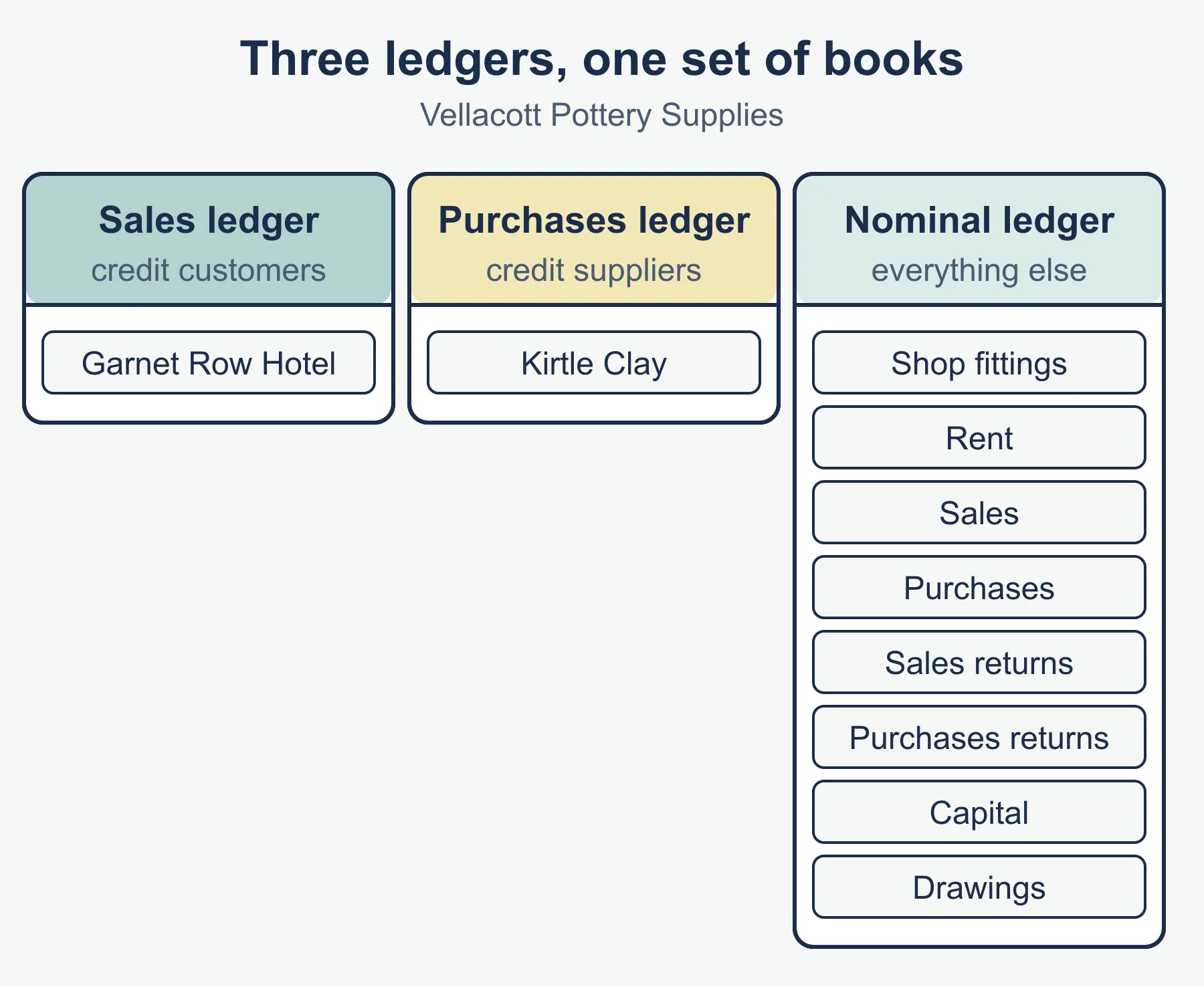
The three ledgers (2.3a)
| Ledger | Contains | Purpose in one line |
|---|---|---|
| Nominal | Every account that is not a credit customer or credit supplier: assets, liabilities, capital, drawings, income, expenses | Totals and balances for each item, used for the trial balance and financial statements |
| Receivables | One account per credit customer | Who owes the business money, how much, and why |
| Payables | One account per credit supplier | Whom the business owes, how much, and when to pay |
Cash sales and cash purchases need no personal account. They stay in the nominal ledger.
Writing the purpose of a ledger (2.3a)
A purpose answer needs what the ledger holds and why that helps the business. Model sentences:
- The receivables ledger holds an account for each credit customer, so the business can see how much each one owes and send a statement of account.
- The payables ledger holds an account for each credit supplier, so the business knows how much it owes, to whom, and when to pay.
- The nominal ledger holds the accounts for everything else, such as sales, expenses, assets, capital and loans, so the business has a balance for each item to use in the trial balance and financial statements.
Debit and credit rules (2.3b)
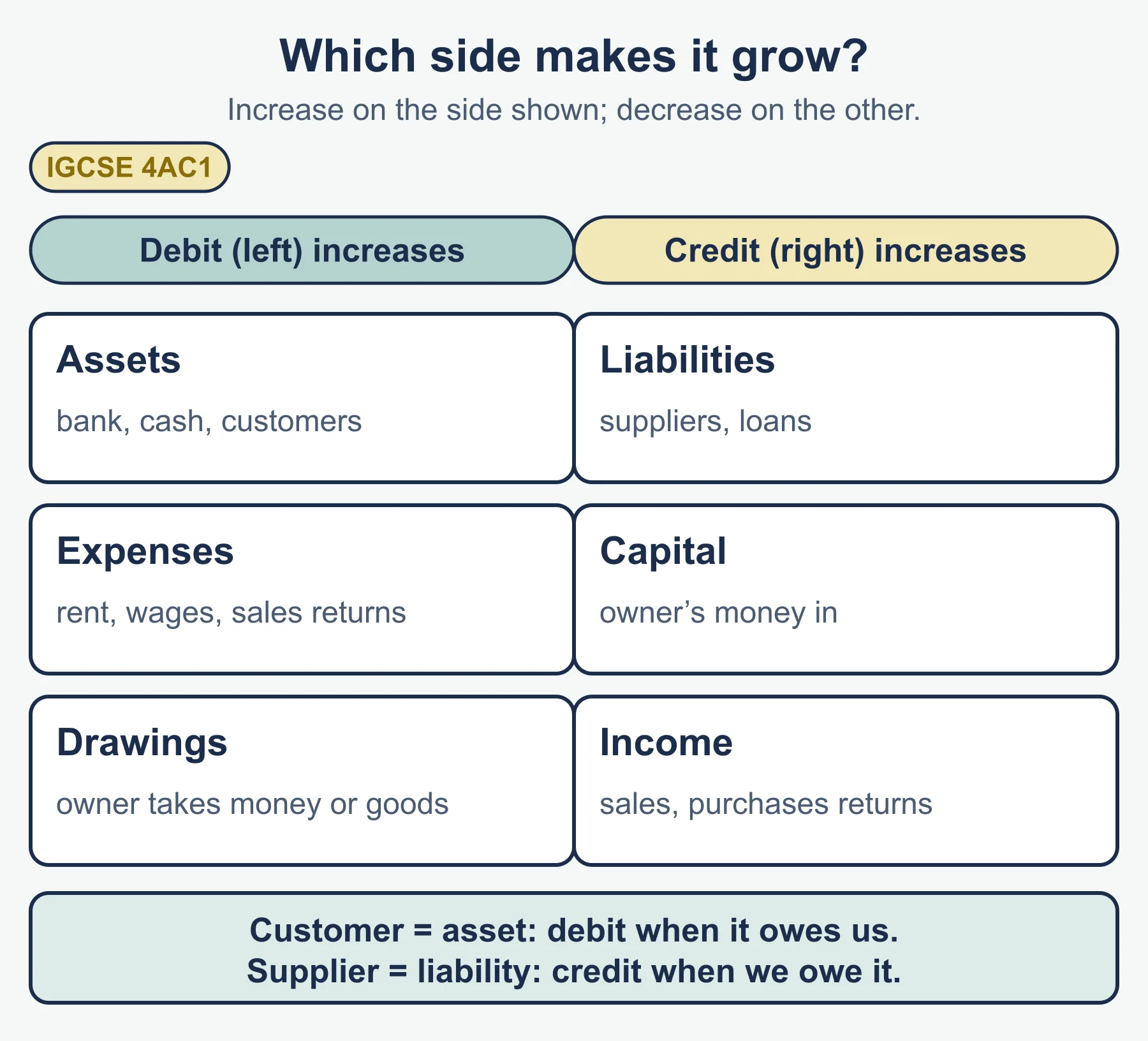
| Account | Increase | Decrease |
|---|---|---|
| Assets (bank, cash, equipment, customers) | Debit | Credit |
| Expenses (rent, wages, purchases, sales returns) | Debit | Credit |
| Drawings | Debit | – |
| Liabilities (suppliers, loans) | Credit | Debit |
| Capital | Credit | Debit |
| Income (sales, purchases returns) | Credit | Debit |
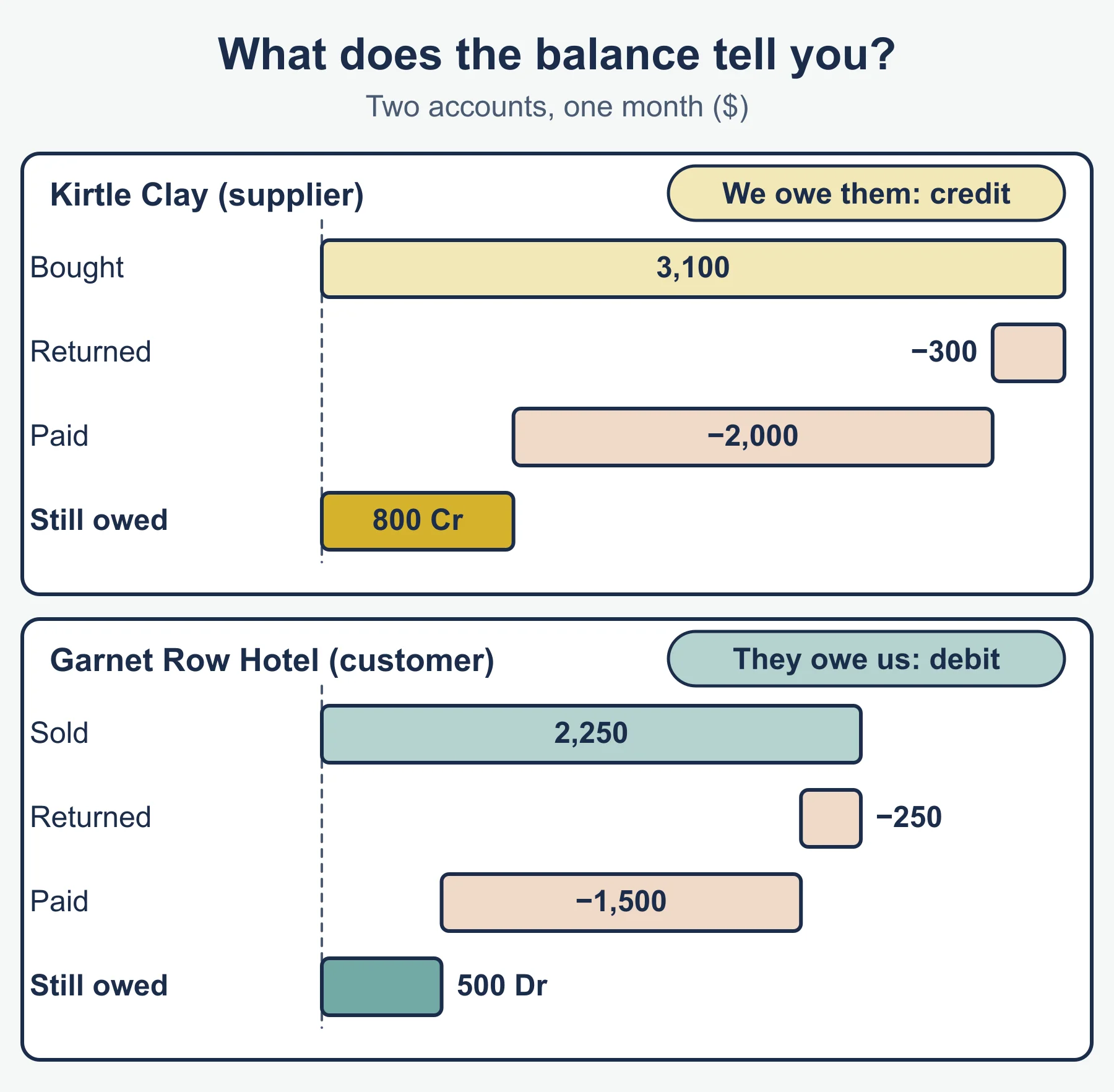
Memory aid: assets, expenses and drawings go up on the debit side. Everything else goes up on the credit side. Money in is a debit to Bank or Cash. Money out is a credit.
Standard entries to know
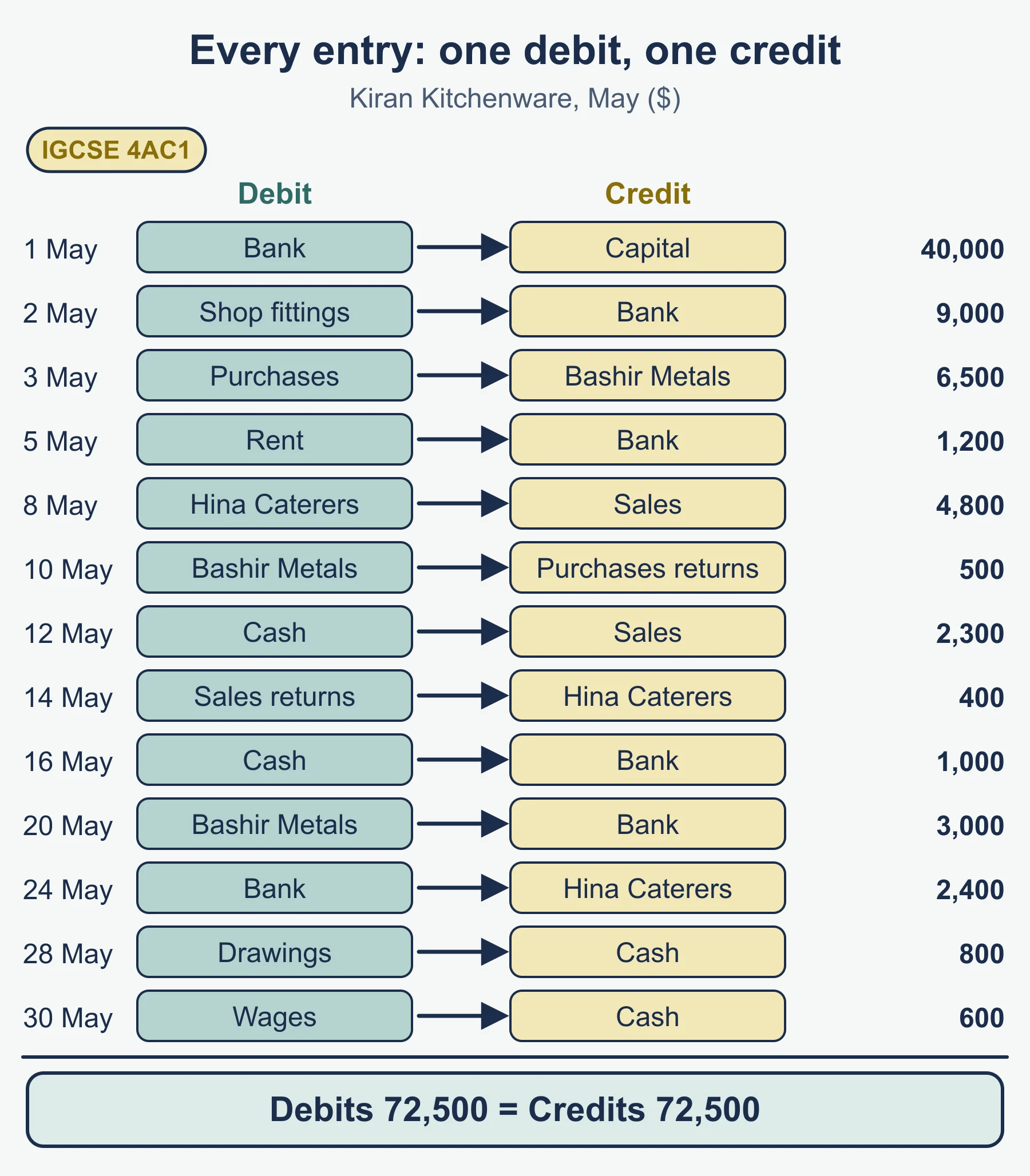
| Transaction | Debit | Credit |
|---|---|---|
| Owner pays money into the bank | Bank | Capital |
| Asset bought, paid by bank | The asset | Bank |
| Goods bought on credit | Purchases | Supplier |
| Goods sold on credit | Customer | Sales |
| Goods returned to a supplier | Supplier | Purchases returns |
| Goods returned by a customer | Sales returns | Customer |
| Customer pays by bank | Bank | Customer |
| Supplier paid by bank | Supplier | Bank |
| Expense paid by bank or cash | The expense | Bank or Cash |
| Owner takes cash | Drawings | Cash |
| Cash taken out of the bank | Cash | Bank |
| Loan received into the bank | Bank | Loan |
Method in steps
- Read the transaction and name the two accounts.
- Decide for each whether it increases or decreases.
- Use the table to choose debit or credit.
- Enter the date, the name of the other account and the amount on that side. Do it in both accounts.
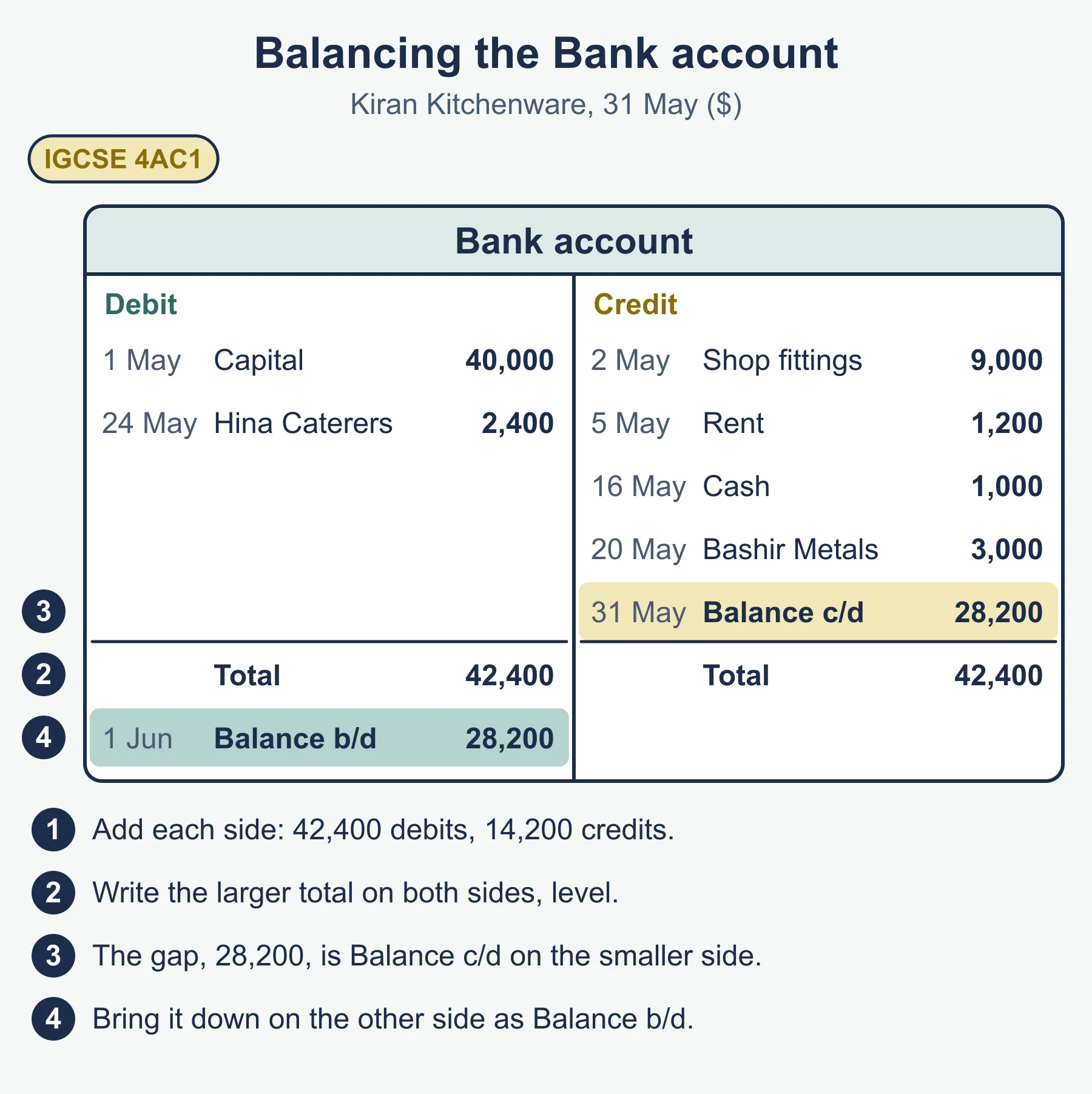
- At the end of the period, total each side, insert the Balance c/d on the smaller side, show equal totals, then bring the balance down on the other side.
Worked reminder: Sadiq Stationers, June
On 1 June, Rubina Offices owes Sadiq Stationers 1,800 and Sadiq owes Nisar Paper Mills 2,700. During June the following happen.
- 4 June: goods sold on credit to Rubina Offices for 3,200.
- 6 June: goods bought on credit from Nisar Paper Mills for 4,100.
- 9 June: Rubina Offices returns goods worth 350.
- 15 June: Rubina Offices pays 1,800 by bank.
- 18 June: Nisar Paper Mills is paid 2,700 by bank.
- 22 June: goods worth 600 are returned to Nisar Paper Mills.
Rubina Offices account (receivables ledger)
| Date | Details (Dr) | Amount | Date | Details (Cr) | Amount |
|---|---|---|---|---|---|
| 1 Jun | Balance b/d | 1,800 | 9 Jun | Sales returns | 350 |
| 4 Jun | Sales | 3,200 | 15 Jun | Bank | 1,800 |
| 30 Jun | Balance c/d | 2,850 | |||
| Total | 5,000 | Total | 5,000 | ||
| 1 Jul | Balance b/d | 2,850 |
Nisar Paper Mills account (payables ledger)
| Date | Details (Dr) | Amount | Date | Details (Cr) | Amount |
|---|---|---|---|---|---|
| 18 Jun | Bank | 2,700 | 1 Jun | Balance b/d | 2,700 |
| 22 Jun | Purchases returns | 600 | 6 Jun | Purchases | 4,100 |
| 30 Jun | Balance c/d | 3,500 | |||
| Total | 6,800 | Total | 6,800 | ||
| 1 Jul | Balance b/d | 3,500 |
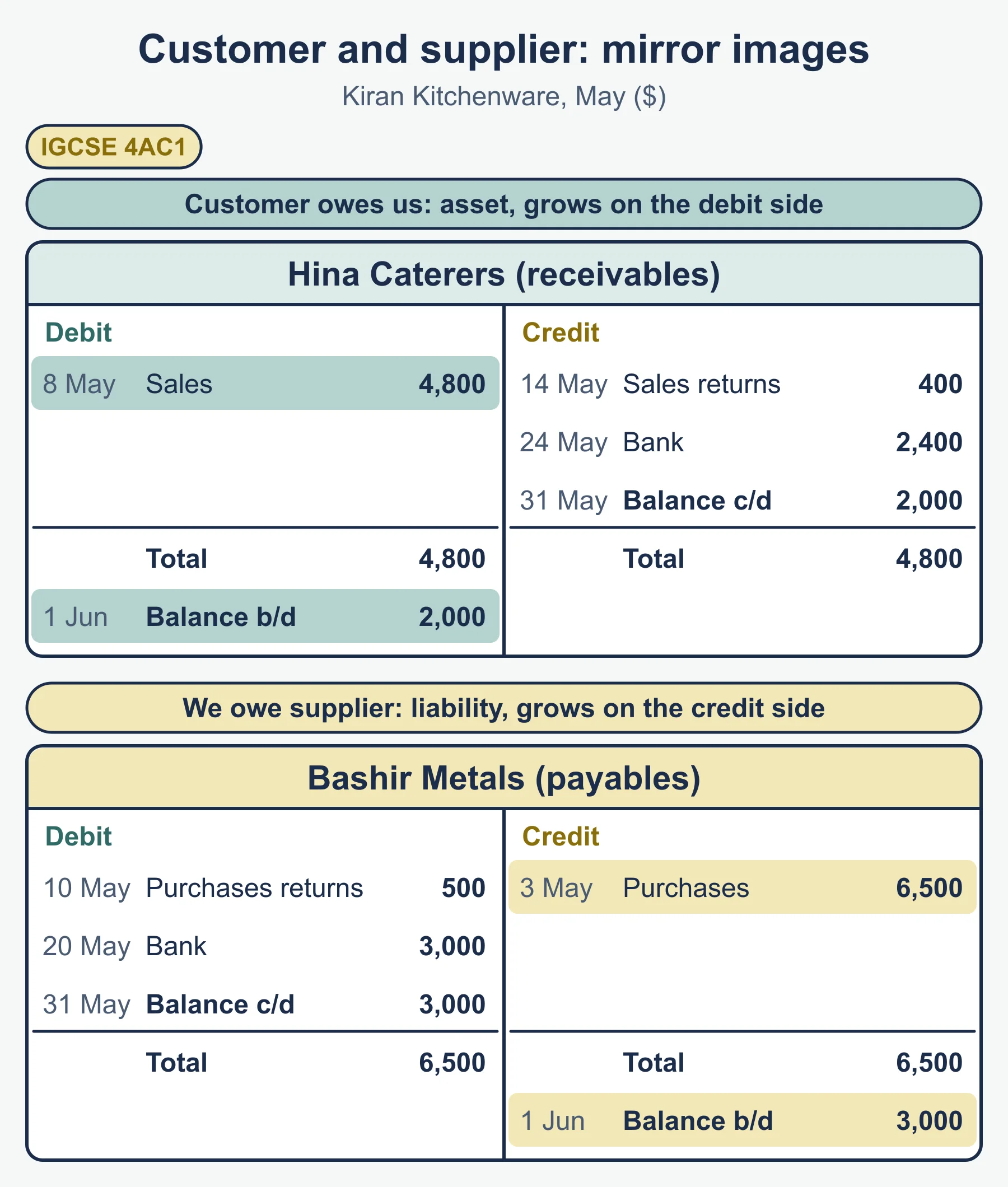
Rubina Offices owes 2,850 at the end of June, a debit balance because it is an asset. Sadiq owes Nisar Paper Mills 3,500, a credit balance because it is a liability.
Layout reminders
- Debit side on the left, credit side on the right.
- Each entry has a date, the other account’s name and an amount.
- Opening balances are written as Balance b/d on the side where the account normally sits.
- The two totals must be equal and level with each other.
- Do not write an amount on a line without also making the matching entry in the other account.
Worked reminder: classifying three more
- The owner pays 2,000 of her own money into the bank. Bank is an asset that rises, so debit Bank. Capital rises, so credit Capital.
- A van is bought and paid for by bank. The van is an asset that rises, so debit Vans. Bank falls, so credit Bank.
- A customer who owed 500 pays in cash. Cash rises, so debit Cash. The customer’s receivable falls, so credit the customer.
Must-know distinctions
- Debit and credit are sides of an account, not good or bad. Debit is left, credit is right.
- Customer and supplier: a customer account is normally a debit balance, a supplier account normally a credit balance.
- Nominal ledger and personal ledgers: sales, rent and bank belong to the nominal ledger. Named customers belong to the receivables ledger and named suppliers to the payables ledger.
- Sales and sales returns: a return is not a negative sale entered in the Sales account. It has its own account, and the customer account is credited.
- Balance c/d and Balance b/d: c/d closes the period on the smaller side. b/d opens the next period on the opposite side.
- Purchases and assets: goods bought to resell go to Purchases. Equipment bought to keep and use goes to its own asset account.
Quick self-test
- Which ledger holds the account of a supplier who is owed money?
- Which ledger holds the Rent account?
- Name the accounts debited and credited when the owner takes 600 cash for private use.
- Name the accounts debited and credited when goods are sold on credit to a customer.
- Name the accounts debited and credited when goods are returned to a supplier.
- An account has debit entries of 6,200 and 1,150 and credit entries of 2,400. State the balance and the side it is carried down on.
- What does a debit balance on the Bank account tell you?
- Is a supplier account normally a debit balance or a credit balance?
- A customer pays 900 by cheque, which is banked. Name the accounts debited and credited.
- Why does a cash sale not appear in the receivables ledger?
- On which side, and on which date, is the balance brought down?
Answers
- The payables ledger.
- The nominal ledger.
- Debit Drawings 600, credit Cash 600.
- Debit the customer, credit Sales.
- Debit the supplier, credit Purchases returns.
- Total debits 7,350 less total credits 2,400 leaves 4,950. It is a debit balance, so Balance c/d of 4,950 is written on the credit side and brought down on the debit side.
- The business has money in the bank (an asset).
- A credit balance, because the business owes the supplier.
- Debit Bank 900, credit the customer.
- Nobody owes the business anything after a cash sale, so no personal account is needed.
- On the side opposite to the Balance c/d, on the first day of the next period.
Where marks are usually lost
- Putting the entry on the wrong side because the account was not classified first as asset, liability, expense or income.
- Writing the account’s own name in the details column.
- Posting a customer return as a debit to the customer, or a supplier payment as a credit to the supplier.
- Leaving out the second entry of a transaction.
- Not dating entries, or omitting the Balance b/d.
- Totals that are not level after balancing, usually from an addition slip.
- Naming the wrong ledger for a customer or supplier.
- Giving a purpose of a ledger that is only a definition, with no reason a business would want it.
Frequently asked questions
Why does a business keep ledgers? Books of original entry record transactions in date order, while ledger accounts sort the same information by account. This lets the business see everything about one expense or one customer and find each balance.
Is a cash sale recorded in the receivables ledger? No. A cash sale has no customer account because nobody owes the business anything, so it is recorded only in the nominal ledger, debiting cash and crediting sales.
How are sales returns recorded in the ledger? A return from a customer is debited to the sales returns account and credited to the customer’s account, because the customer owes less. Posting it to the sales account or debiting the customer are common errors.
Are drawings an expense in ledger accounting? No. Drawings have their own account, debited when the owner takes money or goods from the business. They are not an expense of the business.
Official syllabus
Pearson Edexcel International GCSE in Accounting (4AC1) specification, Issue 1, October 2016, published by Pearson Education Limited – Topic 2 Introduction to bookkeeping, section 2.3 Ledger accounting, points 2.3a and 2.3b.
Get free revision emails (optional)
Occasional emails with practice questions, worked explanations and links to free resources for the qualification and subjects you choose. No spam, and you can unsubscribe from any email. The free tools on this site never need an email.
Related resources
-
Study guides
Edexcel IGCSE Accounting: Business documentation and books of original entry (4AC1)
Study guide to Edexcel IGCSE Accounting 4AC1 business documents, day books, cash book, petty cash book and journal, with five worked examples.
Accounting · Pearson Edexcel · IGCSE
Read guide -
Practice questions
Edexcel IGCSE Accounting: Business documentation and books of original entry (4AC1) – Practice Questions
Eleven original questions with worked answers on Edexcel IGCSE Accounting 4AC1 documents, day books, cash book, petty cash book and journal.
Accounting · Pearson Edexcel · IGCSE
Try questions -
Revision notes
Edexcel IGCSE Accounting: Business documentation and books of original entry (4AC1) – Revision Notes
Condensed Edexcel IGCSE Accounting 4AC1 revision notes on business documents, day books, cash book, petty cash and journal, with a self-test.
Accounting · Pearson Edexcel · IGCSE
Revise topic
Related articles
-
teaching
A Level tuition in Dubai: Cambridge or Pearson Edexcel International A Level?
Schools in Dubai and Abu Dhabi teach either Cambridge International AS & A Level or Pearson Edexcel International A Level. How the two are structured, why it matters for tuition, and how online classes from Lahore work.
9 October 2026
-
curriculum guides
Choosing subjects at IGCSE and A Level
How subject choices at 14 and 16 affect university options later, and how to keep pathways open without overloading a timetable.
28 July 2026
Studying this with a teacher
Working through Accounting IGCSE?
This page is free and stays free. If you would rather be taught it, Marlbridge runs Accounting classes one-to-one and in small groups of up to 15, online in your own time zone. The first trial class is free. WhatsApp replies within an hour (8am–11pm Pakistan time, every day); email the same day.
Pearson Edexcel Accounting teachers at Marlbridge

