
Study Guides
Edexcel IGCSE Accounting: Trial balance and control accounts (4AC1)
Study guide to the trial balance and to trade receivables and trade payables control accounts for Pearson Edexcel International GCSE Accounting 4AC1.
- Subject
- Accounting
- Level
- IGCSE
- Topic
- Introduction to control processes
- Author
- Marlbridge Academic Team
- Updated
- Reviewed by
- Javaid Iqbal Sabri (what this means)
Aligned to Pearson Edexcel IGCSE Accounting (4AC1), Issue 1, October 2016. Official specification .
Syllabus page (what it covers and how it is assessed): Pearson Edexcel IGCSE Accounting.
Syllabus points this page covers
4AC1
- 3 Introduction to control processes (whole topic)
- 3.1 Trial balance
- 3.2 Control accounts
Found an error? Report a correction.
Want a teacher for this? Marlbridge teaches Accounting online. Request a free trial class.
This guide teaches sections 3.1 Trial balance and 3.2 Control accounts of Topic 3, Introduction to control processes, in the Pearson Edexcel International GCSE in Accounting (4AC1) specification, Issue 1, October 2016. Topic 3 belongs to Paper 1, Introduction to Bookkeeping and Accounting, which draws exclusively on topics 1 to 3. Paper 2 builds on the same skills. All figures in this guide are in dollars ($) and every business is invented.
Links: 4AC1 Accounting course hub, printable 4AC1 checklist, free diagnostics. For condensed recall use the revision notes. For exam-style questions with worked answers use the practice questions.
What the specification asks you to do
| Section | Outcome | Covered under |
|---|---|---|
| 3.1a | Explain the purpose of a trial balance | Purpose of a trial balance |
| 3.1b | Prepare a trial balance | Preparing a trial balance |
| 3.1c | Understand the limitations of a trial balance | Limitations |
| 3.2a | Explain the purpose of control accounts | Purpose of control accounts |
| 3.2b | Prepare a trade receivables control account and a trade payables control account | Two worked control accounts |
Purpose of a trial balance
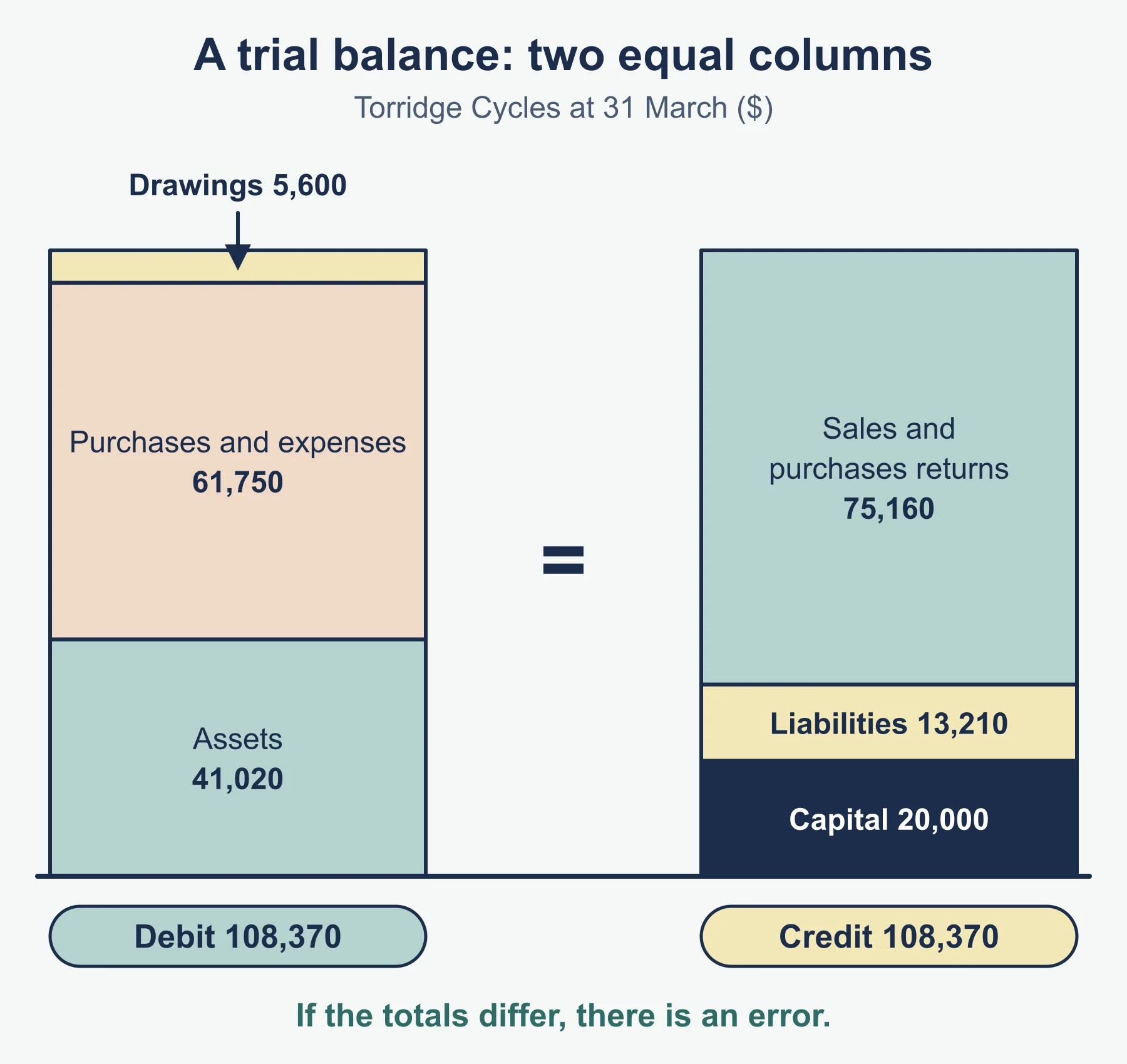
A trial balance sets out the balance of every ledger account at one date, in two columns: debit balances on the left and credit balances on the right. Double entry puts every transaction on the debit side of one account and the credit side of another for the same amount. If every entry was made and balanced correctly, the two columns must total the same.
The purposes are:
- To check the arithmetical accuracy of the double entry. Agreeing totals show that debits and credits are equal.
- To supply the figures for the financial statements. The income statement and the statement of financial position take their figures from it.
- To help locate errors. If the totals differ, the size of the difference narrows the search.
Preparing a trial balance
Take the closing balance of each ledger account and place it on the side where it sits. Use these rules.
| Debit column | Credit column |
|---|---|
| Assets: premises, equipment, inventory, trade receivables, bank (if positive), cash | Liabilities: trade payables, loans, bank overdraft |
| Expenses: wages, electricity, insurance | Income: sales, discount received |
| Purchases, returns inwards, discount allowed | Returns outwards |
| Drawings | Capital |
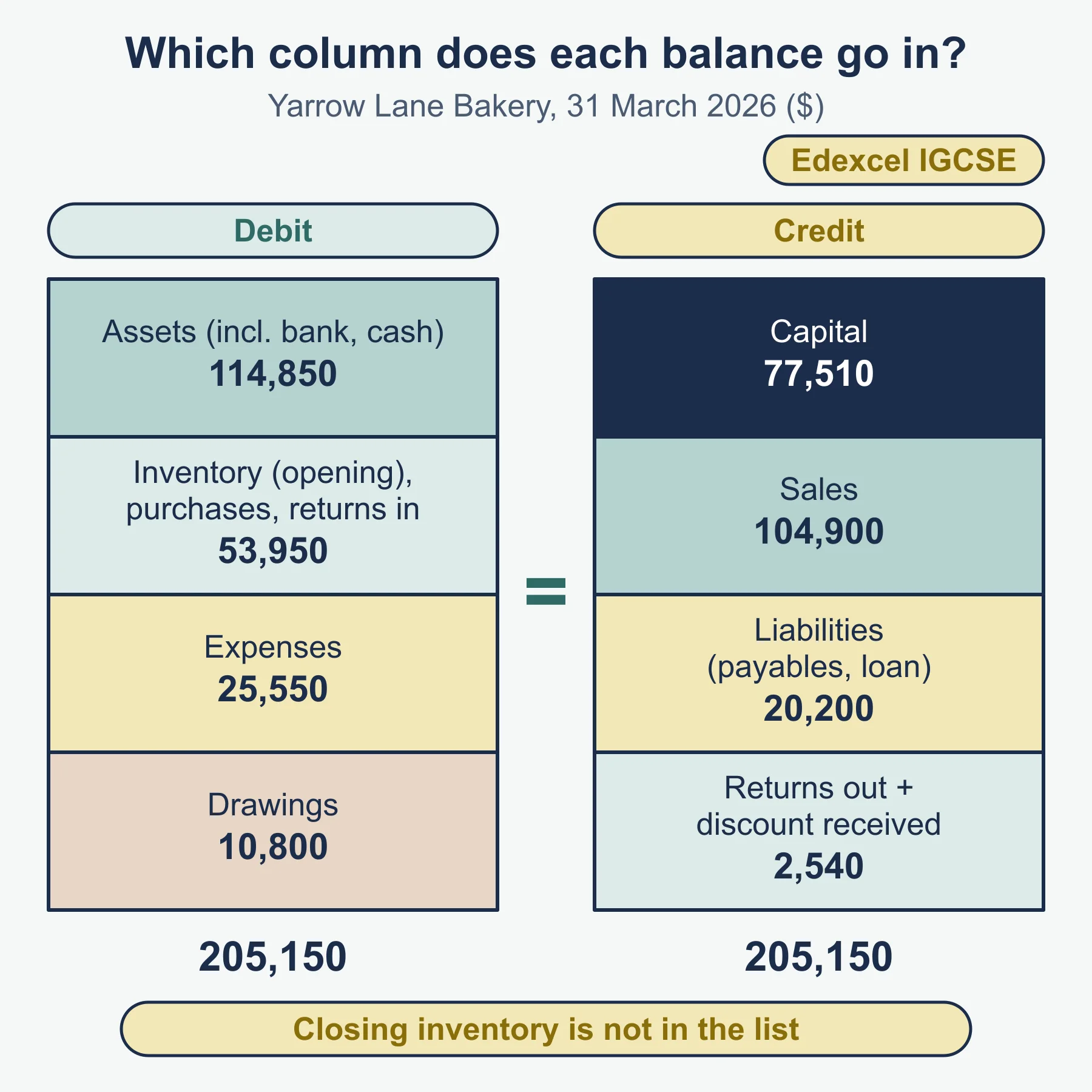
Example: Yarrow Lane Bakery, trial balance as at 31 March 2026.
| Account | Debit | Credit |
|---|---|---|
| Premises | 85,000 | |
| Ovens and equipment | 18,400 | |
| Inventory at 1 April 2025 | 3,100 | |
| Purchases | 49,600 | |
| Returns inwards | 1,250 | |
| Wages | 21,300 | |
| Electricity | 2,850 | |
| Insurance | 1,400 | |
| Drawings | 10,800 | |
| Trade receivables | 4,750 | |
| Bank | 6,320 | |
| Cash | 380 | |
| Sales | 104,900 | |
| Returns outwards | 1,900 | |
| Trade payables | 5,200 | |
| Bank loan | 15,000 | |
| Discount received | 640 | |
| Capital | 77,510 | |
| Total | 205,150 | 205,150 |
Notes on the method:
- Unless the question gives it as a ledger balance, closing inventory is not in the trial balance. The inventory line is the opening figure, because closing inventory is counted at the year end and dealt with in the financial statements.
- Give each account one entry only. The balance is the net figure, not the individual transactions.
- Add each column separately, and show the totals on one line at the foot.
- Put a bank overdraft in the credit column, because the business owes the bank.
Limitations of a trial balance
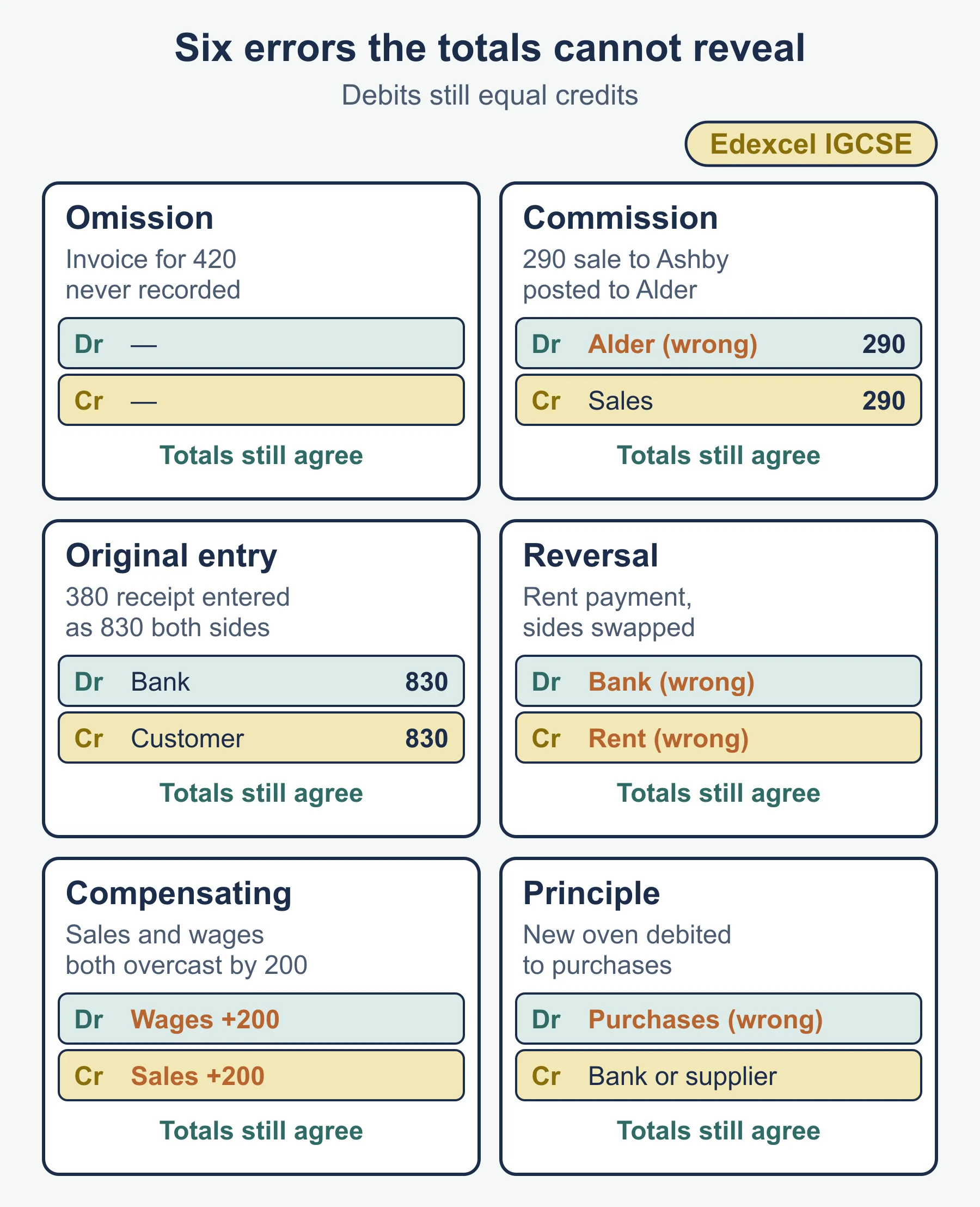
Agreeing totals show only that total debits equal total credits. They do not show that every entry is right. The following errors leave the totals equal, so the trial balance cannot reveal them.
| Error | Example | Why the totals still agree |
|---|---|---|
| Omission | An invoice for 420 is never recorded | No debit and no credit were made |
| Commission | A 290 sale to Ashby is debited to Alder’s account | Right class of account, wrong person |
| Original entry | A 380 receipt is entered as 830 on both sides | Both sides use the same wrong amount |
| Reversal | A rent payment is credited to rent and debited to bank | The two entries are on the wrong sides, but equal |
| Compensating | Sales is overcast by 200 and wages is overcast by 200 | One error cancels the other |
| Principle | A new oven is debited to purchases, not equipment | Right amount, wrong type of account |
Other limits are that the trial balance gives balances at one date only, and it says nothing about whether the amounts are fair.
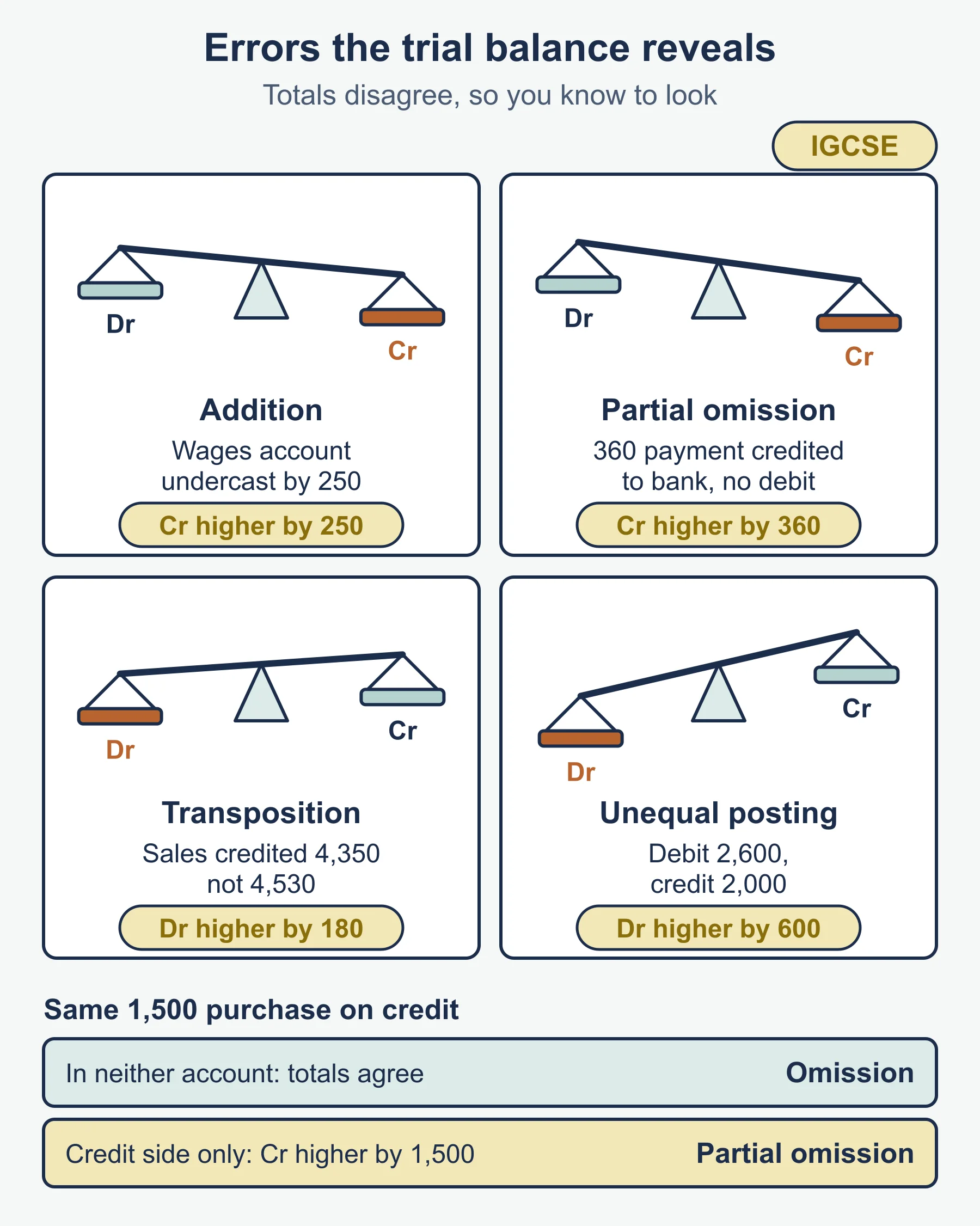
Errors that do make the totals differ include a one-sided entry (the debit was posted but the credit was not, or the reverse), a different amount on each side, an addition error in a ledger account, and a balance carried down wrongly. For example, a sale of 380 credited to sales with no debit entry makes the credit column bigger by 380. A difference tells you that a mistake exists and gives you its size. It does not tell you where the mistake is. Section 3.3, Correction of errors, covers how to correct these errors and use a suspense account.
Purpose of control accounts
A business with many customers has many accounts in the receivables ledger. It buys from many suppliers, so it has many accounts in the payables ledger. A control account is a summary account for the whole ledger. It is built from the totals of the books of original entry, not from the individual customer or supplier accounts. The purposes are:
- To check the accuracy of the ledger. The closing balance of the control account is set against the sum of the separate customer or supplier balances. If they agree, the ledger is probably right.
- To locate errors. A difference shows the error is in that ledger, so the search is narrower.
- To help prevent fraud. If one person keeps the ledger and another prepares the control account, a concealed fraud is harder.
- To give totals quickly. The control account shows the total of trade receivables or trade payables without adding every account. That helps when preparing the statement of financial position.
Trade receivables control account: layout and sources
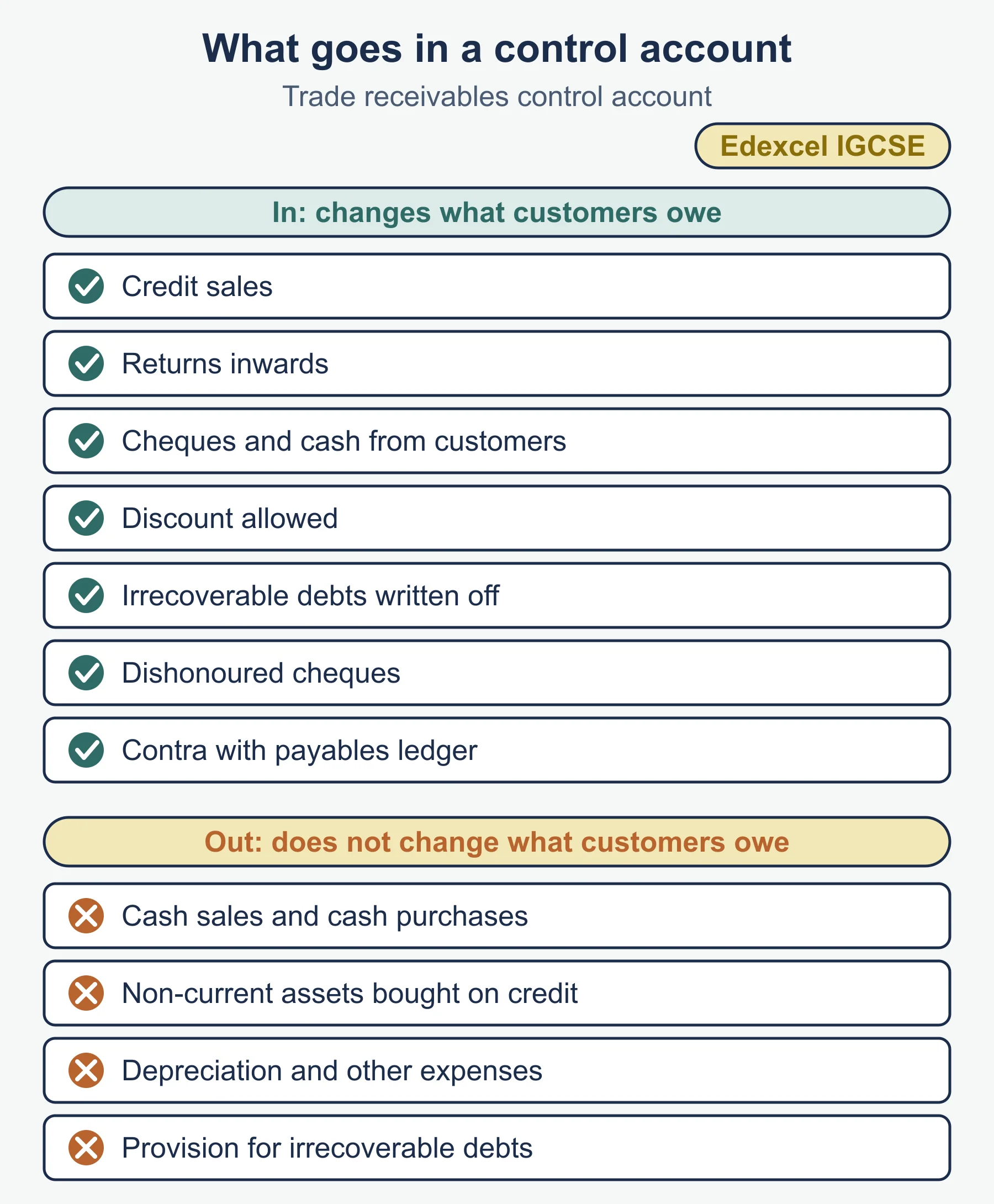
Trade receivables are people who owe the business for goods sold on credit. The account is a total version of the receivables ledger, so entries that increase what customers owe go on the debit side and entries that reduce it go on the credit side.
| Debit side (increases) | Source of the total |
|---|---|
| Opening balance b/d | Previous period |
| Credit sales | Sales day book |
| Dishonoured cheques | Cash book |
| Credit side (decreases) | Source of the total |
|---|---|
| Returns inwards | Sales returns book |
| Cash and cheques received from customers | Cash book (bank column) |
| Discount allowed | Cash book (discount column) |
| Irrecoverable debts written off | Journal |
| Set-off (contra) with the payables ledger | Journal |
| Closing balance c/d | Balancing figure |
Worked example: Orrin Bell Hardware, year ended 30 June 2026
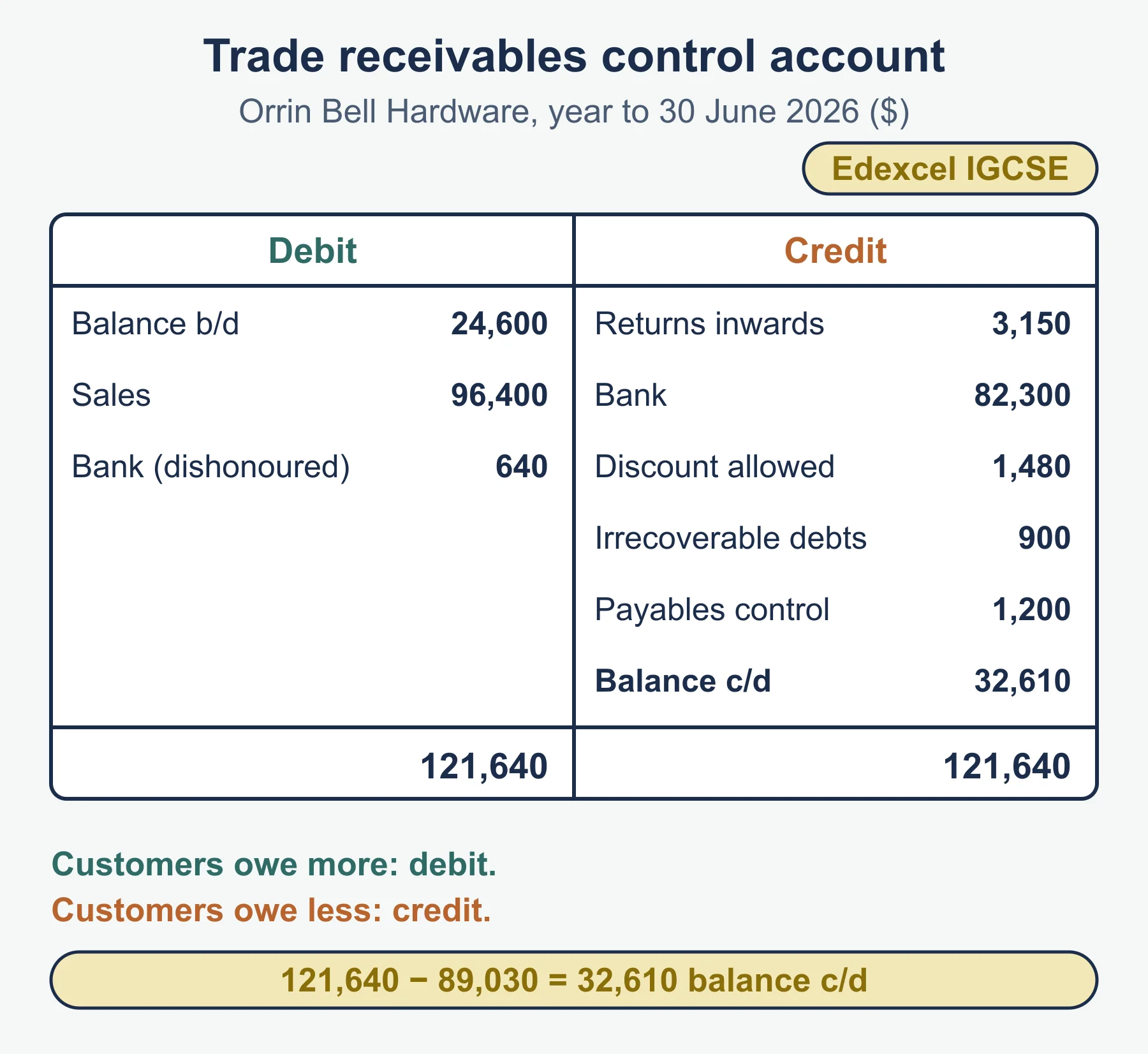
The records show: customers owed 24,600 at 1 July 2025; credit sales were 96,400; returns inwards were 3,150; cheques and cash received from customers were 82,300; discount allowed was 1,480; irrecoverable debts written off were 900; a customer’s cheque for 640 was dishonoured; and 1,200 owed by a customer was set off against what the business owed that same person as a supplier.
| Trade receivables control account | |||
|---|---|---|---|
| Debit | Credit | ||
| Balance b/d | 24,600 | Returns inwards | 3,150 |
| Sales | 96,400 | Bank | 82,300 |
| Bank (dishonoured cheque) | 640 | Discount allowed | 1,480 |
| Irrecoverable debts | 900 | ||
| Payables control (contra) | 1,200 | ||
| Balance c/d | 32,610 | ||
| 121,640 | 121,640 |
Check: the credit entries before the balance total 89,030, and 121,640 less 89,030 is 32,610. The balance carried down becomes the trade receivables line in the statement of financial position, provided it agrees with the ledger.
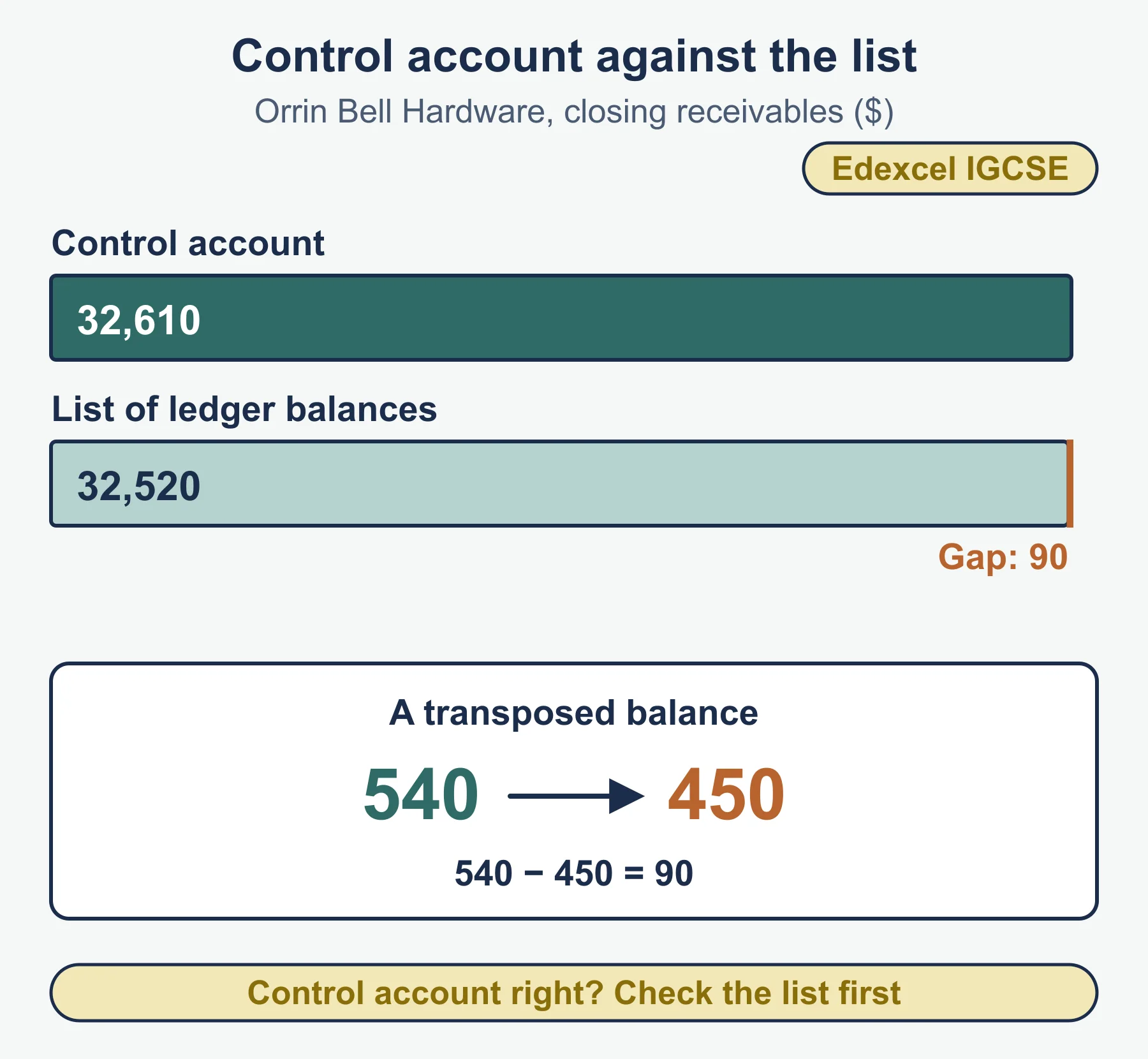
Suppose the list of individual balances in the receivables ledger adds to 32,520. The difference is 90. The bookkeeper might look for a transposed figure, such as a balance of 540 copied as 450. The control account is correct if its entries are right, so the list is suspect first.
Trade payables control account
Trade payables are suppliers the business owes for goods bought on credit. The account is a total version of the payables ledger. Entries that increase what the business owes go on the credit side. Entries that reduce it go on the debit side.
| Credit side (increases) | Source |
|---|---|
| Opening balance b/d | Previous period |
| Credit purchases | Purchases day book |
| Debit side (decreases) | Source |
|---|---|
| Returns outwards | Purchases returns book |
| Payments to suppliers | Cash book |
| Discount received | Cash book (discount column) |
| Set-off (contra) with the receivables ledger | Journal |
| Closing balance c/d | Balancing figure |
Worked example: Tellis Cycles, year ended 30 June 2026
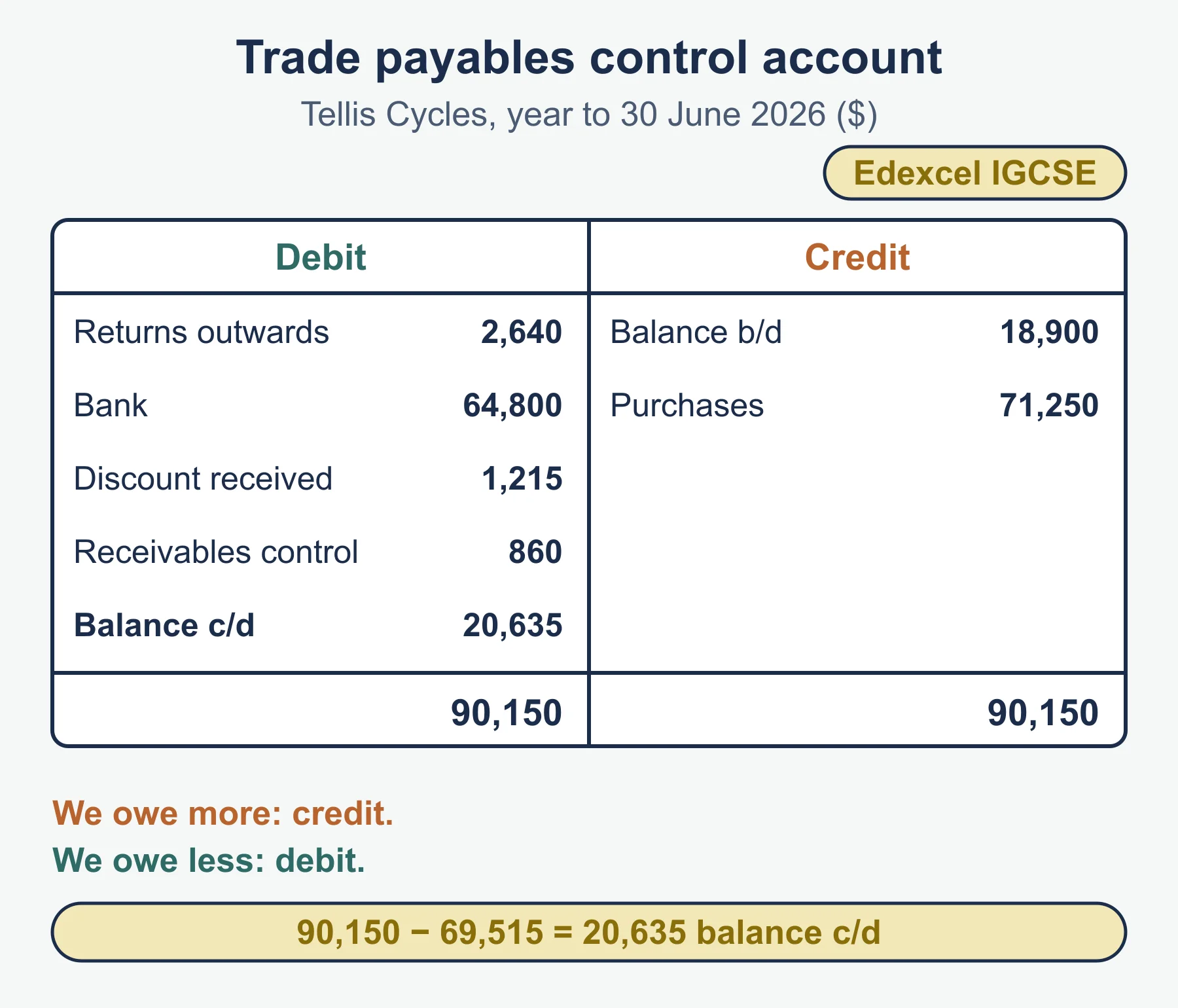
At 1 July 2025 the business owed suppliers 18,900. During the year, credit purchases were 71,250, returns outwards were 2,640, payments to suppliers were 64,800, discount received was 1,215, and 860 owed to a supplier was set off against a balance that supplier owed Tellis Cycles as a customer.
| Trade payables control account | |||
|---|---|---|---|
| Debit | Credit | ||
| Returns outwards | 2,640 | Balance b/d | 18,900 |
| Bank | 64,800 | Purchases | 71,250 |
| Discount received | 1,215 | ||
| Receivables control (contra) | 860 | ||
| Balance c/d | 20,635 | ||
| 90,150 | 90,150 |
Check: 2,640 + 64,800 + 1,215 + 860 = 69,515, and 90,150 less 69,515 is 20,635.
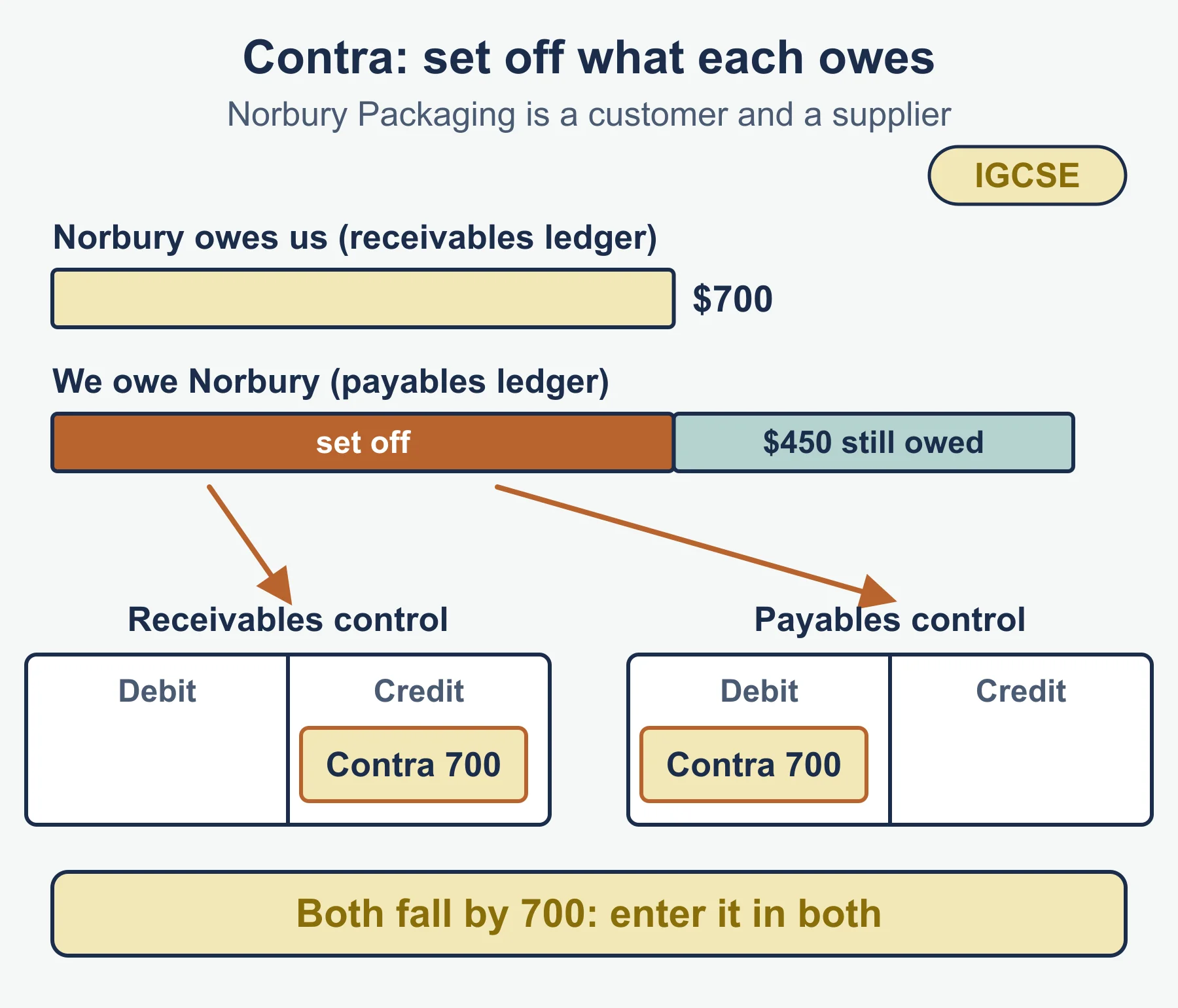
The two examples use the contra the same way. The set-off reduces both control accounts, because the business no longer expects to receive, nor needs to pay, that amount.
What stays out of a control account
- Cash sales and cash purchases, because they never pass through the ledgers.
- Purchases and sales of non-current assets, even if on credit, because they are not trading transactions.
- Depreciation and other expenses.
- The provision for irrecoverable debts. Only irrecoverable debts actually written off appear.
- Any amount that does not change what customers owe or what suppliers are owed.
A customer who overpays has a credit balance in the receivables ledger. The control account closing balance is the net figure, so the debit balances less any credit balances in the ledger should equal it. Read the question to see how it wants such balances shown.
Common errors
- Putting the opening trade payables balance on the debit side. Payables are credit balances, so b/d is credit.
- Using cash sales in the receivables control account.
- Reversing the sides for returns inwards and returns outwards.
- Showing dishonoured cheques on the credit side. The customer owes again, so it is a debit.
- Entering the provision for irrecoverable debts instead of the amount written off.
- Leaving out the contra, or entering it on only one control account when the question asks for both.
- Putting the closing inventory in a trial balance. Only the opening figure belongs there.
- Placing drawings in the credit column. Drawings reduce the owner’s stake, but the account holds a debit balance.
Next steps
Work through the revision notes, then try the practice questions. Use the 4AC1 course hub and the checklist to track coverage.
Frequently asked questions
What is the purpose of a trial balance in Edexcel IGCSE Accounting? A trial balance checks the arithmetical accuracy of the double entry, supplies the figures for the financial statements and helps locate errors. It lists every ledger balance at one date, with debit balances on the left and credit balances on the right.
Why is opening inventory, not closing inventory, in the trial balance? Closing inventory is counted at the year end and dealt with in the financial statements, so the inventory figure in the ledger is the opening balance. Unless the question gives closing inventory as a ledger balance, it does not appear in the trial balance.
What is a control account? A control account is a summary account for a whole ledger, built from the totals of the books of original entry. Its closing balance is compared with the total of the individual customer or supplier balances to check the ledger.
Which side does a dishonoured cheque go on in a trade receivables control account? A dishonoured cheque goes on the debit side, because the customer owes the money again. Entries that increase what customers owe are debits and entries that reduce it are credits.
What is left out of a control account? Cash sales and cash purchases, sales or purchases of non-current assets, depreciation and other expenses, and the provision for irrecoverable debts stay out. Only irrecoverable debts actually written off are included.
Official syllabus
Pearson Edexcel International GCSE in Accounting (4AC1) specification, Issue 1, October 2016, published by Pearson Education Limited – Topic 3 Introduction to control processes, sections 3.1 Trial balance and 3.2 Control accounts.
Get free revision emails (optional)
Occasional emails with practice questions, worked explanations and links to free resources for the qualification and subjects you choose. No spam, and you can unsubscribe from any email. The free tools on this site never need an email.
Related resources
-
Practice questions
Edexcel IGCSE Accounting: Trial balance and control accounts (4AC1) – Practice Questions
Original 4AC1 practice questions with worked answers on preparing a trial balance and trade receivables and payables control accounts.
Accounting · Pearson Edexcel · IGCSE
Try questions -
Revision notes
Edexcel IGCSE Accounting: Trial balance and control accounts (4AC1) – Revision Notes
Condensed 4AC1 revision notes on the trial balance, its limitations and trade receivables and payables control accounts, with a self-test and answers.
Accounting · Pearson Edexcel · IGCSE
Revise topic -
Study guides
Edexcel IGCSE Accounting: Correction of errors and bank reconciliation statements (4AC1)
Study guide to Edexcel IGCSE Accounting errors, correcting journals, the suspense account and bank reconciliation statements, with worked examples.
Accounting · Pearson Edexcel · IGCSE
Read guide
Related articles
-
teaching
A Level tuition in Dubai: Cambridge or Pearson Edexcel International A Level?
Schools in Dubai and Abu Dhabi teach either Cambridge International AS & A Level or Pearson Edexcel International A Level. How the two are structured, why it matters for tuition, and how online classes from Lahore work.
9 October 2026
-
curriculum guides
Choosing subjects at IGCSE and A Level
How subject choices at 14 and 16 affect university options later, and how to keep pathways open without overloading a timetable.
28 July 2026
Studying this with a teacher
Working through Accounting IGCSE?
This page is free and stays free. If you would rather be taught it, Marlbridge runs Accounting classes one-to-one and in small groups of up to 15, online in your own time zone. The first trial class is free. WhatsApp replies within an hour (8am–11pm Pakistan time, every day); email the same day.
Pearson Edexcel Accounting teachers at Marlbridge

