
Revision Notes
Edexcel IGCSE Accounting: Trial balance and control accounts (4AC1) – Revision Notes
Condensed 4AC1 revision notes on the trial balance, its limitations and trade receivables and payables control accounts, with a self-test and answers.
- Subject
- Accounting
- Level
- IGCSE
- Topic
- Introduction to control processes
- Author
- Marlbridge Academic Team
- Updated
- Reviewed by
- Javaid Iqbal Sabri (what this means)
Aligned to Pearson Edexcel IGCSE Accounting (4AC1), Issue 1, October 2016. Official specification .
Syllabus page (what it covers and how it is assessed): Pearson Edexcel IGCSE Accounting.
Syllabus points this page covers
4AC1
- 3 Introduction to control processes (whole topic)
- 3.1 Trial balance
- 3.2 Control accounts
Found an error? Report a correction.
Want a teacher for this? Marlbridge teaches Accounting online. Request a free trial class.
These notes condense sections 3.1 Trial balance and 3.2 Control accounts of Topic 3, Introduction to control processes, in the Pearson Edexcel International GCSE in Accounting (4AC1) specification, Issue 1, October 2016. The topic is part of Paper 1, which draws on topics 1 to 3, and Paper 2 builds on it. For full explanations and worked examples, use the trial balance and control accounts study guide. All amounts are in dollars and all businesses are invented.
Links: 4AC1 Accounting course hub, printable 4AC1 checklist, free diagnostics. For exam-style questions with worked answers, use the practice set.
3.1a Purpose of a trial balance
| Purpose | In one line |
|---|---|
| Check accuracy | Total debit balances should equal total credit balances |
| Prepare statements | It lists the balances used to build the income statement and statement of financial position |
| Locate errors | A difference shows an error exists and gives its size |
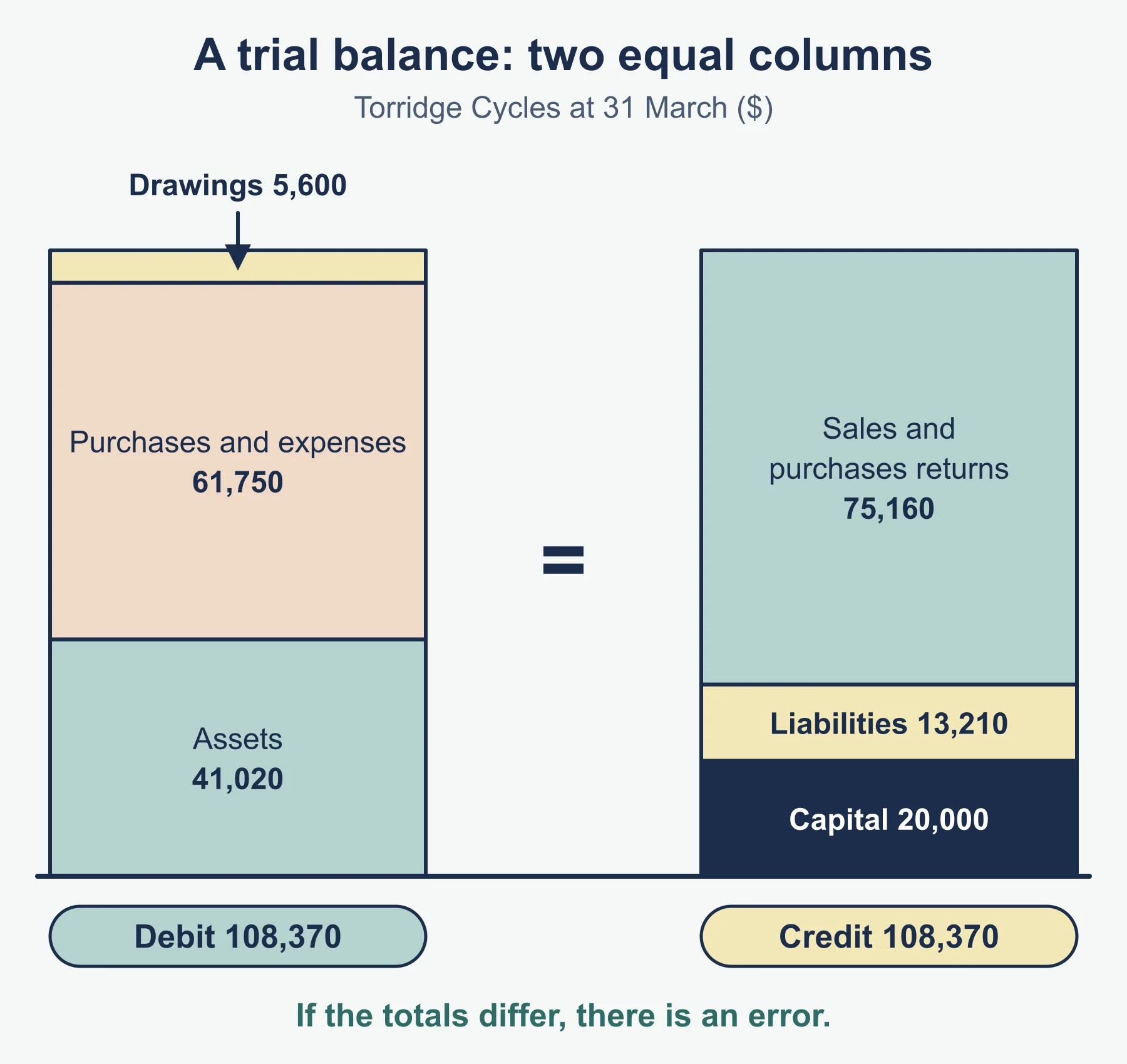
Definition: a list of ledger balances at a date, in a debit column and a credit column.
3.1b Preparing a trial balance
Method in steps
1. List every ledger account with its closing balance.
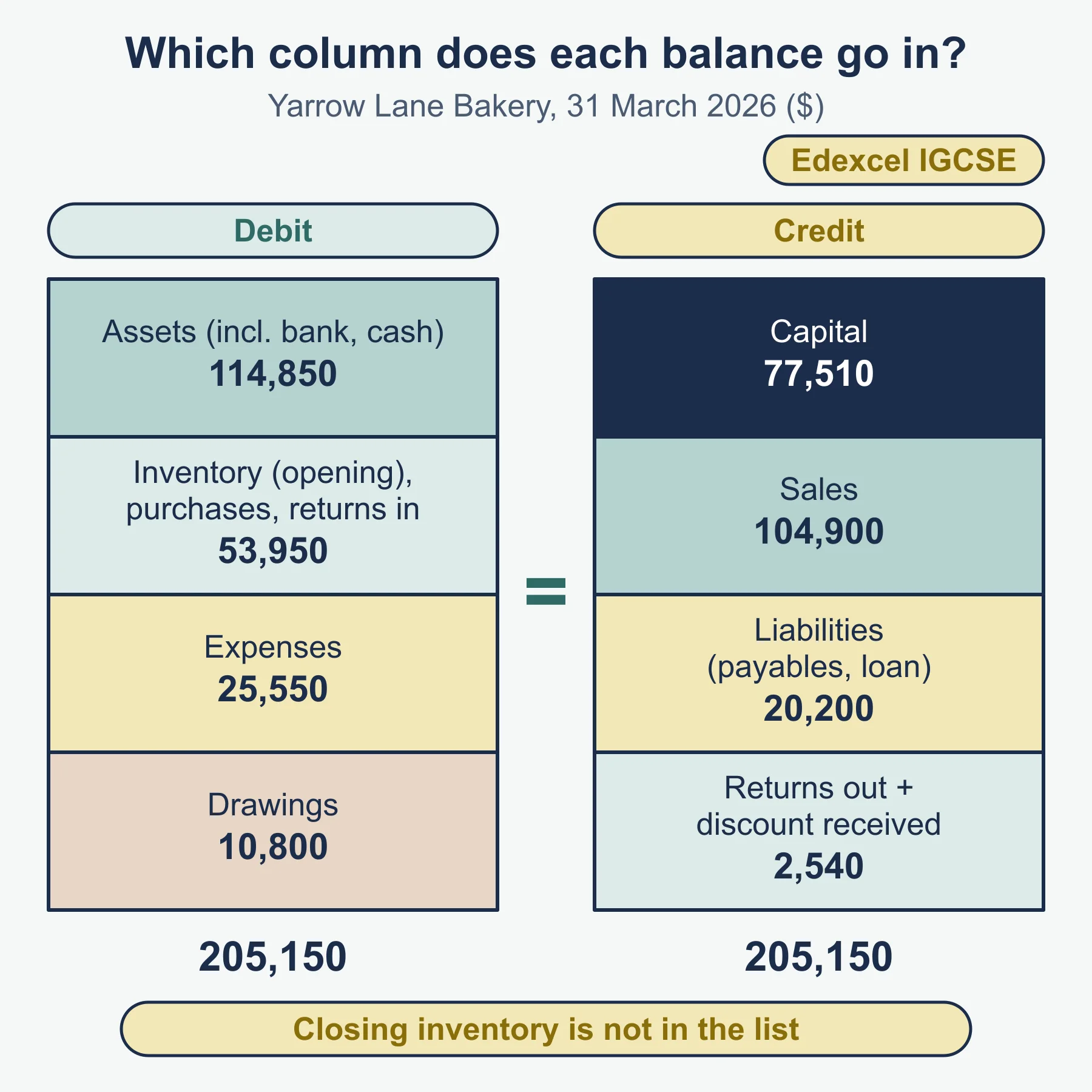
2. Debit balance: assets, expenses, purchases, returns inwards,
   discount allowed, drawings.
3. Credit balance: liabilities, income, sales, returns outwards,
   discount received, capital.
4. Add each column separately.
5. Compare the two totals. They should agree.
Worked reminder: Merrowdean Pet Supplies, trial balance at 31 December 2026.
| Account | Debit | Credit |
|---|---|---|
| Shop fittings | 22,600 | |
| Inventory at 1 January 2026 | 2,900 | |
| Purchases | 31,800 | |
| Carriage inwards | 540 | |
| Rent | 6,000 | |
| Drawings | 7,200 | |
| Trade receivables | 3,480 | |
| Bank | 2,150 | |
| Sales | 48,700 | |
| Returns outwards | 960 | |
| Trade payables | 4,120 | |
| Loan | 8,000 | |
| Capital | 14,890 | |
| Total | 76,670 | 76,670 |
Memory hook: assets and expenses sit on the debit side, and the owner’s money, loans, income and what is owed to suppliers sit on the credit side.
3.1c Limitations
The trial balance does not prove the books are right. These errors leave it balanced.
| Type | One-line reminder |
|---|---|
| Omission | The whole transaction is missing |
| Commission | Right type of account, wrong account |
| Original entry | A wrong figure is used on both sides |
| Reversal | Debit and credit are placed on opposite sides |
| Compensating | Two mistakes of the same amount, one on each side, offset each other |
| Principle | Posted to the wrong class of account |
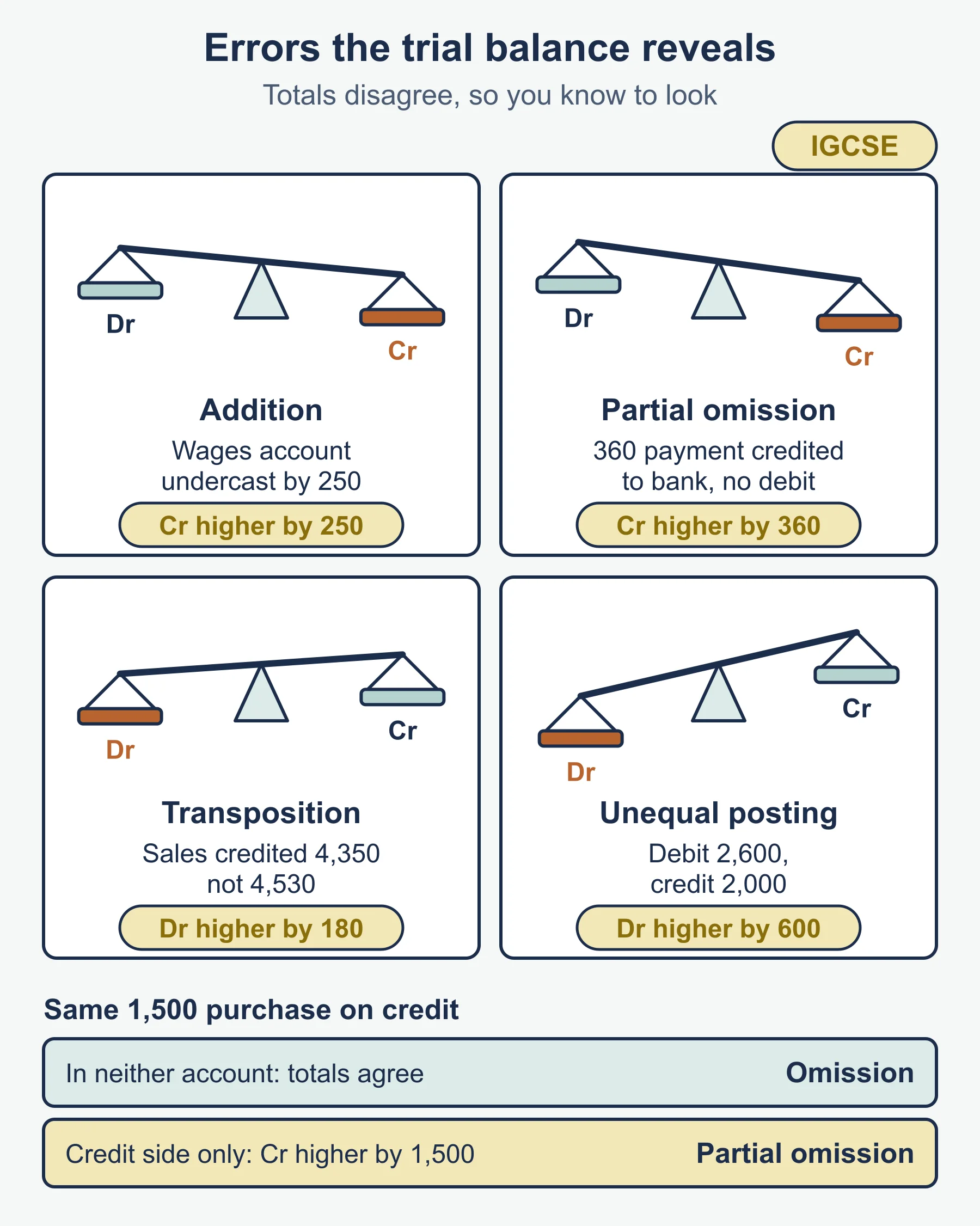
These errors do make the totals differ: a one-sided entry, different amounts on each side, a wrong addition of a ledger account, a wrongly carried down balance.
Other limits: balances are for one date only, and the trial balance does not show profit or the value of the business.
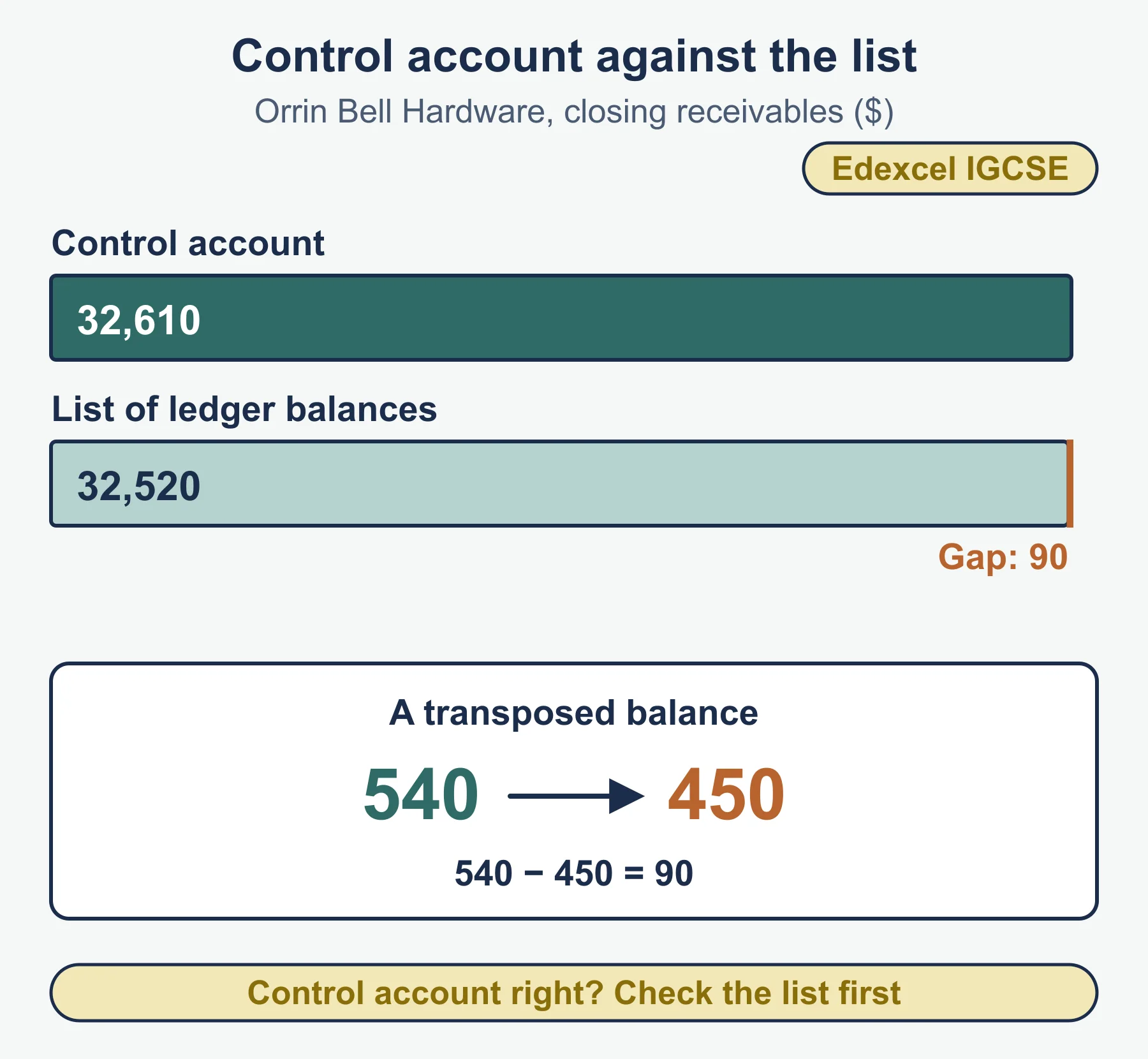
Worked reminder: a cheque of 450 received from a customer is debited to bank as 450 but credited to the customer’s account as 540. The two sides differ, so the credit column is 90 larger than it should be and the trial balance shows a difference of 90. Now suppose the cheque had been posted as 540 on both sides. The totals agree, so the trial balance does not warn you. That is an error of original entry.
Method in steps: when the totals differ
1. Work out the difference and note which column is larger.
2. Re-add both columns.
3. Check that every ledger balance is in the right column.
4. Look for a one-sided entry of exactly that amount.
5. Park what remains in a suspense account (section 3.3).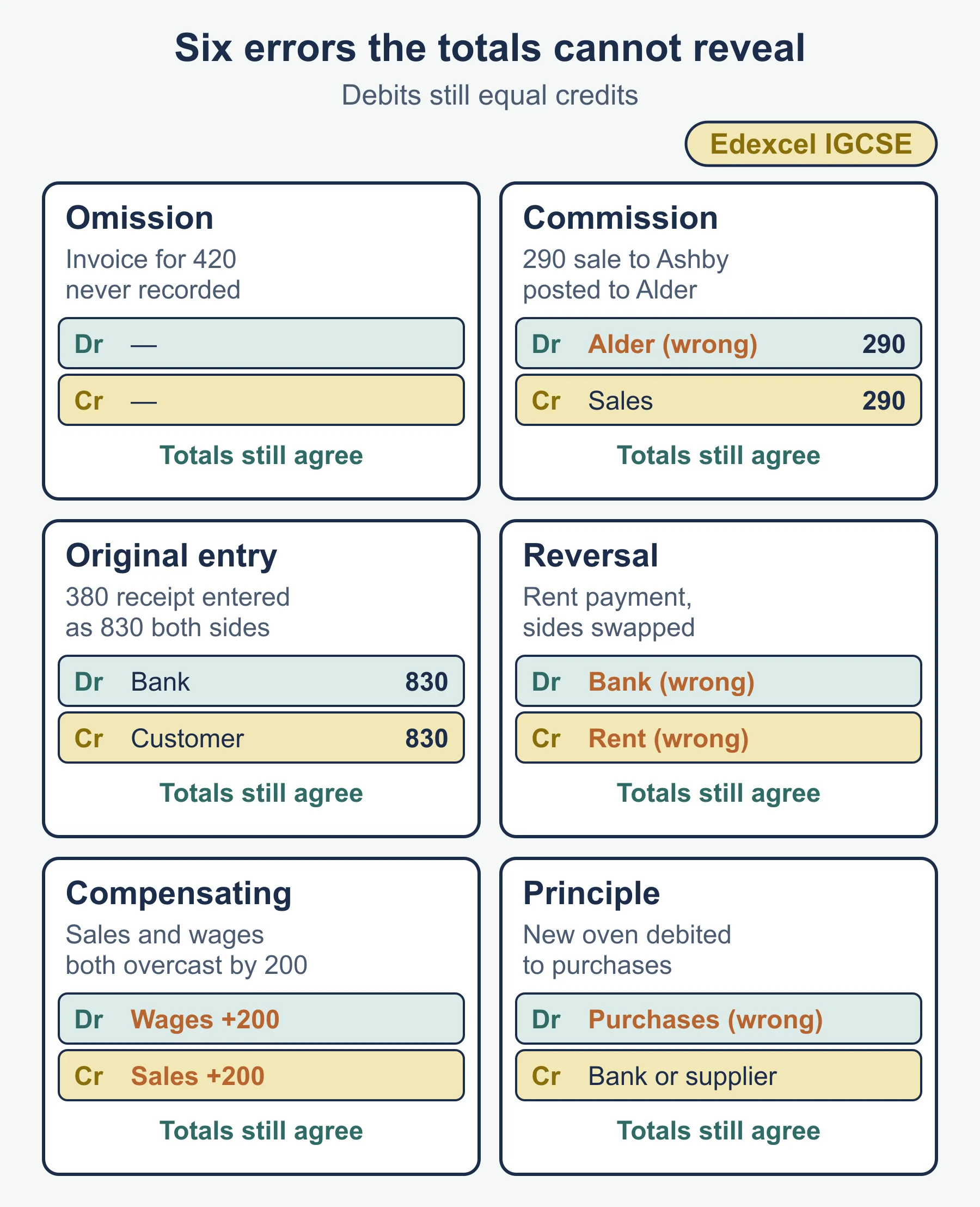
3.2a Purpose of control accounts
- Check the accuracy of a ledger by comparing the control balance with the total of individual balances.
- Help locate errors, because a difference points to that ledger.
- Help deter fraud when the control account and the ledger are kept by different people.
- Give a ready total, for example trade receivables for the statement of financial position.
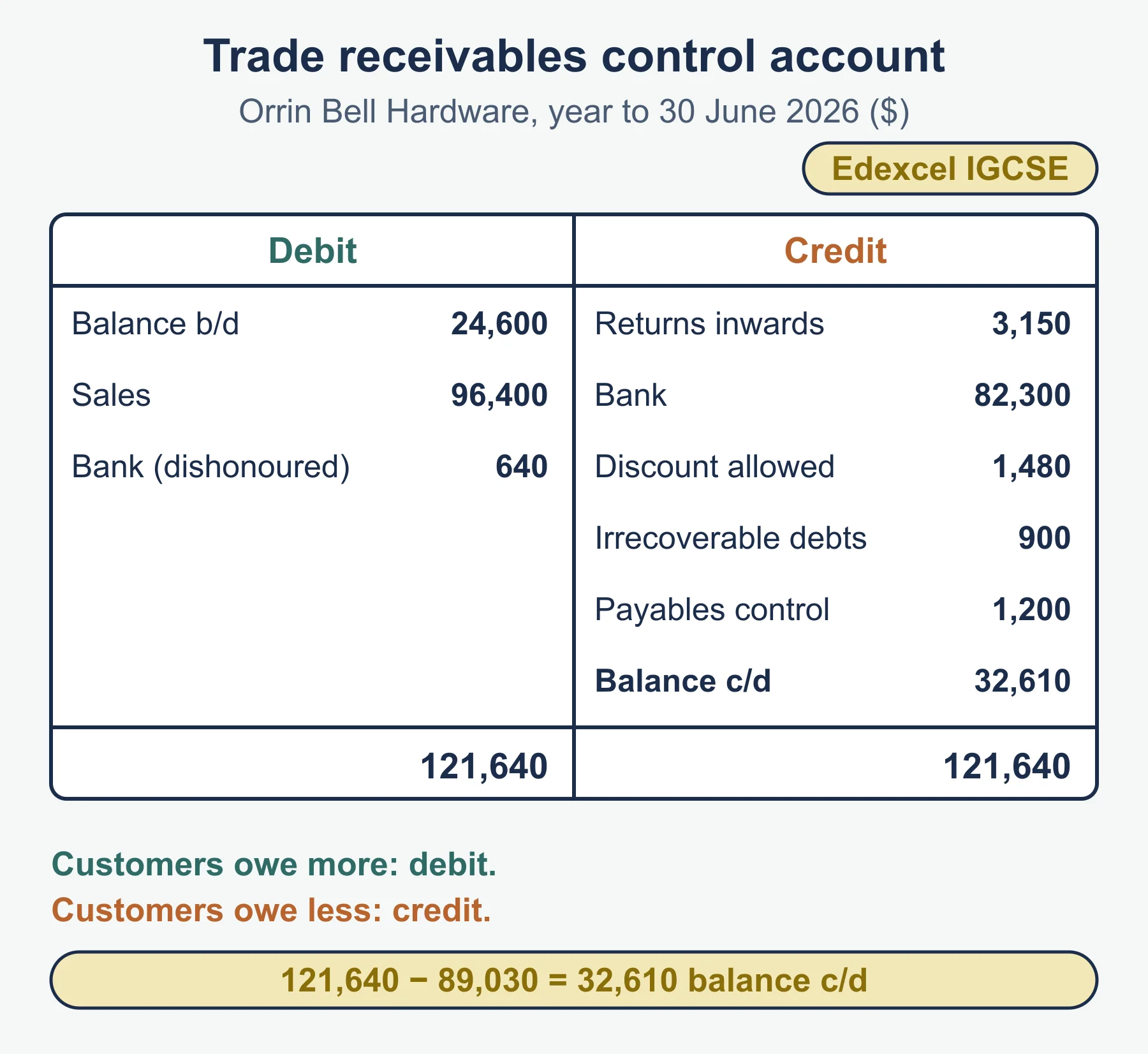
3.2b Trade receivables control account
Rule: increases go on the debit side, decreases on the credit side.
| Debit | Credit |
|---|---|
| Opening balance b/d | Returns inwards |
| Credit sales | Cash and cheques received |
| Dishonoured cheques | Discount allowed |
| Irrecoverable debts written off | |
| Contra (set-off) | |
| Closing balance c/d |
Method in steps
1. Put the opening balance on the debit side.
2. Enter credit sales and dishonoured cheques on the debit side.
3. Enter returns inwards, receipts, discount allowed, irrecoverable
   debts and contra on the credit side.
4. Total the larger side. Balance the other side with the figure c/d.
5. Bring the balance down on the debit side.
Worked reminder: Bexley Rowe Timber, year ended 30 September 2026. Opening receivables 15,800; credit sales 63,900; returns inwards 2,100; cheques received 57,450; discount allowed 960; irrecoverable debts 750; dishonoured cheque 420; contra 500.
| Trade receivables control account | |||
|---|---|---|---|
| Debit | Credit | ||
| Balance b/d | 15,800 | Returns inwards | 2,100 |
| Sales | 63,900 | Bank | 57,450 |
| Bank (dishonoured) | 420 | Discount allowed | 960 |
| Irrecoverable debts | 750 | ||
| Contra | 500 | ||
| Balance c/d | 18,360 | ||
| 80,120 | 80,120 |
Trade payables control account
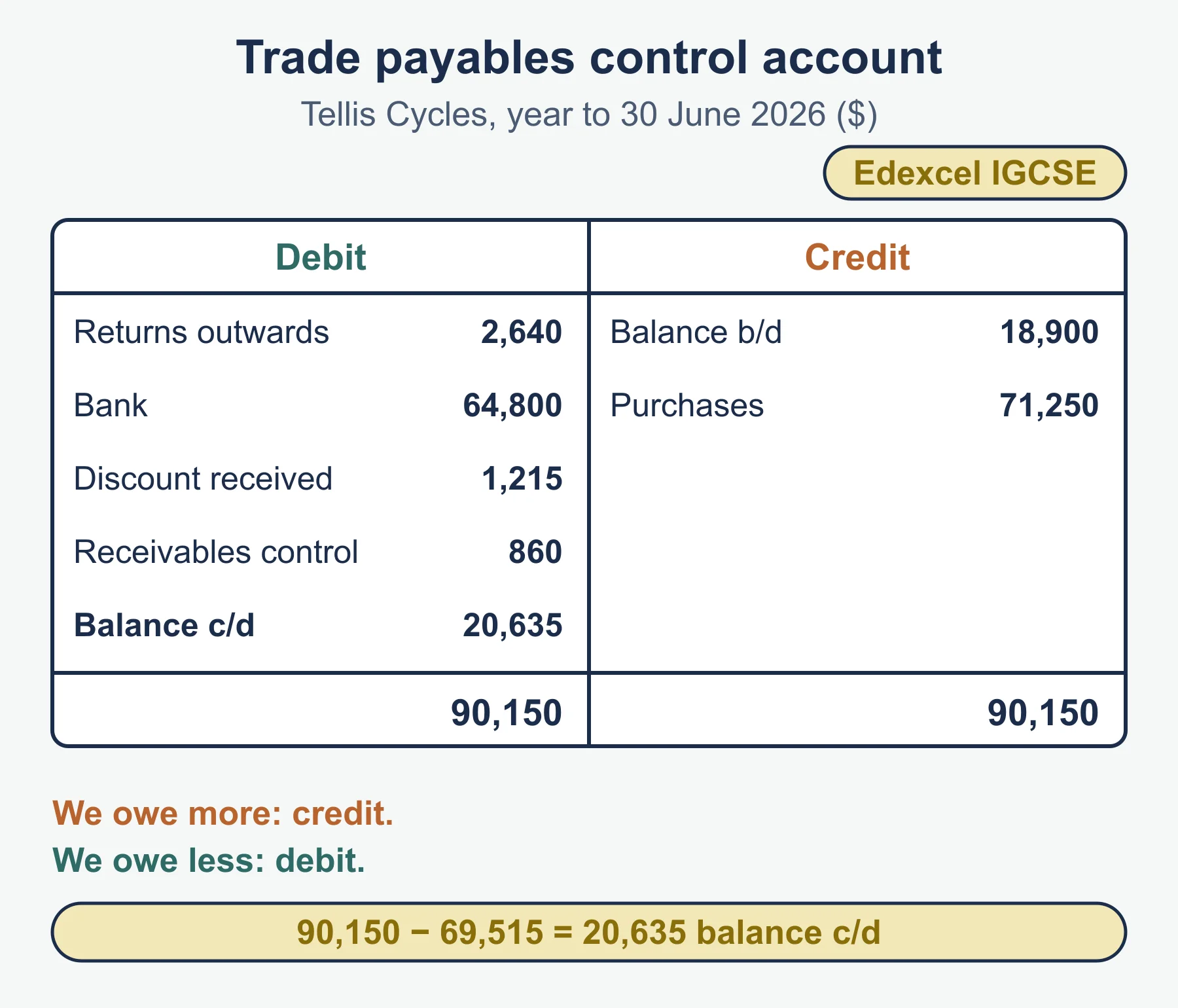
Rule: increases go on the credit side, decreases on the debit side.
| Debit | Credit |
|---|---|
| Returns outwards | Opening balance b/d |
| Payments to suppliers | Credit purchases |
| Discount received | |
| Contra (set-off) | |
| Closing balance c/d |
Worked reminder (same business): opening payables 9,400; credit purchases 40,250; returns outwards 1,380; payments 38,600; discount received 770; contra 500.
| Trade payables control account | |||
|---|---|---|---|
| Debit | Credit | ||
| Returns outwards | 1,380 | Balance b/d | 9,400 |
| Bank | 38,600 | Purchases | 40,250 |
| Discount received | 770 | ||
| Contra | 500 | ||
| Balance c/d | 8,400 | ||
| 49,650 | 49,650 |
Must-know distinctions
| Pair | Difference |
|---|---|
| Trial balance and financial statements | The trial balance checks the double entry. The statements show profit and financial position |
| Control account and ledger account | A control account totals a whole ledger. A ledger account is for one customer or supplier |
| Irrecoverable debt and provision | A written-off debt is a loss on a particular customer. A provision is an estimate and does not belong in the control account |
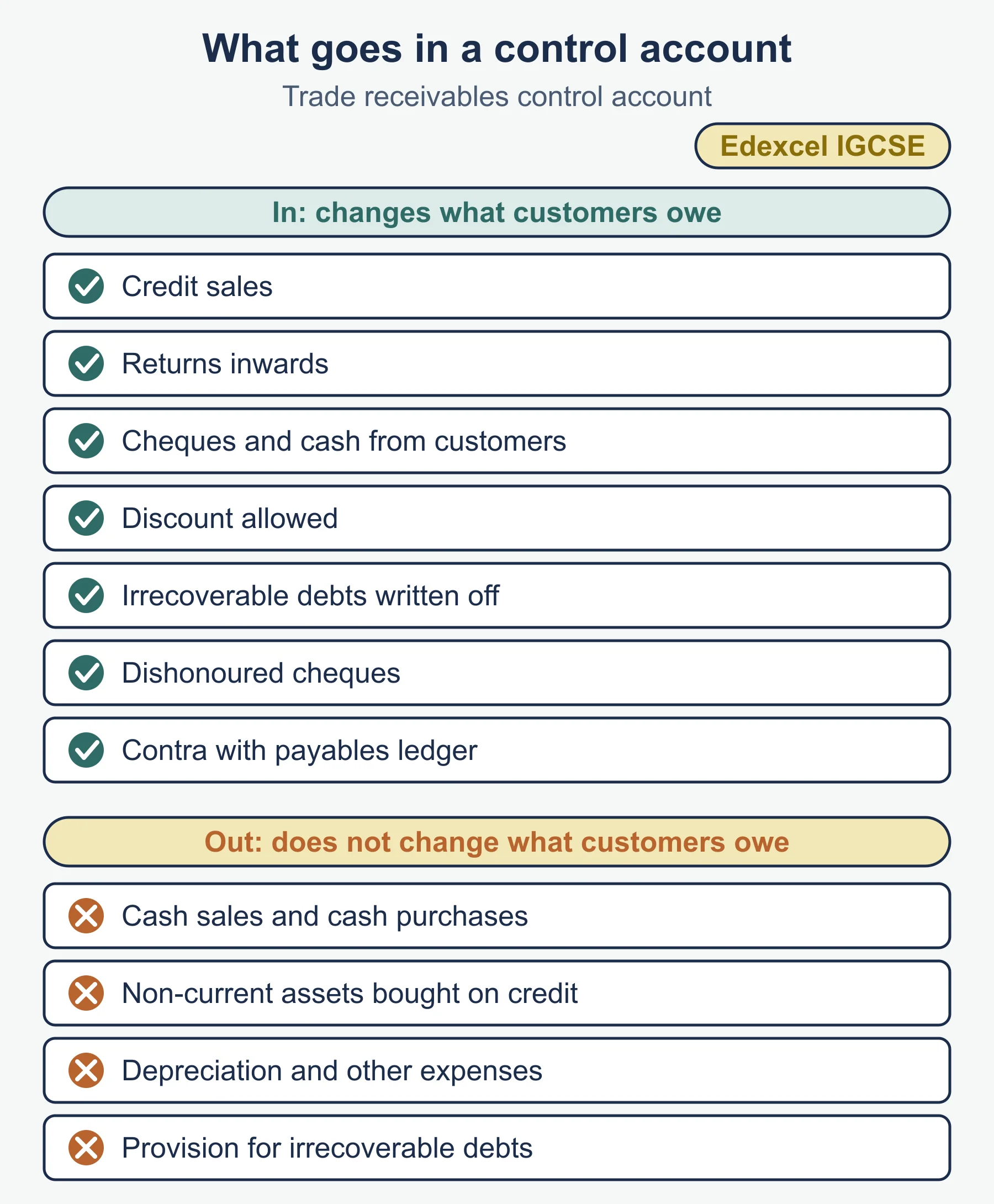
| Credit sales and cash sales | Receivables control takes credit sales only |
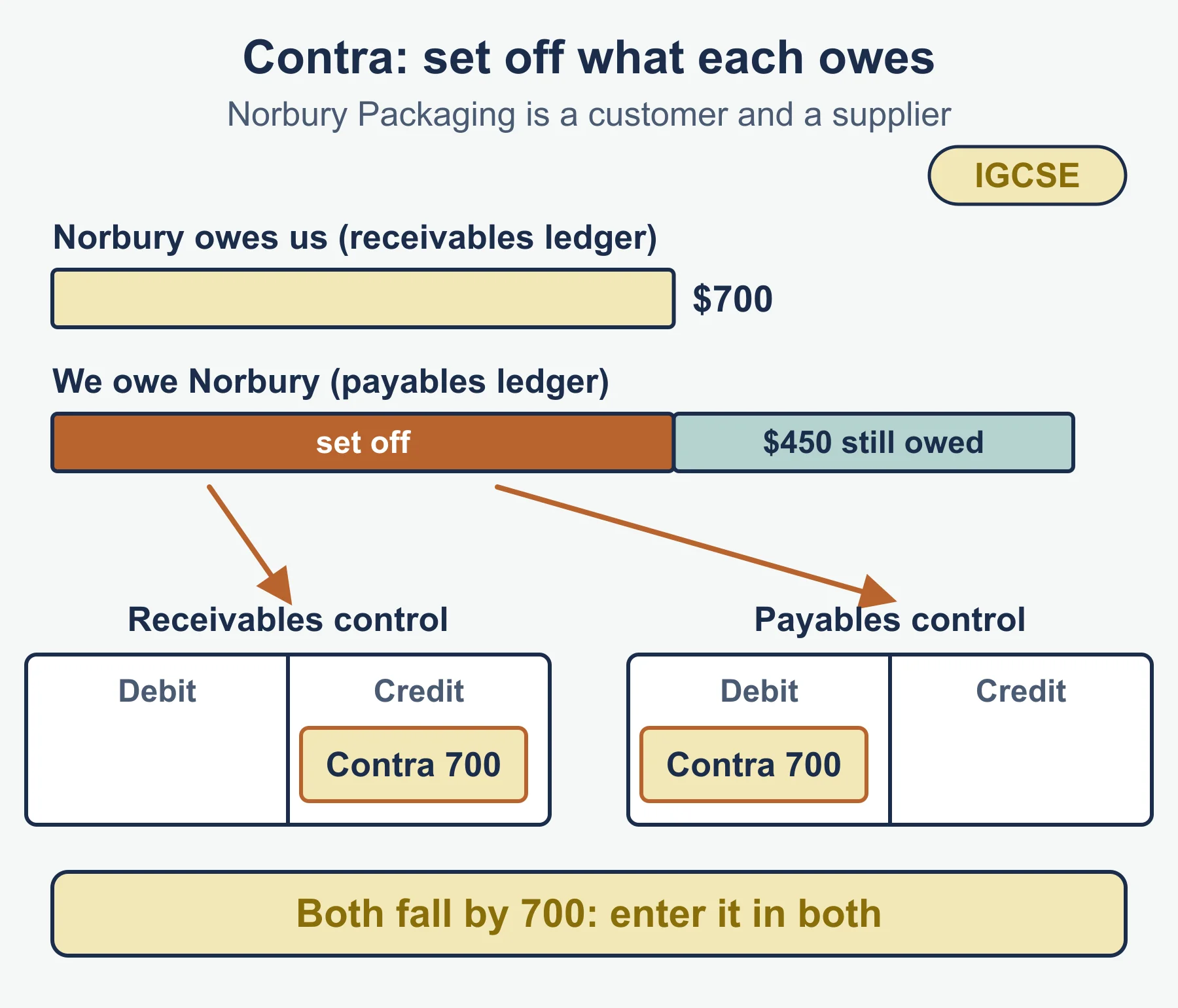
| Contra | Set-off between the two ledgers; it reduces both control accounts |
Quick self-test
- State two purposes of a trial balance.
- Say whether each balance is a debit or credit: drawings, returns outwards, bank overdraft, discount allowed.
- A trial balance has debit total 46,310 and credit total 46,130. State the difference and which total is larger.
- A repair bill of 150 is debited to the equipment account. Name the type of error and say if the trial balance would reveal it.
- A purchase on credit is debited as 600 to purchases and credited as 500 to the supplier. Would the trial balance reveal it, and by how much do the totals differ?
- Opening receivables 8,000; credit sales 30,000; returns inwards 1,000; cash and cheques received 28,000; irrecoverable debts 600. Find the closing balance of the receivables control account.
- Which side of the receivables control account shows a dishonoured cheque?
- Opening payables 6,500; credit purchases 22,400; returns outwards 800; payments 21,000; discount received 450. Find the closing balance of the payables control account.
- Name two items that do not appear in the receivables control account.
- The control account balance is 17,640 and the total of ledger balances is 17,460. Which is checked first, and why?
Answers
- To check the arithmetical accuracy of double entry; to supply the balances for the financial statements; to help locate errors.
- Drawings: debit. Returns outwards: credit. Bank overdraft: credit. Discount allowed: debit.
- The difference is 180, and the debit total is the larger.
- Error of principle (revenue expense treated as a non-current asset). No: the debit and credit amounts are equal.
- Yes, because the amounts on each side differ. The debit total is 100 larger than the credit total.
- 8,000 + 30,000 = 38,000. The deductions are 1,000 + 28,000 + 600 = 29,600. Closing balance: 8,400.
- The debit side, because the customer owes the money again.
- 6,500 + 22,400 = 28,900. The debits are 800 + 21,000 + 450 = 22,250. Closing balance (credit): 6,650.
- Any two of: cash sales, depreciation, provision for irrecoverable debts, purchases of non-current assets.
- The list of ledger balances, which is where the 180 difference most probably lies, because the control account is built from the totals of the books of original entry. Check for an omitted or mis-copied balance.
Where marks are usually lost
- Putting trade payables b/d on the debit side of the control account.
- Using total sales, rather than credit sales, in the receivables control account.
- Showing a dishonoured cheque on the credit side.
- Entering the provision for irrecoverable debts instead of debts written off.
- Missing the contra, or putting it on only one control account when both are asked for.
- Placing drawings, returns inwards or discount allowed in the credit column.
- Using closing inventory in a trial balance when the ledger shows the opening figure.
- Saying a trial balance proves the books are correct. It proves only that the debits and credits are equal.
- Listing a limitation without saying why the totals still agree.
Frequently asked questions
What are the limitations of a trial balance? It cannot reveal errors that leave the debit and credit totals equal, it shows balances at one date only, and it says nothing about whether the amounts are fair.
What are the purposes of control accounts? Control accounts check the accuracy of a ledger, narrow the search for errors to one ledger, help prevent fraud when different people keep the ledger and the control account, and give quick totals of trade receivables and trade payables.
Are drawings a debit or a credit in the trial balance? Drawings are a debit balance, along with assets, expenses, returns inwards and discount allowed. Putting drawings in the credit column is a common error.
Should total sales be used in the trade receivables control account? No. Only credit sales go in the trade receivables control account, because cash sales never pass through the receivables ledger.
Official syllabus
Pearson Edexcel International GCSE in Accounting (4AC1) specification, Issue 1, October 2016, published by Pearson Education Limited – Topic 3 Introduction to control processes, sections 3.1 Trial balance and 3.2 Control accounts.
Get free revision emails (optional)
Occasional emails with practice questions, worked explanations and links to free resources for the qualification and subjects you choose. No spam, and you can unsubscribe from any email. The free tools on this site never need an email.
Related resources
-
Study guides
Edexcel IGCSE Accounting: Correction of errors and bank reconciliation statements (4AC1)
Study guide to Edexcel IGCSE Accounting errors, correcting journals, the suspense account and bank reconciliation statements, with worked examples.
Accounting · Pearson Edexcel · IGCSE
Read guide -
Practice questions
Edexcel IGCSE Accounting: Correction of errors and bank reconciliation statements (4AC1) – Practice Questions
Twelve original Edexcel IGCSE Accounting questions on error types, correcting journals, suspense accounts and bank reconciliation statements, fully marked.
Accounting · Pearson Edexcel · IGCSE
Try questions -
Revision notes
Edexcel IGCSE Accounting: Correction of errors and bank reconciliation statements (4AC1) – Revision Notes
Condensed Edexcel IGCSE Accounting revision notes on error types, correcting journals, suspense accounts and bank reconciliation, with a self-test.
Accounting · Pearson Edexcel · IGCSE
Revise topic
Related articles
-
teaching
A Level tuition in Dubai: Cambridge or Pearson Edexcel International A Level?
Schools in Dubai and Abu Dhabi teach either Cambridge International AS & A Level or Pearson Edexcel International A Level. How the two are structured, why it matters for tuition, and how online classes from Lahore work.
9 October 2026
-
curriculum guides
Choosing subjects at IGCSE and A Level
How subject choices at 14 and 16 affect university options later, and how to keep pathways open without overloading a timetable.
28 July 2026
Studying this with a teacher
Working through Accounting IGCSE?
This page is free and stays free. If you would rather be taught it, Marlbridge runs Accounting classes one-to-one and in small groups of up to 15, online in your own time zone. The first trial class is free. WhatsApp replies within an hour (8am–11pm Pakistan time, every day); email the same day.
Pearson Edexcel Accounting teachers at Marlbridge

