
Revision Notes
Edexcel IGCSE Accounting: Correction of errors and bank reconciliation statements (4AC1) – Revision Notes
Condensed Edexcel IGCSE Accounting revision notes on error types, correcting journals, suspense accounts and bank reconciliation, with a self-test.
- Subject
- Accounting
- Level
- IGCSE
- Topic
- Introduction to control processes
- Author
- Marlbridge Academic Team
- Updated
- Reviewed by
- Javaid Iqbal Sabri (what this means)
Aligned to Pearson Edexcel IGCSE Accounting (4AC1), Issue 1, October 2016. Official specification .
Syllabus page (what it covers and how it is assessed): Pearson Edexcel IGCSE Accounting.
Syllabus points this page covers
4AC1
- 3 Introduction to control processes (whole topic)
- 3.3 Correction of errors
- 3.4 Bank reconciliation statements
Found an error? Report a correction.
Want a teacher for this? Marlbridge teaches Accounting online. Request a free trial class.
These notes condense sections 3.3 Correction of errors and 3.4 Bank reconciliation statements of Topic 3, Introduction to control processes, in the Pearson Edexcel International GCSE in Accounting (4AC1) specification, Issue 1 (October 2016). The specification does not split them into tiers. For full explanations and worked examples, use the study guide. All amounts are in dollars.
Links: Edexcel IGCSE Accounting hub, printable checklist and free diagnostics. For exam-style questions, use the practice questions.
3.3 a: errors and the trial balance
The specification does not name error types. The names are common labels, so also describe the error in words.
| Does the trial balance still agree? | Error |
|---|---|
| Yes | Omission, commission, principle, original entry, compensating, complete reversal |
| No | One-sided entry, unequal amounts, both entries on one side, addition error, wrong balance carried, balance copied wrongly |
Memory hook: if a debit and a credit of the same amount were posted, the trial balance agrees. If the debit and credit totals were disturbed, it does not.
A balanced trial balance checks arithmetic only. It cannot show that entries went to the right accounts, in the right class, or at the right figure.
Definitions in one line each
- Omission: the transaction was never recorded.
- Commission: the wrong account of the right type.
- Principle: the wrong class of account, such as capital as revenue expenditure.
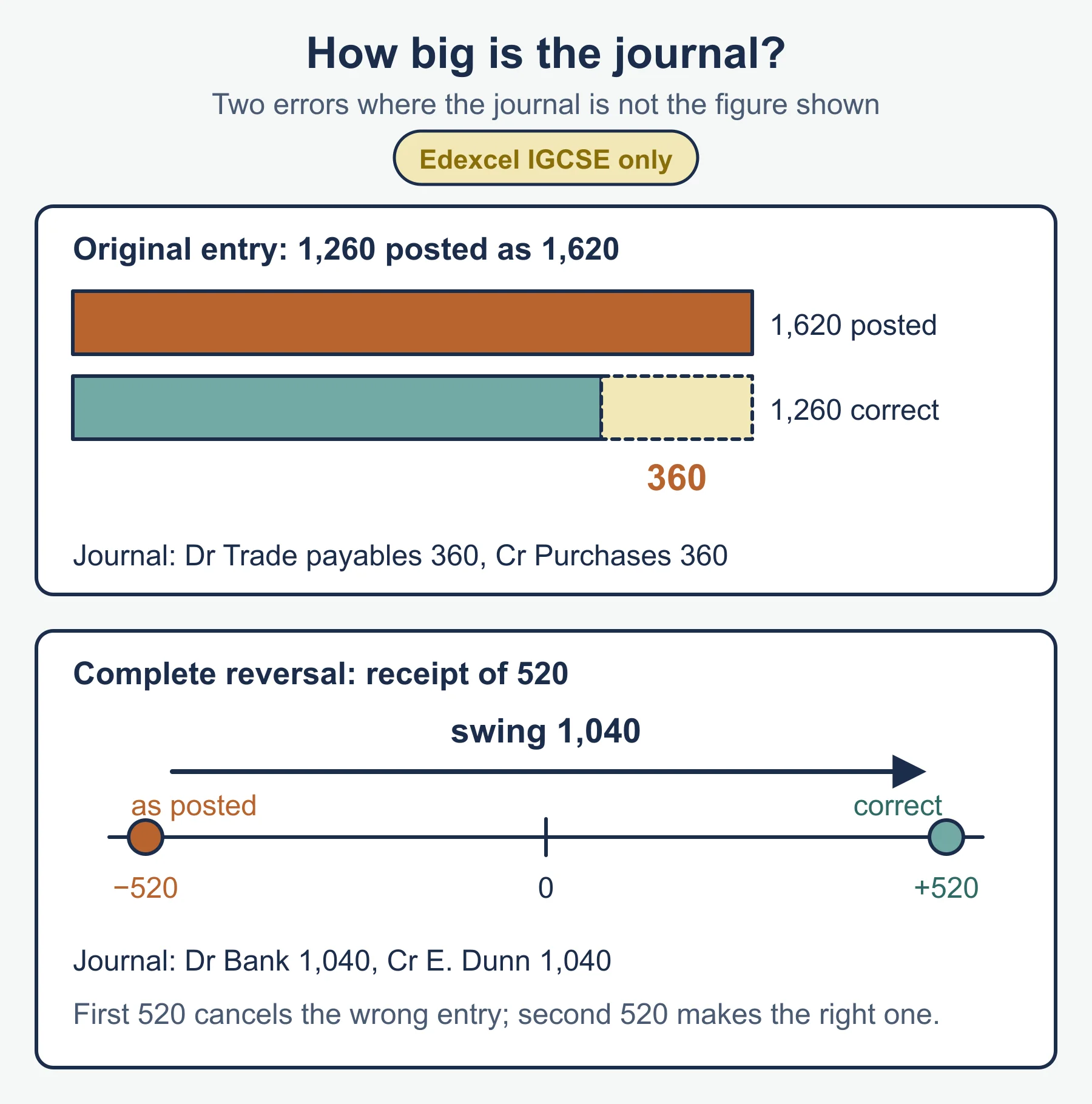
- Original entry: the wrong figure in both entries.
- Compensating: two errors that cancel out.
- Complete reversal: the right accounts on the wrong sides.
One quick example of each. Omission: a cash sale is never entered. Commission: telephone costs debited to the postage account. Principle: a new computer debited to repairs. Original entry: 530 entered as 350 in both accounts. Compensating: purchases overcast by 200 and sales overcast by 200. Complete reversal: a payment to a supplier shown as a receipt.
3.3 b: journal entries
Method in steps:
- Write down the wrong entry: the accounts debited and credited, and the amount.
- State what should have happened.
- Write the journal that moves the difference: Dr account, Cr account, amount, narrative.
- Never cross out the original. Correct it with a new entry.
| Type of error | Size of the correction |
|---|---|
| Omission | The full amount, both accounts |
| Commission | The amount moves from the wrong account to the right one |
| Principle | The amount moves from the wrong class to the right one |
| Original entry | Only the difference between the right and wrong figures |
| Complete reversal | Twice the amount |
| One-sided entry | The missing side, with suspense as the other account |
Worked reminder. Shop fittings costing 2,300 were debited to repairs. This is an error of principle. Dr Shop fittings 2,300, Cr Repairs 2,300. Narrative: fittings are capital expenditure.
3.3 c: suspense account
Use it when the trial balance does not agree, until the errors are found.
| Trial balance | Suspense entry | Side |
|---|---|---|
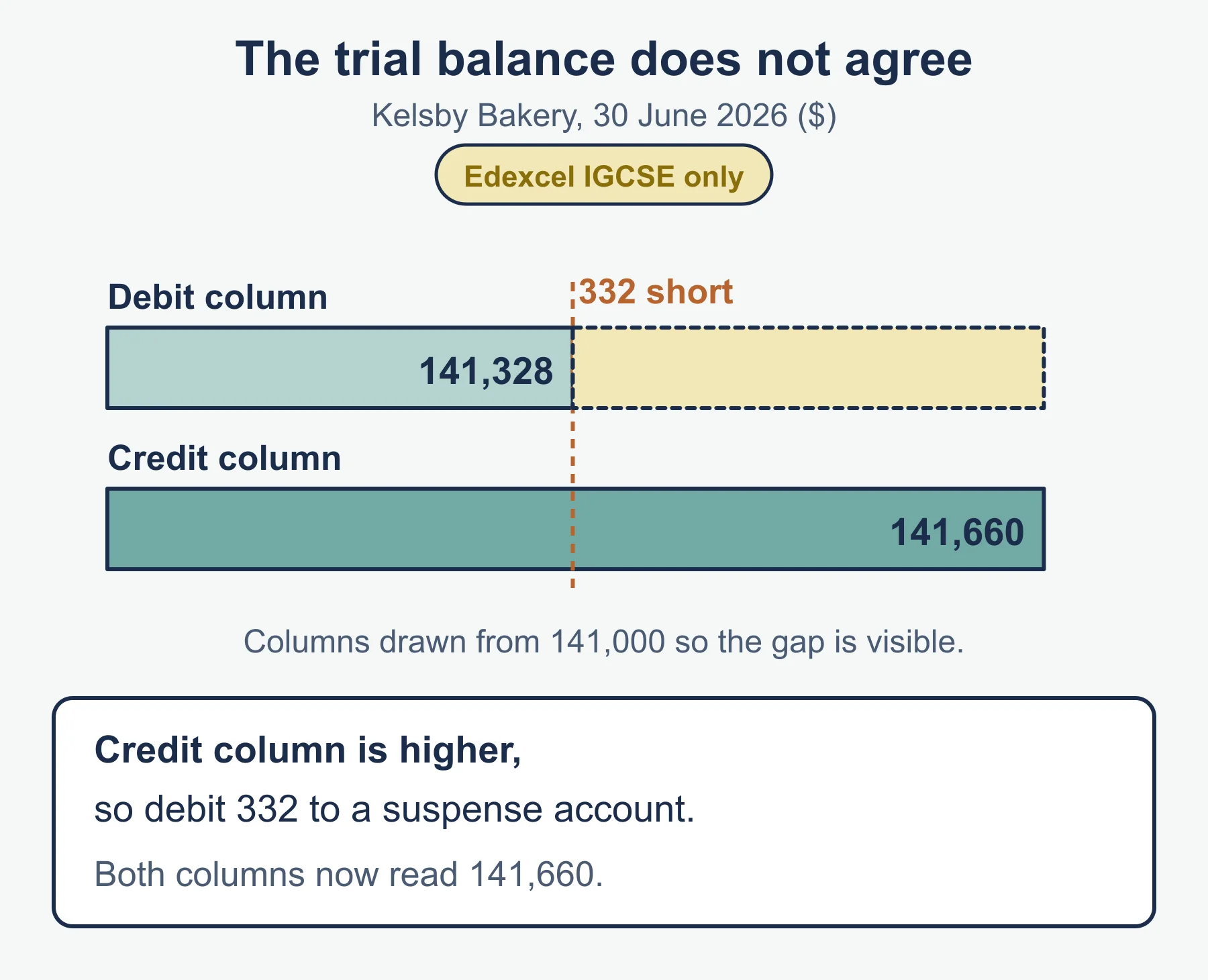
| Debit total higher | Difference | Credit |
| Credit total higher | Difference | Debit |
Method in steps:
- Total both columns and find the difference.
- Open a suspense account and enter the difference on the correct side.
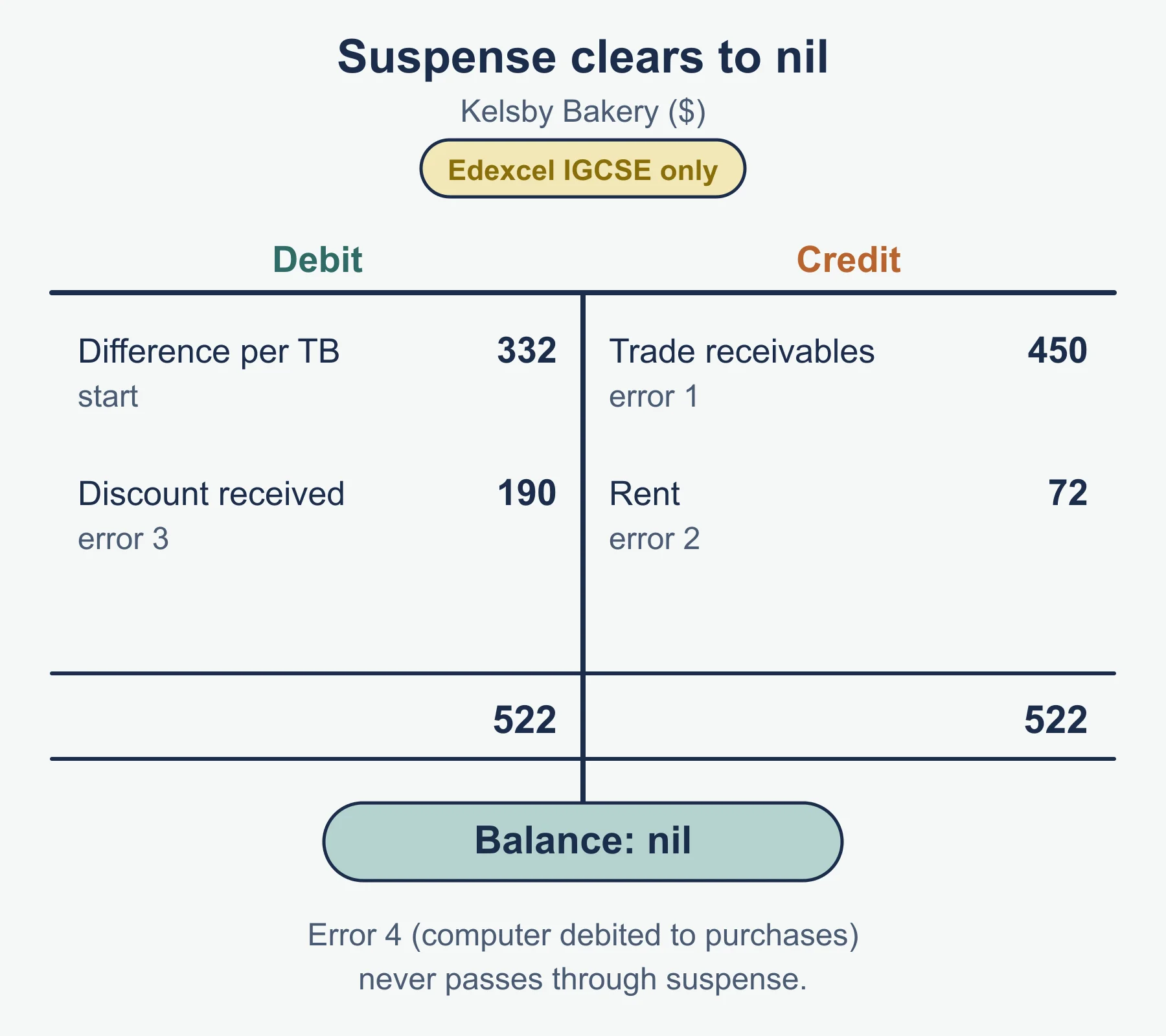
- For each error that affected the balancing, write a journal with suspense on one side.
- Post the journals to suspense. Errors that did not affect the balancing never go through it.
- Check the account clears to nil.
Worked reminder. Trelowen Garage’s debit column totals 86,420 and its credit column 85,960. The debit column is 460 higher, so suspense is credited with 460. It is found that a purchases return of 230 was posted to the debit side of the purchases returns account. The account is wrong by twice 230, so Dr Suspense 460, Cr Purchases returns 460. Suspense then has 460 on each side and clears to nil.
When a suspense account does not clear to nil, look for another error. If a transaction was left out entirely, suspense is not involved.
3.4 a: purpose of a bank reconciliation statement
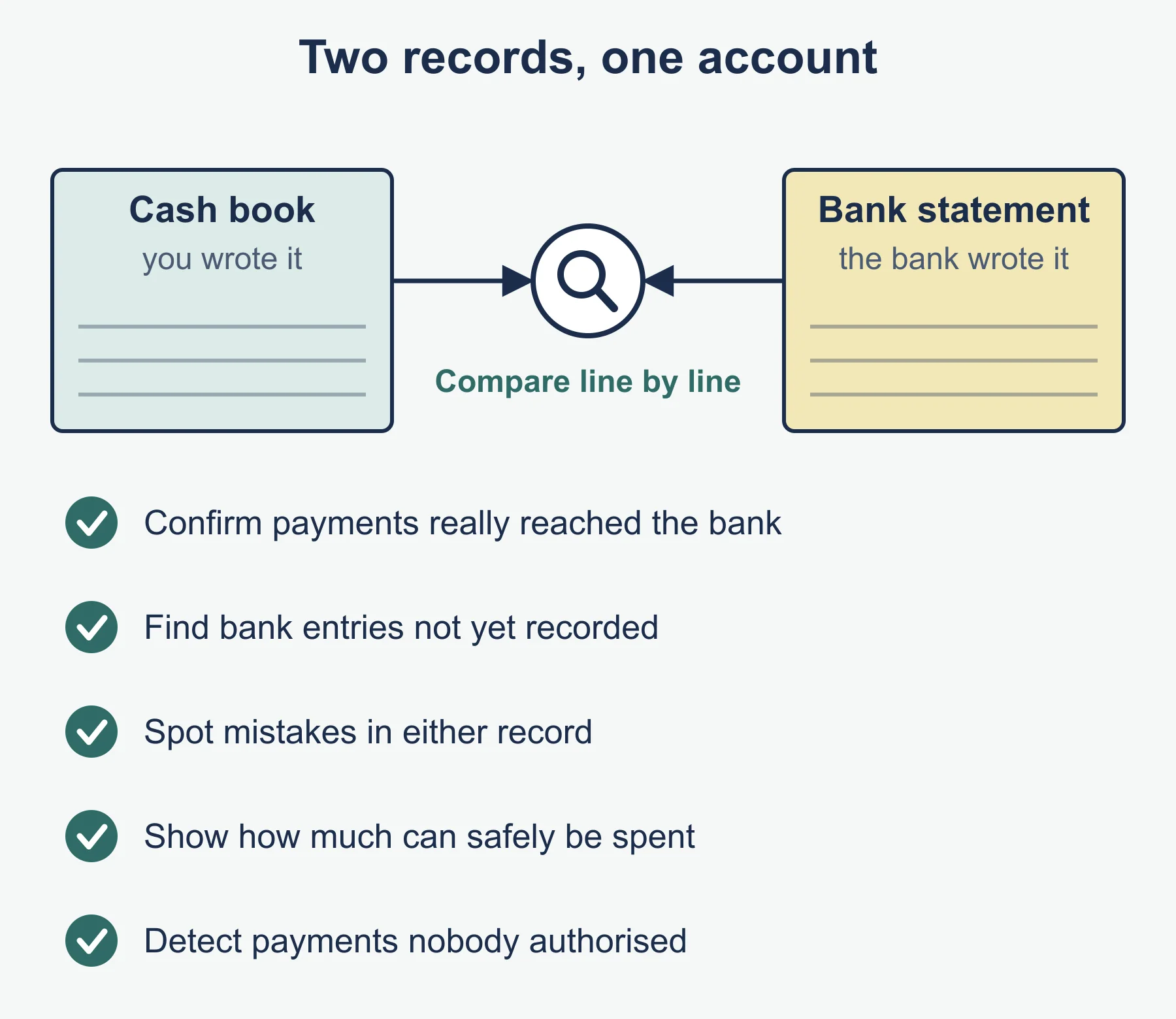
- To check that the cash book and the bank statement agree, apart from timing items.
- To find errors made by the business or the bank.
- To spot entries on the statement that are missing from the cash book.
- To help detect fraud and show the true available balance.
3.4 b: the process
- Compare the bank column of the cash book with the statement, ticking matched items.
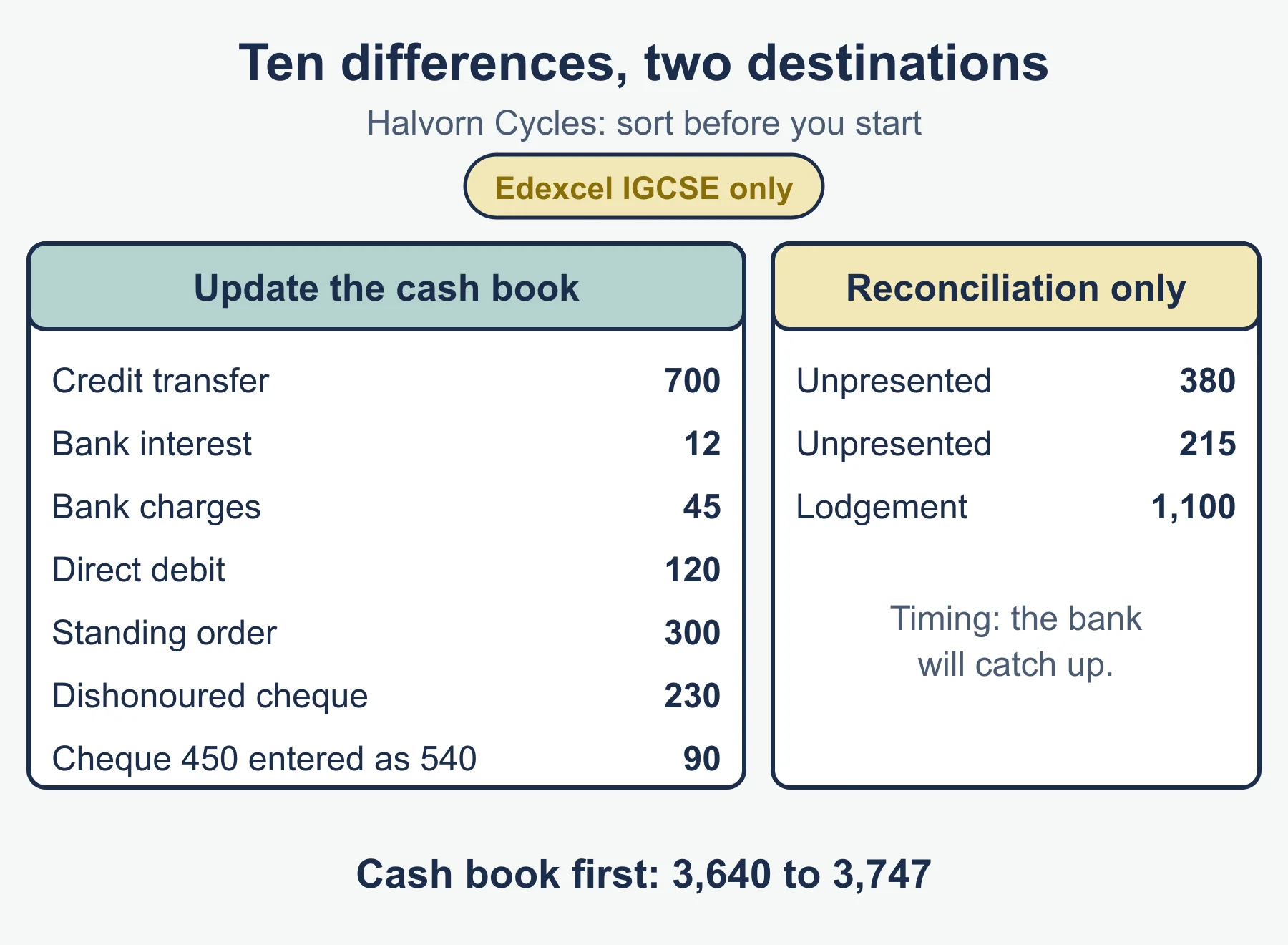
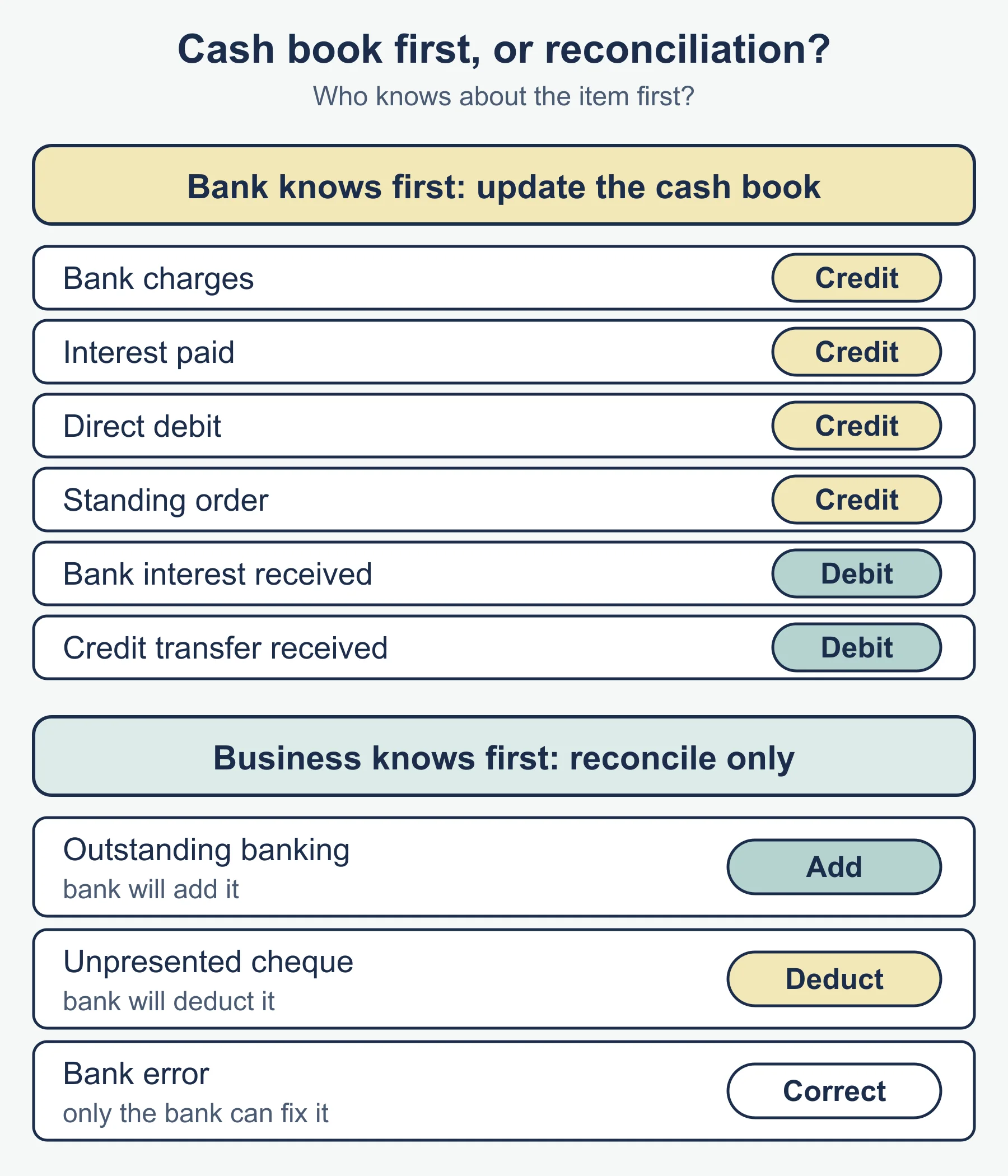
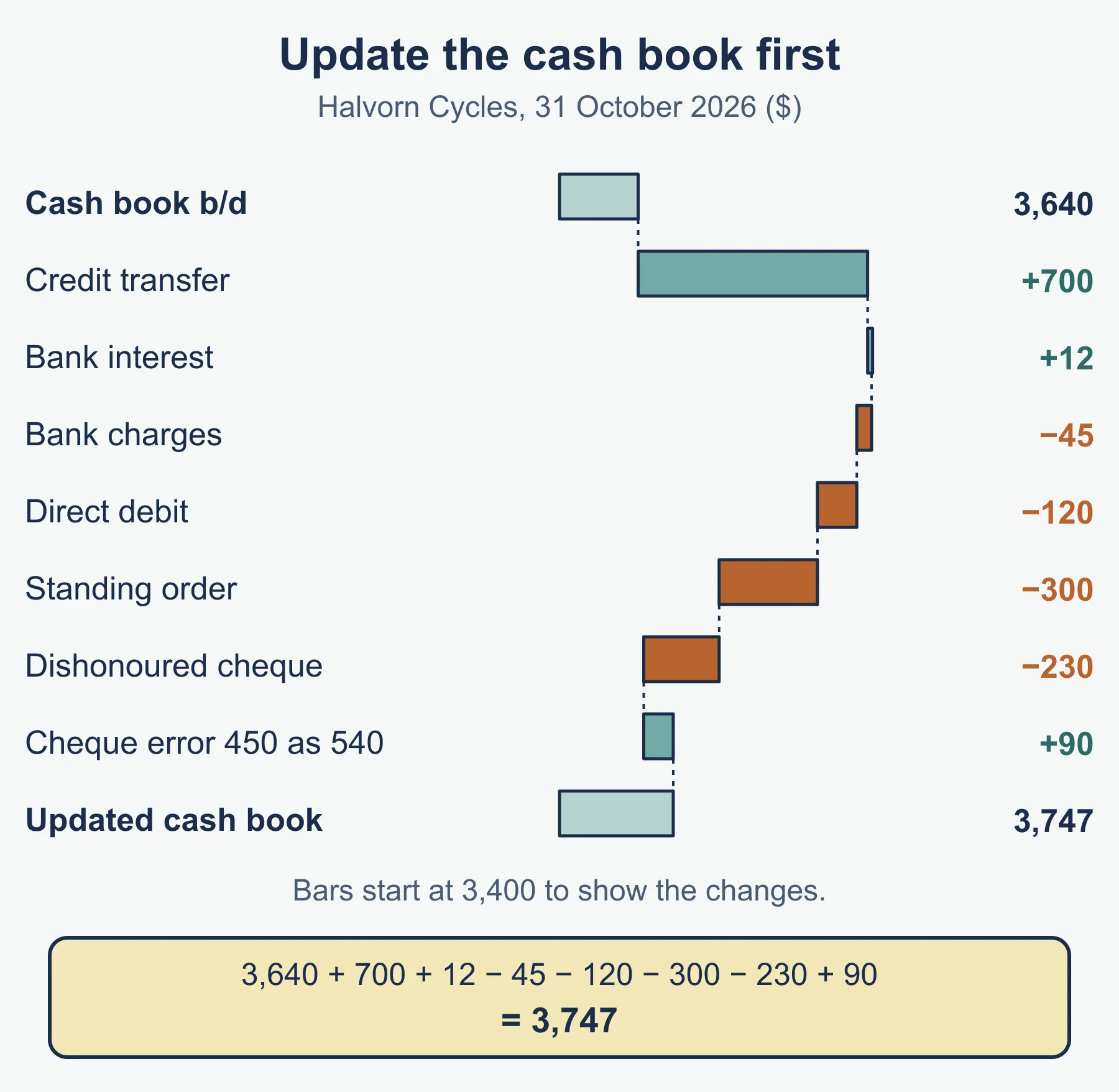
- Items on the statement but not in the cash book, or errors in the cash book, mean you update the cash book.
- Items in the cash book but not on the statement are timing items. They go on the reconciliation statement.
- A bank error also goes on the reconciliation statement. Tell the bank.
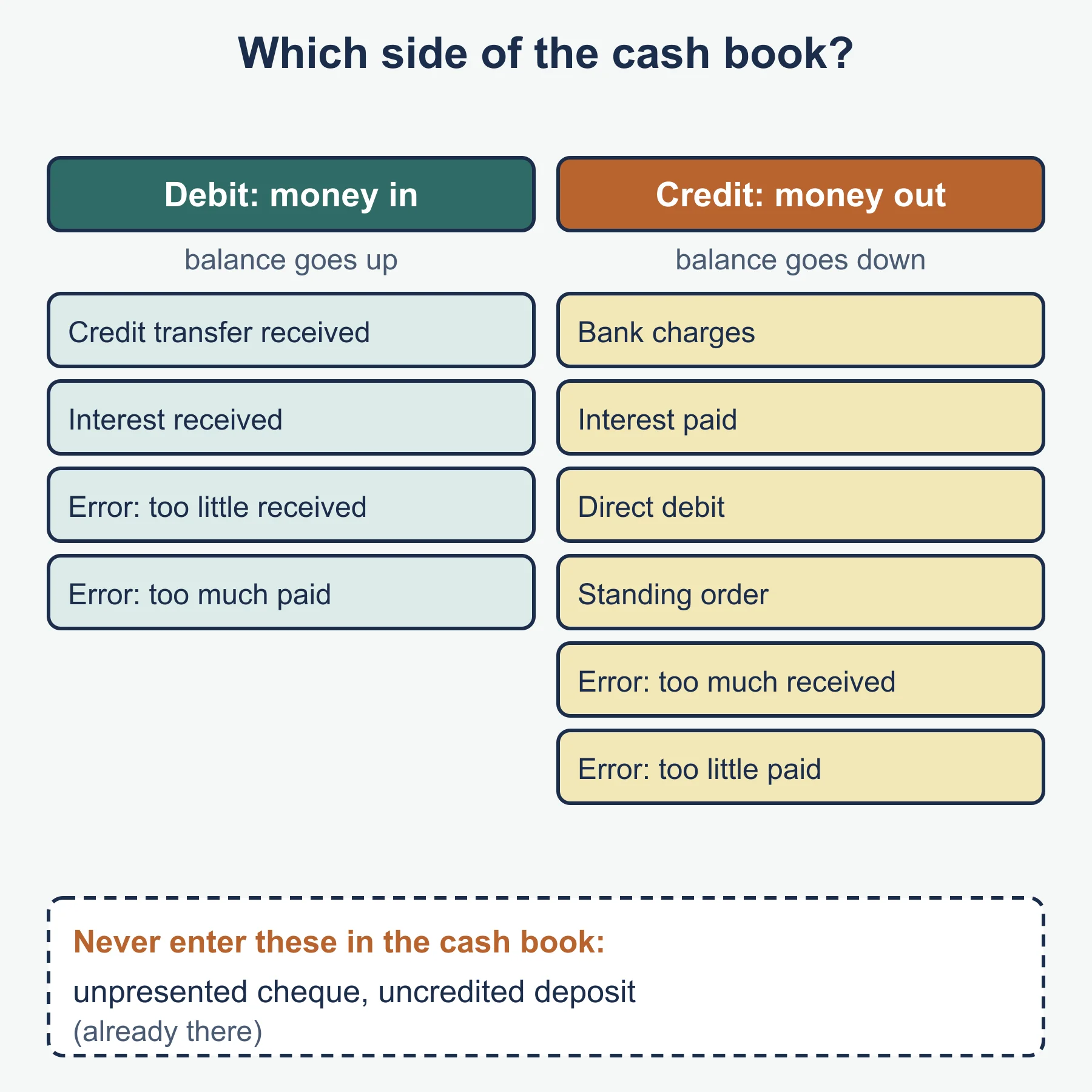
| Item | Where it goes | Effect |
|---|---|---|
| Bank charges | Cash book | Reduce balance |
| Bank interest received | Cash book | Increase balance |
| Direct debit or standing order | Cash book | Reduce balance |
| Credit transfer | Cash book | Increase balance |
| Dishonoured cheque from a customer | Cash book | Reduce balance |
| Cash book error | Cash book | Correct, either way |
| Unpresented cheque | Reconciliation | Add to cash book balance |
| Uncredited lodgement | Reconciliation | Deduct from cash book balance |
3.4 c: preparing the statement
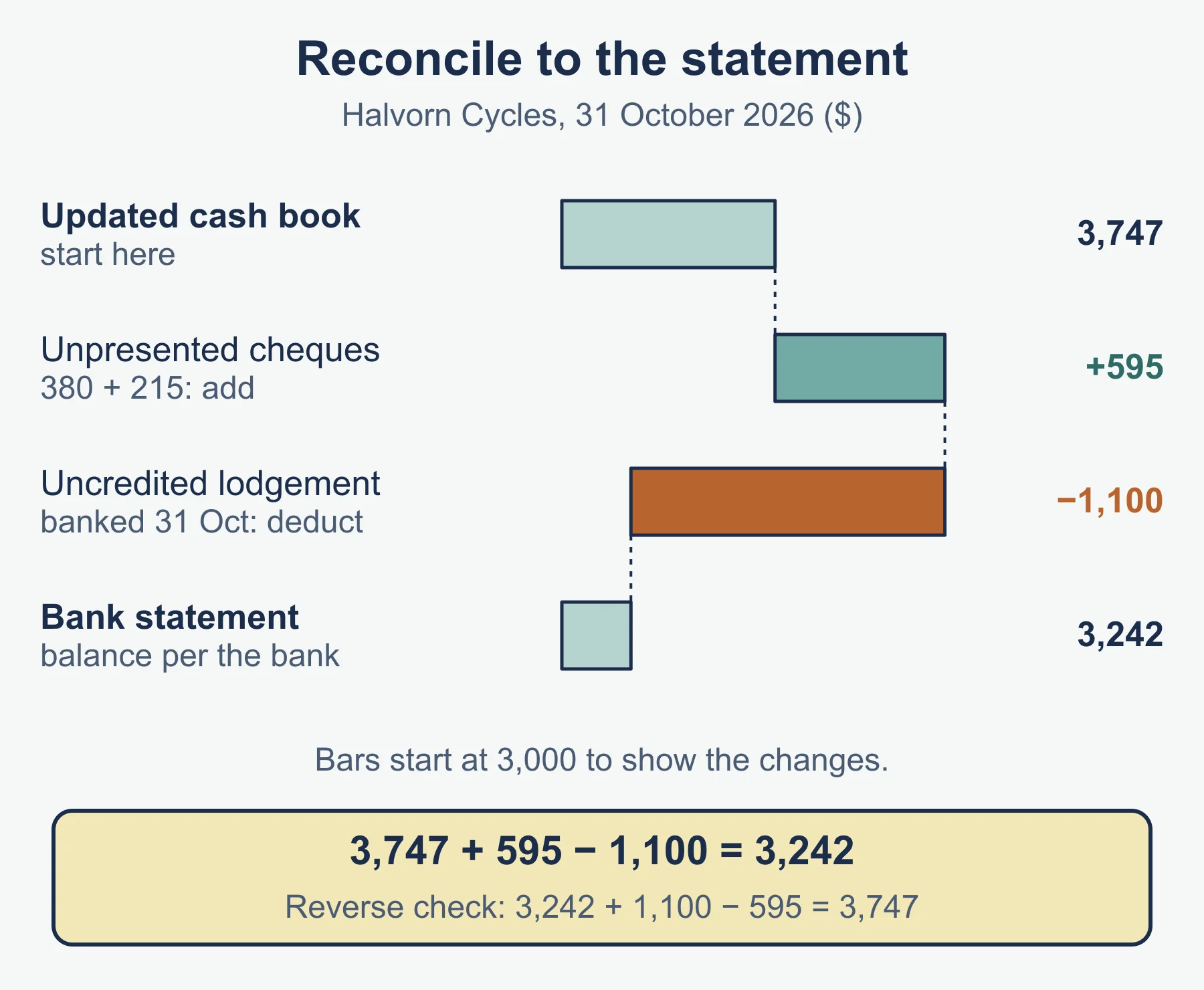
Layout when you start from the updated cash book:
Balance per updated cash book              X
Add:  unpresented cheques                  X
Less: uncredited lodgements               (X)
Balance per bank statement                 X
If you start from the statement, the signs reverse: add uncredited lodgements and deduct unpresented cheques to reach the cash book balance. Use the same layout every time.
Worked reminder. Wyndlow Florist’s cash book shows 2,950. A bank charge of 38 and a standing order of 150 are missing, so the updated balance is 2,950 − 38 − 150 = 2,762. Unpresented cheques are 410 and an uncredited lodgement is 640. Statement balance = 2,762 + 410 − 640 = 2,532.
Overdrawn accounts. An overdrawn cash book is a credit balance. Treat overdrafts as negatives. Suppose the updated cash book shows an overdraft of 1,025, unpresented cheques are 520 and an uncredited lodgement is 610. Then (1,025) + 520 − 610 = (1,115). The statement shows an overdraft of 1,115.
Quick check before you write the answer. Ask: is a statement item already in my cash book? If yes, it is a timing item or an error. If no, it is a cash book update. Ask this for every line on the statement and every line in the cash book, and tick each one as you go. An item you cannot match is the one that needs thought.
Must-know distinctions
- Unpresented cheque (you paid, bank not yet) versus uncredited lodgement (you banked, bank not yet).
- Cash book update (permanent record) versus reconciliation item (temporary timing).
- Suspense debit (credit column higher) versus suspense credit (debit column higher).
- Error of principle (wrong class) versus commission (wrong account, same class).
- Statement credit balance (bank owes you) versus cash book debit balance (same position).
Quick self-test
- State whether a complete reversal affects the trial balance.
- A trial balance has debits of 52,340 and credits of 51,880. Which side of suspense is used, and for how much?
- A sale of 870 was recorded as 780 in both accounts. Write the correcting journal.
- A payment of 640 to a supplier was debited to bank and credited to the supplier. Write the correcting journal.
- Discount allowed of 60 was credited to the discount allowed account instead of debited. Give the suspense effect and journal.
- Name the type of error where a motor car is debited to motor expenses.
- State two purposes of a bank reconciliation statement.
- A cash book balance of 4,100 omits bank charges of 36 and a credit transfer of 250. Find the updated balance.
- Classify each as a cash book update or a reconciliation item: direct debit, unpresented cheque, uncredited lodgement, credit transfer.
- Updated cash book 3,300, unpresented cheques 270, uncredited lodgement 480. Find the statement balance.
Answers
- No. Both entries use the right amount, only on the wrong sides.
- The debit column is 460 higher. Credit suspense with 460.
- Dr Trade receivables 90, Cr Sales 90.
- Dr Supplier 1,280, Cr Bank 1,280.
- The credit total is 120 higher, so debit suspense 120. Dr Discount allowed 120, Cr Suspense 120.
- Error of principle.
- Any two: check agreement of the records, find errors, find unrecorded items, detect fraud.
- 4,100 − 36 + 250 = 4,314.
- Cash book update: direct debit, credit transfer. Reconciliation item: unpresented cheque, uncredited lodgement.
- 3,300 + 270 − 480 = 3,090.
Where marks are usually lost
- Writing the suspense difference on the wrong side.
- Using the single amount to correct a complete reversal, not twice the amount.
- Correcting an original entry error with the full figure, not the difference.
- Using suspense for an error that does not affect the trial balance.
- Giving a journal with no narrative, or with an unclear account name.
- Putting an unpresented cheque in the cash book instead of the reconciliation statement.
- Adding charges to the cash book balance instead of deducting them.
- Mixing up the signs for unpresented cheques and uncredited lodgements.
- Treating an overdraft as a positive balance.
- Leaving the final line unlabelled or the date off.
Frequently asked questions
What is the difference between an error of commission and an error of principle? An error of commission posts an entry to the wrong account of the right type, such as telephone costs to postage. An error of principle posts it to the wrong class of account, such as a new computer debited to repairs.
Which side of the suspense account does the difference go on? Put the difference on the side of the trial balance that is lower. If the credit total is higher, the difference is debited to suspense; if the debit total is higher, it is credited.
How do you correct a complete reversal of entries? A complete reversal posts the right accounts on the wrong sides, so the correcting journal uses twice the amount: once to cancel the wrong entry and once to make the right one.
What is the purpose of a bank reconciliation statement? It checks the accuracy of the business’s and the bank’s records, identifies items missing from the cash book, helps detect fraud or unauthorised payments, and shows the true bank balance once timing differences are understood.
Official syllabus
Pearson Edexcel International GCSE in Accounting (4AC1) specification, Issue 1, October 2016, published by Pearson Education Limited – Topic 3 Introduction to control processes, sections 3 Correction of errors and 4 Bank reconciliation statements, numbered 3.3 and 3.4 here.
Get free revision emails (optional)
Occasional emails with practice questions, worked explanations and links to free resources for the qualification and subjects you choose. No spam, and you can unsubscribe from any email. The free tools on this site never need an email.
Related resources
-
Study guides
Edexcel IGCSE Accounting: Trial balance and control accounts (4AC1)
Study guide to the trial balance and to trade receivables and trade payables control accounts for Pearson Edexcel International GCSE Accounting 4AC1.
Accounting · Pearson Edexcel · IGCSE
Read guide -
Practice questions
Edexcel IGCSE Accounting: Trial balance and control accounts (4AC1) – Practice Questions
Original 4AC1 practice questions with worked answers on preparing a trial balance and trade receivables and payables control accounts.
Accounting · Pearson Edexcel · IGCSE
Try questions -
Revision notes
Edexcel IGCSE Accounting: Trial balance and control accounts (4AC1) – Revision Notes
Condensed 4AC1 revision notes on the trial balance, its limitations and trade receivables and payables control accounts, with a self-test and answers.
Accounting · Pearson Edexcel · IGCSE
Revise topic
Related articles
-
teaching
A Level tuition in Dubai: Cambridge or Pearson Edexcel International A Level?
Schools in Dubai and Abu Dhabi teach either Cambridge International AS & A Level or Pearson Edexcel International A Level. How the two are structured, why it matters for tuition, and how online classes from Lahore work.
9 October 2026
-
curriculum guides
Choosing subjects at IGCSE and A Level
How subject choices at 14 and 16 affect university options later, and how to keep pathways open without overloading a timetable.
28 July 2026
Studying this with a teacher
Working through Accounting IGCSE?
This page is free and stays free. If you would rather be taught it, Marlbridge runs Accounting classes one-to-one and in small groups of up to 15, online in your own time zone. The first trial class is free. WhatsApp replies within an hour (8am–11pm Pakistan time, every day); email the same day.
Pearson Edexcel Accounting teachers at Marlbridge

