
Study Guides
Edexcel IGCSE Business: Business objectives and types of organisation (4BS1)
Study guide to business objectives, why they change, and the types of business organisation for Pearson Edexcel International GCSE Business.
- Subject
- Business
- Level
- IGCSE
- Topic
- Business activity and influences on business
- Author
- Marlbridge Academic Team
- Updated
- Reviewed by
- Asif Iqbal (what this means)
Aligned to Pearson Edexcel IGCSE Business (4BS1), Issue 2, February 2026. Official specification .
Syllabus page (what it covers and how it is assessed): Pearson Edexcel IGCSE Business.
Syllabus points this page covers
4BS1
- 1 Business activity and influences on business (whole topic)
- 1.1 Business objectives
- 1.2 Types of organisations
Found an error? Report a correction.
Want a teacher for this? Marlbridge teaches Business online. Request a free trial class.
This guide follows the Pearson Edexcel International GCSE in Business (4BS1) specification, Issue 2, February 2026. It covers Topic 1, “Business activity and influences on business”, sections 1.1 (Business objectives) and 1.2 (Types of organisations). The specification sets a single tier of entry, and Paper 1 (small businesses, up to 49 employees) and Paper 2 (large businesses, more than 250 employees) can each draw on the whole content, so expect these ideas to turn up inside any scenario.
Course links: the 4BS1 Business hub, the printable checklist and the free diagnostics. Companion pages: the revision notes and the practice questions.
What the specification asks for
| Point | You must know | Where in this guide |
|---|---|---|
| 1.1.1 | Financial aims and objectives (survival, profit, sales, market share, financial security) and non-financial ones (social objectives, personal satisfaction, challenge, independence and control) | Section 1 |
| 1.1.2 | Why aims and objectives change as businesses evolve: market conditions, technology, performance, legislation, internal reasons | Section 2 |
| 1.2.1 | Sole trader, partnerships, limited companies (private and public), public corporations | Section 3 |
| 1.2.2 (headed “Characteristics relating to size”) | Risk, ownership and limited liability; public corporations (reasons for and against public ownership); ownership, control, sources of finance, use of profits, stakeholders and shareholders; appropriateness of different forms of ownership | Sections 4 to 6 |
| 1.2.3 | Franchises, social enterprises, multinationals | Section 7 |
All business names and figures below are invented, and amounts are in dollars.
1. Business aims and objectives (1.1.1)
An aim is the general direction a business wants to go in. An objective is a more specific target that helps it get there, ideally with a number and a date. The specification does not define the two words, so treat this as the standard distinction and use it only when a question asks.
Financial aims and objectives are about money:
- Survival: staying in business. It matters most for a new business, or one in a recession, because nothing else is possible without it.
- Profit: revenue minus total costs. A profit objective might be “raise profit to 50,000 this year”.
- Sales: selling more units or earning more revenue. It can come at the cost of profit if prices are cut to win it.
- Market share: the business’s sales as a percentage of total sales in the market (standard form, not given in the specification).
- Financial security: a stable income and reserves, so the business can cope with a bad year and the owner can plan ahead.
Non-financial aims and objectives are about things other than money:
- Social objectives: benefiting the community or the environment, for example employing local people or cutting waste.
- Personal satisfaction: enjoyment of the work, for example a baker who loves baking.
- Challenge: wanting to test yourself, for example launching a product nobody has tried.
- Independence and control: being your own boss and making your own decisions, even if that means a smaller business.
Worked example: market share and profit
The specification names these objectives but gives no formulas, so the market share, profit and percentage formulas used here are the standard forms from general business knowledge.
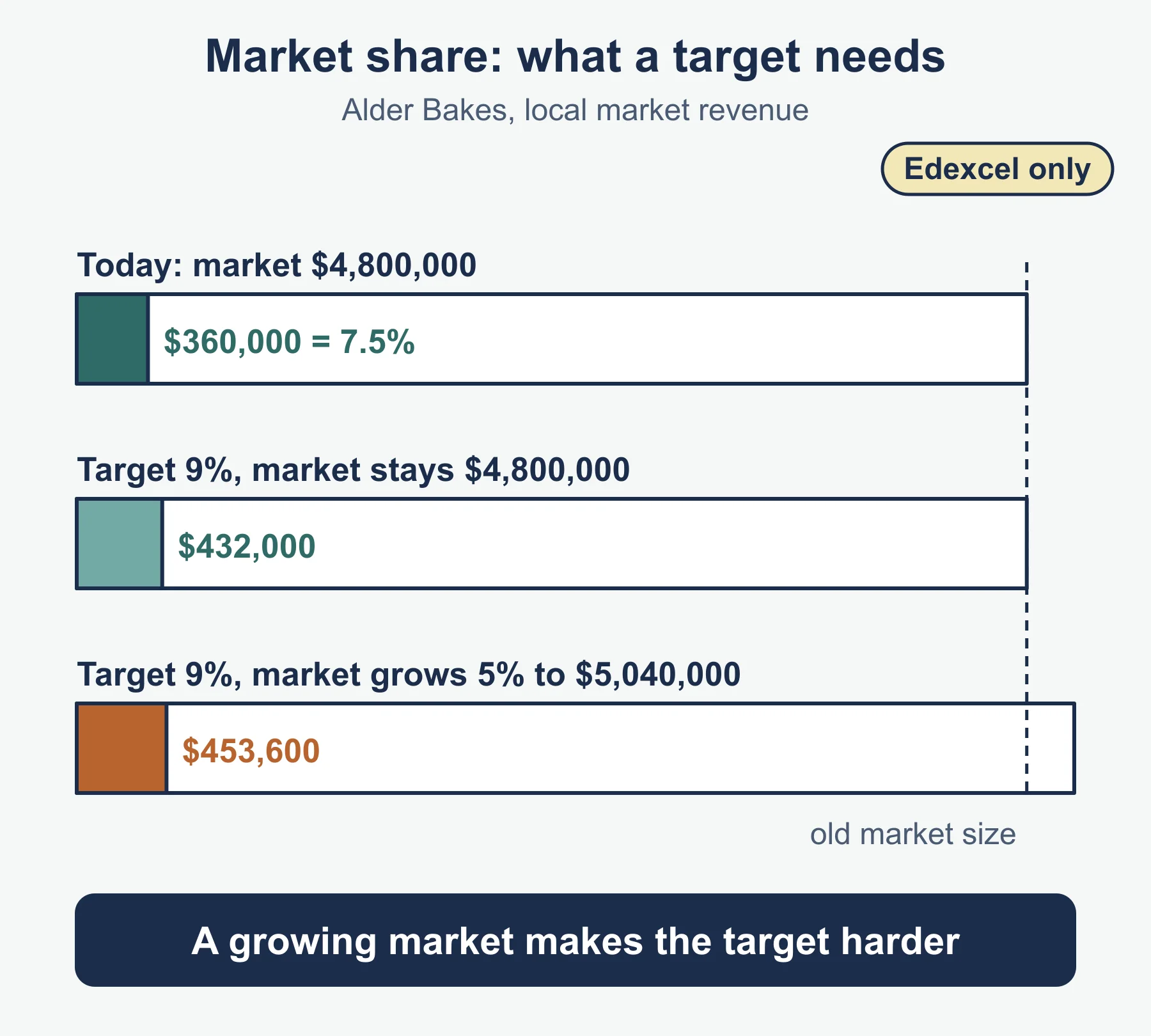
Alder Bakes sells bread and cakes in a town. Last year the whole local market was worth 4,800,000 in revenue. Alder Bakes had revenue of 360,000 and total costs of 318,000.
- Market share = business revenue ÷ market revenue × 100 = 360,000 ÷ 4,800,000 × 100 = 7.5%.
- Profit = revenue − total costs = 360,000 − 318,000 = 42,000.
- Net profit margin = profit ÷ revenue × 100 = 42,000 ÷ 360,000 × 100 = 11.67% (to 2 decimal places).
The owner sets an objective of 9% market share next year. If the market stays at 4,800,000, that needs revenue of 0.09 × 4,800,000 = 432,000. If the market grows 5% to 5,040,000, the same 9% needs 453,600, so a growing market makes the target harder.
Objectives can pull against each other: cutting prices to raise sales and market share may lower profit. A good answer says which objective matters more in the situation given and why.
2. Why objectives change (1.1.2)
Objectives are not fixed. The specification lists five reasons.
| Reason | How it can change objectives | Example |
|---|---|---|
| Market conditions | Demand, competition or the economy shift | In a downturn a business moves from growth to survival |
| Technology | New methods open or close opportunities | A shop adds online selling and sets a target for online revenue |
| Performance | Results beat or miss the old targets | Profit well above target, so a higher share target follows |
| Legislation | New laws change what a business must or may do | A new rule on packaging leads to an objective to redesign it |
| Internal reasons | Changes inside the business | A new owner wants less growth and more time with family |
Link each reason to a consequence. “Technology changes” is a weak point. “A competitor launches an app, so the business sets a new sales objective for its own app” is a developed one. For legislation, describe the effect in general terms; you are not asked for the detail of particular laws.
3. The main types of business ownership (1.2.1)
- Sole trader: one person owns the business. There may still be employees.
- Partnership: two or more people own the business together and share its profits.
- Private limited company: a company owned by shareholders whose shares are not offered to the general public.
- Public limited company: a company whose shares can be bought and sold by the general public.
- Public corporation: a business owned by the state (government) on behalf of the public.
These short descriptions are standard general knowledge; the specification lists the types without defining them. A limited company is a separate legal body from its owners. That is why its owners can have limited liability.
4. Risk, ownership and limited liability (1.2.2)
Risk is the chance of losing money. Every owner takes some, because a business may make a loss.
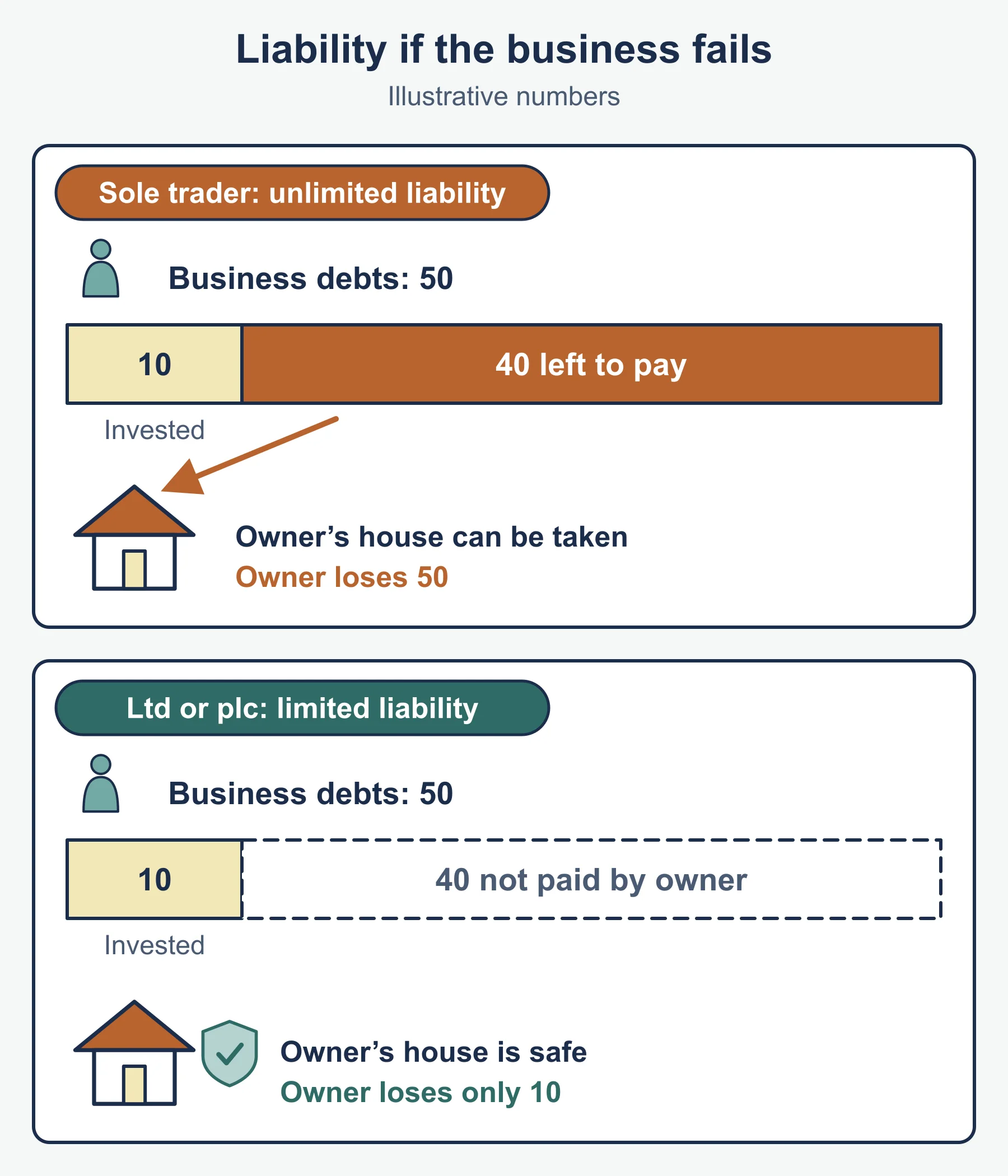
Unlimited liability means the owner is personally responsible for all the business’s debts, down to personal property. Sole traders and partners have it. Limited liability means shareholders can lose no more than the money they put into the company. Their personal belongings are not at risk for the company’s debts.
Worked example: liability
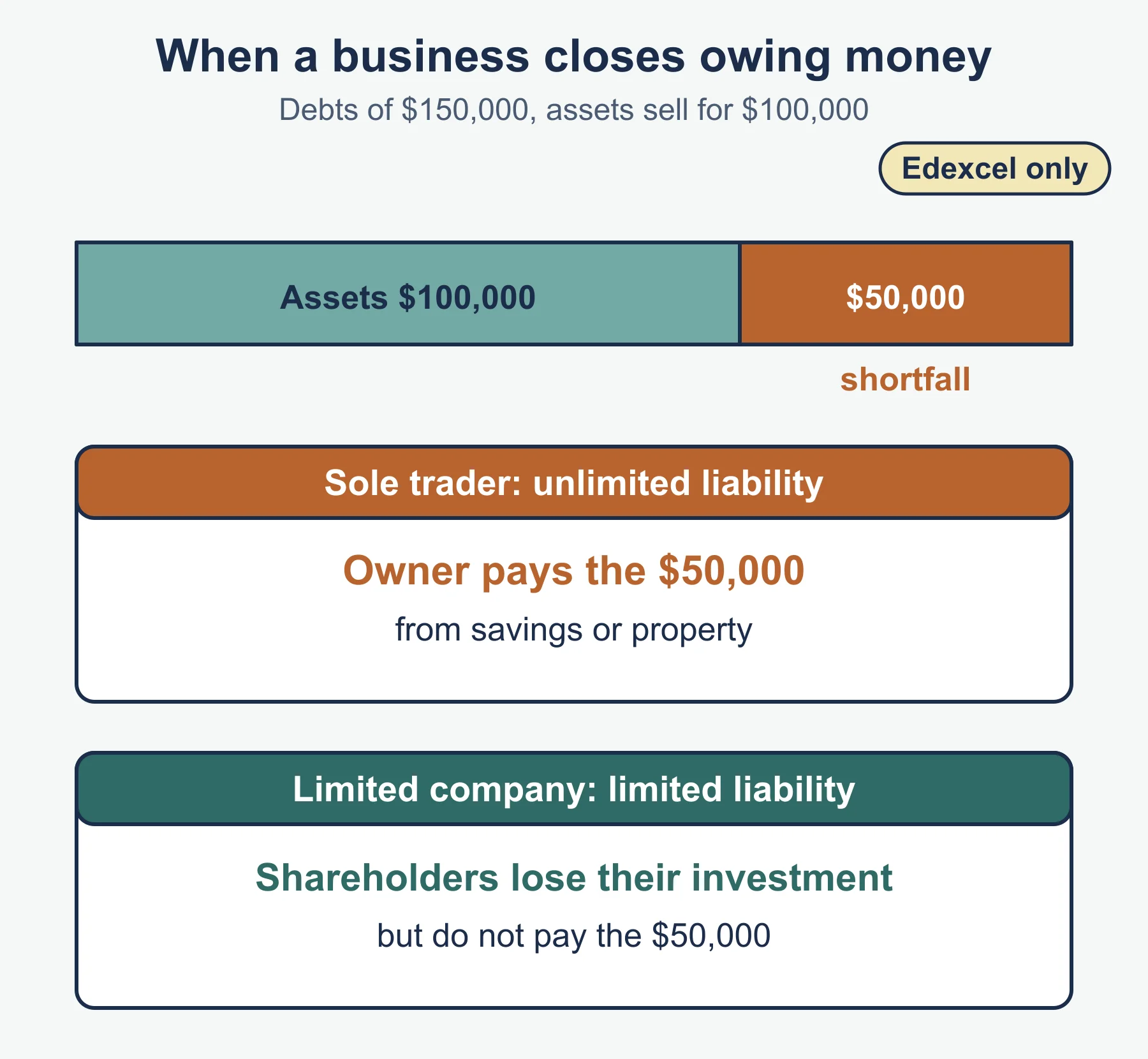
A business closes owing creditors 150,000. Its assets sell for 100,000, leaving a shortfall of 50,000.
- If it was a sole trader, the owner is personally responsible for the 50,000 and may have to use personal savings or property.
- If it was a limited company, the shareholders lose the money they invested but are not asked to pay the 50,000 from their own pockets.
Limited liability reduces the risk of investing, so it makes it easier to attract investors. It is a reason owners choose to form a company.
5. Ownership, control, finance and profits (1.2.2)
| Sole trader | Partnership | Private limited company | Public limited company | Public corporation | |
|---|---|---|---|---|---|
| Owners | One person | Two or more partners | Shareholders (not the general public) | Shareholders (any member of the public) | The state |
| Control | Owner alone | Partners, often by agreement | Directors, appointed by shareholders | Directors, appointed by shareholders | Government-appointed managers |
| Liability | Unlimited | Unlimited | Limited | Limited | Not usually a concern for individuals |
| Main sources of finance | Owner’s savings, profits kept in the business, loans | Partners’ money, retained profit, loans | Shareholders, retained profit, loans | Selling shares widely, retained profit, loans | Government funds, revenue earned, loans |
| Profits | Belong to the owner | Shared between partners | Shared as dividends and retained profit | Dividends and retained profit | Kept or returned to the government |
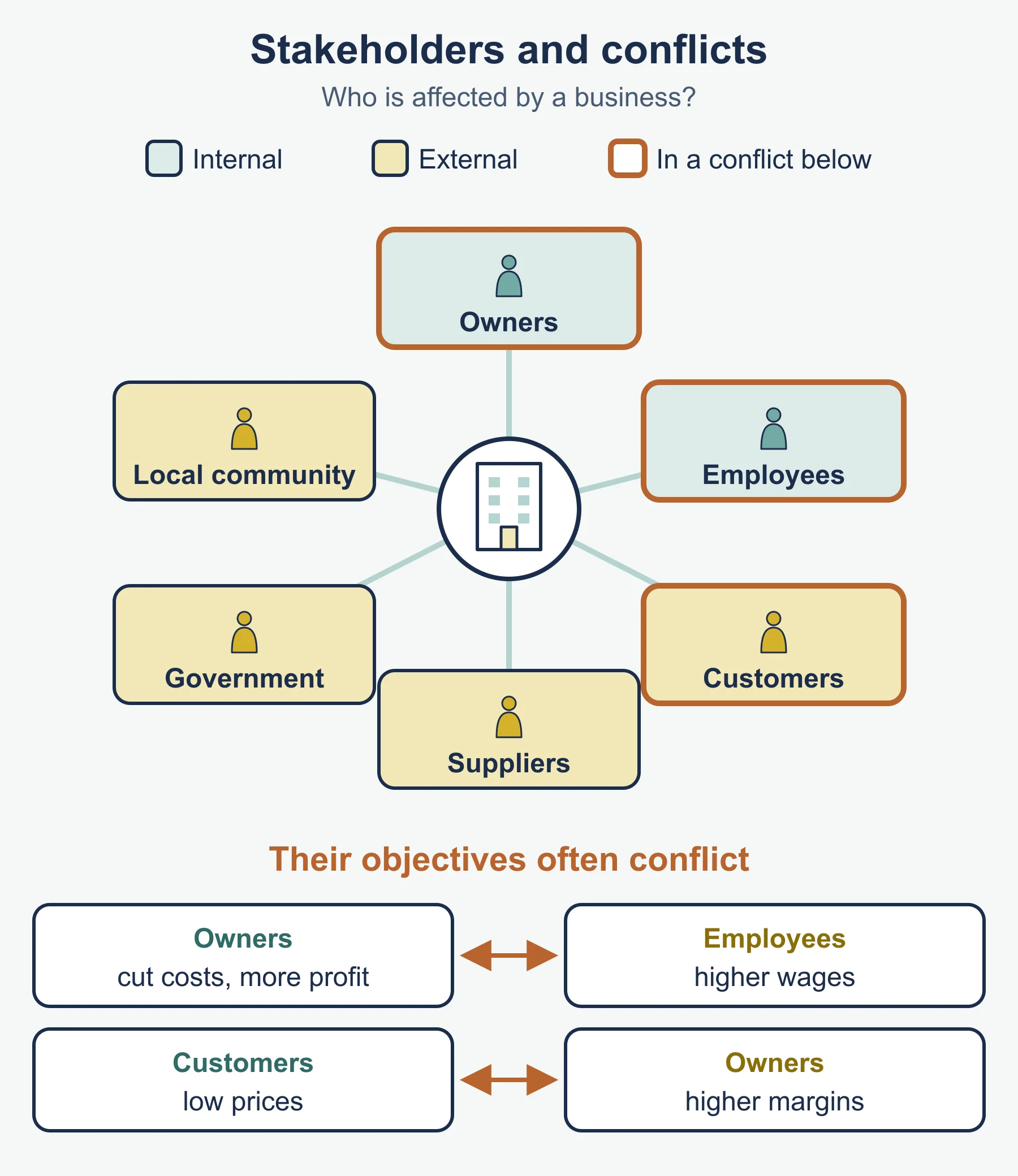
Two terms to separate: stakeholders are all groups with an interest in a business (owners, employees, customers, suppliers, lenders, the local community, the government); shareholders are the particular stakeholders who own shares in a company. All shareholders are stakeholders, but not all stakeholders are shareholders.
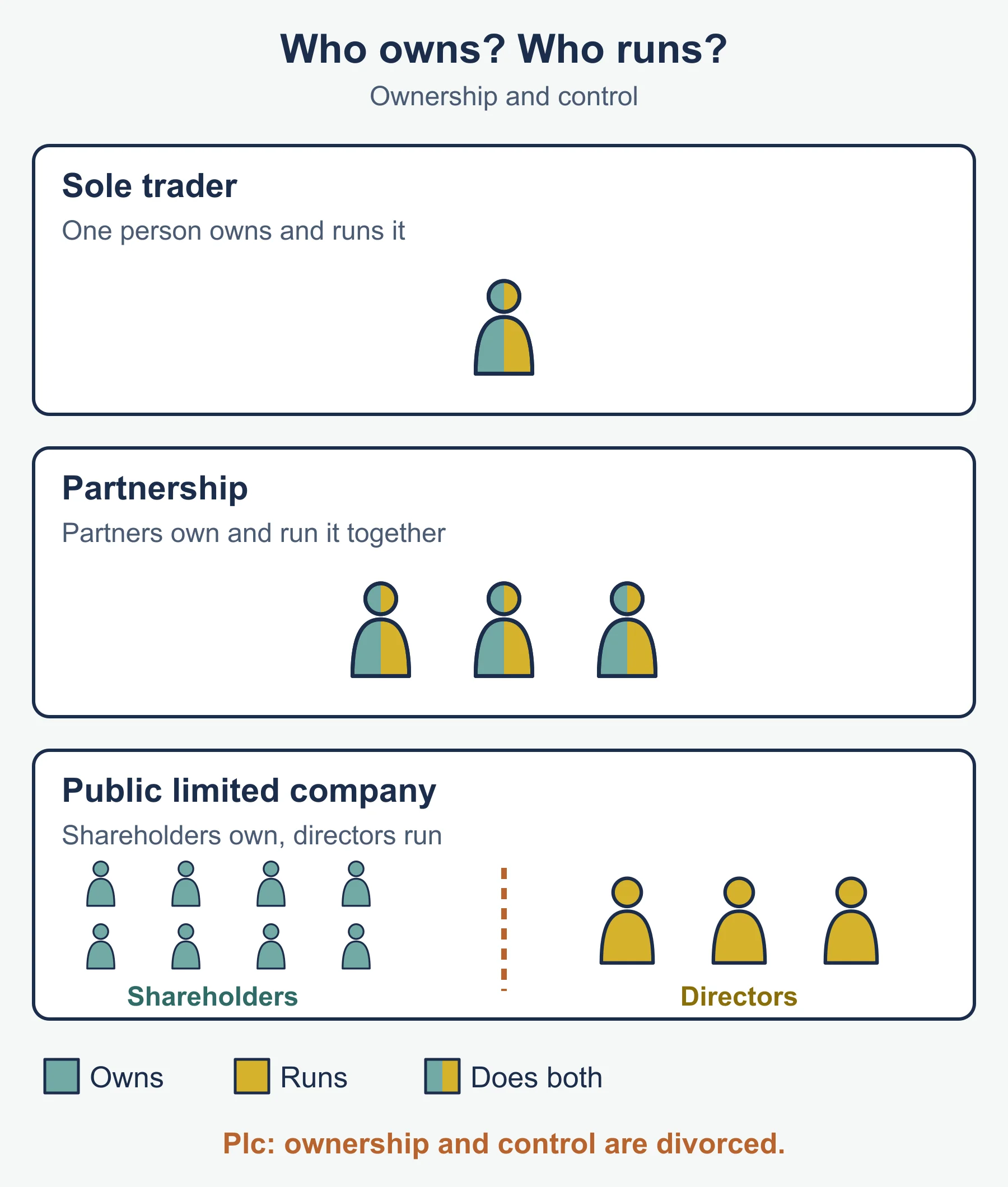
A company separates ownership from control. Shareholders own it, but directors usually run it day to day. In a sole trader business the owner and manager are the same person.
Worked example: use of profits
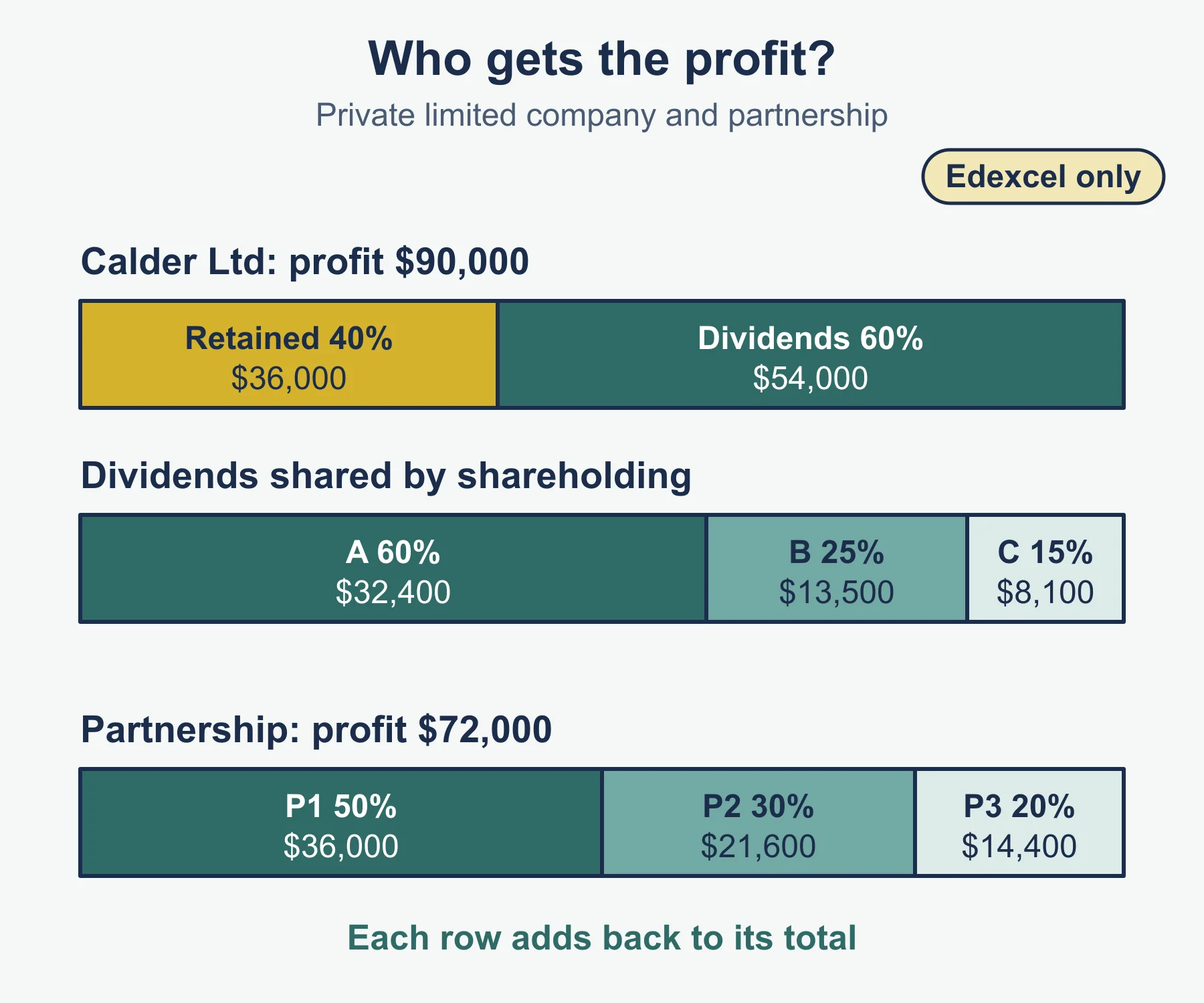
Calder Ltd, a private limited company, makes a profit of 90,000. The directors keep 40% in the business: 0.4 × 90,000 = 36,000 retained profit. The remaining 54,000 is paid out as dividends. Three shareholders hold 60%, 25% and 15% of the shares, so they receive 32,400, 13,500 and 8,100. Check: 32,400 + 13,500 + 8,100 = 54,000.
Now compare a partnership earning 72,000, shared 50%, 30% and 20% between three partners: 36,000, 21,600 and 14,400. Retained profit is a decision for the partners, not a separate group of directors.
6. Public corporations and choosing a form (1.2.2)
The specification asks for reasons for and against public ownership but does not list them. The arguments below are standard general knowledge, so treat them as examples of reasoning rather than a fixed list.
Reasons for public ownership (arguments in favour):
- Services seen as essential can be provided even where they make little profit.
- Decisions can put the public interest before profit.
- Prices can be kept affordable.
Reasons against public ownership:
- With no pressure from competition or owners seeking profit, managers may be less efficient.
- Losses may have to be covered by taxpayers.
- Political decisions can override commercial ones.
Appropriateness of different forms means matching the form to the situation. Use the question’s facts: how much finance is needed, how much risk the owners will accept, how much control they want to keep, and how big the business plans to be.
- A hairdresser who wants independence and low start-up costs suits a sole trader.
- Two friends pooling savings and skills may suit a partnership.
- A growing manufacturer needing large sums and wanting to protect owners’ homes may suit a private limited company.
- A business that needs very large amounts of finance and wants to sell shares to anyone may become a public limited company.
7. Franchises, social enterprises and multinationals (1.2.3)
The descriptions below are standard general knowledge, since the specification names these three forms without defining them.
Franchise: the franchisor lets a franchisee use its brand, products and methods in return for payments. These are usually a start-up fee and a continuing fee. Franchisees run their own outlet.
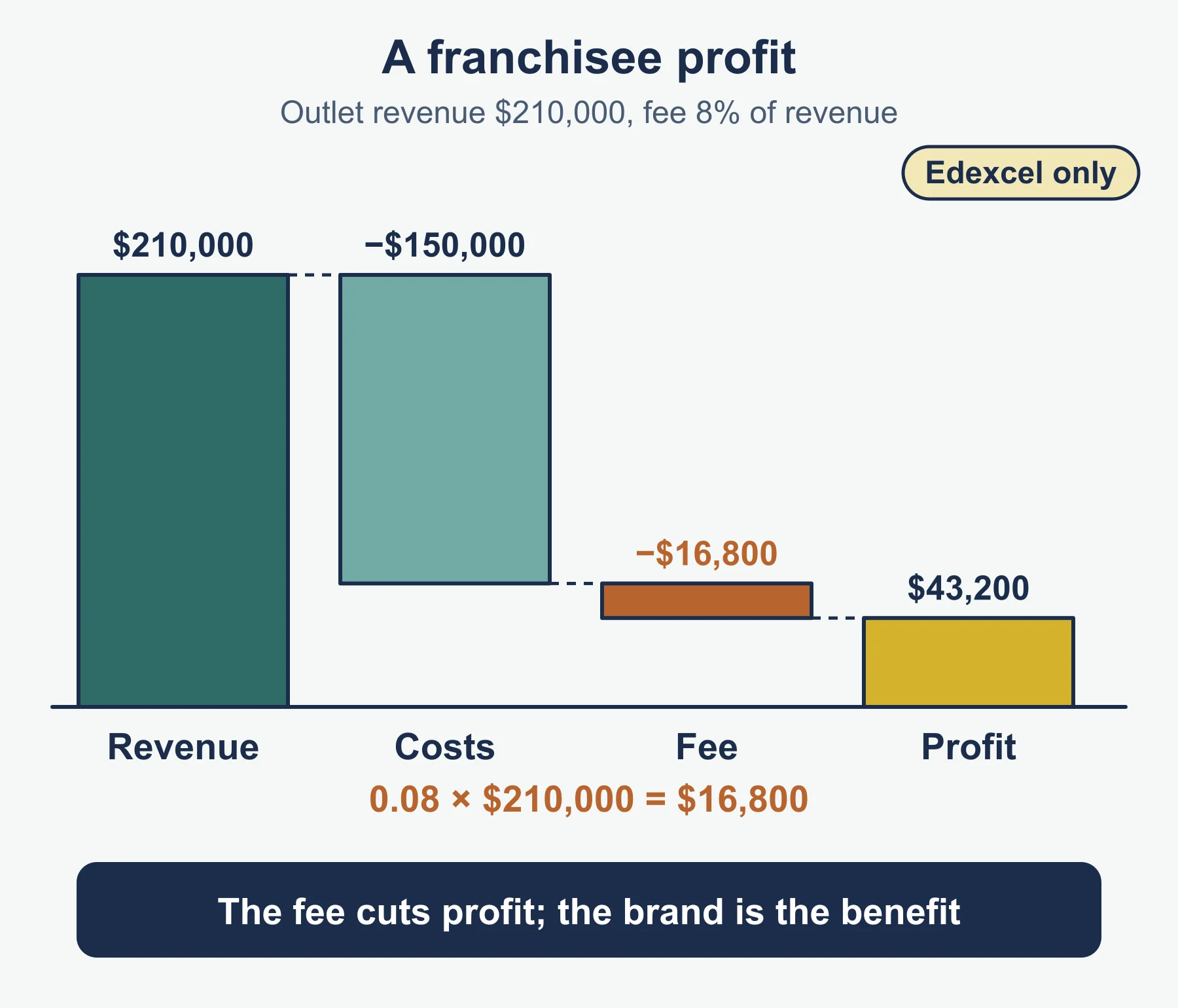
Example: a franchisee outlet has revenue of 210,000 and costs of 150,000 before the franchisor’s fee. The fee is 8% of revenue (invented): 0.08 × 210,000 = 16,800. Profit = 210,000 − 150,000 − 16,800 = 43,200.
- Benefits to the franchisee: a known brand, support and training, a tested business model.
- Drawbacks: fees reduce profit, and the franchisee must follow the franchisor’s rules.
- Benefits to the franchisor: growth without raising all the money itself. Drawback: its reputation depends on outlets it does not fully control.
Social enterprise: a business with social or environmental objectives that earns revenue by trading. It still aims to cover costs, but profits are usually put back into the social purpose rather than only paid out to owners.
Multinational: a business with operations in more than one country, usually run from a head office. Benefits include access to new markets and the chance to produce where costs are lower. Drawbacks include the difficulty of controlling operations in many places and the effects of different laws and cultures.
Common errors
- Saying profit is the only objective, or treating non-financial objectives as unimportant.
- Confusing market share (a percentage of the market) with sales (the business’s own revenue).
- Calling limited liability “no risk”.
- For public corporations, giving only advantages or only disadvantages when a question asks for both.
- Naming a reason for changing objectives without a consequence for the business.
Next steps
Condense this with the revision notes, then try the practice questions. Return to the 4BS1 Business hub, tick off progress on the checklist or find weak spots with the free diagnostics.
Frequently asked questions
Why do business objectives change? The 4BS1 specification lists market conditions, technology, performance, legislation and internal reasons. In a downturn, for example, a business may move from a growth objective to survival.
What are the arguments for and against public ownership? Public ownership can provide essential services even where they make little profit and keep prices affordable. Against it, managers may be less efficient without competition, taxpayers may cover losses and political decisions can override commercial ones.
What does separation of ownership and control mean? In a company, shareholders own the business but directors usually run it day to day. In a sole trader business, the owner and manager are the same person.
Can objectives conflict with each other? Yes. Cutting prices to raise sales and market share may lower profit, so a good answer says which objective matters more in the situation given and why.
Official syllabus
Pearson Edexcel International GCSE in Business (4BS1), Specification, Issue 2, February 2026, published by Pearson Education Limited. Topic 1: Business activity and influences on business, sections 1.1 and 1.2.
Get free revision emails (optional)
Occasional emails with practice questions, worked explanations and links to free resources for the qualification and subjects you choose. No spam, and you can unsubscribe from any email. The free tools on this site never need an email.
Related resources
-
Practice questions
Edexcel IGCSE Business: Business objectives and types of organisation (4BS1) – Practice Questions
Original practice questions with worked answers on business objectives and types of organisation for Pearson Edexcel International GCSE Business.
Business · Pearson Edexcel · IGCSE
Try questions -
Revision notes
Edexcel IGCSE Business: Business objectives and types of organisation (4BS1) – Revision Notes
Condensed revision notes on business objectives and types of organisation, with a self-test, for Pearson Edexcel International GCSE Business.
Business · Pearson Edexcel · IGCSE
Revise topic -
Study guides
Edexcel IGCSE Business: Classification of businesses and location decisions (4BS1)
Study guide to the primary, secondary and tertiary sectors and the factors behind location and relocation, for Edexcel International GCSE Business.
Business · Pearson Edexcel · IGCSE
Read guide
Related articles
-
teaching
A Level tuition in Dubai: Cambridge or Pearson Edexcel International A Level?
Schools in Dubai and Abu Dhabi teach either Cambridge International AS & A Level or Pearson Edexcel International A Level. How the two are structured, why it matters for tuition, and how online classes from Lahore work.
9 October 2026
-
curriculum guides
Choosing subjects at IGCSE and A Level
How subject choices at 14 and 16 affect university options later, and how to keep pathways open without overloading a timetable.
28 July 2026
Studying this with a teacher
Working through Business IGCSE?
This page is free and stays free. If you would rather be taught it, Marlbridge runs Business classes one-to-one and in small groups of up to 15, online in your own time zone. The first trial class is free. WhatsApp replies within an hour (8am–11pm Pakistan time, every day); email the same day.
Pearson Edexcel Business teachers at Marlbridge

