
Revision Notes
Edexcel IGCSE Business: Business objectives and types of organisation (4BS1) – Revision Notes
Condensed revision notes on business objectives and types of organisation, with a self-test, for Pearson Edexcel International GCSE Business.
- Subject
- Business
- Level
- IGCSE
- Topic
- Business activity and influences on business
- Author
- Marlbridge Academic Team
- Updated
- Reviewed by
- Asif Iqbal (what this means)
Aligned to Pearson Edexcel IGCSE Business (4BS1), Issue 2, February 2026. Official specification .
Syllabus page (what it covers and how it is assessed): Pearson Edexcel IGCSE Business.
Syllabus points this page covers
4BS1
- 1 Business activity and influences on business (whole topic)
- 1.1 Business objectives
- 1.2 Types of organisations
Found an error? Report a correction.
Want a teacher for this? Marlbridge teaches Business online. Request a free trial class.
Quick recall for the Pearson Edexcel International GCSE in Business (4BS1) specification, Issue 2, February 2026, Topic 1, sections 1.1 and 1.2. Full explanations and worked examples are in the study guide; questions to try are in the practice set. Course links: the 4BS1 Business hub, the printable checklist and the free diagnostics. Paper 1 uses a small business and Paper 2 a large one, and both can draw on all of this content.
1. Objectives (1.1.1)
| Type | Objectives named in the specification | One-line meaning |
|---|---|---|
| Financial | Survival | Still trading next year |
| Financial | Profit | Revenue minus total costs |
| Financial | Sales | More units sold or more revenue |
| Financial | Market share | Own sales as a percentage of the whole market |
| Financial | Financial security | Steady income and a cushion for bad periods |
| Non-financial | Social objectives | Benefit to community or environment |
| Non-financial | Personal satisfaction | Enjoying the work |
| Non-financial | Challenge | Taking on something difficult or new |
| Non-financial | Independence and control | Being the decision maker |
Standard forms (the specification gives no formulas here):
- Market share (%) = business sales ÷ total market sales × 100
- Profit = revenue − total costs
- Percentage change = (new − old) ÷ old × 100
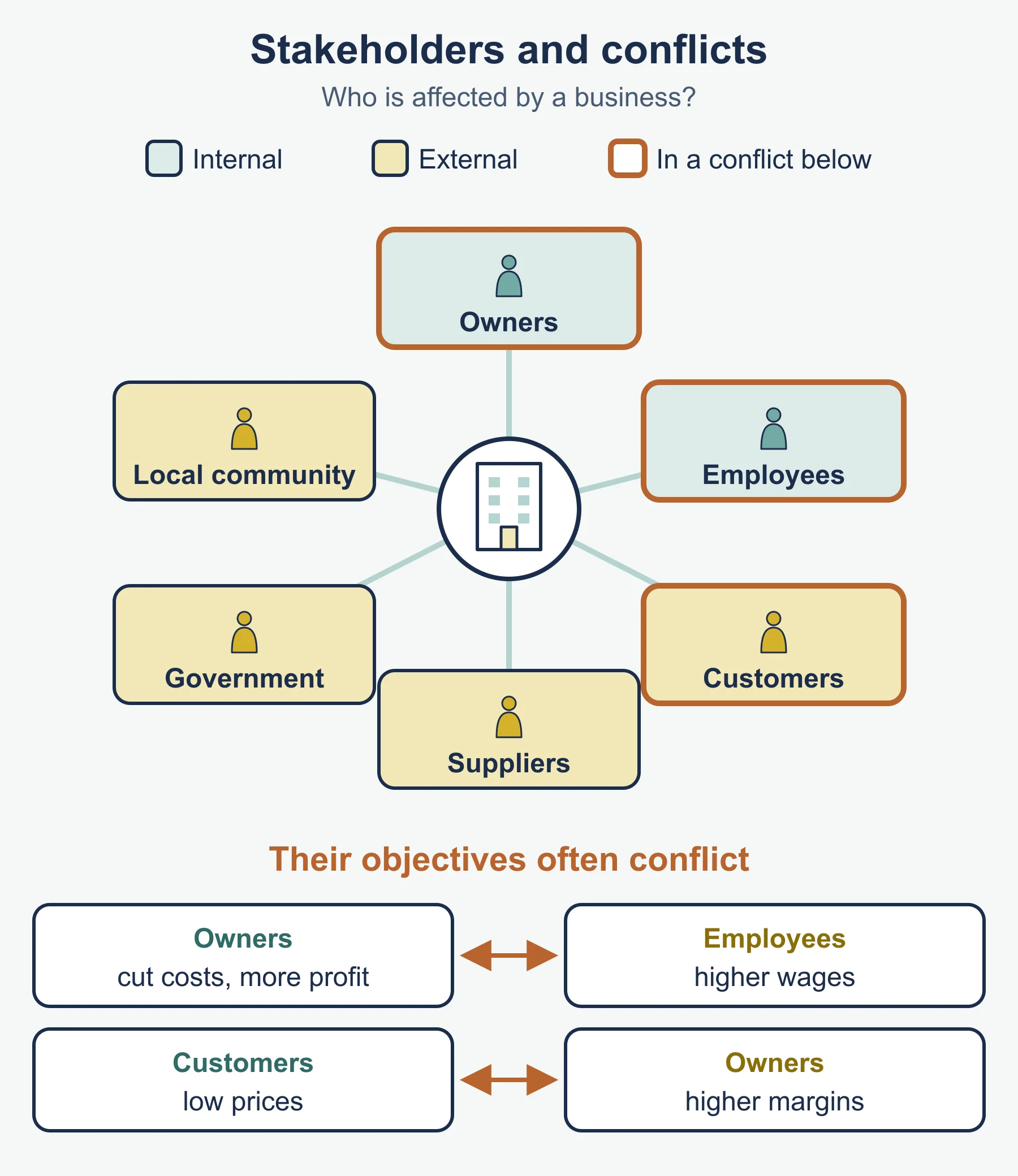
Aim = general direction. Objective = specific, measurable target (a standard distinction; the specification does not define the words). Objectives can conflict, so a judgement needs a reason: the answer depends on the stage of the business and what the owner values.
2. Why objectives change (1.1.2)
Five triggers, each needing a consequence:
- Market conditions: demand falls, so survival replaces growth.
- Technology: new equipment or online selling creates new targets.
- Performance: missing a target may lower it; beating it may raise it.
- Legislation: a new law forces a change of practice and so of goals.
- Internal reasons: new owner, new manager, new priorities.
3. Forms of ownership (1.2.1 and 1.2.2)
| Form | Owners | Liability | Finance | Profit goes to |
|---|---|---|---|---|
| Sole trader | One person | Unlimited | Own money, retained profit, loans | The owner |
| Partnership | Two or more | Unlimited | Partners, retained profit, loans | Partners |
| Private limited company | Shareholders, not sold to the public | Limited | Shareholders, retained profit, loans | Shareholders (dividends) and retained profit |
| Public limited company | Shareholders, shares open to the public | Limited | Wide share sales, retained profit, loans | Shareholders (dividends) and retained profit |
| Public corporation | The state | n/a for private individuals | Government, own revenue, loans | Retained or returned to government |
Key distinctions:
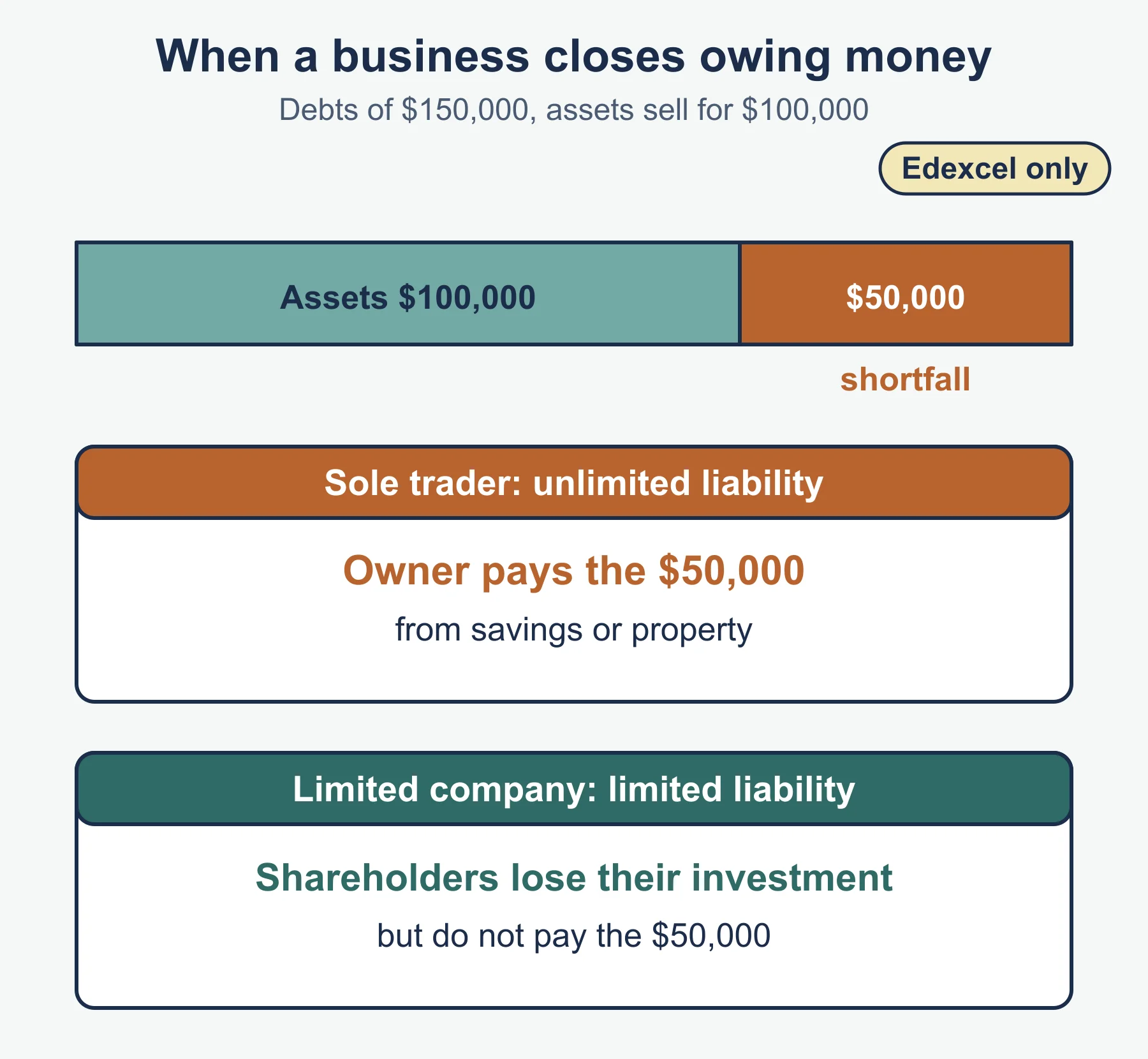
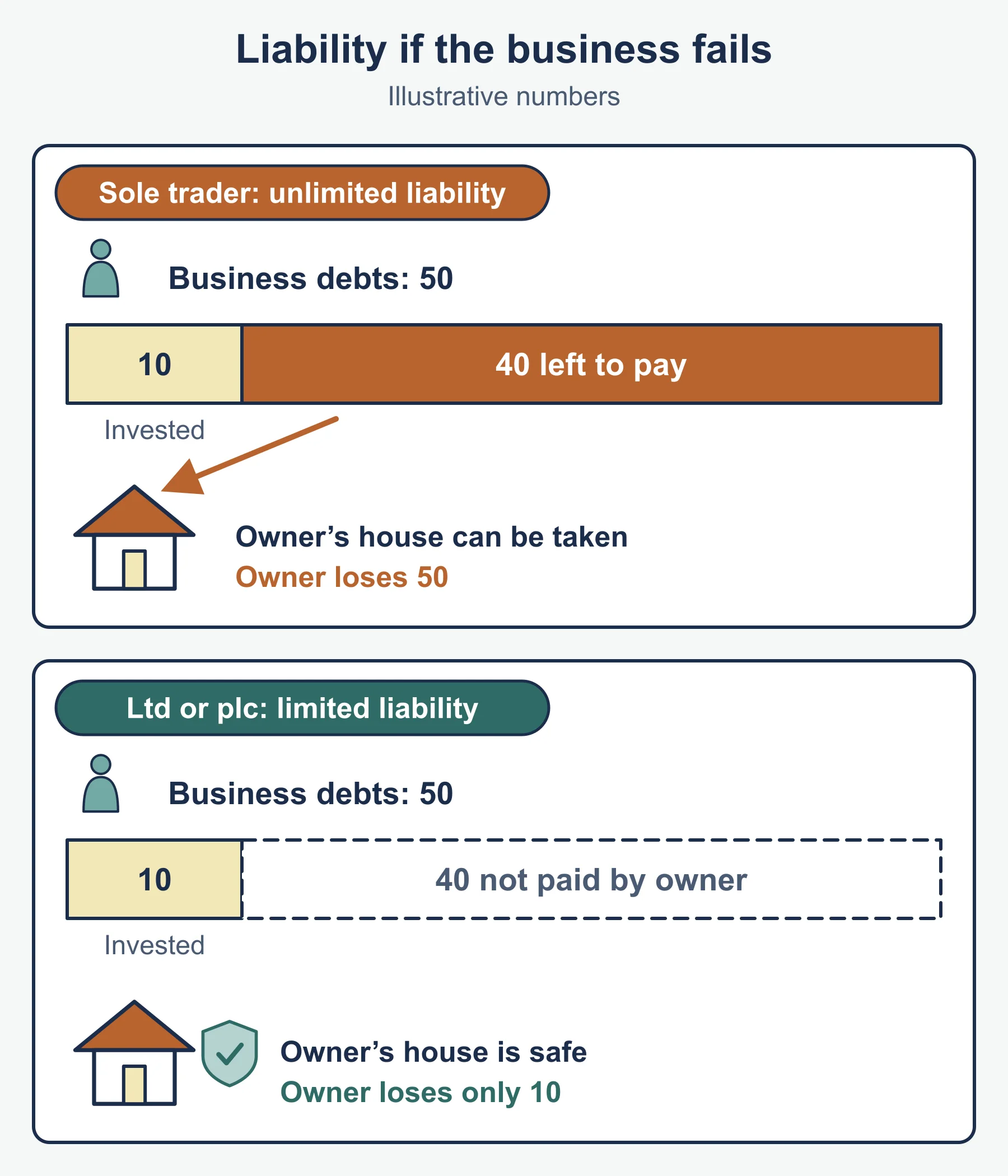
- Unlimited liability = personal assets can be used to pay debts. Limited liability = loss capped at the money invested.
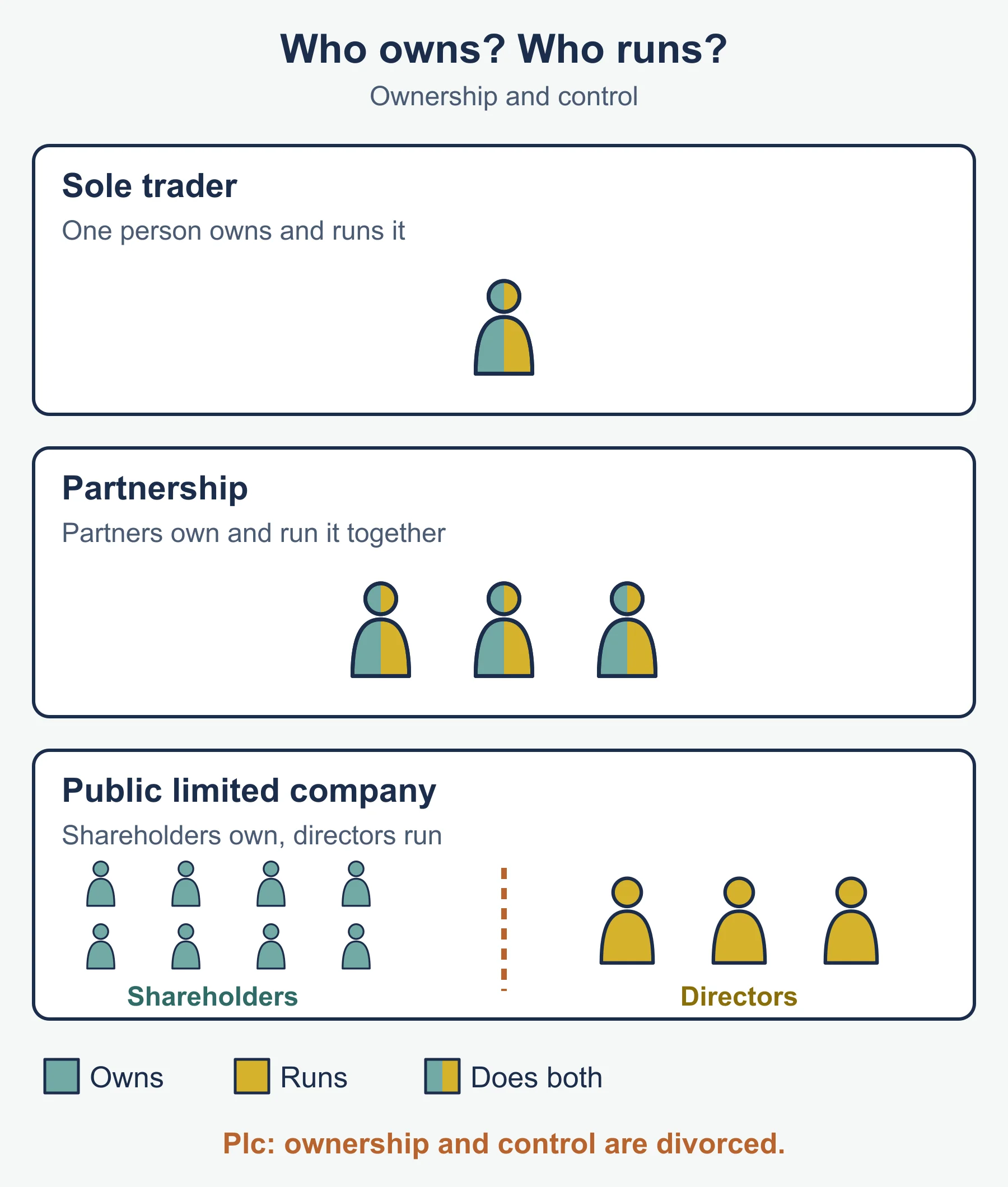
- Ownership = who holds the business. Control = who makes the decisions. They are the same person in a sole trader and different people in a larger company.
- Shareholder = owns shares. Stakeholder = any group affected by or interested in the business.
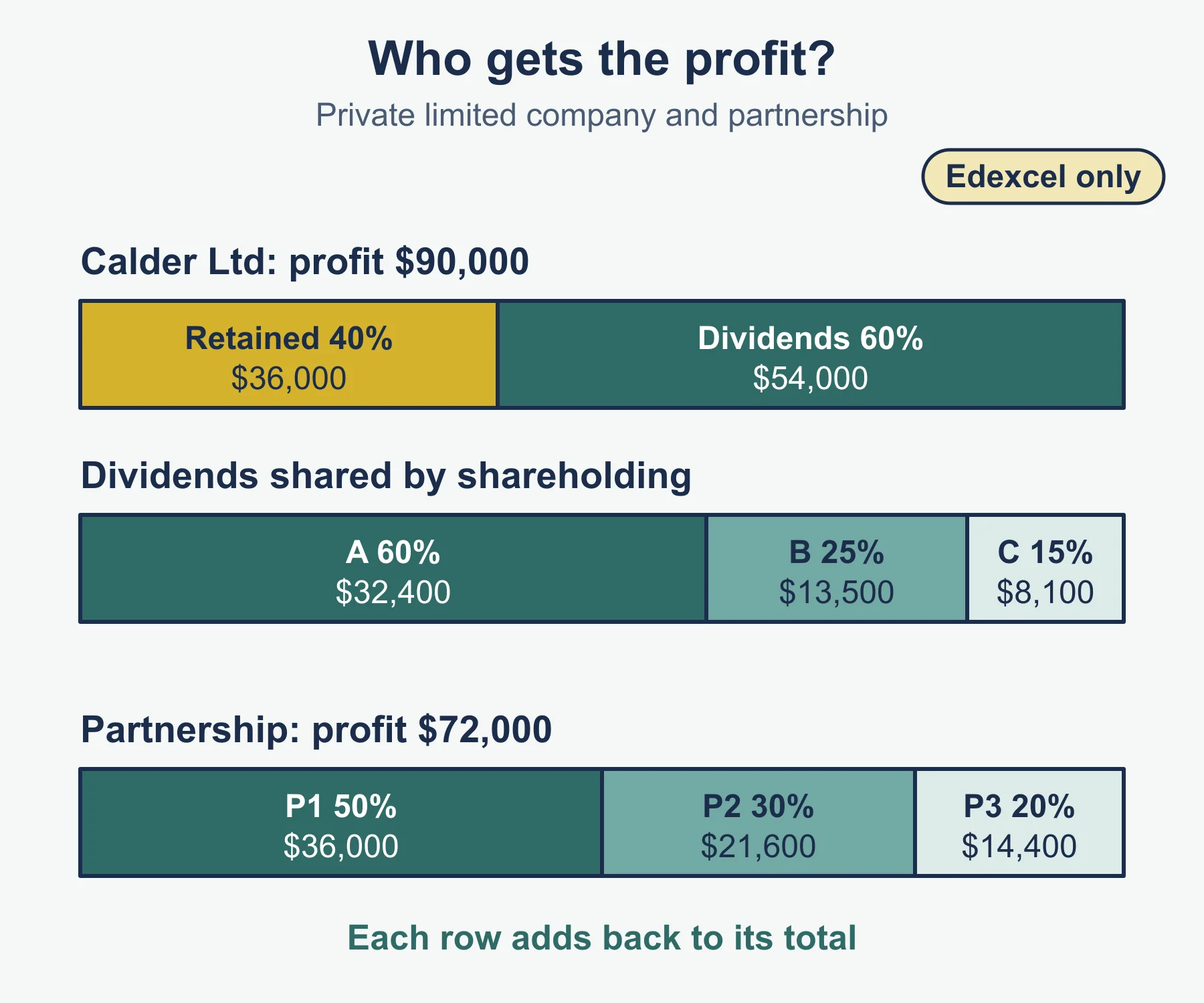
- Dividend = the part of profit paid to shareholders. Retained profit = the part kept for the business.
4. Public corporations: for and against
| For public ownership | Against public ownership |
|---|---|
| Essential services provided even if unprofitable | Less pressure to be efficient |
| Public interest placed before profit | Taxpayers may cover losses |
| Prices can be held down | Decisions may be political |
5. Franchise, social enterprise, multinational (1.2.3)
The one-line meanings here and the for-and-against points in section 4 are standard general knowledge, not specification text.
| Form | Core idea | Plus | Minus |
|---|---|---|---|
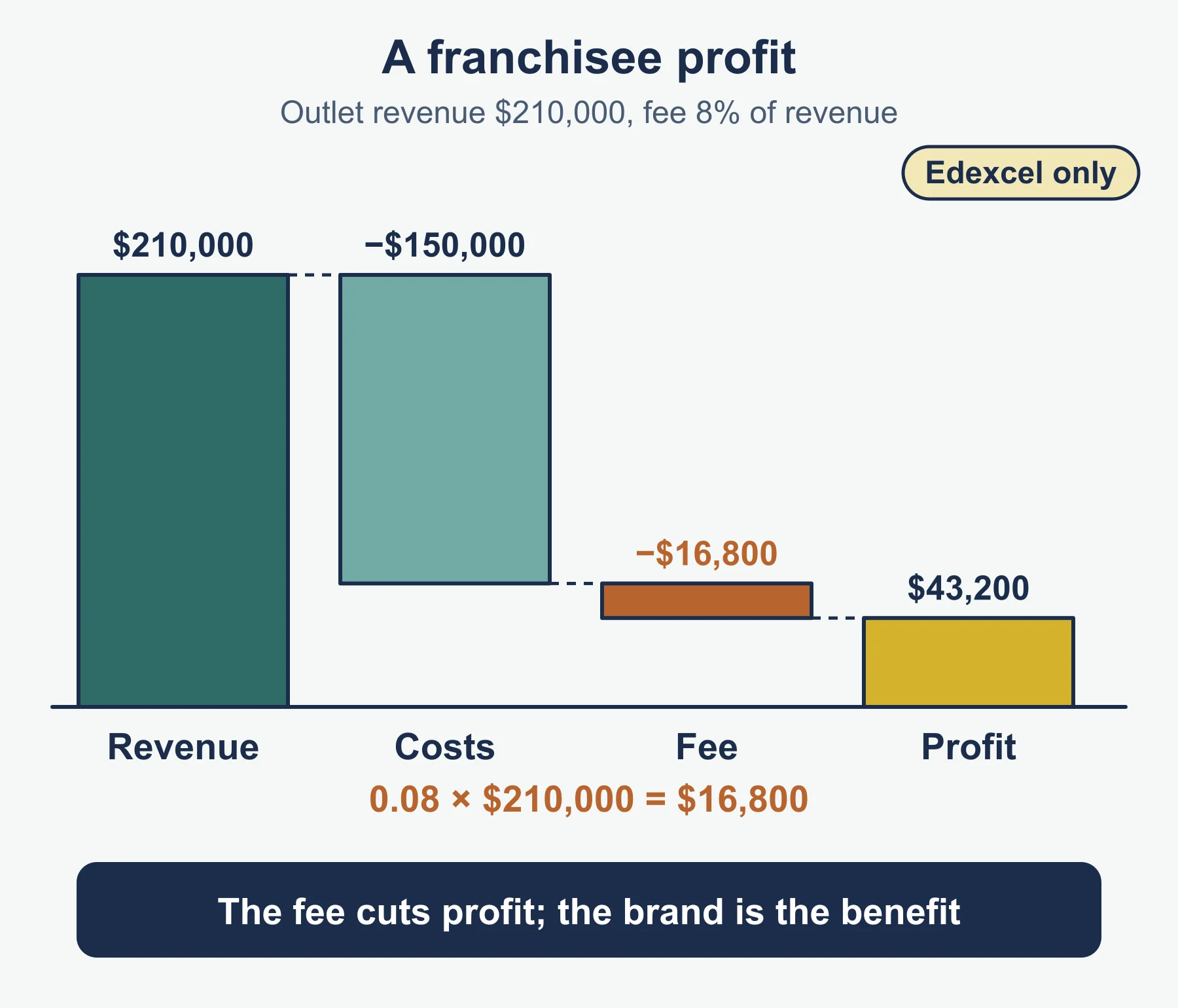
| Franchise | Franchisee pays to use the franchisor’s brand and methods | Known name, support | Fees, must follow rules |
| Social enterprise | Trades to achieve a social or environmental purpose | Purpose and customer goodwill | Profit may be limited by the purpose |
| Multinational | Operates in more than one country | New markets, lower-cost sites | Harder to control, different laws |
6. Method: choosing a suitable form
- List what the scenario says about finance needed, risk, control and growth plans.
- Match each fact to a feature of a form.
- State the benefit to the owner of that form.
- State a limitation.
- Reach a judgement tied to the facts.
7. Worked reminders
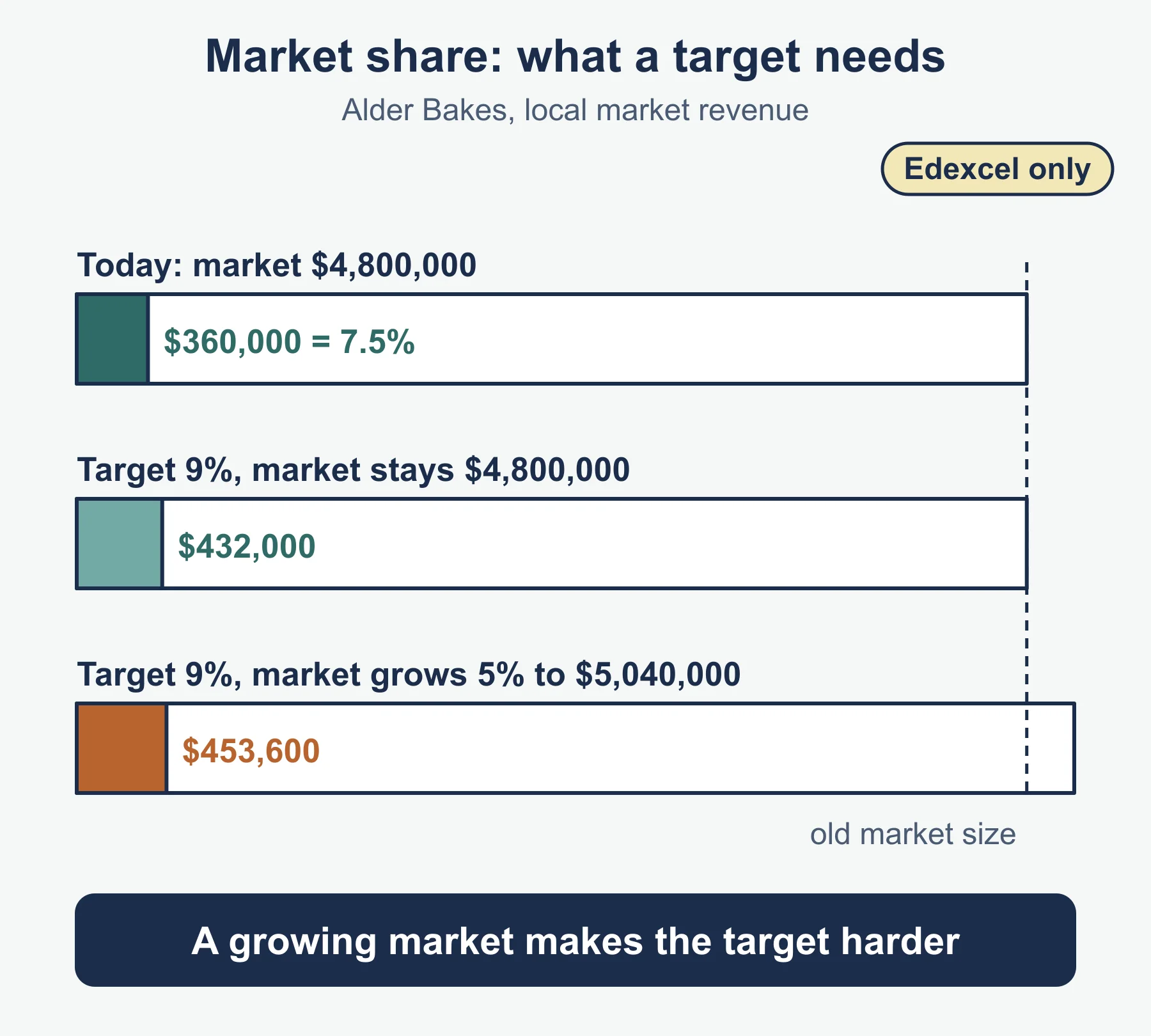
Market share target. Tolan Tea sells 18,000 in a market of 240,000, so its share is 18,000 ÷ 240,000 × 100 = 7.5%. To reach 10% of the same market it needs 0.10 × 240,000 = 24,000 of sales, which is 6,000 more.
Growth in the market. If the market grows to 300,000 and Tolan Tea sells 24,000, the share is 24,000 ÷ 300,000 × 100 = 8%. Sales rose but share did not reach 10%, so the target was missed. Always say which figure you are judging.
Profit and the owner’s choice. A sole trader has revenue of 96,000 and total costs of 84,000, so profit is 12,000. All of it belongs to the owner. If the same profit were earned by a partnership of four equal partners, each would receive 3,000.
Dividend or retained profit. A company with a profit of 80,000 keeps 25%: 0.25 × 80,000 = 20,000 retained and 60,000 for dividends. Retained profit finances growth without borrowing; dividends reward shareholders. More of one means less of the other.
8. Must-know distinctions
| Pair | Difference |
|---|---|
| Aim and objective | General direction, and a specific target |
| Financial and non-financial objective | Measured in money, and about other things such as satisfaction or social benefit |
| Sales and market share | The business’s own figure, and its figure relative to the whole market |
| Profit and revenue | What is left after costs, and what is earned before costs |
| Private and public limited company | Shares not offered to the public, and shares open to the public |
| Public limited company and public corporation | Owned by shareholders, and owned by the state |
| Franchisor and franchisee | The brand owner, and the operator who pays to use the brand |
| Social enterprise and a business run only for its owners | Trades to earn revenue with a social purpose, and trades mainly for the owners’ gain |
9. Evaluating a choice of ownership
A question that says “evaluate” or “justify” needs both sides and a decision. A short frame:
- Point for: tie a feature of the form to a fact in the case (for example “needs a large loan, and limited liability protects the owners”).
- Point against: a limit that matters in this case (for example “shareholders may expect dividends, so less profit is kept”).
- Judgement: choose, and give the deciding reason. For example, the form that best suits the owner’s stated priority, whether that is control, protection from risk, or access to finance.
For “outline”, give two linked points. For “explain”, give a statement of fact with two further expansion points. Those readings of the command words come from the specification’s own table.
Quick self-test
- Define market share.
- A firm sells 33,000 of goods in a market worth 220,000. Calculate its market share.
- Give two non-financial objectives.
- Revenue rose from 45,000 to 54,000. Calculate the percentage change.
- A new law on product labelling makes a firm change a target. Which reason for changing objectives is this?
- State the type of liability of a partner.
- State one difference between a private and a public limited company.
- Three partners share a profit of 60,000 equally. How much does each receive?
- A company pays out 20,000 in dividends on 2,000 shares, all of one type. Calculate the dividend per share.
- Define a franchisee.
- Give one reason in favour of public ownership.
- Explain why every shareholder is a stakeholder but not every stakeholder is a shareholder.
Answers
- A business’s sales as a percentage of the total sales in its market.
- 33,000 ÷ 220,000 × 100 = 15%.
- Any two of: social objectives, personal satisfaction, challenge, independence and control.
- (54,000 − 45,000) ÷ 45,000 × 100 = 20% increase.
- Legislation.
- Unlimited liability.
- A public limited company can sell shares to the general public; a private limited company cannot.
- 60,000 ÷ 3 = 20,000.
- 20,000 ÷ 2,000 = 10 per share.
- The person or business that pays to run an outlet using another business’s brand and methods.
- Essential services can be provided even if they are not profitable (or: public interest is put before profit).
- A shareholder owns part of the company, so has an interest in how it performs, which makes them a stakeholder. Stakeholders also include employees, customers, suppliers and others who have an interest but own no shares.
Where marks are usually lost
- Defining profit as “money in the bank” instead of revenue minus costs.
- Giving a market share answer in currency rather than a percentage.
- Listing only financial objectives when asked about objectives in general.
- Saying a limited company “cannot fail”. Limited liability caps the loss; it does not remove it.
- Mixing up ownership and control.
- Giving a reason for changing objectives with no effect on the business.
- Treating public corporations as if they were public limited companies.
- Writing a one-sided answer to “evaluate” or “justify” with no judgement at the end.
- Describing a franchise from the franchisor’s side only, when the question asks about the franchisee.
Next steps
Work through the practice questions, re-read the study guide where you slip, and check the 4BS1 Business hub, the checklist and the free diagnostics.
Frequently asked questions
What is the difference between an aim and an objective? An aim is the general direction a business wants to go in. An objective is a more specific target that helps it get there, ideally with a number and a date.
What are financial and non-financial objectives in Edexcel IGCSE Business? The 4BS1 specification lists survival, profit, sales, market share and financial security as financial objectives, and social objectives, personal satisfaction, challenge, and independence and control as non-financial ones.
What is the difference between stakeholders and shareholders? Stakeholders are all groups with an interest in a business, such as employees, customers, suppliers and the community. Shareholders are the owners of a limited company.
What is a social enterprise? A social enterprise has social or environmental objectives and earns revenue by trading. It aims to cover its costs, but profits are usually put back into the social purpose.
Official syllabus
Pearson Edexcel International GCSE in Business (4BS1), Specification, Issue 2, February 2026, published by Pearson Education Limited. Topic 1: Business activity and influences on business, sections 1.1 and 1.2.
Get free revision emails (optional)
Occasional emails with practice questions, worked explanations and links to free resources for the qualification and subjects you choose. No spam, and you can unsubscribe from any email. The free tools on this site never need an email.
Related resources
-
Study guides
Edexcel IGCSE Business: Classification of businesses and location decisions (4BS1)
Study guide to the primary, secondary and tertiary sectors and the factors behind location and relocation, for Edexcel International GCSE Business.
Business · Pearson Edexcel · IGCSE
Read guide -
Practice questions
Edexcel IGCSE Business: Classification of businesses and location decisions (4BS1) – Practice Questions
Original practice questions with worked answers on business sectors and location decisions for Pearson Edexcel International GCSE Business.
Business · Pearson Edexcel · IGCSE
Try questions -
Revision notes
Edexcel IGCSE Business: Classification of businesses and location decisions (4BS1) – Revision Notes
Condensed revision notes on business sectors, location factors, e-commerce, trade blocs and relocation for Pearson Edexcel International GCSE Business.
Business · Pearson Edexcel · IGCSE
Revise topic
Related articles
-
teaching
A Level tuition in Dubai: Cambridge or Pearson Edexcel International A Level?
Schools in Dubai and Abu Dhabi teach either Cambridge International AS & A Level or Pearson Edexcel International A Level. How the two are structured, why it matters for tuition, and how online classes from Lahore work.
9 October 2026
-
curriculum guides
Choosing subjects at IGCSE and A Level
How subject choices at 14 and 16 affect university options later, and how to keep pathways open without overloading a timetable.
28 July 2026
Studying this with a teacher
Working through Business IGCSE?
This page is free and stays free. If you would rather be taught it, Marlbridge runs Business classes one-to-one and in small groups of up to 15, online in your own time zone. The first trial class is free. WhatsApp replies within an hour (8am–11pm Pakistan time, every day); email the same day.
Pearson Edexcel Business teachers at Marlbridge

