
Revision Notes
Edexcel IGCSE Business: Classification of businesses and location decisions (4BS1) – Revision Notes
Condensed revision notes on business sectors, location factors, e-commerce, trade blocs and relocation for Pearson Edexcel International GCSE Business.
- Subject
- Business
- Level
- IGCSE
- Topic
- Business activity and influences on business
- Author
- Marlbridge Academic Team
- Updated
- Reviewed by
- Asif Iqbal (what this means)
Aligned to Pearson Edexcel IGCSE Business (4BS1), Issue 2, February 2026. Official specification .
Syllabus page (what it covers and how it is assessed): Pearson Edexcel IGCSE Business.
Syllabus points this page covers
4BS1
- 1 Business activity and influences on business (whole topic)
- 1.3 Classification of businesses
- 1.4 Decisions on location
Found an error? Report a correction.
Want a teacher for this? Marlbridge teaches Business online. Request a free trial class.
These notes condense sections 1.3 and 1.4 of the Pearson Edexcel International GCSE in Business (4BS1) specification, Issue 2, February 2026: the three sectors (1.3.1) and the factors in location decisions and relocation (1.4.1). For full explanations and worked examples, use the study guide. Then test yourself with the practice questions.
Course links: the Business hub, the printable checklist and the free diagnostics.
1. The three sectors (1.3.1)
| Sector | Specification wording | Typical activities | Clue verbs |
|---|---|---|---|
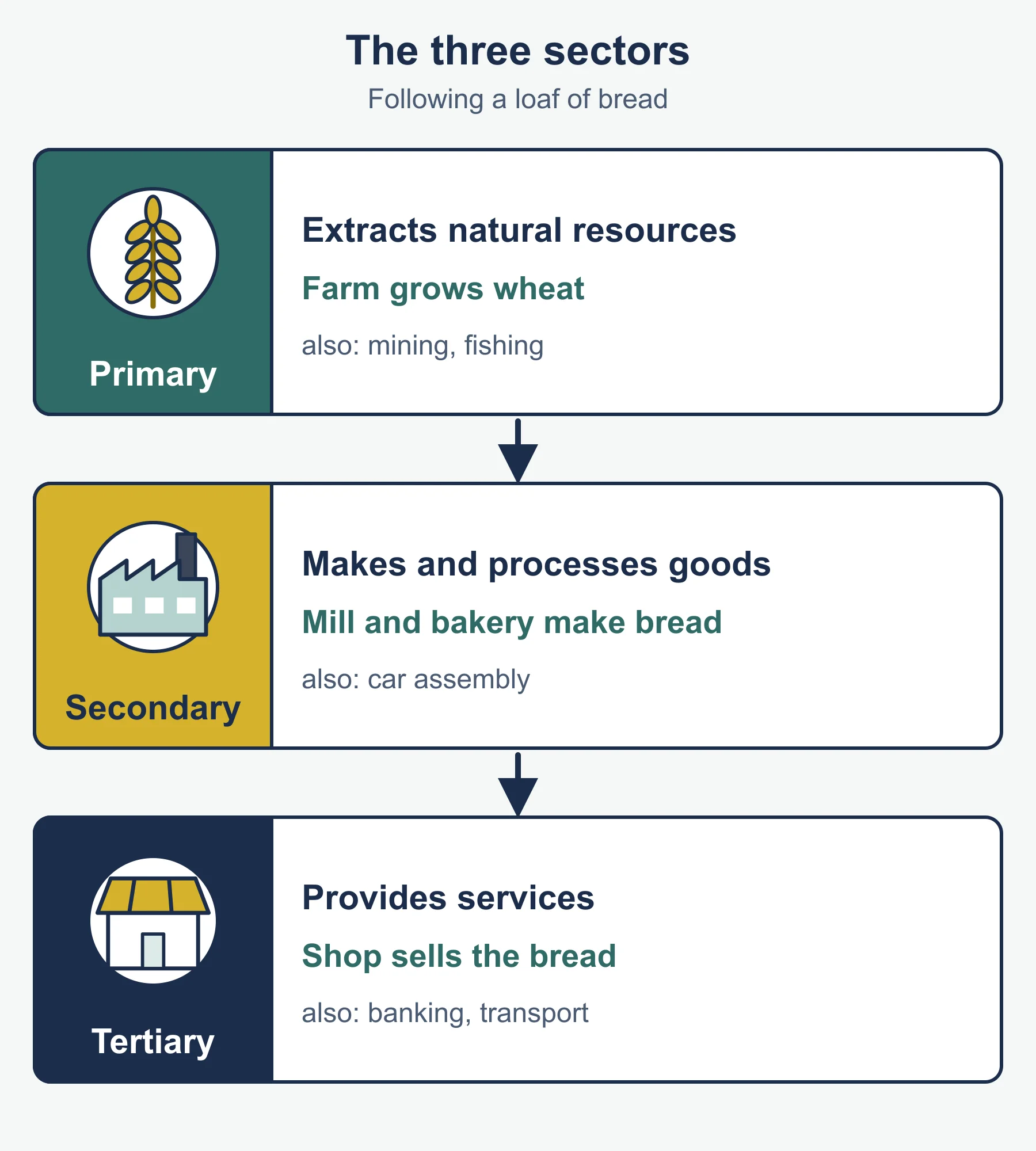
| Primary | Extracting raw materials from the earth | Farming, fishing, forestry, mining | grows, catches, digs, drills |
| Secondary | Converting raw materials into finished or semi-finished goods | Manufacturing, construction, food processing | makes, builds, assembles, refines |
| Tertiary | Provision of a wide variety of services | Retail, banking, transport, teaching, repairs | sells, delivers, advises, cleans |
Must-know distinctions:
- A semi-finished good (steel sheet, sawn timber, flour) is still secondary output. It is an input for another business.
- A business that grows tomatoes is primary. One that turns them into sauce is secondary. One that sells the sauce is tertiary.
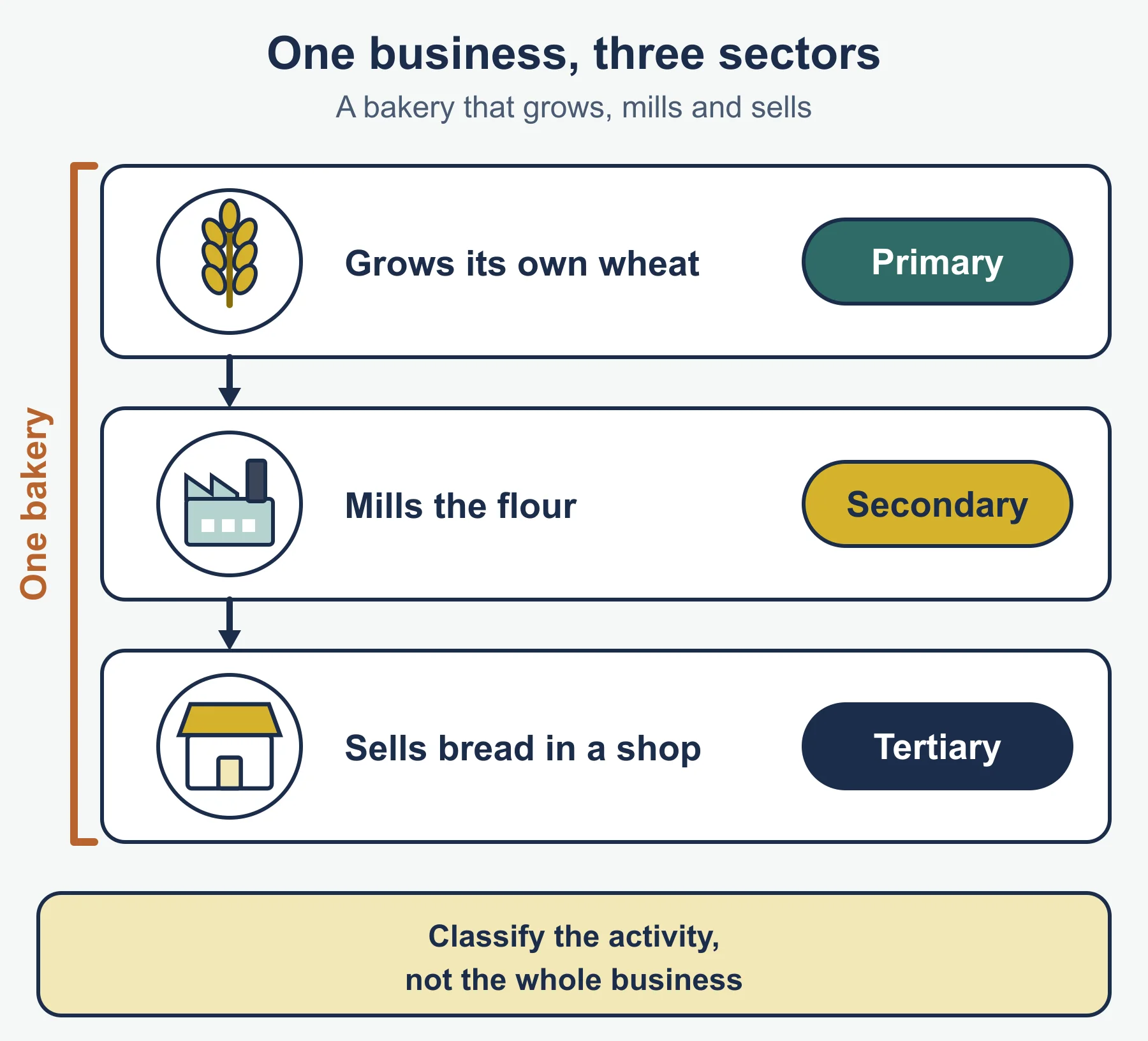
- One business can sit in several sectors. Classify each activity, not the company name.
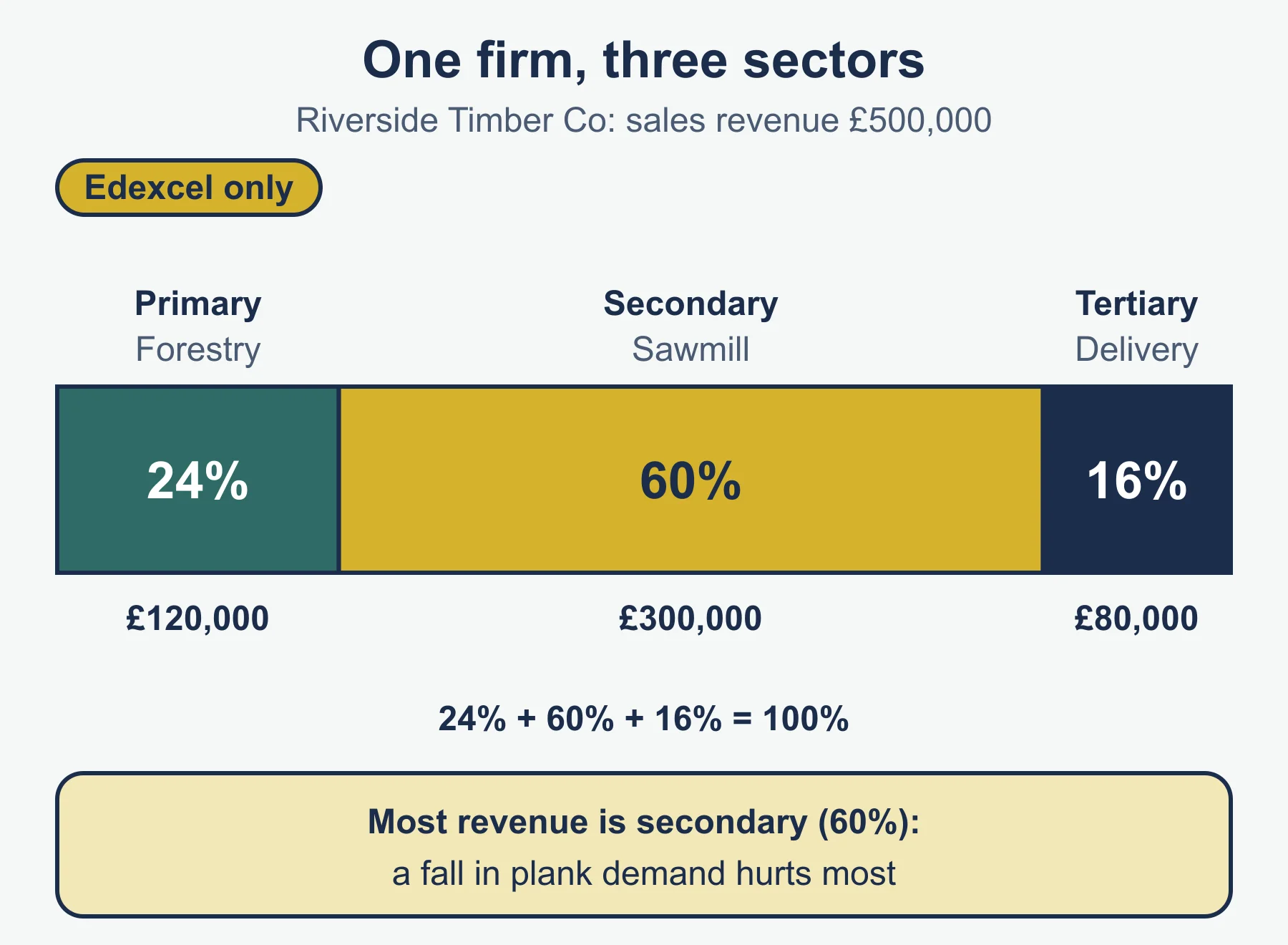
- Sector share of revenue = revenue from that sector / total revenue x 100.
Method in steps for a sector-share question:
- Add the revenues to find the total.
- Divide each sector’s revenue by the total.
- Multiply by 100 and check the shares add to 100%.
- Say what the biggest share means for the business.
2. Location factors at a glance (1.4.1)
| Factor | Why it can pull a business towards a site | Why it can push it away |
|---|---|---|
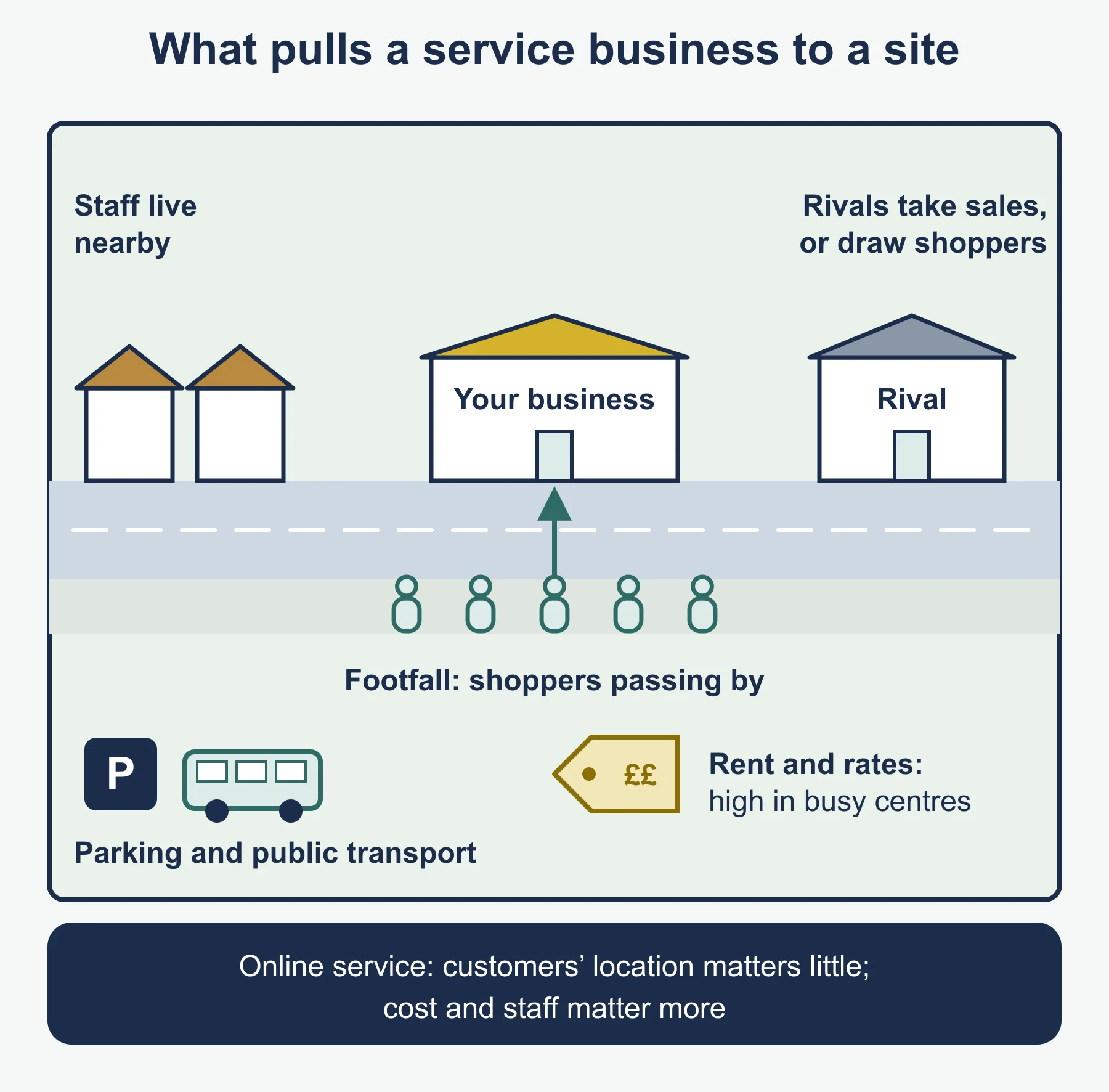
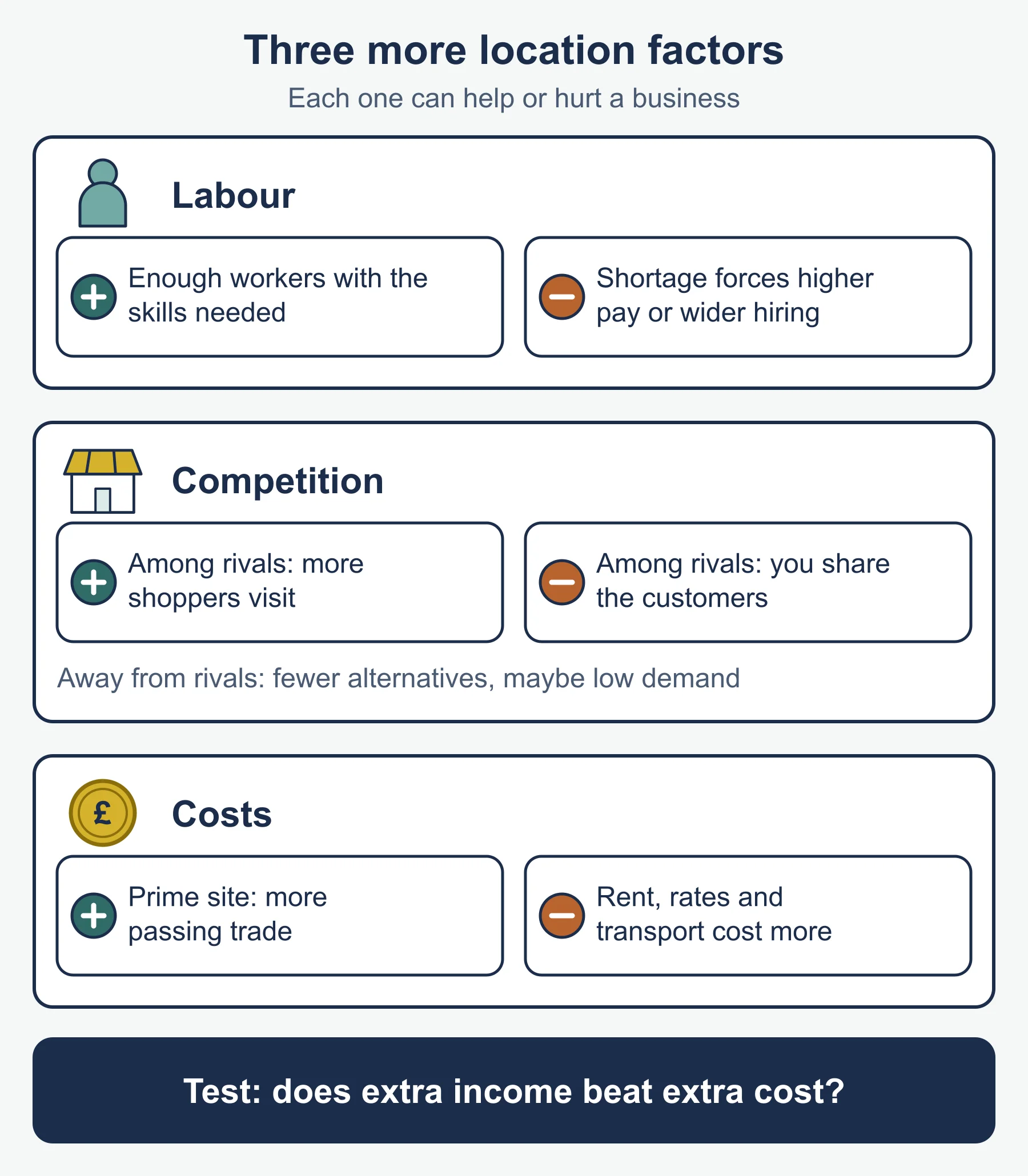
| Proximity to market | Easy access for customers, low delivery cost, fresh goods | Rent and rates in busy areas are high |
| Proximity to labour | Easy recruitment, right skills, lower wage costs | Competition for staff can raise wages; remote sites mean transport or relocation of staff |
| Proximity to materials | Lower transport cost, less waste or spoilage, reliable supply | Remote or hard-to-reach supply sites; the market may be far away |
| Proximity to competitors | Clusters attract customers and skilled workers | Customers can compare and switch; price pressure |
| Nature of the business activity | Matches the site to what the activity needs (resource, space, footfall) | Some activities have almost no choice (mining) |
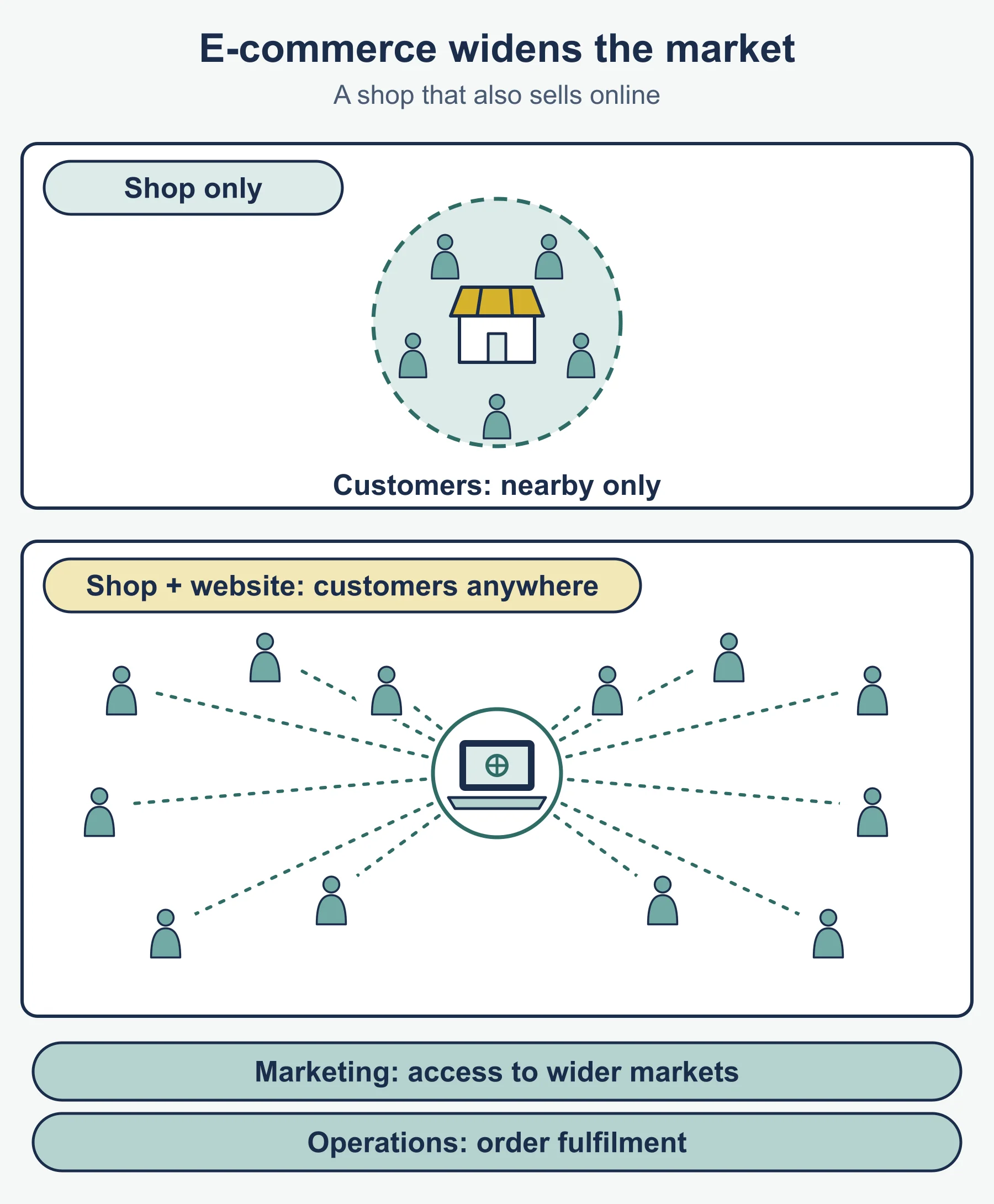
| Internet / e-commerce | Cheaper premises, wider market | Delivery and website costs; customers who want to see goods |
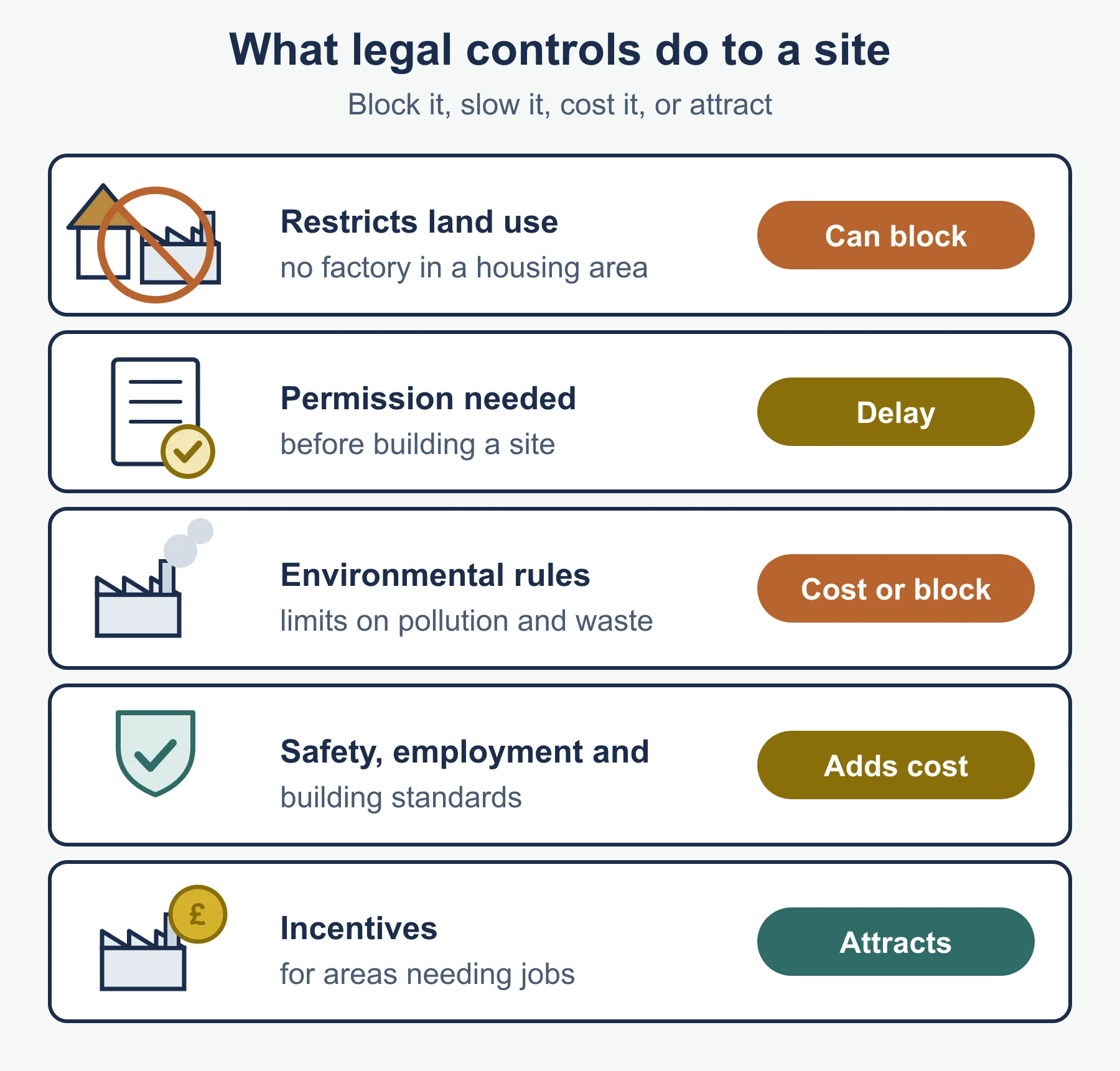
| Legal controls | Clear rules, protected neighbourhoods | Restrictions on use of land, noise, pollution; extra compliance costs |
| Trade blocs | Free or easier trade with members; no tariff inside | Tariffs on goods coming from outside |
Which factor leads?
Use this guide to get started, then check it against the case.
| If the business… | The factor that often leads |
|---|---|
| Handles heavy, bulky or perishable inputs | Materials |
| Sells to walk-in customers | Market |
| Needs particular skills in quantity | Labour |
| Extracts a resource | Nature of the activity |
| Sells small, light goods online | Internet (cheaper premises) |
| Exports to a bloc with a tariff | Trade bloc |
These are tendencies, not rules. A bulky product with a very small customer base may be driven by the market.
3. The internet and location (1.4.1)
- E-commerce is buying and selling online.
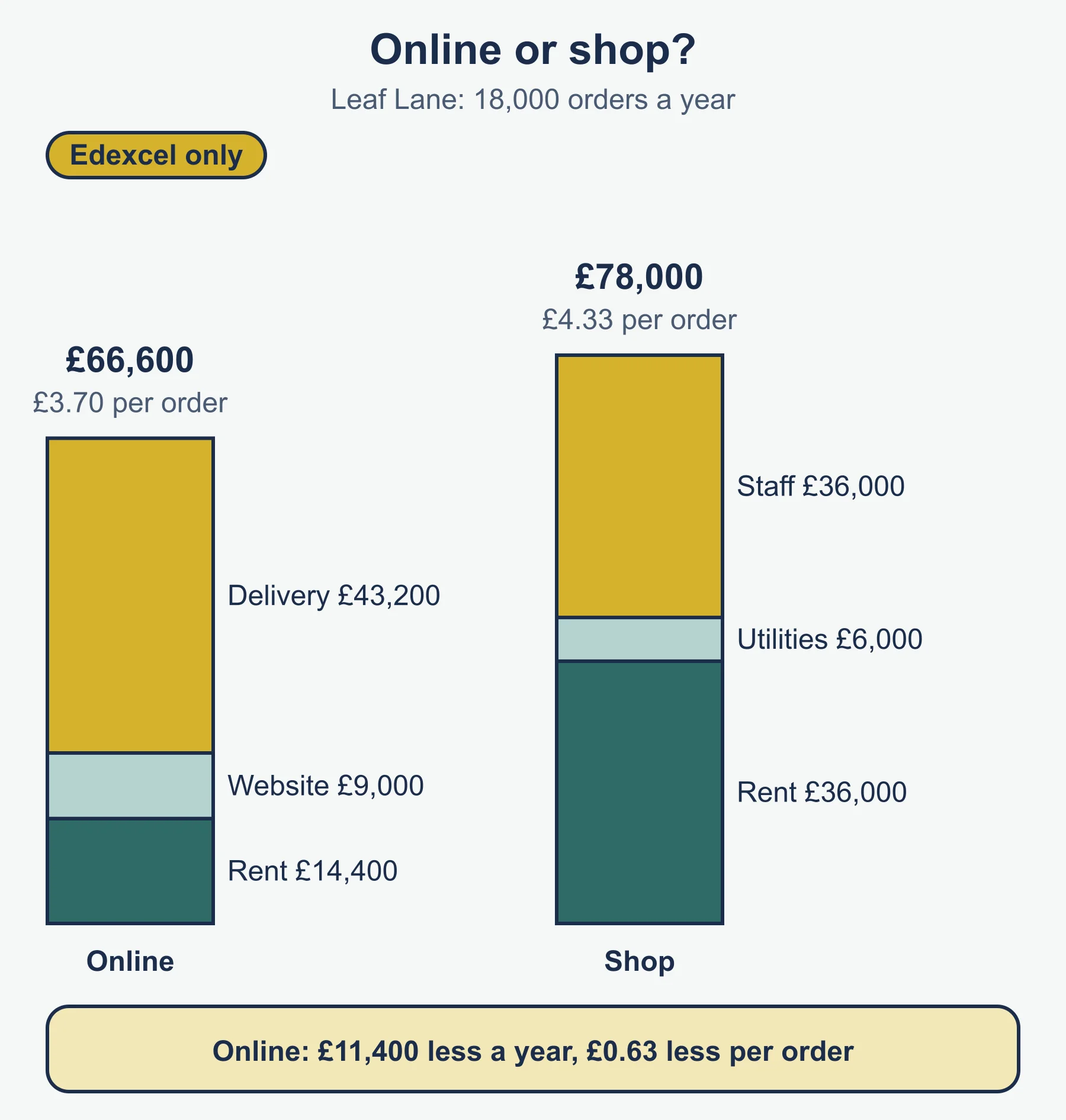
- Benefits: lower-cost premises, wider market, longer opening hours, lower staffing at the point of sale.
- Costs and limits: delivery, packaging, returns, website upkeep, no chance to touch or try goods, dependence on carriers.
- Fixed premises still matter when customers want to see goods, receive a personal service or collect quickly.
- Many businesses combine both.
Quick reminder calculation: a business ships 9,000 online orders at £3.20 delivery each. Delivery cost = 9,000 x 3.20 = £28,800.
4. Legal controls and trade blocs (1.4.1)
- Legal controls: rules that limit where or how a business may operate (use of land, noise, pollution, safety). Effects: a site may be unavailable, costs may rise, or a firm may be pushed away from housing. Describe the effect. Do not invent a statute.
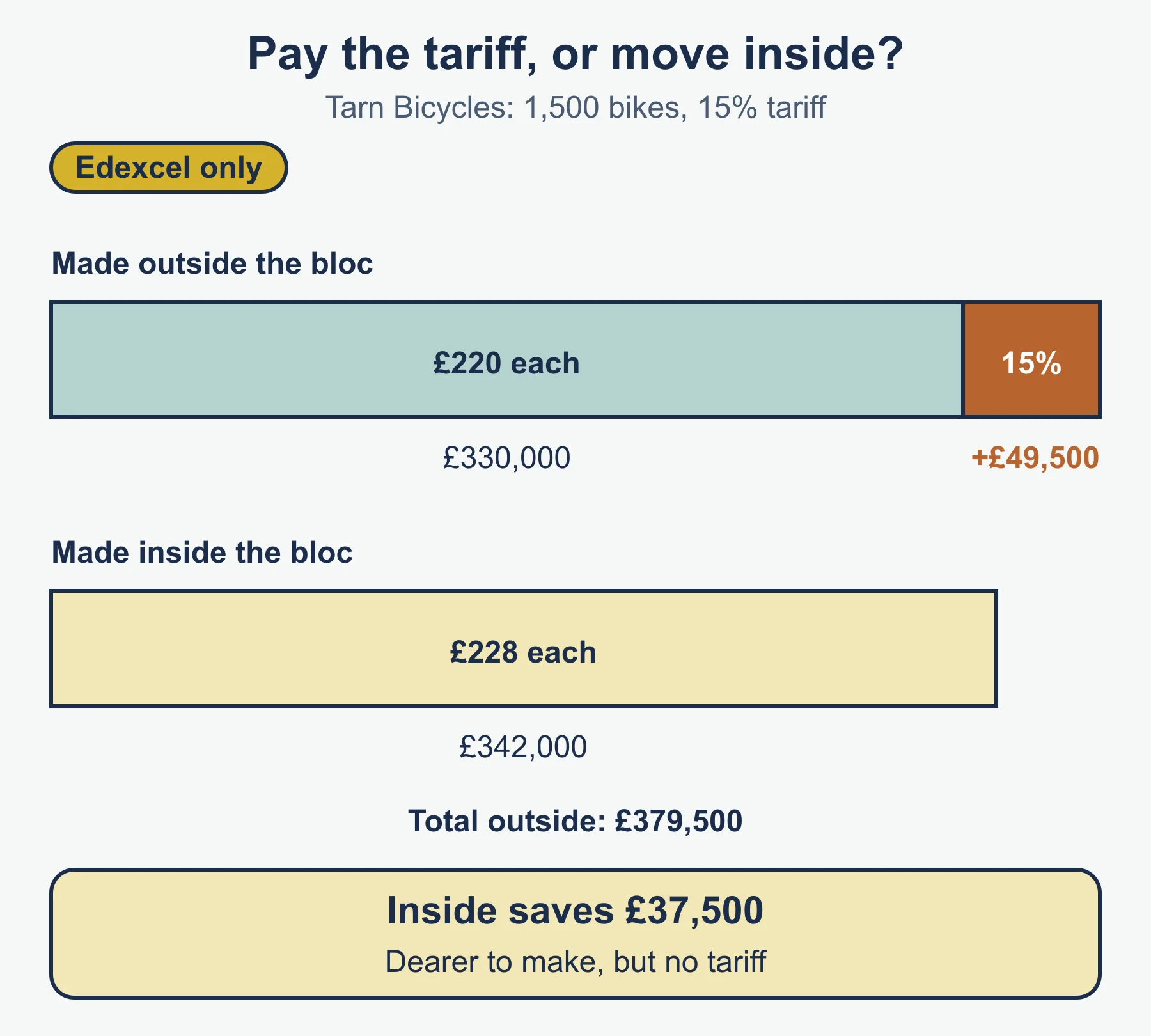
- Trade bloc: a group of countries that agree to reduce trade barriers between themselves. This is the standard form of the definition. Inside the bloc, trade is easier. Outsiders may pay a tariff (a tax on imports).
- Reminder calculation: a 10% tariff on £80,000 of imports = 0.10 x 80,000 = £8,000.
Compare the cost of locating inside and outside a bloc by adding the tariff to the outside cost, then comparing totals.
5. Relocation (1.4.1)
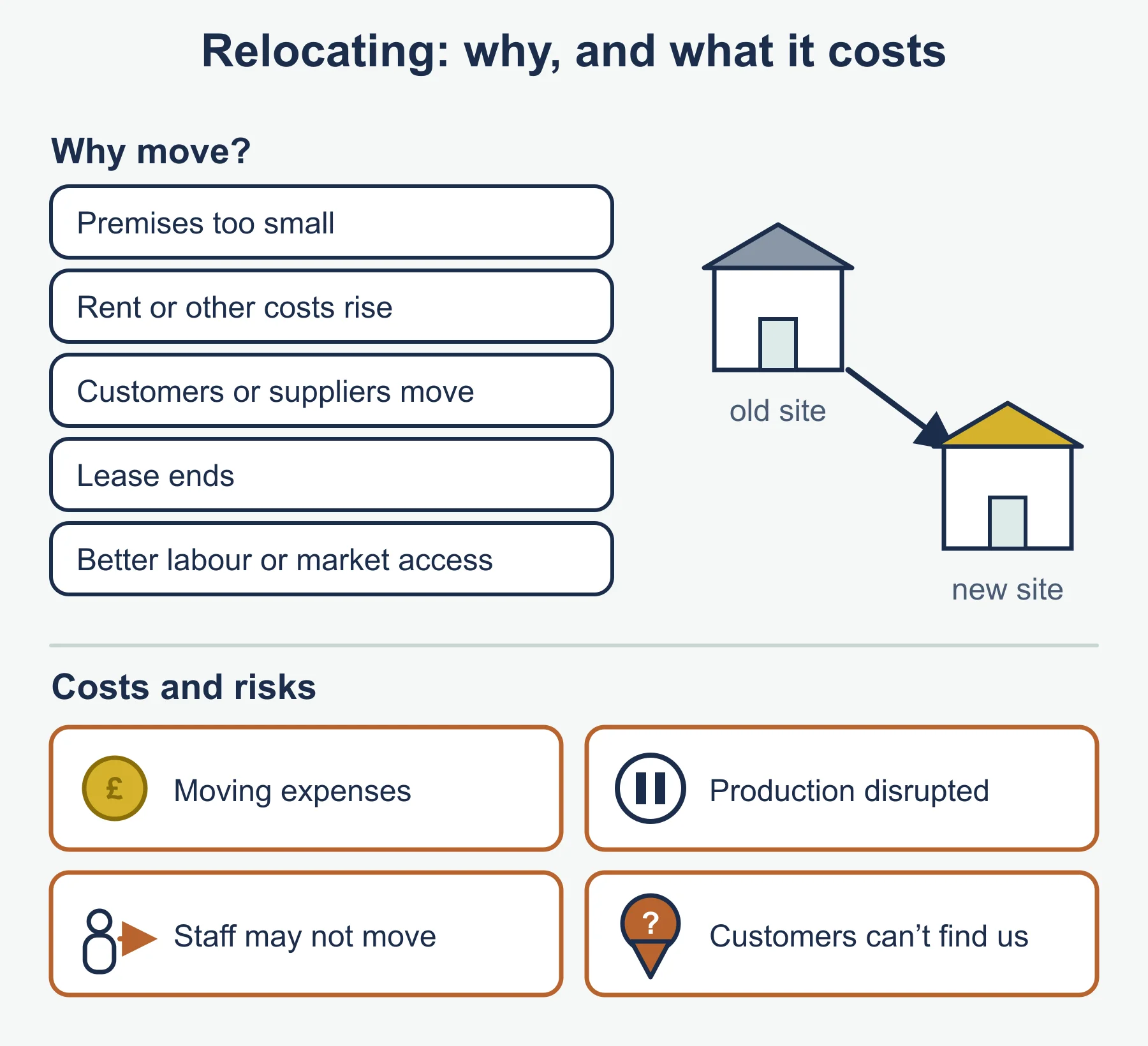
| Reasons a business may move | One-off costs and risks |
|---|---|
| Rent or other costs have risen | Moving and fitting-out costs |
| Business has outgrown its premises | Disruption to production and sales |
| Customers, labour or materials are now elsewhere | Staff who will not move |
| A new legal control restricts the site | Customers who cannot find the new site |
| A trade bloc change affects tariffs | Possible higher transport costs |
Method for a relocation decision:
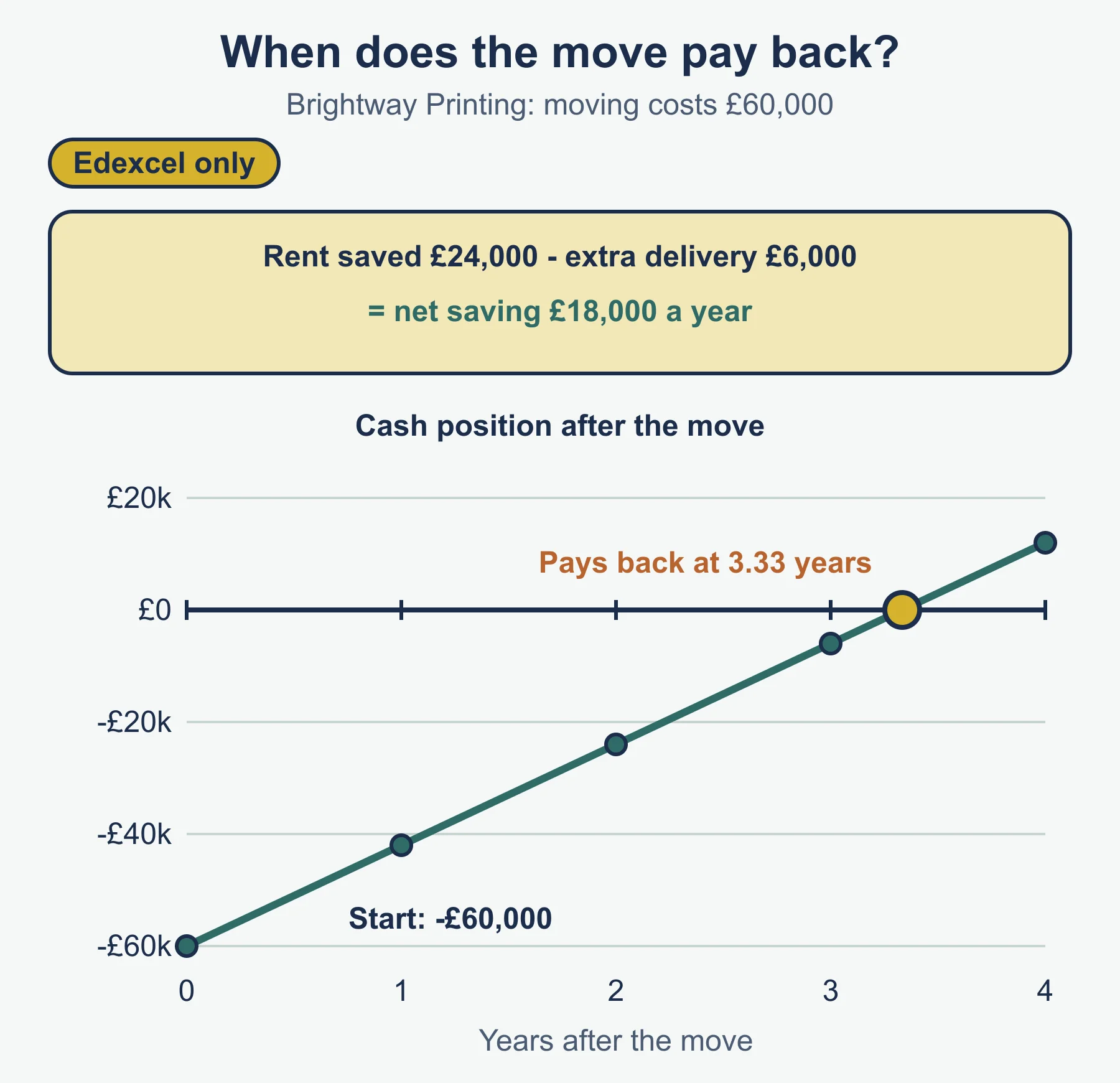
- Find the annual saving (or extra cost) of the new site.
- Subtract extra costs, such as transport.
- Compare the one-off cost with the annual net saving: one-off cost / annual net saving = years to recover.
- Weigh the non-financial effects (staff, customers, risk).
- Make a decision and give a reason.
Command words for this topic
The specification’s command-word table describes the answers as follows.
| Command word | What the table says | How to use it here |
|---|---|---|
| Define | define a term from the specification content | One clear sentence, such as the sector definitions above |
| Outline | two linked points, placed in context | Link cause and effect in the case |
| Explain | a statement of fact with two expansion points, no context | General statement, then two developments |
| Analyse | extended answer, placed in context | Chain of reasoning using case facts |
| Justify | extended answer recommending one of two options | Choose, then say why the other is weaker |
| Evaluate | extended answer reaching a supported conclusion | Weigh both sides, then judge |
Worked reminders
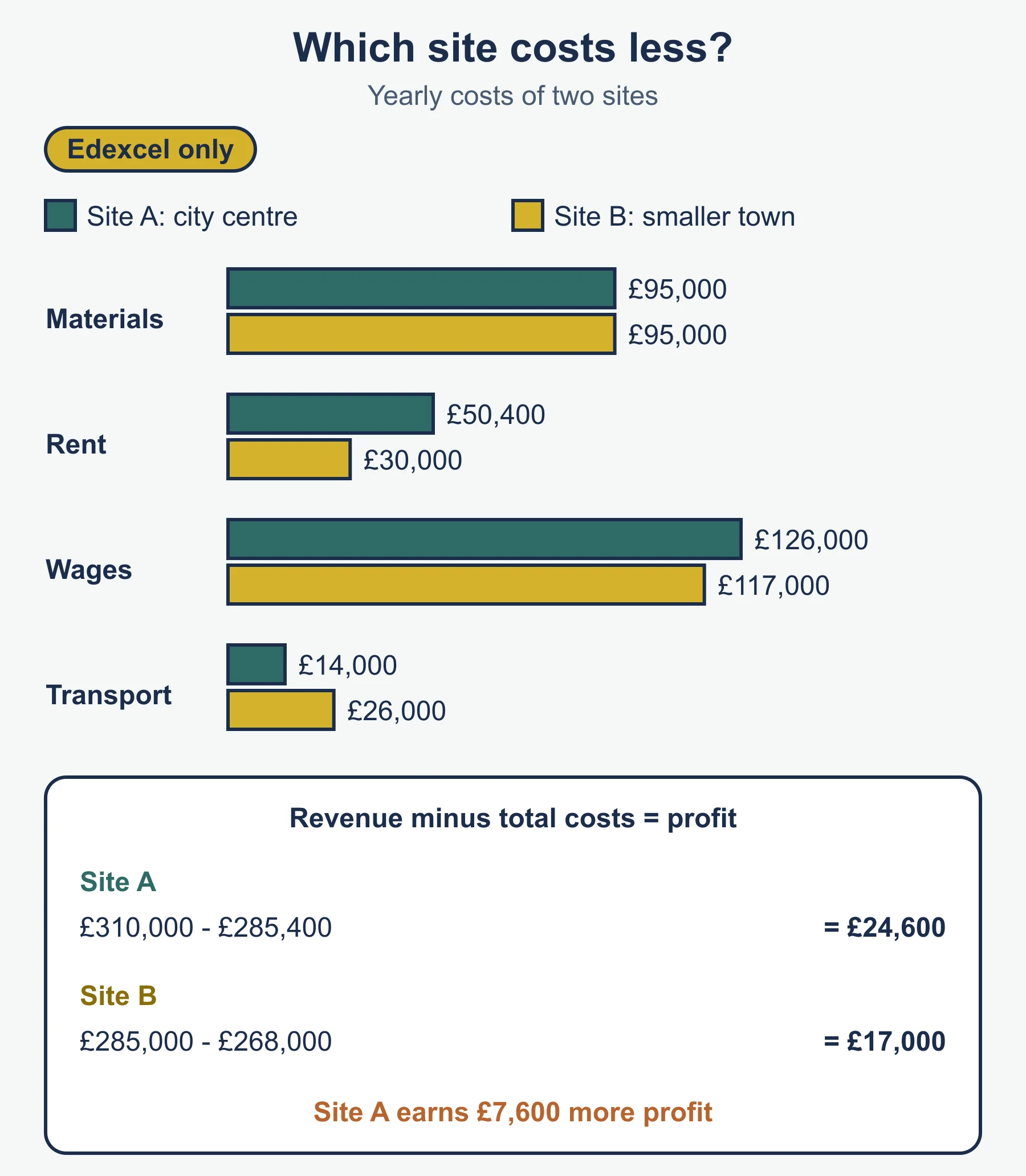
Comparing two sites. A bakery expects site P to cost £92,000 a year and bring in £120,000, and site Q to cost £81,000 and bring in £104,000. Profit at P = 120,000 - 92,000 = £28,000. Profit at Q = 104,000 - 81,000 = £23,000. P is £5,000 better on the figures. Then ask what the forecasts assume and what the figures leave out.
Reading a trade-off. Cheap rent far from customers lowers one cost but may cut revenue and raise delivery cost. Always follow a cost saving through to its knock-on effect.
Writing an analyse paragraph. Point (the factor), evidence (a fact from the case), consequence (what it does to cost, sales or convenience), link (why that matters for the decision).
Quick self-test
- Which sector does an oil-extraction company belong to?
- Which sector does a car assembly plant belong to?
- Which sector does an accountancy firm belong to?
- A firm has total revenue of £150,000, of which £45,000 comes from farming. What percentage is primary?
- Name the four proximity factors in 1.4.1.
- Why is the location of a quarry largely fixed?
- A town’s wage is £18,000 and another’s is £15,300. Calculate the percentage fall in wage cost.
- State one cost that rises when a shop moves online.
- A bloc charges a 10% tariff on goods worth £80,000. State the tariff.
- A move costs £90,000 and saves £30,000 a year net. How many years to recover the cost?
- Define “trade bloc”.
Answers
- Primary.
- Secondary.
- Tertiary.
- 45,000 / 150,000 x 100 = 30%.
- Market, labour, materials, competitors.
- The activity must take place where the resource is.
- (18,000 - 15,300) / 18,000 x 100 = 15%.
- Delivery (or packaging, returns, or website upkeep).
- £8,000.
- 90,000 / 30,000 = 3 years.
- A group of countries that agree to reduce barriers to trade between themselves.
Where marks are usually lost
- Giving a sector without a reason when the question asks you to link the activity to its definition.
- Classifying the company by its name rather than the activity described.
- Listing factors without saying how they change cost, revenue or convenience for the business in the case.
- Treating competitors as only a threat.
- Writing that the internet means a business needs no premises.
- Forgetting to add the tariff to the outside cost before comparing.
- Leaving out one-off costs in a relocation decision.
- Stopping at figures in an evaluate or justify answer, with no judgement.
- Describing legal controls in detail that is not in the question, or naming a law you are unsure of.
Frequently asked questions
What are the primary, secondary and tertiary sectors? The 4BS1 specification describes primary as extracting raw materials from the earth, secondary as converting raw materials into finished or semi-finished goods, and tertiary as the provision of a wide variety of services.
Is being close to competitors good or bad for a business? It can be both. A cluster of similar businesses may draw customers and skilled workers to an area, but it also means sharing customers and facing price competition.
How does e-commerce affect location decisions? An online seller can use cheaper premises away from busy areas and reach customers in other regions without opening shops. Costs shift to delivery, packaging, website upkeep and returns, and many businesses keep fixed premises as well.
What is a trade bloc? In the standard form, a trade bloc is a group of countries that agree to reduce barriers to trade between them. Producing inside a bloc can avoid tariffs on goods sold to its members.
Official syllabus
Pearson Edexcel International GCSE in Business (4BS1), Specification, Issue 2, February 2026, published by Pearson Education Limited. Topic 1: Business activity and influences on business, sections 1.3 Classification of businesses and 1.4 Decisions on location.
Get free revision emails (optional)
Occasional emails with practice questions, worked explanations and links to free resources for the qualification and subjects you choose. No spam, and you can unsubscribe from any email. The free tools on this site never need an email.
Related resources
-
Study guides
Edexcel IGCSE Business: Government objectives and policies, and external factors (4BS1)
Study guide to public spending, taxes, tariffs, interest rates and social, technological, environmental and political factors for Edexcel IGCSE Business.
Business · Pearson Edexcel · IGCSE
Read guide -
Practice questions
Edexcel IGCSE Business: Government objectives and policies, and external factors (4BS1) – Practice Questions
Original practice questions with worked answers on public spending, tariffs, interest rates and external factors for Edexcel IGCSE Business (4BS1).
Business · Pearson Edexcel · IGCSE
Try questions -
Revision notes
Edexcel IGCSE Business: Government objectives and policies, and external factors (4BS1) – Revision Notes
Condensed revision notes on public spending, taxation, tariffs, interest rates and the four external factors for Edexcel IGCSE Business, with a self-test.
Business · Pearson Edexcel · IGCSE
Revise topic
Related articles
-
teaching
A Level tuition in Dubai: Cambridge or Pearson Edexcel International A Level?
Schools in Dubai and Abu Dhabi teach either Cambridge International AS & A Level or Pearson Edexcel International A Level. How the two are structured, why it matters for tuition, and how online classes from Lahore work.
9 October 2026
-
curriculum guides
Choosing subjects at IGCSE and A Level
How subject choices at 14 and 16 affect university options later, and how to keep pathways open without overloading a timetable.
28 July 2026
Studying this with a teacher
Working through Business IGCSE?
This page is free and stays free. If you would rather be taught it, Marlbridge runs Business classes one-to-one and in small groups of up to 15, online in your own time zone. The first trial class is free. WhatsApp replies within an hour (8am–11pm Pakistan time, every day); email the same day.
Pearson Edexcel Business teachers at Marlbridge

