
Revision Notes
Edexcel IGCSE Business: Government objectives and policies, and external factors (4BS1) – Revision Notes
Condensed revision notes on public spending, taxation, tariffs, interest rates and the four external factors for Edexcel IGCSE Business, with a self-test.
- Subject
- Business
- Level
- IGCSE
- Topic
- Business activity and influences on business
- Author
- Marlbridge Academic Team
- Updated
- Reviewed by
- Asif Iqbal (what this means)
Aligned to Pearson Edexcel IGCSE Business (4BS1), Issue 2, February 2026. Official specification .
Syllabus page (what it covers and how it is assessed): Pearson Edexcel IGCSE Business.
Syllabus points this page covers
4BS1
- 1 Business activity and influences on business (whole topic)
- 1.6 Government objectives and policies
- 1.7 External factors
Found an error? Report a correction.
Want a teacher for this? Marlbridge teaches Business online. Request a free trial class.
These revision notes condense Topic 1, sections 1.6 and 1.7 of the Pearson Edexcel International GCSE in Business (4BS1) specification, Issue 2, February 2026. For full explanations and worked examples, read the study guide first. The specification says Paper 1 (small businesses) and Paper 2 (large businesses) can both draw on the whole content, so revise this for either paper.
Also useful: the 4BS1 Business hub, the printable checklist, the practice questions and the free diagnostics.
Outcome map
| Point | Content | Key terms |
|---|---|---|
| 1.6.1 | Government spending to provide public service; taxation; constraints on public spending | public services, tax, opportunity cost |
| 1.6.2 | Infrastructure provision; legislation; trade policy (membership of trading blocs, tariffs) | infrastructure, law, trading bloc, tariff |
| 1.6.3 | Effect of interest rates on businesses and on consumer spending | cost of borrowing, credit, saving |
| 1.7.1 | External factors: social, technological, environmental, political | outside the firm’s control |
The specification lists these points without defining them: the short definitions here are standard textbook definitions, not specification wording, and the treatment of taxes and laws is general. The command word definitions at the end are the specification’s own.
Briefest coverage in these notes: legislation (the specification names no particular laws, so it is kept general) and the political factor.
1.6.1 Government spending
Public services are provided by the government and paid for from public funds (for example health, education, policing).
Taxation raises the money. In general terms:
| Tax falls on | Effect on a business |
|---|---|
| Business profits | Less profit kept for growth or owners |
| Workers’ incomes | Less to spend, so weaker demand |
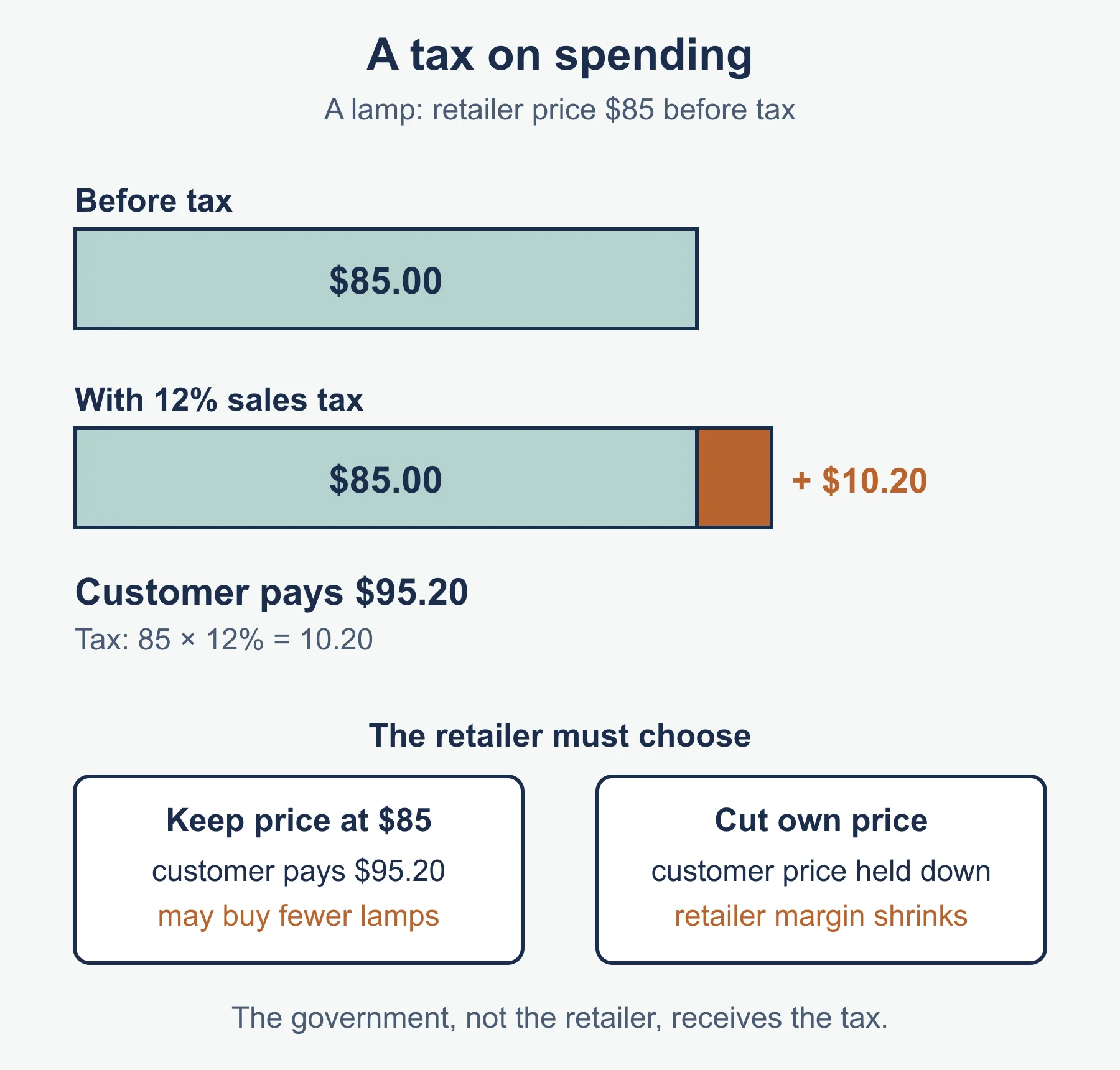
| Spending | Higher customer price, so possibly lower sales |
Constraints on public spending
- Tax revenue is limited.
- Borrowing must be repaid with interest.
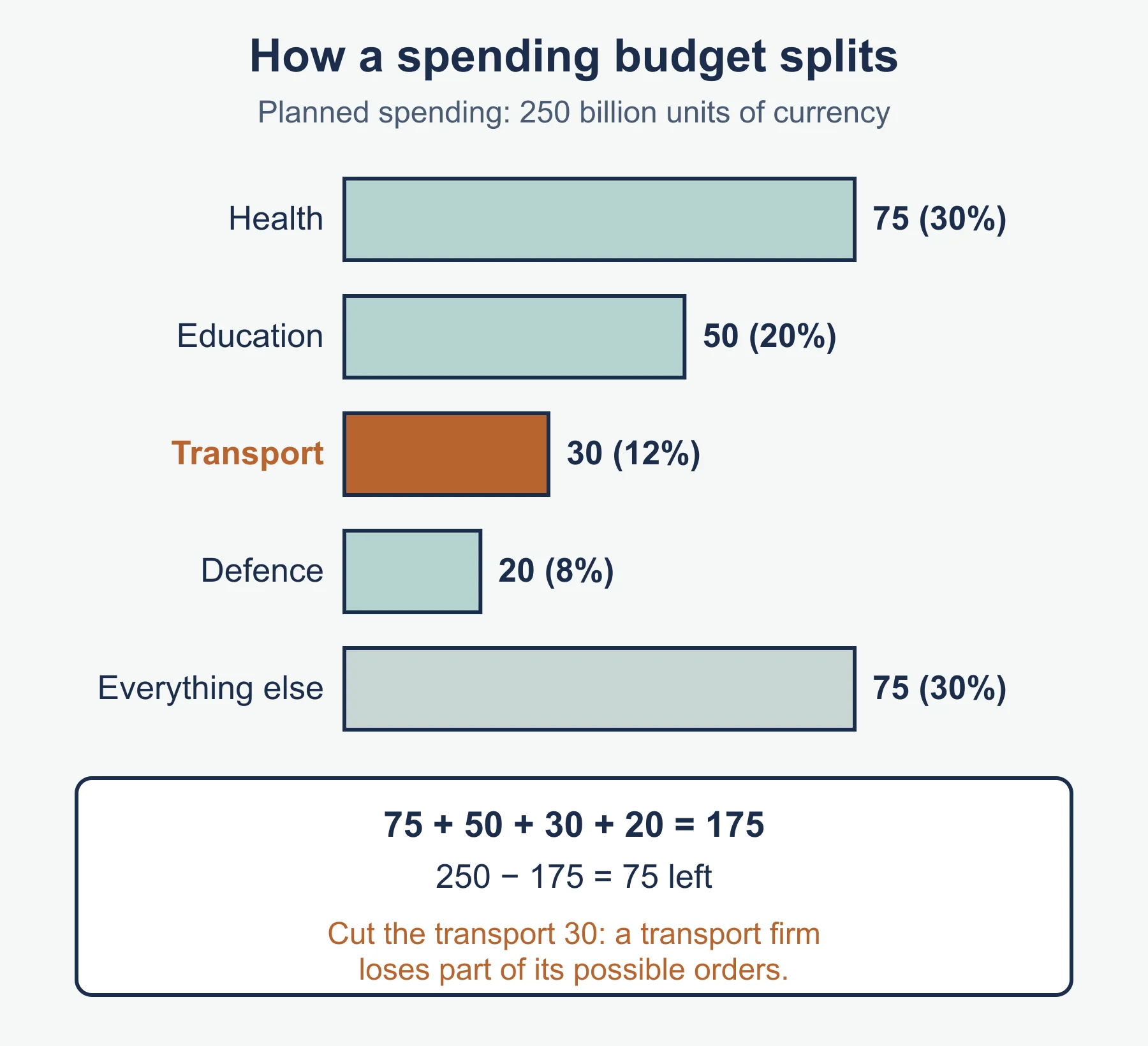
- Opportunity cost: spending on one thing means not spending on another.
- A weak economy lowers tax receipts.
Reminder calculation. Sales tax: price × rate = tax; price + tax = customer price. At 12% on 85, the tax is 10.20 and the customer pays 95.20.
1.6.2 How governments affect business activity
| Policy | What it is | Likely effect on a business |
|---|---|---|
| Infrastructure | Roads, rail, ports, power, communications | Lower transport costs, reliability, access to markets and workers |
| Legislation | Laws on consumers, employees, environment, competition | Compliance costs, product changes, penalty risk, consumer trust |
| Trading bloc | Group of countries trading on easier terms | Cheaper access to a bigger market, but more competition |
| Tariff | Tax on imports | Dearer imports, protected home producers, revenue for government |
Method in steps: working out a tariff
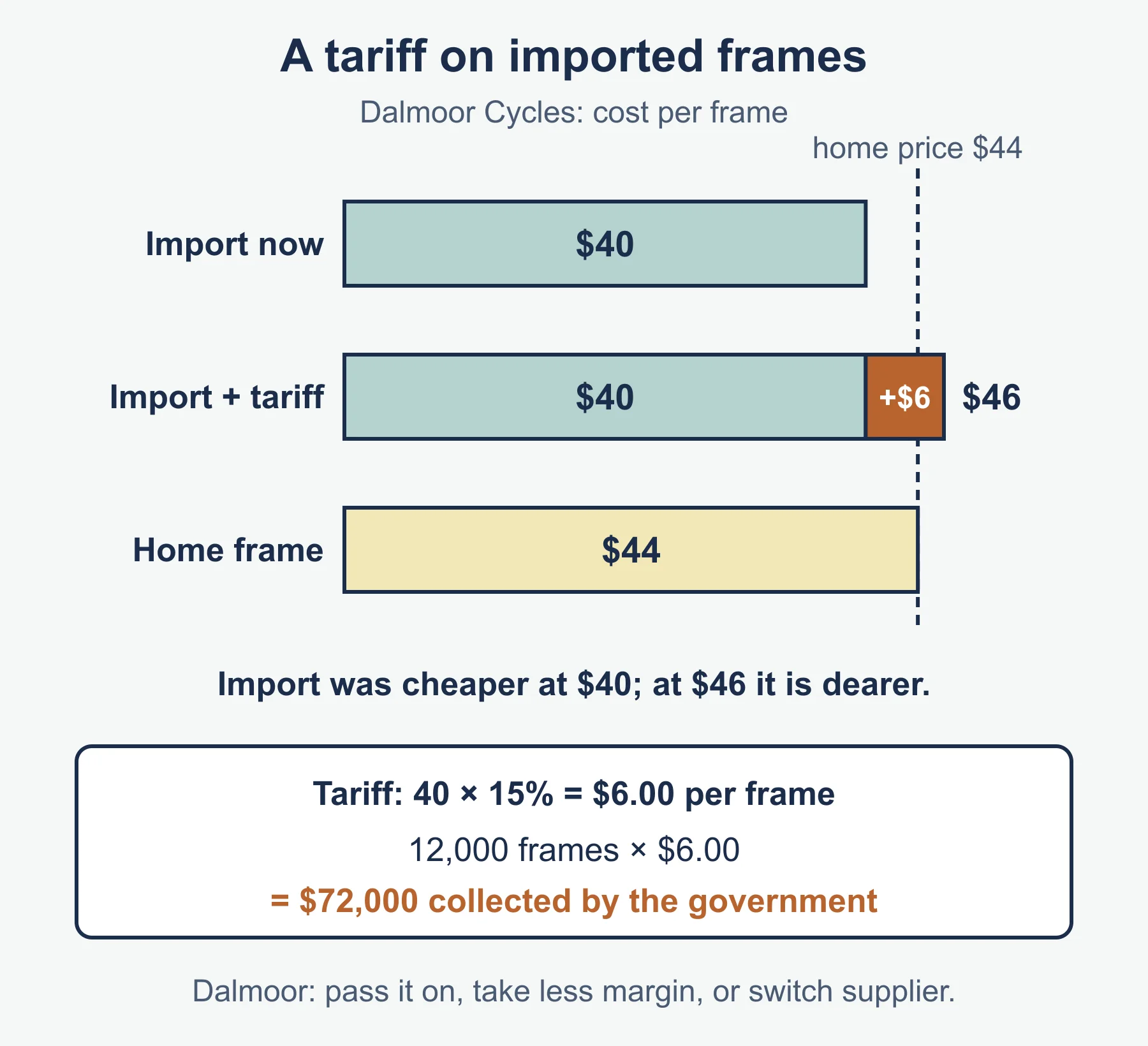
- Tariff = import price × tariff rate.
- New cost = import price + tariff.
- Compare with the home-produced price.
- Decide who gains (home producers, government) and who loses (importers, customers).
Reminder: 40 with a 15% tariff becomes 46.00, so a home product at 44 is now cheaper.
1.6.3 Interest rates
Businesses. Higher rates mean higher interest on loans and overdrafts, lower profit, and fewer projects worth the borrowing cost. Lower rates reverse this.
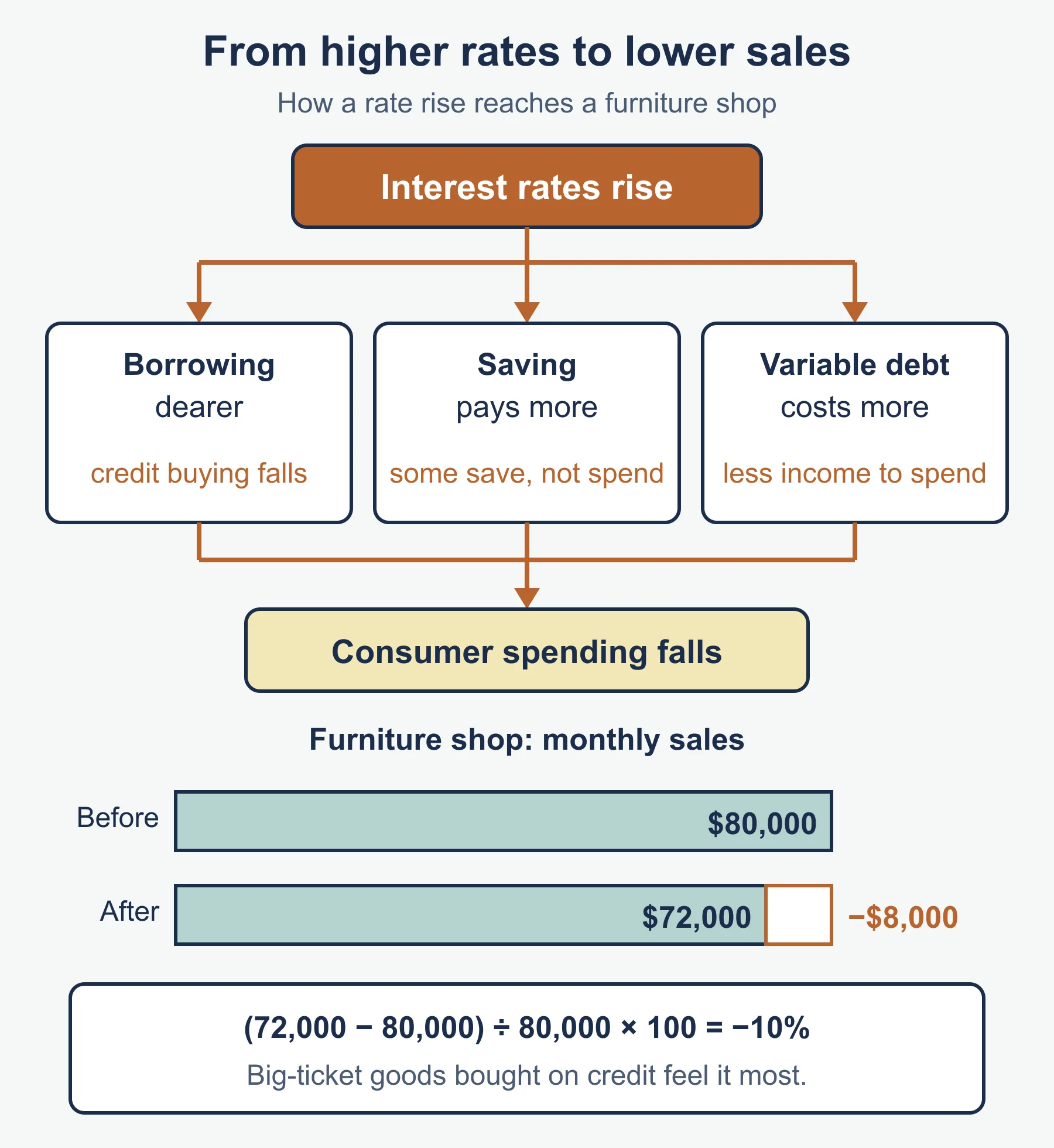
Consumers. Higher rates make credit dearer and saving more attractive, so spending on credit-financed goods falls. Lower rates raise spending.
| Rates rise | Rates fall |
|---|---|
| Interest cost up | Interest cost down |
| Investment delayed | Investment more attractive |
| Consumer spending down | Consumer spending up |
| Biggest hit: cars, furniture, houses | Biggest boost: same big-ticket goods |
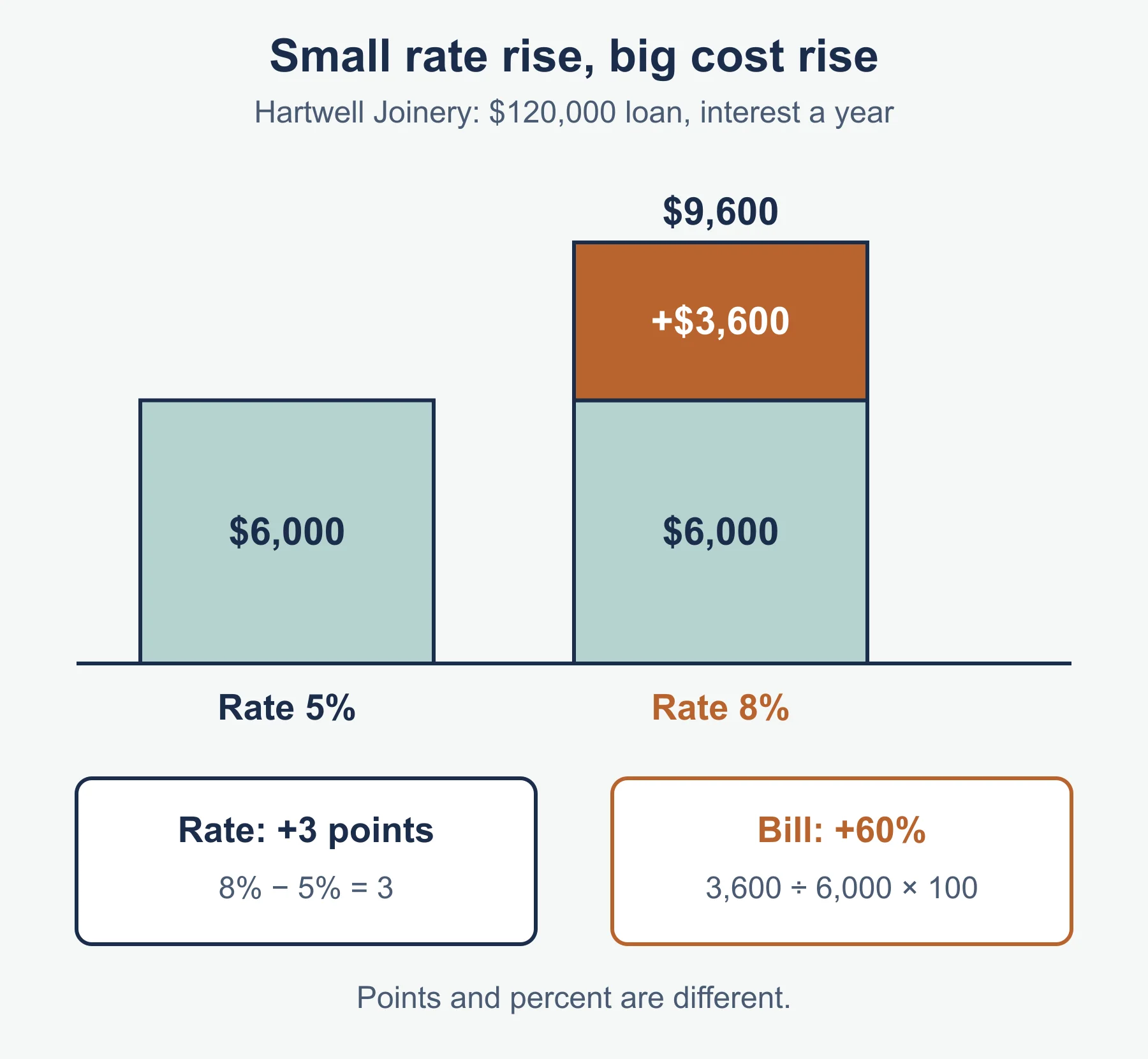
Reminder calculation. Interest = loan × rate. 120,000 at 5% is 6,000; at 8% is 9,600. That is a rise of 3 percentage points but a 60% rise in the bill.
1.7.1 External factors
| Factor | Examples | Effect on decisions |
|---|---|---|
| Social | Ageing population, changing tastes, ethical attitudes | Product range, advertising, staffing |
| Technological | Automation, online selling, new software | Costs, sales channels, retraining |
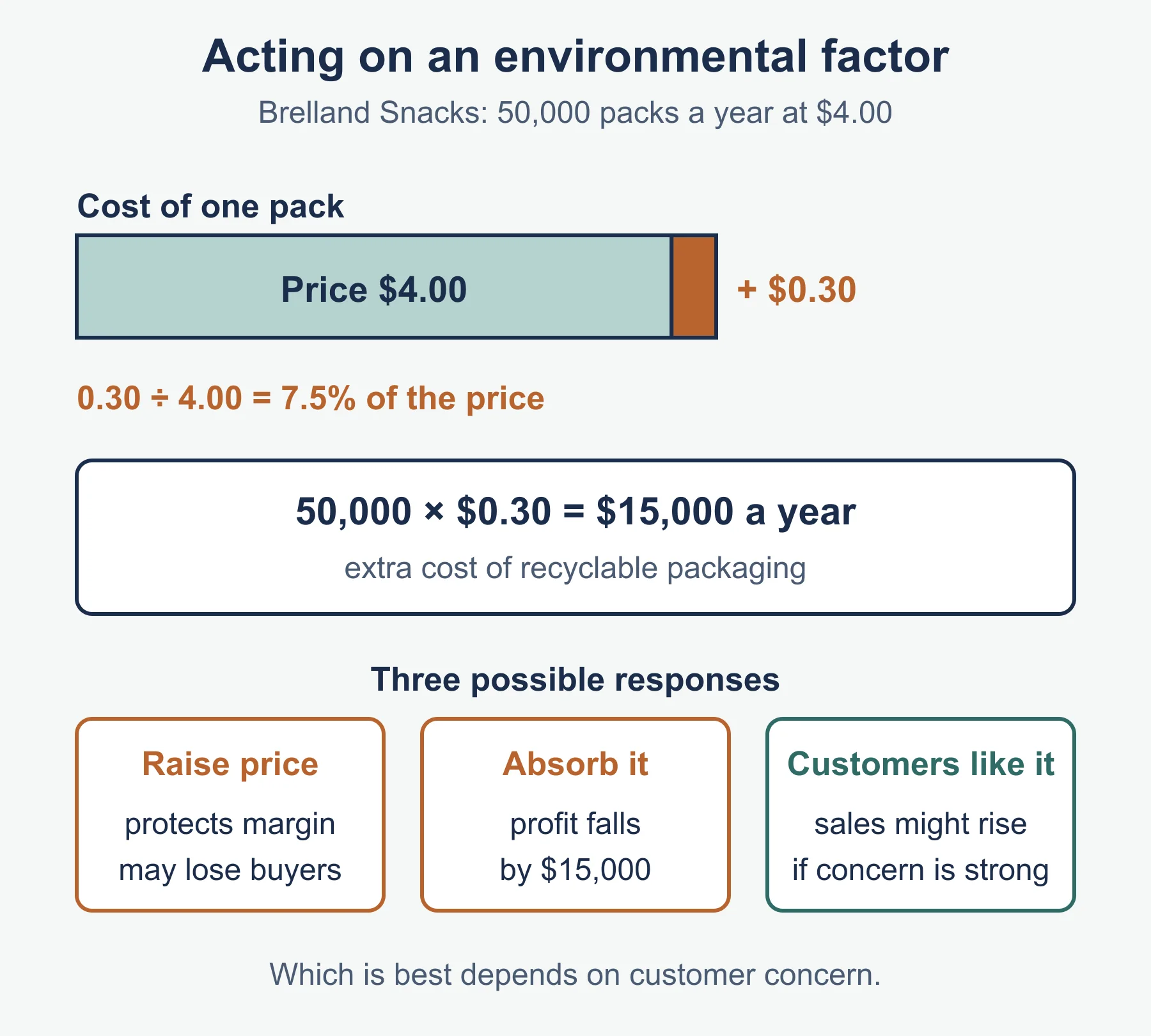
| Environmental | Pollution, waste, resource use, climate concern | Packaging, energy use, reputation |
| Political | Government policy, elections, stability | Planning, tax, trade, laws |
An external factor is something the firm cannot control but must respond to. Always link the factor to a specific decision: what to sell, where, at what price, how to produce.
Method in steps: answering an analyse or evaluate question
- Identify the policy or factor in the stem (for example a rate rise, a new tariff, a social trend).
- Name the first effect on the business: costs, price, demand or the way it operates.
- Expand: say what that does to profit, cash flow, market share or customers.
- Use the numbers in the case. Work out the change before commenting on it.
- For evaluate, weigh the other side and say which effect is likely to be larger for this business and why. Give a supported conclusion.
Worked reminders
Tax on profit. A business makes a profit of 200,000 and the tax rate on profit is 20%. Tax = 40,000; profit after tax = 160,000. The business can use the 160,000 to reinvest or to pay owners.
Consumer borrowing. A shopper borrows 2,400 on a store card. At 6% the interest is 144 a year; at 9% it is 216. The difference of 72 is a small amount for one person, but it is repeated across many customers, so a retailer who sells on credit sees demand change.
Online sales share. A shop has sales of 640,000, of which 18% are online (115,200). If online sales grow by 25% they reach 144,000, which is 22.5% of the original total. A technological shift can change the sales mix quickly.
Wage costs and social change. A rise of 8% in an hourly wage of 5.50 gives 5.94. Social factors such as changing expectations of pay and conditions feed through to the cost of labour in the same way.
Linking the two sections
Government policy and external factors overlap. Environmental concern leads customers to demand greener products (social and environmental), and the government may respond with legislation (political). Technology can create an infrastructure need, such as better communications networks. When a question gives one factor, ask what others it triggers.
| Starting point | Possible chain |
|---|---|
| Rates rise | Loan interest up, consumer credit costly, sales fall, profit falls |
| Tariff on imports | Imported inputs dearer, price rises or margin falls, home rivals gain |
| New environmental law | Compliance cost, product change, reputation gain |
| Better roads | Lower delivery cost, wider customer reach, new competitors arrive |
Must-know distinctions
- Tariff versus tax on spending: a tariff applies to imports; a tax on spending applies to purchases generally.
- Percentage points versus percentage change: from 5% to 8% is 3 points; the interest bill rises 60%.
- Public service versus infrastructure: public services are provided to people; infrastructure is the physical network businesses use.
- Legislation versus policy: a law must be obeyed; a policy is a plan of action that may use laws, taxes or spending.
- Internal versus external: the firm controls its own prices and staff; it does not control social, technological, environmental or political factors.
Command words
The specification defines these as follows. Outline: give two linked points about a business concept or issue, placed in context. Explain: give a statement of fact with two further expansion points, with no context. Analyse: write an extended answer with expansion and exploration, placed in context. Justify: use the information provided to recommend one of two options. Evaluate: use knowledge of the content to reach a supported conclusion about a business situation.
Quick self-test
- State one way a government pays for public services.
- Give two constraints on public spending.
- Define infrastructure.
- A 25% tariff is placed on an import costing 52. Calculate the new cost.
- Name one benefit and one drawback of joining a trading bloc for a business.
- A business has a loan of 150,000. The rate rises from 6% to 9%. Calculate the extra yearly interest.
- Explain why higher interest rates may reduce sales of cars.
- Name the four external factors in 1.7.1.
- Sales fall from 9,600 to 8,160. Calculate the percentage change.
- Give one way a technological change could affect a small business.
Answers
- Taxation (it may also borrow).
- Any two of: limited tax revenue, borrowing must be repaid, opportunity cost, weak economy lowering tax receipts.
- The basic physical networks such as roads, rail, ports, power and communications that businesses rely on.
- 52 × 25% = 13.00, so the cost is 65.00.
- Benefit: cheaper access to a larger market. Drawback: more competition from other members.
- 150,000 × 9% = 13,500; 150,000 × 6% = 9,000; extra = 4,500.
- Cars are often bought on credit; dearer borrowing makes monthly payments higher, so fewer people buy.
- Social, technological, environmental, political.
- (8,160 − 9,600) ÷ 9,600 × 100 = −15%.
- For example, online selling opens a wider market without a shop; or the cost of new equipment strains its cash.
Where marks are usually lost
- Describing a policy without naming its effect on the business in the question.
- Treating a tariff as a tax on exports.
- Giving only one side of a bloc, tariff or interest rate change.
- Saying “interest rates go up so profit goes down” without explaining that the loan interest increases.
- Mixing up percentage points and percentage change.
- Listing the four external factors but not linking any to a decision.
- Ignoring the context: a small local business and a large multinational feel the same policy differently.
- In evaluate questions, stopping at analysis and not giving a supported conclusion.
Frequently asked questions
What are the constraints on government spending? Tax revenue is limited, borrowing has to be repaid with interest, every spending choice has an opportunity cost, and a weak economy can cut tax receipts just when demand for public services rises.
How do higher interest rates affect consumer spending? Borrowing on credit cards, car finance and mortgages costs more, saving becomes more rewarding and people with variable-rate debts have less to spend. Sellers of big-ticket goods bought on credit usually notice the change most.
What are the four external factors in Edexcel IGCSE Business? The 4BS1 specification names social, technological, environmental and political factors. They are outside a business’s control but still affect its decisions.
What is a trading bloc? A trading bloc is a group of countries that agree to trade with one another on easier terms, typically with lower or no tariffs between members, while outsiders may face barriers.
Official syllabus
Pearson Edexcel International GCSE in Business (4BS1), Specification, Issue 2, February 2026, published by Pearson Education Limited. Topic 1: Business activity and influences on business, sections 1.6 and 1.7.
Get free revision emails (optional)
Occasional emails with practice questions, worked explanations and links to free resources for the qualification and subjects you choose. No spam, and you can unsubscribe from any email. The free tools on this site never need an email.
Related resources
-
Study guides
Edexcel IGCSE Business: What makes a business successful (4BS1)
Study guide to measuring business success and the reasons for business failure in Edexcel IGCSE Business (4BS1), with worked examples.
Business · Pearson Edexcel · IGCSE
Read guide -
Practice questions
Edexcel IGCSE Business: What makes a business successful (4BS1) – Practice Questions
Original practice questions with worked answers on measuring success and reasons for business failure, Edexcel IGCSE Business 4BS1 section 1.8.
Business · Pearson Edexcel · IGCSE
Try questions -
Revision notes
Edexcel IGCSE Business: What makes a business successful (4BS1) – Revision Notes
Condensed revision notes on measuring business success and the reasons for failure for Edexcel IGCSE Business 4BS1 section 1.8, with a self-test.
Business · Pearson Edexcel · IGCSE
Revise topic
Related articles
-
teaching
A Level tuition in Dubai: Cambridge or Pearson Edexcel International A Level?
Schools in Dubai and Abu Dhabi teach either Cambridge International AS & A Level or Pearson Edexcel International A Level. How the two are structured, why it matters for tuition, and how online classes from Lahore work.
9 October 2026
-
curriculum guides
Choosing subjects at IGCSE and A Level
How subject choices at 14 and 16 affect university options later, and how to keep pathways open without overloading a timetable.
28 July 2026
Studying this with a teacher
Working through Business IGCSE?
This page is free and stays free. If you would rather be taught it, Marlbridge runs Business classes one-to-one and in small groups of up to 15, online in your own time zone. The first trial class is free. WhatsApp replies within an hour (8am–11pm Pakistan time, every day); email the same day.
Pearson Edexcel Business teachers at Marlbridge

