
Study Guides
Edexcel IGCSE Business: Government objectives and policies, and external factors (4BS1)
Study guide to public spending, taxes, tariffs, interest rates and social, technological, environmental and political factors for Edexcel IGCSE Business.
- Subject
- Business
- Level
- IGCSE
- Topic
- Business activity and influences on business
- Author
- Marlbridge Academic Team
- Updated
- Reviewed by
- Asif Iqbal (what this means)
Aligned to Pearson Edexcel IGCSE Business (4BS1), Issue 2, February 2026. Official specification .
Syllabus page (what it covers and how it is assessed): Pearson Edexcel IGCSE Business.
Syllabus points this page covers
4BS1
- 1 Business activity and influences on business (whole topic)
- 1.6 Government objectives and policies
- 1.7 External factors
Found an error? Report a correction.
Want a teacher for this? Marlbridge teaches Business online. Request a free trial class.
This guide follows the Pearson Edexcel International GCSE in Business (4BS1) specification, Issue 2, February 2026. It covers Topic 1, section 1.6 “Government objectives and policies” (1.6.1 to 1.6.3) and section 1.7 “External factors” (1.7.1). The specification says both Paper 1 (small businesses, up to 49 employees) and Paper 2 (large businesses, more than 250 employees) can draw on the whole content, so expect this material in either paper, applied to a business in the question.
Course links: the 4BS1 Business hub, the printable checklist and the free diagnostics. Companion pages: the revision notes and the practice questions.
What the specification asks for
| Point | You must be able to | Where in this guide |
|---|---|---|
| 1.6.1 | Government spending: to provide public service; taxation and constraints on public spending | Section 1 |
| 1.6.2 | How governments can affect business activity: infrastructure provision, legislation, trade policy (membership of trading blocs, tariffs) | Section 2 |
| 1.6.3 | The effect of interest rates on businesses and on consumer spending | Section 3 |
| 1.7.1 | External factors affecting business decisions: social, technological, environmental, political | Section 4 |
All amounts in this guide are in dollars. The people and businesses are invented.
The specification lists these points as topics without defining them. The definitions of infrastructure, legislation, trading bloc, tariff and interest rate below are standard textbook definitions, not specification wording, and the account of taxes and laws is general.
1. Government spending and taxation (1.6.1)
A government spends money to provide public services: health care, education, policing, defence, public transport and similar services that are paid for from public funds, not by the customer at the point of use. Businesses feel this spending in two ways. As citizens they gain from a healthier, better-educated workforce. As suppliers, many sell directly to the government: a construction firm builds a school, a software firm supplies a hospital system.
Taxation is how the government raises most of the money. The specification does not list individual taxes, so think in general terms: taxes on the profits of businesses, on the incomes of workers and on spending. Each one affects a business differently.
- A tax on business profits leaves less to retain for growth or to pay to owners.
- A tax on workers’ incomes leaves employees with less to spend, which can reduce demand.
- A tax on spending raises the price the customer pays for the product, which can reduce the quantity bought.
Constraints on public spending are the limits on what a government can afford. It cannot spend more than it can raise through taxes and borrowing without consequences. Typical constraints are:
- Tax revenue is limited, because raising taxes too far upsets voters and businesses.
- Borrowing has to be repaid, with interest.
- Every spending choice has an opportunity cost: money spent on roads cannot also be spent on schools.
- The economy may be weak, so tax receipts fall just when demand for public services rises.
Worked example 1: the effect of a tax on spending
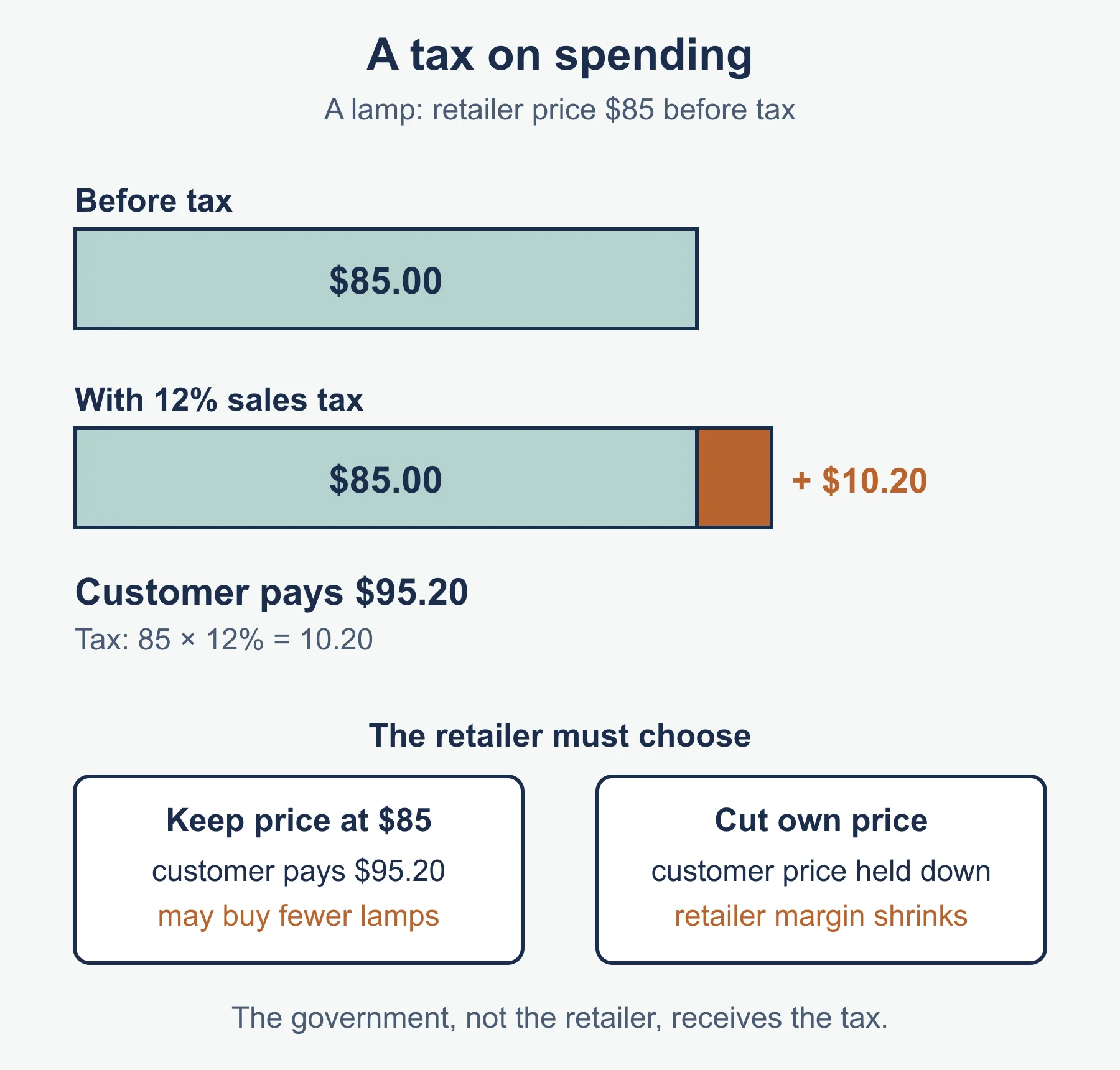
A sales tax of 12% is added to the price of a lamp that a retailer sells for 85 before tax.
Tax = 85 × 12% = 10.20. Price paid by the customer = 85 + 10.20 = 95.20.
The retailer now faces a decision. If it keeps the pre-tax price at 85, the customer pays 95.20 and may buy fewer lamps. If it cuts its own price to hold the customer price down, its margin shrinks. Either way the tax affects the business even though the government, not the retailer, receives the money.
Worked example 2: how a spending budget splits
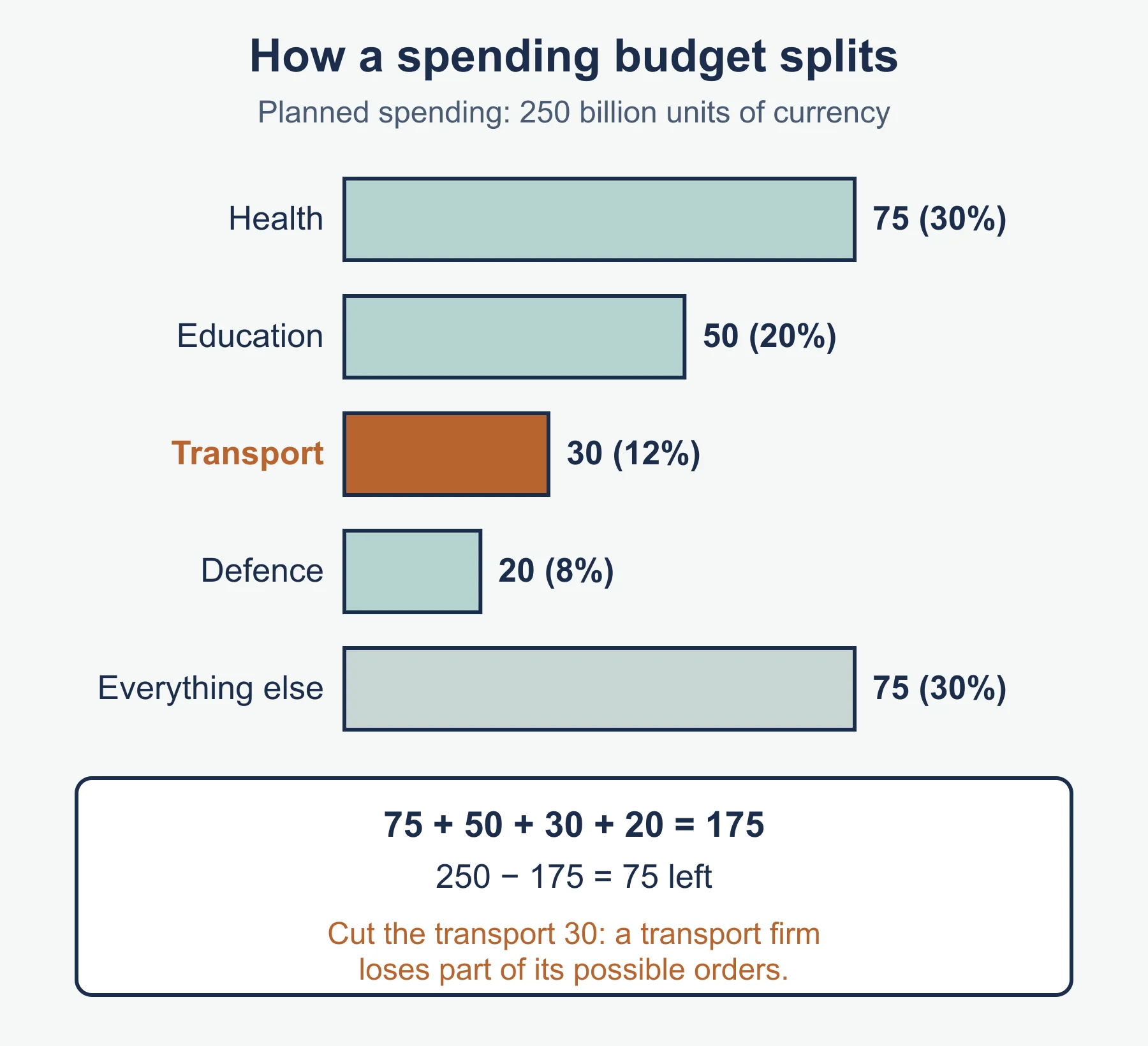
A country plans to spend 250 billion units of currency. Health takes 30%, education 20%, transport 12% and defence 8%.
Health = 250 × 30% = 75. Education = 250 × 20% = 50. Transport = 12% of 250 = 30. Defence = 8% of 250 = 20. Total of these four = 175, so 75 is left for everything else.
A firm in the transport sector sees a large part of its possible demand coming from the 30. If the government is forced by a constraint to cut that figure, the firm’s order book is at risk. That is the link examiners want: spending decision, constraint, effect on a named business.
2. How governments affect business activity (1.6.2)
Infrastructure provision
Infrastructure is the roads, railways, ports, airports, energy supply, water and communications networks that businesses rely on. When the government provides it, businesses gain lower transport costs, faster deliveries, reliable power and better access to customers and workers. Good infrastructure can also influence where a business chooses to locate. Poor infrastructure does the opposite: delays, breakdowns and higher costs. Building it takes a long time and uses public money, so it links back to the constraints in section 1.
Legislation
Legislation is the laws that a government passes. Businesses must obey them, and the specification does not name particular laws here, so describe the effect in general terms. Laws can protect consumers, protect employees, protect the environment and set rules for competition. For a business the effects are usually:
- extra costs, such as training, new equipment or safer working conditions
- the need to change a product, process or advertisement
- a risk of penalties or damaged reputation if the business breaks the law
- benefits too: a level playing field, and customers who trust products that must meet standards.
A small business may find the cost of compliance heavier than a large one, because it spreads the cost over fewer sales.
Trade policy: trading blocs and tariffs
A trading bloc is a group of countries that agree to trade with one another on easier terms, typically with lower or no tariffs between members. For a business inside the bloc, this means cheaper access to a larger market, and more competition from other member countries. For a business outside the bloc, it can mean tariffs and extra hurdles when selling in.
A tariff is a tax on imported goods. It raises the price of the import in the home market. The government gains revenue and home producers become more price-competitive. Importers and consumers lose.
Worked example 3: a tariff
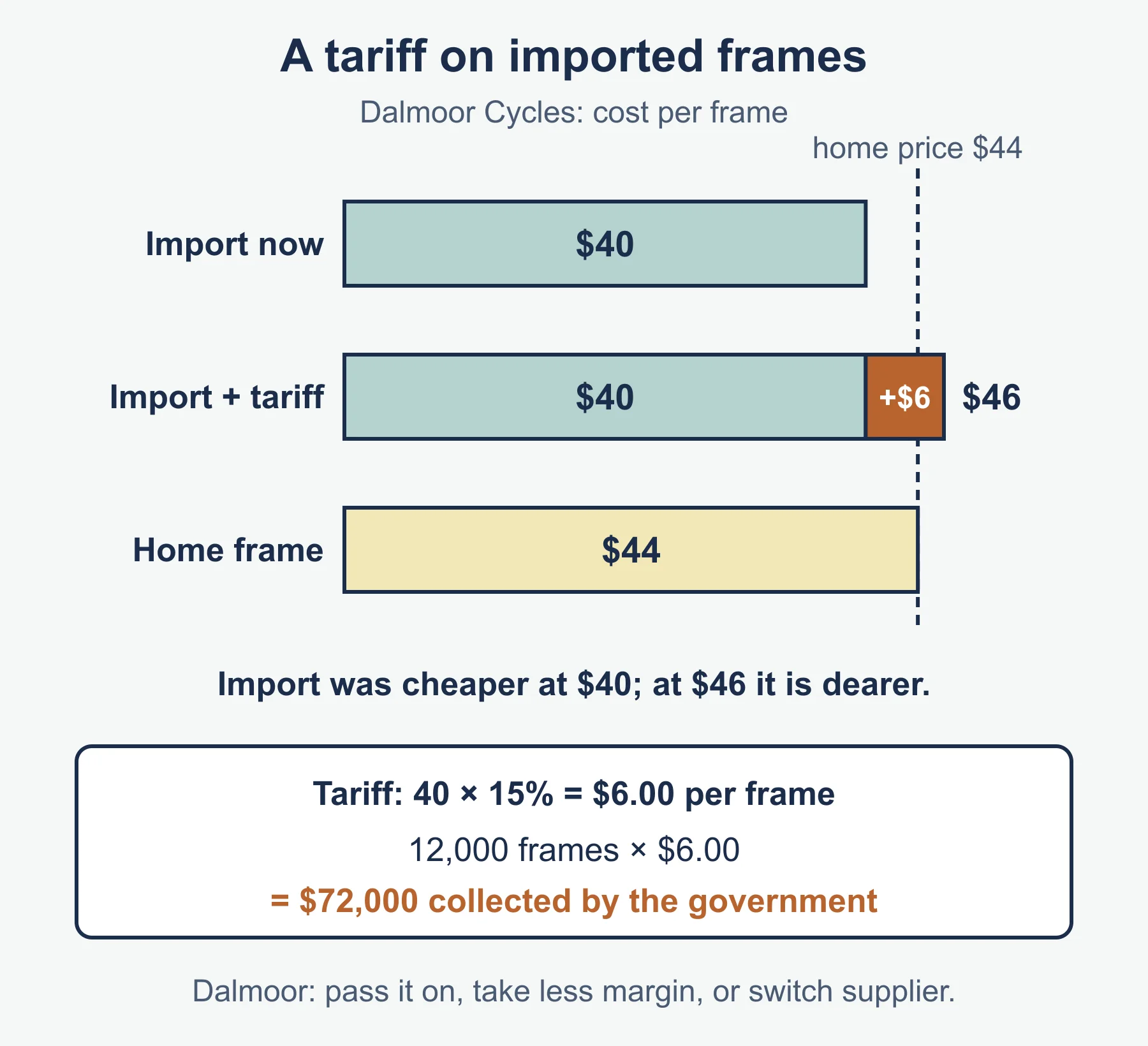
Dalmoor Cycles imports a frame at a cost of 40 each. The government puts a 15% tariff on imported frames.
Tariff per frame = 40 × 15% = 6.00. Cost after tariff = 46.00.
A home producer sells similar frames for 44. Before the tariff the import was cheaper at 40. After it, the import is more expensive at 46. Dalmoor’s costs rise by 15%. It can pass the increase on to its customers, accept a lower margin, or switch to the home supplier. If it imported 12,000 frames in the year, the government collects 12,000 × 6.00 = 72,000 in tariff.
3. Interest rates (1.6.3)
An interest rate is the price of borrowing money (and the reward for saving). When rates change, they affect both businesses and consumers.
Effect on businesses
- Cost of borrowing. Higher rates raise the interest paid on loans and overdrafts, which cuts profit and cash flow. Lower rates do the reverse.
- Investment. With higher rates fewer projects look worth the cost of borrowing, so firms delay expansion.
- Demand. Because customers react to rates too, the effect on sales matters as much as the effect on costs.
Worked example 4: a business loan
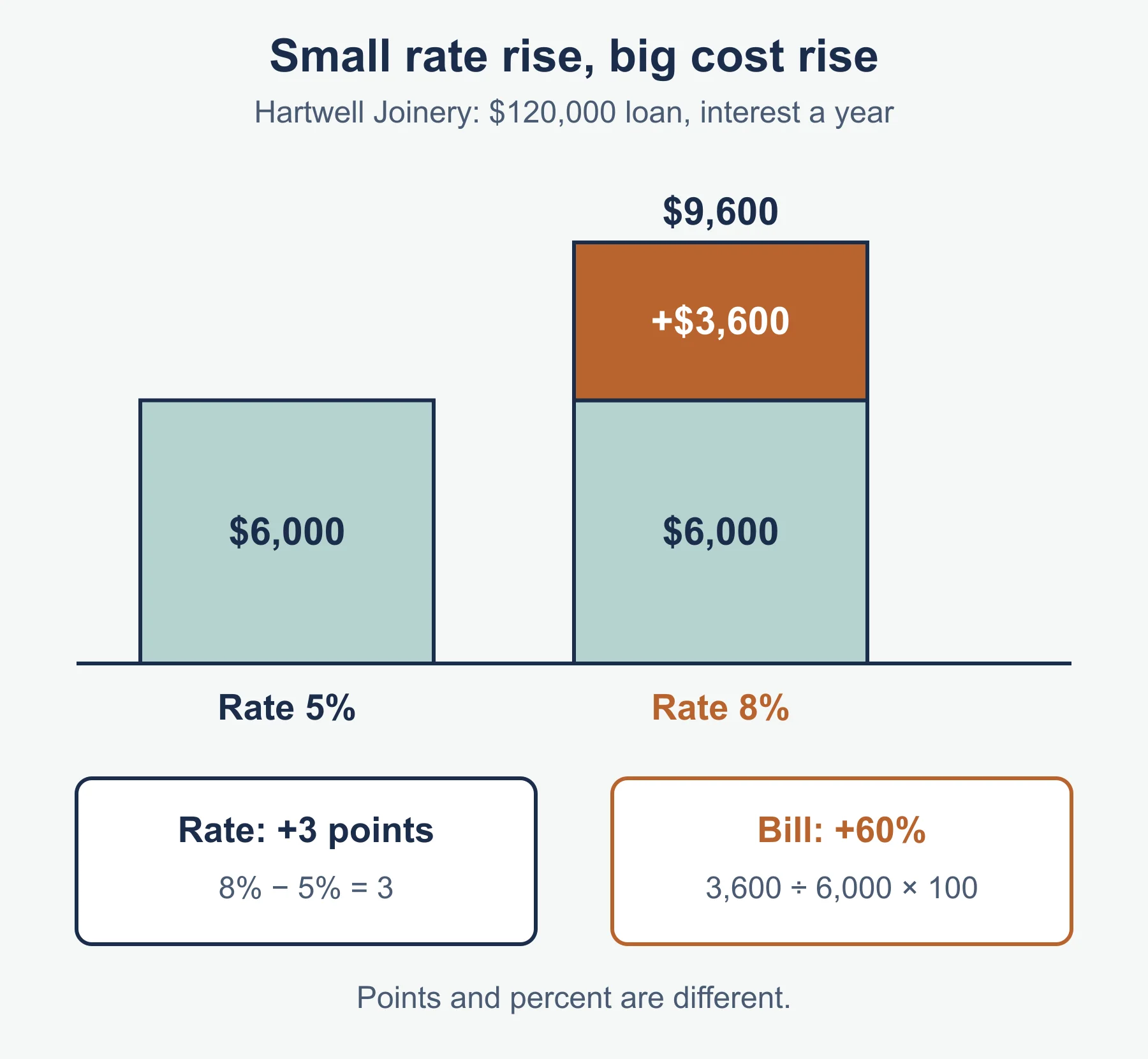
Hartwell Joinery has a loan of 120,000 at 5% interest a year.
Interest at 5% = 120,000 × 5% = 6,000 a year. If the rate rises to 8%, interest = 120,000 × 8% = 9,600. Extra cost = 9,600 − 6,000 = 3,600 a year.
The rate has risen by 3 percentage points, but the interest bill has risen by (3,600 ÷ 6,000) × 100 = 60%. A small change in the rate can be a large change in the cost, especially for a heavily borrowed firm.
Effect on consumer spending
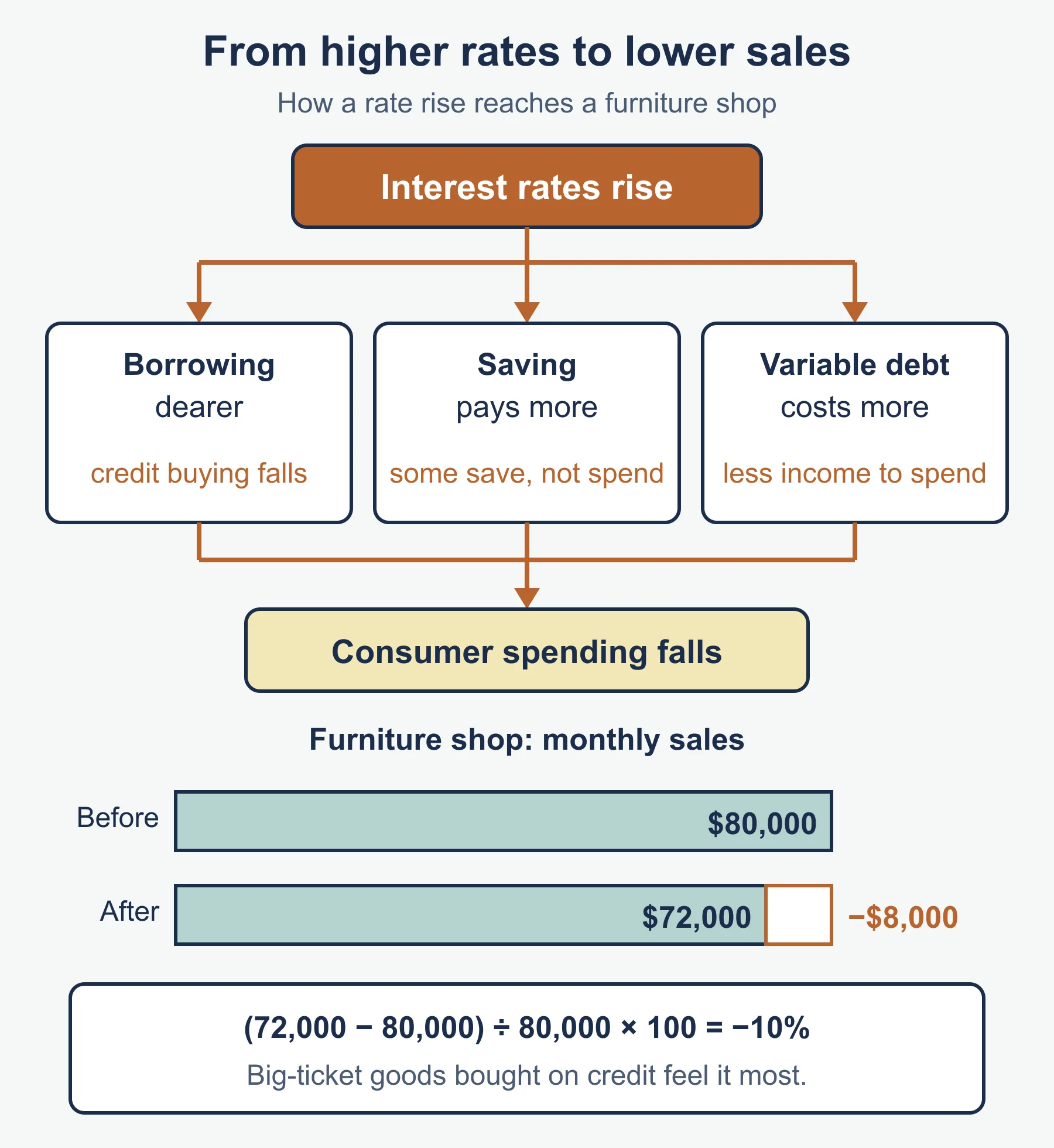
Consumers also borrow, through credit cards, car finance and mortgages, and they can save. When rates rise:
- borrowing is more expensive, so credit-financed purchases fall
- saving is more rewarding, so some people save instead of spending
- people with existing variable-rate debts have less income left to spend.
Falling rates push spending the other way. Businesses selling big-ticket goods bought on credit, such as cars, furniture and houses, usually notice the change most. Businesses selling everyday necessities notice less.
Worked example 5: from interest rates to sales
A furniture shop sells 80,000 worth of goods a month. After interest rates rise, its monthly sales fall to 72,000.
Change = 72,000 − 80,000 = −8,000. Percentage change = (−8,000 ÷ 80,000) × 100 = −10%.
The shop has a double problem: weaker sales, and a higher interest bill if it borrowed to buy stock. A balanced answer says which effect is likely to be larger.
4. External factors (1.7.1)
External factors are things outside a business’s control that still affect its decisions. The specification names four: social, technological, environmental and political.
Social factors
Changes in how people live and what they want. Examples: an ageing population, changing tastes, growing demand for healthy food, different working patterns, shifts in attitudes to a business’s ethics. A business that spots a trend can adjust its products; one that ignores it loses customers.
Technological factors
New equipment, software and ways of selling. Technology can lower costs through automation, open new channels such as online selling, and speed up communication. It also costs money to adopt, may need retraining, and can make existing products or skills out of date.
Environmental factors
Concern for the natural environment: pollution, waste, use of resources and climate. Pressure comes from customers, the government and the public. Responding can mean higher costs, for example recyclable packaging, but it can also win customers and improve reputation.
Political factors
The decisions and stability of governments. Policies on tax, spending, laws and trade (section 2) are political decisions, and so are elections, a change of government and unrest. Political uncertainty makes planning harder.
Worked example 6: a cost of acting on an environmental factor
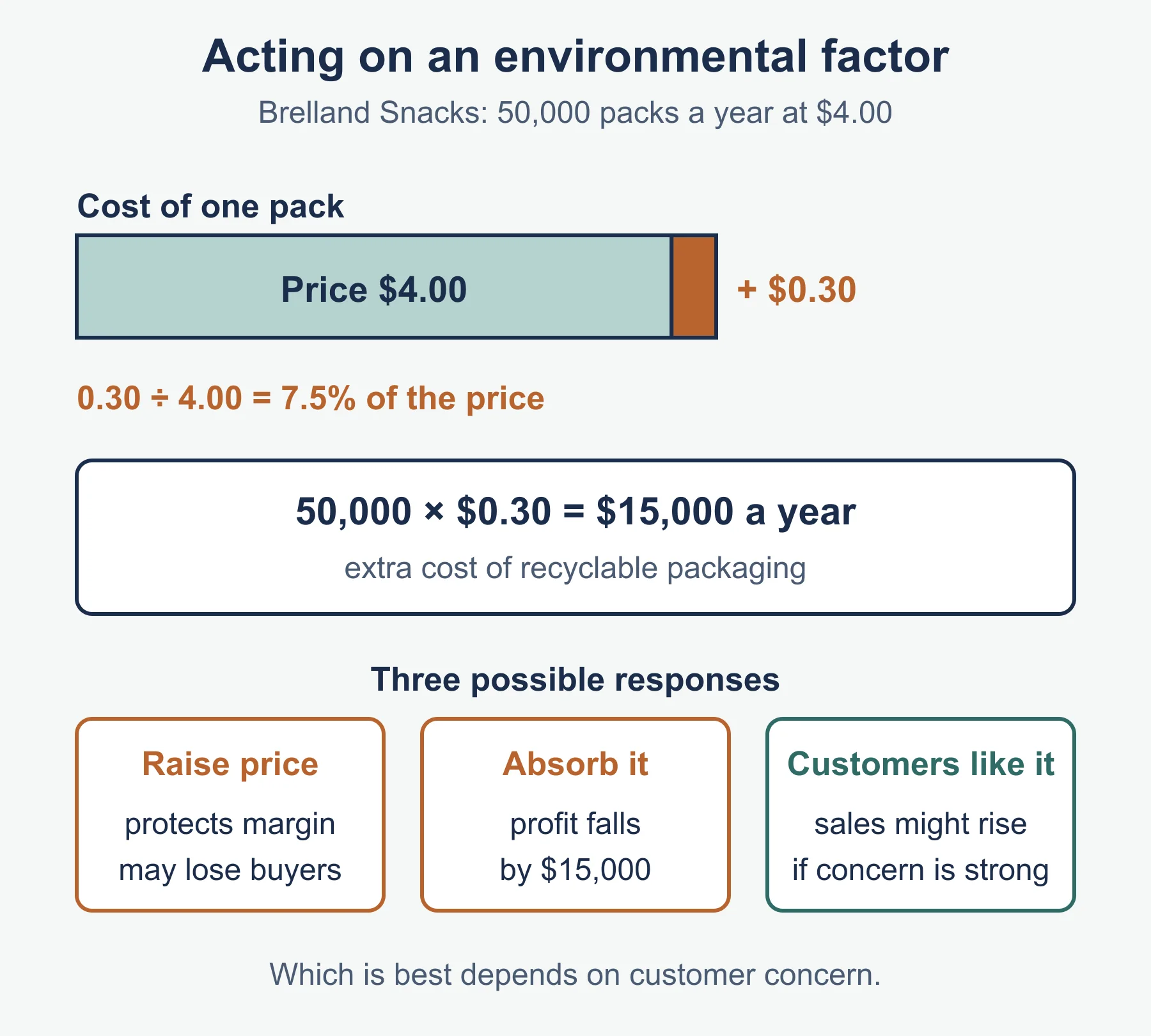
Brelland Snacks sells 50,000 packs a year at 4.00. Recyclable packaging adds 0.30 a pack.
Extra cost = 50,000 × 0.30 = 15,000 a year. As a share of the price, 0.30 ÷ 4.00 = 7.5%.
If it raises the price by 0.30 it protects its margin but may lose price-sensitive customers. If it absorbs the cost, profit falls by 15,000. If customers value the change, sales might rise. The decision depends on how strong that customer concern is.
Common errors
- Writing about trade, rates and laws without naming how the business is affected (cost, revenue, price, demand).
- Calling a tariff a tax on exports. It is a tax on imports.
- Saying higher interest rates always hurt every business. A business with savings or one selling necessities may be little affected.
- Giving the four external factors as a list with no link to a decision.
- Treating the government as separate from the business environment, instead of as a stakeholder that sets rules.
- Percentage points confused with percentages (3 points versus a 60% rise).
Next steps
Condense the key terms with the revision notes, then test yourself with the practice questions. Return to the 4BS1 Business hub, tick off progress on the checklist, or find weak spots with the free diagnostics.
Frequently asked questions
How does infrastructure affect businesses? Infrastructure is the roads, railways, ports, airports, energy, water and communications networks businesses rely on. Good infrastructure provided by the government lowers transport costs and makes it easier to reach customers and suppliers.
How does legislation affect a business? Laws can bring extra costs, such as training or new equipment, and may force changes to products, processes or adverts, with penalties for breaking them. They also create a level playing field and products customers trust.
Do higher interest rates hurt every business? Not equally. A heavily borrowed business faces higher interest costs and weaker demand, but a business with savings or one selling everyday necessities may be little affected.
How can environmental factors affect business decisions? Pressure from customers, the government and the public may push a business to cut pollution and waste. Responses such as recyclable packaging raise costs, but customers who value the change may buy more.
Official syllabus
Pearson Edexcel International GCSE in Business (4BS1), Specification, Issue 2, February 2026, published by Pearson Education Limited. Topic 1: Business activity and influences on business, sections 1.6 (1.6.1 to 1.6.3) and 1.7 (1.7.1).
Get free revision emails (optional)
Occasional emails with practice questions, worked explanations and links to free resources for the qualification and subjects you choose. No spam, and you can unsubscribe from any email. The free tools on this site never need an email.
Related resources
-
Practice questions
Edexcel IGCSE Business: Government objectives and policies, and external factors (4BS1) – Practice Questions
Original practice questions with worked answers on public spending, tariffs, interest rates and external factors for Edexcel IGCSE Business (4BS1).
Business · Pearson Edexcel · IGCSE
Try questions -
Revision notes
Edexcel IGCSE Business: Government objectives and policies, and external factors (4BS1) – Revision Notes
Condensed revision notes on public spending, taxation, tariffs, interest rates and the four external factors for Edexcel IGCSE Business, with a self-test.
Business · Pearson Edexcel · IGCSE
Revise topic -
Study guides
Edexcel IGCSE Business: What makes a business successful (4BS1)
Study guide to measuring business success and the reasons for business failure in Edexcel IGCSE Business (4BS1), with worked examples.
Business · Pearson Edexcel · IGCSE
Read guide
Related articles
-
teaching
A Level tuition in Dubai: Cambridge or Pearson Edexcel International A Level?
Schools in Dubai and Abu Dhabi teach either Cambridge International AS & A Level or Pearson Edexcel International A Level. How the two are structured, why it matters for tuition, and how online classes from Lahore work.
9 October 2026
-
curriculum guides
Choosing subjects at IGCSE and A Level
How subject choices at 14 and 16 affect university options later, and how to keep pathways open without overloading a timetable.
28 July 2026
Studying this with a teacher
Working through Business IGCSE?
This page is free and stays free. If you would rather be taught it, Marlbridge runs Business classes one-to-one and in small groups of up to 15, online in your own time zone. The first trial class is free. WhatsApp replies within an hour (8am–11pm Pakistan time, every day); email the same day.
Pearson Edexcel Business teachers at Marlbridge

