
Study Guides
Edexcel IGCSE Business: What makes a business successful (4BS1)
Study guide to measuring business success and the reasons for business failure in Edexcel IGCSE Business (4BS1), with worked examples.
- Subject
- Business
- Level
- IGCSE
- Topic
- Business activity and influences on business
- Author
- Marlbridge Academic Team
- Updated
- Reviewed by
- Asif Iqbal (what this means)
Aligned to Pearson Edexcel IGCSE Business (4BS1), Issue 2, February 2026. Official specification .
Syllabus page (what it covers and how it is assessed): Pearson Edexcel IGCSE Business.
Syllabus points this page covers
4BS1
- 1 Business activity and influences on business (whole topic)
- 1.8 What makes a business successful?
Found an error? Report a correction.
Want a teacher for this? Marlbridge teaches Business online. Request a free trial class.
This guide follows the Pearson Edexcel International GCSE in Business (4BS1) specification, Issue 2, February 2026. It covers Topic 1, section 1.8 “What makes a business successful?”, points 1.8.1 (measuring success in business) and 1.8.2 (reasons for business failure). The specification says both Paper 1 (small businesses) and Paper 2 (large businesses) can draw on the whole content, so this section can appear in either paper and alongside any other topic.
Course links: the 4BS1 Business hub, the printable checklist and the free diagnostics. Companion pages: the revision notes and the practice questions.
What the specification asks for
| Point | Content | Where in this guide |
|---|---|---|
| 1.8.1 | Revenue | Section 1 |
| 1.8.1 | Market share | Section 2 |
| 1.8.1 | Customer satisfaction | Section 3 |
| 1.8.1 | Profit | Section 4 |
| 1.8.1 | Growth | Section 5 |
| 1.8.1 | Owner/shareholder satisfaction | Section 6 |
| 1.8.1 | Employee satisfaction | Section 7 |
| 1.8.2 | Cash flow problems/lack of finance | Section 9 |
| 1.8.2 | Not competitive | Section 10 |
| 1.8.2 | Failure to adapt to changes in the market | Section 11 |
The specification lists these as headings only. It does not tell you how to measure customer or employee satisfaction, so the indicators below are sensible examples you can use, not a required list.
Why success needs a yardstick
A business is successful when it achieves its objectives. Section 1.1 of the specification lists financial objectives (survival, profit, sales, market share, financial security) and non-financial ones (social objectives, personal satisfaction, challenge, independence and control). No single number captures all of these. A café owner who wants a relaxed lifestyle may judge success very differently from a company whose shareholders want rising returns. So in an exam answer, always ask: success against which objective, and for whom?
The seven measures below fall into three groups.
- Numbers taken from the accounts or the market: revenue, market share, profit, growth.
- Opinions of people the business depends on: customers, owners/shareholders, employees.
- Failure, which is the other side of the coin: the business cannot carry on.
1. Revenue
Revenue is the money a business receives from selling its goods or services in a period. The specification’s glossary of terminology says assessments use the term revenue, in place of the older word sales. Revenue = selling price per unit × number of units sold. If a business sells several products, add up each product’s revenue.
Higher revenue usually shows that customers want what the business sells. But revenue alone says nothing about cost. A business can raise revenue by cutting prices so far that it earns less profit than before. Treat revenue as a first check, then look further down the statement of profit or loss.
2. Market share
Market share is the proportion of a market’s total sales, expressed as a percentage, that goes to one business. The specification does not print a formula for it, so use the standard form:
Market share (%) = (business sales ÷ total market sales) × 100
Use the same measure for both numbers, either revenue or units, over the same period and the same market.
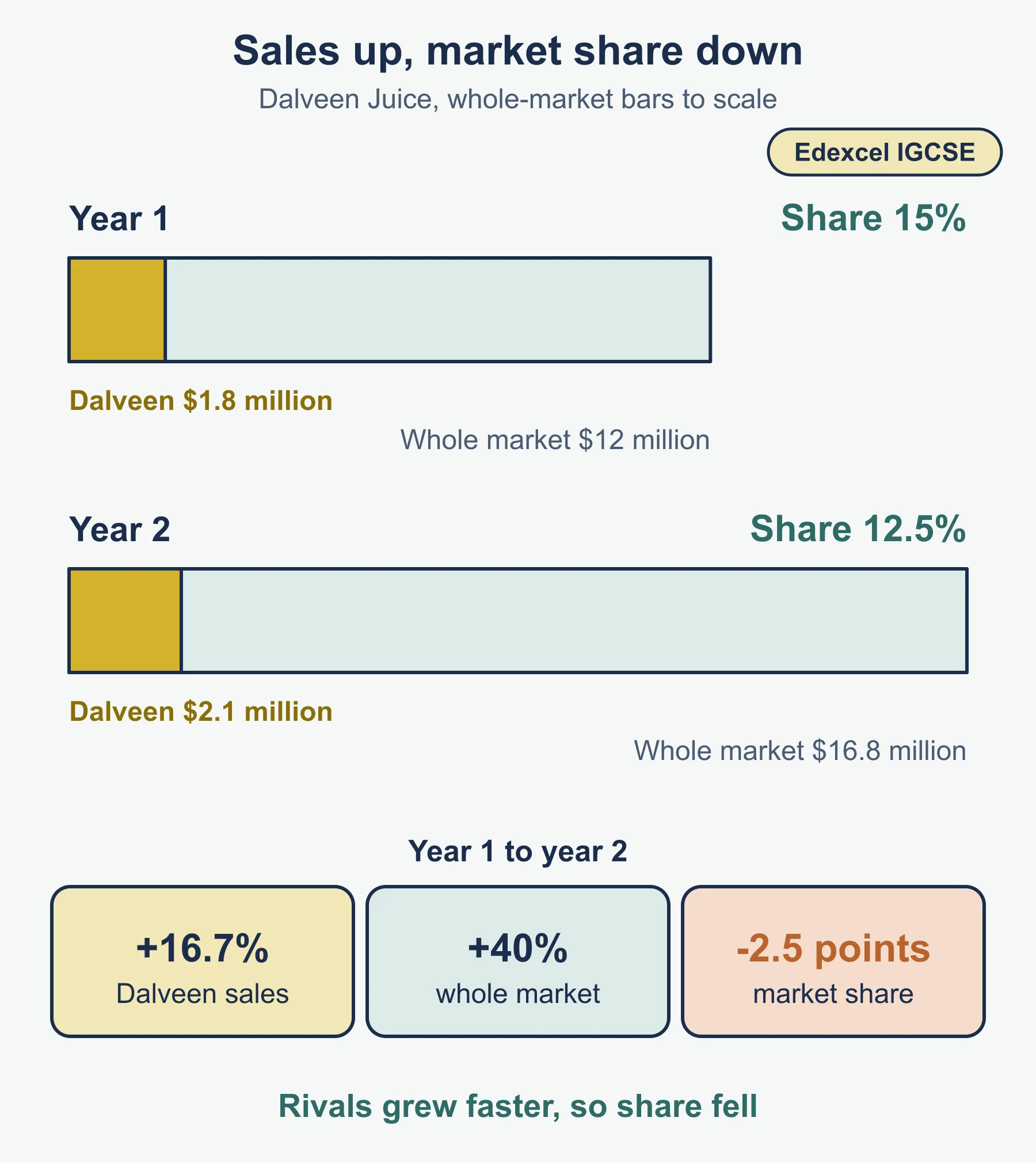
Worked example. Dalveen Juice sold 1.8 million dollars of juice in a market worth 12 million dollars. The next year it sold 2.1 million in a market worth 16.8 million.
- Year 1 share = 1.8 ÷ 12 × 100 = 15%.
- Year 2 share = 2.1 ÷ 16.8 × 100 = 12.5%.
- Dalveen’s sales grew by (2.1 − 1.8) ÷ 1.8 × 100 = 16.7% (to 1 d.p.), but the market grew by (16.8 − 12) ÷ 12 × 100 = 40%.
So Dalveen sold more and still lost share. Competitors grew faster. This is the key point about market share: it shows performance relative to rivals, which revenue cannot do.
3. Customer satisfaction
Customer satisfaction describes how far customers feel the product, price and service meet their expectations. Satisfied customers tend to buy again and may recommend the business to others, which supports revenue and market share. Dissatisfied customers complain, return goods or leave.
Indicators a business might use include survey results, complaints, returns and repeat purchases.
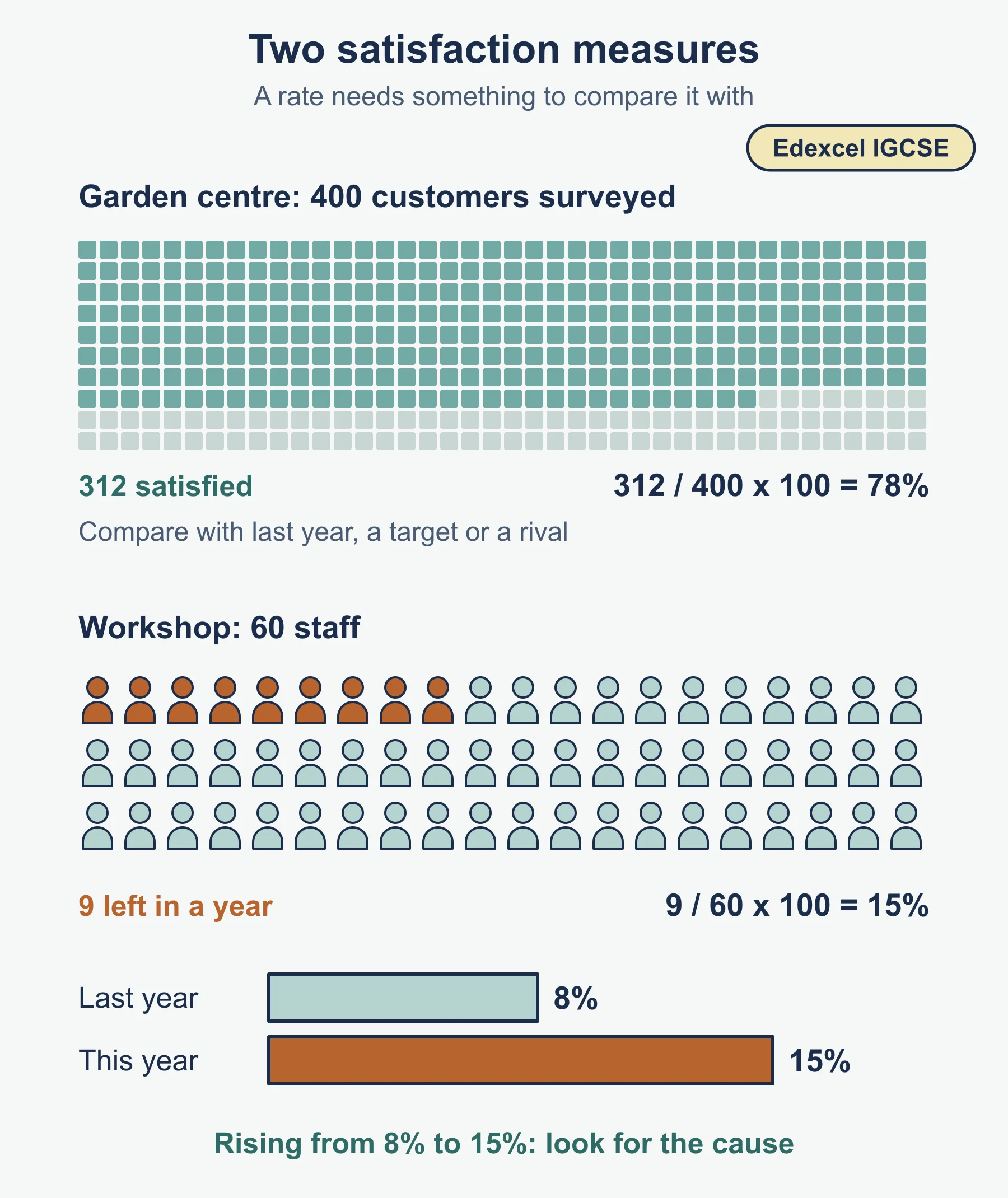
Worked example. A garden centre surveys 400 customers and 312 say they are satisfied.
- Satisfaction rate = 312 ÷ 400 × 100 = 78%.
- A rate on its own needs a comparison: with last year’s figure, with a target, or with a rival. Without one you cannot say whether 78% is good.
4. Profit
Profit is what is left from revenue after costs. The specification’s formulae section gives these definitions and ratios, and states that formulae will be provided in the examinations:
- Gross profit = revenue − cost of sales.
- Gross profit margin = (gross profit ÷ revenue) × 100.
- Operating profit = gross profit − other operating expenses.
- Operating profit margin = (operating profit ÷ revenue) × 100.
The quantitative skills section also refers to the net profit margin. The specification does not print that formula, so use the standard form: (profit for the year ÷ revenue) × 100. Profit for the year is the specification’s term for what was once called net profit.
A margin is a better test of success than a profit figure alone because it relates profit to the size of the business. A rising profit with a falling margin means costs are growing faster than revenue.
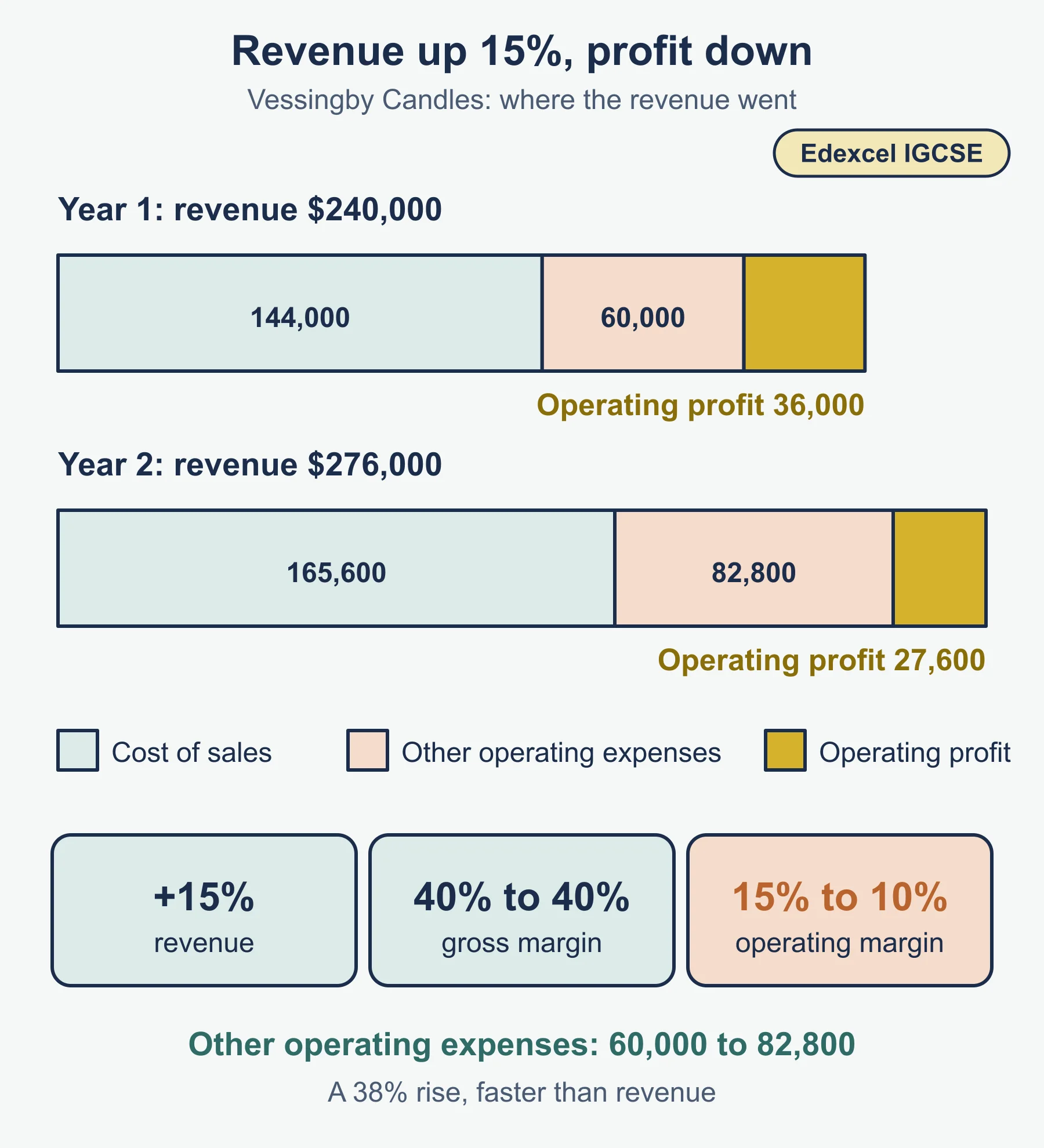
Worked example. Vessingby Candles reports:
| Year 1 | Year 2 | |
|---|---|---|
| Revenue | 240,000 | 276,000 |
| Cost of sales | 144,000 | 165,600 |
| Other operating expenses | 60,000 | 82,800 |
- Revenue growth = (276,000 − 240,000) ÷ 240,000 × 100 = 15%.
- Year 1 gross profit = 240,000 − 144,000 = 96,000, so the gross profit margin is 96,000 ÷ 240,000 × 100 = 40%.
- Year 2 gross profit = 276,000 − 165,600 = 110,400, so the gross profit margin is 110,400 ÷ 276,000 × 100 = 40%.
- Year 1 operating profit = 96,000 − 60,000 = 36,000, so the operating profit margin is 15%.
- Year 2 operating profit = 110,400 − 82,800 = 27,600, so the operating profit margin is 27,600 ÷ 276,000 × 100 = 10%.
Revenue grew by 15%, the gross margin held at 40%, but operating profit fell from 36,000 to 27,600. The cause lies in other operating expenses, which rose from 60,000 to 82,800. A good answer names that cause and suggests checking what the extra expenses bought.
5. Growth
Growth means the business is getting bigger. It can be measured by revenue, by output, by the number of outlets or by the number of employees. The most common calculation is percentage growth:
Growth (%) = (new figure − old figure) ÷ old figure × 100
Vessingby’s revenue growth above is an example. Growth is attractive because a bigger business may have more market power and more security. But growth is not the same as profit. It needs money for inventory, premises and staff before the extra revenue arrives, which is why fast growth can lead into the cash flow problems in section 9.
6. Owner/shareholder satisfaction
The owners of a sole trader or partnership usually want a reasonable income and control. Shareholders in a company want a return on their investment, which they receive as dividends and, if the share price rises, as a gain on selling. Their satisfaction depends on how the profit is used. A business that keeps most of its profit to expand may please owners who want long-term growth but disappoint those who want income now.
Owner/shareholder satisfaction can conflict with other measures. Paying a large dividend leaves less for investment, and cutting staff costs may raise profit while lowering employee satisfaction. Say which group is being judged.
7. Employee satisfaction
Employee satisfaction describes how content staff are with pay, conditions, security and the work itself. Satisfied employees tend to stay and work well, which cuts the cost of recruiting and training replacements and supports customer satisfaction. Indicators a business might use include staff surveys, absence and the proportion of staff who leave in a year.
Worked example. A workshop with 60 staff sees 9 leave in a year.
- Staff leaving rate = 9 ÷ 60 × 100 = 15%.
- If the rate was 8% the year before, the rise is a warning sign. The business should look for causes such as low pay compared with local rivals or poor management, before deciding what to change.
8. Using the measures together
Different measures can point in different directions, so a “how successful is this business?” answer should weigh them.
| Pattern in the data | What it suggests |
|---|---|
| Revenue up, market share down | Market growing faster than the business |
| Revenue up, margin down | Costs rising or prices cut |
| Profit up, employee satisfaction down | Possible short-term gain, risk of losing staff |
| Growth fast, cash balance falling | Expansion may be outrunning finance |
A reasoned judgement says which measure matters most for this business, given its objectives.
9. Reasons for failure: cash flow problems/lack of finance
A business fails when it cannot continue, usually because it cannot pay what it owes. Cash flow is the movement of money into and out of the business. A cash flow forecast (section 3.2 of the specification) shows receipts, payments, net cash flow and the closing balance. Net cash flow = cash in − cash out. Closing balance = opening balance + net cash flow.
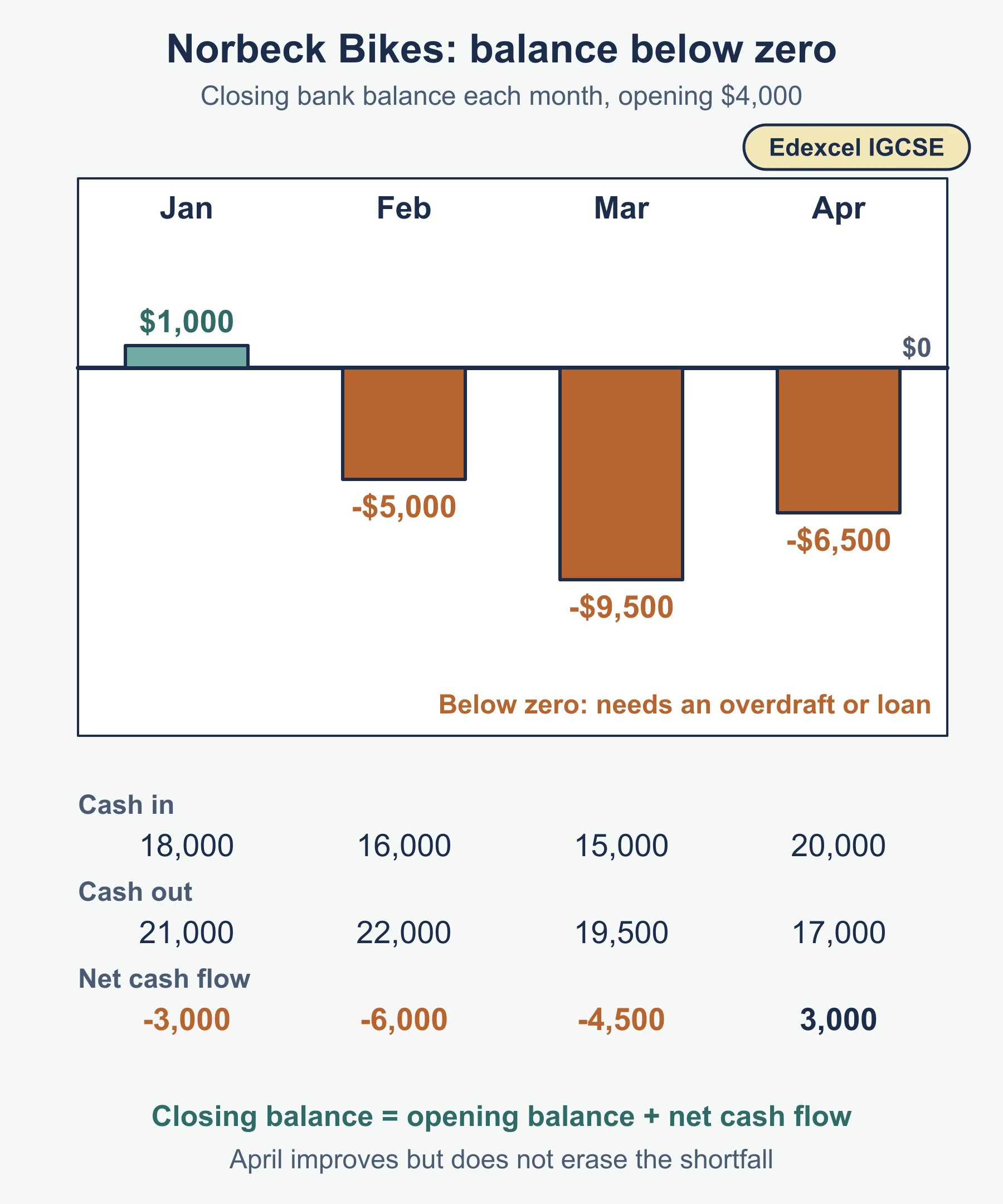
Worked example. Norbeck Bikes starts January with 4,000 in the bank.
| Month | Cash in | Cash out | Net cash flow | Closing balance |
|---|---|---|---|---|
| January | 18,000 | 21,000 | −3,000 | 1,000 |
| February | 16,000 | 22,000 | −6,000 | −5,000 |
| March | 15,000 | 19,500 | −4,500 | −9,500 |
| April | 20,000 | 17,000 | 3,000 | −6,500 |
The balance goes below zero in February. April’s improvement is welcome but does not erase the shortfall. A business in this position needs finance, perhaps an overdraft or a loan, and lenders may refuse if the trend looks poor. Lack of finance is the reason a business cannot cover the gap, so the two phrases in the specification are linked. A business can be profitable on paper and still fail if customers pay late and suppliers must be paid now.
10. Reasons for failure: not competitive
A business is competitive when customers choose it over rivals. It becomes not competitive when rivals offer a better combination of price, quality, service, range or convenience. Symptoms include falling market share, falling revenue and more customer complaints. A business may lose out because its costs are higher and it must charge more, or because it has not kept up with the quality or service customers now expect.
11. Reasons for failure: failure to adapt to changes in the market
Markets change: customers’ tastes move, new technology arrives, rivals enter and prices shift. A business that does not respond keeps selling what people no longer want. The difference from section 10 is the cause. Not competitive describes the weakness against rivals; failure to adapt describes not responding to change. In practice they overlap, so in an answer, state the cause, then explain its effect on revenue, share and cash flow.
Common errors
- Using “sales” where the specification uses revenue.
- Saying higher revenue means higher profit.
- Quoting a market share without saying which market and which period.
- Giving a satisfaction rate with nothing to compare it against.
- Treating growth as success when cash is running out.
- Confusing “not competitive” with “failure to adapt” without naming the cause.
Next steps
Condense the formulas with the revision notes, then test yourself on the practice questions. Return to the 4BS1 Business hub or the checklist. Find weak spots with the free diagnostics.
Frequently asked questions
When is a business successful? A business is successful when it achieves its objectives, which can be financial, such as profit or market share, or non-financial, such as satisfaction or independence.
Why is a profit margin a better measure than profit alone? A margin relates profit to the size of the business. A rising profit with a falling margin means costs are growing faster than revenue.
How can a business grow and still fail? If expansion outruns finance, the cash balance can fall below zero, so the business cannot pay what it owes even while revenue grows.
What is the difference between “not competitive” and “failure to adapt”? A business is not competitive when rivals offer a better mix of price, quality, service, range or convenience. Failure to adapt means it keeps selling what customers no longer want after tastes, technology or the market change.
Official syllabus
Pearson Edexcel International GCSE in Business (4BS1), Specification, Issue 2, February 2026, published by Pearson Education Limited. Topic 1: Business activity and influences on business, section 1.8 “What makes a business successful?”, points 1.8.1 and 1.8.2.
Get free revision emails (optional)
Occasional emails with practice questions, worked explanations and links to free resources for the qualification and subjects you choose. No spam, and you can unsubscribe from any email. The free tools on this site never need an email.
Related resources
-
Practice questions
Edexcel IGCSE Business: What makes a business successful (4BS1) – Practice Questions
Original practice questions with worked answers on measuring success and reasons for business failure, Edexcel IGCSE Business 4BS1 section 1.8.
Business · Pearson Edexcel · IGCSE
Try questions -
Revision notes
Edexcel IGCSE Business: What makes a business successful (4BS1) – Revision Notes
Condensed revision notes on measuring business success and the reasons for failure for Edexcel IGCSE Business 4BS1 section 1.8, with a self-test.
Business · Pearson Edexcel · IGCSE
Revise topic -
Study guides
Edexcel IGCSE Business: Business and the international economy (4BS1)
Study guide to globalisation, multinationals, exchange rate calculations and exchange rate effects for Edexcel IGCSE Business, with worked examples.
Business · Pearson Edexcel · IGCSE
Read guide
Related articles
-
teaching
A Level tuition in Dubai: Cambridge or Pearson Edexcel International A Level?
Schools in Dubai and Abu Dhabi teach either Cambridge International AS & A Level or Pearson Edexcel International A Level. How the two are structured, why it matters for tuition, and how online classes from Lahore work.
9 October 2026
-
curriculum guides
Choosing subjects at IGCSE and A Level
How subject choices at 14 and 16 affect university options later, and how to keep pathways open without overloading a timetable.
28 July 2026
Studying this with a teacher
Working through Business IGCSE?
This page is free and stays free. If you would rather be taught it, Marlbridge runs Business classes one-to-one and in small groups of up to 15, online in your own time zone. The first trial class is free. WhatsApp replies within an hour (8am–11pm Pakistan time, every day); email the same day.
Pearson Edexcel Business teachers at Marlbridge

