
Revision Notes
Edexcel IGCSE Business: What makes a business successful (4BS1) – Revision Notes
Condensed revision notes on measuring business success and the reasons for failure for Edexcel IGCSE Business 4BS1 section 1.8, with a self-test.
- Subject
- Business
- Level
- IGCSE
- Topic
- Business activity and influences on business
- Author
- Marlbridge Academic Team
- Updated
- Reviewed by
- Asif Iqbal (what this means)
Aligned to Pearson Edexcel IGCSE Business (4BS1), Issue 2, February 2026. Official specification .
Syllabus page (what it covers and how it is assessed): Pearson Edexcel IGCSE Business.
Syllabus points this page covers
4BS1
- 1 Business activity and influences on business (whole topic)
- 1.8 What makes a business successful?
Found an error? Report a correction.
Want a teacher for this? Marlbridge teaches Business online. Request a free trial class.
These notes condense Topic 1, section 1.8 “What makes a business successful?” of the Pearson Edexcel International GCSE in Business (4BS1) specification, Issue 2, February 2026: points 1.8.1 (measuring success) and 1.8.2 (reasons for failure). For full explanations and worked examples, read the study guide first. Then try the practice questions.
Course links: the 4BS1 Business hub, the printable checklist and the free diagnostics. The specification says Paper 1 (small businesses) and Paper 2 (large businesses) both draw on the whole content.
The two lists to learn
| Point | The specification lists |
|---|---|
| 1.8.1 Measuring success | revenue, market share, customer satisfaction, profit, growth, owner/shareholder satisfaction, employee satisfaction |
| 1.8.2 Reasons for failure | cash flow problems/lack of finance, not competitive, failure to adapt to changes in the market |
Memory hook for 1.8.1: money (revenue, profit, growth), position (market share), people (customers, owners/shareholders, employees). Memory hook for 1.8.2: cash, rivals, change.
Key terms
| Term | Short definition |
|---|---|
| Success | Achieving the business’s objectives, which differ between businesses |
| Revenue | Money received from selling goods or services in a period (the specification’s term, in place of sales) |
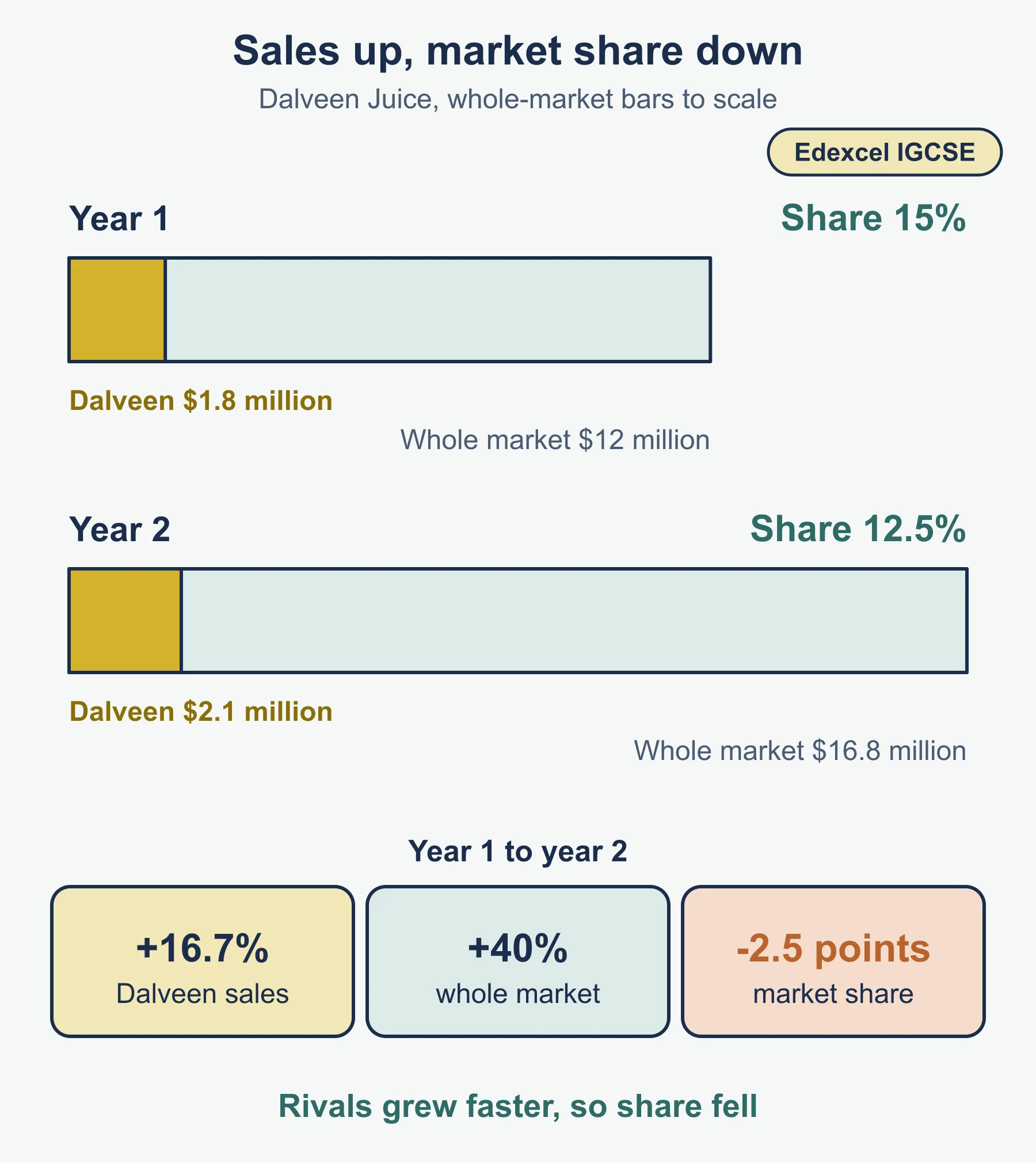
| Market share | A business’s percentage of total sales in its market |
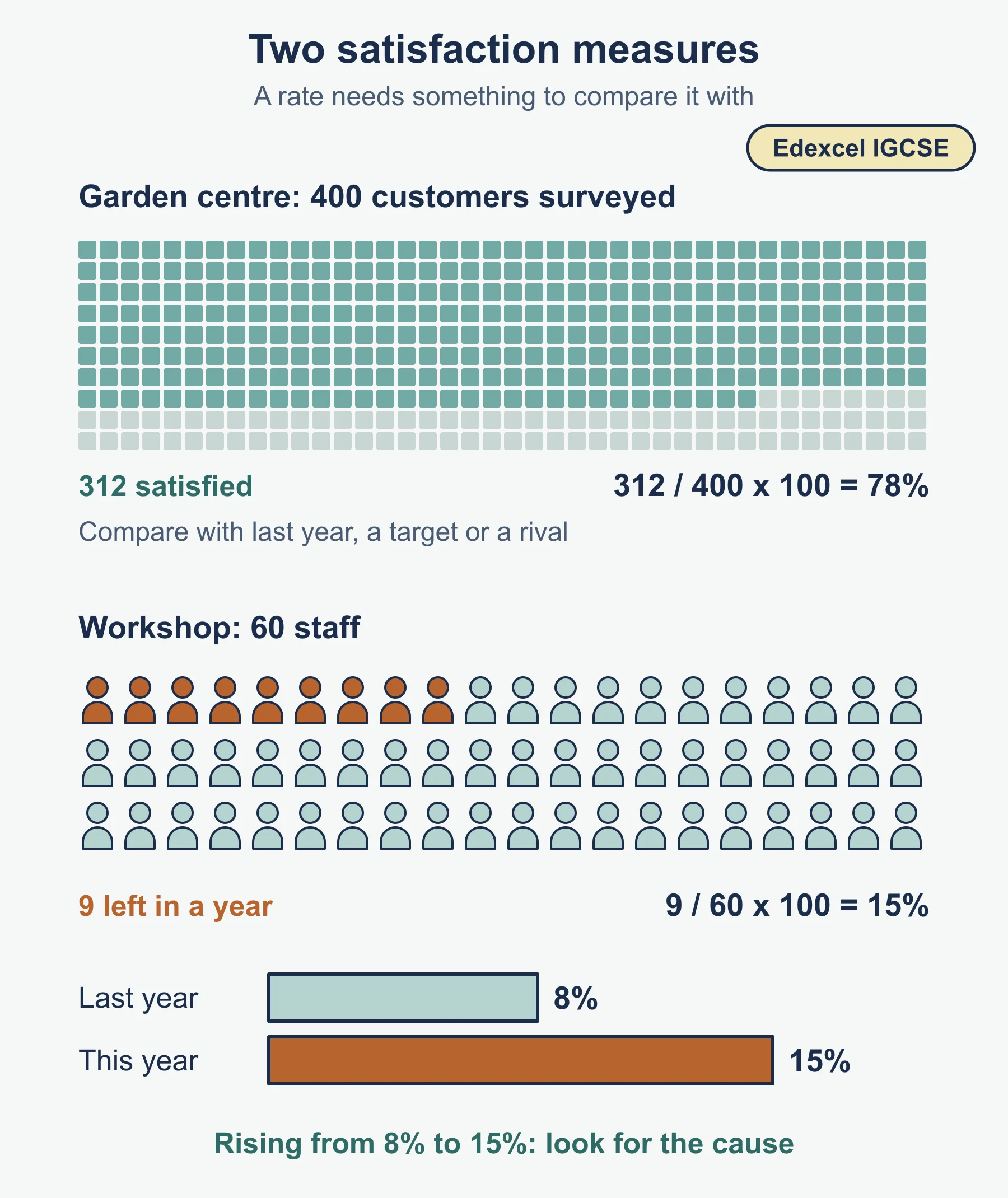
| Customer satisfaction | How far customers feel their expectations were met |
| Profit | Revenue minus costs |
| Growth | The business getting bigger, for example in revenue or number of outlets |
| Owner/shareholder satisfaction | How content owners are with income, return and control |
| Employee satisfaction | How content staff are with pay, conditions, security and work |
| Cash flow | Movement of money into and out of the business |
| Business failure | The business cannot carry on, usually because it cannot pay what it owes |
Formulas
The specification’s formulae section gives gross profit, gross profit margin, operating profit and operating profit margin, and says formulae will be provided in the examinations. The other three rows are the standard forms: the specification does not print them.
| Measure | Formula |
|---|---|
| Revenue | Selling price per unit × number sold (standard form) |
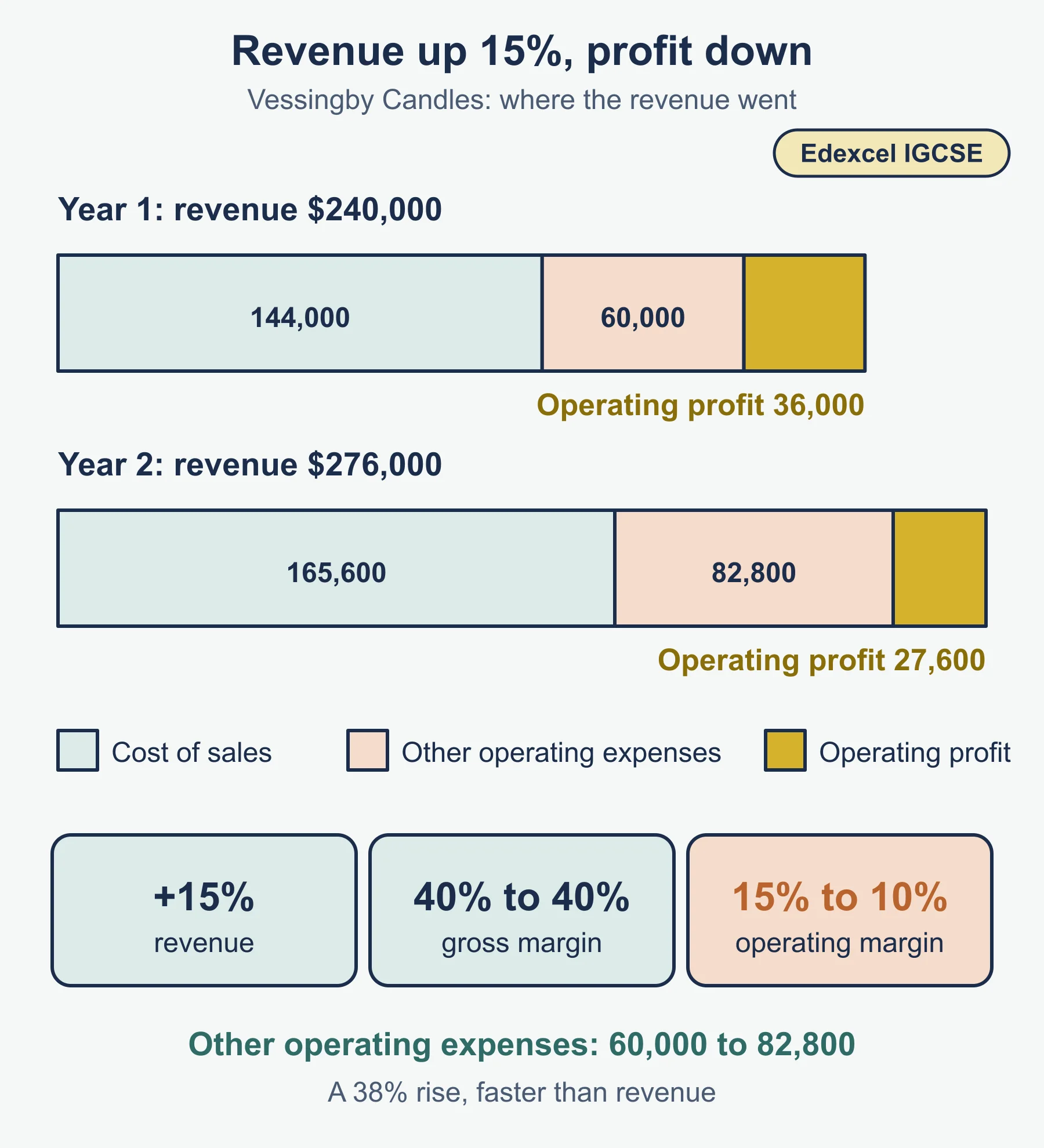
| Gross profit | Revenue − cost of sales |
| Gross profit margin | Gross profit ÷ revenue × 100 |
| Operating profit | Gross profit − other operating expenses |
| Operating profit margin | Operating profit ÷ revenue × 100 |
| Net profit margin (standard form) | Profit for the year ÷ revenue × 100 |
| Market share (standard form) | Business sales ÷ total market sales × 100 |
| Growth (standard form) | (New − old) ÷ old × 100 |
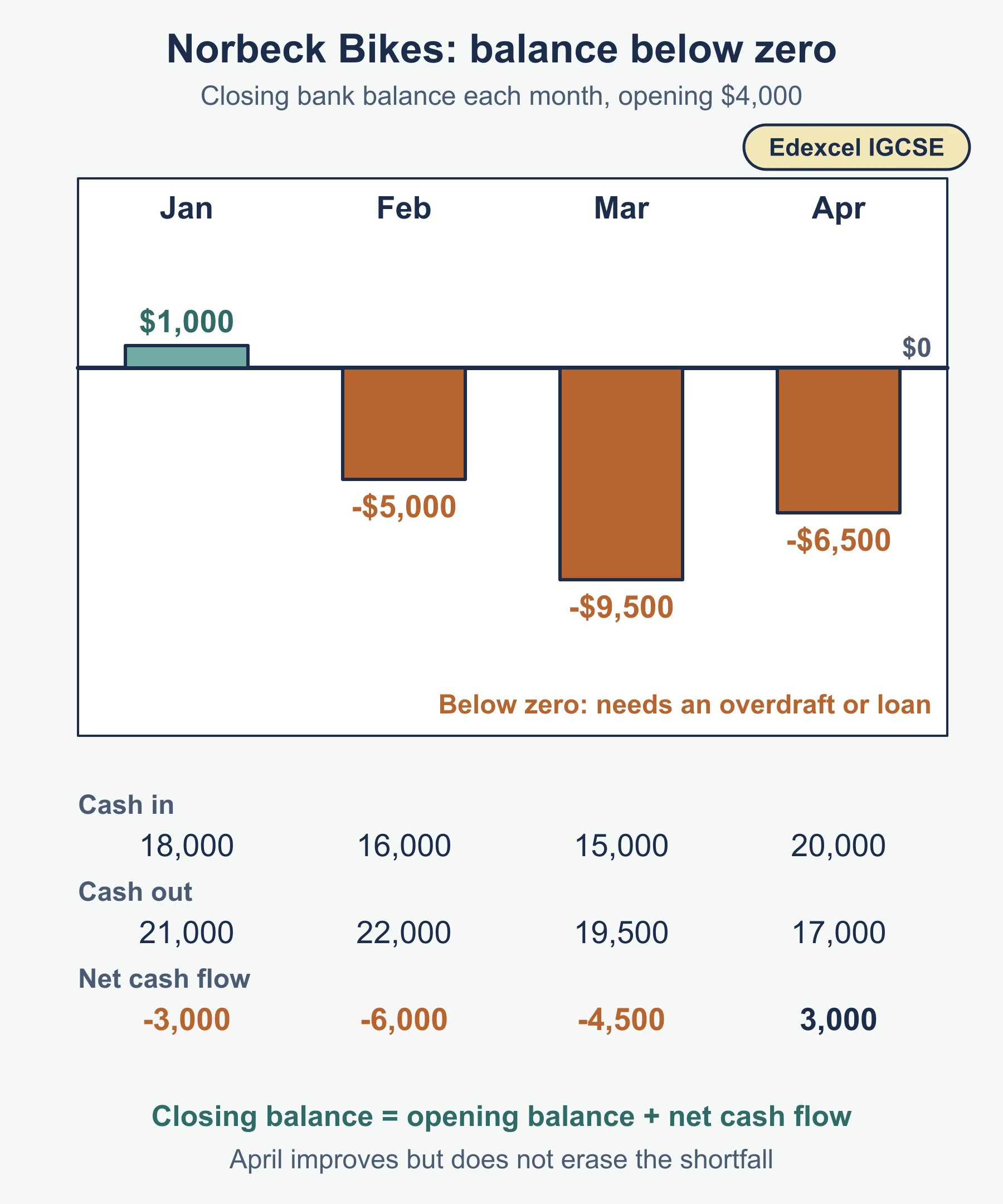
| Net cash flow | Cash in − cash out |
| Closing balance | Opening balance + net cash flow |
Method boxes
Percentage growth in steps
- Find the change: new figure − old figure.
- Divide by the old figure.
- Multiply by 100 and add the % sign.
Margin in steps
- Work out the profit first (gross or operating, as asked).
- Divide by revenue, not by cost of sales.
- Multiply by 100.
Cash flow table in steps
- Net cash flow = cash in − cash out for the month.
- Closing balance = opening balance + net cash flow.
- The closing balance of one month is the opening balance of the next.
Evaluate / justify answer in steps
- Quote the figures from the stem.
- Say what each shows, for better and for worse.
- Judge against the business’s objectives.
- State a conclusion and a reason, and say what else you would want to know.
Worked reminders
Market share. Kirkfield Tea sells 45,000 dollars of tea in a market worth 300,000 dollars. Market share = 45,000 ÷ 300,000 × 100 = 15%.
Growth. Sales rise from 1,000,000 to 1,150,000. Growth = 150,000 ÷ 1,000,000 × 100 = 15%.
Margins. Revenue is 80,000, cost of sales is 52,000 and other operating expenses are 16,000.
- Gross profit = 80,000 − 52,000 = 28,000, so gross profit margin = 28,000 ÷ 80,000 × 100 = 35%.
- Operating profit = 28,000 − 16,000 = 12,000, so operating profit margin = 12,000 ÷ 80,000 × 100 = 15%.
Cash. A month with cash in of 9,000 and cash out of 12,500 gives net cash flow of −3,500. From an opening balance of 3,000 the closing balance is −500.
Satisfaction rate. 270 satisfied out of 300 surveyed is 90%.
What each measure tells you, and what it hides
| Measure | Tells you | Can hide |
|---|---|---|
| Revenue | Demand for the product | Costs and profit |
| Market share | Performance against rivals | Whether the business is profitable |
| Customer satisfaction | Likely repeat business | Cost of keeping customers happy |
| Profit | Whether income covers costs | Cash position and how the profit was made |
| Growth | Size and momentum | Whether growth is paid for by borrowing |
| Owner/shareholder satisfaction | Whether investors will stay | Staff or customer views |
| Employee satisfaction | Likely staff retention and effort | Whether pay costs are affordable |
Must-know distinctions
- Revenue versus profit: revenue is money in from sales; profit is what remains after costs.
- Sales growing versus market share growing: share only rises if the business grows faster than its market.
- Profit versus cash: profit is revenue minus costs; cash is money actually in the bank. A profitable business can run out of cash.
- Not competitive versus failure to adapt: the first is weakness against rivals now; the second is not responding to changes in the market.
- Cash flow problems versus lack of finance: one is the gap in timing of money; the other is having no way to fund that gap.
Linking success to objectives
Section 1.1 of the specification lists financial objectives (survival, profit, sales, market share, financial security) and non-financial ones (social objectives, personal satisfaction, challenge, independence and control). Use this to choose the right measure in an answer.
- A new business with survival as its aim: look at cash and finance first.
- A business aiming to win customers from rivals: look at market share and customer satisfaction.
- A company owned by shareholders: look at profit and owner/shareholder satisfaction.
- An owner who values independence: a smaller profit may still count as success.
Reasons for failure at a glance
| Reason | Typical causes | Typical effect |
|---|---|---|
| Cash flow problems/lack of finance | Customers pay late, bills due before receipts, no overdraft or loan | Cannot pay suppliers or staff |
| Not competitive | Higher prices, weaker quality or service than rivals | Falling revenue and market share |
| Failure to adapt to changes in the market | Tastes, technology or rivals change, business stays the same | Products become less wanted |
Quick self-test
- Name the seven measures of success listed in 1.8.1.
- Name the three reasons for failure listed in 1.8.2.
- A firm sells 24 million dollars in a market of 160 million. State its market share.
- Revenue falls from 80,000 to 68,000. Calculate the percentage change.
- Gross profit is 33,000 on revenue of 110,000. Calculate the gross profit margin.
- Operating profit is 9,900 on revenue of 110,000. Calculate the operating profit margin.
- A firm has opening cash of 2,500, cash in of 14,000 and cash out of 16,200. Calculate the closing balance.
- Explain one way low employee satisfaction can reduce profit.
- A business doubles its revenue but its bank balance falls each month. Give one reason.
- Give one difference between “not competitive” and “failure to adapt to changes in the market”.
Answers
- Revenue, market share, customer satisfaction, profit, growth, owner/shareholder satisfaction, employee satisfaction.
- Cash flow problems/lack of finance; not competitive; failure to adapt to changes in the market.
- 24 ÷ 160 × 100 = 15%.
- (68,000 − 80,000) ÷ 80,000 × 100 = −15%, a fall of 15%.
- 33,000 ÷ 110,000 × 100 = 30%.
- 9,900 ÷ 110,000 × 100 = 9%.
- Net cash flow = 14,000 − 16,200 = −2,200. Closing balance = 2,500 − 2,200 = 300.
- Unhappy staff may leave, so the business pays to recruit and train replacements, which raises costs and lowers profit. They may also work less well, which can lose sales.
- Growth needs spending on inventory, staff and premises before customers pay, so cash goes out faster than it comes in.
- Not competitive is a weakness compared with rivals, for example higher prices. Failure to adapt is not changing as the market changes, for example ignoring new technology.
Where marks are usually lost
- Writing sales where the specification uses revenue.
- Dividing by the new figure, not the old one, in a growth calculation.
- Using cost of sales, not revenue, as the base for a margin.
- Quoting a figure without saying what it shows about the business.
- Calling one measure “success” without linking it to the business’s objectives.
- Mixing up profit and cash in an answer about failure.
- Giving a list of failure reasons without a developed link to the business in the stem.
- Ending an evaluate answer without a judgement.
Next steps
Work through the practice questions, return to the study guide for any weak point, and tick progress on the checklist. The free diagnostics help you find gaps.
Frequently asked questions
What are the measures of business success in Edexcel IGCSE Business? The 4BS1 specification lists revenue, market share, customer satisfaction, profit, growth, owner/shareholder satisfaction and employee satisfaction.
What are the reasons for business failure in the 4BS1 specification? The specification lists cash flow problems or lack of finance, not being competitive, and failure to adapt to changes in the market.
Does higher revenue mean higher profit? No. Revenue alone says nothing about costs, and a business can raise revenue by cutting prices so far that its profit falls.
How do you calculate growth as a percentage? Subtract the old figure from the new one, divide by the old figure and multiply by 100. Dividing by the new figure is a common error.
Official syllabus
Pearson Edexcel International GCSE in Business (4BS1), Specification, Issue 2, February 2026, published by Pearson Education Limited. Topic 1: Business activity and influences on business, section 1.8 “What makes a business successful?”, points 1.8.1 and 1.8.2.
Get free revision emails (optional)
Occasional emails with practice questions, worked explanations and links to free resources for the qualification and subjects you choose. No spam, and you can unsubscribe from any email. The free tools on this site never need an email.
Related resources
-
Study guides
Edexcel IGCSE Business: Business and the international economy (4BS1)
Study guide to globalisation, multinationals, exchange rate calculations and exchange rate effects for Edexcel IGCSE Business, with worked examples.
Business · Pearson Edexcel · IGCSE
Read guide -
Practice questions
Edexcel IGCSE Business: Business and the international economy (4BS1) – Practice Questions
Original practice questions with worked answers on globalisation, multinationals and exchange rates for Edexcel IGCSE Business (4BS1), section 1.5.
Business · Pearson Edexcel · IGCSE
Try questions -
Revision notes
Edexcel IGCSE Business: Business and the international economy (4BS1) – Revision Notes
Condensed revision notes on globalisation, multinationals, exchange rate calculations and their effects for Edexcel IGCSE Business, with a self-test.
Business · Pearson Edexcel · IGCSE
Revise topic
Related articles
-
teaching
A Level tuition in Dubai: Cambridge or Pearson Edexcel International A Level?
Schools in Dubai and Abu Dhabi teach either Cambridge International AS & A Level or Pearson Edexcel International A Level. How the two are structured, why it matters for tuition, and how online classes from Lahore work.
9 October 2026
-
curriculum guides
Choosing subjects at IGCSE and A Level
How subject choices at 14 and 16 affect university options later, and how to keep pathways open without overloading a timetable.
28 July 2026
Studying this with a teacher
Working through Business IGCSE?
This page is free and stays free. If you would rather be taught it, Marlbridge runs Business classes one-to-one and in small groups of up to 15, online in your own time zone. The first trial class is free. WhatsApp replies within an hour (8am–11pm Pakistan time, every day); email the same day.
Pearson Edexcel Business teachers at Marlbridge

