
Study Guides
Edexcel IGCSE Business: Business and the international economy (4BS1)
Study guide to globalisation, multinationals, exchange rate calculations and exchange rate effects for Edexcel IGCSE Business, with worked examples.
- Subject
- Business
- Level
- IGCSE
- Topic
- Business activity and influences on business
- Author
- Marlbridge Academic Team
- Updated
- Reviewed by
- Asif Iqbal (what this means)
Aligned to Pearson Edexcel IGCSE Business (4BS1), Issue 2, February 2026. Official specification .
Syllabus page (what it covers and how it is assessed): Pearson Edexcel IGCSE Business.
Syllabus points this page covers
4BS1
- 1 Business activity and influences on business (whole topic)
- 1.5 Business and the international economy
Found an error? Report a correction.
Want a teacher for this? Marlbridge teaches Business online. Request a free trial class.
This guide follows the Pearson Edexcel International GCSE in Business (4BS1) specification, Issue 2, February 2026. It covers Topic 1, section 1.5 “Business and the international economy”, points 1.5.1 to 1.5.4. The specification says both papers can draw on the whole of the subject content. Paper 1 focuses on a small business of up to 49 employees and Paper 2 on a large business of more than 250 employees, so you may meet this material in either setting.
Course links: the 4BS1 Business hub, the printable checklist and the free diagnostics. Companion pages: the revision notes and the practice questions.
What the specification asks for
| Point | You must be able to | Where in this guide |
|---|---|---|
| 1.5.1 | Explain the concept of globalisation; give opportunities and threats of globalisation for businesses | Section 1 |
| 1.5.2 | Explain the importance and growth of multinationals: benefits to a business of becoming one; benefits and possible drawbacks to a country and/or economy where one is located | Section 2 |
| 1.5.3 | Carry out exchange rate calculations | Section 3 |
| 1.5.4 | Explain the impact of exchange rate changes on international competitiveness and on importers and exporters | Section 4 |
The specification does not set a list of countries or currencies, so the figures below are invented. The exchange rates are made up for practice and are not real market rates.
1. Globalisation (1.5.1)
The concept
Globalisation is the process by which markets, businesses and economies around the world become more closely linked. Goods, services, money, workers, technology and ideas move across borders more easily than they once did. A business in one country can buy materials from a second, make products in a third and sell to customers in a fourth.
The specification lists the concept of globalisation but gives no wording for it. This definition is standard knowledge, not specification wording. Define it in one clear sentence, then link it to a business.
Opportunities for businesses
- Bigger markets. Selling abroad adds customers beyond the home market, so sales revenue can grow even if home demand is flat.
- Lower costs. A business can buy materials or components from the cheapest supplier worldwide, or locate production where wages or premises cost less.
- Economies of scale. Producing for a larger market means a larger output, which can spread fixed costs over more units and cut the cost per unit.
- Spreading risk. If one country has weak demand, sales elsewhere can make up some of the loss.
Threats for businesses
- More competition. Overseas rivals can enter the home market, often with lower prices. A local business may lose customers.
- Dependence on overseas suppliers. A delay, a price rise or a political problem abroad can stop production.
- Exchange rate risk. Trading in other currencies makes costs and revenue less predictable (section 4).
- Differences in culture, language and rules. A product may need changes to suit another market.
- Pressure to cut prices. If customers can compare prices worldwide, margins can be squeezed.
Worked example: Quillbeck Cycles
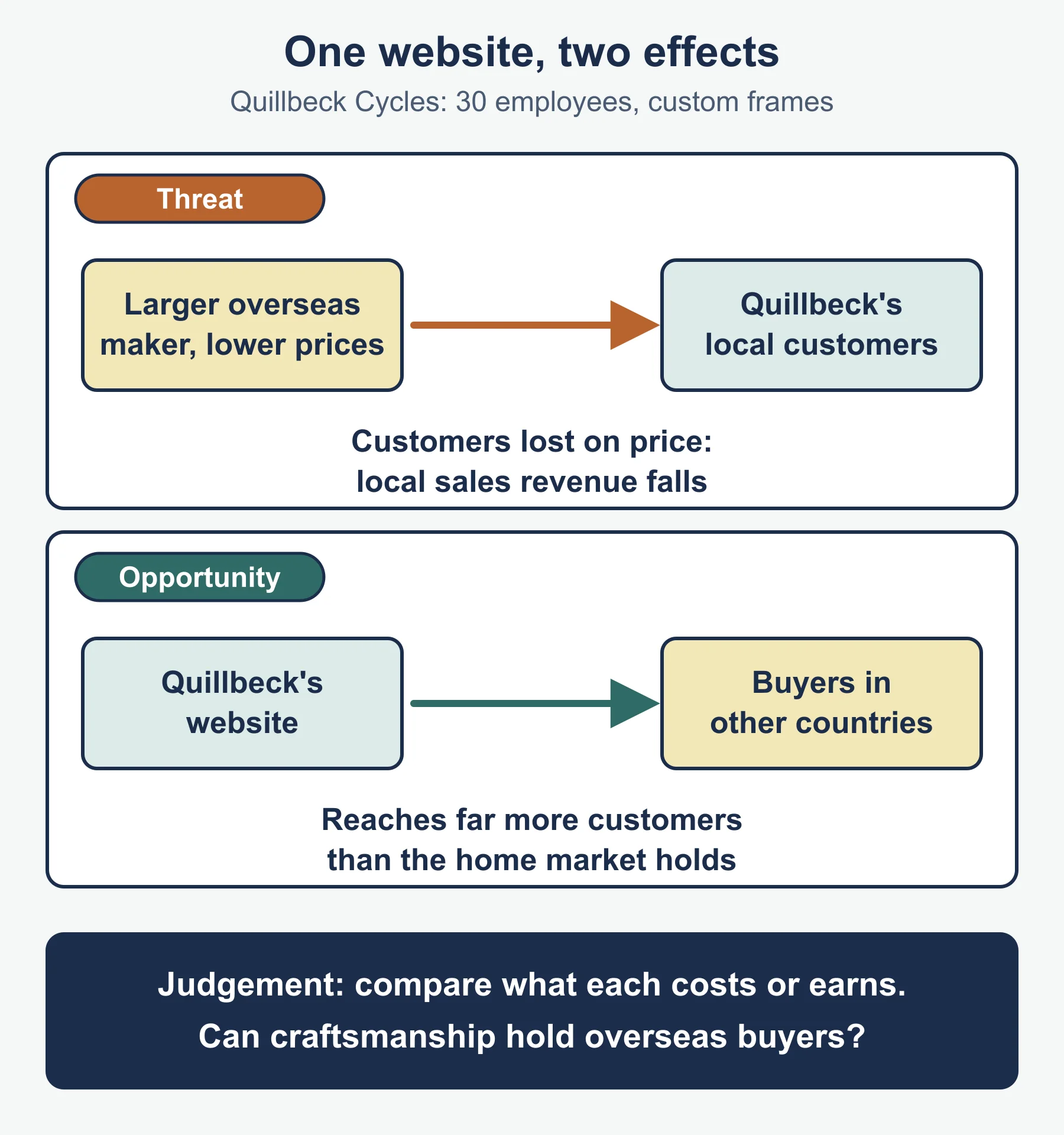
Quillbeck Cycles is an invented business with 30 employees. It makes custom bicycle frames in one town and sells locally. A larger overseas maker begins selling similar frames online to Quillbeck’s customers at lower prices.
Threat: Quillbeck loses some customers on price, and its local-market sales revenue falls.
Opportunity: the same website also lets Quillbeck show its frames to buyers in other countries. If it ships abroad, it reaches many more customers than the home market holds.
Judgement: Quillbeck should compare what each threat or opportunity would cost or earn. It could stress craftsmanship and customising, which a bulk producer may not match. Whether globalisation helps or harms it depends on whether it can reach enough overseas buyers who value that difference.
That last step matters. A good answer on 1.5.1 does not list opportunities and threats and stop. It decides which matters more for this business and gives a reason.
2. Multinationals (1.5.2)
The specification does not define the term. The following is the standard definition, not specification wording: a multinational is a business that has operations, such as factories, offices or shops, in more than one country. The specification also lists multinationals under forms of business organisation in section 1.2, and it focuses Paper 2 on a large business with a multinational or global market.
Importance and growth
Multinationals matter because of their size, their share of world trade and their influence on the countries where they locate. They grow by opening new sites abroad, by buying or merging with overseas firms, or by building up international brands. Globalisation makes this easier, because trade barriers have often fallen, communication is cheap and consumers recognise global brands.
Benefits to a business of becoming a multinational
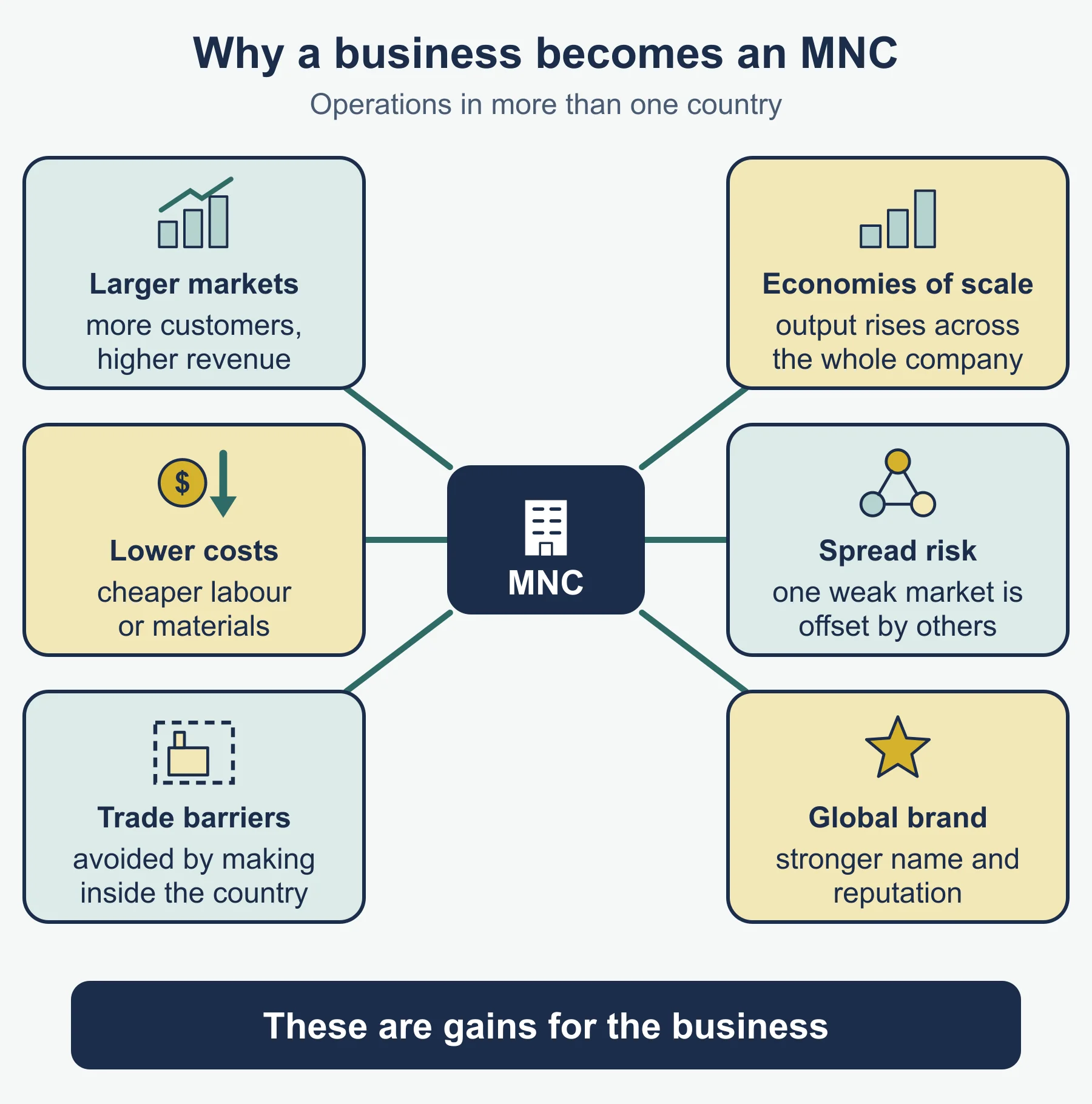
- Access to new markets and so higher sales revenue.
- Lower costs, from cheaper labour, land or materials in the host country.
- Producing inside the market can avoid some trade barriers, such as tariffs on imports (see section 1.6 of the specification).
- Economies of scale from a larger global output.
- Spreading risk across several economies.
- Using brand strength in more places, and gaining local knowledge from a local base.
Benefits to a country and/or economy where a multinational is located
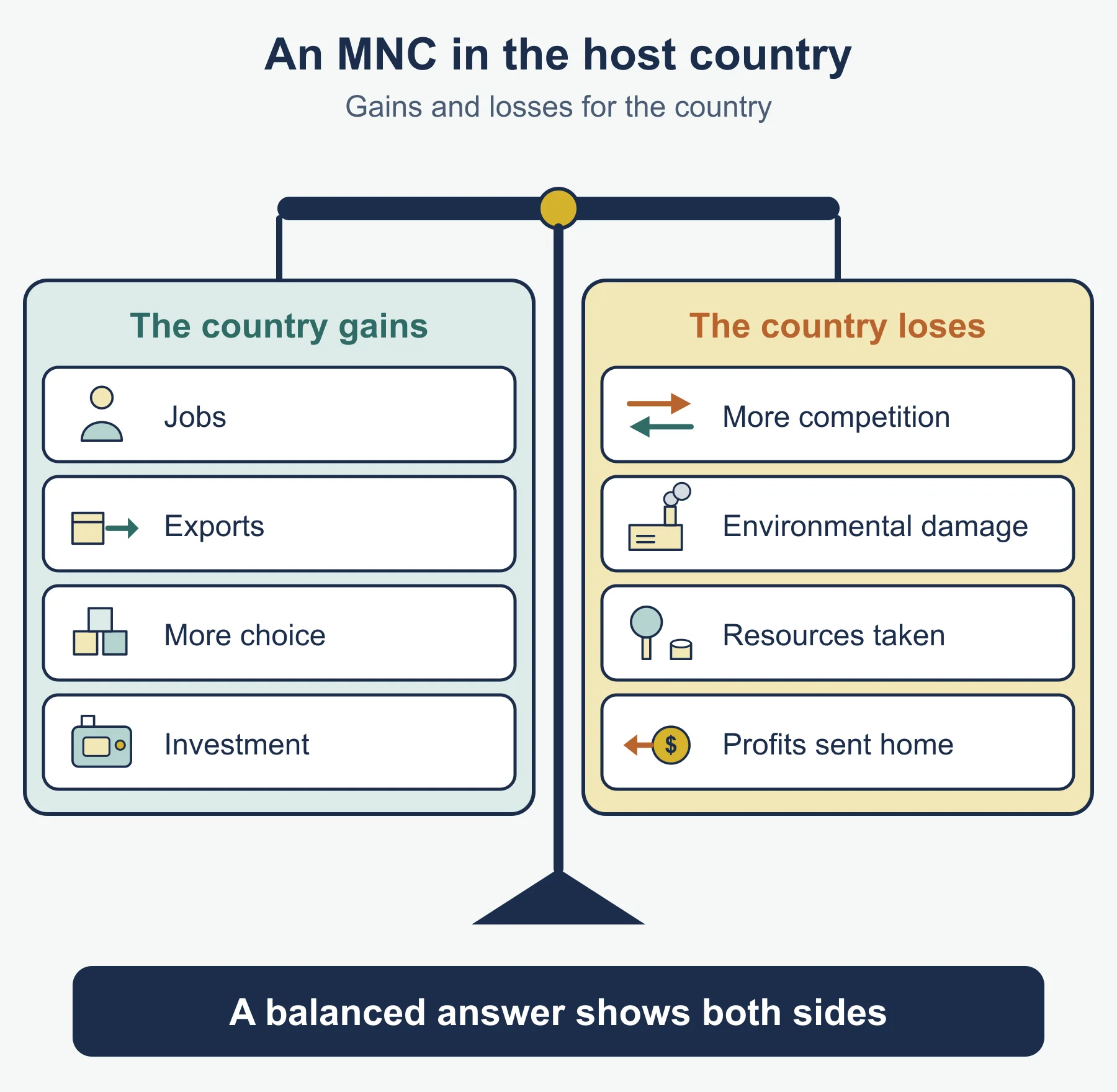
- Jobs and incomes. Workers gain wages, which they spend in the local economy.
- Tax payments to the government, which it can spend on public services.
- Investment in buildings, equipment and infrastructure.
- Skills and technology. Local workers are trained, and local firms can learn new methods.
- More choice and often lower prices for consumers.
- Local suppliers may gain a large customer.
- Exports, if the multinational sells its output abroad, which brings money into the economy.
Possible drawbacks to a country and/or economy where a multinational is located
- Profits may leave the country to reach owners elsewhere, so less is spent locally.
- Local firms may close if they cannot compete with a larger, cheaper rival.
- Jobs can be insecure. The multinational may move production again if costs rise elsewhere.
- Low wages or poor working conditions may be accepted in return for jobs.
- Environmental damage, such as pollution or heavy use of natural resources.
- Influence over government decisions, because the country wants to keep the investment.
- Cultural change, if global brands replace local products and habits.
- Dependence on one large employer for local jobs.
Keep each point tied to the host location, not to the multinational’s home.
Worked example: Sundar Foods
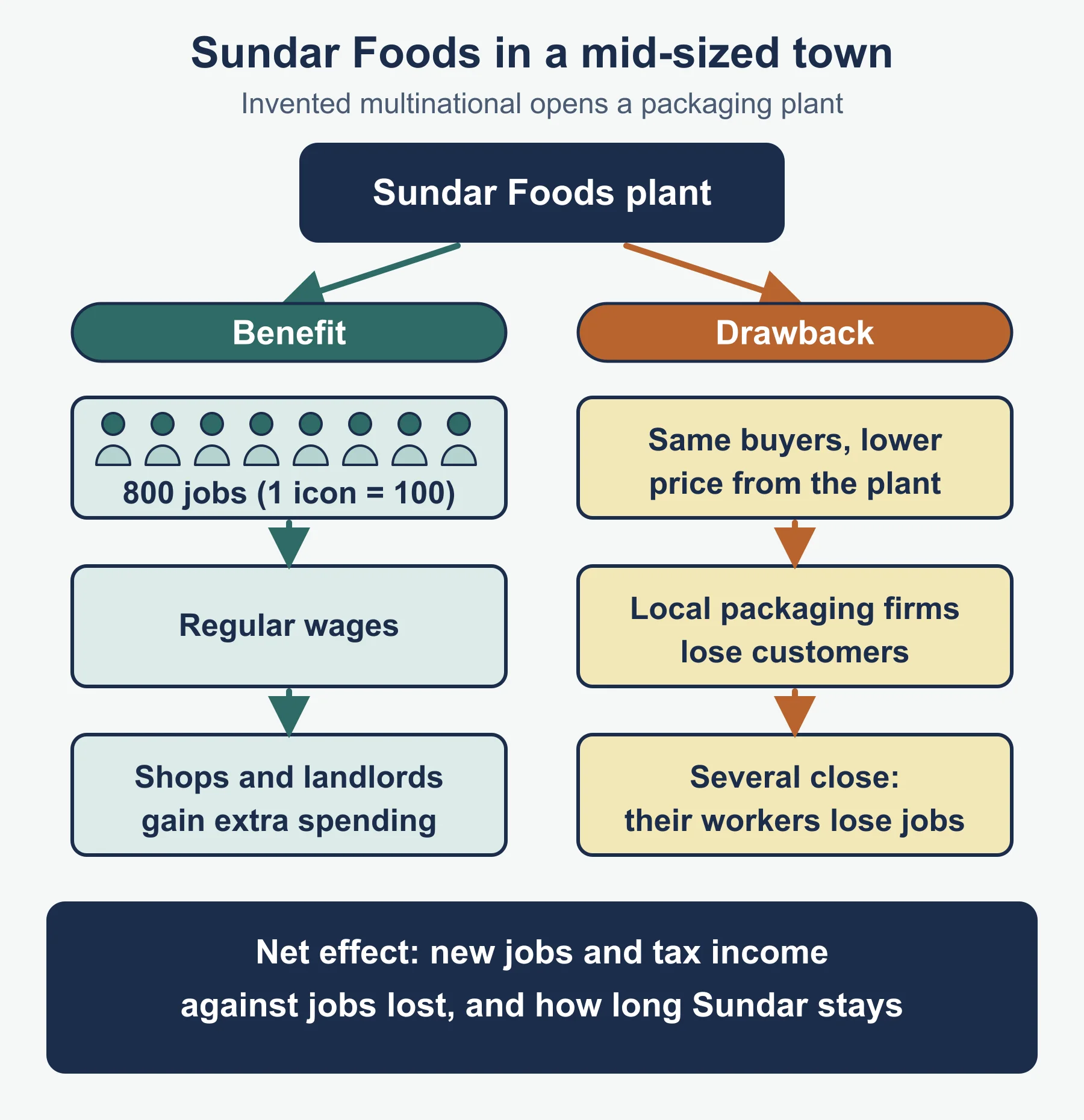
Sundar Foods is an invented multinational. It opens a packaging plant that employs 800 people in a mid-sized town in a lower-income country.
Benefit: the 800 jobs bring regular wages, and shops and landlords in the town gain extra spending.
Drawback: local packaging firms lose customers, because Sundar’s plant supplies the same buyers at a lower price. Several close and their workers lose jobs.
Judgement: the net effect depends on whether new jobs and tax income exceed the jobs lost, and on how long Sundar stays. The strongest answers weigh the two sides and say which is likely to be larger, with a reason.
3. Exchange rate calculation (1.5.3)
An exchange rate is the price of one currency in terms of another. It tells you how many units of the foreign currency one unit of your own currency buys.
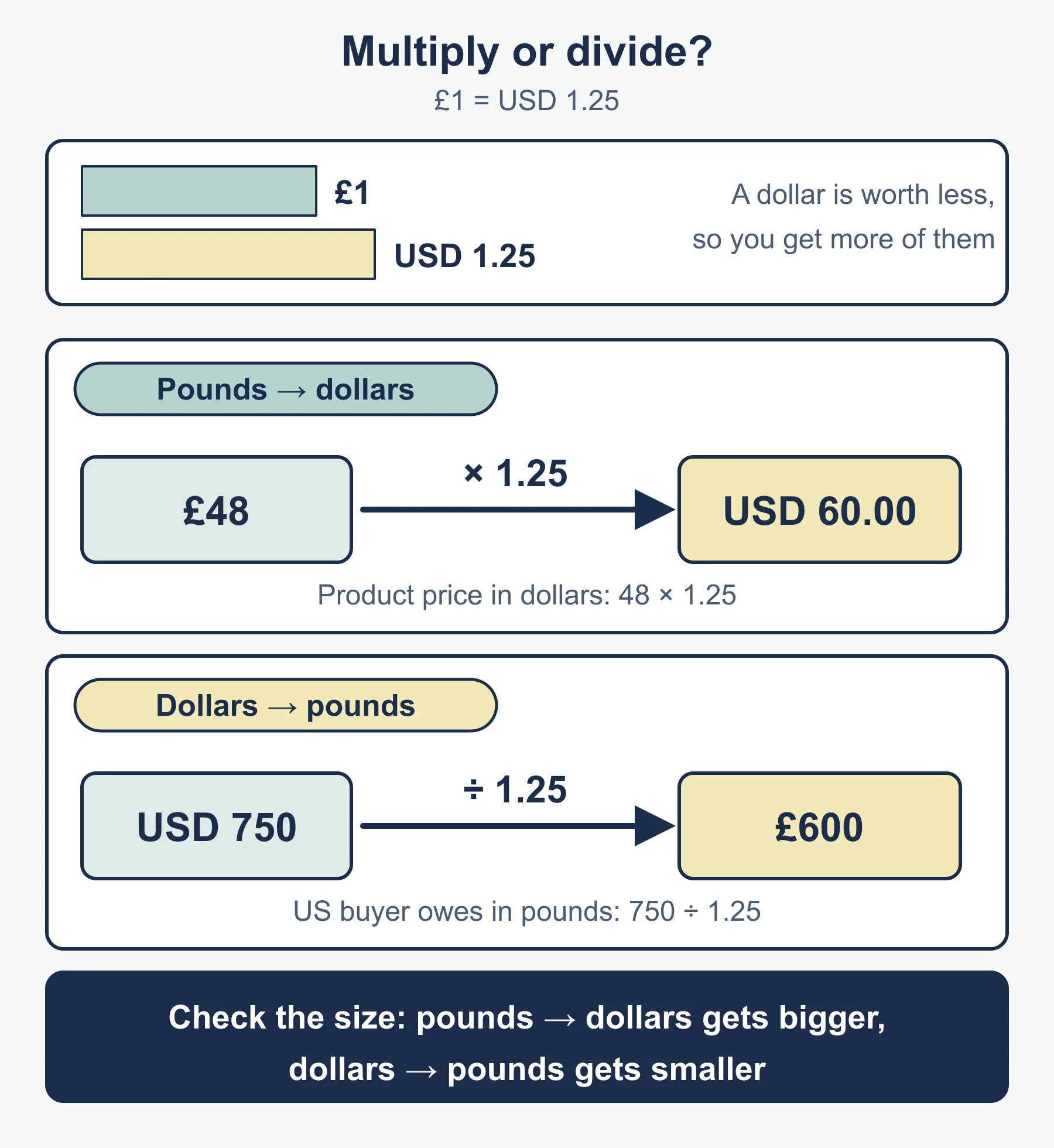
The specification does not give a formula or a rule, so the multiply and divide rule below is standard knowledge, not specification wording. If £1 = USD 1.25:
- To change pounds into dollars, multiply by 1.25.
- To change dollars into pounds, divide by 1.25.
A quick check: the currency with the larger number is worth less per unit, so you get more of it. Dollars into pounds should give a smaller number, and pounds into dollars a larger one. If your answer goes the wrong way, you have multiplied when you should have divided.
Worked example 1
£1 = USD 1.25.
(a) A product sells for £48 at home. Its price in dollars is 48 × 1.25 = USD 60.00.
(b) A US buyer owes USD 750. In pounds that is 750 ÷ 1.25 = £600.
Worked example 2: cost of imports
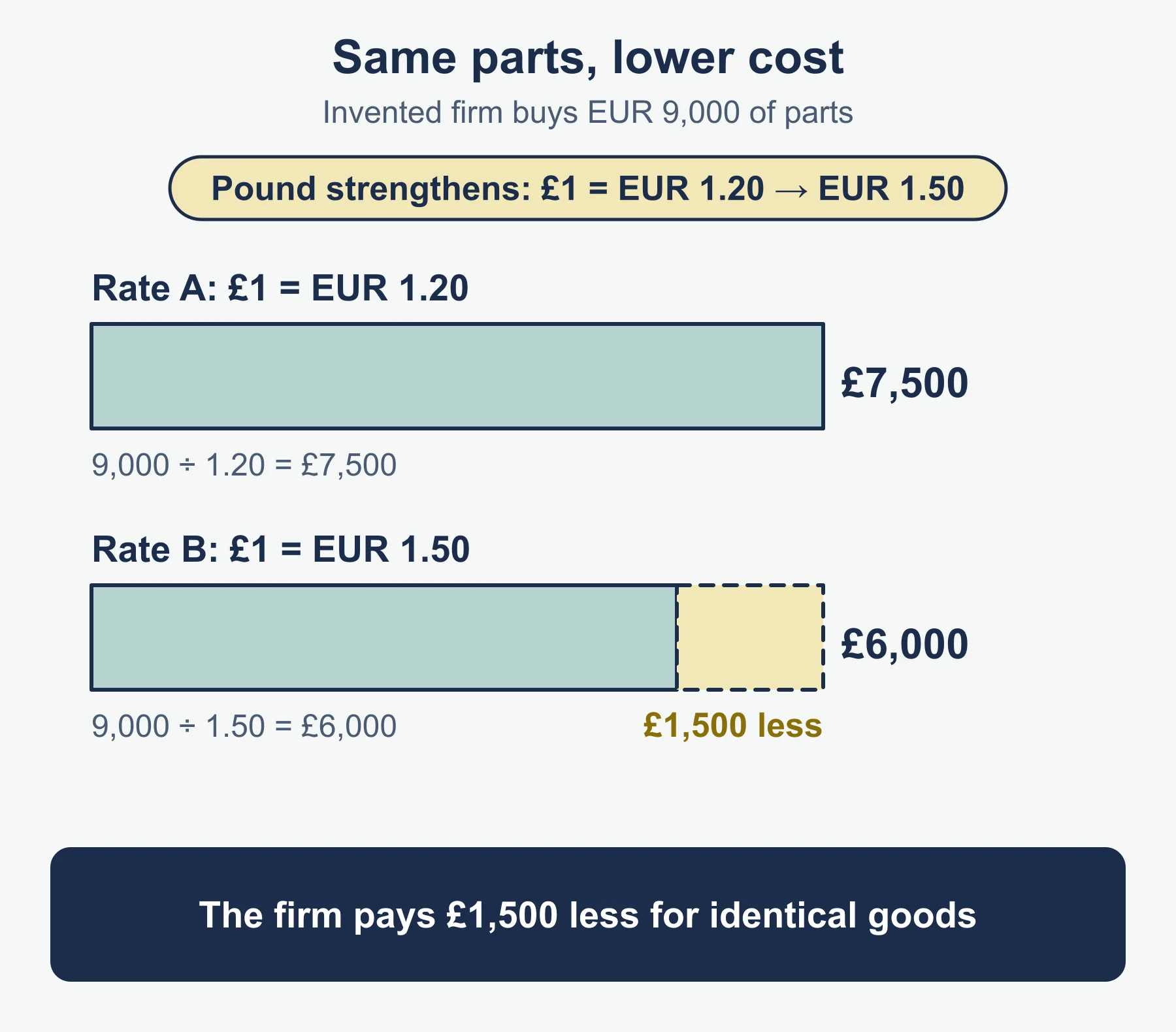
An invented firm buys parts costing EUR 9,000. The rate is £1 = EUR 1.20.
Cost in pounds = 9,000 ÷ 1.20 = £7,500.
If the rate later moves to £1 = EUR 1.50, the same parts cost 9,000 ÷ 1.50 = £6,000. The firm pays £1,500 less for identical goods.
Show the rate used and the operation (multiply or divide) so that your method is visible. State the currency in the answer, and give money to a sensible number of decimal places, usually two.
4. The impact of exchange rate changes (1.5.4)
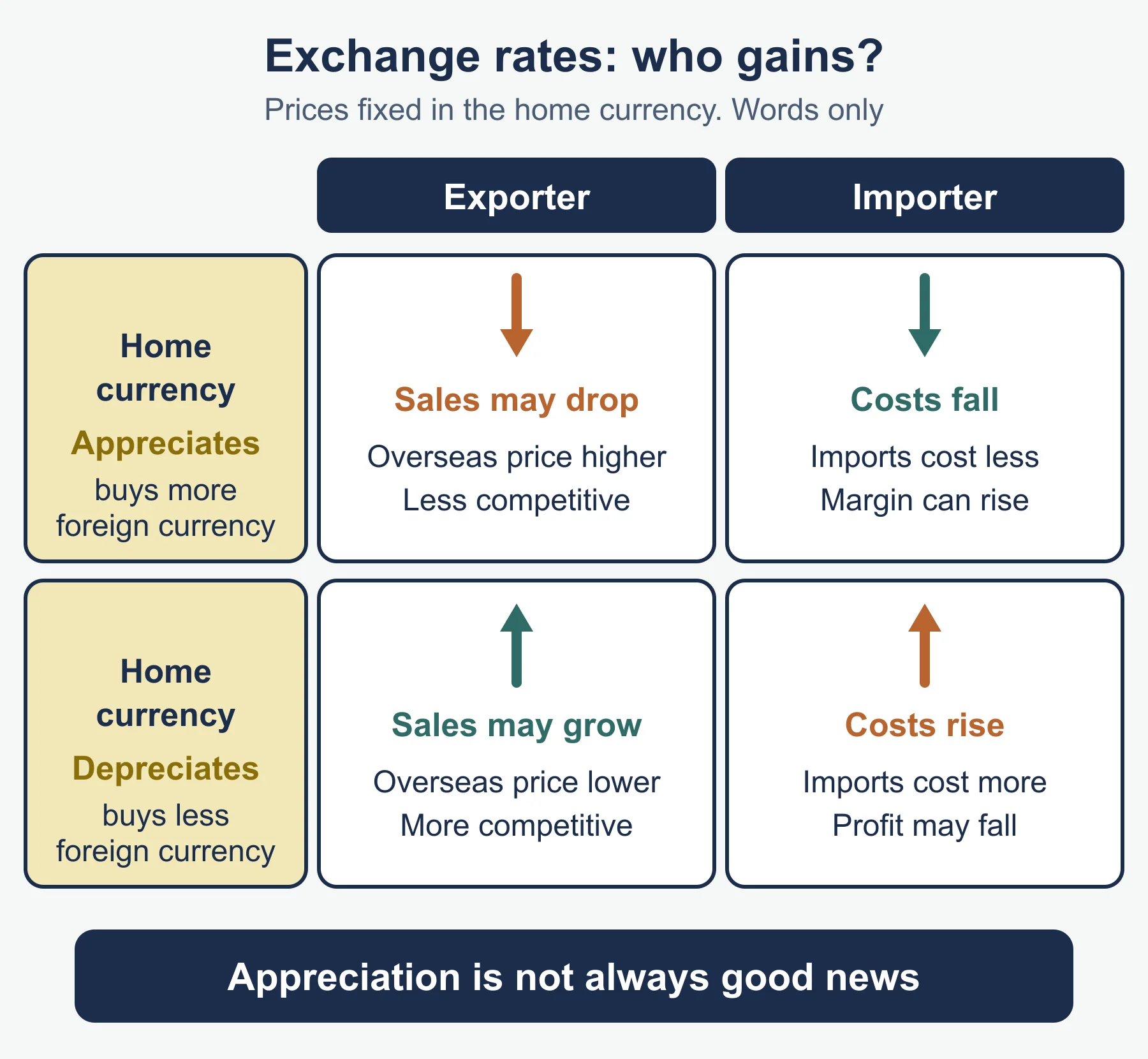
Exchange rates move over time. When the pound can buy more foreign currency, it has strengthened. When it buys less, it has weakened. The same move looks different from the other side: a stronger pound means a weaker dollar against it.
On international competitiveness
Competitiveness here means how attractive a country’s products are to buyers abroad compared with rivals. If the home currency strengthens, overseas buyers need more of their own currency to buy the same goods, so exports look more expensive and imports into the home market look cheaper. Competitiveness falls. If the home currency weakens, the reverse happens and competitiveness rises. How far demand changes depends on how sensitive buyers are to price and on how much of the product’s appeal comes from something other than price.
On exporters and importers
| Home currency strengthens | Home currency weakens | |
|---|---|---|
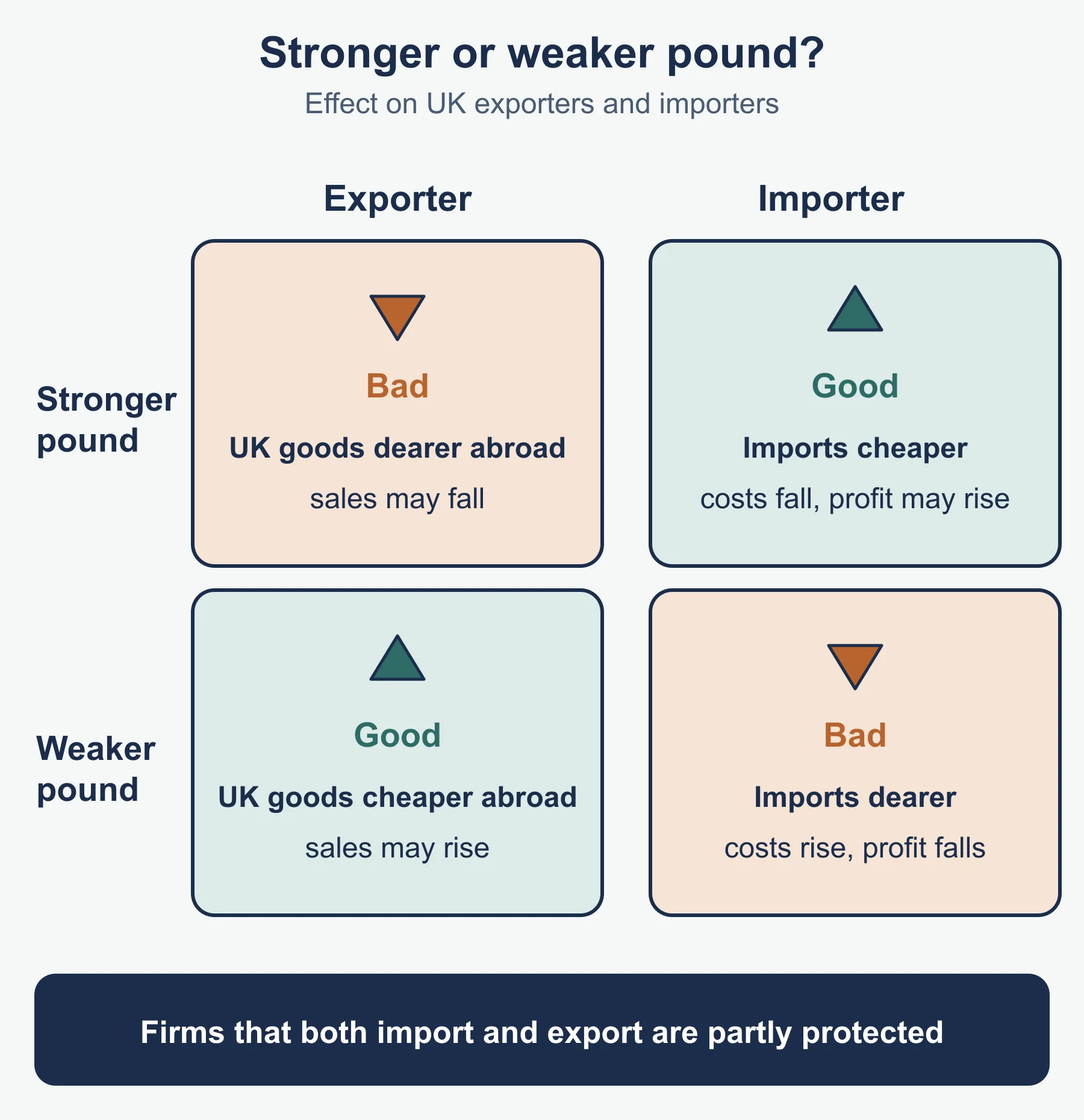
| Exporters | Foreign prices rise, or home-currency earnings per sale fall. Sales or profit may fall. | Foreign prices can fall, or home-currency earnings per sale rise. Sales or profit may grow. |
| Importers | Imports cost fewer units of home currency. Costs fall and profit margins may rise. | Imports cost more in home currency. Costs rise, so profit falls or prices rise. |
Worked example: an exporter and an importer
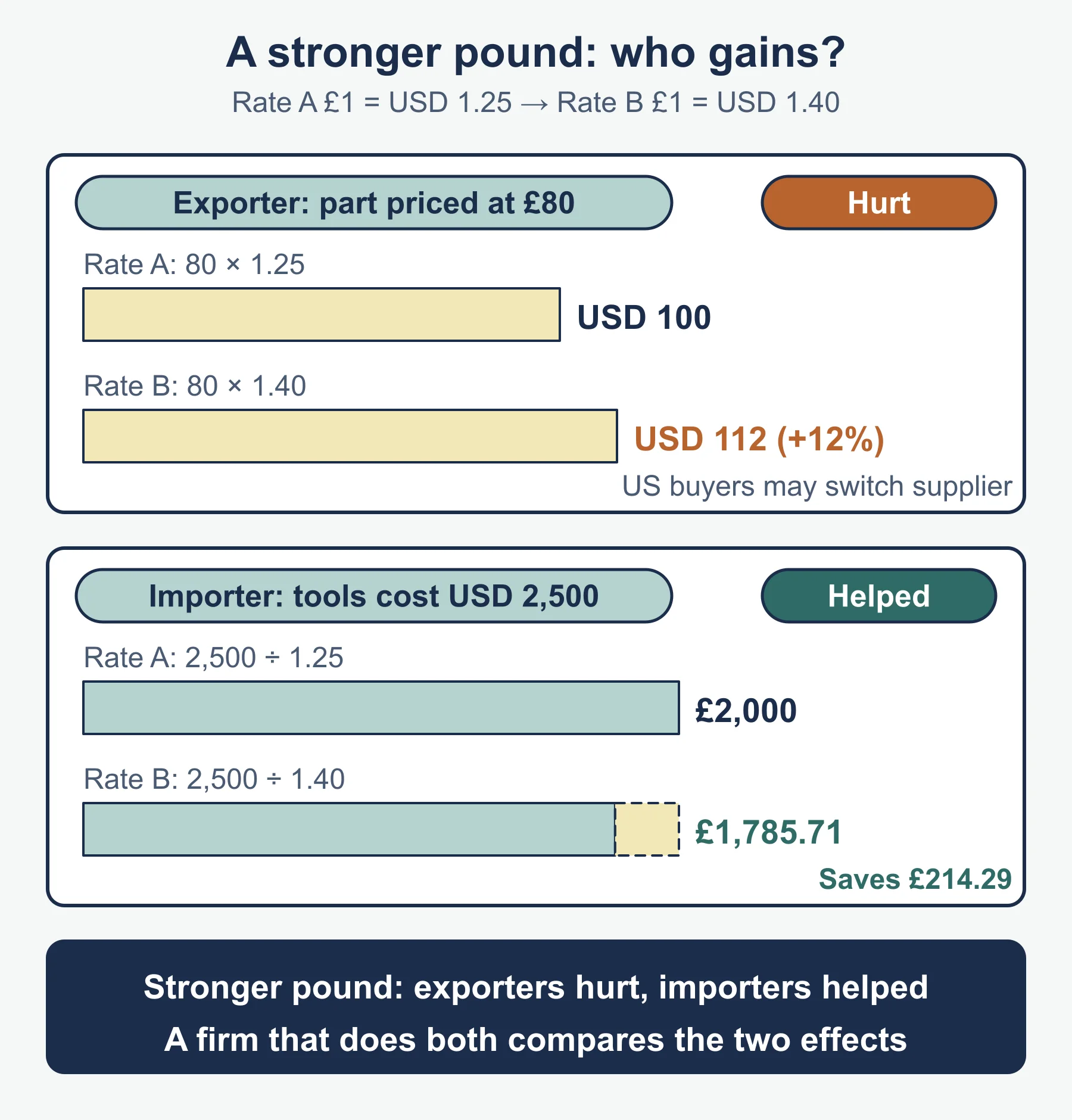
An invented UK firm sells a machine part at £80 and prices it in pounds.
Rate A: £1 = USD 1.25, so the US price is 80 × 1.25 = USD 100. Rate B: £1 = USD 1.40, so the US price is 80 × 1.40 = USD 112.
The US price rises by 12%. US buyers may switch to a cheaper supplier, so the pound’s strengthening hurts this exporter.
The same firm imports tools costing USD 2,500.
At Rate A the cost is 2,500 ÷ 1.25 = £2,000. At Rate B it is 2,500 ÷ 1.40 = £1,785.71, so the firm saves £214.29. The strengthening helps it as an importer.
A firm that both imports and exports is affected both ways. Compare the size of each effect before deciding whether the change helps or harms it.
Limits to remember
These two points are standard knowledge added for balance. The specification does not list them.
- A business may have agreed a price in advance, so a rate change may not show up at once.
- A business may choose to absorb a change in its profit margin instead of changing its price.
Common errors
- Multiplying when you should divide, or the reverse, and not noticing the answer is the wrong size.
- Writing a one-word label such as “more competition” without saying who is affected and how.
- Describing benefits of a multinational without saying whether they go to the business or to the host country.
- Mixing up which party gains: a stronger home currency helps importers and hurts exporters.
- Listing points in an evaluation without reaching a conclusion that fits the business in the question.
Next steps
Condense the key points with the revision notes, then test yourself with the practice questions. Return to the 4BS1 Business hub or tick off progress on the checklist. Find weak spots with the free diagnostics.
Frequently asked questions
What is globalisation in Edexcel IGCSE Business? Globalisation is the process by which markets, businesses and economies around the world become more closely linked, so goods, services, money, workers, technology and ideas move across borders more easily. The 4BS1 specification names the concept without wording it, so this is the standard definition.
What are the opportunities and threats of globalisation for a business? Opportunities include bigger markets, lower costs, economies of scale and spreading risk. Threats include more overseas competition, dependence on overseas suppliers, exchange rate risk, cultural and legal differences and pressure to cut prices.
What are the drawbacks of a multinational for the host country? Profits may leave the country, local firms may close, jobs can be insecure if production moves again, and there may be low wages, environmental damage or too much influence over government decisions.
How can you check an exchange rate answer is sensible? The currency with the larger number per pound is worth less per unit, so converting pounds into it should give a larger number and converting it into pounds a smaller one. If not, you have probably multiplied instead of divided.
Official syllabus
Pearson Edexcel International GCSE in Business (4BS1), Specification, Issue 2, February 2026, published by Pearson Education Limited. Topic 1: Business activity and influences on business, section 1.5 “Business and the international economy”, points 1.5.1 to 1.5.4.
Get free revision emails (optional)
Occasional emails with practice questions, worked explanations and links to free resources for the qualification and subjects you choose. No spam, and you can unsubscribe from any email. The free tools on this site never need an email.
Related resources
-
Practice questions
Edexcel IGCSE Business: Business and the international economy (4BS1) – Practice Questions
Original practice questions with worked answers on globalisation, multinationals and exchange rates for Edexcel IGCSE Business (4BS1), section 1.5.
Business · Pearson Edexcel · IGCSE
Try questions -
Revision notes
Edexcel IGCSE Business: Business and the international economy (4BS1) – Revision Notes
Condensed revision notes on globalisation, multinationals, exchange rate calculations and their effects for Edexcel IGCSE Business, with a self-test.
Business · Pearson Edexcel · IGCSE
Revise topic -
Study guides
Edexcel IGCSE Business: Business objectives and types of organisation (4BS1)
Study guide to business objectives, why they change, and the types of business organisation for Pearson Edexcel International GCSE Business.
Business · Pearson Edexcel · IGCSE
Read guide
Related articles
-
teaching
A Level tuition in Dubai: Cambridge or Pearson Edexcel International A Level?
Schools in Dubai and Abu Dhabi teach either Cambridge International AS & A Level or Pearson Edexcel International A Level. How the two are structured, why it matters for tuition, and how online classes from Lahore work.
9 October 2026
-
curriculum guides
Choosing subjects at IGCSE and A Level
How subject choices at 14 and 16 affect university options later, and how to keep pathways open without overloading a timetable.
28 July 2026
Studying this with a teacher
Working through Business IGCSE?
This page is free and stays free. If you would rather be taught it, Marlbridge runs Business classes one-to-one and in small groups of up to 15, online in your own time zone. The first trial class is free. WhatsApp replies within an hour (8am–11pm Pakistan time, every day); email the same day.
Pearson Edexcel Business teachers at Marlbridge

