
Revision Notes
Edexcel IGCSE Business: Business and the international economy (4BS1) – Revision Notes
Condensed revision notes on globalisation, multinationals, exchange rate calculations and their effects for Edexcel IGCSE Business, with a self-test.
- Subject
- Business
- Level
- IGCSE
- Topic
- Business activity and influences on business
- Author
- Marlbridge Academic Team
- Updated
- Reviewed by
- Asif Iqbal (what this means)
Aligned to Pearson Edexcel IGCSE Business (4BS1), Issue 2, February 2026. Official specification .
Syllabus page (what it covers and how it is assessed): Pearson Edexcel IGCSE Business.
Syllabus points this page covers
4BS1
- 1 Business activity and influences on business (whole topic)
- 1.5 Business and the international economy
Found an error? Report a correction.
Want a teacher for this? Marlbridge teaches Business online. Request a free trial class.
These revision notes condense Topic 1, section 1.5 “Business and the international economy” (points 1.5.1 to 1.5.4) of the Pearson Edexcel International GCSE in Business (4BS1) specification, Issue 2, February 2026. For full explanations and worked examples, read the study guide first. Then try the practice questions.
Course links: the 4BS1 Business hub, the printable checklist and the free diagnostics. The specification says both Paper 1 (small business, up to 49 employees) and Paper 2 (large business, more than 250 employees) can draw on all the content, so revise this section for both.
Key definitions
These definitions are standard knowledge. The specification does not give wording for them.
| Term | Meaning |
|---|---|
| Globalisation | Markets, businesses and economies becoming more closely linked, with goods, services, money and ideas crossing borders more easily |
| Multinational | A business with operations in more than one country |
| Host country | The country where a multinational locates an operation |
| Exchange rate | The price of one currency in terms of another |
| Importer | A business that buys goods or services from abroad |
| Exporter | A business that sells goods or services abroad |
| International competitiveness | How attractive a country’s or firm’s products are to overseas buyers compared with rivals |
| Strengthens / weakens | A currency buys more / less of another currency than before |
1.5.1 Globalisation at a glance
| Opportunities | Threats |
|---|---|
| Larger markets and more sales revenue | More competition from overseas rivals in the home market |
| Cheaper materials, components or labour | Dependence on overseas suppliers |
| Economies of scale from larger output | Exchange rate risk |
| Risk spread across several markets | Differences in culture, language and rules |
| Pressure on prices and margins |
Method for a globalisation answer:
- Define the term in a clause.
- Pick the one or two points that fit this business (small or large, importer or exporter).
- Explain the chain: cause, effect on the business, effect on profit or sales.
- If asked to evaluate, say which side is bigger and why.
1.5.2 Multinationals at a glance
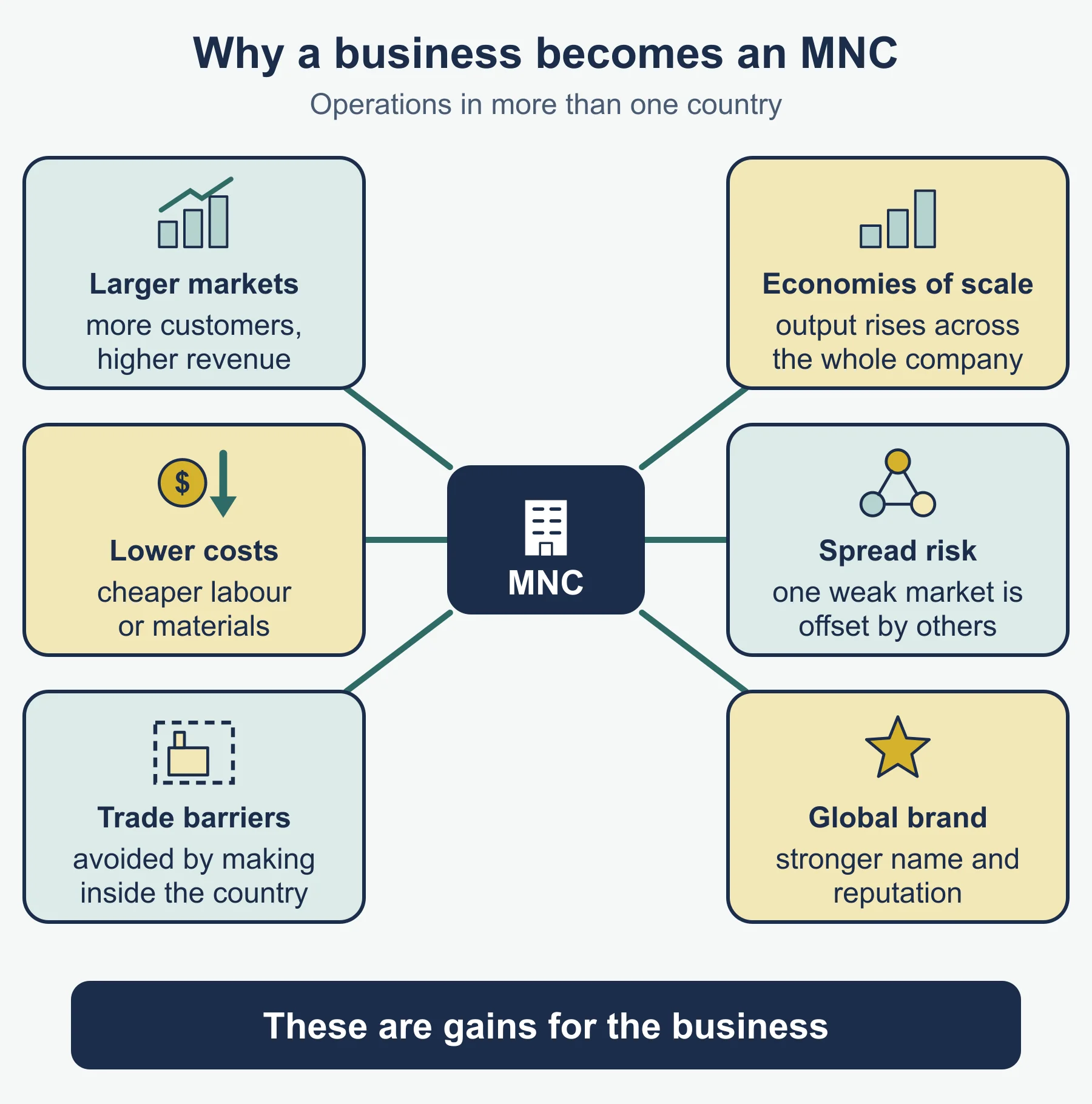
Why a business becomes a multinational:
- new markets and higher sales revenue
- lower costs abroad
- producing inside a market can avoid tariffs
- economies of scale
- spread risk across economies
- use of a global brand
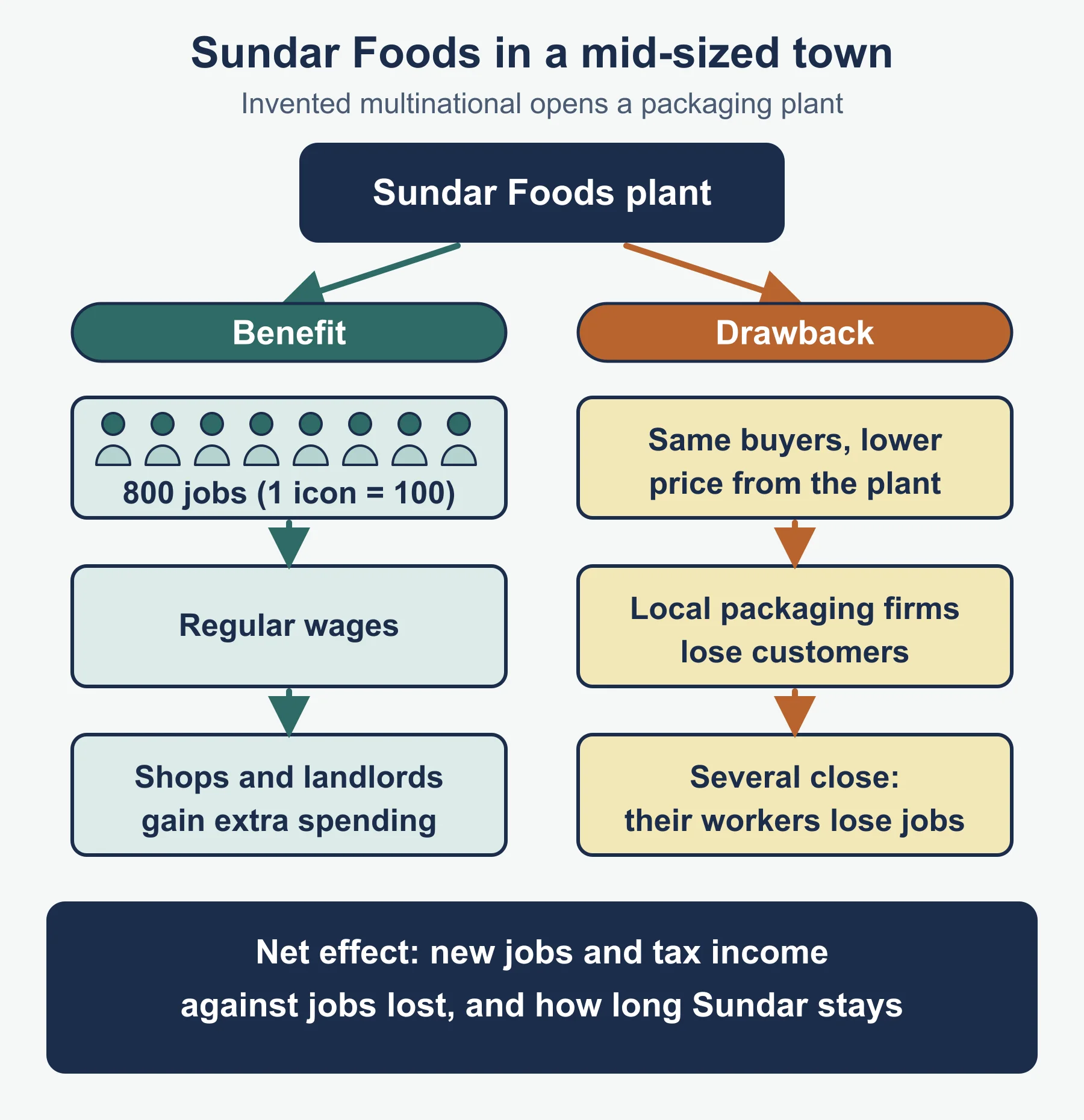
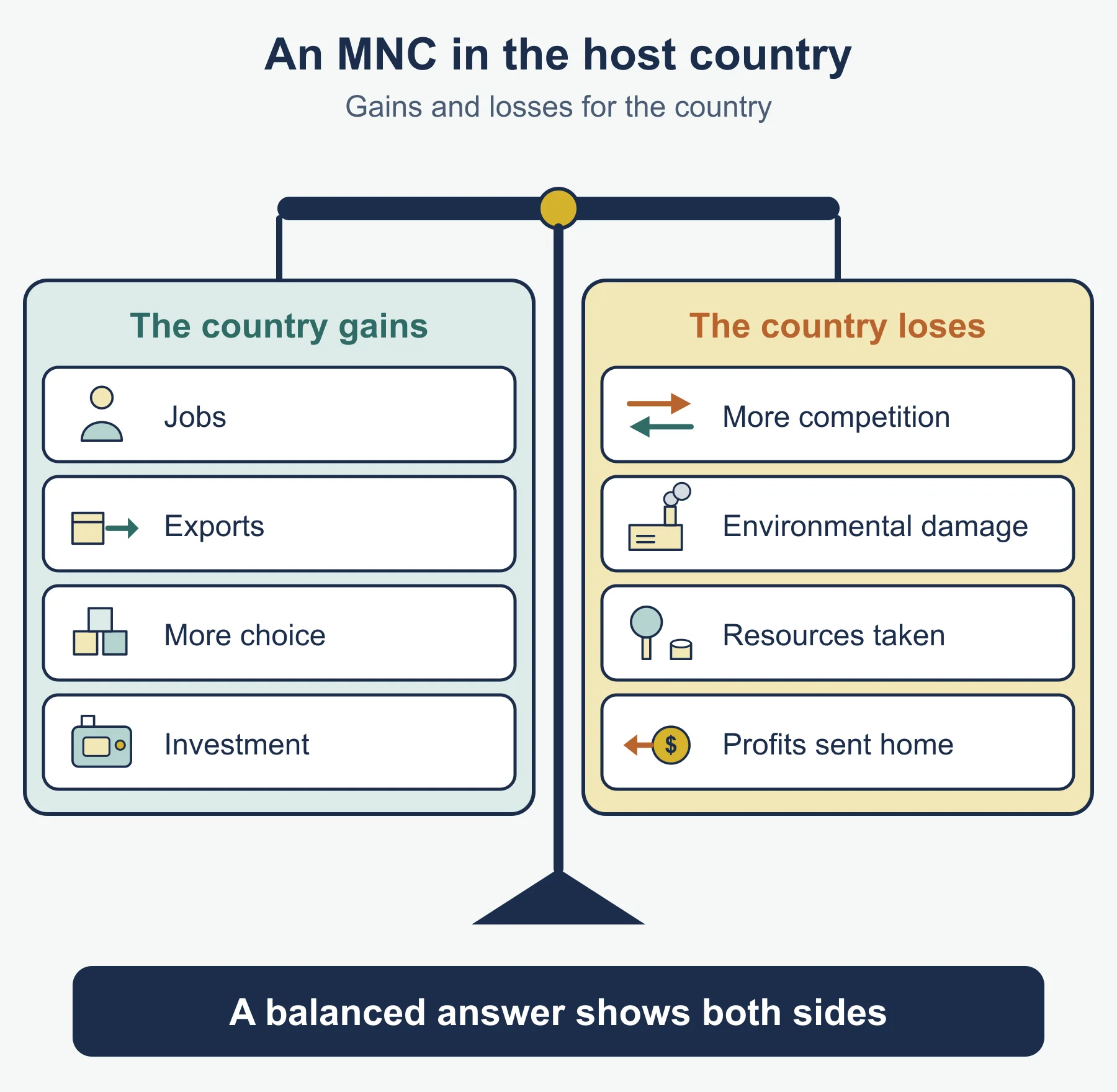
| Benefits to the host country and/or economy | Possible drawbacks to the host country and/or economy |
|---|---|
| Jobs and wages | Profits sent abroad to owners |
| Tax payments | Local firms may close |
| Investment | Jobs insecure if production moves |
| Skills and technology | Low pay or poor conditions |
| Consumer choice and lower prices | Environmental damage |
| Local suppliers gain a customer | Influence over government |
| Possible exports | Cultural change and dependence on one employer |
Must-know distinction: a benefit to the multinational (for example lower costs) is not automatically a benefit to the host country. Always say who gains.
1.5.3 Exchange rate calculations
The specification does not state a formula or rule. The multiply and divide rule below is standard knowledge, not specification wording:
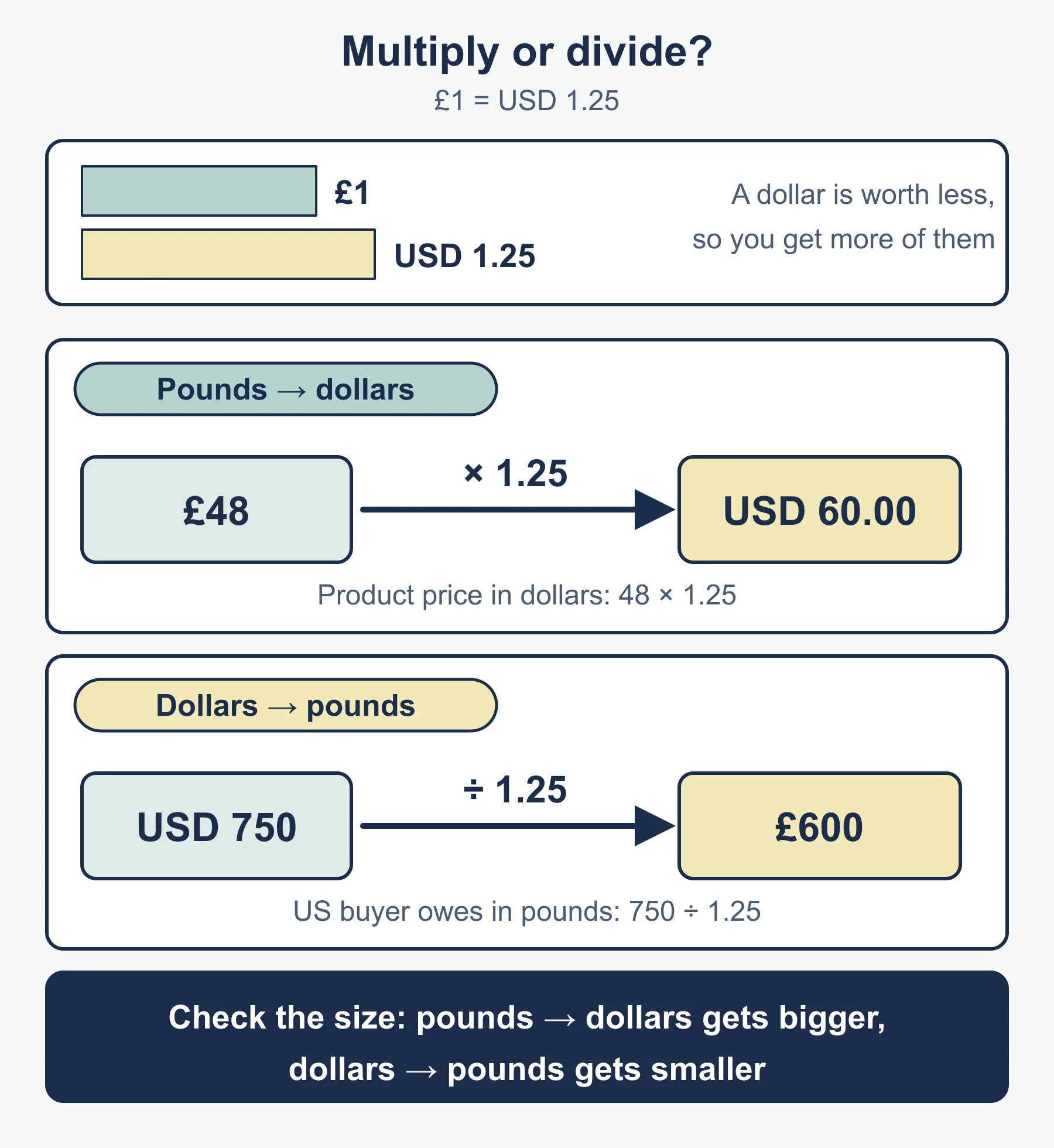
| Task | Operation (rate: £1 = foreign units) |
|---|---|
| Home currency into foreign | Multiply by the rate |
| Foreign currency into home | Divide by the rate |
Steps:
- Write the rate and which currency is £1 (the base).
- Decide the direction: home to foreign (multiply), foreign to home (divide).
- Calculate and label the currency.
- Sense check: the currency with the larger number per £1 gives bigger figures.
Worked reminder: £1 = USD 1.60. A £35 item costs 35 × 1.60 = USD 56. A bill of USD 840 is 840 ÷ 1.60 = £525.
1.5.4 Exchange rate changes
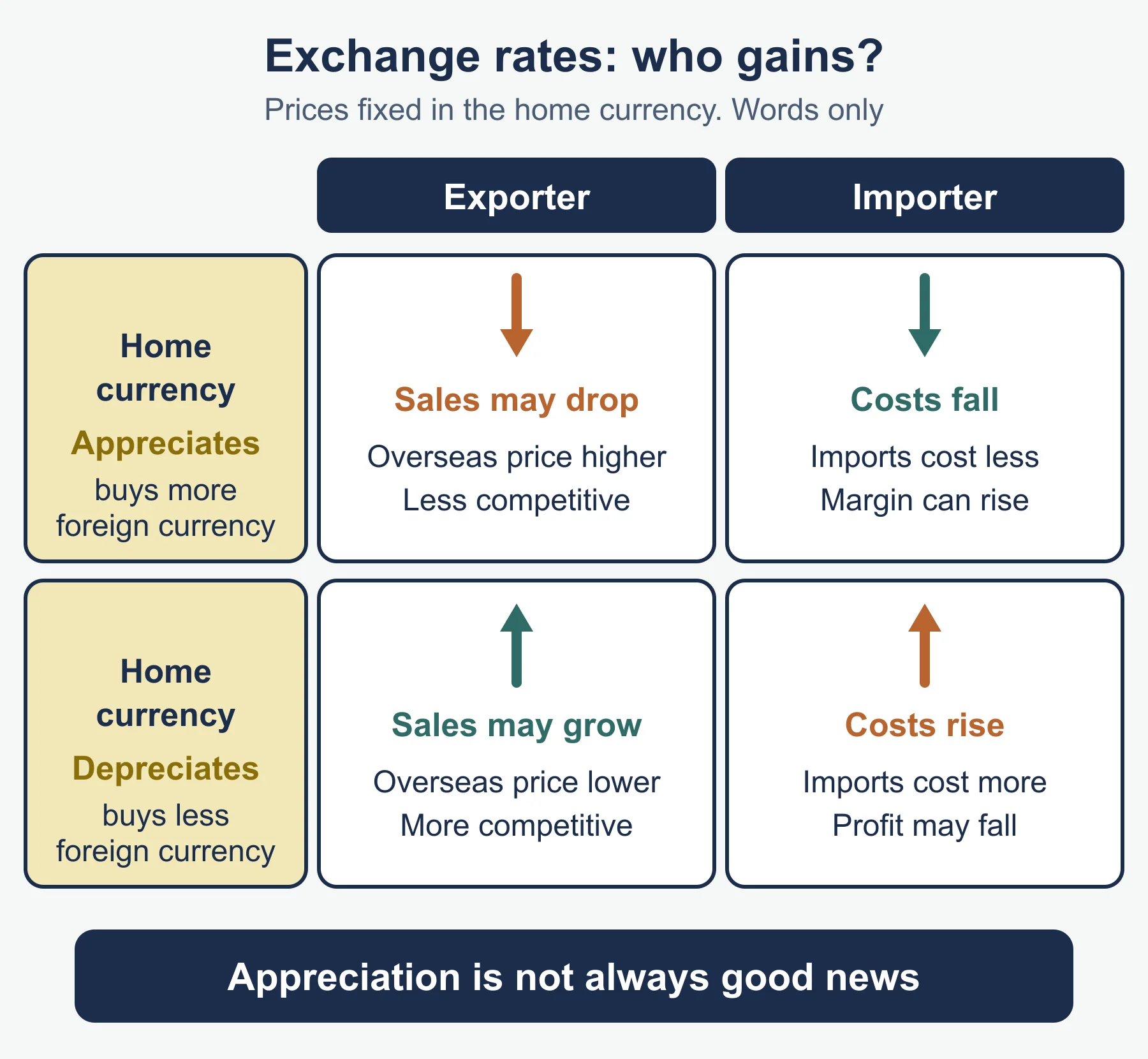
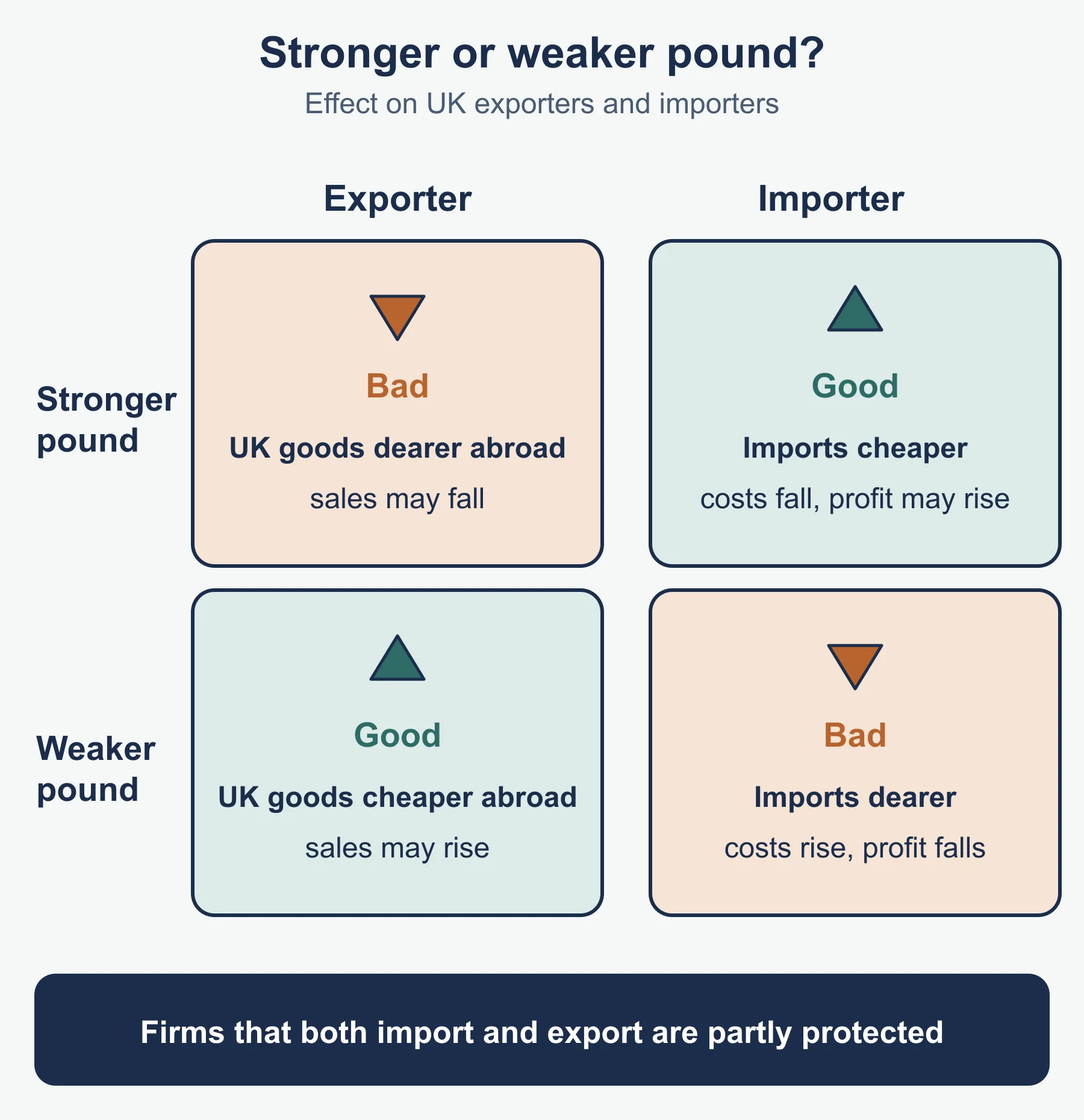
| Effect of a stronger home currency | Effect of a weaker home currency |
|---|---|
| Exports dearer abroad, competitiveness falls | Exports cheaper abroad, competitiveness rises |
| Imports cheaper in home currency | Imports dearer in home currency |
| Exporters: sales or earnings per sale fall | Exporters: sales or earnings per sale rise |
| Importers: costs fall, margins may improve | Importers: costs rise, margins may shrink |
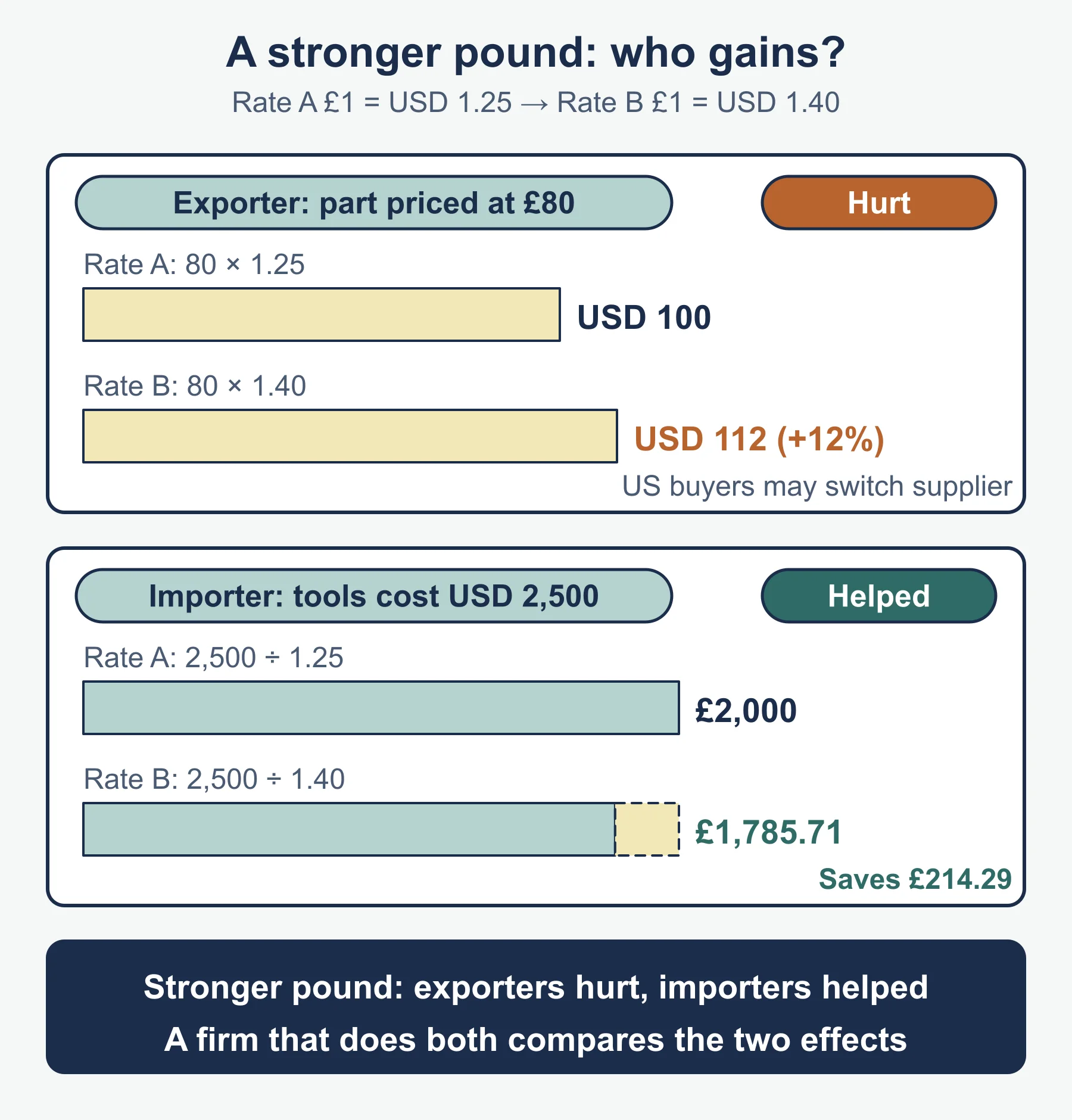
Worked reminder: a £50 product is priced in pounds. At £1 = USD 1.30 the US price is 50 × 1.30 = USD 65. If the pound weakens to £1 = USD 1.10, the US price is 50 × 1.10 = USD 55. A fall of USD 10 makes the product easier to sell in the US.
Linking points (standard knowledge, not specification wording):
- A firm that both imports and exports must weigh the two effects.
- Price contracts agreed in advance can delay the effect.
- A business may absorb a change in its margin rather than change its price.
- Competitiveness also depends on quality, brand and service, not only on price.
Quick links between points
- Globalisation (1.5.1) is the background. It explains why multinationals (1.5.2) grow and why more businesses trade in foreign currencies (1.5.3 and 1.5.4).
- Exchange rate risk is both a threat of globalisation and the reason section 1.5.4 matters.
- A multinational that earns in one currency and pays costs in another is exposed to rate changes in both directions.
- The same host-country effect can be a benefit or a drawback depending on scale and timing, for example new jobs against closing local firms.
Writing the answer
Match your response to the command word in the question.
| Command word | What to write |
|---|---|
| State / identify / define | A short answer, no explanation needed |
| Calculate | The rate, the operation, the result and the currency |
| Explain / analyse | A point, then the chain of cause and effect, tied to the business |
| Evaluate / justify / recommend | Both sides, a weighed judgement, and a reason that fits the business |
Short model for an explain answer: “If the pound strengthens, a UK exporter’s goods cost more in dollars. US buyers may switch to cheaper suppliers, so the exporter’s sales fall.”
Short model for a judgement: “Becoming a multinational gives the firm access to a larger market, but the cost of building abroad is high. Overall it is worthwhile only if overseas demand is likely to be large enough to repay that cost.”
Quick self-test
- Define globalisation.
- State two opportunities of globalisation for a business.
- State two threats of globalisation for a business.
- Give two benefits to a business of becoming a multinational.
- Give one benefit and one drawback of a multinational for the host country.
- At £1 = USD 1.60, convert £35 into US dollars.
- At £1 = EUR 1.10, convert EUR 5,500 into pounds.
- A UK exporter prices a part at £50. The pound weakens from £1 = USD 1.30 to £1 = USD 1.10. Show what happens to the US dollar price.
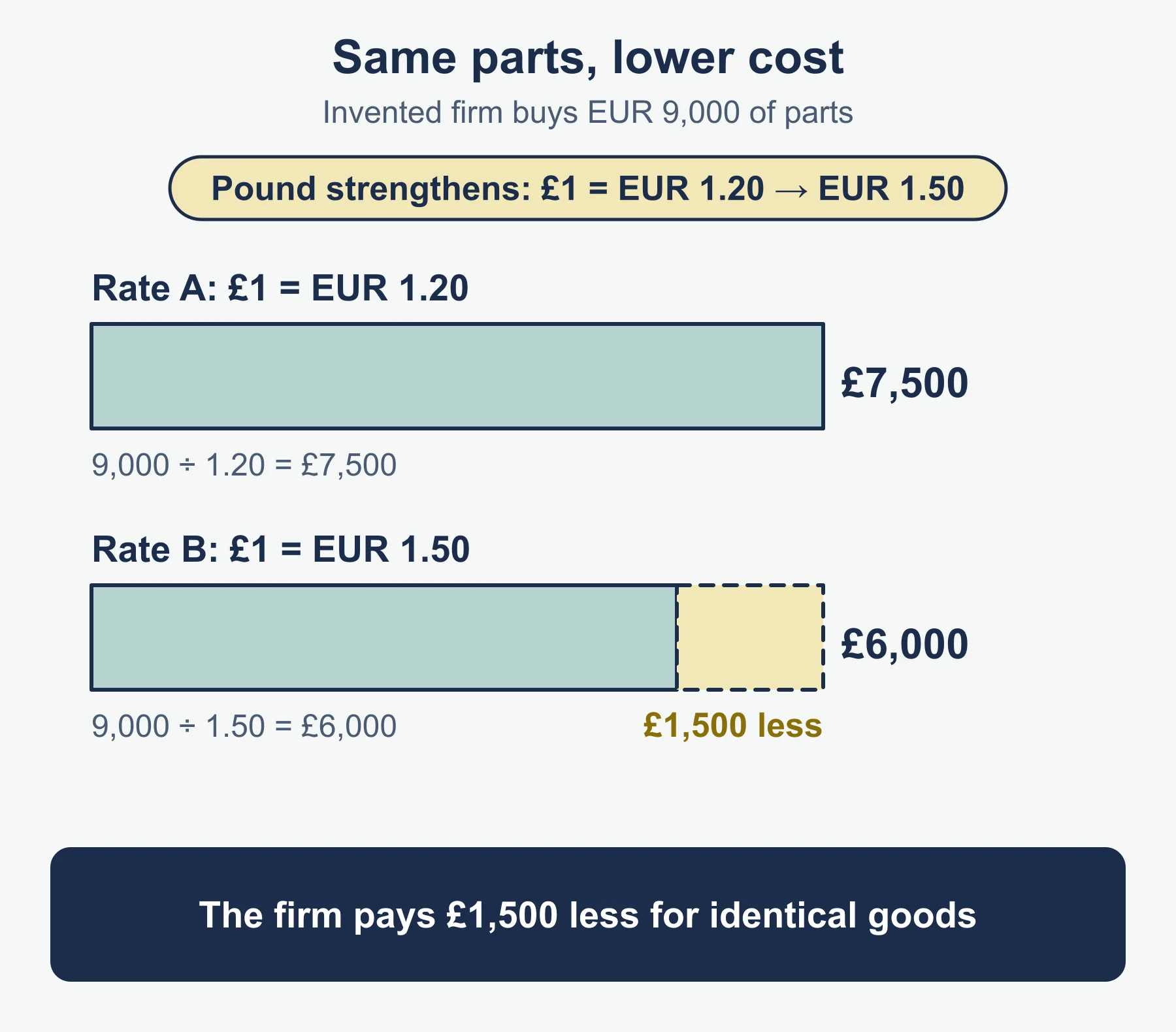
- A UK importer pays EUR 6,600 for stock. The rate moves from £1 = EUR 1.10 to £1 = EUR 1.32. Calculate the change in the pound cost.
- Explain why a weaker pound might harm a UK business that imports most of its materials.
Answers
- The process by which markets, businesses and economies become more closely linked, so goods, services, money and ideas cross borders more easily.
- Any two of: larger markets, lower costs, economies of scale, spreading risk.
- Any two of: more overseas competition at home, dependence on overseas suppliers, exchange rate risk, cultural and legal differences.
- Any two of: new markets, lower costs, avoiding trade barriers, economies of scale, spreading risk.
- Benefit: for example jobs and wages. Drawback: for example profits leaving the country, or local firms closing.
- 35 × 1.60 = USD 56.
- 5,500 ÷ 1.10 = £5,000.
- 50 × 1.30 = USD 65 before; 50 × 1.10 = USD 55 after. The US price falls by USD 10.
- At 1.10: 6,600 ÷ 1.10 = £6,000. At 1.32: 6,600 ÷ 1.32 = £5,000. The cost falls by £1,000 (the pound has strengthened).
- Each pound buys less foreign currency, so imported materials cost more in pounds. Costs rise, so profit falls unless the business raises its prices, and a price rise could lose customers.
Where marks are usually lost
- Giving a list of opportunities or threats with no link to the named business.
- Using “it” or “they” without making clear whether the business or the host country is meant.
- Muddling the benefits to a multinational with the benefits to the host country.
- Multiplying instead of dividing when converting into the home currency.
- Leaving out the currency label from a final answer.
- Stating that a stronger currency is “good” or “bad” without saying for whom.
- Missing the exporter and importer effects on a business that does both.
- Writing a long one-sided answer to an evaluate or justify question and ending without a judgement.
- Repeating the same point in different words instead of adding a second distinct point.
Next steps
Go back to the study guide for any gap, work through the practice questions, and tick off progress on the checklist. Use the 4BS1 Business hub for other topics, and the free diagnostics to find weak areas.
Frequently asked questions
What is an exchange rate? An exchange rate is the price of one currency in terms of another. It tells you how many units of a foreign currency one unit of your own currency buys.
How does a stronger pound affect exporters and importers? A stronger home currency makes exports dearer abroad, so exporters may lose sales or profit, while imports cost less in home currency, so importers’ costs fall. A weaker currency does the reverse.
What are the benefits of becoming a multinational? A business can gain access to new markets, lower costs, economies of scale and the chance to spread risk, and producing inside a market can avoid some trade barriers such as tariffs.
Why might an exchange rate change not affect a business straight away? The business may have agreed a price in advance, or it may choose to absorb the change in its profit margin instead of changing its price.
Official syllabus
Pearson Edexcel International GCSE in Business (4BS1), Specification, Issue 2, February 2026, published by Pearson Education Limited. Topic 1: Business activity and influences on business, section 1.5 “Business and the international economy”, points 1.5.1 to 1.5.4.
Get free revision emails (optional)
Occasional emails with practice questions, worked explanations and links to free resources for the qualification and subjects you choose. No spam, and you can unsubscribe from any email. The free tools on this site never need an email.
Related resources
-
Study guides
Edexcel IGCSE Business: Business objectives and types of organisation (4BS1)
Study guide to business objectives, why they change, and the types of business organisation for Pearson Edexcel International GCSE Business.
Business · Pearson Edexcel · IGCSE
Read guide -
Practice questions
Edexcel IGCSE Business: Business objectives and types of organisation (4BS1) – Practice Questions
Original practice questions with worked answers on business objectives and types of organisation for Pearson Edexcel International GCSE Business.
Business · Pearson Edexcel · IGCSE
Try questions -
Revision notes
Edexcel IGCSE Business: Business objectives and types of organisation (4BS1) – Revision Notes
Condensed revision notes on business objectives and types of organisation, with a self-test, for Pearson Edexcel International GCSE Business.
Business · Pearson Edexcel · IGCSE
Revise topic
Related articles
-
teaching
A Level tuition in Dubai: Cambridge or Pearson Edexcel International A Level?
Schools in Dubai and Abu Dhabi teach either Cambridge International AS & A Level or Pearson Edexcel International A Level. How the two are structured, why it matters for tuition, and how online classes from Lahore work.
9 October 2026
-
curriculum guides
Choosing subjects at IGCSE and A Level
How subject choices at 14 and 16 affect university options later, and how to keep pathways open without overloading a timetable.
28 July 2026
Studying this with a teacher
Working through Business IGCSE?
This page is free and stays free. If you would rather be taught it, Marlbridge runs Business classes one-to-one and in small groups of up to 15, online in your own time zone. The first trial class is free. WhatsApp replies within an hour (8am–11pm Pakistan time, every day); email the same day.
Pearson Edexcel Business teachers at Marlbridge

