
Study Guides
Edexcel IGCSE Business: Classification of businesses and location decisions (4BS1)
Study guide to the primary, secondary and tertiary sectors and the factors behind location and relocation, for Edexcel International GCSE Business.
- Subject
- Business
- Level
- IGCSE
- Topic
- Business activity and influences on business
- Author
- Marlbridge Academic Team
- Updated
- Reviewed by
- Asif Iqbal (what this means)
Aligned to Pearson Edexcel IGCSE Business (4BS1), Issue 2, February 2026. Official specification .
Syllabus page (what it covers and how it is assessed): Pearson Edexcel IGCSE Business.
Syllabus points this page covers
4BS1
- 1 Business activity and influences on business (whole topic)
- 1.3 Classification of businesses
- 1.4 Decisions on location
Found an error? Report a correction.
Want a teacher for this? Marlbridge teaches Business online. Request a free trial class.
This guide follows the Pearson Edexcel International GCSE in Business (4BS1) specification, Issue 2, February 2026. It covers Topic 1 sections 1.3 (Classification of businesses) and 1.4 (Decisions on location), points 1.3.1 and 1.4.1. The specification says both papers can draw on knowledge from across the entire content, so these ideas can appear in a small-business scenario (Paper 1, up to 49 employees) or a large-business scenario (Paper 2, more than 250 employees).
Course links: the Business hub, the printable checklist and the free diagnostics. Companion pages: the revision notes and the practice questions.
What the specification asks for
| Point | You must be able to | Where in this guide |
|---|---|---|
| 1.3.1 | Classify activity as primary (extracting raw materials from the earth), secondary (converting raw materials into finished or semi-finished goods) or tertiary (provision of a wide variety of services) | Section 1 |
| 1.4.1 | Explain proximity to market, labour, materials and competitors | Section 2 |
| 1.4.1 | Explain how the nature of the business activity affects location | Section 3 |
| 1.4.1 | Explain the impact of the internet on location: e-commerce and/or fixed premises | Section 4 |
| 1.4.1 | Explain legal controls and trade blocs as influences on location | Section 5 |
| 1.4.1 | Apply the factors to relocation of a business | Section 6 |
1. Primary, secondary and tertiary activities (1.3.1)
Businesses are classified by what they do with resources.
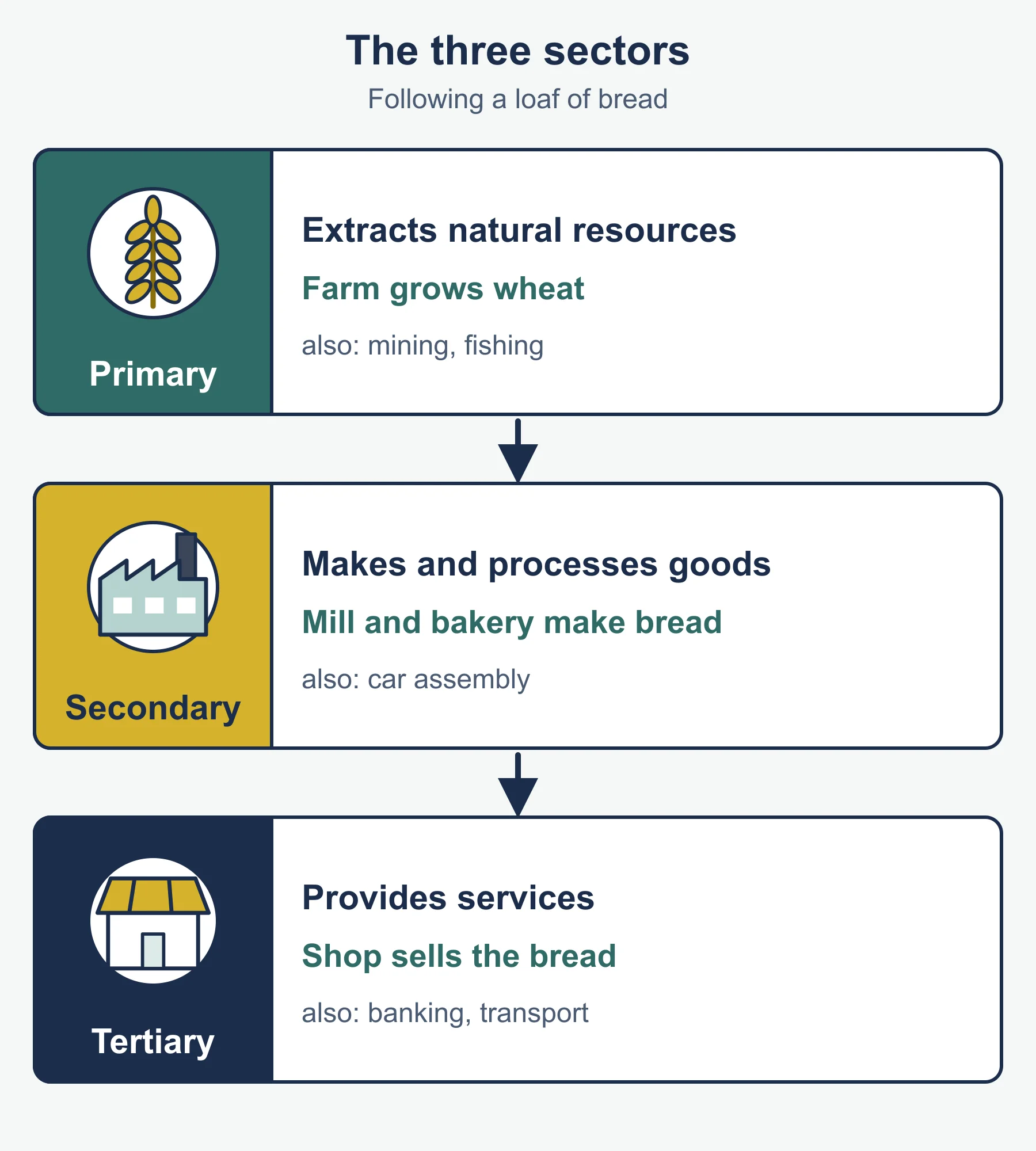
- Primary sector: extracting raw materials from the earth. Think of farming, fishing, forestry and mining.
- Secondary sector: converting raw materials into finished or semi-finished goods. Think of manufacturing, construction and food processing. A semi-finished good, such as sawn timber, becomes an input for another business.
- Tertiary sector: provision of a wide variety of services. Think of retail, banking, transport, education and hairdressing.
Look at the verb in the business description. “Grows”, “catches” and “digs” point to primary. “Makes”, “builds” and “processes” point to secondary. “Sells”, “delivers”, “advises” and “repairs” point to tertiary.
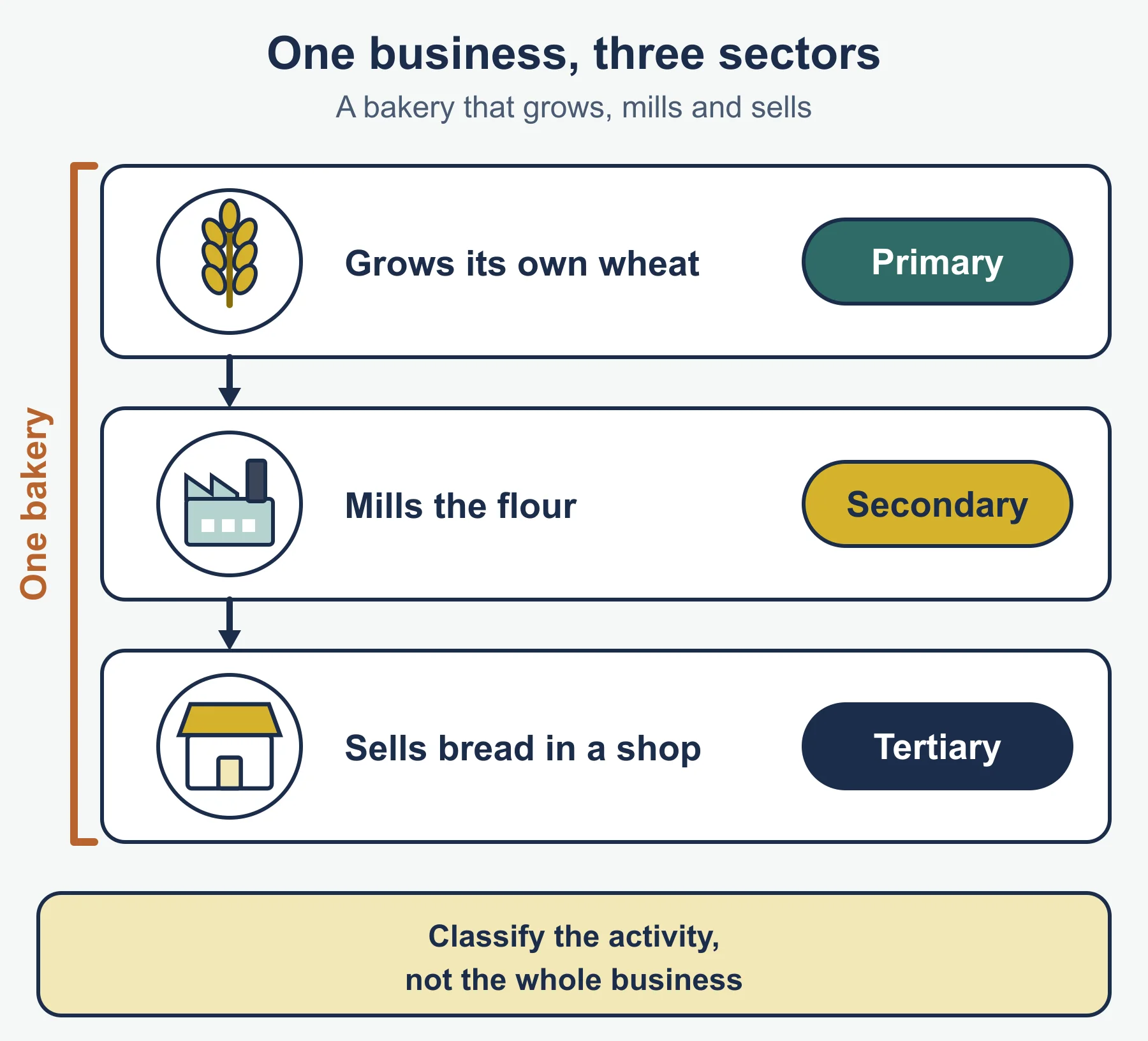
The sectors link in a chain. A forestry firm supplies logs, a sawmill converts them into planks and a builders’ merchant sells the planks. One business can also work in more than one sector.
Worked example: a business in three sectors
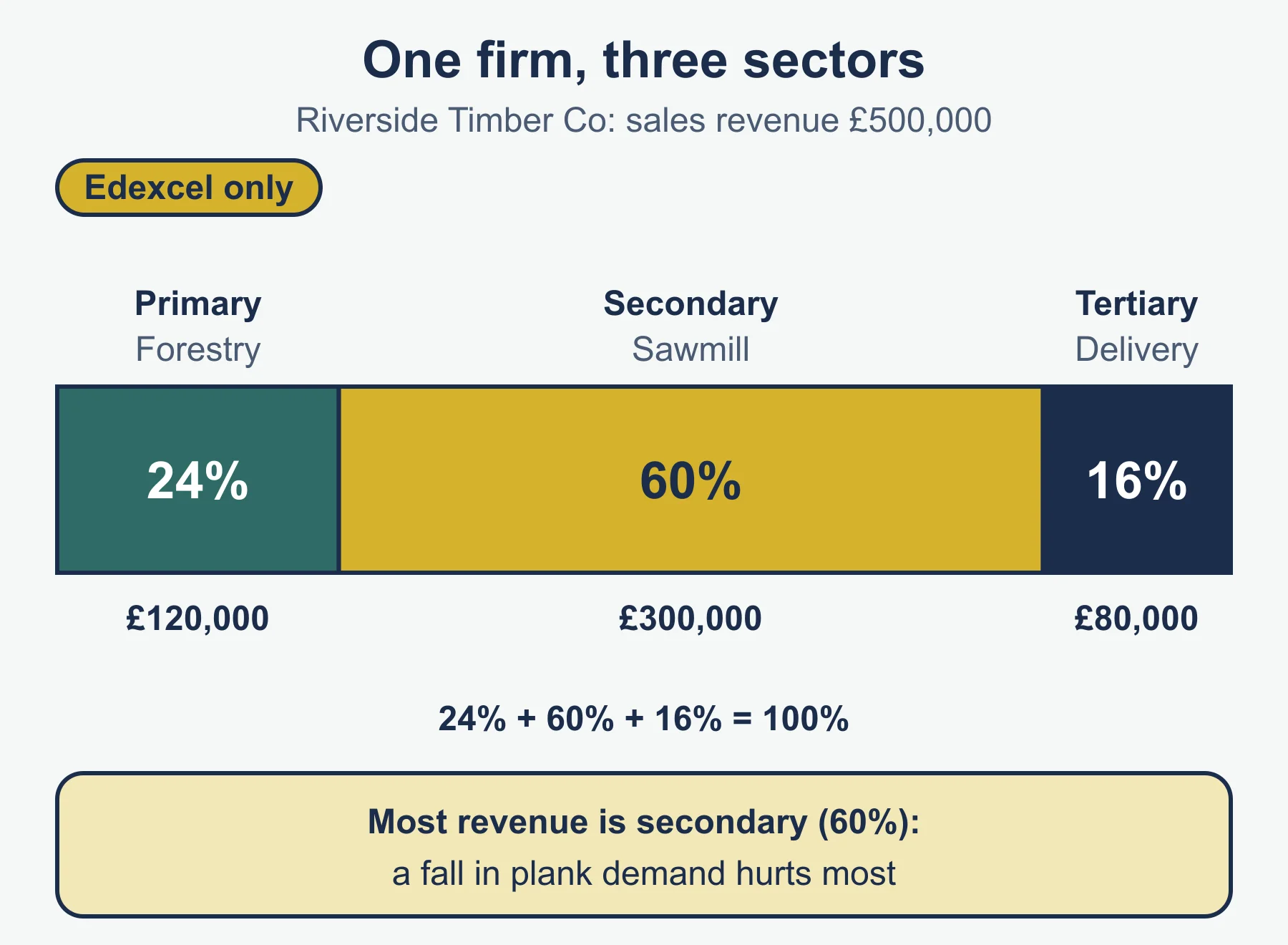
Riverside Timber Co has these annual sales revenues: forestry (selling logs) £120,000, sawmill (selling planks) £300,000 and a delivery service for other firms £80,000.
Total sales revenue = 120,000 + 300,000 + 80,000 = £500,000.
| Activity | Sector | Revenue | Share of total |
|---|---|---|---|
| Forestry | Primary | £120,000 | 120,000 / 500,000 x 100 = 24.0% |
| Sawmill | Secondary | £300,000 | 300,000 / 500,000 x 100 = 60.0% |
| Delivery | Tertiary | £80,000 | 80,000 / 500,000 x 100 = 16.0% |
The shares add to 100%. The business earns most of its revenue from the secondary sector, so a fall in demand for planks would hurt it more than a fall in demand for deliveries.
Why classification matters
Sector affects what a business needs. A primary business needs land or access to a resource. A secondary business needs equipment, materials and often space. A tertiary business needs customers, skilled people and often convenient access. These needs lead straight into the location factors below.
2. Proximity to market, labour, materials and competitors (1.4.1)
A location decision is a choice of where to operate. Four proximity factors are named in the specification.
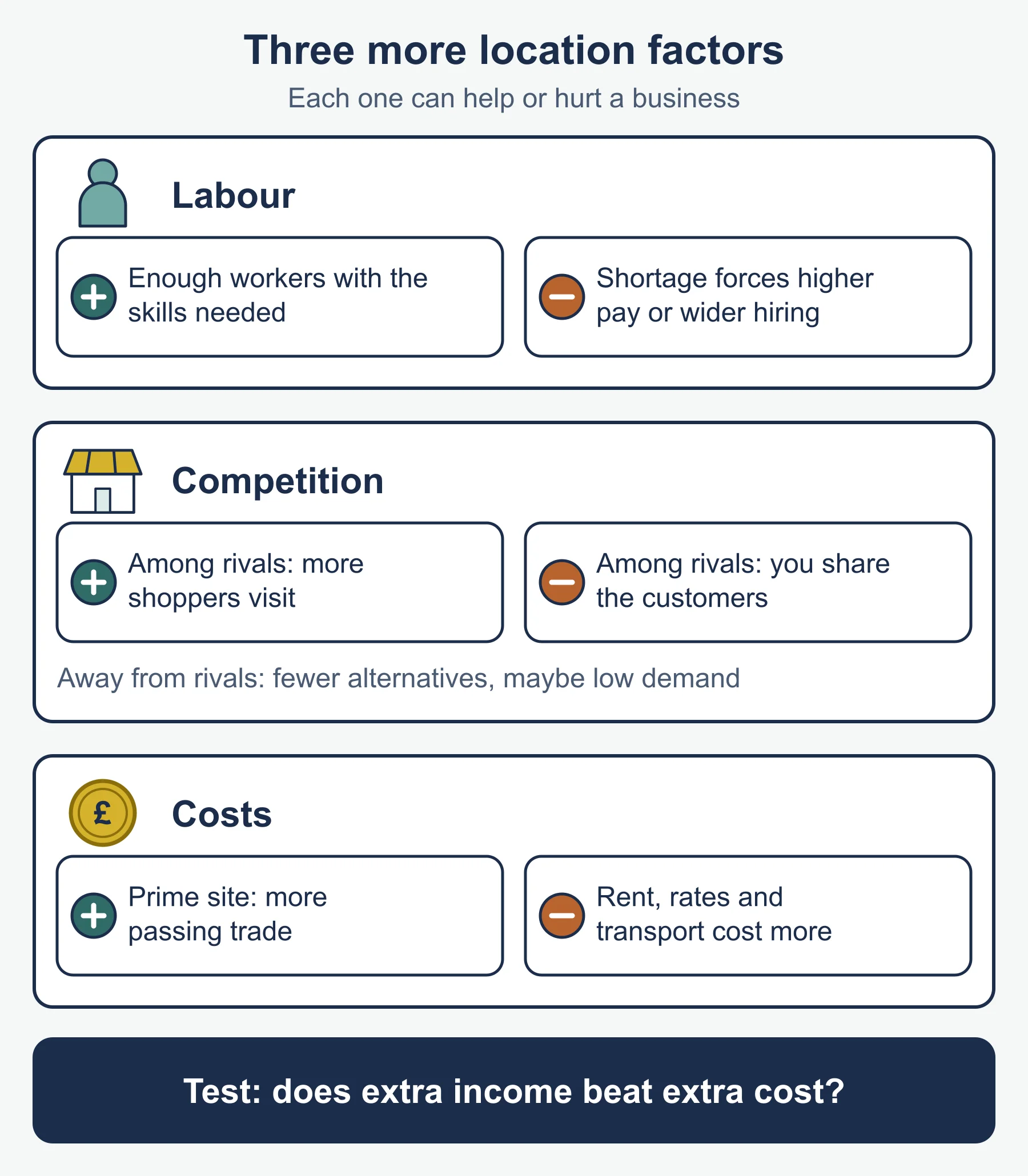
Proximity to market. Being near customers makes it easy for them to reach the business and keeps delivery costs low. This matters most when customers come to the premises (a café, a barber) or when goods are bulky, fragile or perishable (fresh bread). Being far from customers can still work if goods are cheap to transport.
Proximity to labour. A business needs enough people with the right skills at a wage it can afford. A location with a large local workforce makes recruitment easier. A location where similar firms already employ the skilled workers may raise wages. A remote site can mean paying more to attract staff or paying for transport.
Proximity to materials. A business that uses heavy or bulky inputs, or inputs that go off, saves transport costs and delay by being close to its suppliers. If the finished product weighs much less than the inputs, locating near the materials is often cheaper.
Proximity to competitors. There are two opposing effects. Being near competitors may bring customers who are already used to travelling to that area (clusters of restaurants or car showrooms), and it may offer a pool of skilled workers. It also means customers can easily compare prices and switch, so competition may reduce sales and force prices down. Being far from competitors avoids direct rivalry but may mean fewer passing customers.
Worked example: comparing two sites
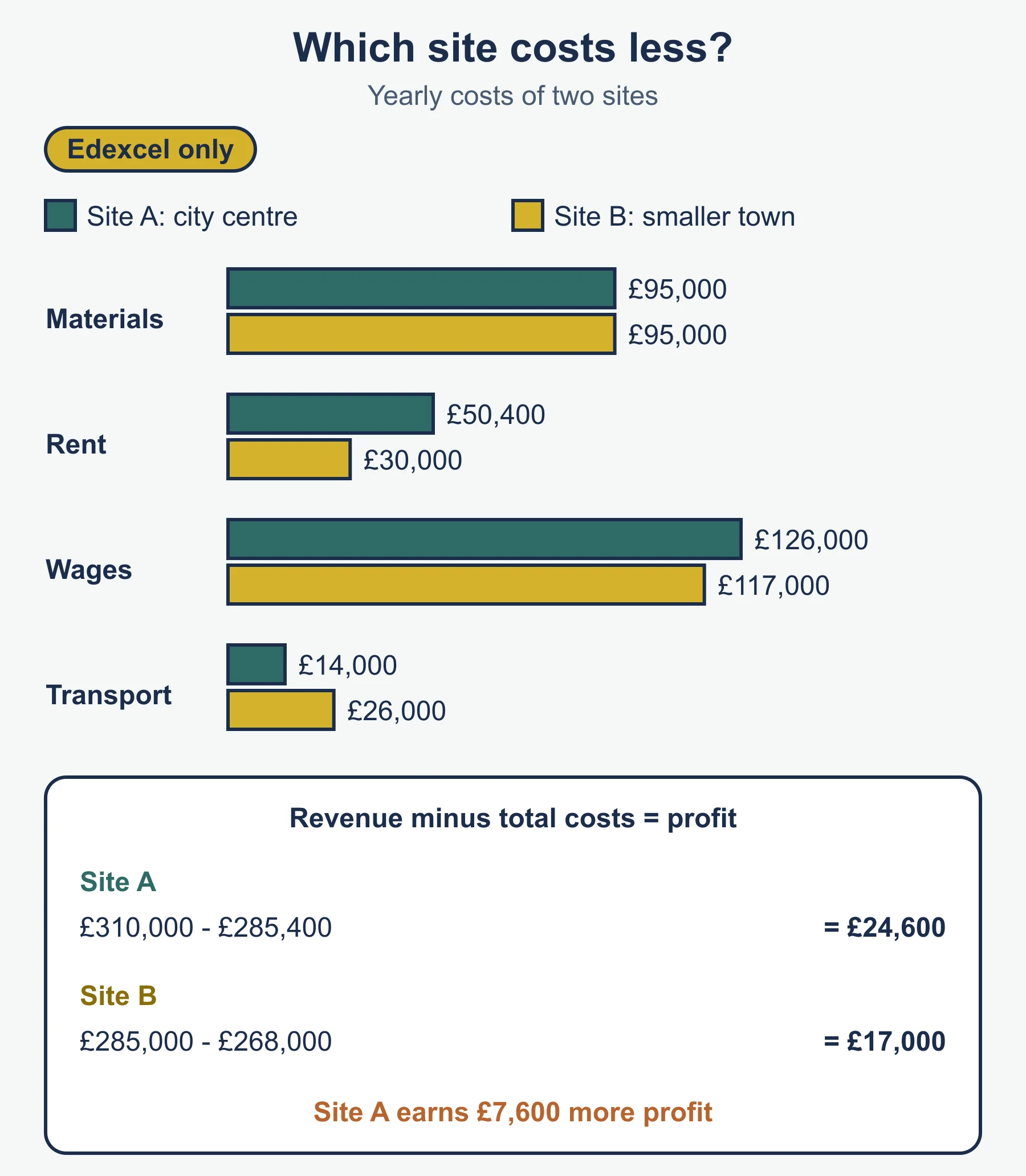
Thornfield Joinery makes made-to-order furniture with six workers. It is choosing between a city-centre unit (Site A) and a unit in a smaller town (Site B).
| Annual figure | Site A | Site B |
|---|---|---|
| Expected sales revenue | £310,000 | £285,000 |
| Materials | £95,000 | £95,000 |
| Rent | £4,200 x 12 = £50,400 | £2,500 x 12 = £30,000 |
| Wages | 6 x £21,000 = £126,000 | 6 x £19,500 = £117,000 |
| Transport of materials and deliveries | £14,000 | £26,000 |
| Total costs | £285,400 | £268,000 |
| Profit (revenue - total costs) | £24,600 | £17,000 |
Site A gives £7,600 more profit. Site B has lower rent and wages but higher transport costs and lower expected sales, because it is further from customers and suppliers.
The numbers favour Site A. A strong answer then weighs what the table leaves out: the revenue figures are forecasts, a city centre may bring parking and congestion problems, and the owner may prefer a smaller town for reasons that are not financial. A recommendation is supported by figures and tested against these limits.
3. Nature of the business activity (1.4.1)
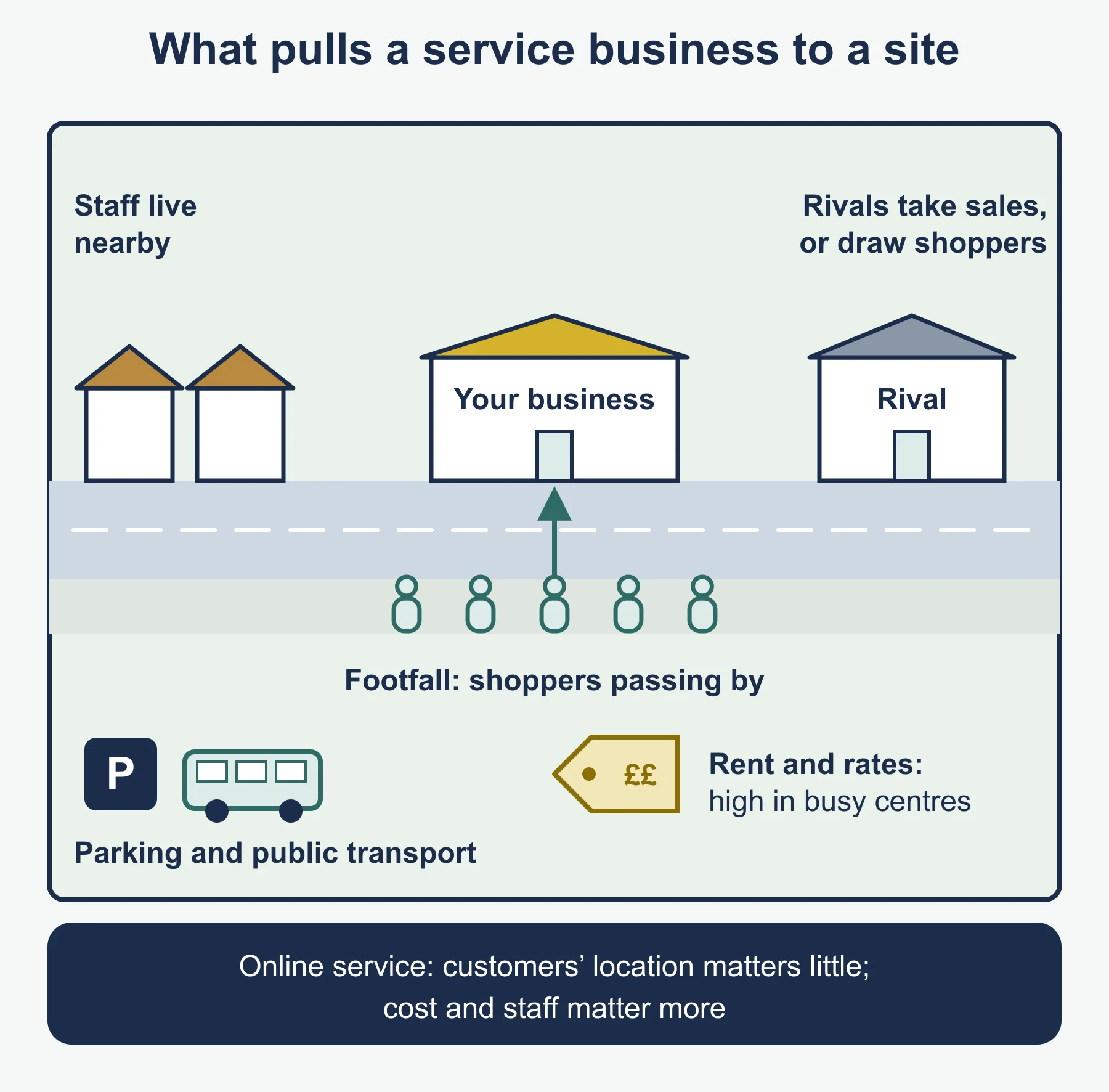
The type of activity can fix, or narrow, the choice of location.
- A mine, quarry or farm must be where the resource is. Location is not really a choice.
- A heavy manufacturer needs large premises and good transport links, so it often chooses edge-of-town land or an industrial estate over a high street.
- A shop or restaurant depends on footfall, so it usually wants a visible, busy site.
- A service such as accountancy or web design may need only an office and a good connection, so it has wide freedom.
Ask the same question each time: what does this activity need most, and where is that found at the lowest cost?
4. The impact of the internet: e-commerce and/or fixed premises (1.4.1)
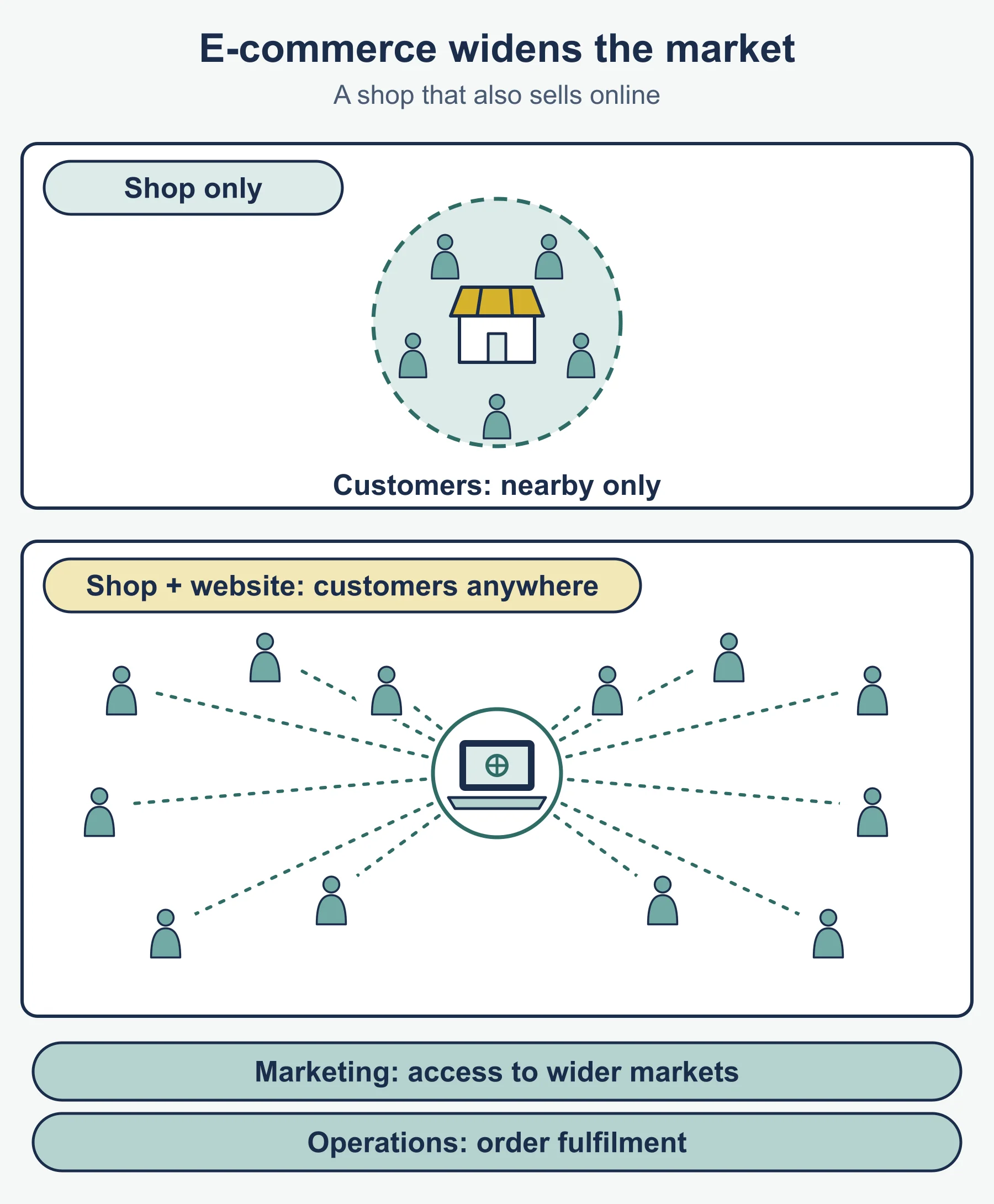
E-commerce means buying and selling over the internet. It changes the location decision because customers no longer have to visit the business.
Effects on location:
- An online seller can use cheaper premises, such as a warehouse away from the town centre, because it needs no passing trade.
- It can reach customers in other regions or countries without opening a shop there.
- Some costs shift to delivery, packaging, website upkeep and returns.
- Some customers still want to see, try or collect goods, so a fixed premises can keep value (a shop for clothing, a salon for hair).
- Many businesses use both: a shop and a website.
Worked example: online or shop?
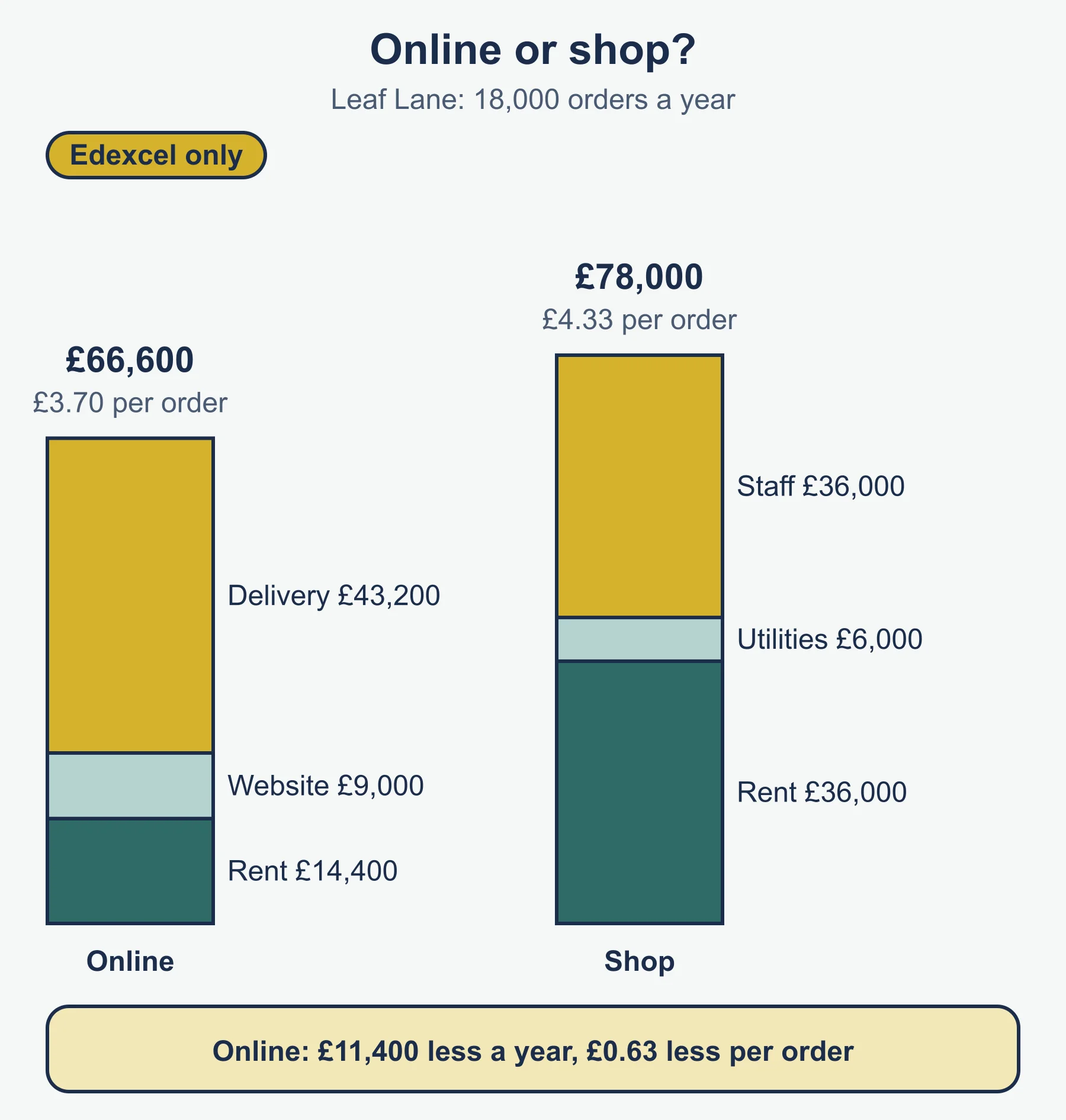
Leaf Lane sells loose tea. It handles 18,000 orders a year of about £26 each.
Online option: warehouse rent £1,200 x 12 = £14,400; website and platform costs £9,000; delivery 18,000 x £2.40 = £43,200. Total £66,600, or £3.70 per order.
Shop option: rent £3,000 x 12 = £36,000; utilities £6,000; two shop assistants at £18,000 each = £36,000. Total £78,000, or £4.33 per order.
The online route costs £11,400 less in these location-related costs and £0.63 less per order. A fuller answer adds that the shop gives customers a chance to taste and smell the tea, which the website cannot, and that the online option depends on reliable couriers.
5. Legal controls and trade blocs (1.4.1)
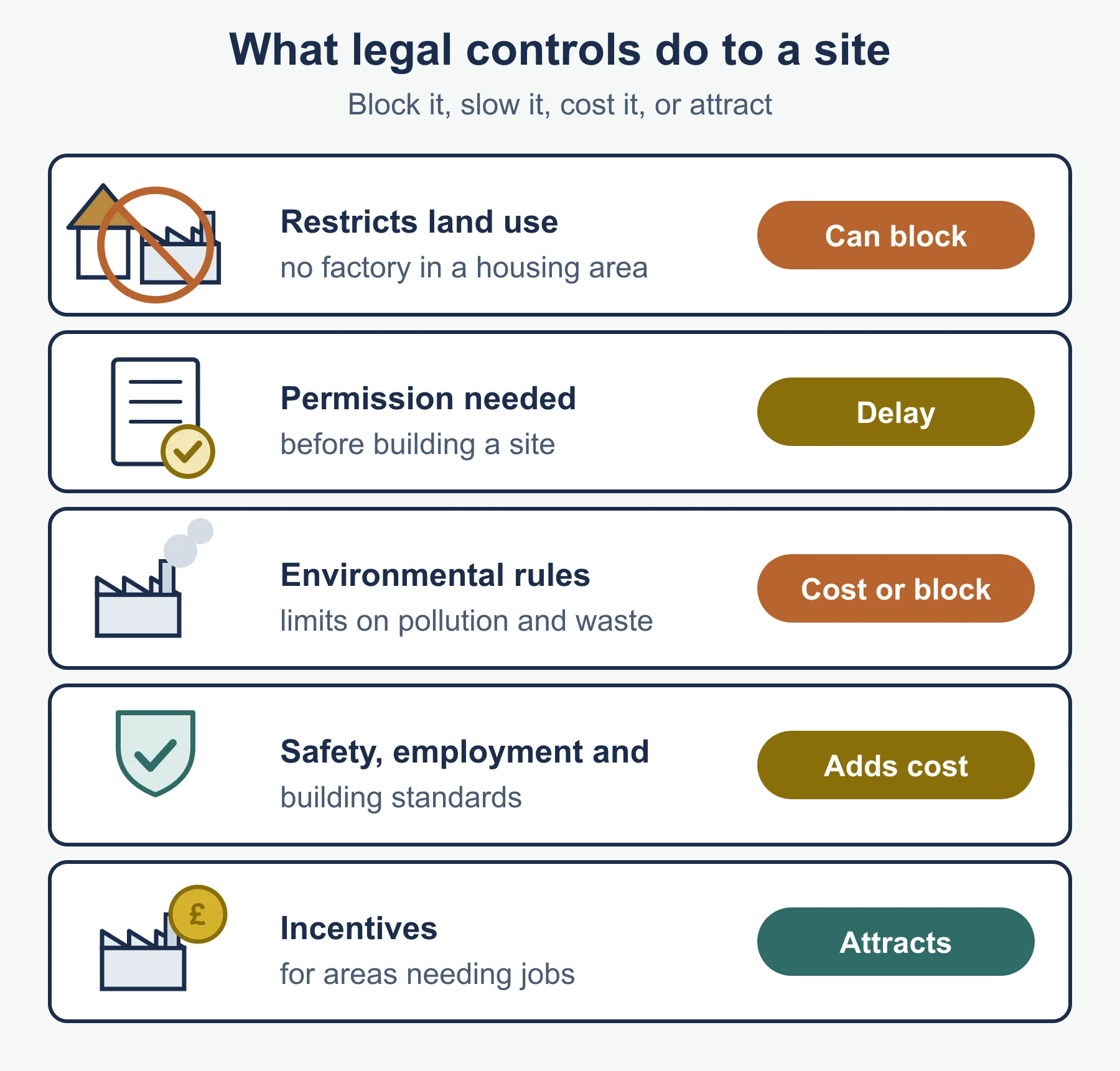
Legal controls. Governments and local authorities can set rules that limit where and how a business operates. In general terms these include limits on the use of land in an area, controls on pollution or noise, and rules on safety at work. Such controls can rule out a site, add costs (for example, equipment to cut pollution) or push noisy or polluting firms away from housing. The specification does not name any particular law for this point, so describe the effect on the business and not the detail of a statute.
Trade blocs. The specification names trade blocs but does not define them or name any example. In the standard form, a trade bloc is a group of countries that agree to reduce barriers to trade between themselves. The European Union is a commonly cited example, used here for illustration and not taken from the specification. Members normally trade with each other more easily than with outsiders, and outsiders may face a tariff, which is a tax on imports. A business may therefore locate inside a bloc to sell freely to the other members, or to avoid a tariff it would pay if it produced outside.
Worked example: tariff or local production?
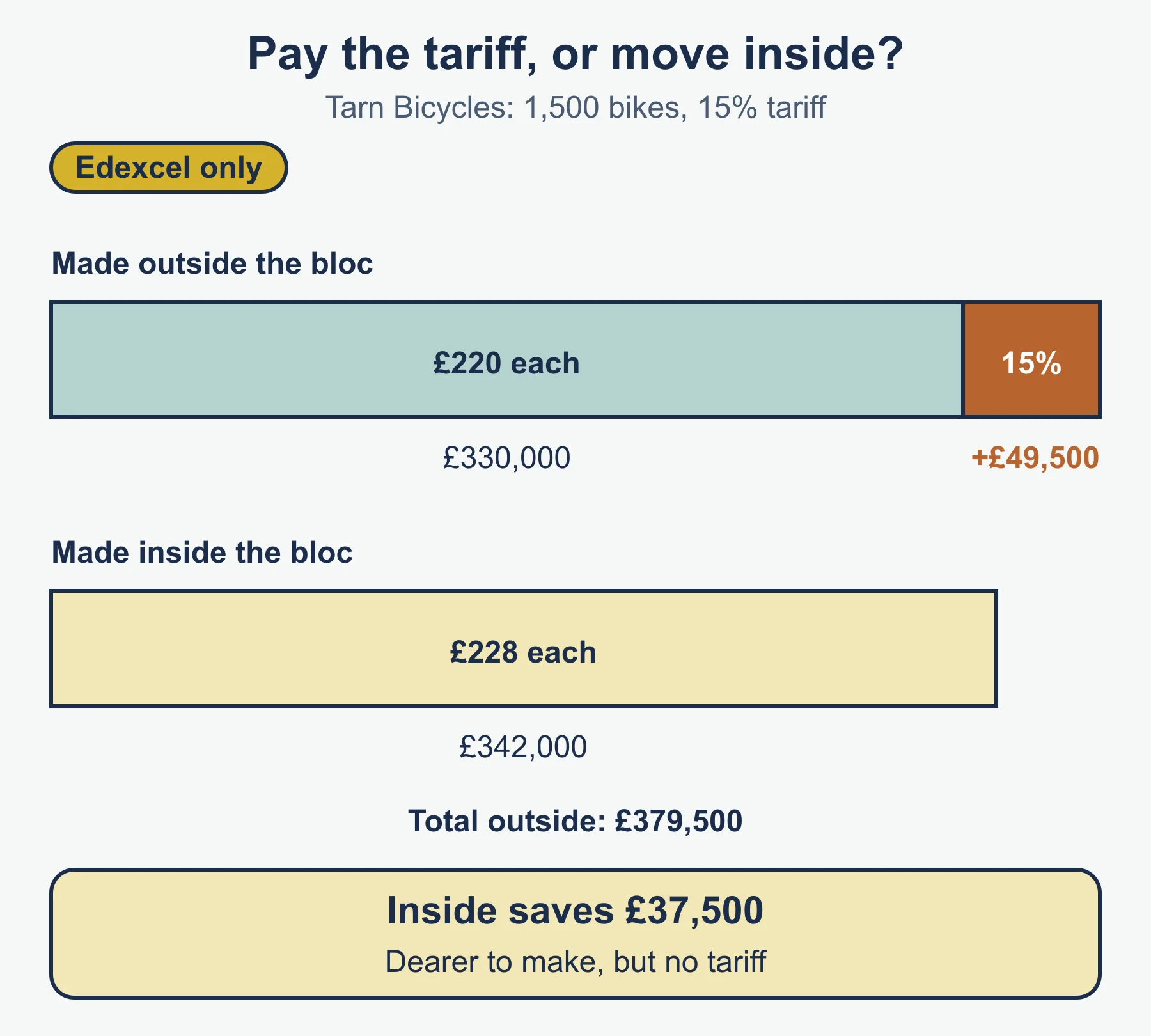
Tarn Bicycles can make 1,500 bikes in Country P, outside a trade bloc, at a value of £220 each and ship them to the bloc, where a 15% tariff applies. Alternatively it can make them inside the bloc at £228 each.
Outside: 1,500 x £220 = £330,000. Tariff = 15% of £330,000 = £49,500. Total = £379,500.
Inside: 1,500 x £228 = £342,000.
Producing inside the bloc saves £37,500 even though the unit cost is higher. If the tariff were much lower, the answer could reverse. Quote the figures and the condition.
6. Relocation (1.4.1)
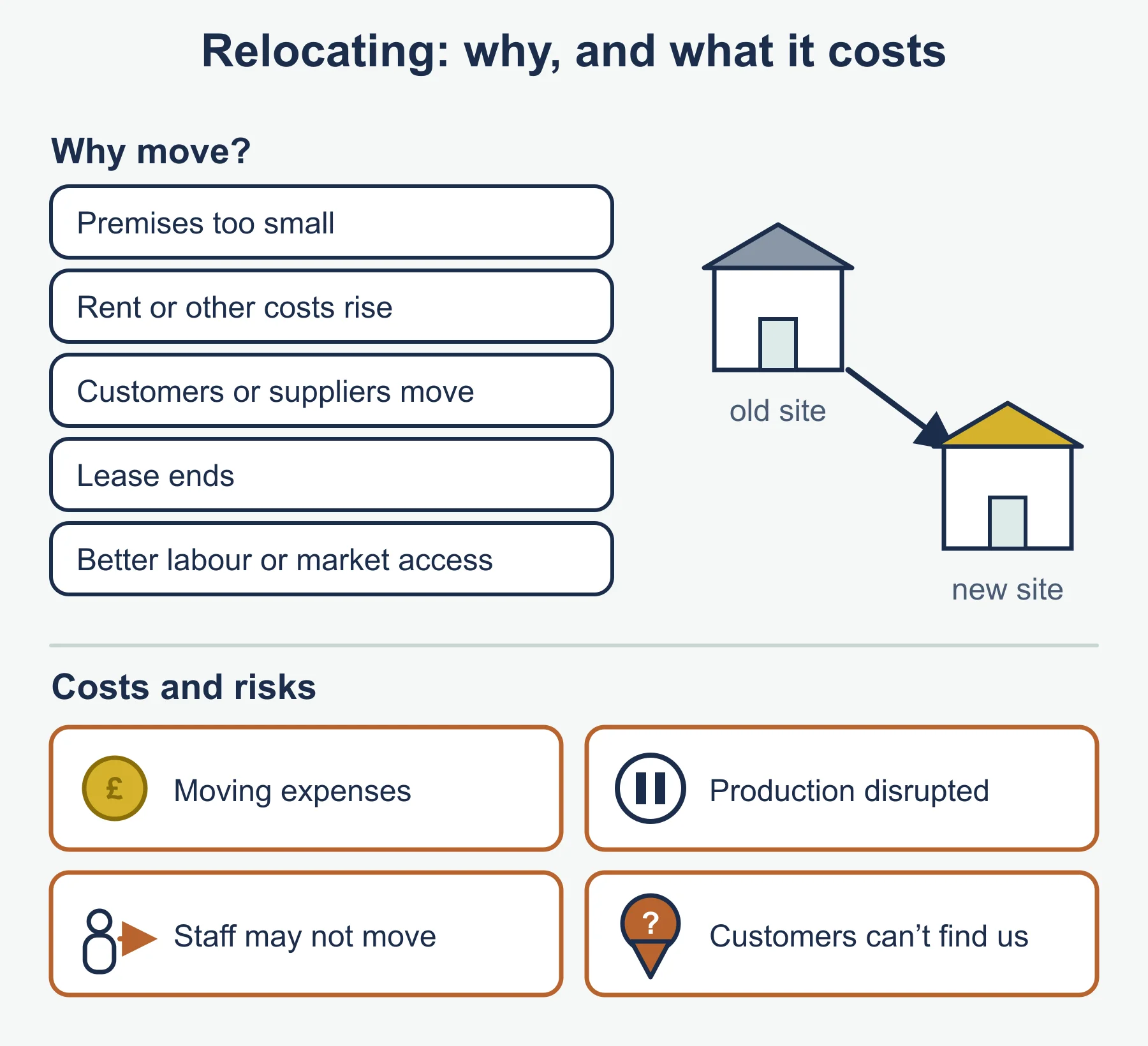
The same factors drive relocation: a business moves when its current site no longer fits, for example when rent rises, when materials or customers are now elsewhere, when it needs more space, or when a legal control changes. Relocation brings one-off costs (moving, fitting out, disruption to production) and risks, such as losing staff who will not move or customers who no longer find you.
Worked example: should Brightway Printing move?
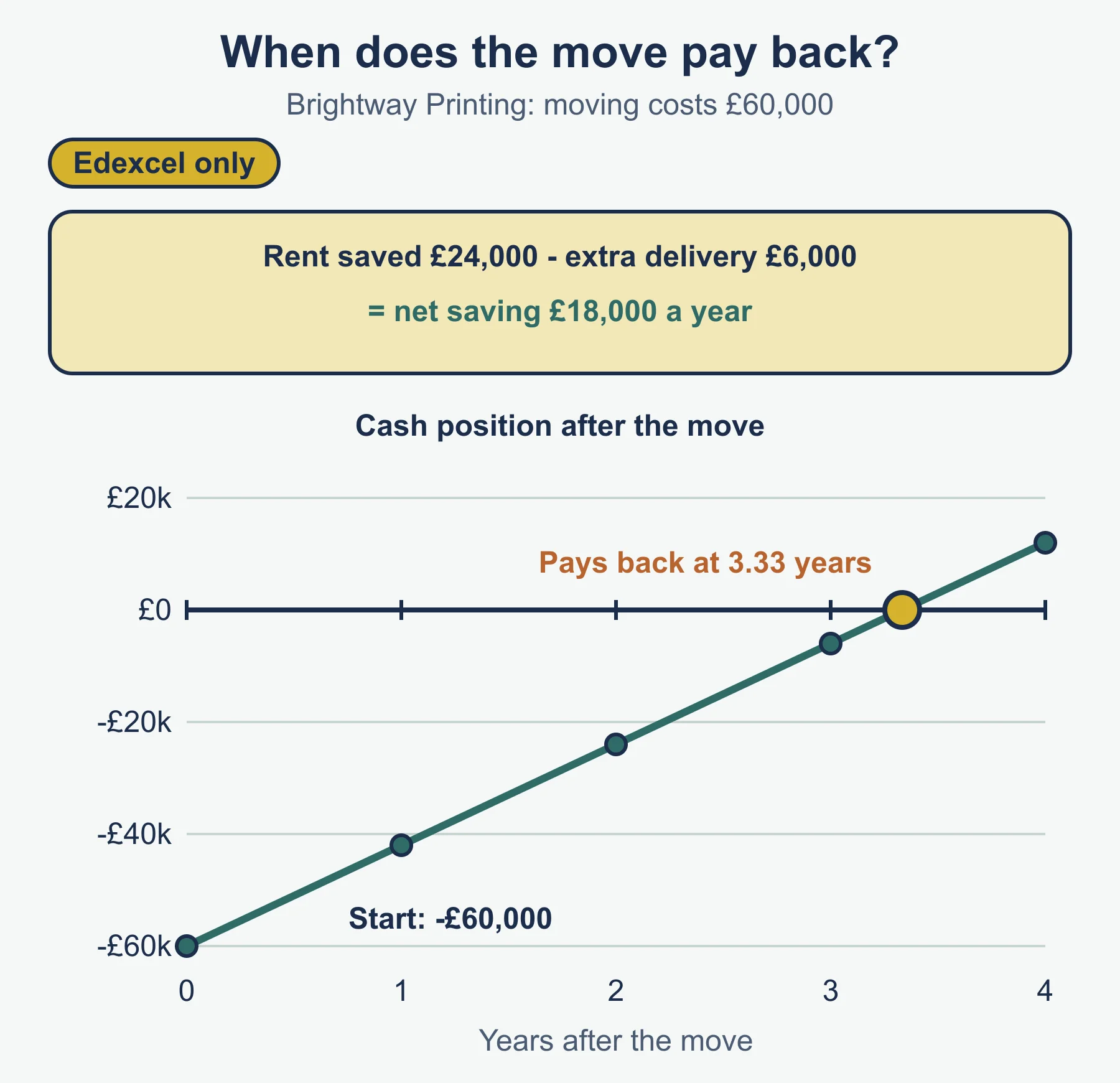
Brightway Printing would move from a city unit to an industrial estate. Rent falls from £3,500 to £1,500 a month, a saving of £2,000 a month (a 57.1% fall). Delivery costs rise by £6,000 a year. The move costs £60,000 once.
Annual rent saving = 2,000 x 12 = £24,000. Net annual saving = 24,000 - 6,000 = £18,000. Years to recover the move cost = 60,000 / 18,000 = 3.33 years.
Whether that is good enough depends on how long the firm expects to stay, whether it will lose any walk-in customers, and the risk to staff morale.
Common errors
- Listing a factor without applying it. “Labour” is not an answer. Say what kind of labour, where it is and what that does to costs.
- Treating proximity to competitors as always bad. It can bring customers and skills.
- Saying e-commerce removes the need for any premises. It changes which premises, not whether they exist.
- Naming a statute you are not sure of. Describe the control in general terms.
- Forgetting one-off costs when comparing the cost of a move.
- Mixing up “explain” and “analyse”. The specification’s command-word table says “Explain” is a statement of fact with two expansion points and no context, while “Analyse” is an extended answer placed in context.
Next steps
Condense this with the revision notes, then test yourself on the practice questions.
Frequently asked questions
How does the nature of a business affect where it locates? A mine or farm must be where the resource is, a heavy manufacturer needs space and transport links, a shop needs footfall, and an office service such as web design has wide freedom of location.
Why does proximity to materials matter? A business using heavy, bulky or perishable inputs saves transport costs and delay by being close to its suppliers, especially when the finished product weighs much less than the materials.
Why might a business relocate? A business may move when rent rises, when materials or customers are now elsewhere, when it needs more space, or for similar reasons. The savings should be weighed against one-off moving costs and any lost customers.
Can one business operate in more than one sector? Yes. A timber company might run forestry (primary), a sawmill (secondary) and a delivery service (tertiary), and the sectors often link in a chain of production.
Official syllabus
Pearson Edexcel International GCSE in Business (4BS1), Specification, Issue 2, February 2026, published by Pearson Education Limited. Topic 1: Business activity and influences on business, sections 1.3 Classification of businesses and 1.4 Decisions on location.
Get free revision emails (optional)
Occasional emails with practice questions, worked explanations and links to free resources for the qualification and subjects you choose. No spam, and you can unsubscribe from any email. The free tools on this site never need an email.
Related resources
-
Practice questions
Edexcel IGCSE Business: Classification of businesses and location decisions (4BS1) – Practice Questions
Original practice questions with worked answers on business sectors and location decisions for Pearson Edexcel International GCSE Business.
Business · Pearson Edexcel · IGCSE
Try questions -
Revision notes
Edexcel IGCSE Business: Classification of businesses and location decisions (4BS1) – Revision Notes
Condensed revision notes on business sectors, location factors, e-commerce, trade blocs and relocation for Pearson Edexcel International GCSE Business.
Business · Pearson Edexcel · IGCSE
Revise topic -
Study guides
Edexcel IGCSE Business: Government objectives and policies, and external factors (4BS1)
Study guide to public spending, taxes, tariffs, interest rates and social, technological, environmental and political factors for Edexcel IGCSE Business.
Business · Pearson Edexcel · IGCSE
Read guide
Related articles
-
teaching
A Level tuition in Dubai: Cambridge or Pearson Edexcel International A Level?
Schools in Dubai and Abu Dhabi teach either Cambridge International AS & A Level or Pearson Edexcel International A Level. How the two are structured, why it matters for tuition, and how online classes from Lahore work.
9 October 2026
-
curriculum guides
Choosing subjects at IGCSE and A Level
How subject choices at 14 and 16 affect university options later, and how to keep pathways open without overloading a timetable.
28 July 2026
Studying this with a teacher
Working through Business IGCSE?
This page is free and stays free. If you would rather be taught it, Marlbridge runs Business classes one-to-one and in small groups of up to 15, online in your own time zone. The first trial class is free. WhatsApp replies within an hour (8am–11pm Pakistan time, every day); email the same day.
Pearson Edexcel Business teachers at Marlbridge

