
Study Guides
Edexcel IGCSE Business: Communication, recruitment and selection (4BS1)
Study guide to communication, barriers, types of employment, recruitment, shortlisting, interviews and employment law for Edexcel IGCSE Business 4BS1.
- Subject
- Business
- Level
- IGCSE
- Topic
- People in business
- Author
- Marlbridge Academic Team
- Updated
- Reviewed by
- Asif Iqbal (what this means)
Aligned to Pearson Edexcel IGCSE Business (4BS1), Issue 2, February 2026. Official specification .
Syllabus page (what it covers and how it is assessed): Pearson Edexcel IGCSE Business.
Syllabus points this page covers
4BS1
- 2 People in business (whole topic)
- 2.1 Internal and external communication
- 2.2 Recruitment and selection process
Found an error? Report a correction.
Want a teacher for this? Marlbridge teaches Business online. Request a free trial class.
This guide follows the Pearson Edexcel International GCSE in Business (4BS1) specification, Issue 2, February 2026. It covers Topic 2 “People in business”, sections 2.1 “Internal and external communication” and 2.2 “Recruitment and selection process”, every numbered content point. The specification has two papers, Paper 1 on small businesses (up to 49 employees) and Paper 2 on large businesses (more than 250 employees). Each draws on the whole content, so you should be able to apply this material to a small firm and to a large one.
Course links: the 4BS1 Business hub, the printable checklist and the free diagnostics. Companion pages: the revision notes and the practice questions. All businesses named here are invented and all money amounts are in dollars.
What the specification asks for
| Point | You must be able to | Where in this guide |
|---|---|---|
| 2.1.1 | Explain why good communication matters and what goes wrong when it is poor; describe the communication methods used, including information technology (IT), with the benefits and limitations of each | Sections 1 and 2 |
| 2.1.2 | Explain how barriers to communication arise, what problems they cause and how they can be removed | Section 3 |
| 2.2.1 | Describe full-time, part-time, job share and casual/seasonal/temporary employment | Section 4 |
| 2.2.2 | Describe the job description, person specification, application form and curriculum vitae (CV)/résumé | Section 5 |
| 2.2.3 | Explain internal and external recruitment, the job advertisement, shortlisting and interviewing | Section 6 |
| 2.2.4 | Explain legal controls over employment and their effects: equal opportunities (gender, race, disability, religion, sexual preference, age) and minimum wage laws | Section 7 |
The specification states these points. It does not list the individual communication methods (beyond including IT), the barriers, what each recruitment document contains or the detailed effects of the law. Those are standard teaching, used here to answer each point, and are not specification wording.
1. Why communication matters (2.1.1)
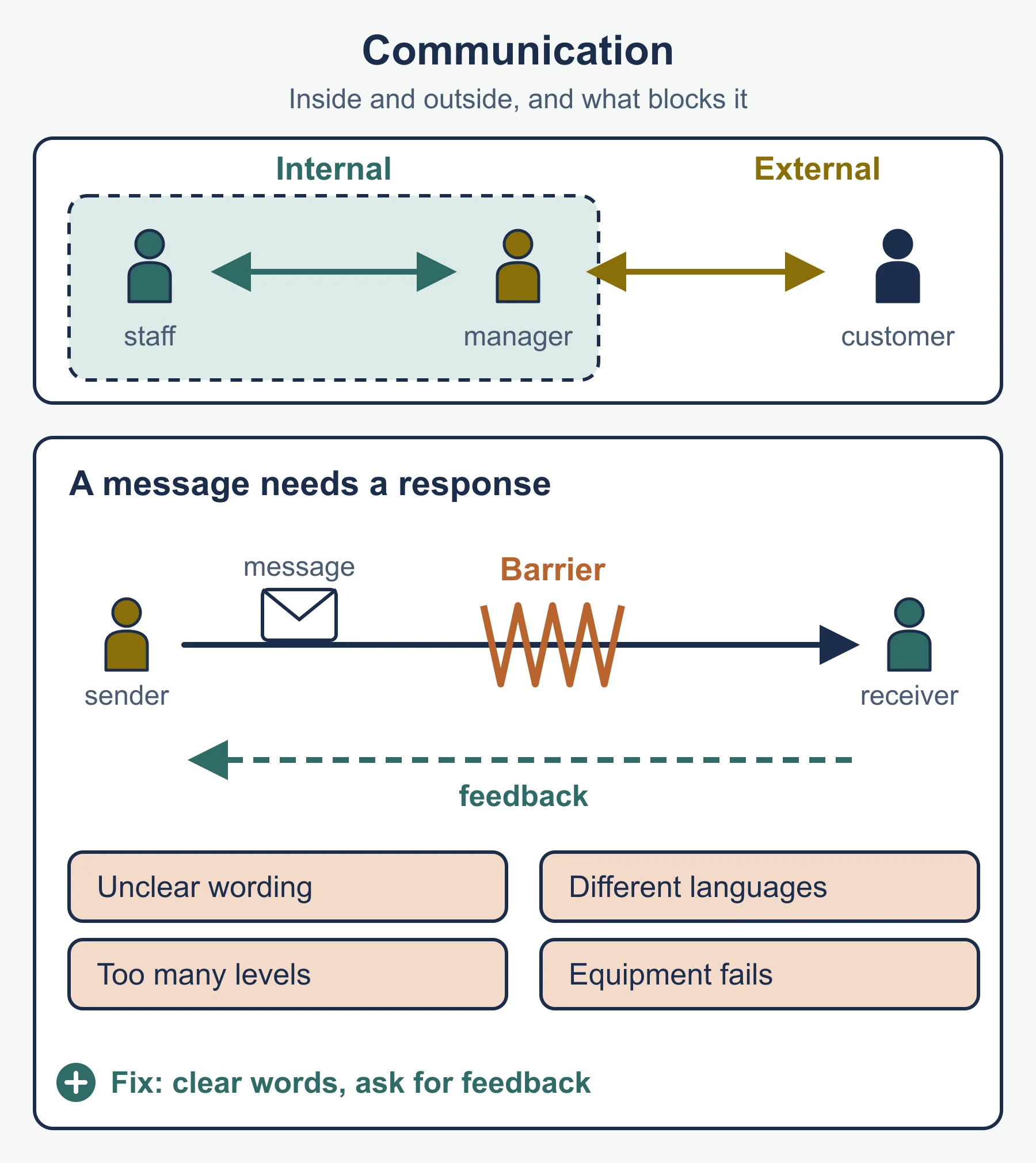
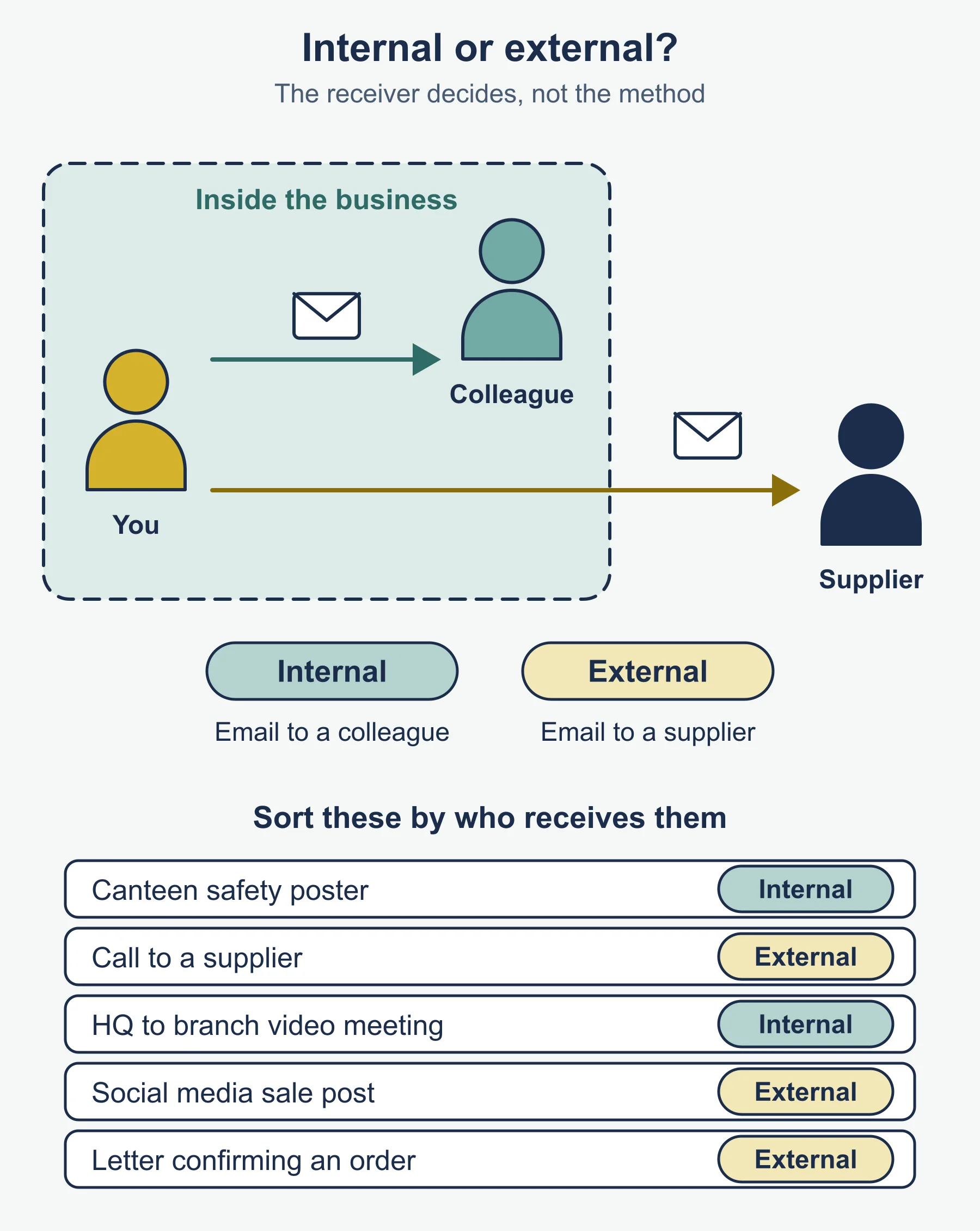
Communication is the passing of information from a sender to a receiver, with the receiver understanding it as the sender meant. Inside a business (internal) it links owners, managers and workers. Outside (external) it links the business to customers, suppliers, lenders and the public.
Good communication helps a business because:
- Workers know what to do, by when and to what standard, so mistakes fall.
- Managers get accurate information from the shop floor and make better decisions.
- Staff kept informed feel valued, which supports morale.
Ineffective communication causes the opposite: orders are filled wrongly, deadlines are missed, rumours spread, customers complain and staff feel ignored. In an answer, link the poor communication to a result (extra cost, lost sales, lower morale), not just to the fault.
2. Communication methods, benefits and limitations (2.1.1)
The specification asks for the methods used, including IT, with their benefits and limitations. It gives no fixed list, so these are standard examples grouped by form.
| Method | Benefit | Limitation |
|---|---|---|
| Face-to-face conversation or meeting | Immediate feedback; tone and body language help understanding | Time-consuming; no written record unless minutes are taken |
| Telephone call | Fast, personal, works across distance | No record; the other person may not answer; no visual cues |
| Letter | Formal, written record, suits legal or official matters | Slow; costs postage and paper; no instant reply |
| Memo or notice board | Reaches many staff cheaply; permanent | Staff may not read it; no check that it was understood |
| Report | Detailed, supports decisions, can be filed | Long to write; may not be read in full |
| Email (IT) | Quick, cheap, written record, attachments, many recipients | Inbox overload; tone can be misread; needs equipment and access |
| Video conferencing (IT) | Meetings across distance without travel; some visual cues | Needs good connections and equipment; technical failures |
| Intranet or website (IT) | Information in one place, available any time | Set-up and upkeep costs; must be kept up to date |
| Social media (IT) | Reaches many external customers cheaply; two-way | Public, so mistakes spread; needs monitoring |
Choice of method depends on the message: urgency, detail, whether a record is needed, cost, the number of receivers and the receiver’s access to technology. A small firm can often talk face to face; a large multi-site firm relies more on email, intranet and video conferencing.
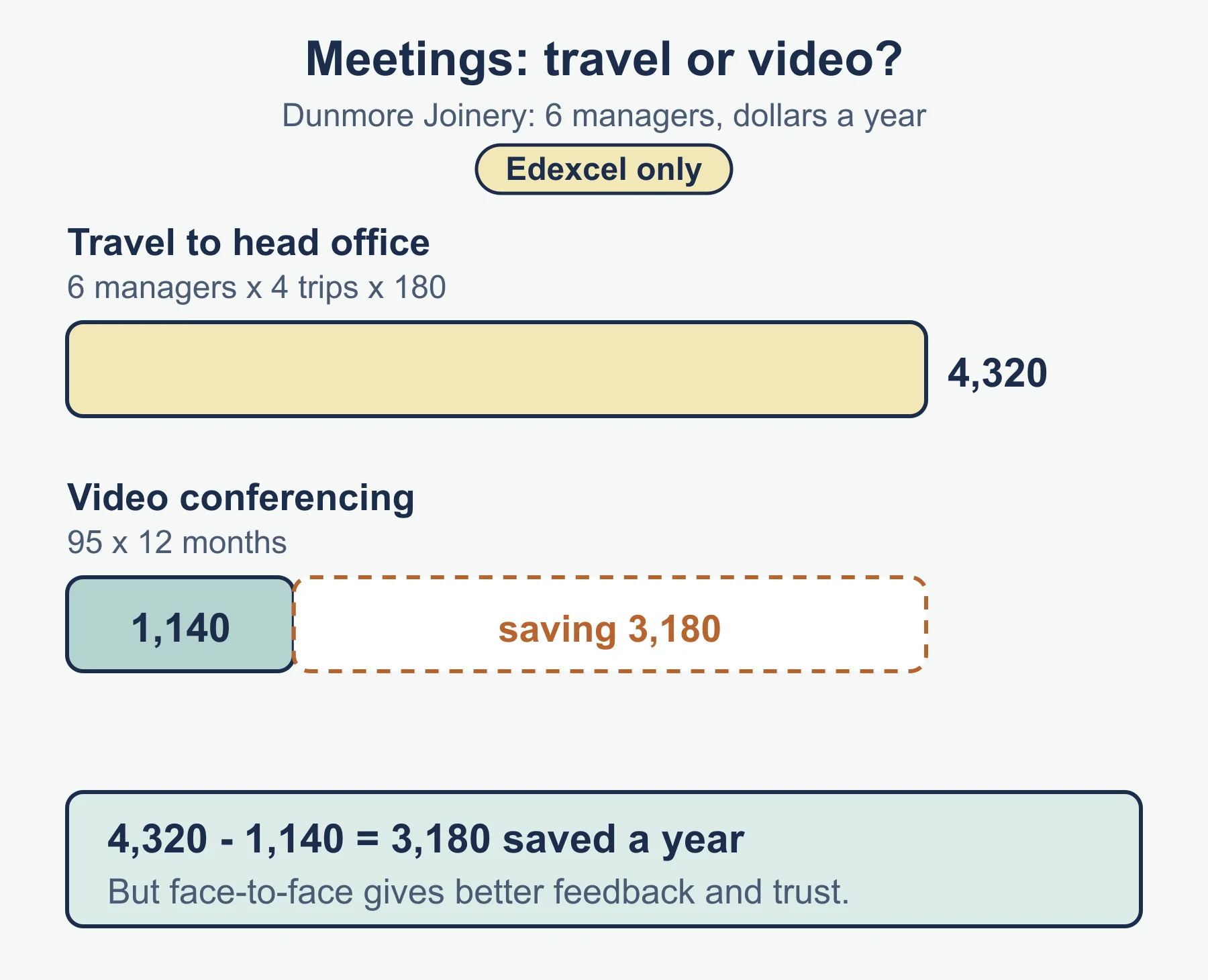
Worked example: choosing a method on cost. Dunmore Joinery has six managers who each travel to head office four times a year for meetings. Each trip costs 180. Video conferencing would cost 95 per month.
- Travel cost per year: 6 × 180 × 4 = 4,320.
- Video conferencing cost per year: 95 × 12 = 1,140.
- Saving: 4,320 − 1,140 = 3,180 a year.
The saving does not settle the question. Face-to-face meetings give better feedback and build trust. A reasoned answer weighs the cost saving against that loss, and might suggest keeping one in-person meeting a year.
3. Barriers to communication and how to remove them (2.1.2)
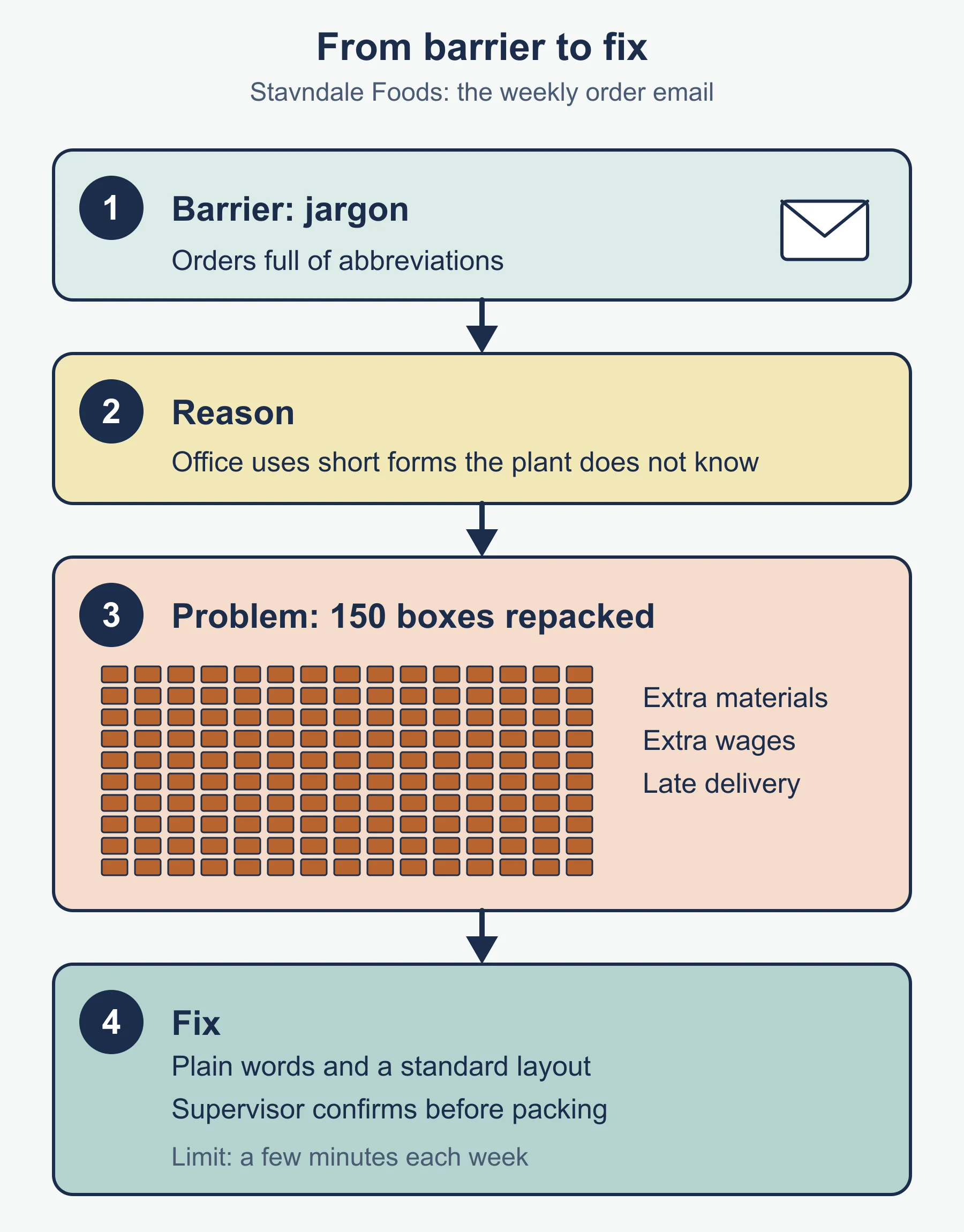
A barrier is whatever prevents a message reaching the receiver or being understood as intended. The specification asks how barriers arise, what problems they cause and how they can be removed; it lists no particular barriers, so those below are standard examples.
| How the barrier arises | Problem caused | How it can be removed |
|---|---|---|
| Jargon or technical language the receiver does not know | Message misunderstood; wrong action taken | Use plain language; explain terms; check understanding |
| Language differences between staff or with overseas customers | Confusion over instructions | Translations, simple wording, pictures or symbols |
| Too many layers in the hierarchy | Message is slow or changes as it passes down | Fewer layers; direct emails or briefings to all |
| Information overload | Important points are missed | Short messages; summaries; one clear action |
| Technology failure or lack of access | Message not delivered | Back-up methods; reliable systems; training |
Feedback is the main remedy: ask the receiver to say back what they will do. Two-way communication (conversation, meetings) usually removes problems faster than one-way communication (a notice).
4. Types of employment (2.2.1)
| Type | What it means | Benefit to the business | Limitation |
|---|---|---|---|
| Full-time | Works the standard full working week for the business | Reliable, committed, available throughout opening hours | Highest wage cost; paid even when work is slack |
| Part-time | Works fewer hours than a full-time worker | Flexible; pay only for hours needed; suits peak times | Less availability; more people to manage |
| Job share | Two (or more) people split one full-time job | Two skill sets; cover during holidays and illness; keeps experienced staff | Handover must be good; more admin; both must cooperate |
| Casual, seasonal or temporary | Hired for short periods, busy seasons or a set task | Cost only while needed; easy to end | Less loyalty; need training each time; higher turnover |
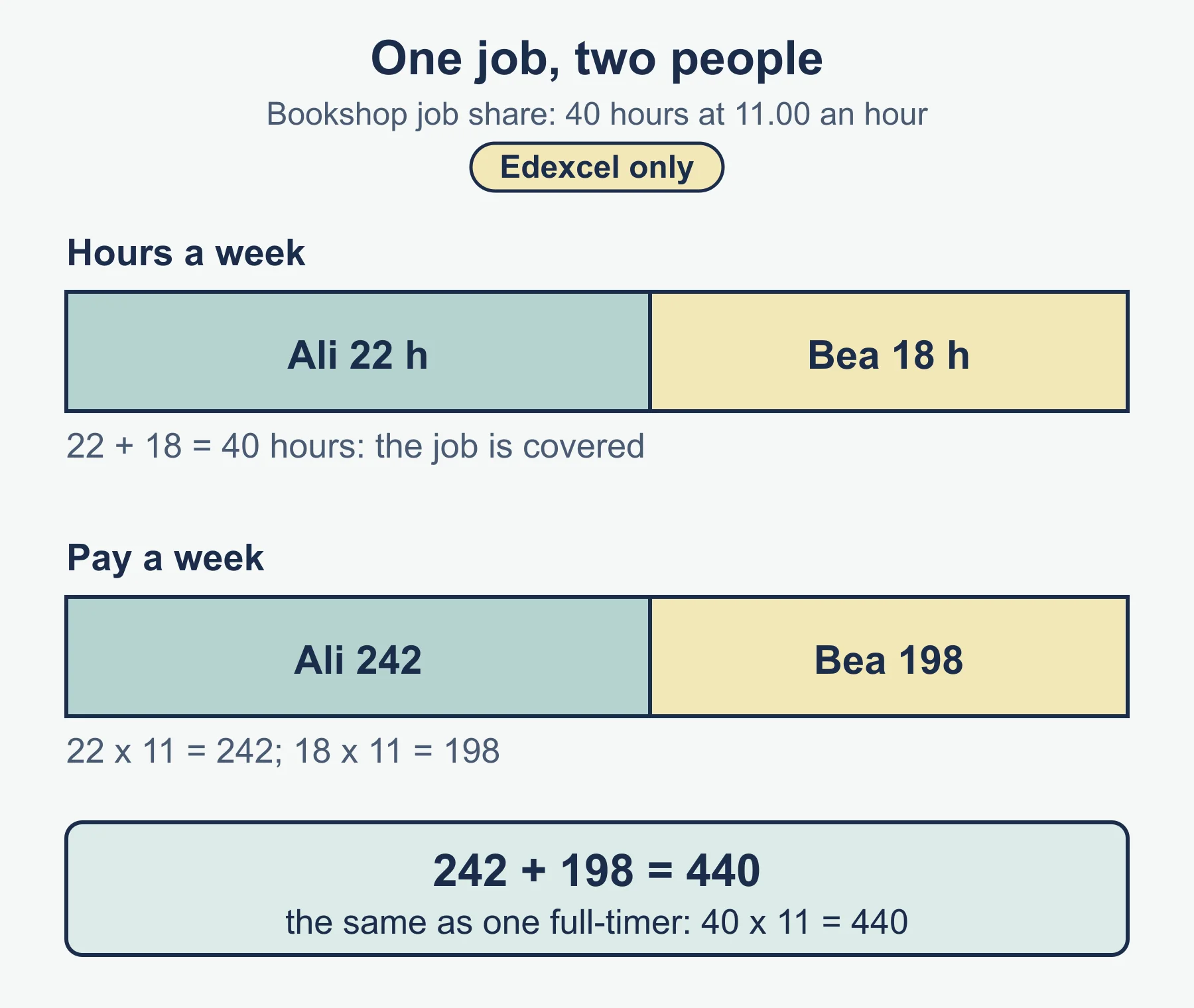
Worked example: job share. A bookshop’s full-time role is 40 hours a week at 11.00 an hour. It is shared by Ali (22 hours) and Bea (18 hours). Hours: 22 + 18 = 40, so the job is covered. Pay: Ali 22 × 11.00 = 242; Bea 18 × 11.00 = 198; total 440, the same as one full-timer.
A seasonal example: a garden centre hires three extra workers for 10 weeks at 30 hours a week and 9.20 an hour. Cost: 3 × 30 × 10 × 9.20 = 8,280, paid only while the peak lasts.
5. Recruitment documents (2.2.2)
| Document | Written by | Contains | Used to |
|---|---|---|---|
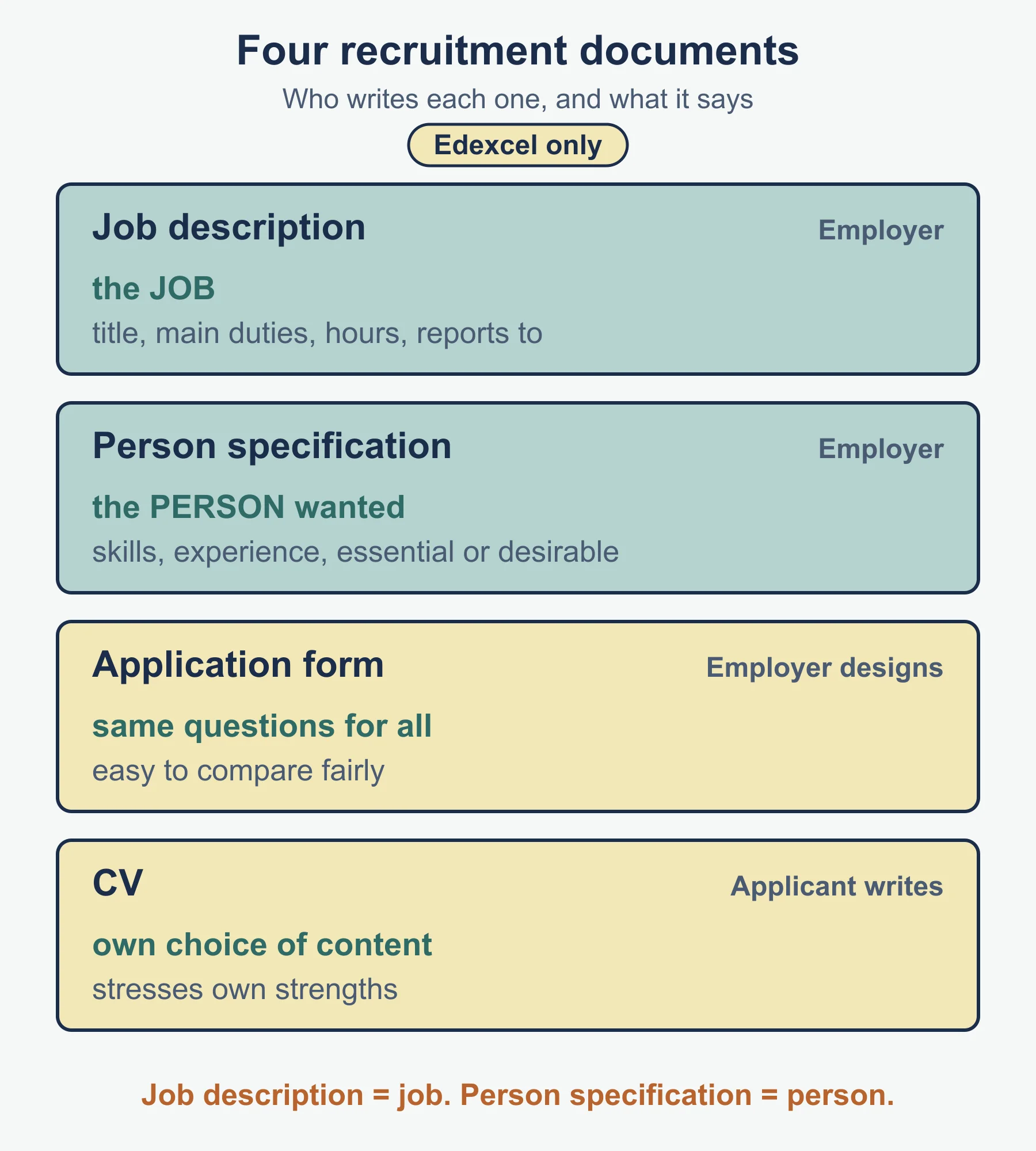
| Job description | Employer | Job title, main duties and responsibilities, hours, who the post reports to | Tell applicants what the job is |
| Person specification | Employer | Qualifications, skills, experience and personal qualities wanted, often split into essential and desirable | Judge which applicants fit; guide shortlisting |
| Application form | Employer designs it; applicant completes it | Same questions for every applicant: details, education, work history, reasons for applying | Compare applicants fairly |
| Curriculum vitae (CV)/résumé | Applicant | The applicant’s own summary of education, experience, skills and referees | Show suitability in the applicant’s own words |
The specification names these four documents; the contents shown are standard teaching. The job description says what the job is. The person specification says who the business wants. A common mistake is to swap them. An application form gives the business consistent information; a CV is flexible and lets the applicant choose what to stress, so forms are easier to compare.
6. Internal and external recruitment, advertising, shortlisting, interviewing (2.2.3)
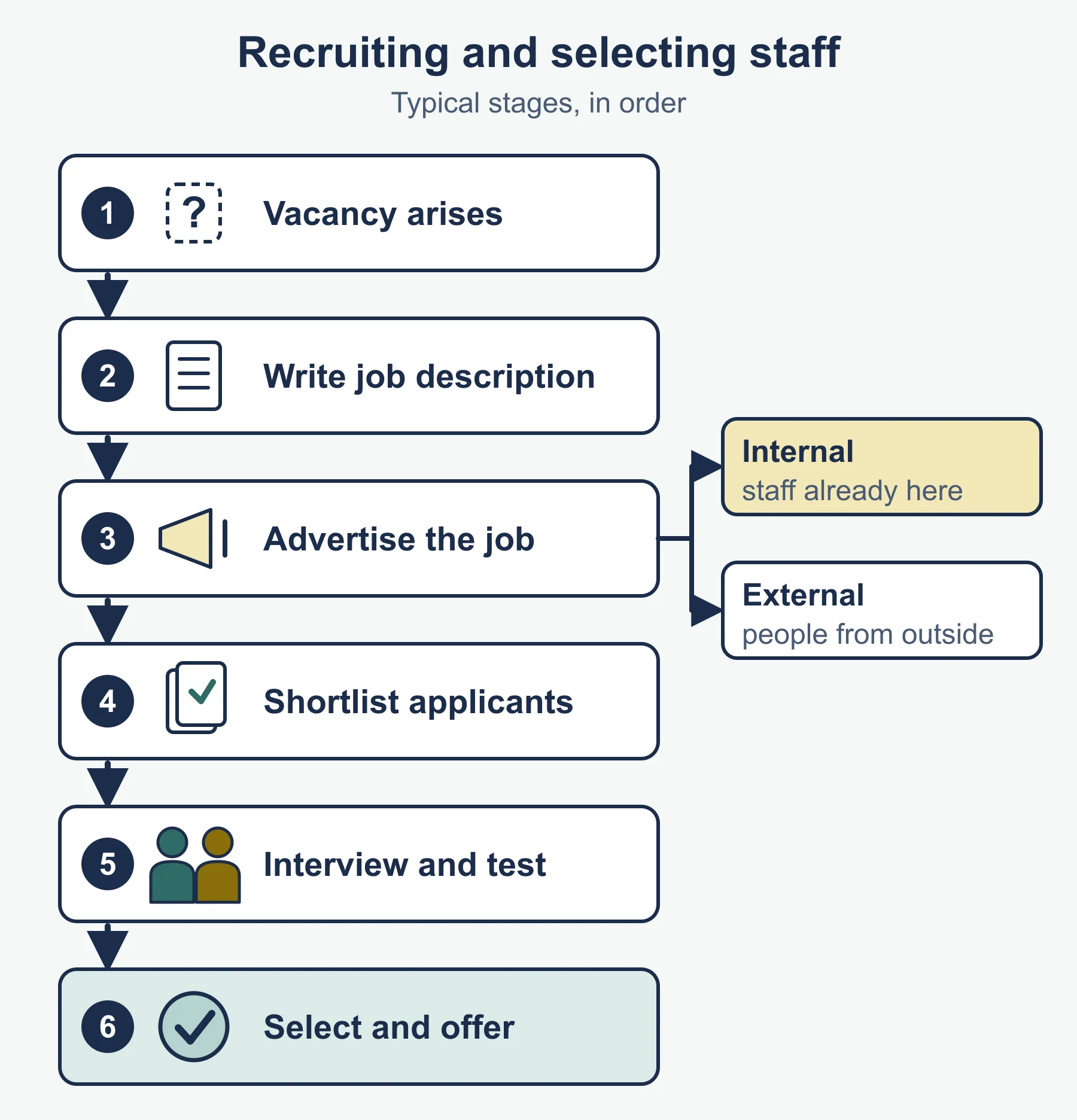
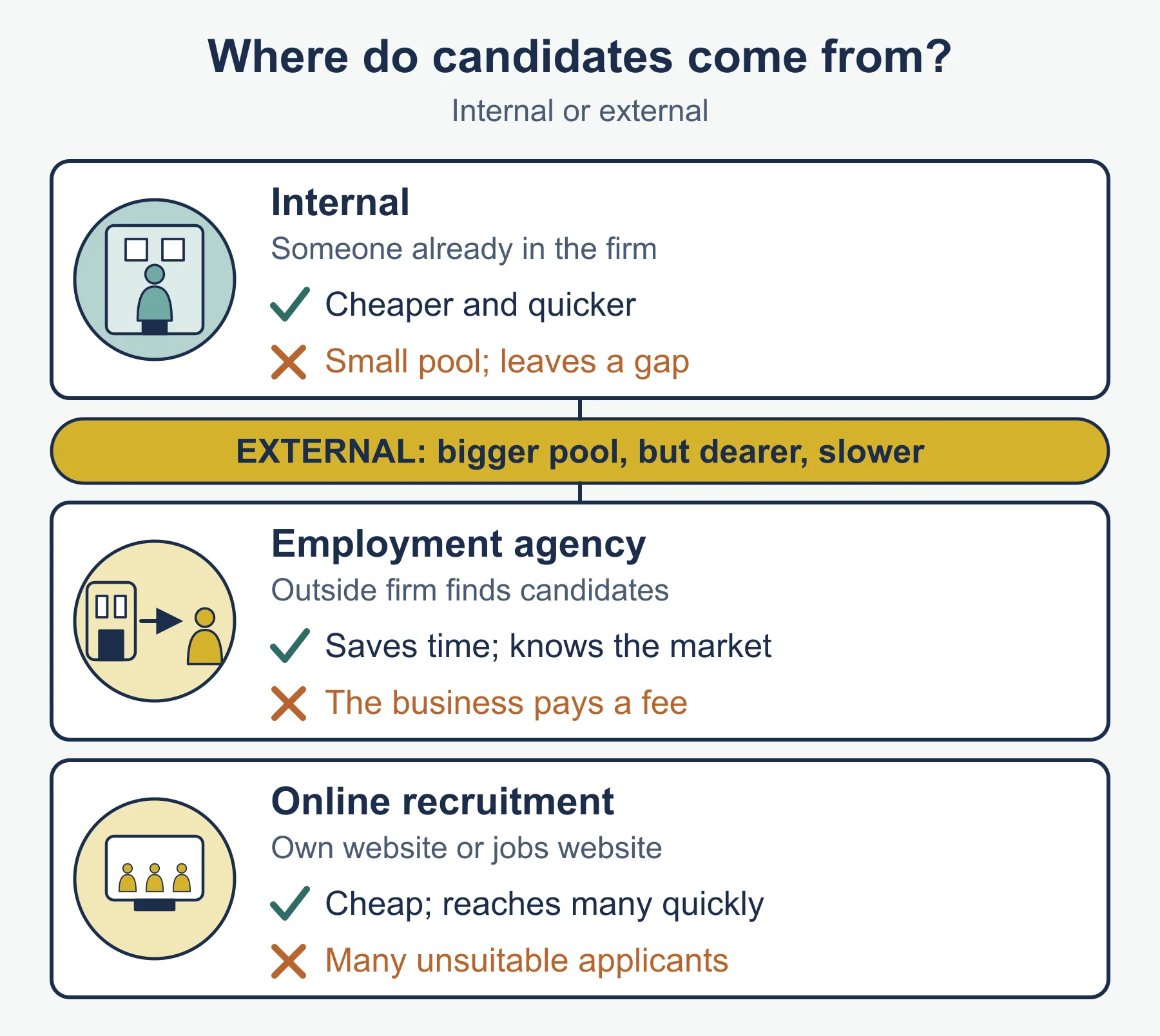
Internal recruitment fills a vacancy from existing staff, usually advertised on a notice board or the intranet. Benefits: cheaper, quicker, the person already knows the business, and it motivates staff by showing promotion is possible. Limitations: a smaller choice of candidates, no new ideas, and another vacancy appears when the person moves.
External recruitment looks outside the business, using a job advertisement in newspapers, trade journals, online job sites, social media or through an agency. Benefits: a wider pool, new skills and fresh ideas. Limitations: higher cost, slower, and more risk because the person is unknown and may need induction.
Good practice is for a job advertisement to state the job title, main duties, pay, location, key requirements, how to apply and the closing date.
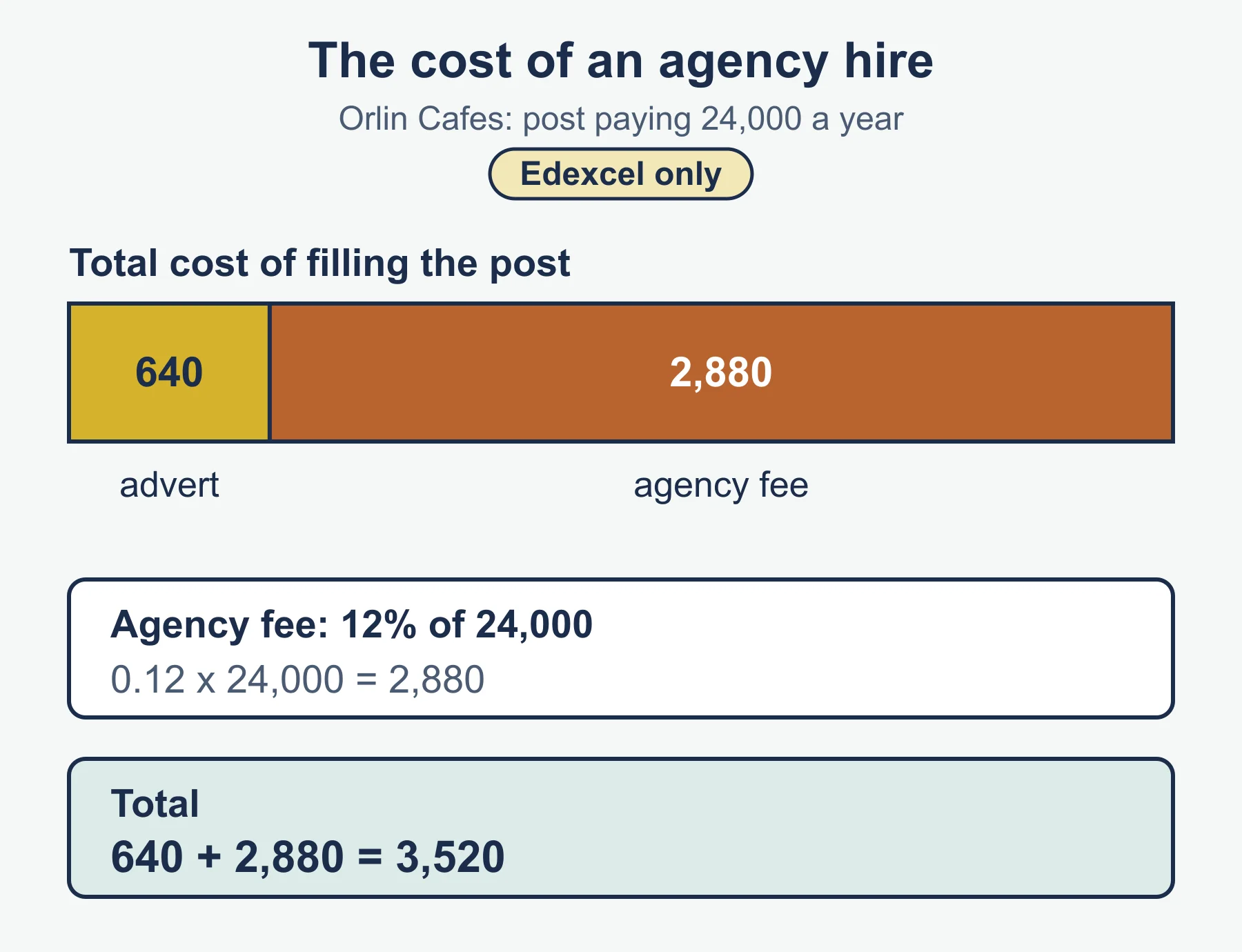
Worked example: cost of external recruitment. Orlin Cafés uses an agency to fill a post paying 24,000 a year. The agency charges 12% of the salary and the advertisement costs 640. Agency fee: 0.12 × 24,000 = 2,880. Total: 640 + 2,880 = 3,520.
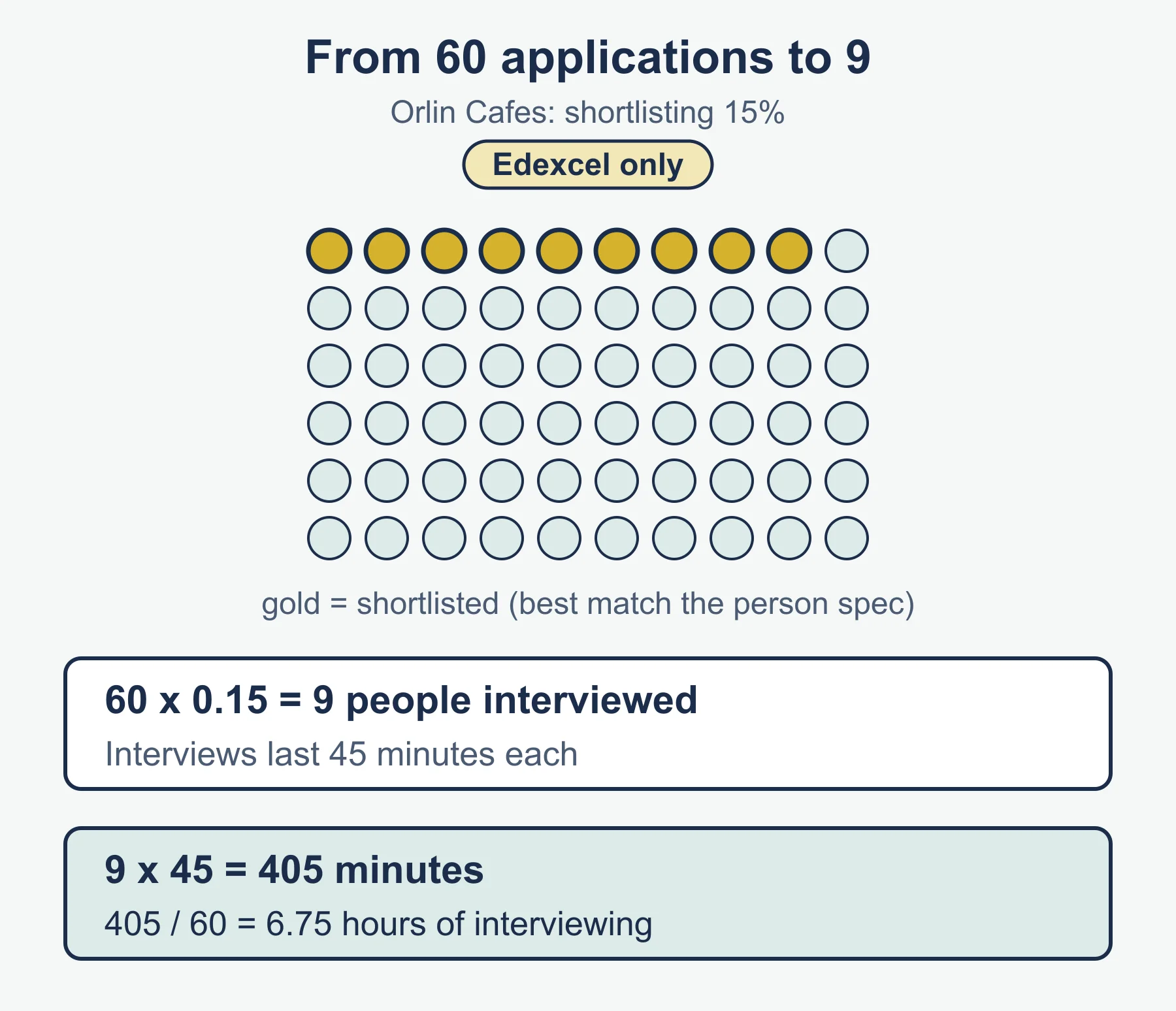
Shortlisting is reducing all applications to the few who best match the person specification. Compare each application form or CV with the essential criteria and set aside those that fail. If Orlin Cafés receives 60 applications and shortlists 15%, it interviews 60 × 0.15 = 9 people. At 45 minutes each, the interviews take 405 minutes, or 6.75 hours.
Interviewing lets the business meet shortlisted candidates, test the claims on their forms and judge personality and communication. Good practice: ask every candidate the same core questions and score answers against the person specification. Limitations: interviews are time-consuming and a confident talker may impress more than the best worker.
7. Legal controls over employment and their effects (2.2.4)
The specification names two controls and no particular laws, so describe them in general terms.
Equal opportunities laws make it unlawful to treat people less favourably because of gender, race, disability, religion, sexual preference or age. This applies to the whole process: wording of adverts, shortlisting, interviews, pay, promotion and dismissal.
Effects on a business (standard teaching):
- Adverts and person specifications must list the real requirements of the job.
- Selection must be based on ability to do the job, with consistent questions and records of decisions.
- Reasonable changes may be needed for a disabled worker, such as adapted equipment, which can cost money.
- Benefit: a wider pool of talent, a better reputation and lower risk of legal action.
- Cost: staff training, record keeping and, if a law is broken, fines, damages and bad publicity.
Minimum wage laws set the lowest hourly pay a business may legally give workers. Effects (standard teaching): labour costs rise for low-paid roles, so prices may go up or profit may fall; the business must check pay for every worker including part-timers and casual staff; workers’ income and motivation may improve, and staff turnover may fall.
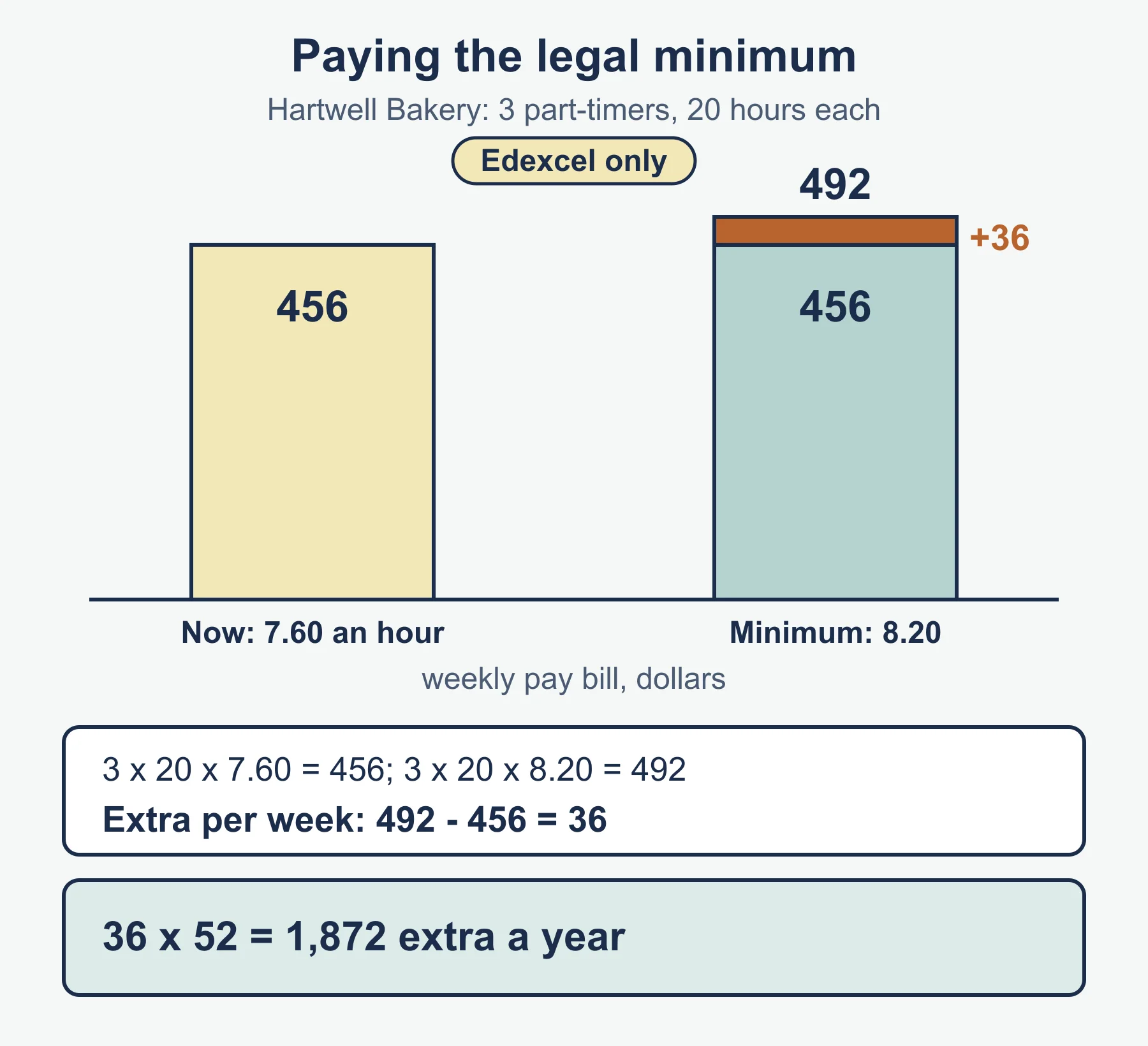
Worked example: minimum wage. The legal minimum in a country is 8.20 an hour (an invented figure). Hartwell Bakery pays three part-time workers 7.60 an hour for 20 hours a week each.
- Current weekly pay: 3 × 20 × 7.60 = 456.
- Pay at the minimum: 3 × 20 × 8.20 = 492.
- Extra cost per week: 36. Over 52 weeks: 1,872.
The bakery must pay the higher rate. It could absorb the cost or raise prices slightly, but it cannot keep the old rate.
Common errors
- Describing a communication method without a limitation, or listing only email and telephone.
- Naming a barrier but not saying how it arises or how to remove it.
- Mixing up the job description (the duties) and the person specification (the person).
Frequently asked questions
Why is good communication important to a business? Good communication means workers know what to do, managers get accurate information for decisions and staff feel valued. Poor communication leads to wrong orders, missed deadlines, rumours and complaints.
What are the advantages of email for business communication? Email is quick and cheap, gives a written record, carries attachments and reaches many people at once. Its limitations are inbox overload, tone that can be misread and the need for equipment and access.
What is the difference between internal and external recruitment? Internal recruitment fills a vacancy from existing staff, which is cheaper and quicker and motivates others. External recruitment uses a job advertisement or agency to reach a wider pool with new skills, but costs more and takes longer.
What is the effect of minimum wage laws on a business? Minimum wage laws set the lowest hourly pay a business may legally give, so labour costs rise for low-paid roles. The business may raise prices or accept lower profit, but it cannot pay below the legal rate.
Official syllabus
Pearson Edexcel International GCSE in Business (4BS1), Specification, Issue 2, February 2026, published by Pearson Education Limited. Topic 2: People in business, sections 2.1 “Internal and external communication” (2.1.1 and 2.1.2) and 2.2 “Recruitment and selection process” (2.2.1 to 2.2.4).
Get free revision emails (optional)
Occasional emails with practice questions, worked explanations and links to free resources for the qualification and subjects you choose. No spam, and you can unsubscribe from any email. The free tools on this site never need an email.
Related resources
-
Practice questions
Edexcel IGCSE Business: Communication, recruitment and selection (4BS1) – Practice Questions
Original practice questions with worked answers on communication, barriers, employment types, recruitment and employment law for Edexcel IGCSE Business.
Business · Pearson Edexcel · IGCSE
Try questions -
Revision notes
Edexcel IGCSE Business: Communication, recruitment and selection (4BS1) – Revision Notes
Condensed Edexcel IGCSE Business revision notes on communication methods, barriers, employment types, recruitment documents and law, with a self-test.
Business · Pearson Edexcel · IGCSE
Revise topic -
Study guides
Edexcel IGCSE Business: Organisation structure and employees (4BS1)
Study guide to organisation charts, span of control, delegation and the four functional areas for Edexcel IGCSE Business 4BS1, section 2.5.
Business · Pearson Edexcel · IGCSE
Read guide
Related articles
-
teaching
A Level tuition in Dubai: Cambridge or Pearson Edexcel International A Level?
Schools in Dubai and Abu Dhabi teach either Cambridge International AS & A Level or Pearson Edexcel International A Level. How the two are structured, why it matters for tuition, and how online classes from Lahore work.
9 October 2026
-
curriculum guides
Choosing subjects at IGCSE and A Level
How subject choices at 14 and 16 affect university options later, and how to keep pathways open without overloading a timetable.
28 July 2026
Studying this with a teacher
Working through Business IGCSE?
This page is free and stays free. If you would rather be taught it, Marlbridge runs Business classes one-to-one and in small groups of up to 15, online in your own time zone. The first trial class is free. WhatsApp replies within an hour (8am–11pm Pakistan time, every day); email the same day.
Pearson Edexcel Business teachers at Marlbridge

