
Study Guides
Edexcel IGCSE Business: Organisation structure and employees (4BS1)
Study guide to organisation charts, span of control, delegation and the four functional areas for Edexcel IGCSE Business 4BS1, section 2.5.
- Subject
- Business
- Level
- IGCSE
- Topic
- People in business
- Author
- Marlbridge Academic Team
- Updated
- Reviewed by
- Asif Iqbal (what this means)
Aligned to Pearson Edexcel IGCSE Business (4BS1), Issue 2, February 2026. Official specification .
Syllabus page (what it covers and how it is assessed): Pearson Edexcel IGCSE Business.
Syllabus points this page covers
4BS1
- 2 People in business (whole topic)
- 2.5 Organisation structure and employees
Found an error? Report a correction.
Want a teacher for this? Marlbridge teaches Business online. Request a free trial class.
This guide follows the Pearson Edexcel International GCSE in Business (4BS1) specification, Issue 2, February 2026. It covers Topic 2 “People in business”, section 2.5 “Organisation structure and employees”, points 2.5.1 to 2.5.3. The specification says both papers can draw on the whole content, so this topic can appear in the small-business paper (up to 49 employees) and the large-business paper (more than 250 employees). Each paper lasts 1 hour 30 minutes and is worth 80 marks.
Course links: the 4BS1 Business hub, the printable checklist and the free diagnostics. Companion pages: the revision notes and the practice questions.
What the specification asks for
| Point | You must be able to | Section below |
|---|---|---|
| 2.5.1 | Use organisational charts for different types of business: hierarchical and flat; centralised and decentralised | 1 and 2 |
| 2.5.2 | Explain employee roles and responsibilities in terms of compliance and accountability: span of control, chain of command, delegation | 3 |
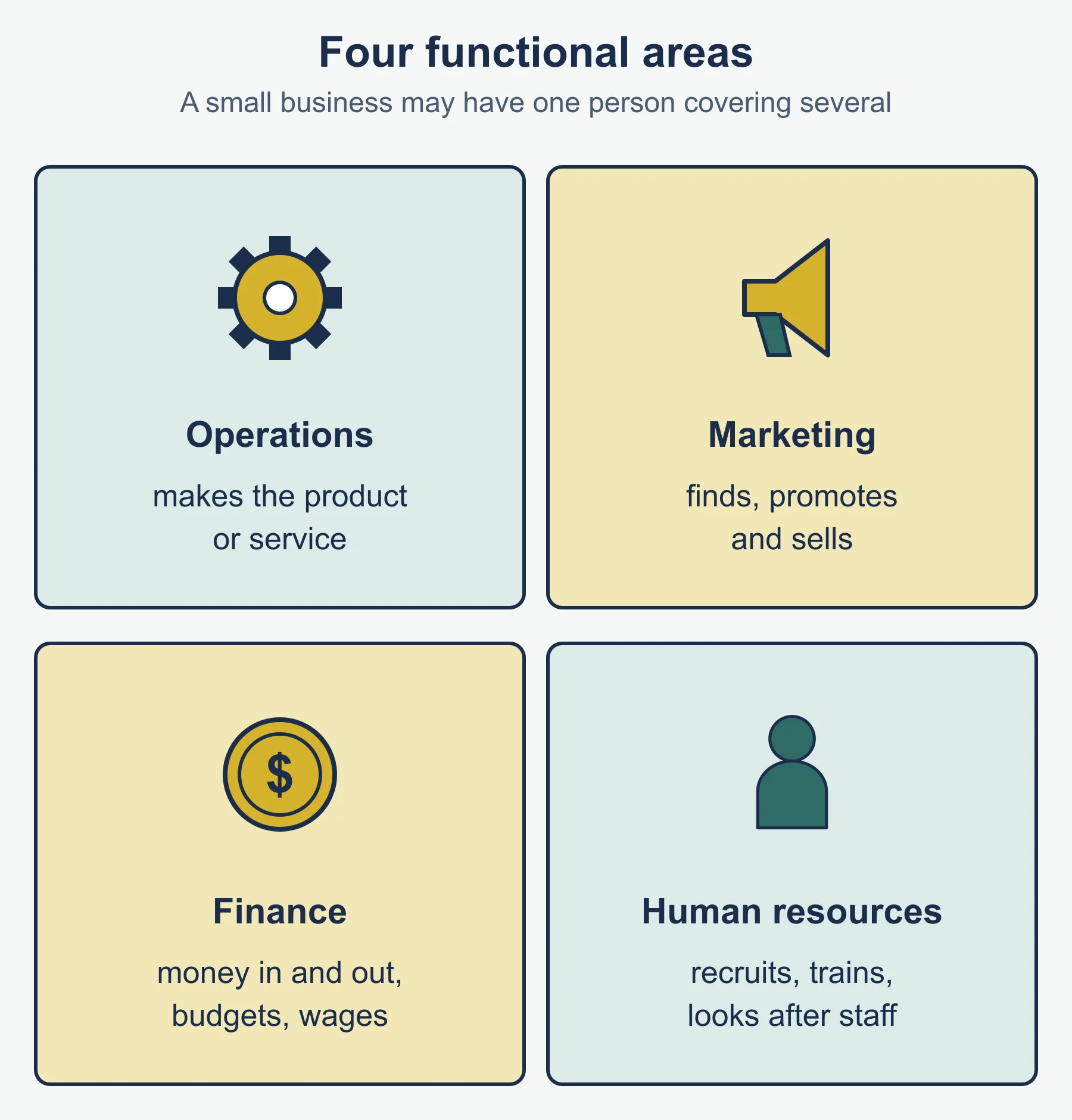
| 2.5.3 | Describe the functional areas: human resources, finance, marketing, production | 4 to 7 |
1. Organisational charts: hierarchical and flat
An organisational chart is a diagram of who works in the business, what level each person is at and who reports to whom. Boxes show posts. Lines show reporting links. Read it from the top (most authority) down.
A hierarchical structure has several levels of authority, with each level controlling the one below. Many levels make the structure tall and narrow. A flat structure has few levels, so there are fewer managers between the owner and the workers.
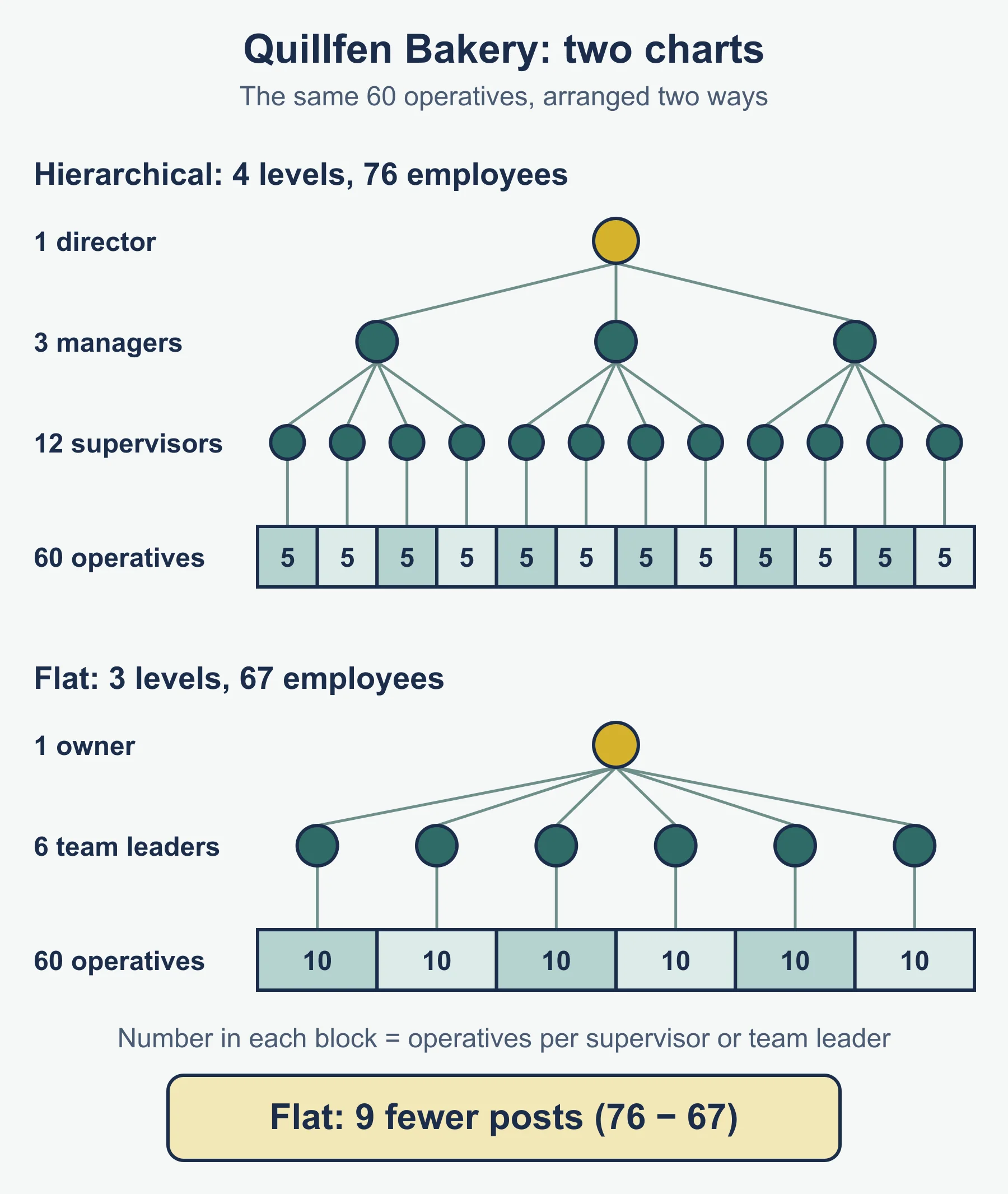
The same workforce can be arranged either way. Take Quillfen Bakery, which has 60 operatives who bake, pack and deliver.
| Hierarchical option | Flat option | |
|---|---|---|
| Operatives per supervisor or team leader | 5 | 10 |
| Supervisors or team leaders needed | 12 | 6 |
| Managers between them and the top | 3 | none |
| Posts above the operatives | 1 director, 3 managers, 12 supervisors | 1 owner, 6 team leaders |
| Total employees | 76 | 67 |
| Levels of authority | 4 | 3 |
Workings: 60 ÷ 5 = 12 supervisors, 12 ÷ 4 = 3 managers, and 1 + 3 + 12 + 60 = 76. In the flat option, 60 ÷ 10 = 6 team leaders and 1 + 6 + 60 = 67.
Hierarchical: benefits. Everyone has a clear promotion path. Supervisors watch small teams closely, so quality is checked. Tasks are clearly allocated.
Hierarchical: limitations. Messages pass through many levels, so communication is slow and can be changed on the way. Extra layers of managers cost more in salaries. Staff at the bottom can feel distant from decisions.
Flat: benefits. Communication is shorter and quicker. Fewer managers lowers the wage bill. Workers get more responsibility, which can raise motivation.
Flat: limitations. Each manager has many people to supervise, so close support is hard. There are fewer promotion steps, which may make ambitious staff leave. Managers can become overloaded.
A small business such as a 12-person workshop often has a flat chart because there is little to layer. A large business with thousands of employees cannot be completely flat, but it can reduce layers by removing middle management.
2. Centralised and decentralised structures
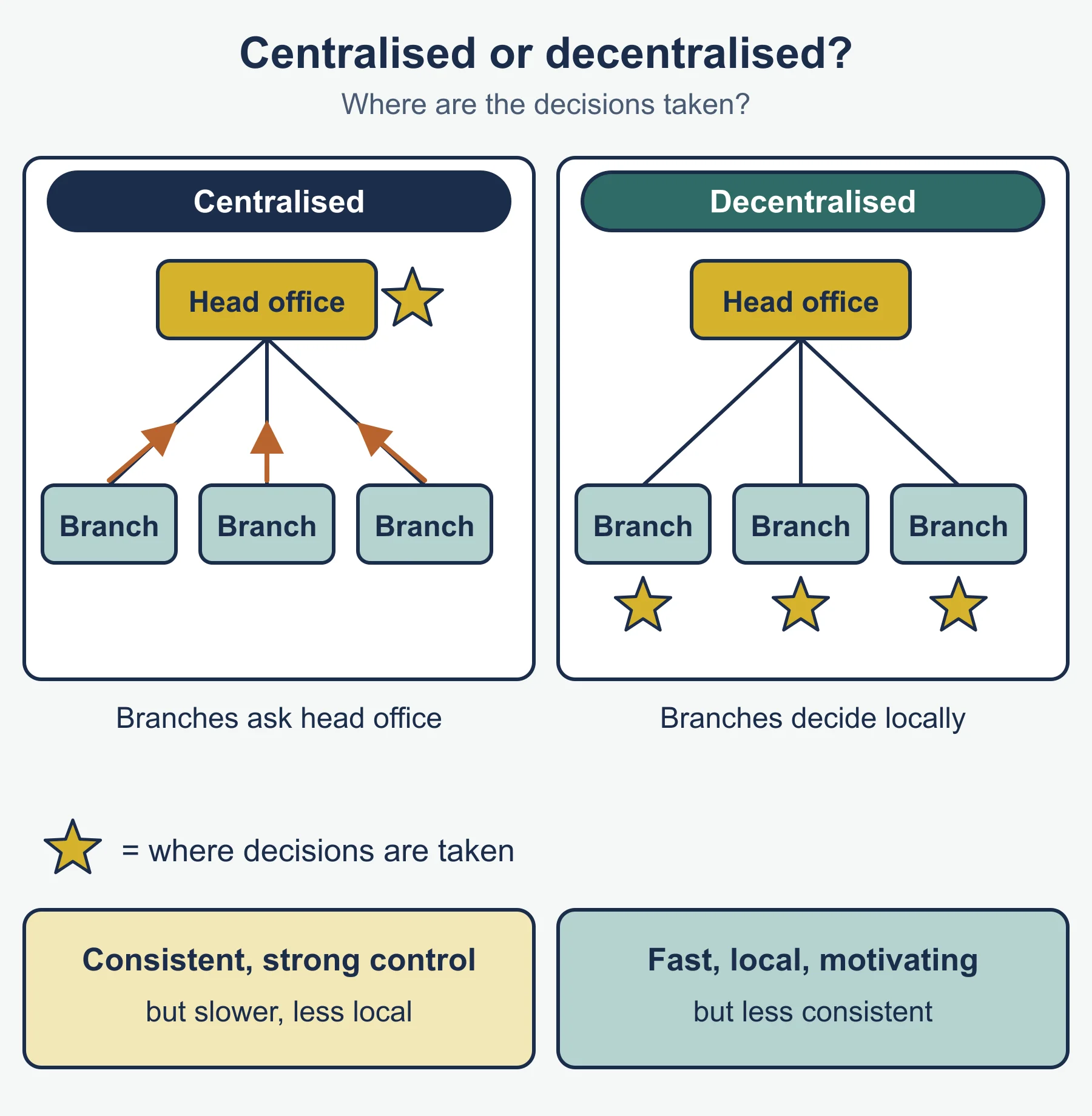
This is a different question from tall versus flat. It asks where decisions are made, not how many levels there are.
- Centralised: important decisions are made at the top, usually at head office. Branches follow instructions.
- Decentralised: decisions are passed down to managers nearer the customers, such as branch or regional managers.
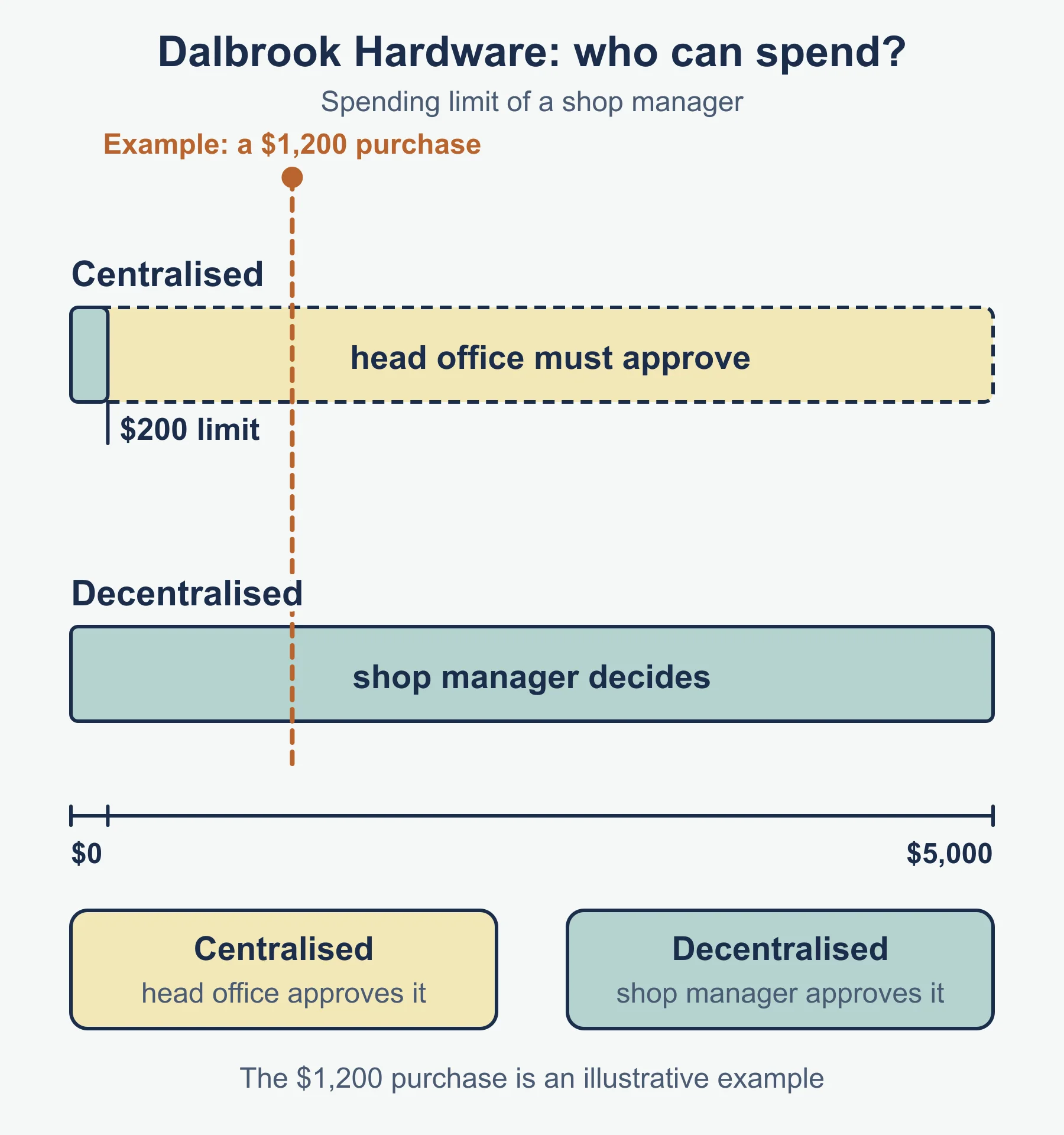
Example: Dalbrook Hardware has five shops (all amounts in this guide are in dollars). In a centralised version, head office chooses stock and prices and any spending above 200 needs head office approval. In a decentralised version, each shop manager can spend up to 5,000 and set local prices within a range.
| Centralised | Decentralised | |
|---|---|---|
| Benefits | Same policy and brand in every shop; central buying can lower costs; senior managers keep control | Quicker decisions; shop managers know local customers; managers feel trusted and may be more motivated |
| Limitations | Slow responses to local problems; branch managers may feel their ideas are ignored | Shops may behave differently; harder for the top to control; mistakes are possible if local managers lack skill |
Which is better depends on the business. A small business with one site is naturally centralised because the owner decides most things. A multinational selling in different countries often needs more local decisions, because tastes, rules and prices differ. A chart can show either: lines of authority and the posts that hold decision-making power, such as regional managers.
3. Roles and responsibilities: compliance and accountability
Employees have duties attached to their posts. Two ideas run through this part of the specification. The specification names them but does not define them, so the meanings below are general working definitions written for this guide, not specification wording.
- Compliance means following the rules that apply: the law, health and safety rules, and the business’s own policies. Employees comply by doing their work as required. Managers must also make sure their teams comply.
- Accountability means being answerable for results and for how a task was done. If something goes wrong, the accountable person explains it and deals with the consequences.
Span of control
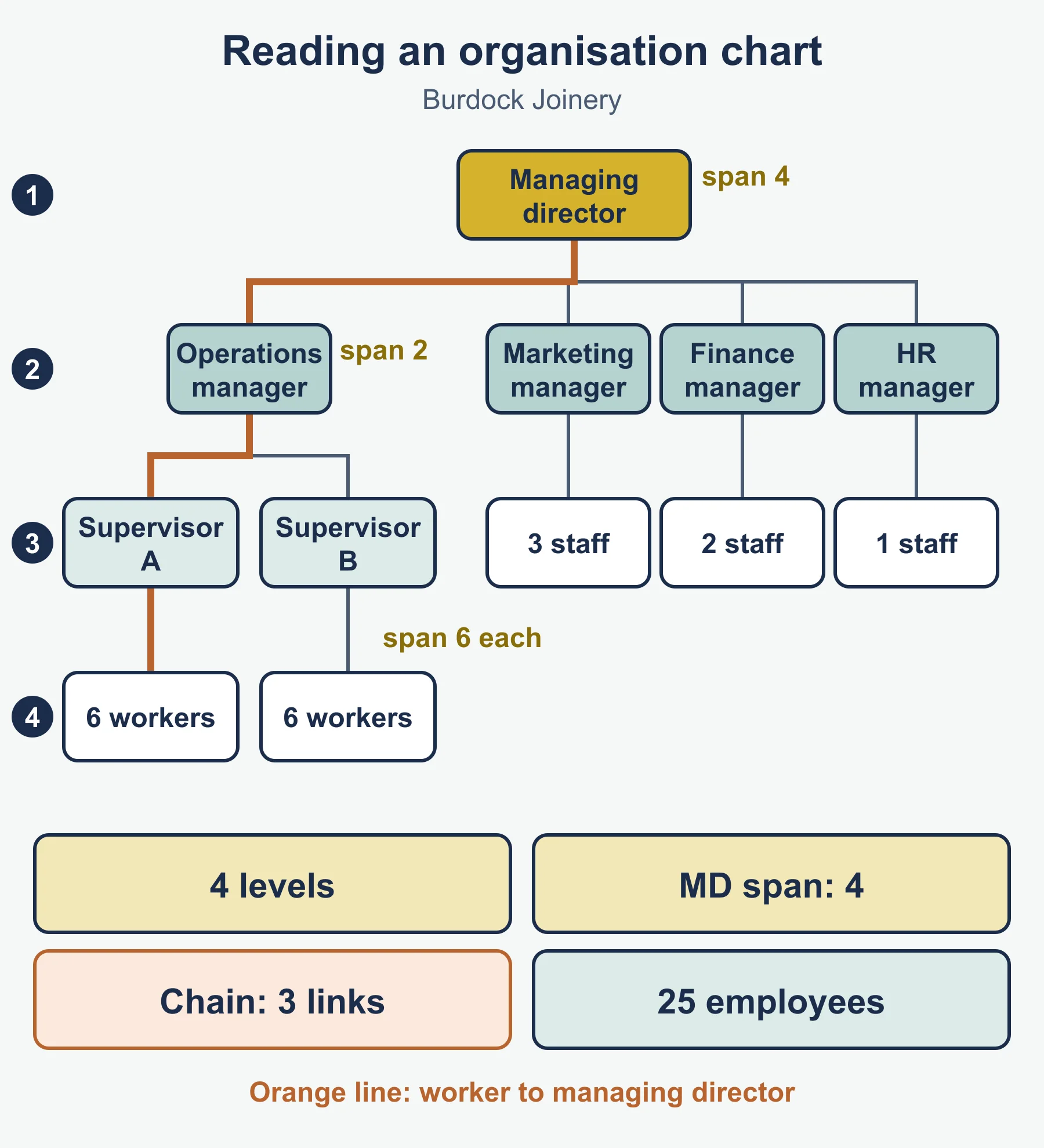
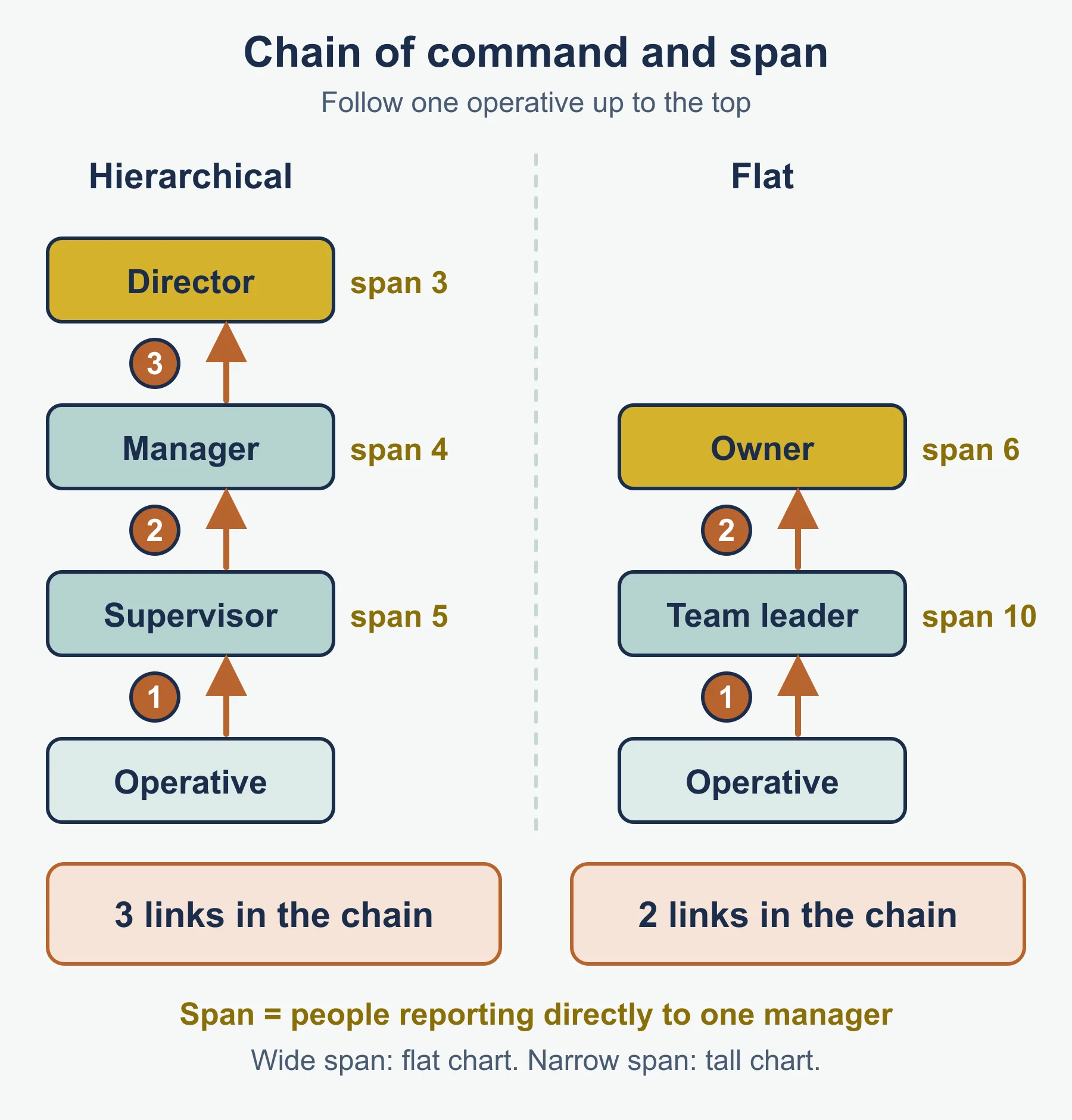
Span of control is the number of subordinates who report directly to one manager. It is counted for one manager at a time, not for the whole business.
A wide span means many subordinates. This is typical of flat charts. A narrow span means few. This is typical of hierarchical charts. A wide span needs staff who can work with little supervision. A narrow span allows close control but needs more managers.
Chain of command
The chain of command is the line of authority from the top of the business to the bottom, along which instructions pass down and reports pass up. In Quillfen’s hierarchical option, an operative’s chain is: operative, supervisor, manager, director. That is three links above the operative. In the flat option it is: operative, team leader, owner, which is two links.
A long chain means slow communication and more chances for a message to change. A short chain is faster. Each person should have one clear line manager so that nobody receives conflicting instructions.
Delegation
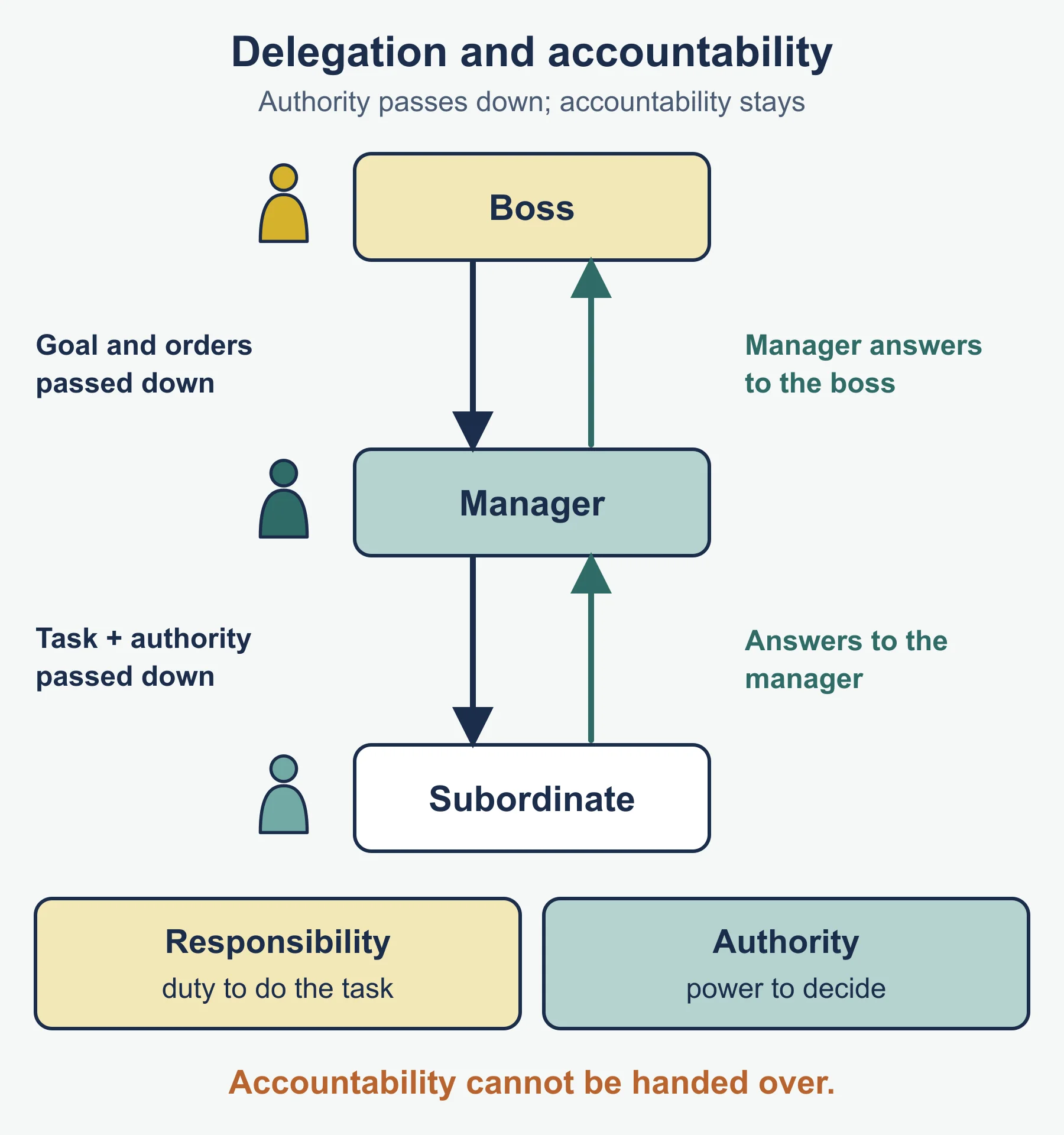
Delegation is passing authority to carry out a task to a subordinate, who is then responsible for doing it. Delegation does not pass on accountability: the delegating manager is still answerable for the result.
Worked example. Ines, an operations manager, delegates the weekly ordering of flour to Sven, a stock controller. Sven is given authority to order up to 1,500 a week. He orders the wrong grade of flour and a batch of bread is spoiled.
- Sven was given responsibility for the ordering and must explain what happened.
- Ines delegated the authority but remains accountable to the director for the lost batch.
- Ines should check whether Sven was trained and had clear instructions, and put checking steps in place.
Benefits of delegation: managers free their time for planning, staff gain skills and motivation, and decisions are made nearer the work. Limitations: the task may be done badly, the manager may lose some control, and staff may feel overloaded if they are not trained or paid for extra duties.
4. Human resources
The human resources (HR) function looks after the business’s people. The specification lists these activities (the short explanations beside them are general descriptions of our own, not specification wording):
- Workforce planning: deciding how many staff, with what skills, are needed now and in future, and how to fill gaps.
- Recruitment and selection: finding and choosing new employees.
- Training: developing employees’ skills and knowledge.
- Health and safety: keeping the workplace safe and ensuring compliance with the rules that apply.
- Staff welfare: looking after employees’ wellbeing, for example sick-pay arrangements, a rest area or counselling support.
- Employment issues: contracts, hours, pay and conditions, and following employment law in general terms.
- Industrial relations: the relationship between the business and its employees, including trade unions or staff representatives where they exist.
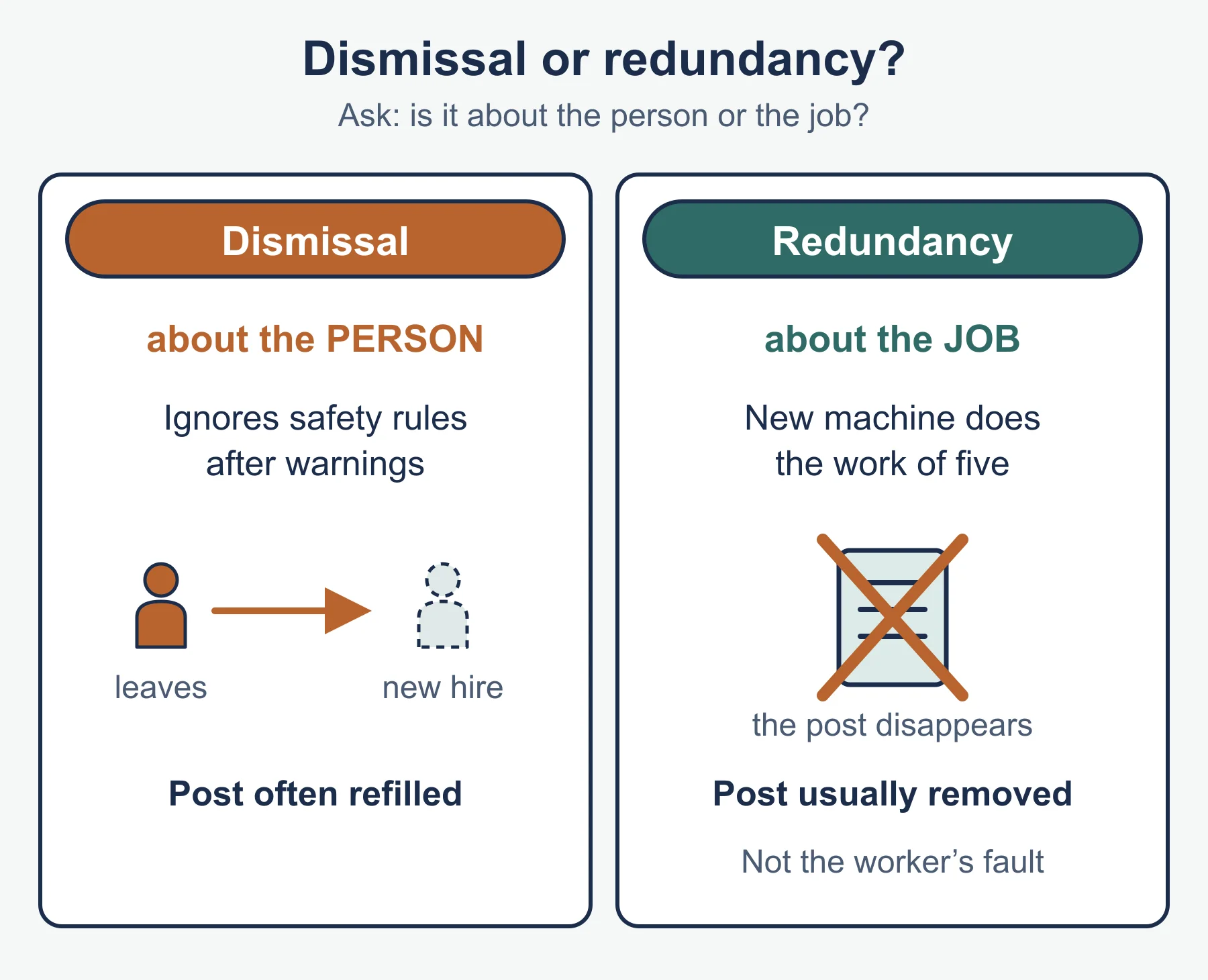
- Disciplinary and grievance procedure: a disciplinary procedure deals with employees who break rules, usually with warnings first. A grievance procedure lets an employee make a formal complaint, for example about treatment by a manager.
- Dismissal, unfair dismissal and redundancy: dismissal is ending a contract because of the employee’s conduct or performance. Unfair dismissal is a dismissal where the reason or the way it was handled was not fair, which the employee may be able to challenge. Redundancy arises when the post itself disappears, for example because a department closes; it is not a judgement of the person.
5. Finance
The finance function looks after the business’s money. The specification lists:
- Wages and salaries: calculating and paying employees correctly and on time.
- Cash-flow forecasting: predicting cash coming in and going out so the business can pay its bills.
- Budgets: plans for income and spending, used to control costs.
- Accounting: recording transactions and preparing financial documents.
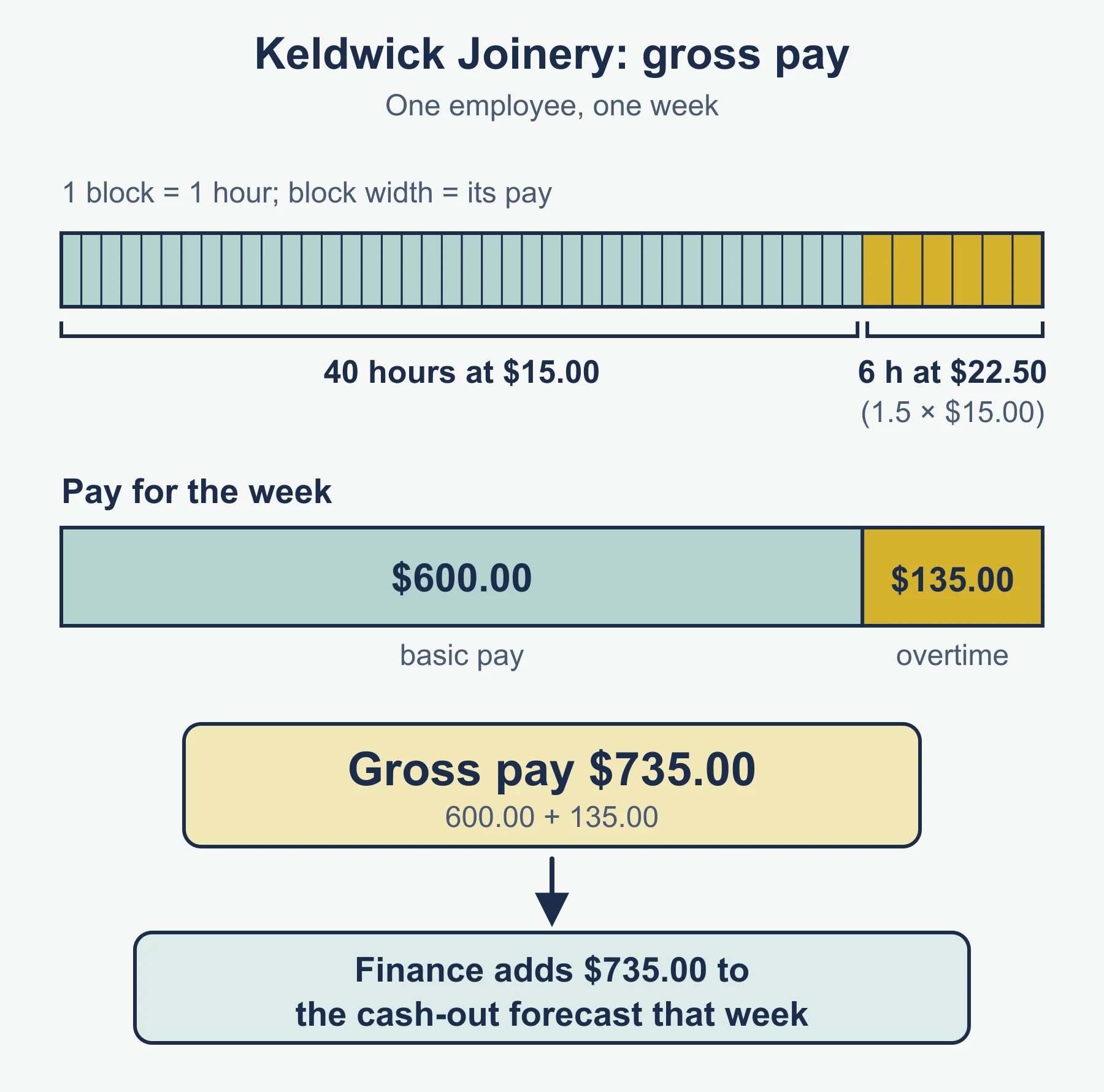
Worked example. Keldwick Joinery has an employee paid 15.00 an hour for a 40-hour week plus 6 hours of overtime at time and a half. Basic pay is 40 × 15.00 = 600.00. Overtime pay is 6 × 15.00 × 1.5 = 135.00. Gross pay is 600.00 + 135.00 = 735.00. Finance must add this to the forecast of cash going out that week.
6. Marketing
The marketing function identifies and satisfies customer needs. The specification lists: market research (finding out about customers and the market), product planning, pricing, sales promotion, advertising, customer service, public relations (managing the business’s image with the public) and packaging and distribution (getting the product to customers in good condition).
7. Production
The production function makes the goods or services. The specification lists: manufacturing the product, designing new products, quality control (checking output meets the standard) and stock control (managing the amount of stock held).
How the areas work together
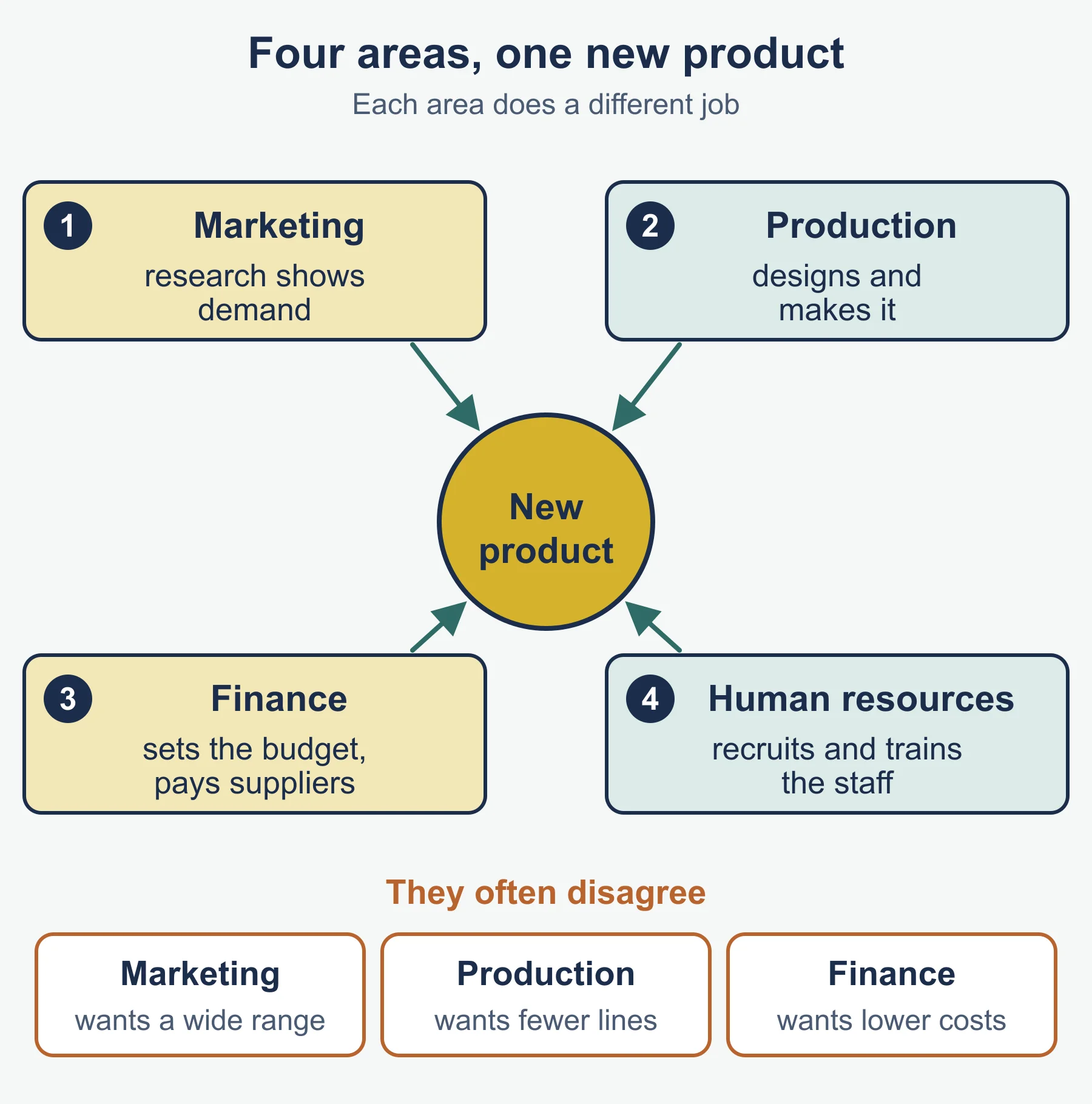
The areas depend on each other. Marketing research shows demand for a new product. Production designs and makes it. Finance sets the budget and pays suppliers. HR recruits and trains the staff who do all of this. Disagreement is common: marketing may want a wide range, while production wants fewer lines and finance wants to cut costs. Good answers show how one area’s decision affects another.
Common errors
- Counting span of control as the total number of staff, instead of the direct reports of one manager.
- Mixing up tall or flat with centralised or decentralised.
- Saying delegation passes accountability to the subordinate.
- Placing an activity in the wrong area, such as putting training in finance.
- Treating redundancy and dismissal as the same thing.
- Writing a list of benefits with no link to the business in the case.
Next steps
Condense this with the revision notes, then try the practice questions. Return to the 4BS1 Business hub or tick off progress on the checklist. Find weak spots with the free diagnostics.
Frequently asked questions
What is the difference between centralised and decentralised structures? In a centralised structure, important decisions are made at the top, usually at head office. In a decentralised structure, decisions are passed down to managers nearer the customers, such as branch or regional managers.
What do compliance and accountability mean for employees? Compliance means following the rules that apply, such as the law, health and safety rules and the business’s own policies. Accountability means being answerable for results and for how a task was done.
What does the human resources function do? HR covers workforce planning, recruitment and selection, training, health and safety, staff welfare, employment issues, industrial relations, disciplinary and grievance procedures, and dismissal and redundancy.
What are the benefits and limitations of delegation? Delegation frees managers’ time for planning, builds staff skills and motivation and puts decisions nearer the work. The task may be done badly, and staff need training and clear instructions.
Official syllabus
Pearson Edexcel International GCSE in Business (4BS1), Specification, Issue 2, February 2026, published by Pearson Education Limited. Topic 2: People in business, section 2.5 “Organisation structure and employees”, points 2.5.1 to 2.5.3.
Get free revision emails (optional)
Occasional emails with practice questions, worked explanations and links to free resources for the qualification and subjects you choose. No spam, and you can unsubscribe from any email. The free tools on this site never need an email.
Related resources
-
Practice questions
Edexcel IGCSE Business: Organisation structure and employees (4BS1) – Practice Questions
Original questions with worked answers on structures, delegation and functional areas for Edexcel IGCSE Business 4BS1, section 2.5.
Business · Pearson Edexcel · IGCSE
Try questions -
Revision notes
Edexcel IGCSE Business: Organisation structure and employees (4BS1) – Revision Notes
Condensed revision notes on structures, span of control, delegation and functional areas for Edexcel IGCSE Business 4BS1, section 2.5.
Business · Pearson Edexcel · IGCSE
Revise topic -
Study guides
Edexcel IGCSE Business: Training, motivation and rewards (4BS1)
Study guide to training types, motivation theories (Herzberg, Maslow, Taylor) and financial and non-financial rewards for Edexcel IGCSE Business.
Business · Pearson Edexcel · IGCSE
Read guide
Related articles
-
teaching
A Level tuition in Dubai: Cambridge or Pearson Edexcel International A Level?
Schools in Dubai and Abu Dhabi teach either Cambridge International AS & A Level or Pearson Edexcel International A Level. How the two are structured, why it matters for tuition, and how online classes from Lahore work.
9 October 2026
-
curriculum guides
Choosing subjects at IGCSE and A Level
How subject choices at 14 and 16 affect university options later, and how to keep pathways open without overloading a timetable.
28 July 2026
Studying this with a teacher
Working through Business IGCSE?
This page is free and stays free. If you would rather be taught it, Marlbridge runs Business classes one-to-one and in small groups of up to 15, online in your own time zone. The first trial class is free. WhatsApp replies within an hour (8am–11pm Pakistan time, every day); email the same day.
Pearson Edexcel Business teachers at Marlbridge

