
Revision Notes
Edexcel IGCSE Business: Organisation structure and employees (4BS1) – Revision Notes
Condensed revision notes on structures, span of control, delegation and functional areas for Edexcel IGCSE Business 4BS1, section 2.5.
- Subject
- Business
- Level
- IGCSE
- Topic
- People in business
- Author
- Marlbridge Academic Team
- Updated
- Reviewed by
- Asif Iqbal (what this means)
Aligned to Pearson Edexcel IGCSE Business (4BS1), Issue 2, February 2026. Official specification .
Syllabus page (what it covers and how it is assessed): Pearson Edexcel IGCSE Business.
Syllabus points this page covers
4BS1
- 2 People in business (whole topic)
- 2.5 Organisation structure and employees
Found an error? Report a correction.
Want a teacher for this? Marlbridge teaches Business online. Request a free trial class.
These notes condense Topic 2, section 2.5 “Organisation structure and employees” (points 2.5.1 to 2.5.3) of the Pearson Edexcel International GCSE in Business (4BS1) specification, Issue 2, February 2026. For full explanations and worked examples, read the study guide. Then test yourself with the practice questions.
Course links: the 4BS1 Business hub, the printable checklist and the free diagnostics. The specification says both papers can draw on the whole content, so expect this topic in small-business and large-business contexts.
Key definitions
The specification names these terms but does not define them. The meanings here and in the later definitions are general working definitions written for these notes, not specification wording.
| Term | Meaning |
|---|---|
| Organisational chart | Diagram of posts, levels and reporting lines |
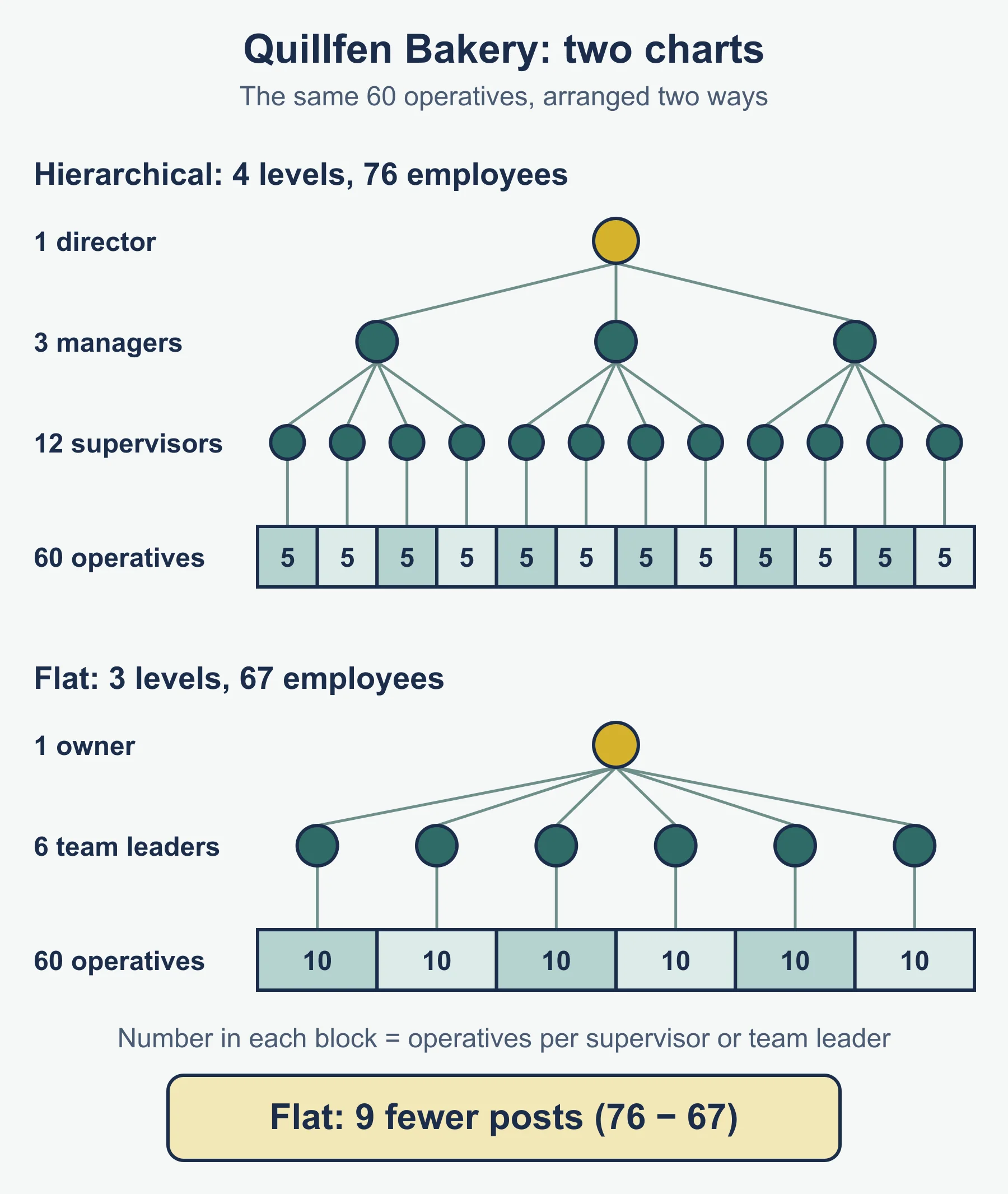
| Hierarchical structure | Many levels of authority; tall and narrow |
| Flat structure | Few levels; fewer managers between top and bottom |
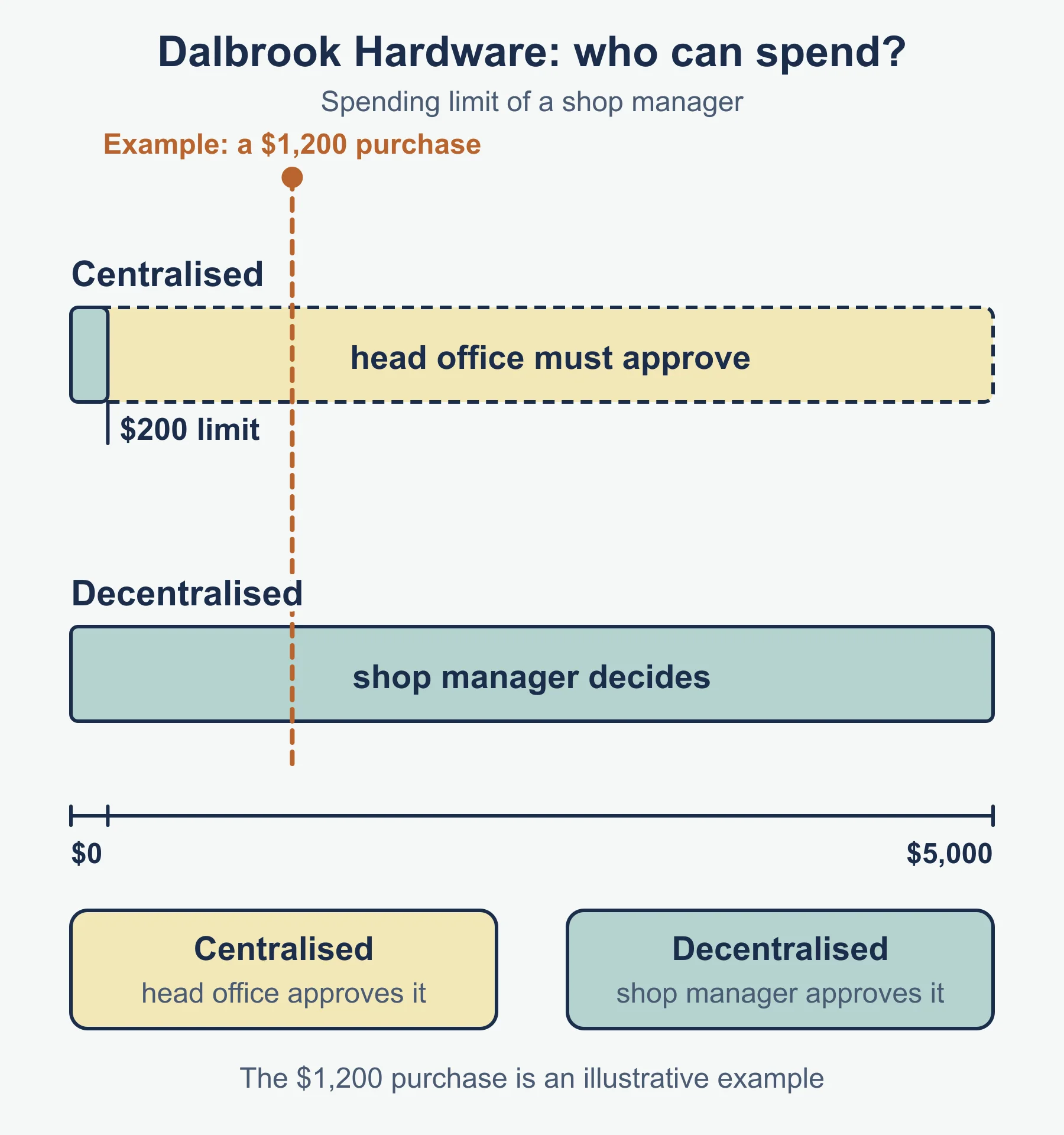
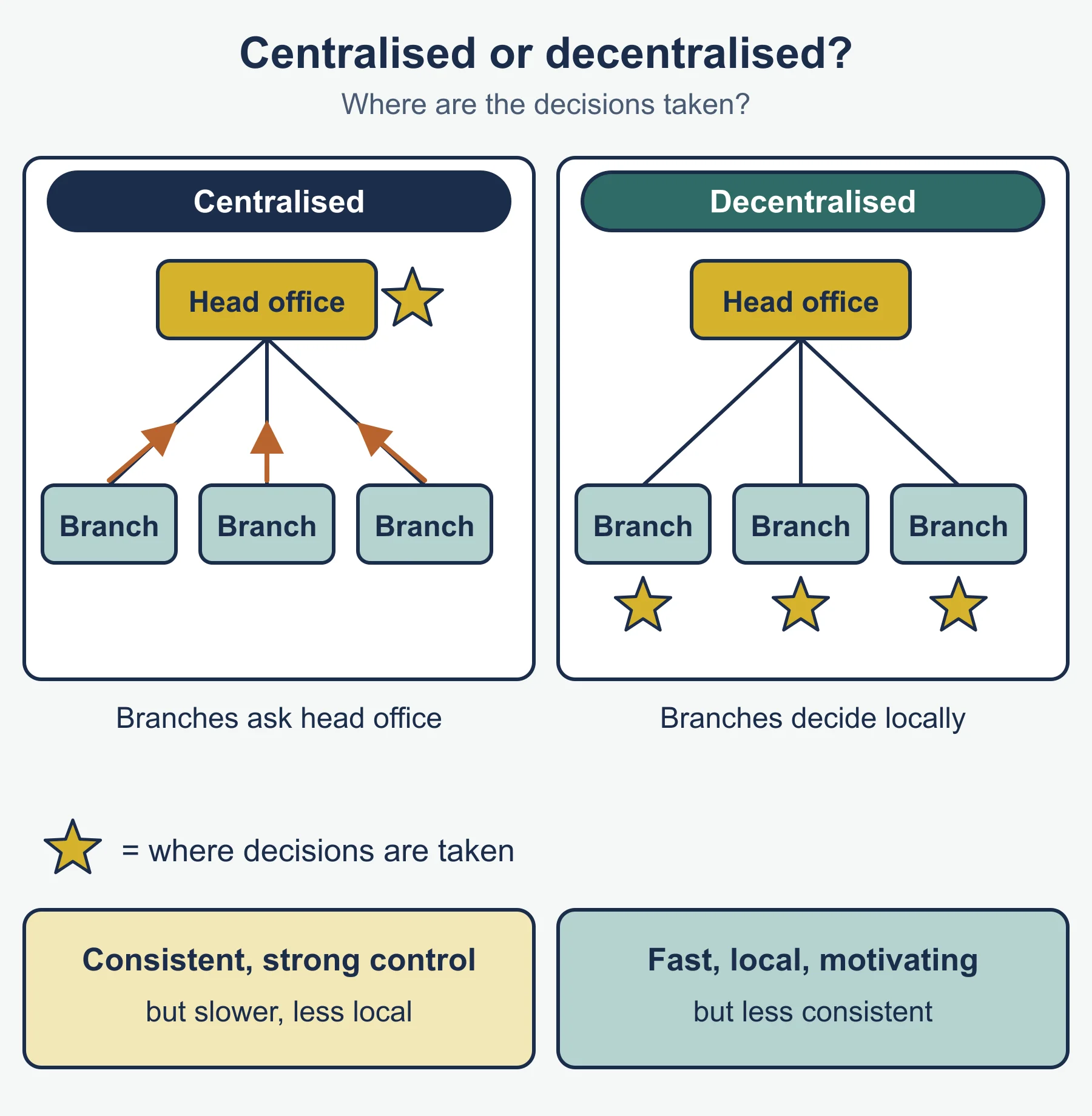
| Centralised | Important decisions made at the top, often head office |
| Decentralised | Decisions passed down to branch or regional managers |
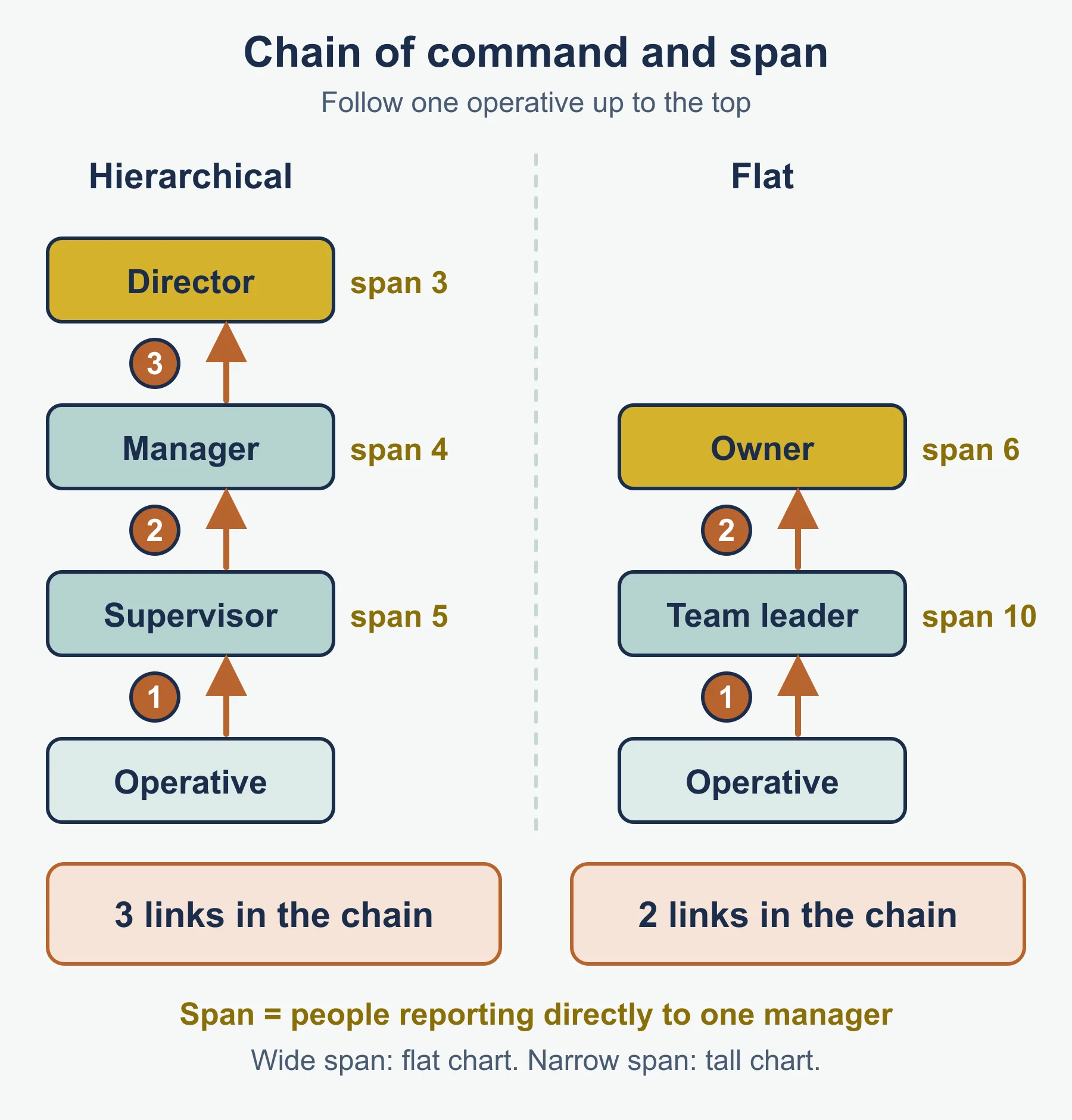
| Span of control | Number of subordinates reporting directly to one manager |
| Chain of command | Line of authority from top to bottom |
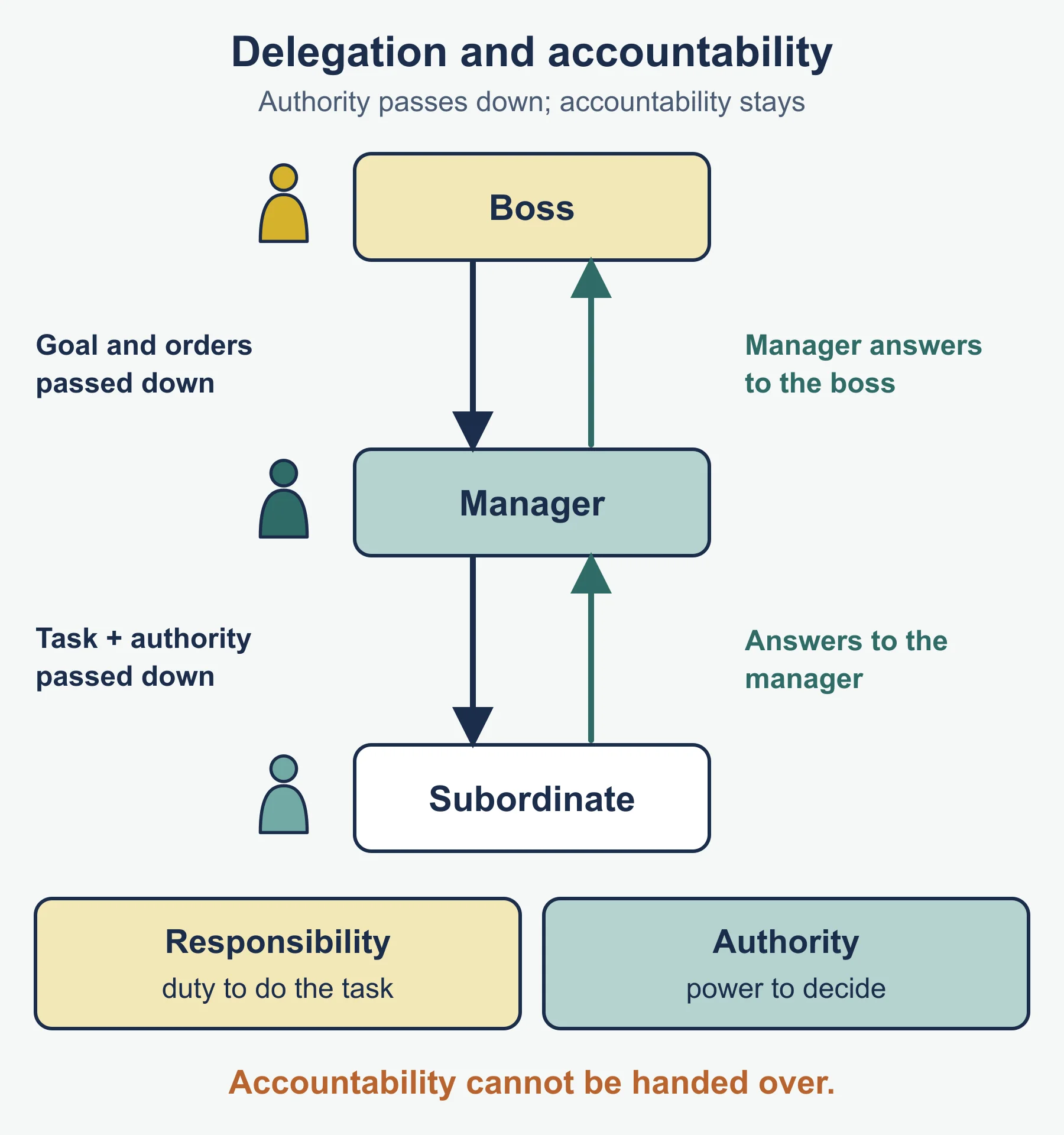
| Delegation | Passing authority for a task to a subordinate |
| Compliance | Following the law, safety rules and business policies |
| Accountability | Being answerable for results and for how a task was done |
Tall versus flat
| Hierarchical (tall) | Flat | |
|---|---|---|
| Levels | Many | Few |
| Span of control | Usually narrow | Usually wide |
| Chain of command | Long | Short |
| Communication | Slower; messages can change | Faster |
| Control | Close supervision | Looser; more trust |
| Promotion | Many steps | Few steps |
| Management cost | Higher | Lower |
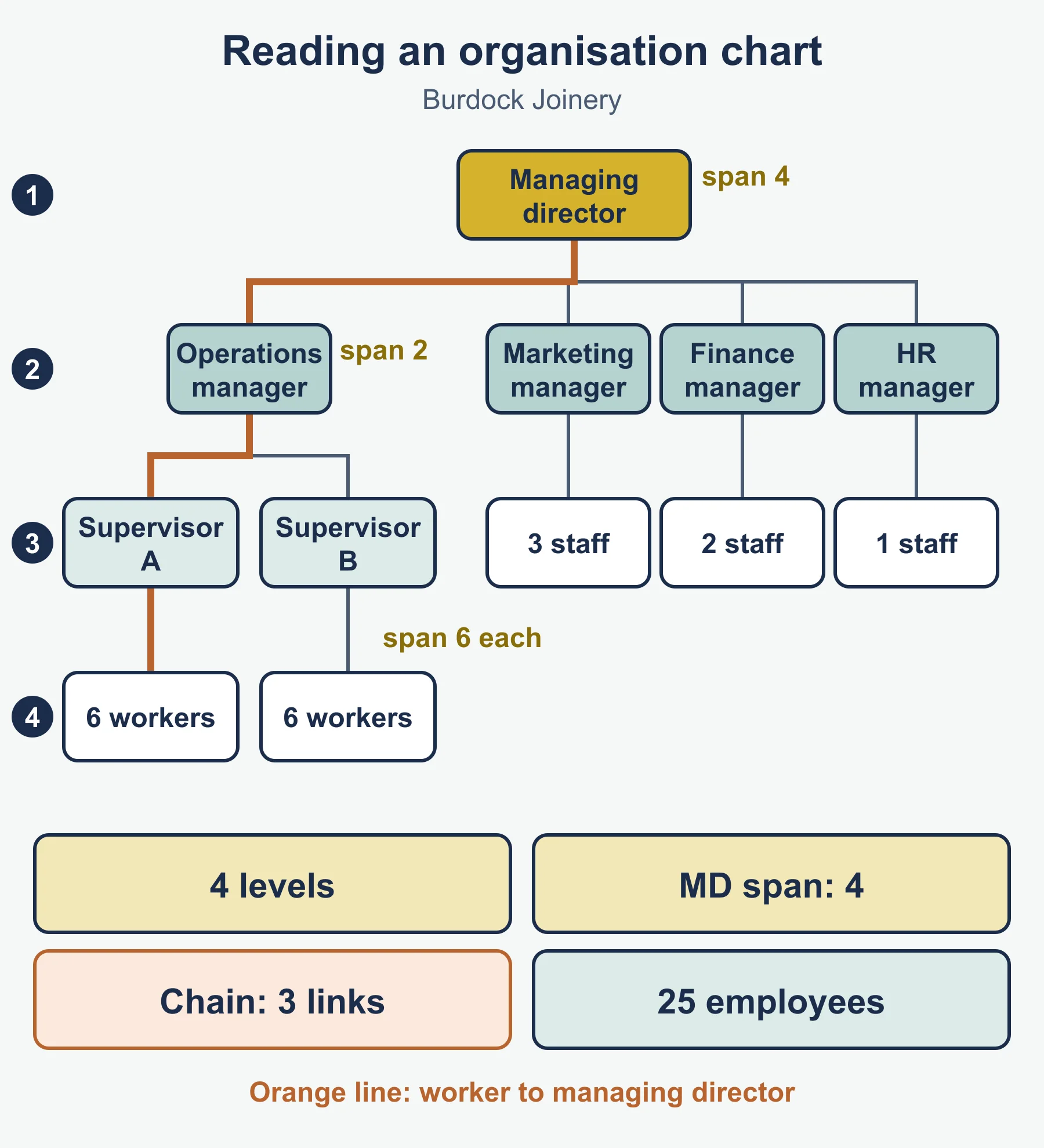
Method for a chart question, in steps:
- Count the levels from top to bottom.
- For one manager, count only the people directly below.
- For total employees, add every post, including the top post.
- For chain of command, list each post from the person to the top.
- Link your comment to the business in the case.
Worked reminder. A firm has 1 owner, 4 team leaders and 8 staff under each team leader. Total employees = 1 + 4 + (4 × 8) = 37. Levels = 3. Each team leader has a span of 8. The owner has a span of 4. An ordinary member of staff has two links above them: team leader and owner.
Centralised versus decentralised
| Centralised | Decentralised | |
|---|---|---|
| Who decides | Top managers | Local managers too |
| Speed | Slower for local issues | Faster |
| Consistency | High | Lower |
| Local knowledge | Less used | More used |
| Motivation of local managers | May be lower | May be higher |
| Risk | Top managers overloaded | Poor local decisions |
Must-know distinction: tall or flat describes the number of levels. Centralised or decentralised describes where decisions are made. A business can be flat and centralised, or tall and decentralised. State which question you are answering.
Compliance, accountability and delegation
- Compliance: the employee follows the rules; the manager checks that the team does too.
- Accountability: stays with the person who holds the post, even after delegation.
- Delegation passes authority and the job to do. It does not pass accountability.
- A good delegator gives clear instructions, suitable training and a way to check progress.
- Delegation helps because managers free time and staff gain skills. It harms if the task is done badly or the person is overloaded.
Functional areas at a glance
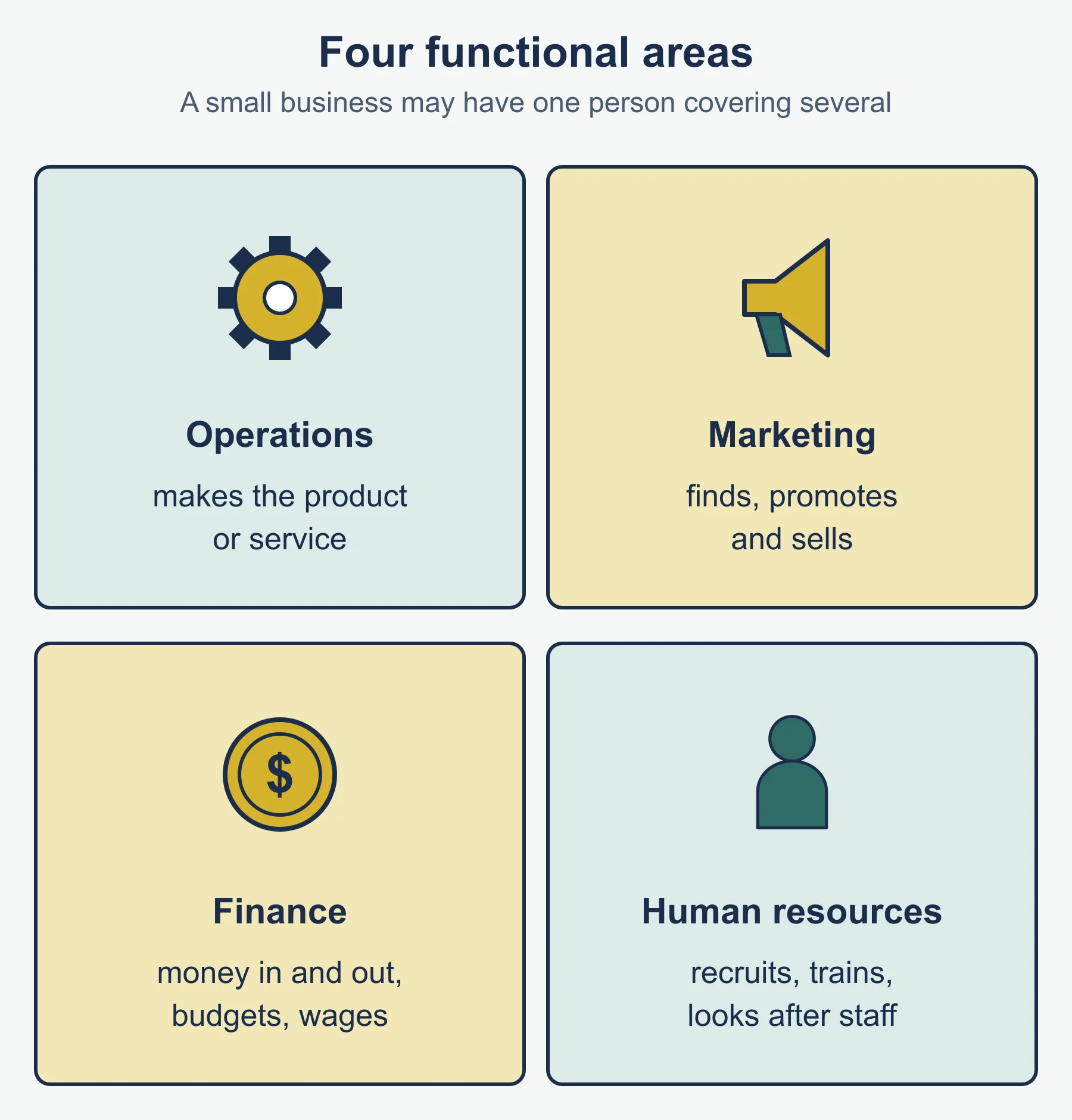
| Area | Specification activities |
|---|---|
| Human resources | Workforce planning; recruitment and selection; training; health and safety; staff welfare; employment issues; industrial relations; disciplinary and grievance procedure; dismissal, unfair dismissal and redundancy |
| Finance | Wages and salaries; cash-flow forecasting; budgets; accounting |
| Marketing | Market research; product planning; pricing; sales promotion; advertising; customer service; public relations; packaging and distribution |
| Production | Manufacturing the product; designing new products; quality control; stock control |
Human resources: short definitions
- Workforce planning: working out how many staff and which skills are needed, now and later.
- Disciplinary procedure: steps used when an employee breaks the rules.
- Grievance procedure: steps an employee uses to complain formally.
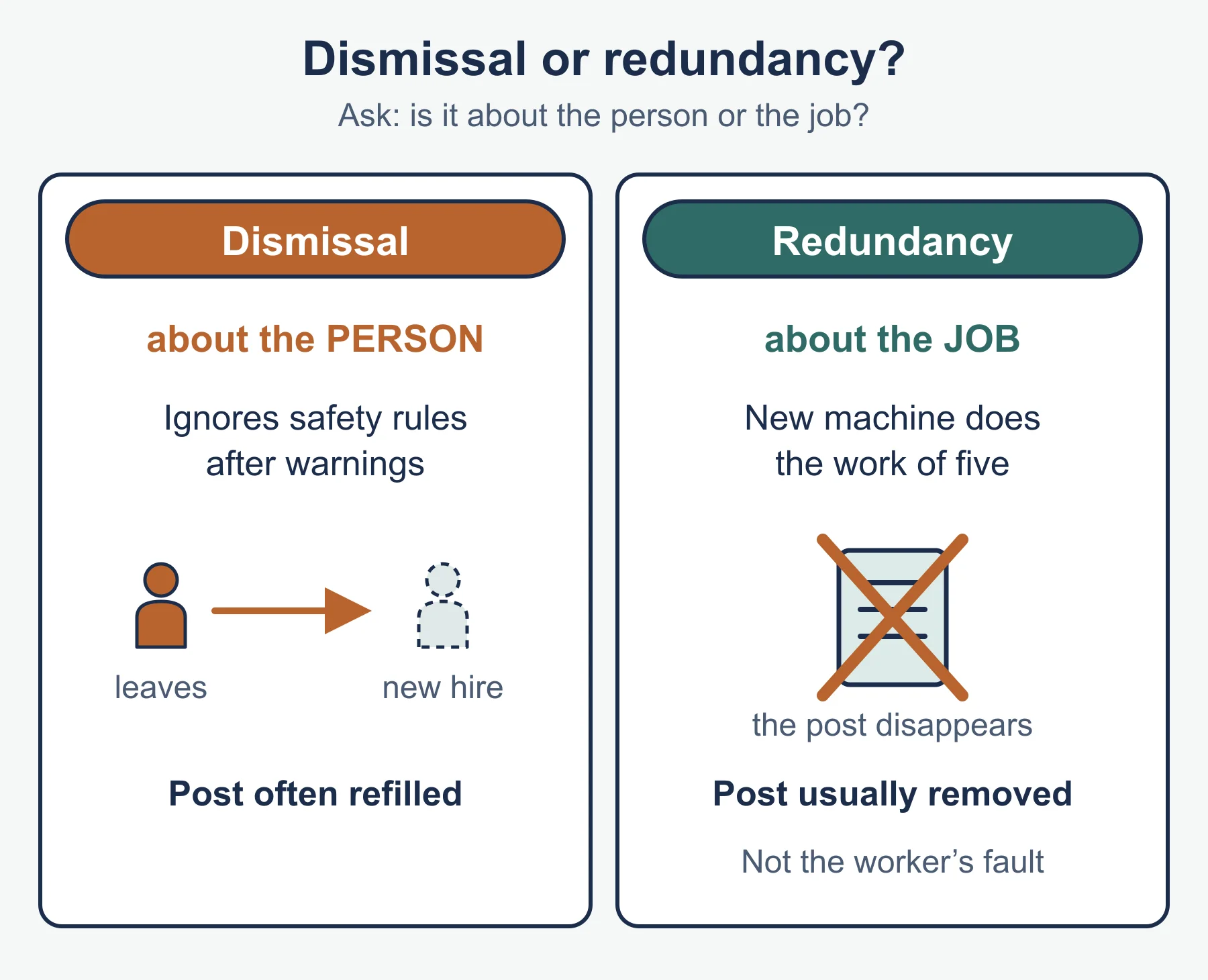
- Dismissal: ending a contract for conduct or performance reasons.
- Unfair dismissal: a dismissal where the reason or handling was not fair. The employee may be able to challenge it.
- Redundancy: the post itself disappears. It is not about the person’s behaviour.
- Industrial relations: the relationship between management and employees or their representatives.
- Staff welfare: support for employees’ wellbeing at work.
Finance: working method
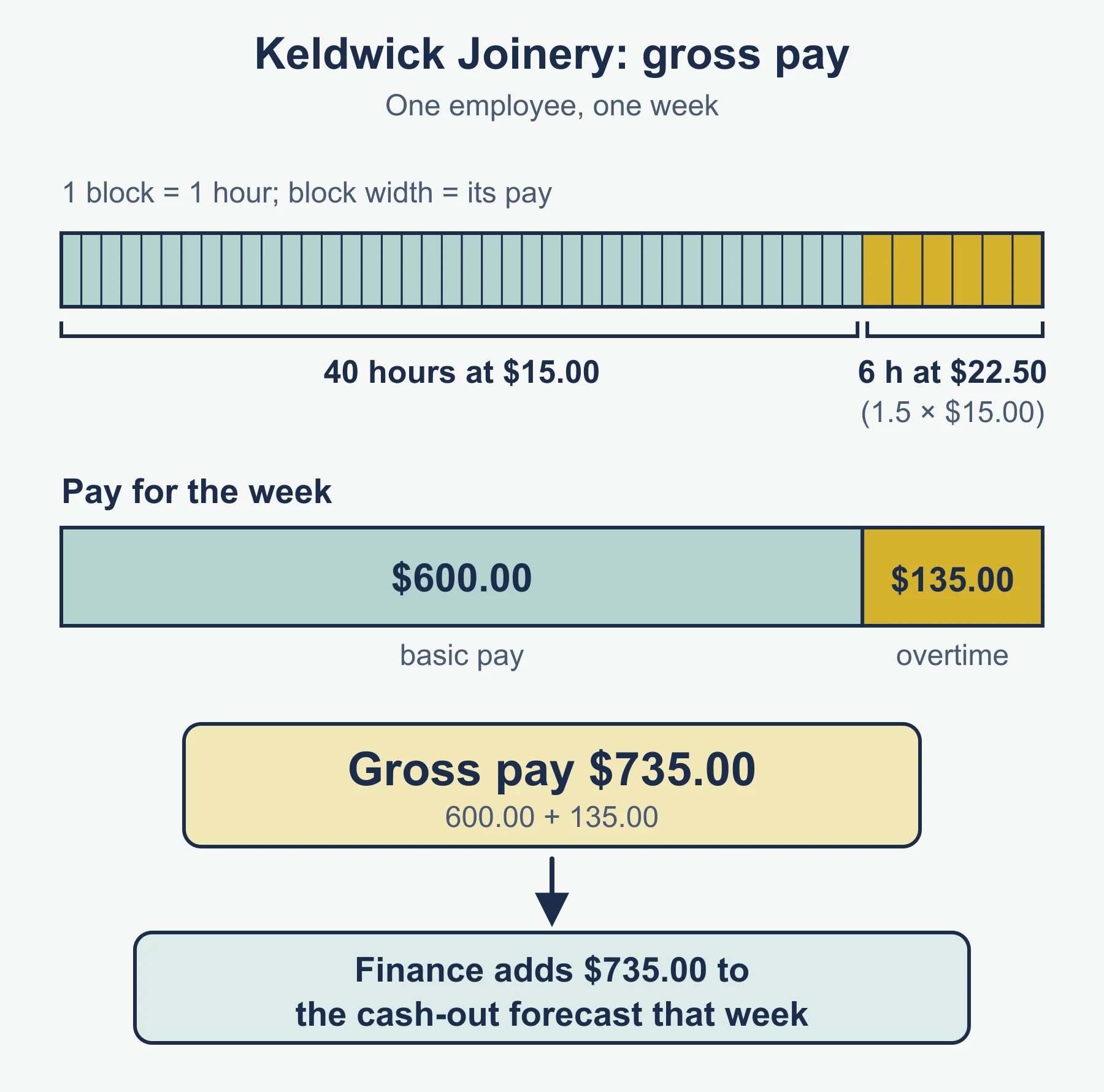
Gross wage = basic pay + overtime pay. Overtime at time and a half = hours × normal rate × 1.5. Worked reminder: 36 hours at 12.50 = 450.00; 4 hours of overtime at time and a half = 4 × 12.50 × 1.5 = 75.00; gross wage = 525.00. Cash-flow forecasts must include this as cash out.
Links between areas
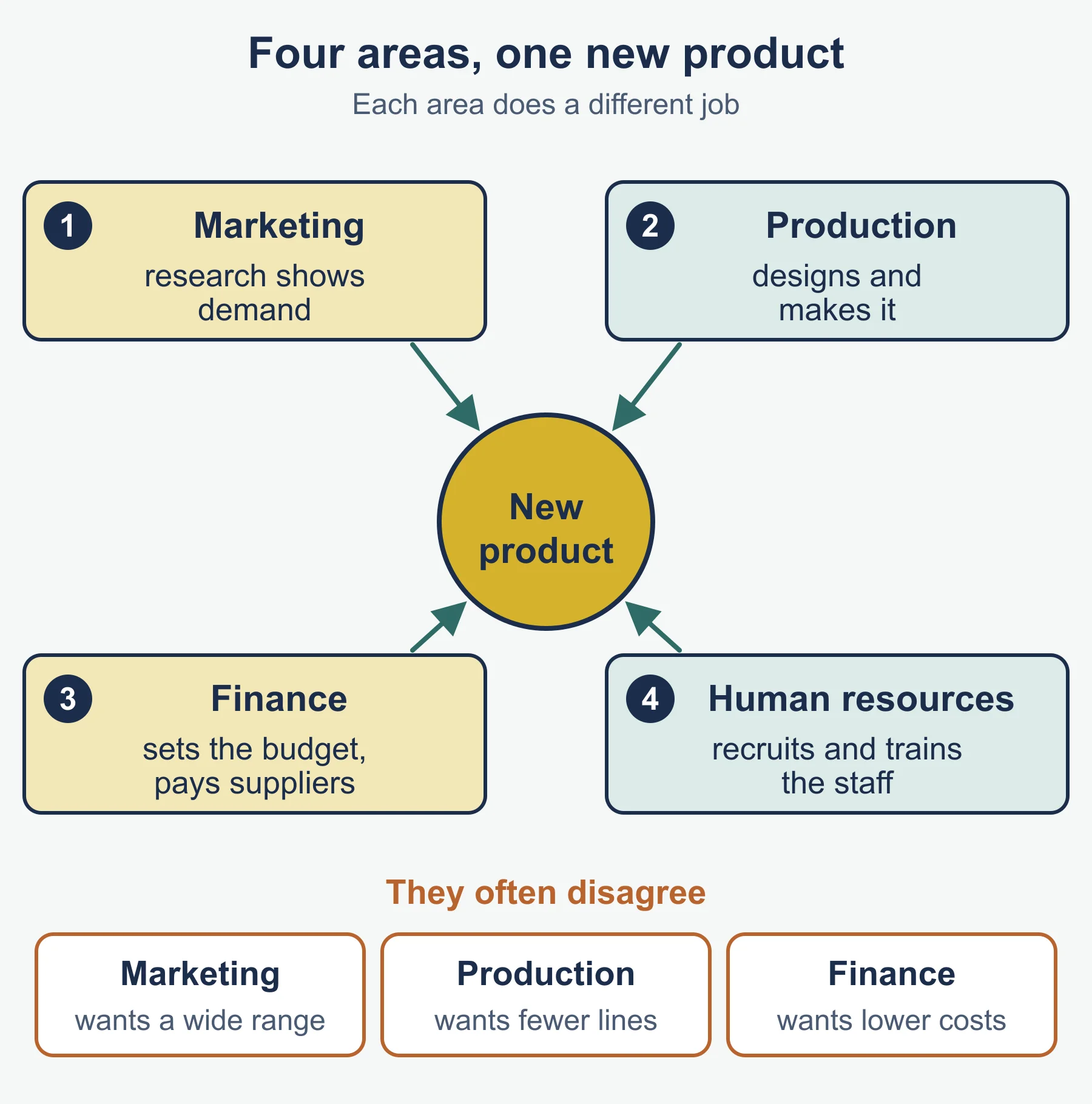
| Decision in one area | Effect on another |
|---|---|
| Marketing launches a promotion | Production must have stock; finance must fund it |
| Production adds quality control | Costs rise (finance); fewer returns (marketing) |
| Finance cuts the budget | Less training (HR); less advertising (marketing) |
| HR plans a recruitment drive | Wages bill rises (finance) |
Command words in this topic
The specification’s own wording for the command words is useful for planning an answer.
| Command word | What the specification says the answer needs | How it applies here |
|---|---|---|
| Define | Define a term from the content | Give a short, exact meaning of span of control, delegation and so on |
| Give | Recall from the content | A named benefit, limitation or activity |
| Identify | Select from a graph or table | Read a number or post from a chart |
| Calculate | Use the given data; workings should be given | Wages, totals of employees, spans |
| Outline | Two linked points, placed in context | Benefit, then what it leads to for the named business |
| Explain | A statement of fact with two expansion points, no context | Point, then two developing steps |
| Analyse | An extended answer in context, with expansion | Build a chain of reasons about one structure or area |
| Justify | Use the information given to recommend one of two options | Choose between two structures, using the figures |
| Evaluate | Extended answer reaching a supported conclusion | Weigh both sides and decide |
Worked reminder: a chain of reasoning
Question style: analyse one effect of a long chain of command on a business with 90 employees and 5 levels.
- Point: messages take longer to travel.
- Development: an instruction from the director passes through four managers before it reaches an operative.
- Effect: customers wait longer for a response, so some may go to competitors.
- Link: for a business of 90 employees, 5 levels is a lot, so removing a level could help.
Each step answers “so what?” for the named business. Use the same pattern for centralised decision-making, narrow spans or any functional area.
Worked reminder: judging two options
When you must justify or evaluate, write in this order.
- Quote the figures that matter (employees, levels, salaries, days of delay).
- Give one strength of each option.
- Give one weakness of each option.
- Choose, and say why that choice suits the business’s aim better.
- Add one condition, such as training for new team leaders, that makes the choice work.
Quick self-test
- Define span of control.
- A manager has 3 supervisors, and each supervisor has 7 workers. How many employees are below the manager, and what is the manager’s span of control?
- State one benefit of a flat structure.
- State one limitation of a hierarchical structure.
- Give one benefit of decentralised decision-making.
- A manager delegates a task and it goes wrong. Who is accountable to the director?
- Which functional area deals with quality control?
- Which functional area deals with a grievance procedure?
- What is the difference between dismissal and redundancy?
- An employee works 36 hours at 12.50 an hour and 4 hours of overtime at time and a half. Calculate gross pay.
Answers
- The number of subordinates who report directly to one manager.
- 3 + (3 × 7) = 24 employees; span of control = 3.
- Faster communication (or lower management costs, or more responsibility for staff).
- Slow communication because messages pass through many levels (or higher management costs).
- Quicker decisions made by managers who know local customers.
- The manager who delegated.
- Production.
- Human resources.
- Dismissal relates to the employee’s conduct or performance. Redundancy happens because the job is no longer needed.
- 36 × 12.50 = 450.00; 4 × 12.50 × 1.5 = 75.00; total = 525.00.
Where marks are usually lost
- Writing the total number of staff as the span of control.
- Writing “flat” when the question asks about centralised decision-making.
- Saying that delegation passes accountability down.
- Listing generic benefits such as “it is better” with no reason.
- Not using the figures in a case study, such as the number of employees or levels.
- Placing pricing in finance rather than marketing, or training in production.
- Giving a one-sided answer to a justify or evaluate question, with no judgement.
- Describing a structure but not explaining its effect on communication, cost or motivation.
- Mixing up redundancy and dismissal.
- Leaving out units or working in a wage calculation.
Next steps
Try the practice questions, reread the study guide for any weak point, and use the free diagnostics. Tick off progress on the checklist.
Frequently asked questions
What is the difference between a hierarchical and a flat structure? A hierarchical structure has several levels of authority, making it tall and narrow with narrow spans of control. A flat structure has few levels and wide spans, giving quicker communication and lower management costs.
What is the chain of command? The chain of command is the line of authority from the top of the business to the bottom, along which instructions pass down and reports pass up. A long chain means slow communication and more chances for a message to change.
What are the four functional areas in Edexcel IGCSE Business? The 4BS1 specification lists human resources, finance, marketing and production. The areas depend on each other, for example marketing research shows demand and production makes the product.
What is the difference between dismissal and redundancy? Dismissal ends a contract because of the employee’s conduct or performance. Redundancy ends a contract because the job is no longer needed, so the two should not be treated as the same.
Official syllabus
Pearson Edexcel International GCSE in Business (4BS1), Specification, Issue 2, February 2026, published by Pearson Education Limited. Topic 2: People in business, section 2.5 “Organisation structure and employees”, points 2.5.1 to 2.5.3.
Get free revision emails (optional)
Occasional emails with practice questions, worked explanations and links to free resources for the qualification and subjects you choose. No spam, and you can unsubscribe from any email. The free tools on this site never need an email.
Related resources
-
Study guides
Edexcel IGCSE Business: Training, motivation and rewards (4BS1)
Study guide to training types, motivation theories (Herzberg, Maslow, Taylor) and financial and non-financial rewards for Edexcel IGCSE Business.
Business · Pearson Edexcel · IGCSE
Read guide -
Practice questions
Edexcel IGCSE Business: Training, motivation and rewards (4BS1) – Practice Questions
Original practice questions with worked answers on training, Herzberg, Maslow, Taylor and pay and non-financial rewards for Edexcel IGCSE Business.
Business · Pearson Edexcel · IGCSE
Try questions -
Revision notes
Edexcel IGCSE Business: Training, motivation and rewards (4BS1) – Revision Notes
Condensed Edexcel IGCSE Business revision notes on training, Herzberg, Maslow, Taylor, financial and non-financial rewards, with a self-test.
Business · Pearson Edexcel · IGCSE
Revise topic
Related articles
-
teaching
A Level tuition in Dubai: Cambridge or Pearson Edexcel International A Level?
Schools in Dubai and Abu Dhabi teach either Cambridge International AS & A Level or Pearson Edexcel International A Level. How the two are structured, why it matters for tuition, and how online classes from Lahore work.
9 October 2026
-
curriculum guides
Choosing subjects at IGCSE and A Level
How subject choices at 14 and 16 affect university options later, and how to keep pathways open without overloading a timetable.
28 July 2026
Studying this with a teacher
Working through Business IGCSE?
This page is free and stays free. If you would rather be taught it, Marlbridge runs Business classes one-to-one and in small groups of up to 15, online in your own time zone. The first trial class is free. WhatsApp replies within an hour (8am–11pm Pakistan time, every day); email the same day.
Pearson Edexcel Business teachers at Marlbridge

