
Study Guides
Edexcel IGCSE Business: Training, motivation and rewards (4BS1)
Study guide to training types, motivation theories (Herzberg, Maslow, Taylor) and financial and non-financial rewards for Edexcel IGCSE Business.
- Subject
- Business
- Level
- IGCSE
- Topic
- People in business
- Author
- Marlbridge Academic Team
- Updated
- Reviewed by
- Asif Iqbal (what this means)
Aligned to Pearson Edexcel IGCSE Business (4BS1), Issue 2, February 2026. Official specification .
Syllabus page (what it covers and how it is assessed): Pearson Edexcel IGCSE Business.
Syllabus points this page covers
4BS1
- 2 People in business (whole topic)
- 2.3 Training
- 2.4 Motivation and rewards
Found an error? Report a correction.
Want a teacher for this? Marlbridge teaches Business online. Request a free trial class.
This guide follows the Pearson Edexcel International GCSE in Business (4BS1) specification, Issue 2, February 2026. It covers Topic 2 “People in business”, section 2.3 Training and section 2.4 Motivation and rewards: every numbered content point, 2.3.1, 2.4.1 and 2.4.2. The specification says Paper 1 (small businesses, up to 49 employees) and Paper 2 (large businesses, more than 250 employees) can both draw on the whole content, so expect this topic in either setting.
Course links: the 4BS1 Business hub, the printable checklist and the free diagnostics. Companion pages: the revision notes and the practice questions. Every business named here is invented, and amounts are in dollars.
What the specification asks for
| Point | You must be able to | Where in this guide |
|---|---|---|
| 2.3.1 | Explain the importance of training to a business and to workers: induction, on-the-job and off-the-job training and the main purpose of each; compliance with health and safety laws; benefits and limitations of training | Sections 1 to 3 |
| 2.4.1 | Explain why motivation matters (attracting employees, retaining employees, productivity) and use the motivational theories of Herzberg, Maslow and Taylor | Sections 4 and 5 |
| 2.4.2 | Explain financial methods (remuneration, bonus, commission, promotion, fringe benefits) and non-financial methods (job rotation, job enrichment, autonomy) | Sections 6 and 7 |
1. Types of training and their main purpose (2.3.1)
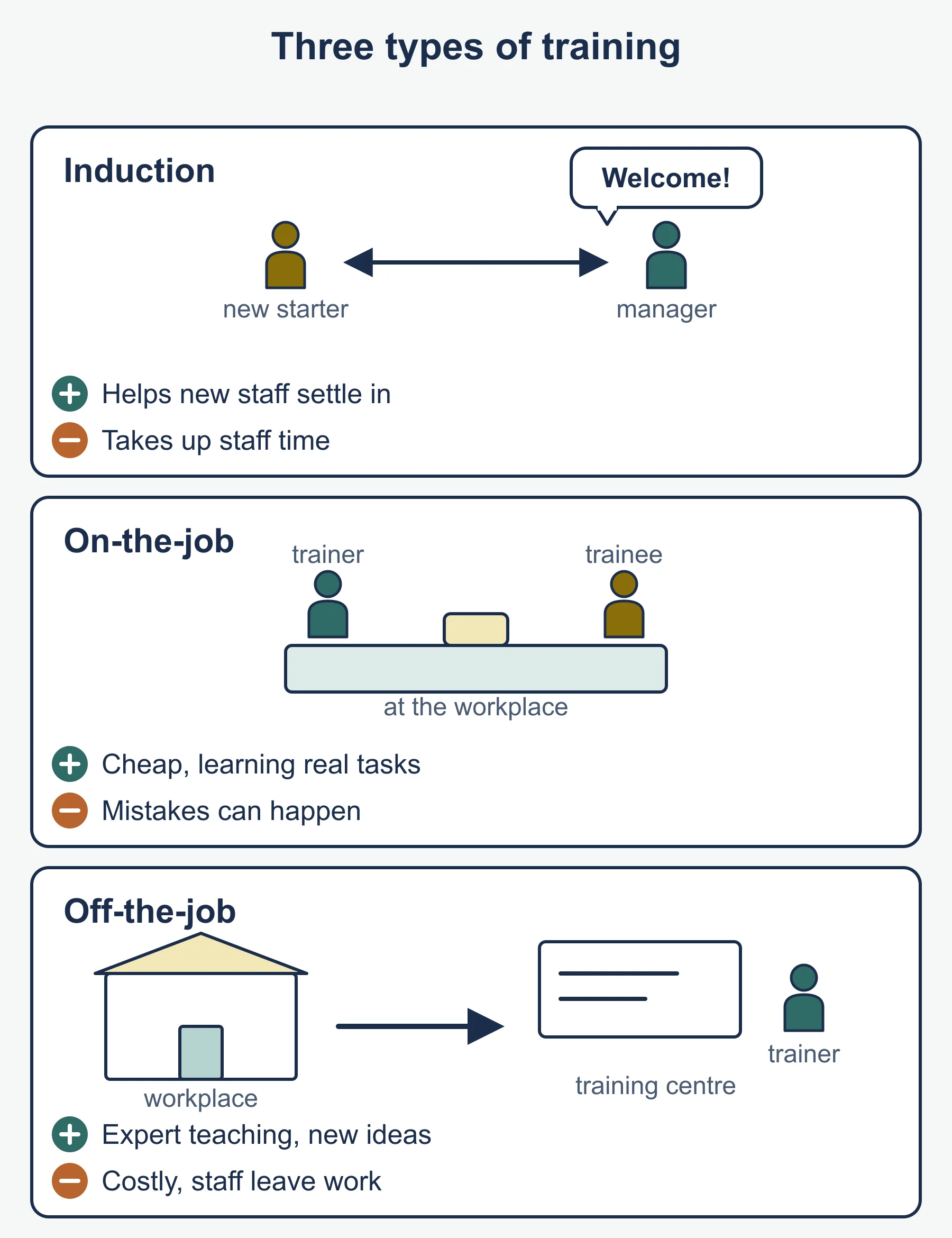
Training is teaching employees the knowledge and skills they need for a job. The specification names three types.
| Type | What happens | Main purpose |
|---|---|---|
| Induction | A short programme for a new starter: meeting colleagues, a tour, rules, safety procedures, how the business works | Help the new employee settle in quickly and know what is expected |
| On-the-job | The employee learns at the workplace while doing the work, often by watching or being coached by an experienced colleague | Build job-specific skills with little disruption to output |
| Off-the-job | The employee learns away from the work area, for example at a college, in a training room or on an external course | Teach wider or specialist skills that are hard to learn while working |
A new barista might have an induction on day one, learn the coffee machine on the job beside a colleague, then attend an external food hygiene course (off-the-job).
On-the-job training is usually cheaper in fees but the trainer is also doing their own work, and a poor trainer passes on bad habits. Off-the-job training can bring in expert knowledge but usually costs more in fees and in time away from work.
2. Health and safety compliance (2.3.1)
Businesses must comply with the health and safety laws of the country they operate in. The specification does not name particular laws, so you only need the general idea: a business has a legal duty to protect people at work, and training is one of the main ways it shows it has done so.
Training that supports compliance includes:
- Induction covering emergency exits, fire procedures and who to report accidents to.
- Instruction in the safe use of machinery, tools and chemicals before an employee is allowed to use them.
- Refresher sessions when equipment, methods or rules change.
Failure to comply can lead to injured workers, fines, legal action and damage to reputation. Compliance training is therefore also a way of protecting the business as well as the worker.
3. Benefits and limitations of training (2.3.1)
| Benefit | Limitation | |
|---|---|---|
| To the business | Higher skills can mean higher quality and fewer mistakes; employees may be able to do more than one job; a better trained team may need less supervision; safe working helps compliance | Fees and lost output while people learn; trained staff may leave and take their skills to a competitor; training may not change behaviour if the employee is unwilling |
| To the worker | New skills; more confidence; better chances of promotion or a higher wage; may feel valued, which links to motivation | Time away from home or normal duties; the training may not suit the individual; a qualification can make them more attractive to other employers |
Worked example 1: is the course worth it?
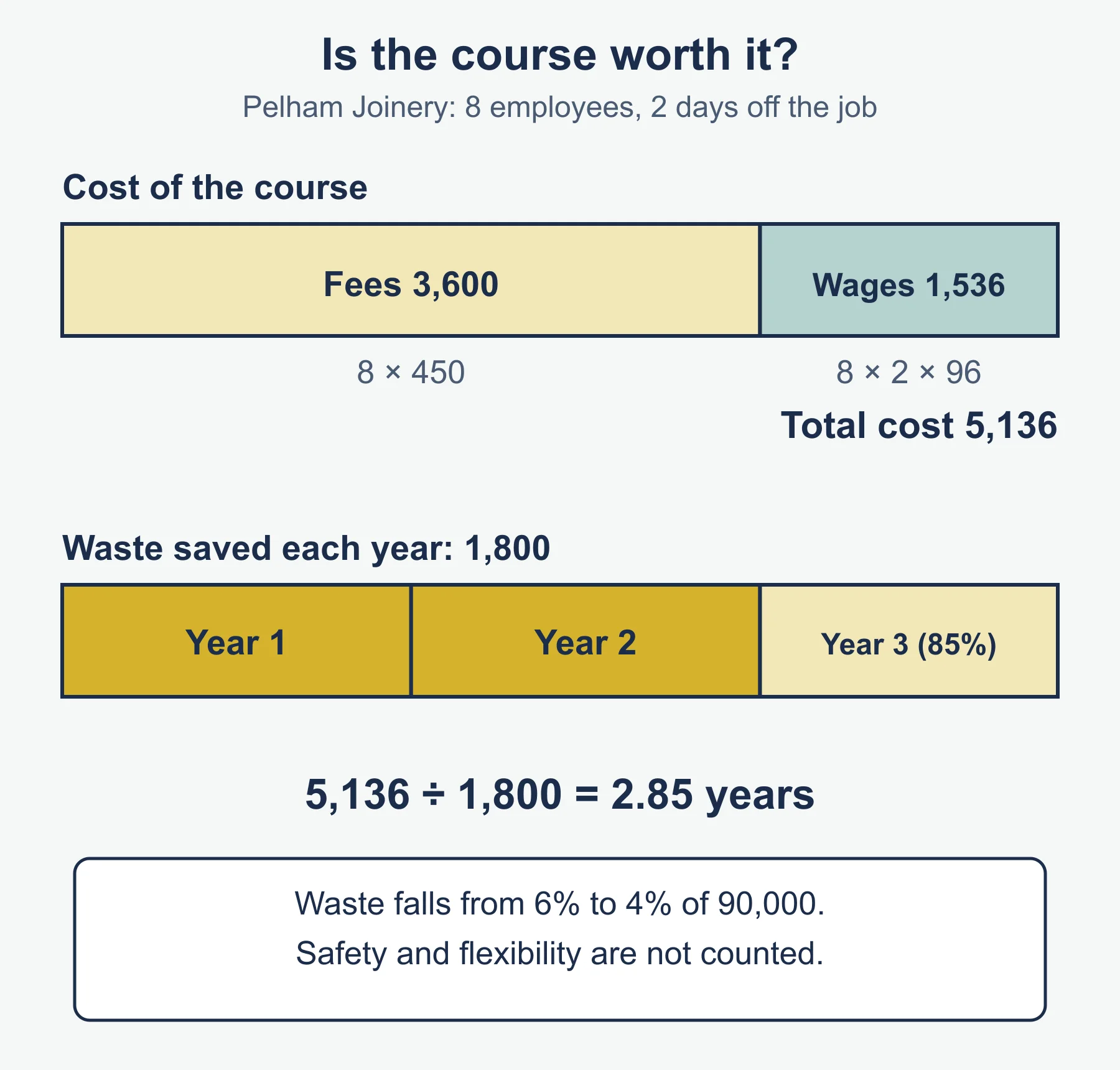
Pelham Joinery has 8 employees on a machine-safety and accuracy course. The fee is 450 each. The course takes 2 days off the job, and the business still pays a day’s wages of 96 per employee for each day. Materials cost 90,000 a year and waste is currently 6% of materials. The owner expects waste to fall to 4%.
- Course fees: 8 × 450 = 3,600.
- Wages paid for time away: 8 × 2 × 96 = 1,536.
- Total cost: 3,600 + 1,536 = 5,136.
- Waste now: 6% × 90,000 = 5,400. Waste after: 4% × 90,000 = 3,600. Saving = 1,800 a year.
- Cost divided by yearly saving = 5,136 ÷ 1,800 = 2.85. The cost is recovered from waste savings alone in about 2.9 years.
A judgement needs more than the sum. The waste saving ignores better safety, fewer injuries and a more flexible team, but it also assumes the 4% is achieved and that nobody leaves.
4. Why motivation matters (2.4.1)
Motivation is the desire to work hard and do a good job. The specification lists three reasons it matters.
- Attracting employees: pay, rewards and a good working environment make a job attractive, so the business gets a larger pool of applicants.
- Retaining employees: motivated staff are less likely to leave. This cuts the cost of recruitment, selection and training new people.
- Productivity: motivated staff tend to produce more output per person, so unit costs can fall.
Productivity is output divided by the number of workers (the standard form of the measure).
Worked example 2: productivity and retention
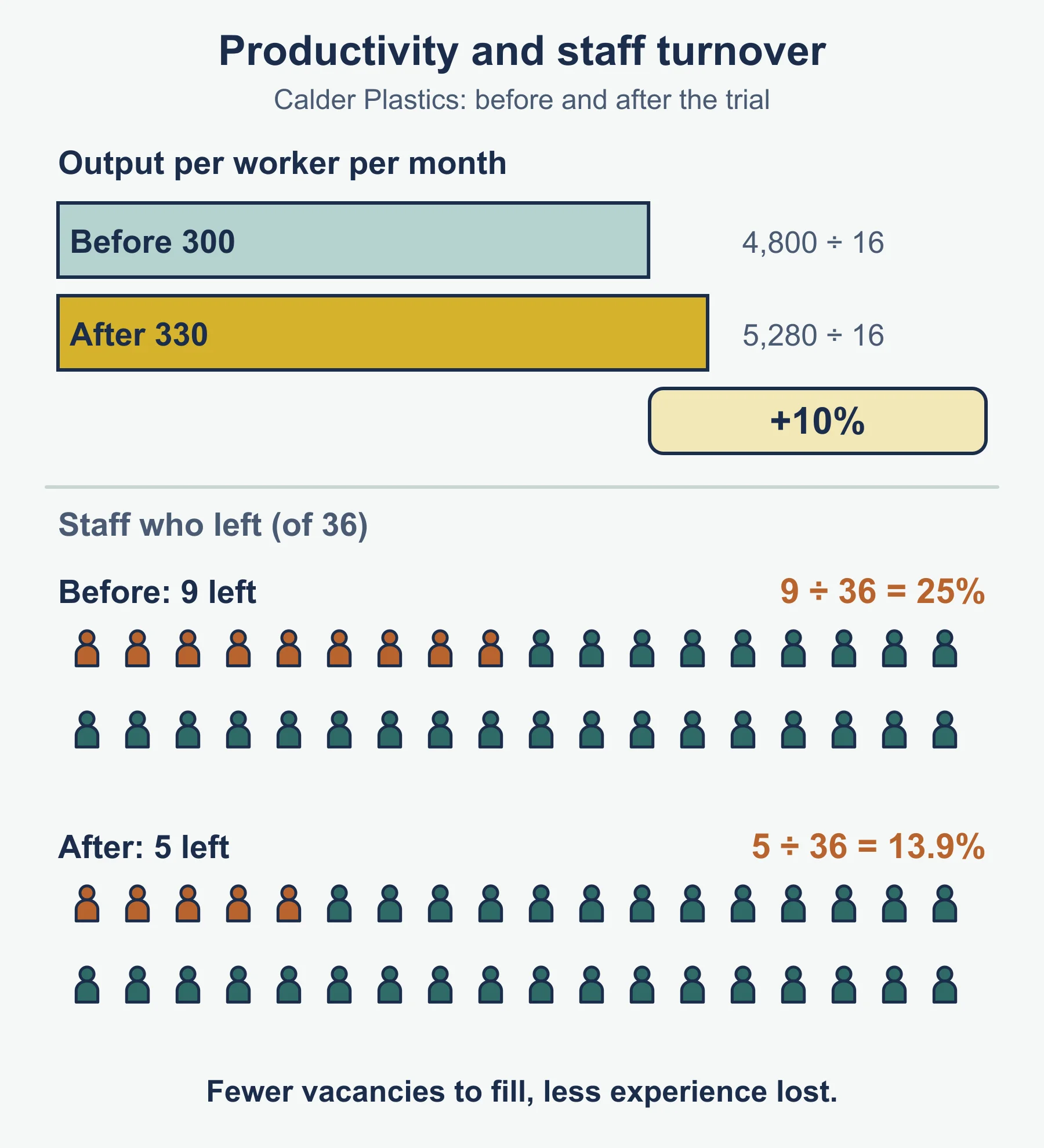
Calder Plastics has 16 workers who make 4,800 units a month, so output per worker is 4,800 ÷ 16 = 300 units. After a trial of new work arrangements, the same 16 workers make 5,280 units: 5,280 ÷ 16 = 330 units per worker. The change is (330 − 300) ÷ 300 × 100 = 10% higher.
Calder also has 36 staff, of whom 9 left last year: 9 ÷ 36 × 100 = 25%. After the changes only 5 left: 5 ÷ 36 × 100 = 13.9%. Staff turnover as a percentage of staff is the standard way to express this (the specification does not give a formula). Say what the fall means: fewer vacancies to fill and less lost experience.
5. Motivational theories (2.4.1)
The specification names the three theorists but does not set out their theories. The descriptions below are the standard textbook forms.
Taylor
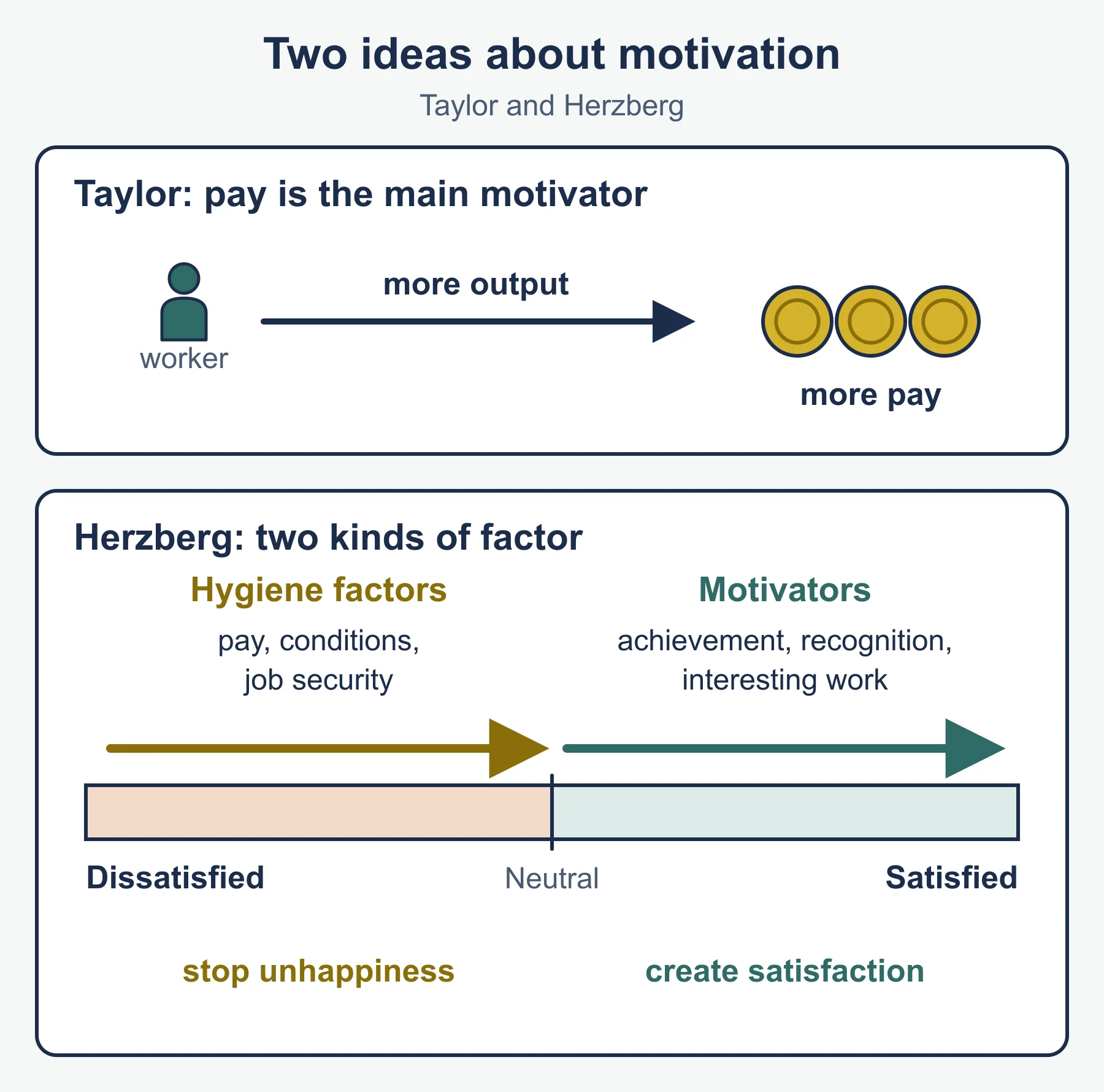
Frederick Taylor’s view, known as scientific management, is that workers are motivated mainly by money. Managers should study tasks, break them into small simple steps, train workers to do them in the most efficient way and pay for output, for example with a piece rate. Strengths: clear, easy to measure and can raise output in repetitive work. Weaknesses: it ignores other needs such as interest, recognition and belonging, and boring tasks can lower quality.
Maslow
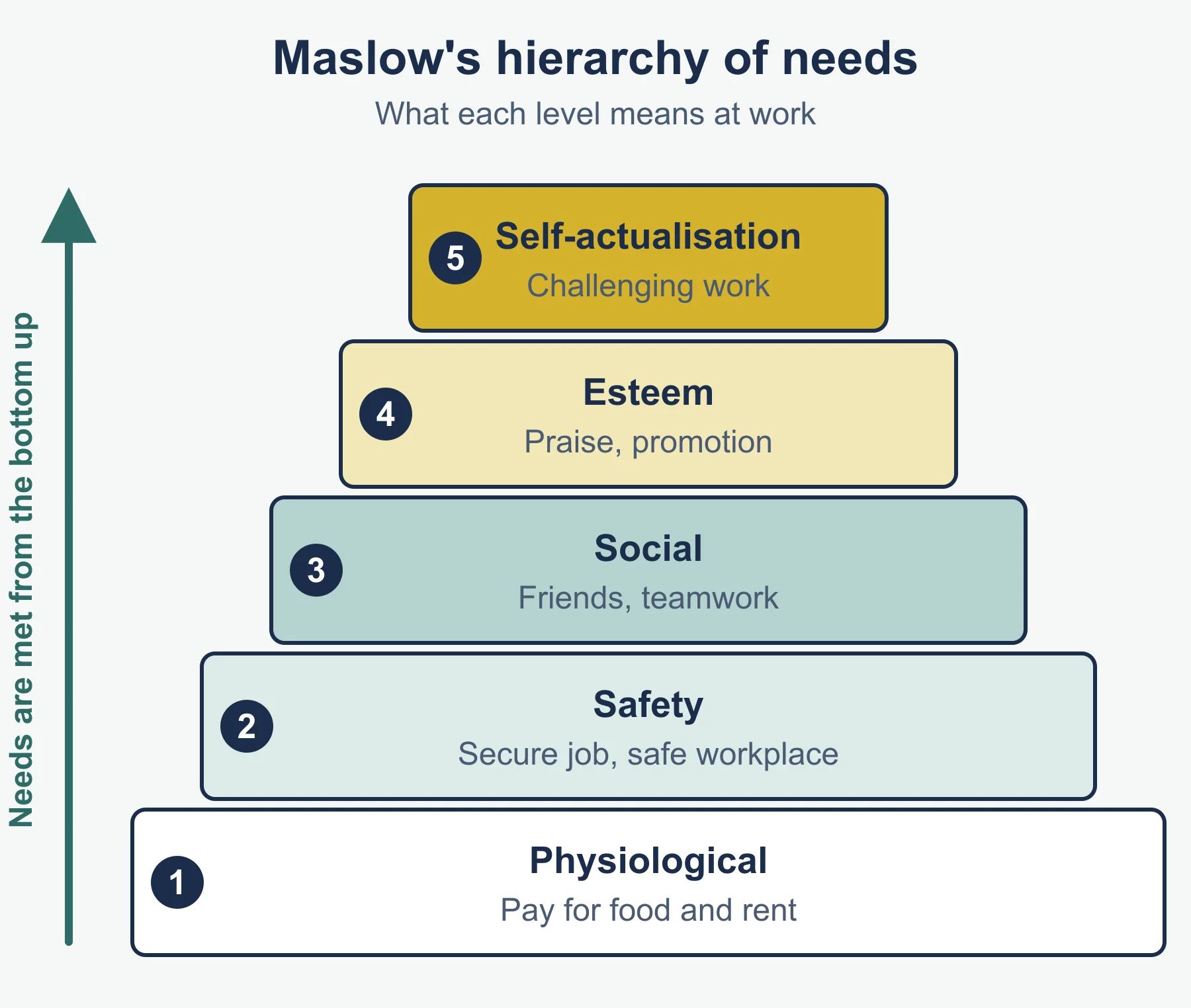
Abraham Maslow said people have needs arranged in a hierarchy and move up only when the lower need is reasonably met. In the standard form, from the bottom:
- Physiological: food, shelter, a wage that covers basics.
- Safety: job security, safe conditions, regular hours.
- Social (belonging): friendships, teamwork, being part of a group.
- Esteem: respect, status, recognition, praise, promotion.
- Self-actualisation: personal growth, using one’s full potential, creative and challenging work.
Business use: find which level an employee is at and offer rewards for that level. A pay rise helps someone worried about bills; it does little for someone who already feels secure but wants responsibility. Weakness: people differ and may not move in a strict order.
Herzberg
Frederick Herzberg’s two-factor theory separates:
- Hygiene factors: pay, working conditions, job security, company policies and relations with supervisors. If poor, workers become dissatisfied. If good, workers are simply not dissatisfied. They do not by themselves motivate.
- Motivators: achievement, recognition, responsibility, interesting work and chances to advance. These give real motivation.
Business use: fix the hygiene factors first, then add motivators. Giving a small pay rise does not make dull work interesting.
6. Financial methods (2.4.2)
| Method | What it is | Advantage | Disadvantage |
|---|---|---|---|
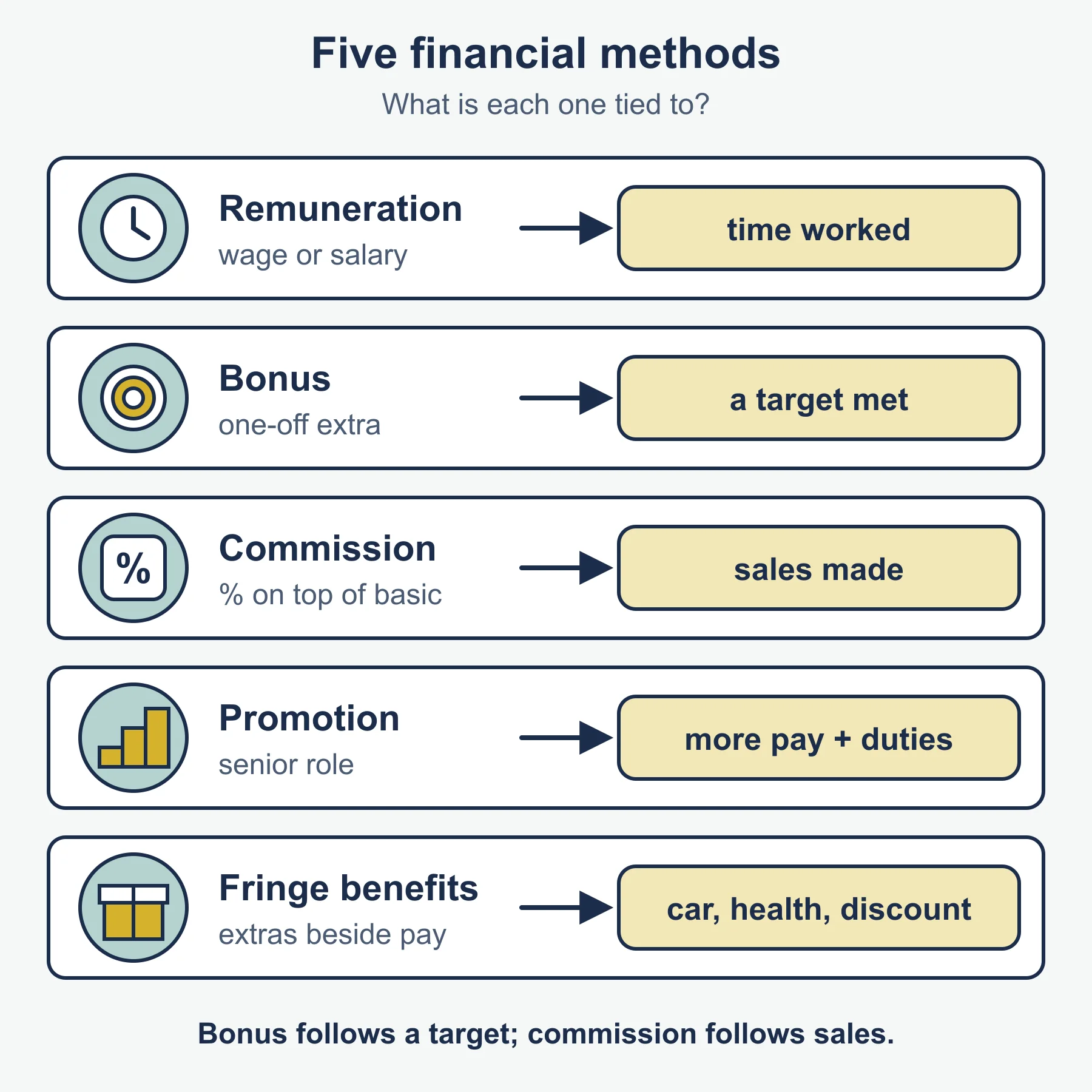
| Remuneration | Payment for work: a wage (often hourly or weekly) or a salary (fixed yearly amount, paid monthly) | Reliable income helps attract and retain staff | Fixed pay does not link reward to effort |
| Bonus | An extra one-off payment for meeting a target, for example a profit or quality target | Rewards effort and links reward to results | Adds cost; can be seen as part of normal pay; missed targets demotivate |
| Commission | A percentage of sales made, usually paid on top of basic pay | Strong incentive in selling jobs | Staff may pressure customers; income varies; not suited to roles without sales |
| Promotion | Moving to a more senior role with more pay and responsibility | Gives a long-term goal; links to esteem | Limited posts, so only a few benefit; disappointment for those passed over |
| Fringe benefits | Extras on top of pay, such as a company car, health cover, staff discount or paid holidays | Can attract and retain staff; may cost the business less than the same value in cash | Cost to the business; some staff may not value the benefit |
Worked example 3: pay under two systems
A salesperson at Wexcombe Kitchens earns 1,450 basic salary each month, with 5% of sales added as commission. This month’s sales were 38,500, and a 250 bonus is paid if sales exceed 35,000.
- Commission: 5% × 38,500 = 1,925.
- Pay without bonus: 1,450 + 1,925 = 3,375.
- Sales exceed 35,000, so add the bonus: 3,625.
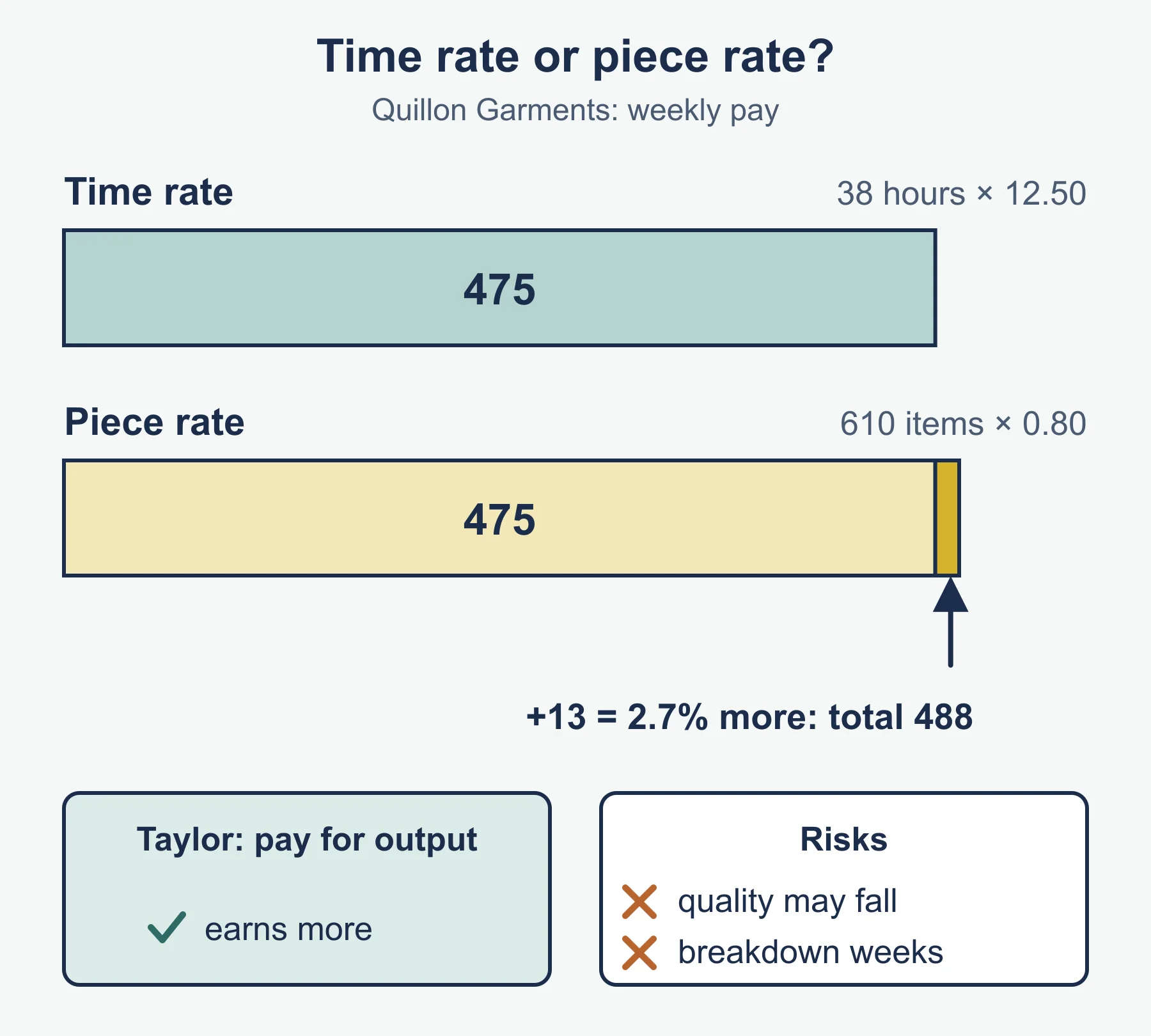
At Quillon Garments, workers could be paid by time (38 hours × 12.50 = 475 a week) or by piece rate at 0.80 per item. A worker who makes 610 items earns 610 × 0.80 = 488, which is 13 or 2.7% more than the time-rate week. Piece rate follows Taylor’s logic but can reduce quality and hurt pay in weeks with machine breakdowns.

7. Non-financial methods (2.4.2)
| Method | What it is | Likely effect | Limitation |
|---|---|---|---|
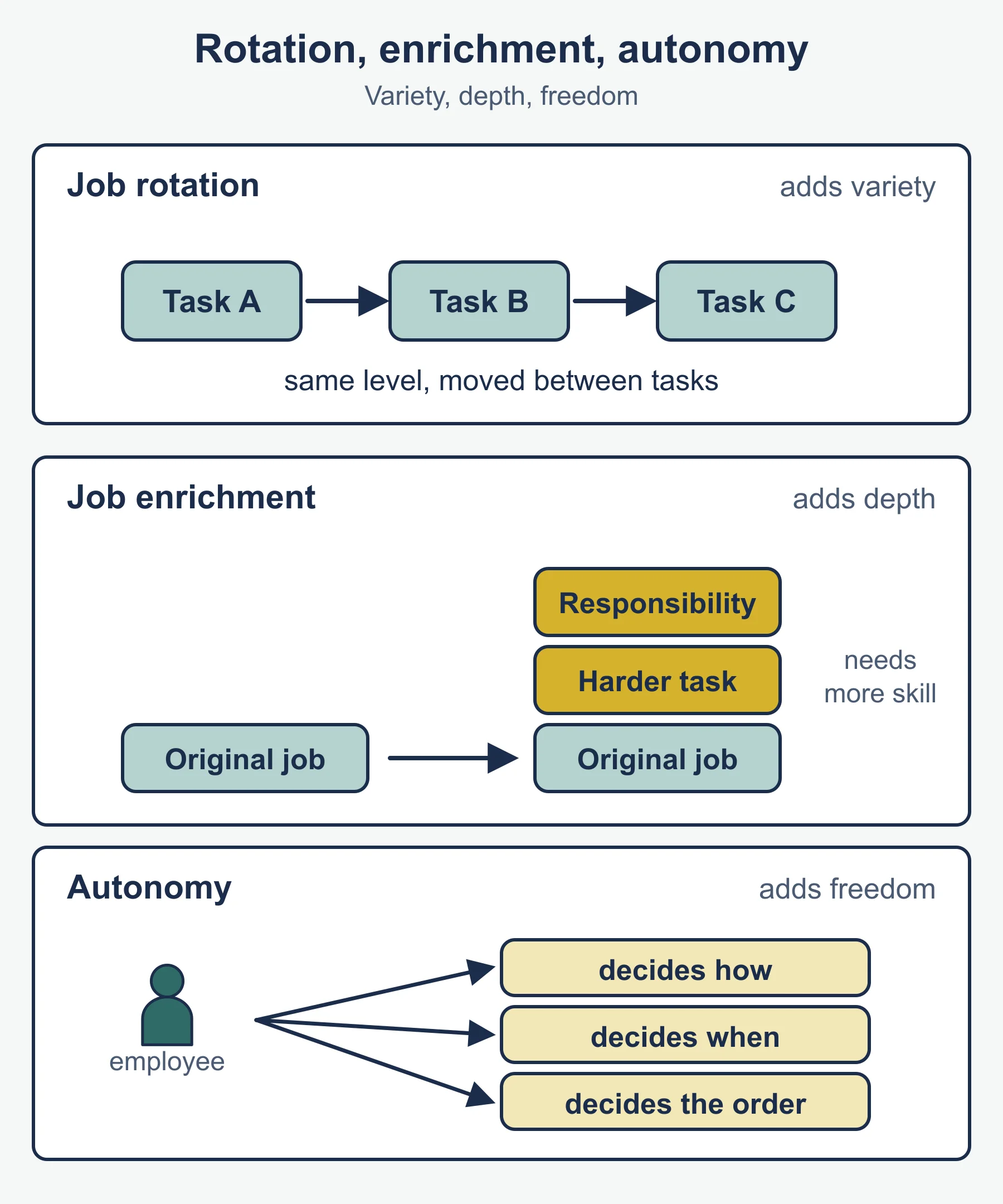
| Job rotation | Moving employees between tasks at the same level | Reduces boredom; builds a flexible team that can cover absence | Does not make the tasks themselves more demanding; training cost |
| Job enrichment | Adding more interesting, demanding tasks and responsibility to a job, so it needs more skill | Meets higher needs (esteem, self-actualisation); links to Herzberg’s motivators | Needs training and may need higher pay; some staff prefer simple jobs |
| Autonomy | Freedom to decide how, when or in what order to do the work | Shows trust; employees feel ownership | Mistakes are possible; needs capable staff; managers may feel they have lost control |
Notice the difference: job rotation adds variety, job enrichment adds depth, autonomy adds freedom.
Common errors
- Writing “motivation is pay”. Pay is only one method and, in Herzberg’s terms, a hygiene factor.
- Mixing up job rotation (moves between tasks) and job enrichment (makes the job bigger and harder).
- Calling a bonus and commission the same thing. Commission is tied to sales made; a bonus is tied to a target.
- Listing training benefits with no link to the business in the question.
- Forgetting that training for compliance protects the business as well as staff.
Next steps
Condense the key points with the revision notes, then try the practice questions. Return to the 4BS1 Business hub or the checklist, and find weak spots with the free diagnostics.
Frequently asked questions
What is Maslow’s hierarchy of needs? Maslow said people’s needs form a hierarchy from physiological needs, through safety, social and esteem needs, to self-actualisation, and people move up only when the lower need is reasonably met.
What did Taylor say about motivation? Taylor’s scientific management holds that workers are motivated mainly by money, so managers should break tasks into simple steps, train workers in the most efficient way and pay for output, for example with a piece rate.
Why does motivation matter to a business? The 4BS1 specification gives three reasons: attracting employees, retaining employees and productivity. Motivated staff are less likely to leave, which cuts recruitment and training costs.
Why is health and safety training important? It helps a business comply with the health and safety laws of the country it operates in. Failure to comply can lead to injured workers, fines, legal action and damage to reputation.
Official syllabus
Pearson Edexcel International GCSE in Business (4BS1), Specification, Issue 2, February 2026, published by Pearson Education Limited. Topic 2: People in business, sections 2.3 Training and 2.4 Motivation and rewards, points 2.3.1, 2.4.1 and 2.4.2.
Get free revision emails (optional)
Occasional emails with practice questions, worked explanations and links to free resources for the qualification and subjects you choose. No spam, and you can unsubscribe from any email. The free tools on this site never need an email.
Related resources
-
Practice questions
Edexcel IGCSE Business: Training, motivation and rewards (4BS1) – Practice Questions
Original practice questions with worked answers on training, Herzberg, Maslow, Taylor and pay and non-financial rewards for Edexcel IGCSE Business.
Business · Pearson Edexcel · IGCSE
Try questions -
Revision notes
Edexcel IGCSE Business: Training, motivation and rewards (4BS1) – Revision Notes
Condensed Edexcel IGCSE Business revision notes on training, Herzberg, Maslow, Taylor, financial and non-financial rewards, with a self-test.
Business · Pearson Edexcel · IGCSE
Revise topic -
Study guides
Edexcel IGCSE Business: Communication, recruitment and selection (4BS1)
Study guide to communication, barriers, types of employment, recruitment, shortlisting, interviews and employment law for Edexcel IGCSE Business 4BS1.
Business · Pearson Edexcel · IGCSE
Read guide
Related articles
-
teaching
A Level tuition in Dubai: Cambridge or Pearson Edexcel International A Level?
Schools in Dubai and Abu Dhabi teach either Cambridge International AS & A Level or Pearson Edexcel International A Level. How the two are structured, why it matters for tuition, and how online classes from Lahore work.
9 October 2026
-
curriculum guides
Choosing subjects at IGCSE and A Level
How subject choices at 14 and 16 affect university options later, and how to keep pathways open without overloading a timetable.
28 July 2026
Studying this with a teacher
Working through Business IGCSE?
This page is free and stays free. If you would rather be taught it, Marlbridge runs Business classes one-to-one and in small groups of up to 15, online in your own time zone. The first trial class is free. WhatsApp replies within an hour (8am–11pm Pakistan time, every day); email the same day.
Pearson Edexcel Business teachers at Marlbridge

