
Revision Notes
Edexcel IGCSE Business: Communication, recruitment and selection (4BS1) – Revision Notes
Condensed Edexcel IGCSE Business revision notes on communication methods, barriers, employment types, recruitment documents and law, with a self-test.
- Subject
- Business
- Level
- IGCSE
- Topic
- People in business
- Author
- Marlbridge Academic Team
- Updated
- Reviewed by
- Asif Iqbal (what this means)
Aligned to Pearson Edexcel IGCSE Business (4BS1), Issue 2, February 2026. Official specification .
Syllabus page (what it covers and how it is assessed): Pearson Edexcel IGCSE Business.
Syllabus points this page covers
4BS1
- 2 People in business (whole topic)
- 2.1 Internal and external communication
- 2.2 Recruitment and selection process
Found an error? Report a correction.
Want a teacher for this? Marlbridge teaches Business online. Request a free trial class.
Quick recall for the Pearson Edexcel International GCSE in Business (4BS1) specification, Issue 2, February 2026, Topic 2 “People in business”, sections 2.1 and 2.2. Full explanations and worked examples are in the study guide; questions to try are in the practice set. Course links: the 4BS1 Business hub, the printable checklist and the free diagnostics. The methods, barriers, document contents and legal effects below are standard teaching, not specification wording; the specification states only the numbered points. Papers 1 and 2 both draw on the whole content, so be ready to apply every point to a small business and a large one. Amounts below are invented and in dollars.
1. Communication: why it matters (2.1.1)
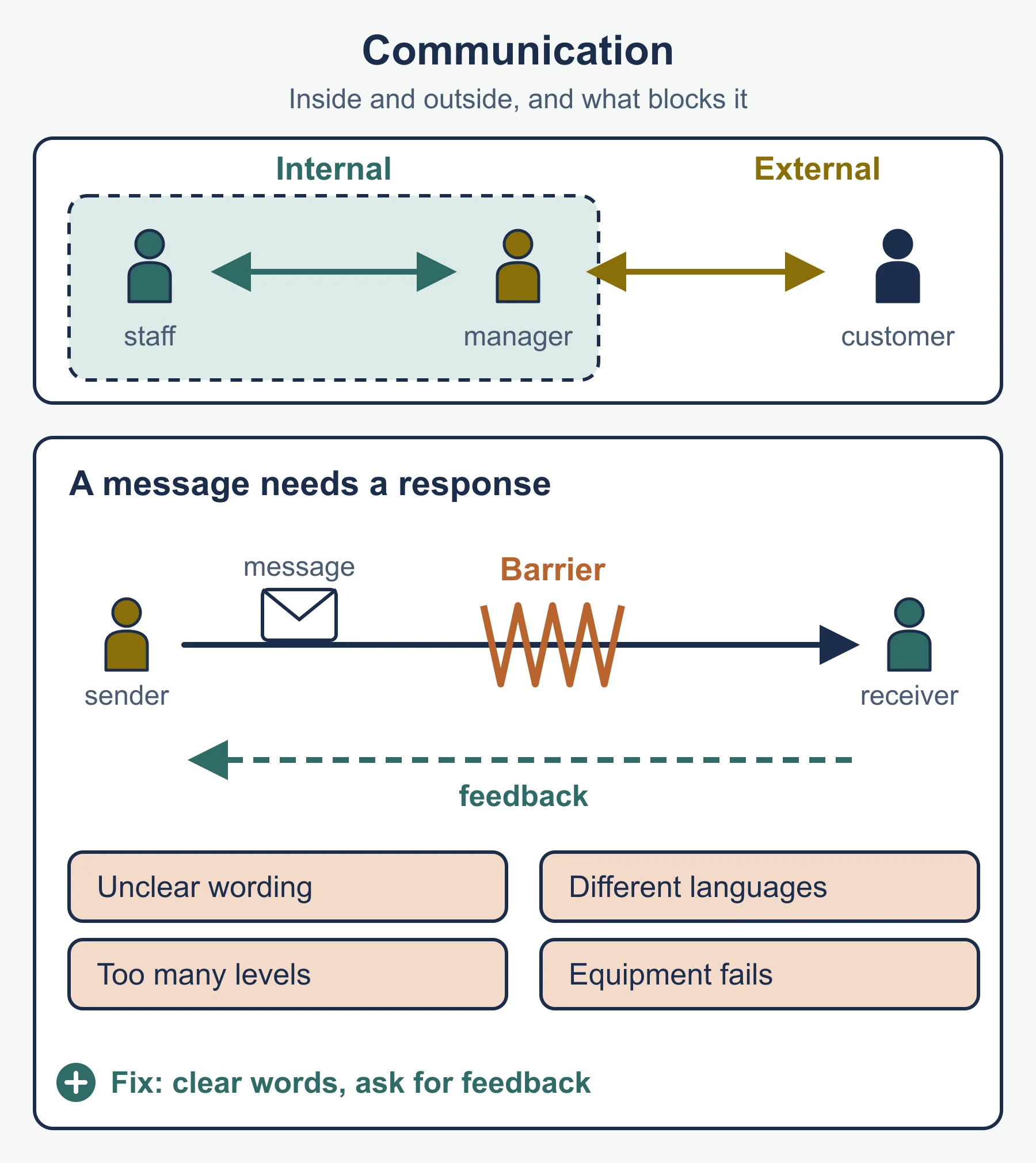
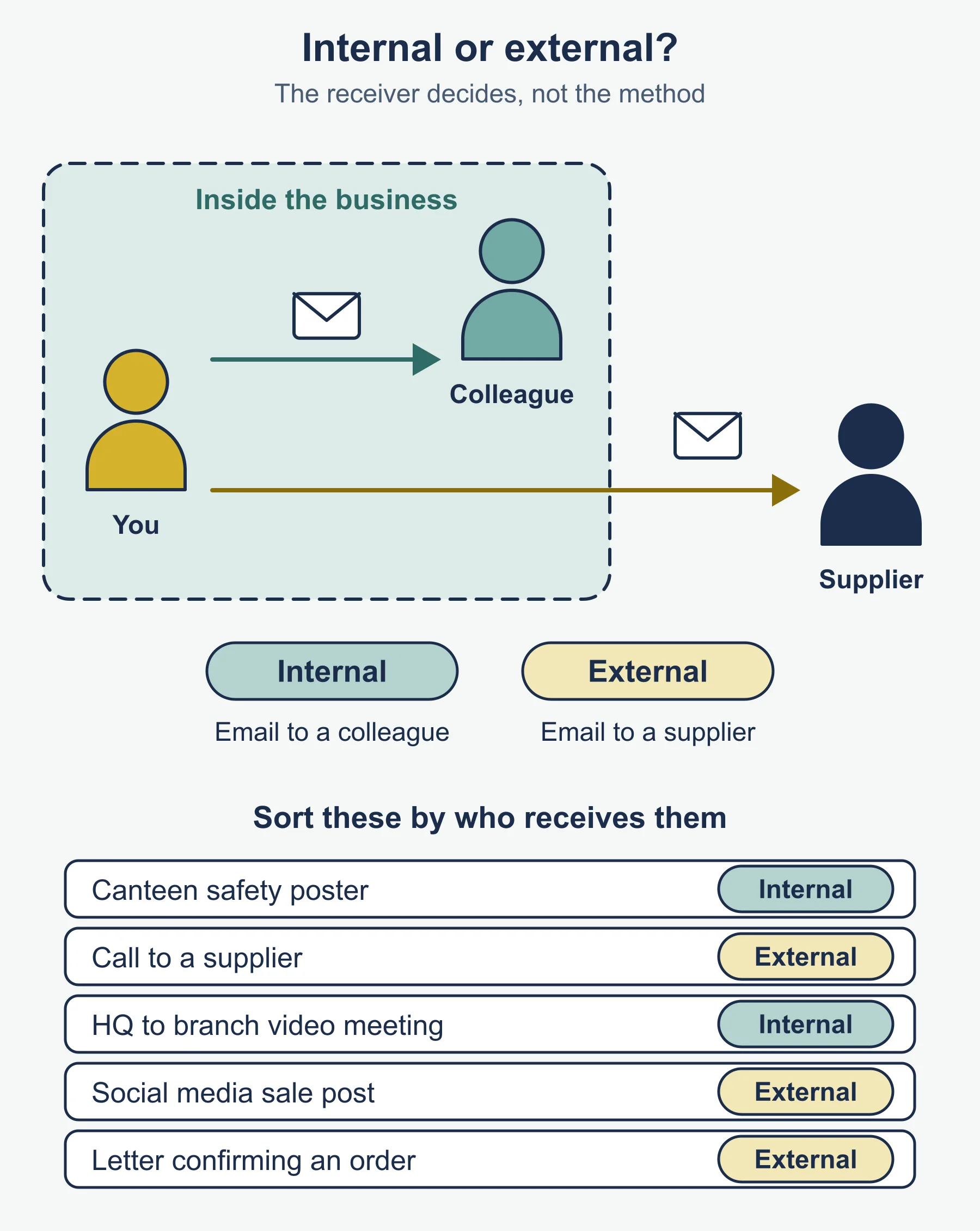
- Communication is the passing of information from sender to receiver so that it is understood. Internal links staff and managers; external links the business to customers, suppliers and others.
- Good communication: fewer errors, better decisions, clear instructions, higher morale and employee satisfaction.
- Ineffective communication: wrong orders, missed deadlines, rumours, complaints, lost sales, staff who feel ignored.
- Always finish the chain: poor communication leads to a result, and the result costs money, time or reputation.
2. Methods, benefits and limitations (2.1.1)
| Method | Key benefit | Key limitation |
|---|---|---|
| Face-to-face / meeting | Instant feedback, tone | Slow, no record without minutes |
| Telephone | Fast, personal | No record, no visual cues |
| Letter | Formal, permanent | Slow, costs postage |
| Memo / notice board | Cheap, reaches many | May not be read |
| Report | Detailed, filed | Long, may not be read in full |
| Email (IT) | Fast, cheap, record | Overload, tone misread |
| Text / instant message (IT) | Very fast | Informal, little detail |
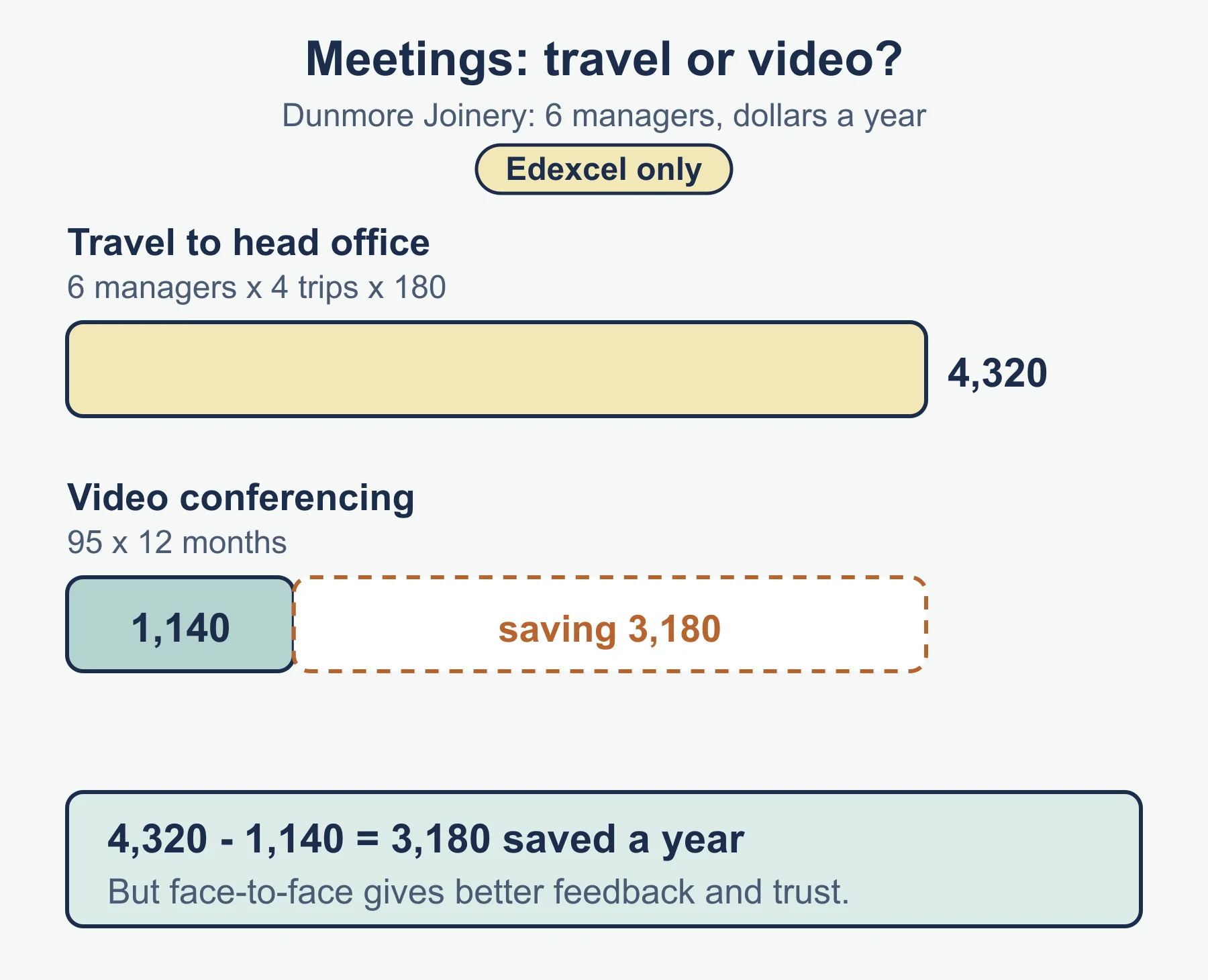
| Video conferencing (IT) | No travel | Equipment and connection needed |
| Intranet / website (IT) | One place, always available | Upkeep cost, can be out of date |
| Social media (IT) | Wide external reach | Public mistakes, monitoring |
Choosing a method. Ask five things: how urgent, how detailed, is a record needed, what does it cost, who has access to the technology.
Method in steps for a “which method” answer:
- Name the method suited to the message.
- Give one benefit linked to the case.
- Give one limitation or a better alternative.
- Make a judgement.
3. Barriers (2.1.2)
| Barrier | How it arises | Removal |
|---|---|---|
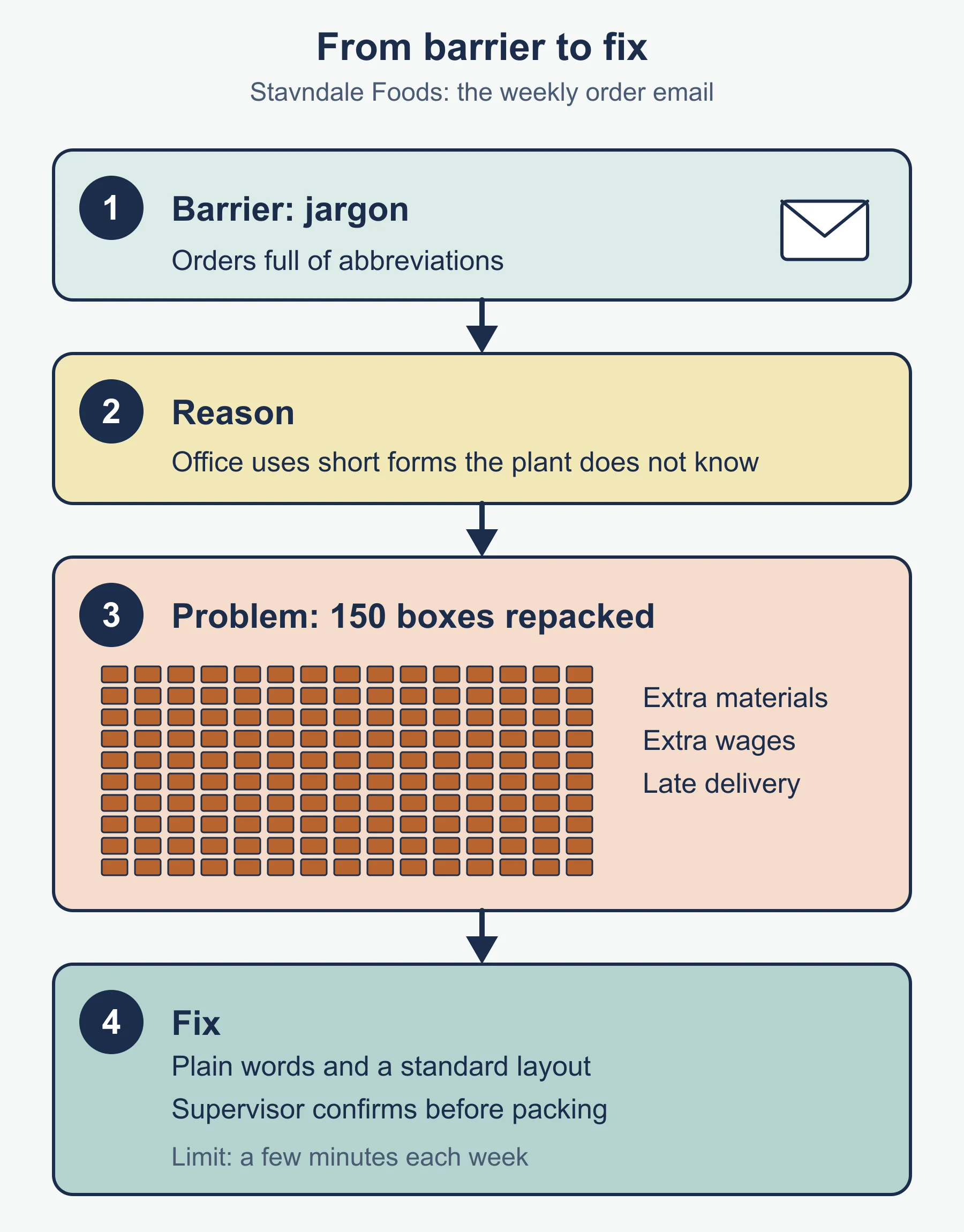
| Jargon | Technical words the receiver does not know | Plain language, explain terms |
| Language difference | Staff or customers use different languages | Translation, simple wording |
| Long chain of command | Message passes through many layers | Fewer layers, direct briefing |
| Overload | Too many messages or too much detail | Short messages, summaries |
| Technology failure | System down, no access | Back-up method, training |
| Poor listening or noise | Distraction, no attention | Quiet setting, note-taking |
Remedy to remember: feedback. Two-way communication (conversation, meeting) catches misunderstanding; one-way communication (notice, memo) does not.
4. Types of employment (2.2.1)
| Type | Meaning | One benefit | One limitation |
|---|---|---|---|
| Full-time | The standard full working week | Reliable and committed | Highest wage cost |
| Part-time | Fewer hours than full-time | Flexible, pay for hours needed | Less availability |
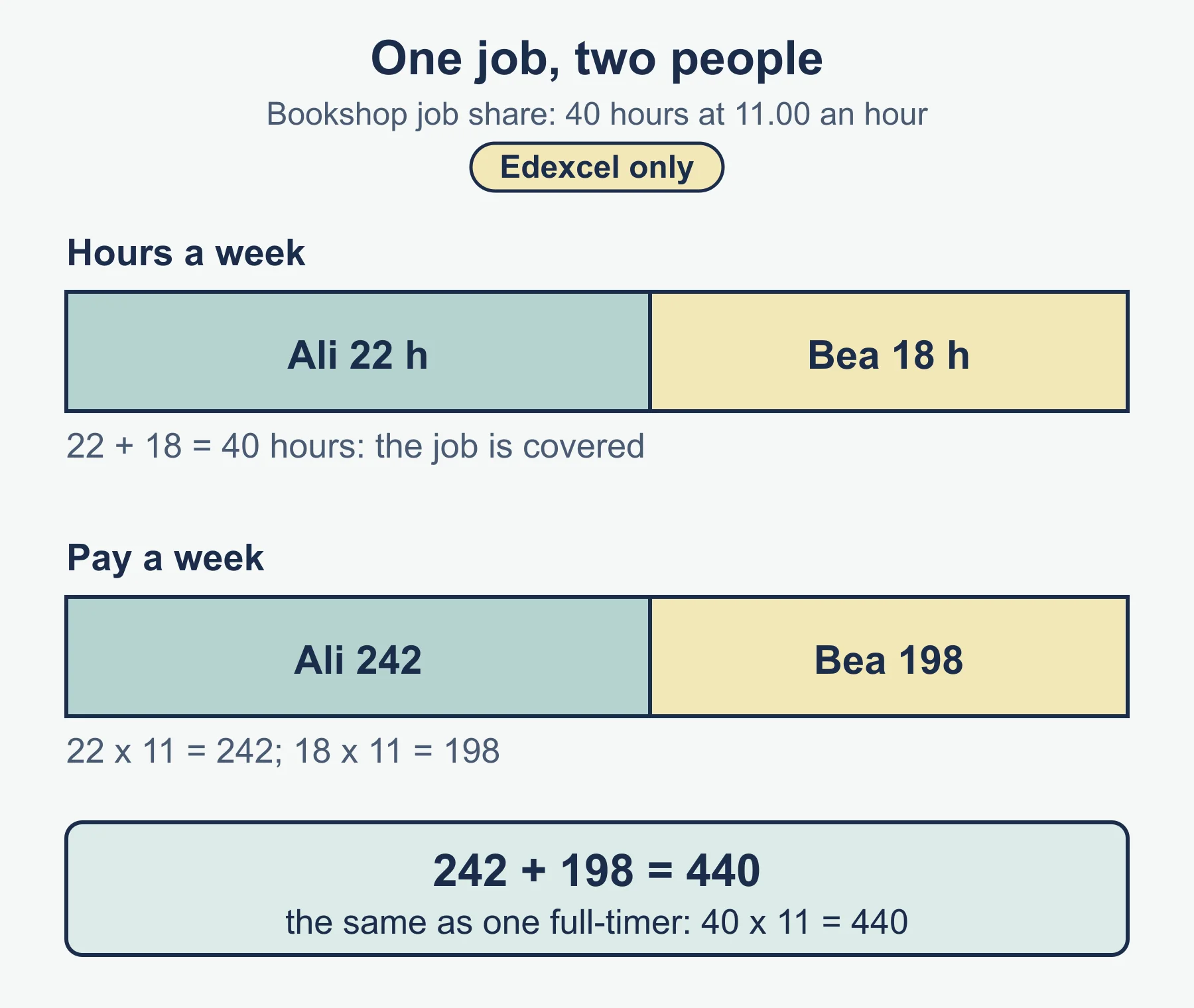
| Job share | One full-time job split between two people | Cover for absence, keeps skilled staff | Handover and extra admin |
| Casual / seasonal / temporary | Short period, peak season or set task | Cost only while needed | Low loyalty, repeated training |
Worked reminder. A part-time worker on 25 hours when the full-time week is 40 hours works 25 ÷ 40 = 62.5% of a full-time week. Pay at 11.00 an hour is 25 × 11.00 = 275 a week.
5. Recruitment documents (2.2.2)
| Document | Who writes it | One line to remember |
|---|---|---|
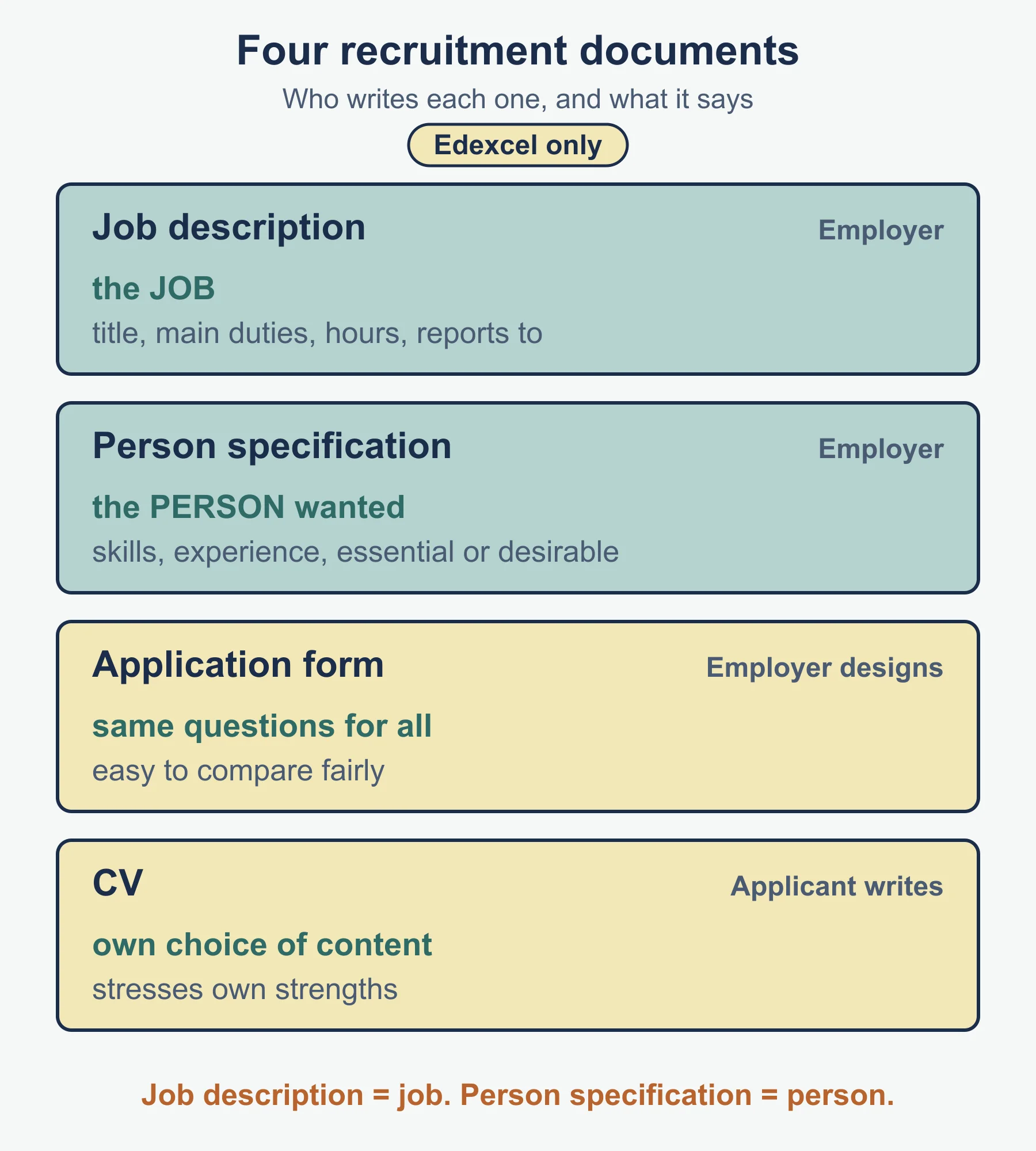
| Job description | Employer | What the job is: title, duties, hours, reporting line |
| Person specification | Employer | Who is wanted: skills, qualifications, experience, qualities |
| Application form | Applicant completes the employer’s form | Same questions for all, easy to compare |
| CV/résumé | Applicant | Applicant’s own summary of history and skills |


6. The recruitment process (2.2.3)
| Internal recruitment | External recruitment | |
|---|---|---|
| Source | Existing staff | Outside the business |
| Benefits | Cheaper, quicker, known person, motivates staff | Wider choice, new ideas and skills |
| Limitations | Few candidates, no fresh ideas, leaves a vacancy | Costly, slower, unknown person |
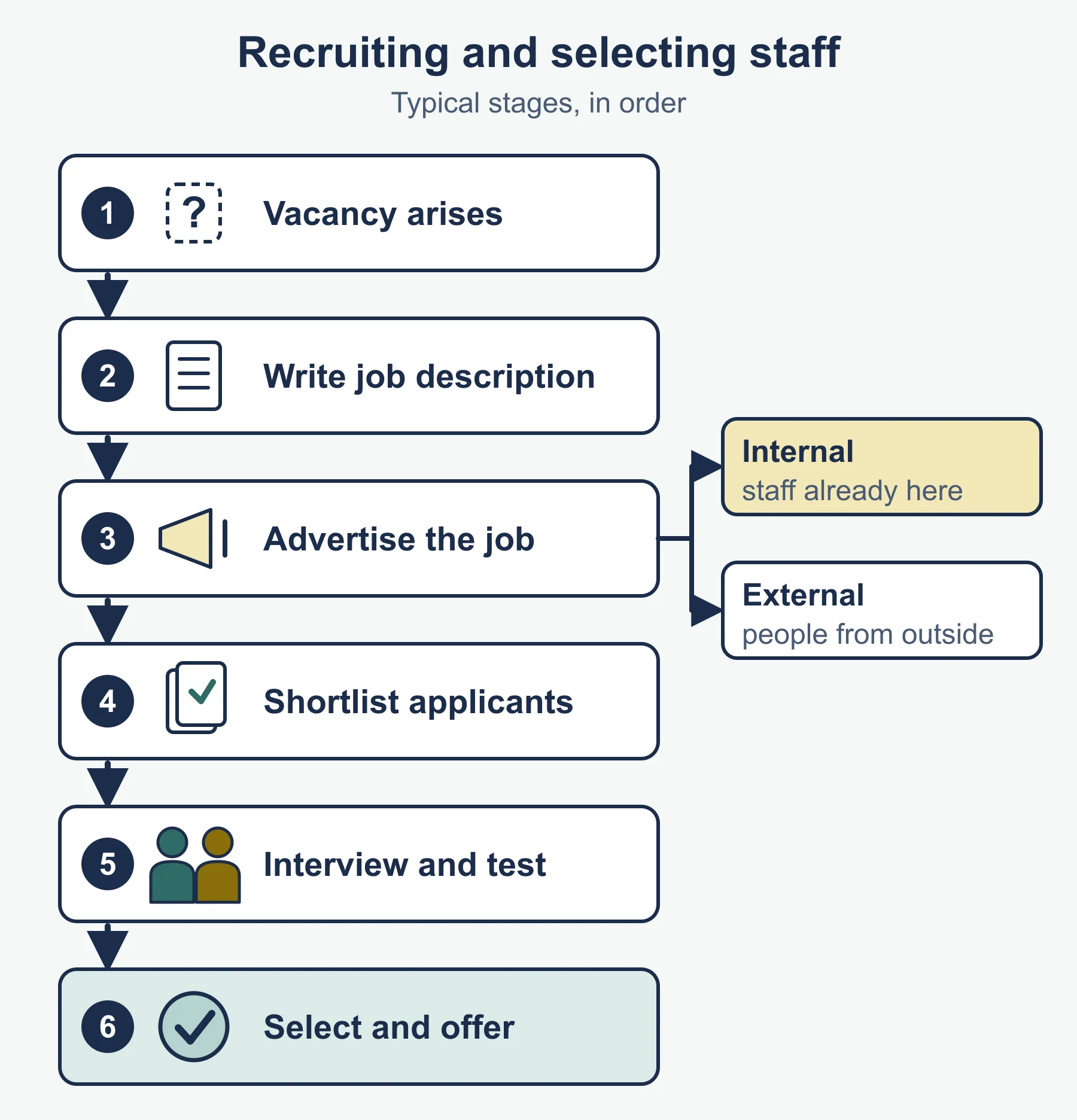
- Job advertisement: title, duties, pay, location, requirements, how to apply, closing date. Choose a place that reaches the right people.
- Shortlisting: compare applications with the person specification and keep the best few.
- Interviewing: same core questions for everyone, scored against the person specification. It tests claims and personality but takes time.
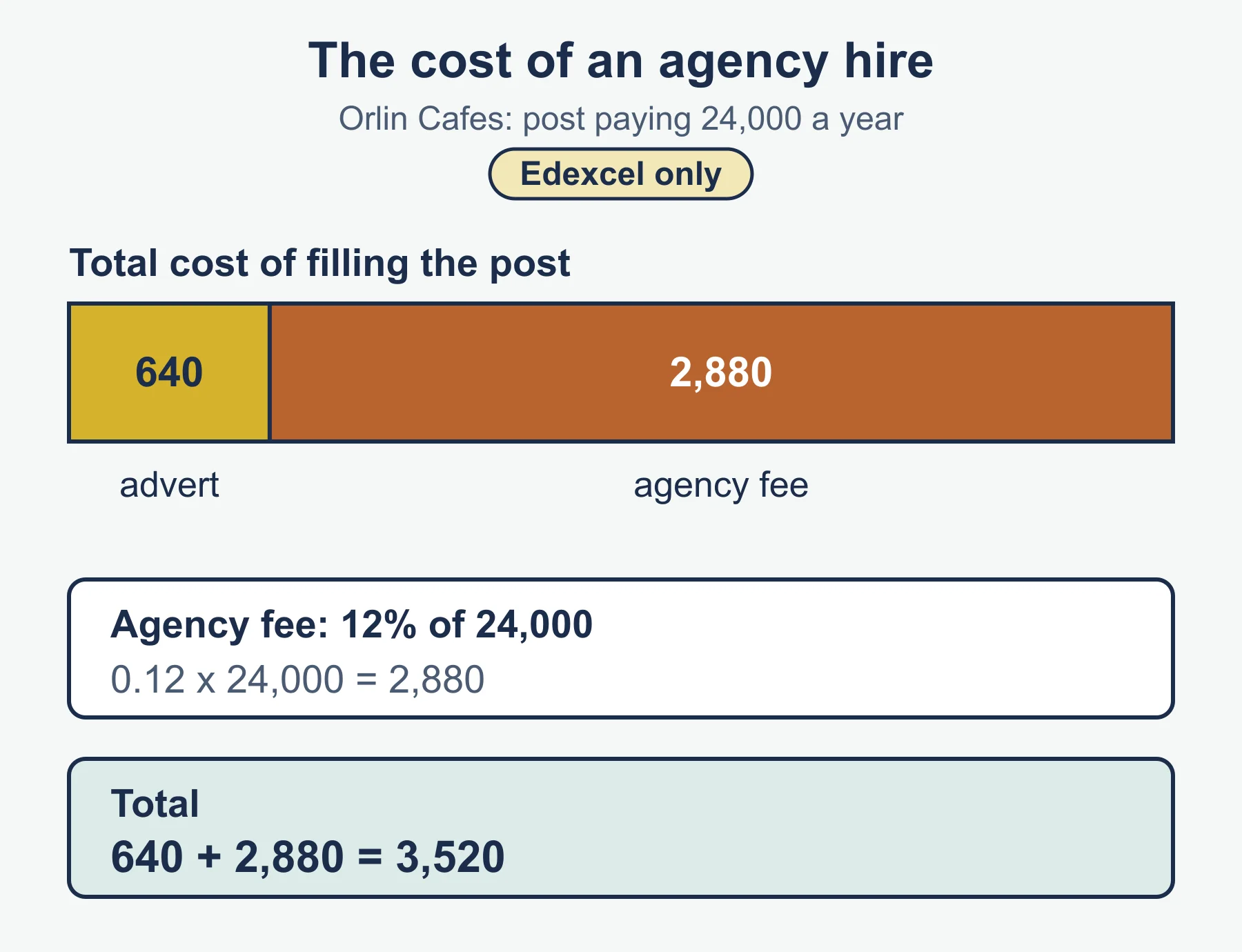
Worked reminder. An advertisement runs for 5 days at 85 a day, and a listing fee is 300. Cost: 5 × 85 = 425, plus 300 = 725.
7. Legal controls (2.2.4)
- Equal opportunities: no less favourable treatment because of gender, race, disability, religion, sexual preference or age. Applies to adverts, shortlisting, interviews, pay and promotion.
- Effects of equal opportunities: fair adverts and criteria, consistent interviews, records, possible adaptations for disabled staff, training; benefits are a wider talent pool and reputation; risks of breaking the law are legal action and bad publicity.
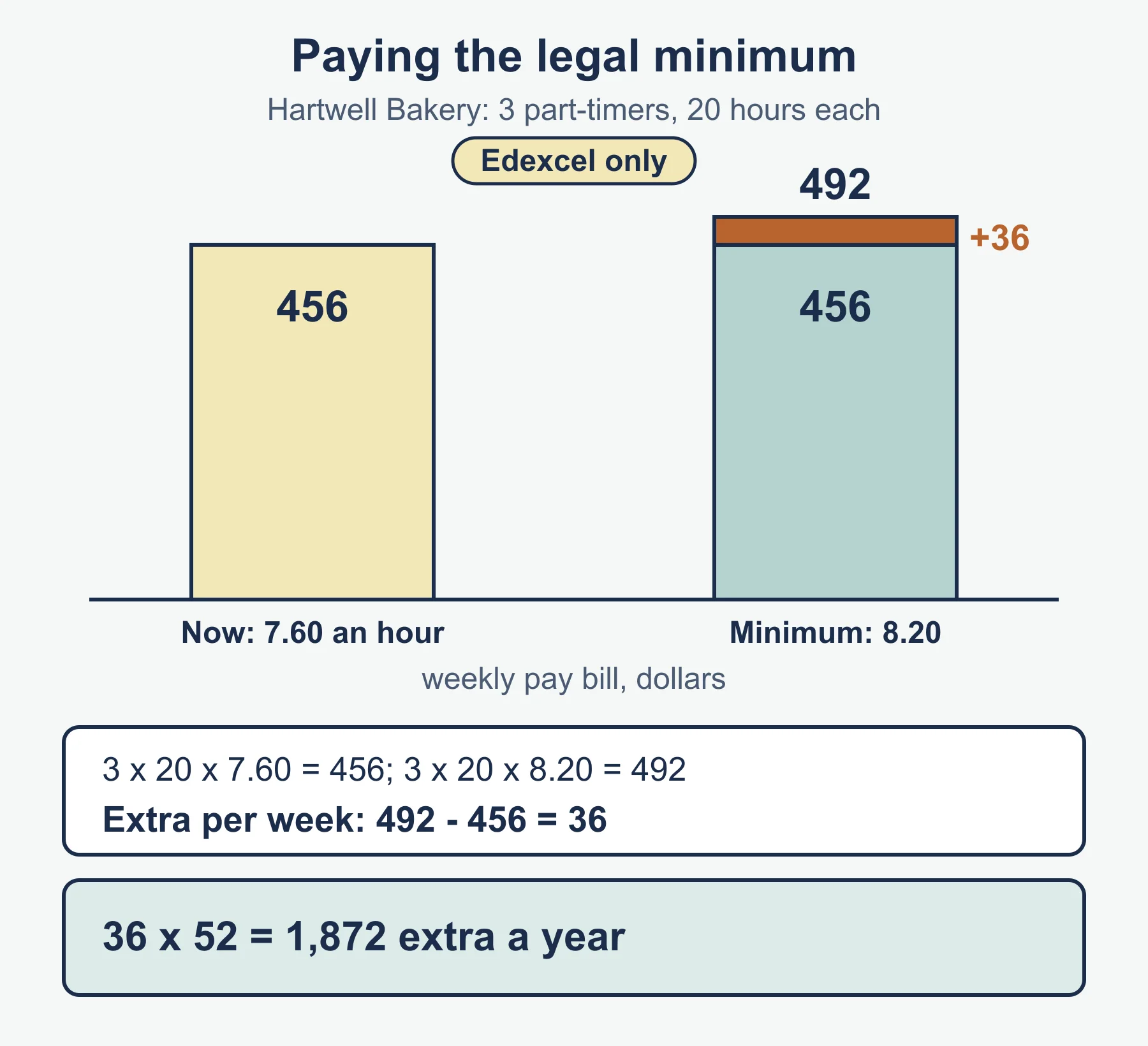
- Minimum wage laws: a legal lowest hourly pay. Effects: higher wage costs (especially for part-time and casual roles), possible price rises or lower profit, better pay and motivation for workers.
Worked reminder. Minimum hourly pay 8.50 (invented). A worker on 35 hours must earn at least 35 × 8.50 = 297.50 a week. A worker on 28 hours paid 7.40 is short by 1.10 an hour: 28 × 1.10 = 30.80 a week, or 1,601.60 over 52 weeks.
Command words with this topic
The specification defines the command words. Here is how each looks on people-in-business content.
| Command word | The specification’s meaning, shortened | Example on this topic |
|---|---|---|
| Outline | Two linked points about a concept or issue, placed in the question’s context | Outline one problem for Tolland Foods of using only notice boards |
| Explain | A statement of fact plus two expansion points, with no context | Explain one benefit of job share |
| Analyse | An extended answer expanding and exploring the issue, in context | Analyse how a language barrier could affect a call centre |
| Justify | Use the information given to recommend one of two options | Justify internal or external recruitment for a supervisor post |
| Evaluate | Use specification knowledge to reach a supported conclusion | Evaluate whether video conferencing suits a firm with three sites |
Chain for an “explain” answer: fact, then because, then so. For example: job share keeps skilled staff (fact), because two people can fit work around family time (because), so the business avoids recruiting and training replacements (so).
Chain for “justify” and “evaluate”: weigh both sides using figures or details in the case, then give a decision and the main reason it wins, with a risk or condition that could change it.
Must-know distinctions
- Job description (the job) versus person specification (the person).
- Internal recruitment (existing staff) versus external (outside).
- Job share (one job, two people) versus part-time (a separate smaller job).
- Barrier (what blocks a message) versus problem (what happens as a result) versus removal (the fix).
- Equal opportunities (who may be chosen and how) versus minimum wage (what must be paid).
Quick self-test
- State two benefits of email as a communication method.
- Give one limitation of using a notice board.
- Define a communication barrier.
- Explain how jargon can be removed as a barrier.
- State what a job share is.
- State which recruitment document lists the duties of a post.
- Give one benefit and one limitation of internal recruitment.
- State the order of the three stages: interviewing, job advertisement, shortlisting.
- Calculate the weekly minimum pay for 32 hours at a minimum of 8.50 an hour.
- Explain one effect of equal opportunities laws on how a firm writes an advertisement.
Answers
- Fast and cheap; leaves a written record (also attachments and many recipients).
- It may not be read, and there is no check that it was understood.
- Anything that stops a message being received and understood as the sender meant.
- Use plain language, explain technical terms and check understanding with feedback.
- One full-time job divided between two (or more) people.
- The job description.
- Benefit: cheaper and quicker. Limitation: a smaller choice of candidates and no new ideas.
- Job advertisement, then shortlisting, then interviewing.
- 32 × 8.50 = 272 a week.
- It must list the real requirements of the job and not prefer one gender, race, age or other group, so the firm reaches a wider pool and avoids legal action.
Where marks are usually lost
- Giving a method with no benefit and limitation that fit the situation.
- Listing barriers without saying how they arise or how to remove them.
- Swapping the job description and the person specification.
- Treating all part-time work as job share.
- Saying internal recruitment is always better, or external always dearer, with no reasoning.
- Describing equal opportunities in general without applying it to recruitment, selection or pay.
- Forgetting that minimum wage applies to part-time and casual workers too.
- Giving an “evaluate” or “justify” answer with no decision.
Frequently asked questions
What is the difference between a job description and a person specification? A job description sets out the job: its title, duties, hours and who it reports to. A person specification sets out the qualifications, skills, experience and qualities wanted in the person, often split into essential and desirable.
What is shortlisting? Shortlisting reduces all applications to the few that best match the person specification, by comparing each application form or CV with the essential criteria.
What are the types of employment in Edexcel IGCSE Business? The 4BS1 specification lists full-time, part-time, job share, and casual, seasonal or temporary employment.
How can barriers to communication be removed? Use plain language, simple wording or translations, fewer layers in the hierarchy, short clear messages and reliable back-up systems. Asking the receiver for feedback is the main remedy.
Official syllabus
Pearson Edexcel International GCSE in Business (4BS1), Specification, Issue 2, February 2026, published by Pearson Education Limited. Topic 2: People in business, sections 2.1 (points 2.1.1 and 2.1.2) and 2.2 (points 2.2.1 to 2.2.4).
Get free revision emails (optional)
Occasional emails with practice questions, worked explanations and links to free resources for the qualification and subjects you choose. No spam, and you can unsubscribe from any email. The free tools on this site never need an email.
Related resources
-
Study guides
Edexcel IGCSE Business: Organisation structure and employees (4BS1)
Study guide to organisation charts, span of control, delegation and the four functional areas for Edexcel IGCSE Business 4BS1, section 2.5.
Business · Pearson Edexcel · IGCSE
Read guide -
Practice questions
Edexcel IGCSE Business: Organisation structure and employees (4BS1) – Practice Questions
Original questions with worked answers on structures, delegation and functional areas for Edexcel IGCSE Business 4BS1, section 2.5.
Business · Pearson Edexcel · IGCSE
Try questions -
Revision notes
Edexcel IGCSE Business: Organisation structure and employees (4BS1) – Revision Notes
Condensed revision notes on structures, span of control, delegation and functional areas for Edexcel IGCSE Business 4BS1, section 2.5.
Business · Pearson Edexcel · IGCSE
Revise topic
Related articles
-
teaching
A Level tuition in Dubai: Cambridge or Pearson Edexcel International A Level?
Schools in Dubai and Abu Dhabi teach either Cambridge International AS & A Level or Pearson Edexcel International A Level. How the two are structured, why it matters for tuition, and how online classes from Lahore work.
9 October 2026
-
curriculum guides
Choosing subjects at IGCSE and A Level
How subject choices at 14 and 16 affect university options later, and how to keep pathways open without overloading a timetable.
28 July 2026
Studying this with a teacher
Working through Business IGCSE?
This page is free and stays free. If you would rather be taught it, Marlbridge runs Business classes one-to-one and in small groups of up to 15, online in your own time zone. The first trial class is free. WhatsApp replies within an hour (8am–11pm Pakistan time, every day); email the same day.
Pearson Edexcel Business teachers at Marlbridge

