
Study Guides
Pearson Edexcel IGCSE English Language (4EA1): Section A Non-fiction Texts
How to read, analyse and compare an anthology text and an unseen extract in 4EA1 Paper 1 Section A, with an annotated worked example on an original passage.
- Subject
- English
- Level
- IGCSE
- Topic
- Component 1 – Non-fiction Texts and Transactional Writing
- Author
- Marlbridge Academic Team
- Updated
- Reviewed by
- Ammar Bilal (what this means)
Aligned to Pearson Edexcel IGCSE English (4EA1), For first teaching 2016 (Issue 7, August 2025). Official specification .
Syllabus page (what it covers and how it is assessed): Pearson Edexcel IGCSE English Language.
Found an error? Report a correction.
Need help with this topic? Request a free trial class for IGCSE English Language (4EA1).
Section A of Component 1 is the reading half of Paper 1 in Pearson Edexcel International GCSE English Language A (4EA1). This guide goes deeper than the Component 1 overview: it takes each of the three reading skills in turn, shows what a mark-earning answer looks like, and works through an original passage written for this page.
What Section A covers
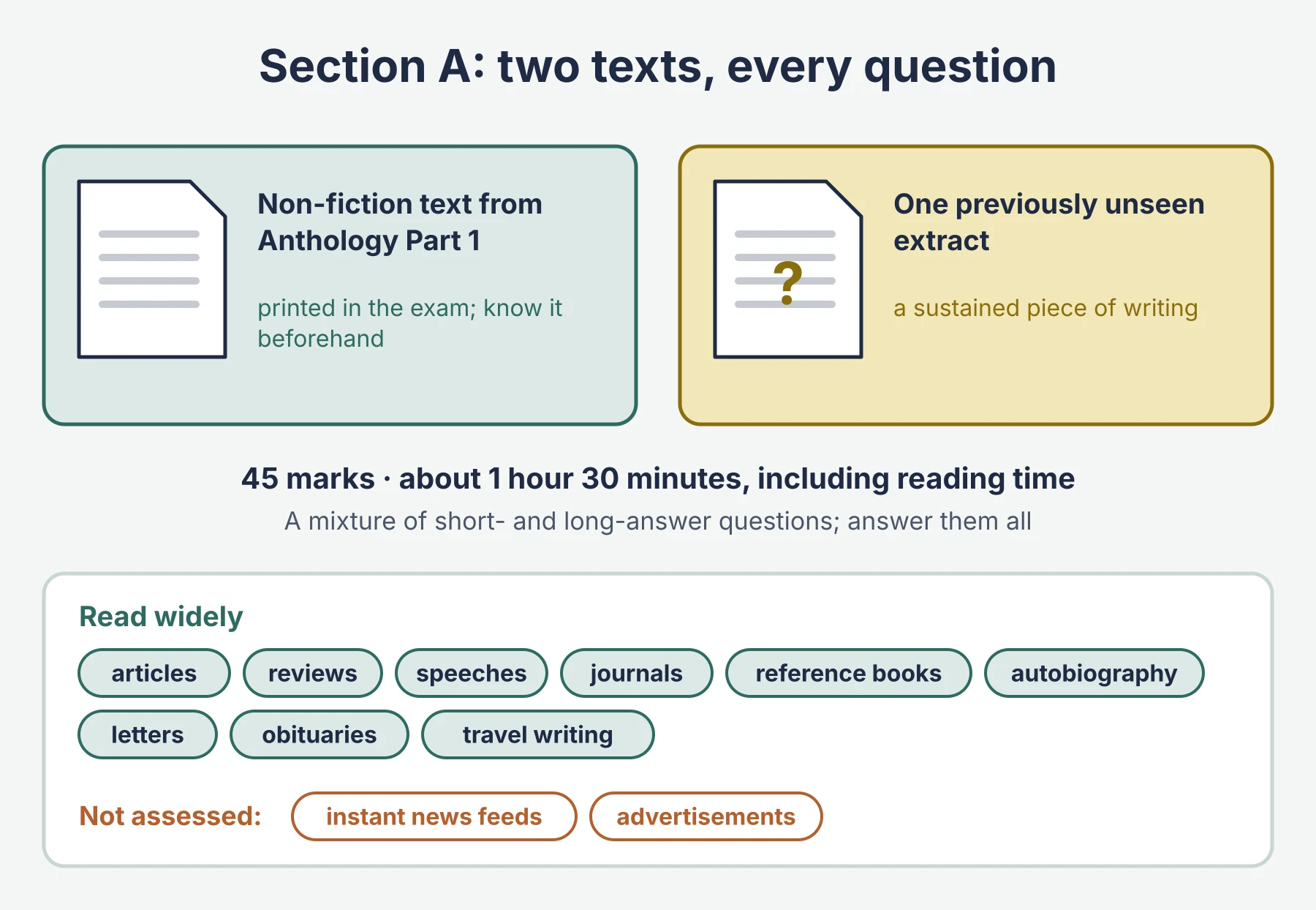
The specification sets a mixture of short- and long-answer questions on two texts: one non-fiction text from Part 1 of the Pearson Edexcel International GCSE English Anthology, printed in the exam, and one previously unseen extract. You answer every question. The section is worth 45 marks, and Pearson advises about 1 hour 30 minutes, including reading time.
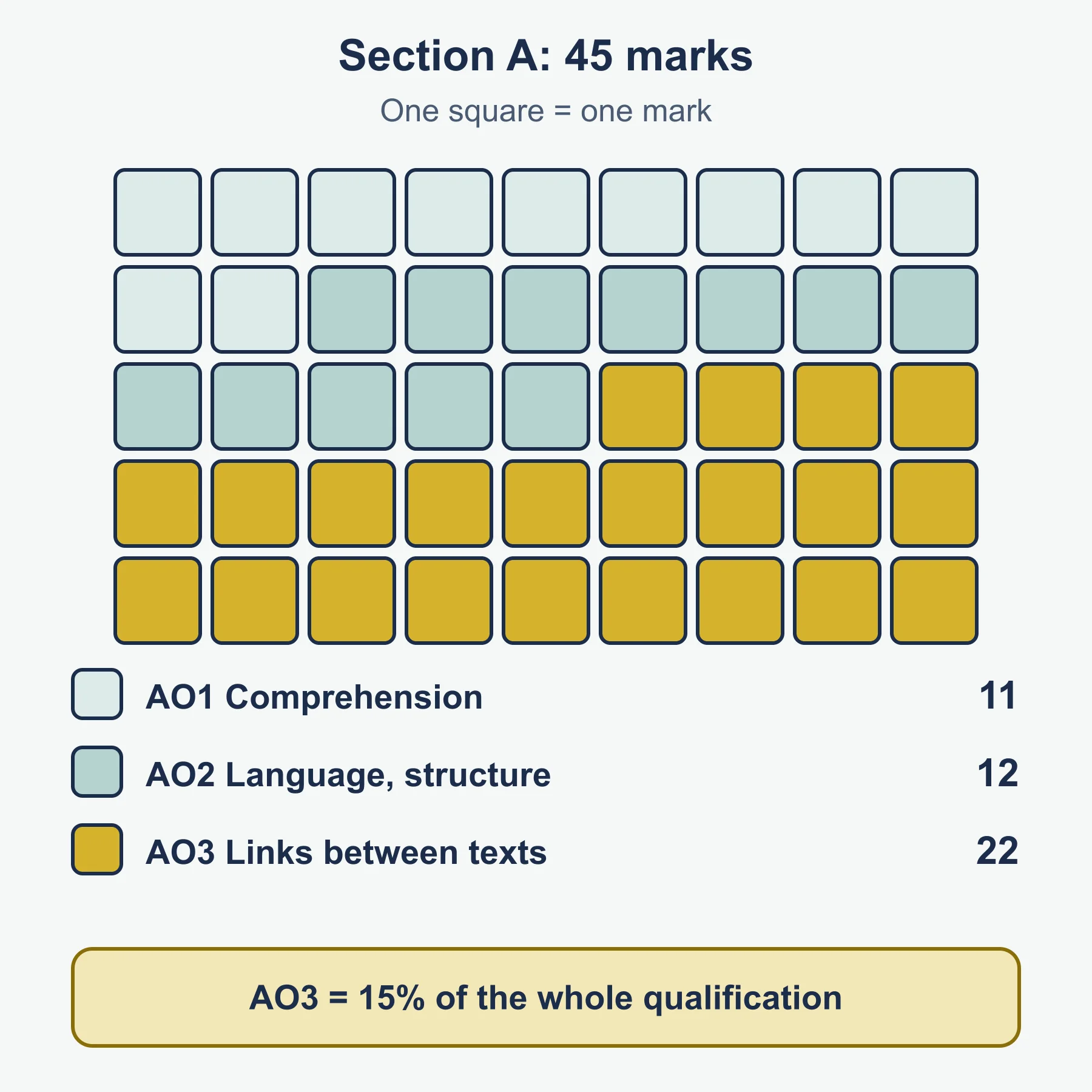
| Assessment objective | What it asks you to do | Marks in Section A |
|---|---|---|
| AO1 | Read and understand, selecting and interpreting information, ideas and perspectives | 11 |
| AO2 | Understand and analyse how writers use linguistic and structural devices to achieve their effects | 12 |
| AO3 | Explore links and connections between writers’ ideas and perspectives, as well as how these are conveyed | 22 |
The specification expects you to have read widely: journalism (such as articles and reviews), speeches, journals and reference-book extracts, and literary non-fiction such as autobiography, letters, obituaries and travel writing. It also states that transient texts such as instant news feeds and advertisements will not be assessed, so an unseen extract will be a sustained piece of writing.
Skill 1: AO1, selecting and interpreting
AO1 questions reward accurate selection. Some ask for information stated directly; others ask what you can infer about a person, place or attitude. The difference matters:
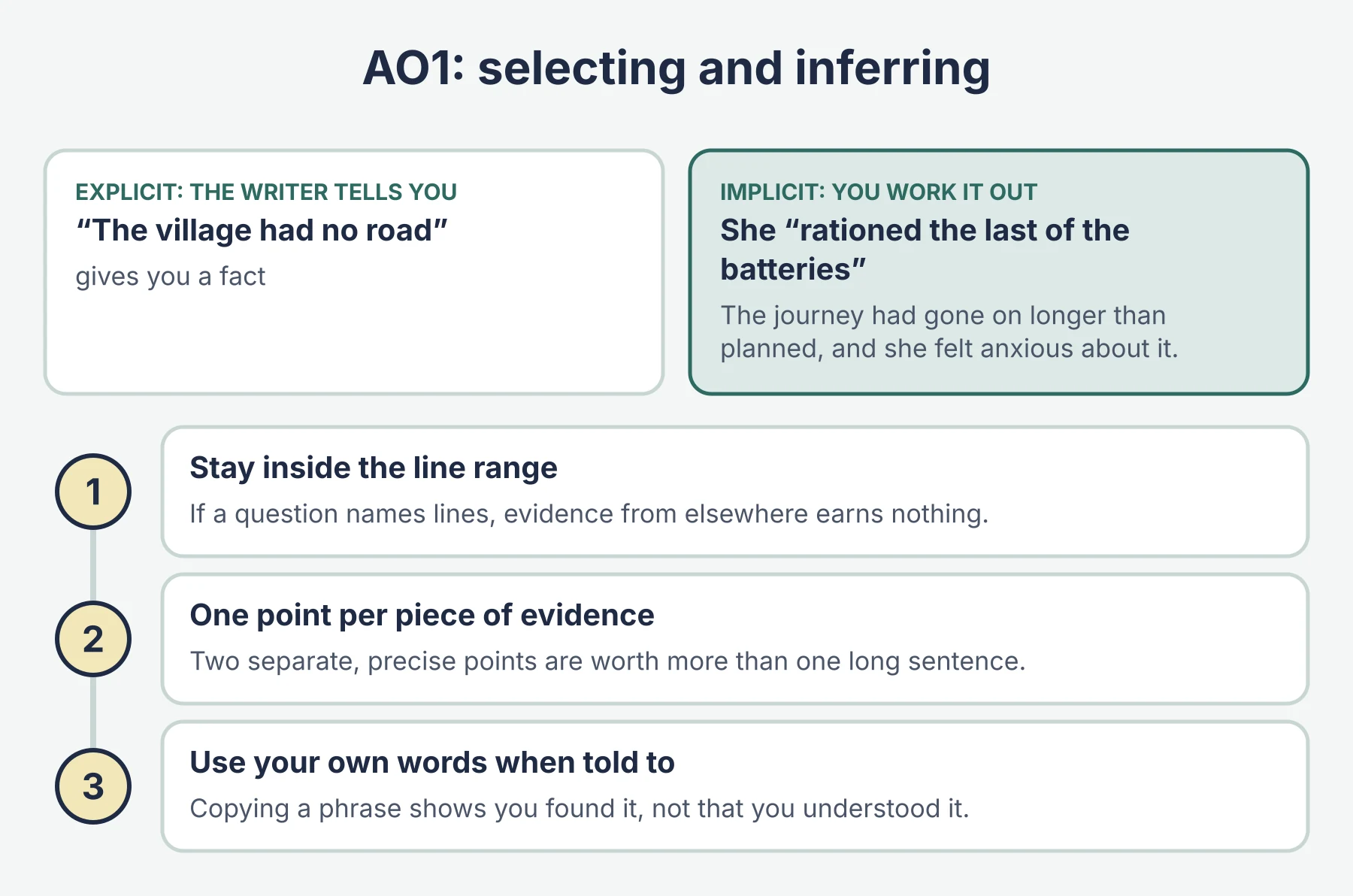
- Explicit: the writer tells you. “The village had no road” gives you a fact.
- Implicit: you work it out. If the writer says she “rationed the last of the batteries”, you can infer the journey had gone on longer than planned and that she felt anxious about it.
Three habits lift AO1 answers:
- Stay inside the line range. If a question names lines, evidence from elsewhere earns nothing.
- Make one point per piece of evidence. Short questions are usually marked point by point, so two separate, precise points are worth more than one long sentence.
- Use your own words when told to. Copying a phrase shows you found it, not that you understood it.
Skill 2: AO2, analysing language and structure
AO2 asks how the writer achieves an effect. Non-fiction writers use many of the same tools as fiction writers, plus some of their own.
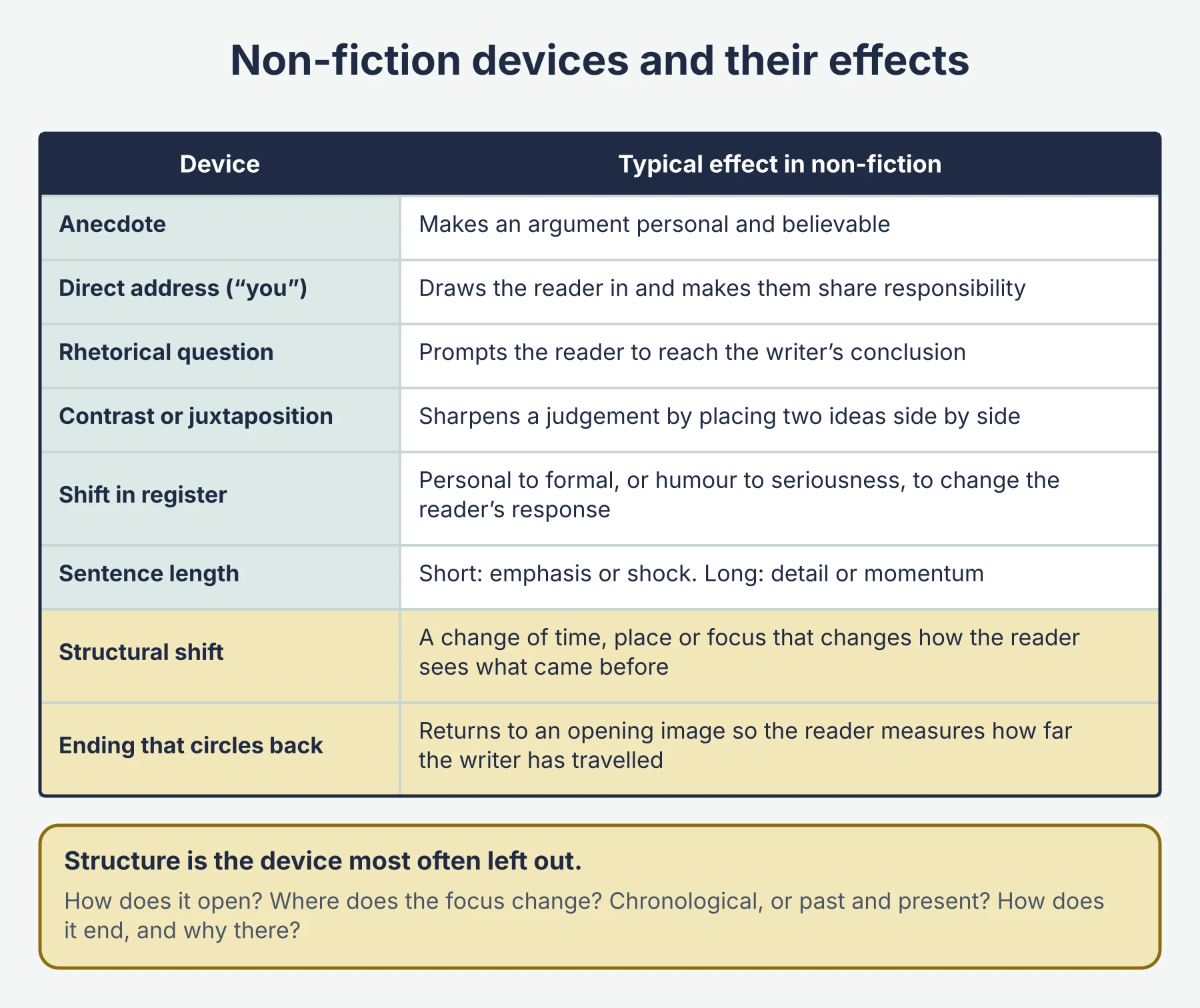
| Device | Typical effect in non-fiction |
|---|---|
| Anecdote | Makes an argument personal and believable |
| Direct address (“you”) | Draws the reader in and makes them share responsibility |
| Rhetorical question | Prompts the reader to reach the writer’s conclusion |
| Contrast or juxtaposition | Sharpens a judgement by placing two ideas side by side |
| Shift in register | Moves from personal to formal, or from humour to seriousness, to change the reader’s response |
| Sentence length | Short sentences create emphasis or shock; long ones build detail or momentum |
| Structural shift | A change of time, place or focus that changes how the reader sees what came before |
| Ending that circles back | Returns to an opening image so the reader measures how far the writer has travelled |
Structure is the device candidates most often leave out. Ask: How does the text open? Where does the focus change? Is it chronological, or does it move between past and present? How does it end, and why there? A single sentence on the effect of the ending is AO2 analysis; a sentence saying “the text has paragraphs” is not.
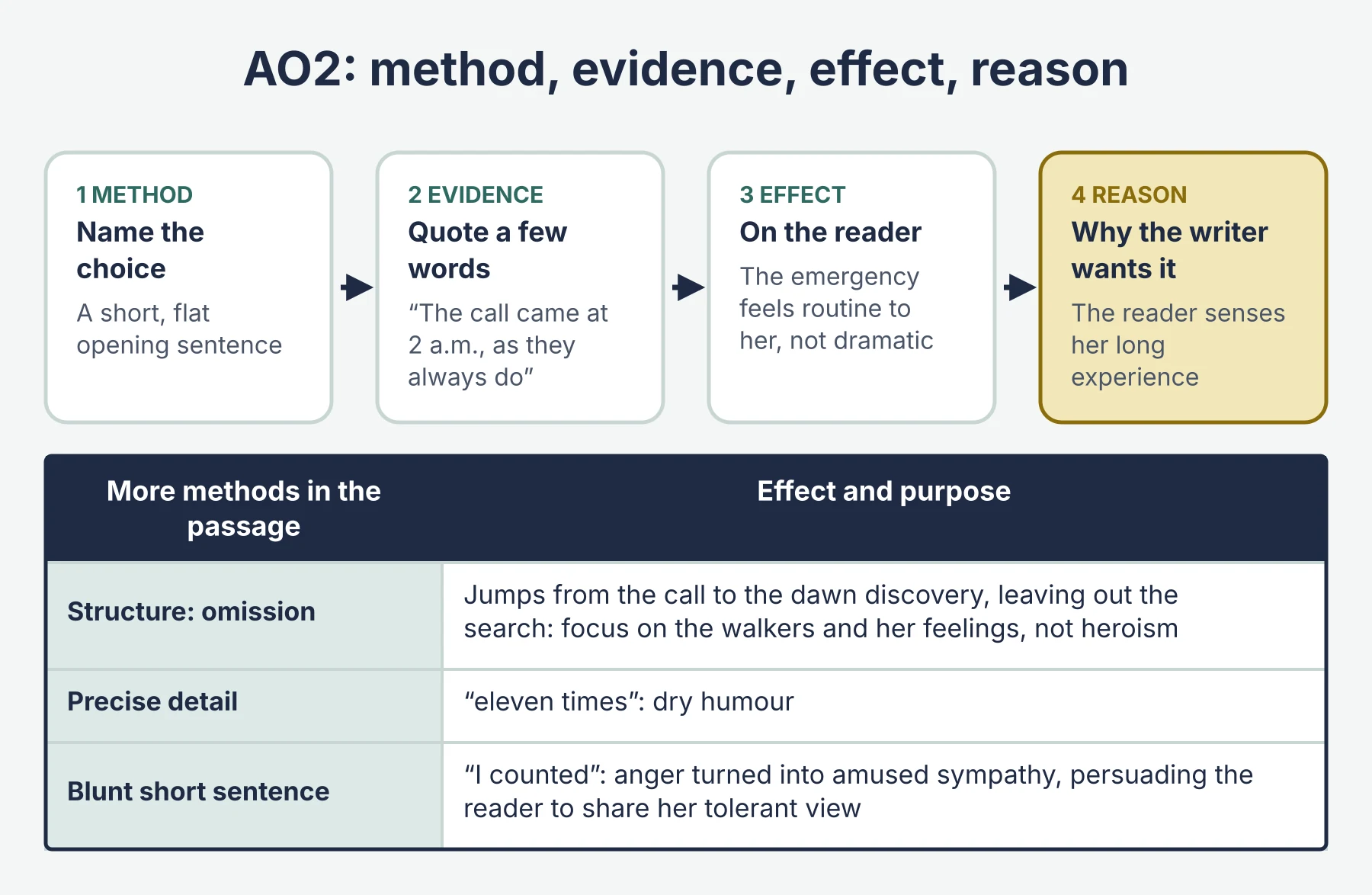
The mark-earning pattern is method, evidence, effect, and the reason behind the effect: name the choice, quote a few words, explain the effect on the reader, then explain why the writer wants that effect for their purpose.
Skill 3: AO3, comparing ideas and perspectives
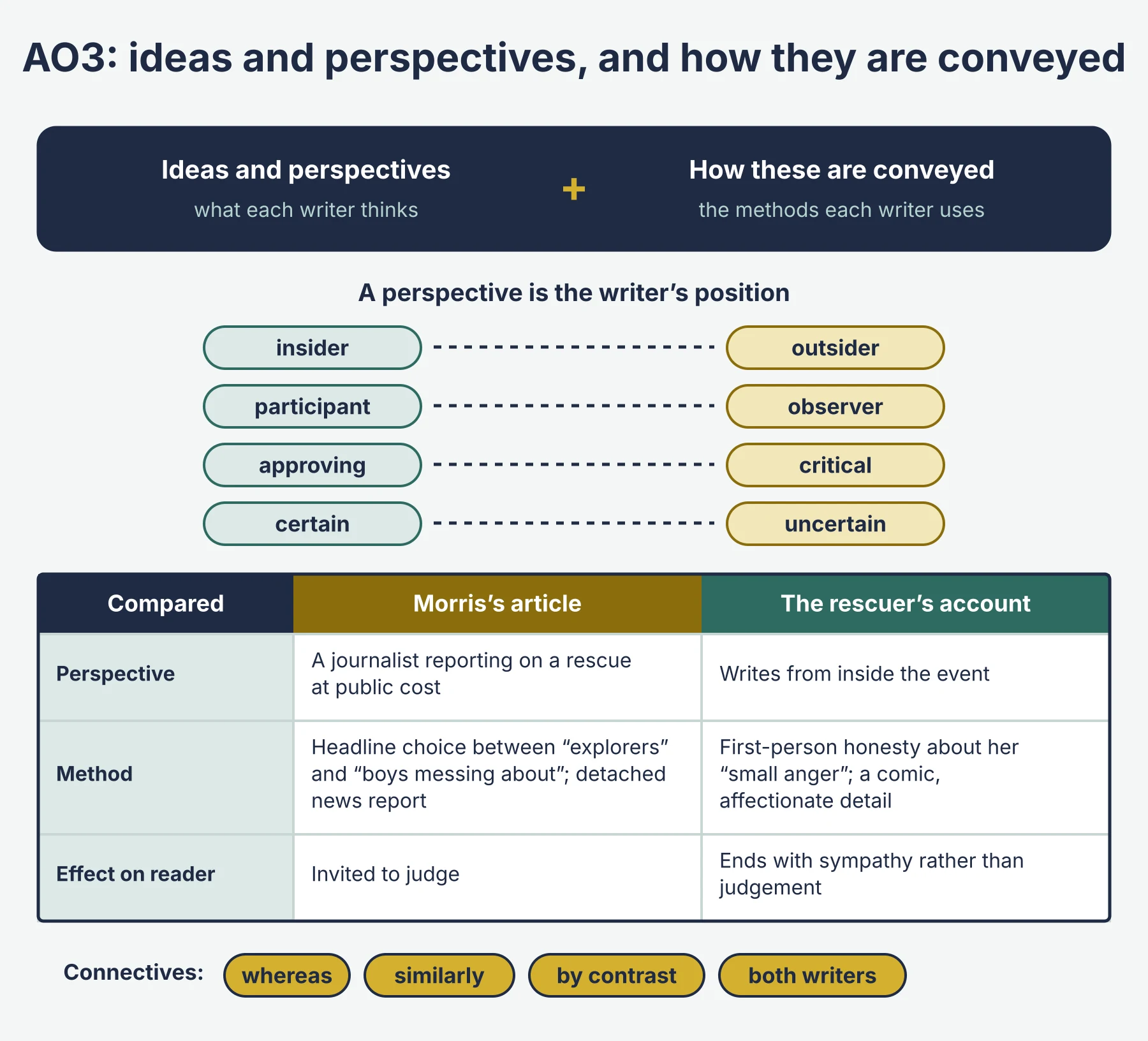
The comparison question carries 22 marks, almost half the section. The AO3 wording has two halves: links between ideas and perspectives, as well as how these are conveyed. A comparison of content alone covers the first half only.
A perspective is the writer’s position: insider or outsider, participant or observer, approving or critical, certain or uncertain. Two writers can describe the same kind of event from very different perspectives. For example, Kari Herbert’s The Explorer’s Daughter presents a hunt with a mixed, uneasy viewpoint, while Steven Morris’s newspaper article, whose headline asks whether adventurers are explorers or “boys messing about”, takes a sceptical public view of risk-taking.
Build each comparative paragraph around one shared idea, then show how the two writers differ in perspective and method. Connectives such as whereas, similarly, by contrast and both writers make the comparison visible in every paragraph, not only at the end.
Worked example on an original unseen extract
The original passage below was written for this page.
The call came at 2 a.m., as they always do. Two walkers, no torch, somewhere above the second waterfall. I have done this for nineteen years and I still feel the same small anger as I lace my boots: anger at them, then at myself for the anger. Nobody plans to be lost. We found them at dawn, sitting on a rock, sharing one chocolate bar with great ceremony. The younger one apologised eleven times. I counted.
AO1 short answer. What can you infer about the narrator’s attitude to the walkers?
She is irritated at first (“small anger”), but she is also fair-minded, because she criticises her own reaction and accepts that “nobody plans to be lost”.
Two separate inferences, each supported. That is the pattern for short-answer marks.
AO2 paragraph. How does the writer use language and structure to present the rescue?
The writer opens with a short, flat sentence, “The call came at 2 a.m., as they always do”, so the emergency feels routine to the narrator rather than dramatic; the reader immediately senses her long experience. Structurally, the passage jumps from the call to the dawn discovery, leaving out the search, so the focus falls on the walkers and on the narrator’s feelings rather than on heroism. The final two sentences use dry humour: the precise detail “eleven times” and the blunt “I counted” show that her anger has turned into amused sympathy, which persuades the reader to share her tolerant view.
This names methods (sentence form, omission in the structure, humour, precise detail), quotes briefly, and links each effect to the writer’s purpose.
AO3 paragraph. Compare how the writers present people who need rescuing. (Pairing the original passage with Morris’s article.)
Both writers question whether people who need rescuing are to blame, but from different perspectives. Morris writes as a journalist reporting on a rescue at public cost, and his headline’s choice between “explorers” and “boys messing about” invites the reader to judge. The rescuer, by contrast, writes from inside the event; her first-person honesty about her “small anger” admits the same suspicion and then rejects it. Morris keeps the detached stance of a news report, whereas the rescuer closes the gap with a comic, affectionate detail, so the reader ends with sympathy rather than judgement.
Notice that the paragraph compares perspective (journalist and participant), method (headline and reporting against first-person anecdote) and effect on the reader.
Common mistakes
- Answering AO1 questions with evidence from outside the line range.
- Feature-spotting. “The writer uses a rhetorical question” earns little until you explain what the question makes the reader think and why.
- Ignoring structure in the AO2 answer, even though the objective names structural devices.
- Writing two separate essays in the comparison: one paragraph on Text 1, one on Text 2, and a sentence of comparison at the end.
- Comparing topics only. Saying both texts are about travel is a starting point, not a comparison of perspectives.
- Treating the anthology text as unseen. It is printed in the exam, but knowing it well beforehand saves reading time you need for the unseen extract.
Exam technique and command words
| Command | What to do |
|---|---|
| Identify / give | Select accurately from the stated lines; brief answers are fine |
| Describe / explain | Show understanding, often of an implicit idea, with a reason |
| Analyse how the writer uses language and structure | Method, evidence, effect and purpose; cover both language and structure |
| Compare how the writers present | Integrated points on ideas, perspectives and methods across both texts |
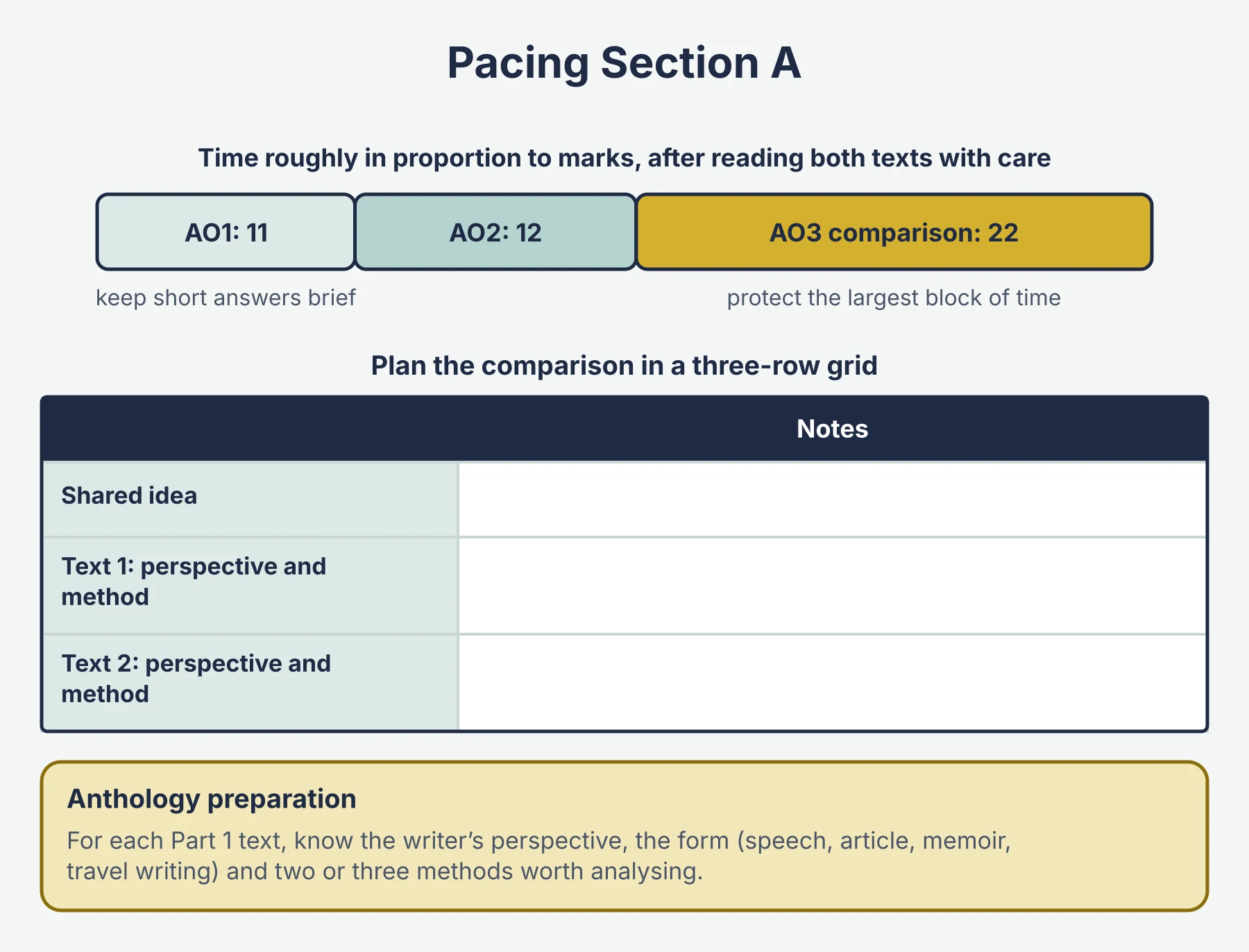
Pacing. Allocate time roughly in proportion to marks within your 90 minutes: read both texts with care first, keep the short AO1 answers brief, and protect the largest block of time for the 22-mark comparison. Plan the comparison with a quick three-row grid: shared idea, Text 1 perspective and method, Text 2 perspective and method.
Anthology preparation. For each of the ten Part 1 texts, know the writer’s perspective, the form (speech, article, memoir, travel writing) and two or three methods worth analysing. That preparation makes the comparison question faster, whichever unseen extract it is paired with. Anthology contents are fixed by specification issue, so check the current list with your teacher.
Where to go next
- Section A Non-fiction Texts revision notes condense these skills for final revision.
- Section A Non-fiction Texts practice questions give you original extracts with mark-scheme-style answers.
- Section B Transactional Writing study guide covers the writing half of the same paper.
Official specification
Pearson Edexcel International GCSE in English Language (Specification A) 4EA1, Issue 7 (August 2025), Component 1 — qualifications.pearson.com.
Related resources
-
Revision notes
Edexcel IGCSE English Language: Non-fiction Texts and Transactional Writing — Revision Notes
Condensed recall notes on reading non-fiction, language analysis, comparison and transactional writing for Edexcel International GCSE English Language 4EA1.
English · Pearson Edexcel · IGCSE
Revise topic -
Practice questions
Pearson Edexcel IGCSE English Language (4EA1): Section A Non-fiction Texts – Practice Questions
Original non-fiction extracts with short AO1 questions, AO2 analysis and an AO3 comparison task for 4EA1 Paper 1 Section A, with mark-scheme-style answers.
English · Pearson Edexcel · IGCSE
Try questions -
Revision notes
Pearson Edexcel IGCSE English Language (4EA1): Section A Non-fiction Texts – Revision Notes
Quick-recall notes for 4EA1 Paper 1 Section A: the AO1, AO2 and AO3 reading skills, non-fiction key terms, exam traps and a twelve-question self-test.
English · Pearson Edexcel · IGCSE
Revise topic
Get free revision emails (optional)
Occasional emails with practice questions, worked explanations and links to free resources for the qualification and subjects you choose. No spam, and you can unsubscribe from any email. The free tools on this site never need an email.