
Study Guides
Pearson Edexcel IGCSE English Language (4EA1): Section B Transactional Writing
The six transactional forms, AO4 and AO5, planning and an annotated model opening for 4EA1 Paper 1 Section B, with the mistakes that cost writing marks.
- Subject
- English
- Level
- IGCSE
- Topic
- Component 1 – Non-fiction Texts and Transactional Writing
- Author
- Marlbridge Academic Team
- Updated
- Reviewed by
- Ammar Bilal (what this means)
Aligned to Pearson Edexcel IGCSE English (4EA1), For first teaching 2016 (Issue 7, August 2025). Official specification .
Syllabus page (what it covers and how it is assessed): Pearson Edexcel IGCSE English Language.
Found an error? Report a correction.
Need help with this topic? Request a free trial class for IGCSE English Language (4EA1).
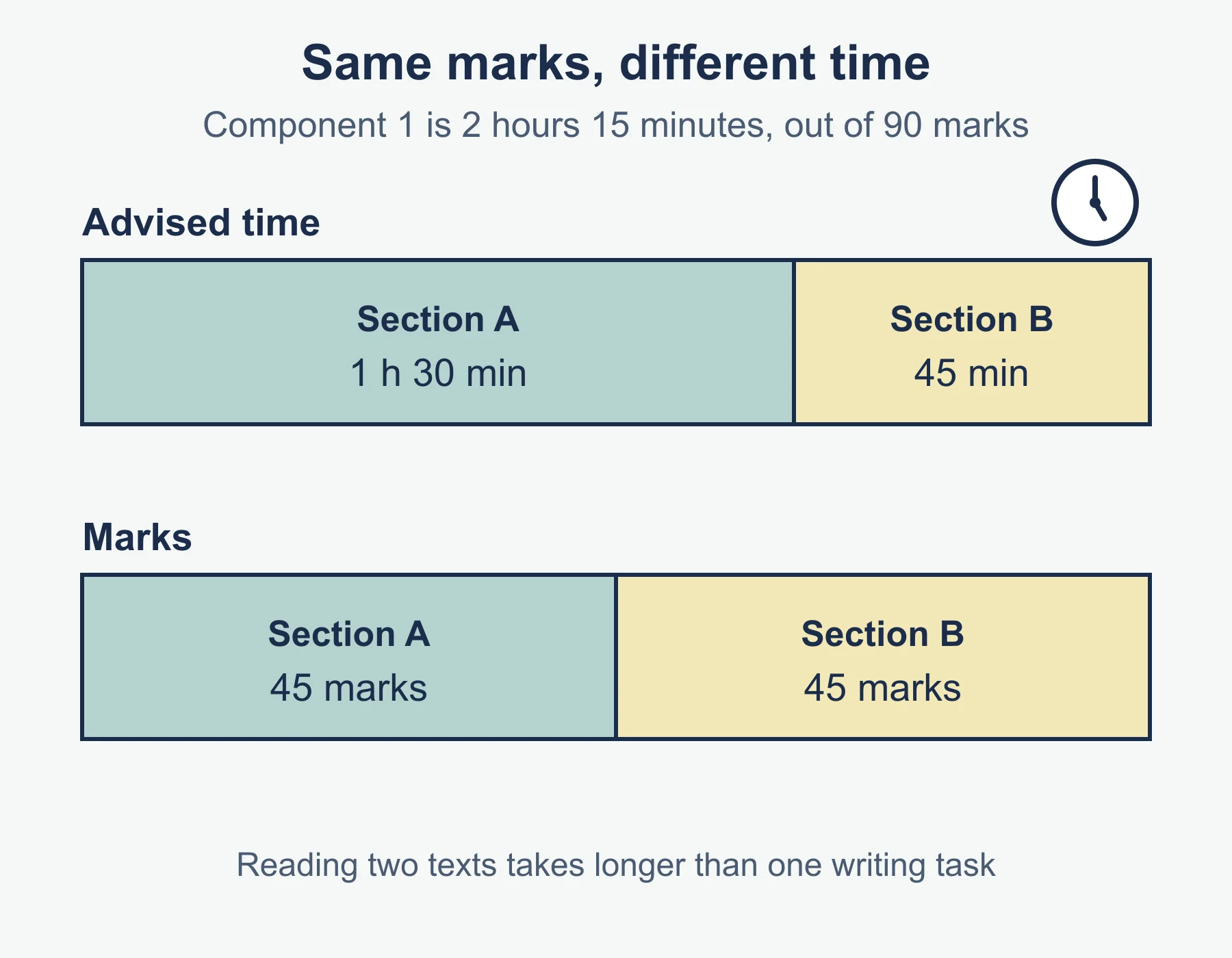
Section B of Component 1 asks you to write one non-fiction piece for a real-world purpose. It is worth the same 45 marks as the reading section but is advised only 45 minutes, so control and planning matter more than length. This guide covers each of the six forms the specification names, how AO4 and AO5 are applied, and how to turn a prompt into a plan. The Component 1 overview sets out the paper as a whole.
What Section B covers
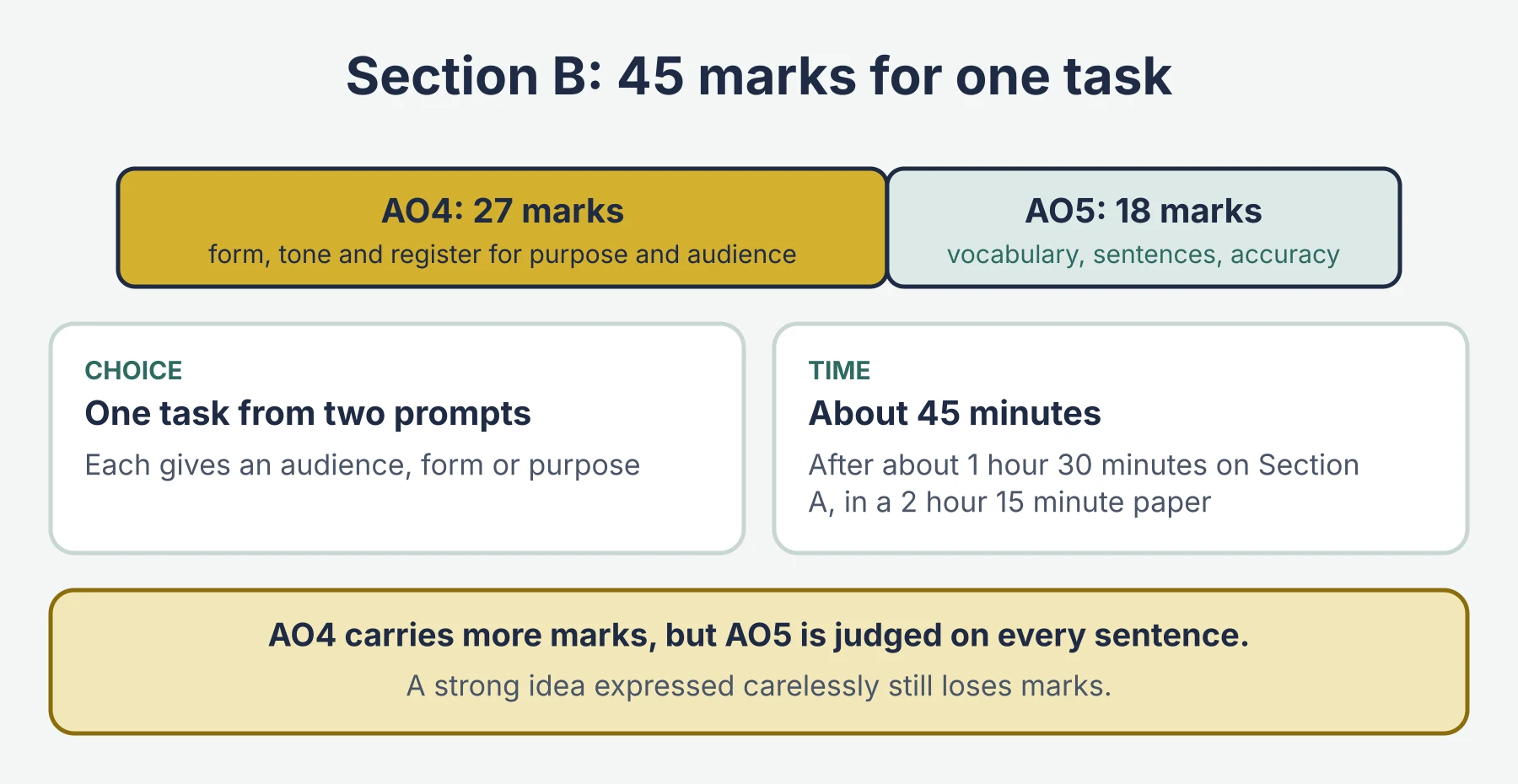
- One writing task, chosen from two prompts, each involving a given audience, form or purpose.
- 45 marks: AO4 27 marks and AO5 18 marks.
- About 45 minutes, after the 1 hour 30 minutes advised for Section A, within a 2 hour 15 minute paper.
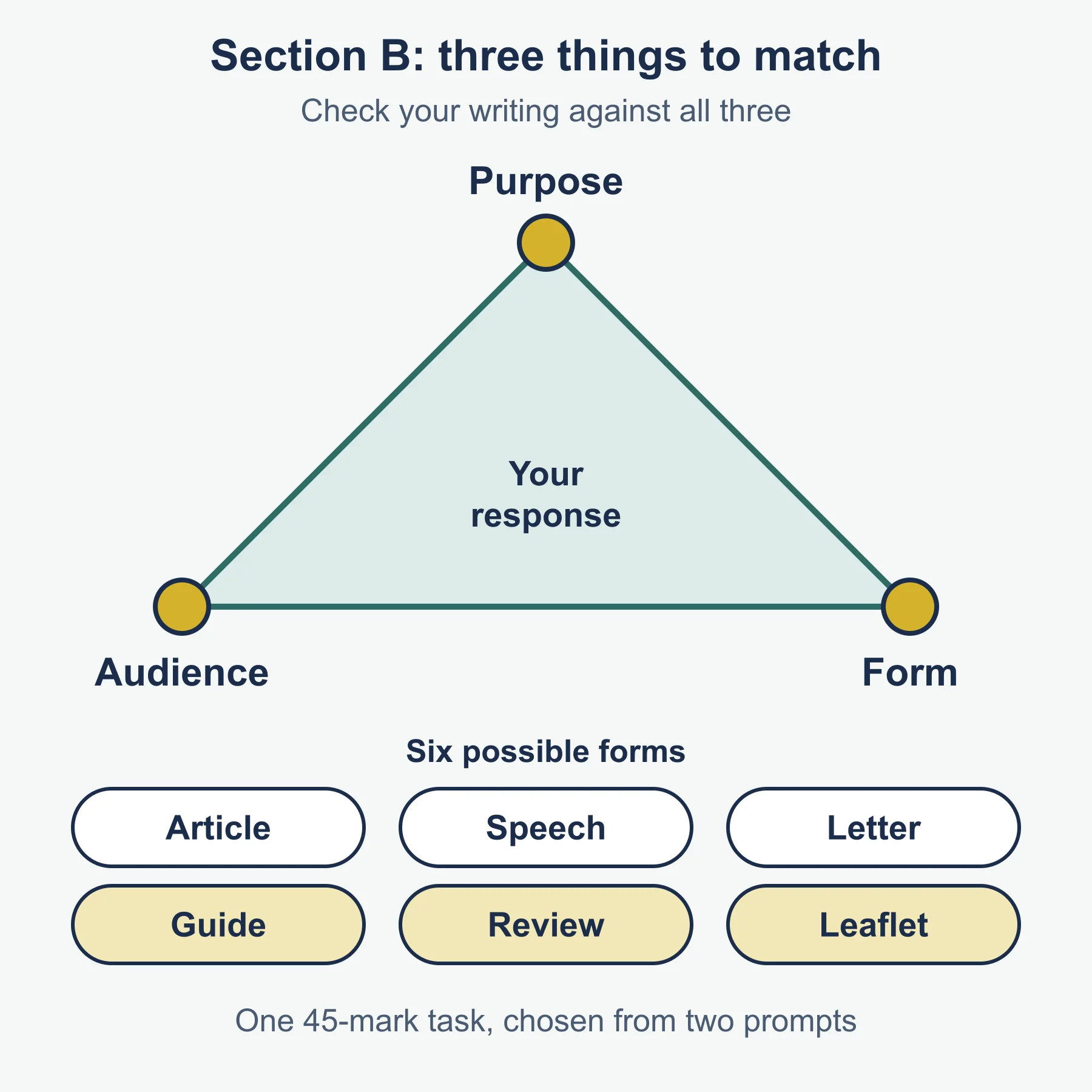
- The specification lists the forms you may be asked to write: article for a magazine or newspaper, speech, letter, guide, review, and the text of a leaflet. A question may also refer to a digital location, such as an article for a website.
| AO | Wording | Marks |
|---|---|---|
| AO4 | Communicate effectively and imaginatively, adapting form, tone and register of writing for specific purposes and audiences | 27 |
| AO5 | Write clearly, using a range of vocabulary and sentence structures, with appropriate paragraphing and accurate spelling, grammar and punctuation | 18 |
AO4 carries more marks, but AO5 is judged on every sentence you write, so a strong idea expressed carelessly still loses marks.
Reading the prompt: purpose, audience, form
Before writing, underline three things in the prompt and write them in the margin:
- Purpose: argue, persuade, advise, inform, explain, describe, review.
- Audience: age, expertise, relationship to you (headteacher, fellow students, readers of a local newspaper, visitors to a website).
- Form: one of the six forms above.
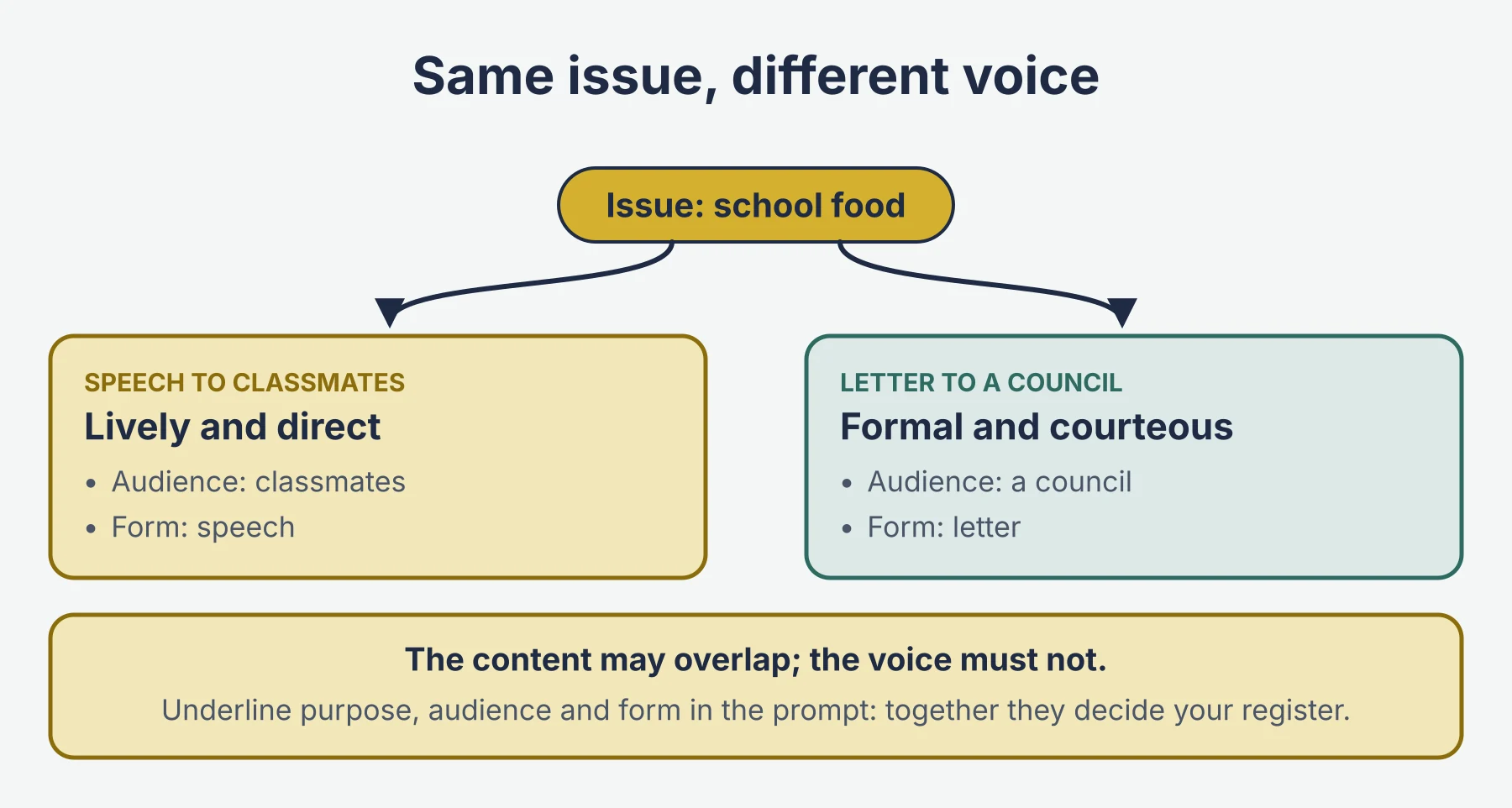
These three decide your register. A speech to classmates about school food can be lively and direct; a letter to a council about the same issue needs a formal, courteous tone. The content may overlap; the voice must not.
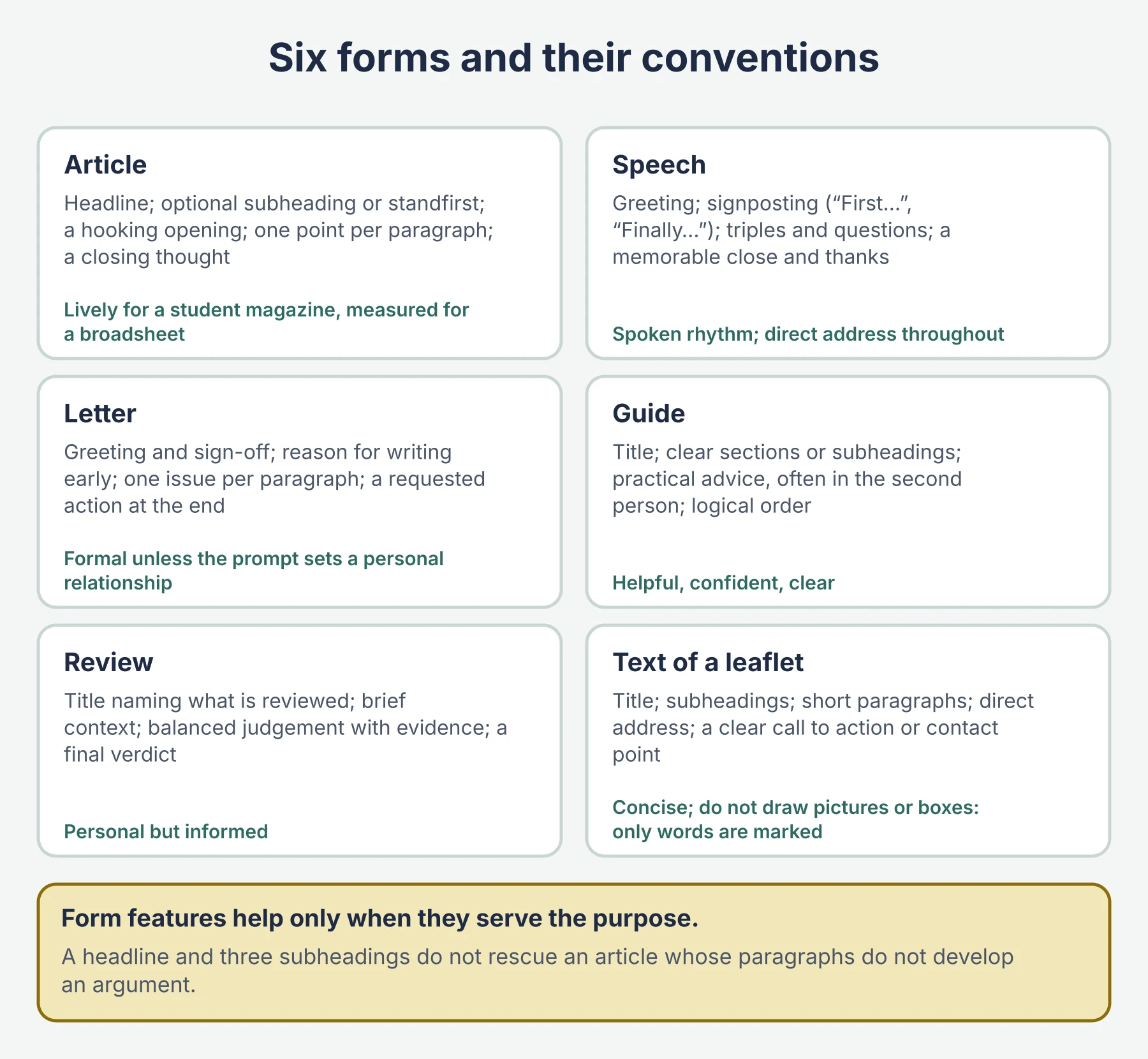
The six forms and their conventions
| Form | Conventions examiners expect | Register notes |
|---|---|---|
| Article (magazine, newspaper or website) | Headline; optional subheading or standfirst; an opening that hooks; paragraphs developing one point each; a closing thought | Varies with publication: lively for a student magazine, measured for a broadsheet |
| Speech | Greeting to the audience; signposting (“First…”, “Finally…”); rhetorical devices such as triples and questions; a memorable close and thanks | Spoken rhythm; direct address throughout |
| Letter | Appropriate greeting and sign-off; clear reason for writing early; one issue per paragraph; a requested action at the end | Formal unless the prompt sets a personal relationship |
| Guide | Title; clear sections or subheadings; practical advice, often in the second person; logical order | Helpful, confident, clear |
| Review | Title naming what is reviewed; brief context; balanced judgement with specific evidence; a final verdict or recommendation | Personal but informed |
| Text of a leaflet | Title; subheadings; short paragraphs; direct address; a clear call to action or contact point | Concise and accessible; do not draw pictures or boxes, since only the words are marked |
Form features help only when they serve the purpose. A headline and three subheadings do not rescue an article whose paragraphs do not develop an argument.
Planning in five minutes
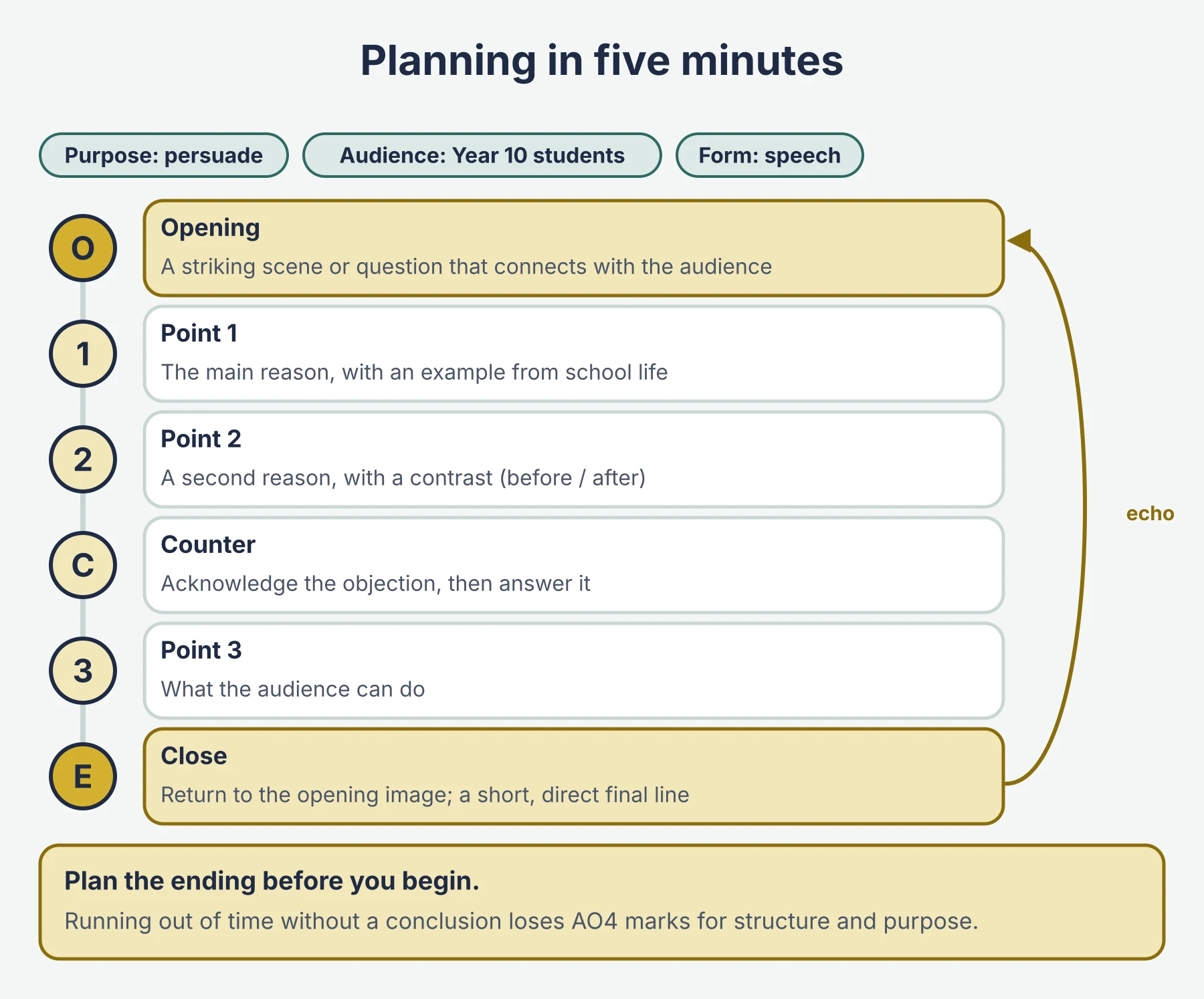
A workable plan for 45 minutes of writing has five to seven paragraph points:
Purpose / audience / form:  persuade / Year 10 students / speech
Opening:  a striking scene or question that connects with the audience
Point 1:  the main reason, with an example from school life
Point 2:  a second reason, with a contrast (before / after)
Counter:  acknowledge the objection, then answer it
Point 3:  what the audience can do
Close:    return to the opening image; a short, direct final line
Plan the ending before you begin. Responses that run out of time without a conclusion lose AO4 marks for structure and purpose.
Annotated model opening
Prompt (original): Write a speech for a school assembly in which you persuade students to take part in a weekly litter-picking scheme.
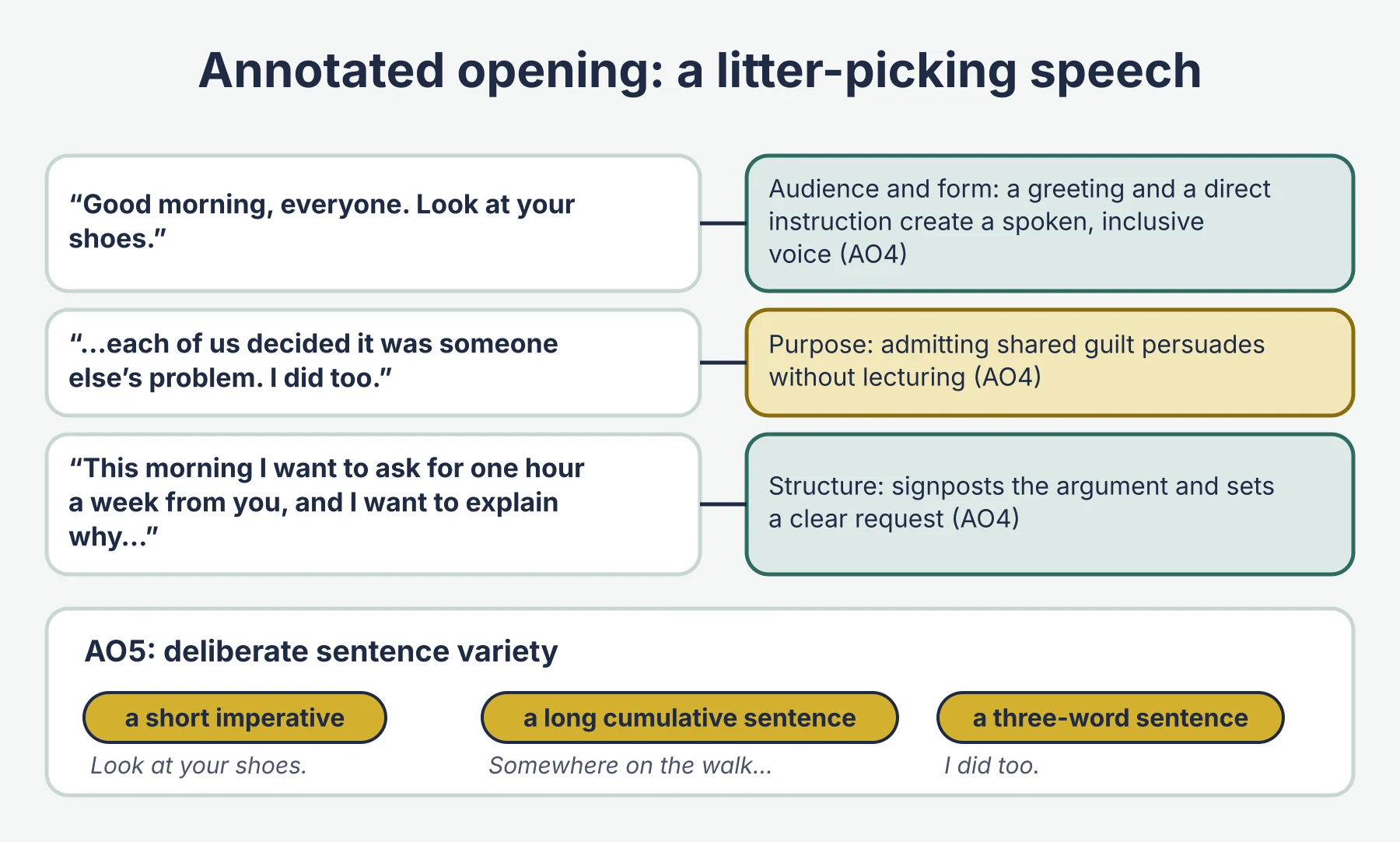
Good morning, everyone. Look at your shoes. Somewhere on the walk to school today, each of us stepped past a crisp packet, a can or a plastic bottle, and each of us decided it was someone else’s problem. I did too. This morning I want to ask for one hour a week from you, and I want to explain why that hour will change more than the pavement.
What earns credit:
- Audience and form: the greeting and direct instruction (“Look at your shoes”) create a spoken, inclusive voice suited to an assembly (AO4).
- Purpose: the speaker admits shared guilt (“I did too”), which persuades without lecturing (AO4).
- Structure: the last sentence signposts the argument to come and sets a clear request (AO4).
- Technical control: a short imperative, a long cumulative sentence and a three-word sentence give deliberate variety; punctuation is accurate (AO5).
Building AO5 under time pressure
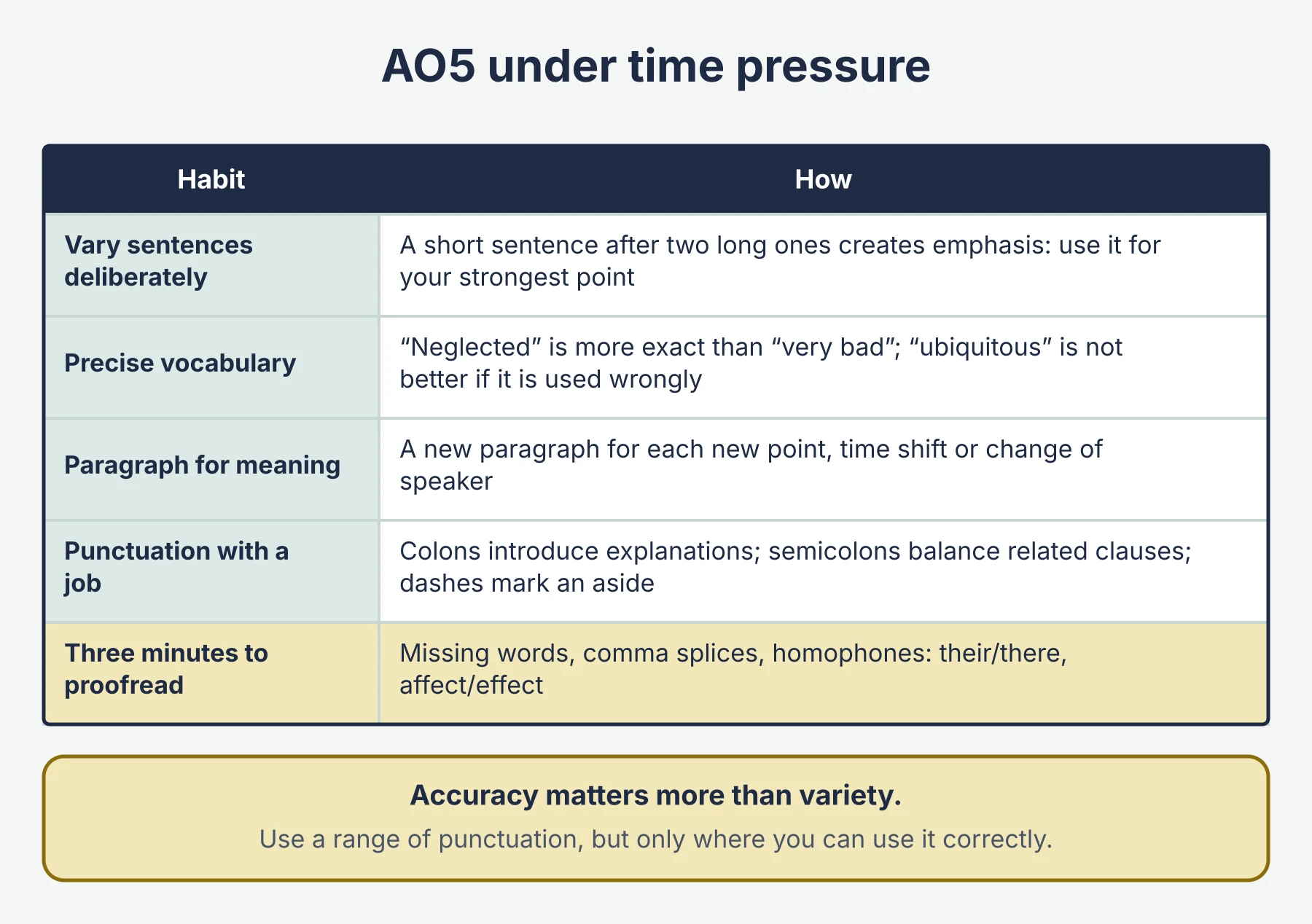
- Vary sentence openings and lengths deliberately. A short sentence after two long ones creates emphasis; use it for your strongest point.
- Choose precise vocabulary over inflated vocabulary. “Neglected” is more exact than “very bad”; “ubiquitous” is not better if it is used wrongly.
- Paragraph for meaning: start a new paragraph for each new point, time shift or change of speaker.
- Use a range of punctuation accurately: colons to introduce explanations, semicolons to balance related clauses, dashes for an aside; but accuracy matters more than variety.
- Leave three minutes to proofread for missing words, comma splices and homophone errors (their/there, affect/effect).
Using Section A to help Section B
The anthology and the unseen extract are models of real non-fiction. Techniques you analysed in Section A, such as an anecdote that opens an argument, a counter-argument conceded and then answered, or a cyclical ending, can be used deliberately in your own writing. The specification links the two sections directly: students should use what they have learned about different text types to develop their transactional writing.
Common mistakes
- Writing an essay whatever the form, so a letter, speech or leaflet sounds identical.
- Ignoring the audience: slang in a letter to a newspaper editor, or a lecturing tone in a speech to peers.
- Listing points without developing them with examples, explanation or consequences.
- Overusing devices: five rhetorical questions in one paragraph read as a checklist, not a voice.
- Drawing layout for a leaflet instead of writing its text.
- No conclusion because the plan was skipped.
- Inventing statistics that sound unconvincing; a specific, plausible example persuades better.
Exam technique
| Prompt wording | What it signals |
|---|---|
| “Write a letter to…” | Letter conventions; the named recipient is your audience |
| “Write the text for a leaflet…” | Headings and short sections; words only |
| “Write an article for a website / magazine…” | Headline and an engaging opening; register suited to that publication |
| Bullet-point content suggestions, if a prompt includes them | Read the wording to see whether they are suggestions or requirements, then plan around them |
| “Your aim is to persuade / advise / inform” | The purpose AO4 will judge |
Choose the prompt you can develop, not the one with the more appealing topic. Within a minute of reading both, decide which one you could write five well-developed paragraphs on.
Where to go next
- Section B Transactional Writing revision notes
- Section B Transactional Writing practice questions
- Section A Non-fiction Texts study guide
Official specification
Pearson Edexcel International GCSE in English Language (Specification A) 4EA1, Issue 7 (August 2025), Component 1 — qualifications.pearson.com.
Related resources
-
Revision notes
Edexcel IGCSE English Language: Non-fiction Texts and Transactional Writing — Revision Notes
Condensed recall notes on reading non-fiction, language analysis, comparison and transactional writing for Edexcel International GCSE English Language 4EA1.
English · Pearson Edexcel · IGCSE
Revise topic -
Practice questions
Pearson Edexcel IGCSE English Language (4EA1): Section B Transactional Writing – Practice Questions
Original transactional writing practice for 4EA1 Paper 1 Section B: short form and register drills plus full 45-mark tasks with AO4 and AO5 guidance.
English · Pearson Edexcel · IGCSE
Try questions -
Revision notes
Pearson Edexcel IGCSE English Language (4EA1): Section B Transactional Writing – Revision Notes
Quick-recall notes on 4EA1 Paper 1 transactional writing: the six forms and their conventions, AO4 and AO5, register, planning, traps and a self-test.
English · Pearson Edexcel · IGCSE
Revise topic
Get free revision emails (optional)
Occasional emails with practice questions, worked explanations and links to free resources for the qualification and subjects you choose. No spam, and you can unsubscribe from any email. The free tools on this site never need an email.