
Revision Notes
Pearson Edexcel IGCSE English Language (4EA1): Section A Non-fiction Texts – Revision Notes
Quick-recall notes for 4EA1 Paper 1 Section A: the AO1, AO2 and AO3 reading skills, non-fiction key terms, exam traps and a twelve-question self-test.
- Subject
- English
- Level
- IGCSE
- Topic
- Component 1 – Non-fiction Texts and Transactional Writing
- Author
- Marlbridge Academic Team
- Updated
- Reviewed by
- Ammar Bilal (what this means)
Aligned to Pearson Edexcel IGCSE English (4EA1), For first teaching 2016 (Issue 7, August 2025). Official specification .
Syllabus page (what it covers and how it is assessed): Pearson Edexcel IGCSE English Language.
Found an error? Report a correction.
Need help with this topic? Request a free trial class for IGCSE English Language (4EA1).
Condensed notes for the reading section of Component 1 in Pearson Edexcel International GCSE English Language A (4EA1). For full explanations and a worked example, use the Section A Non-fiction Texts study guide.
The section in one box
| Detail | Section A: Non-fiction texts |
|---|---|
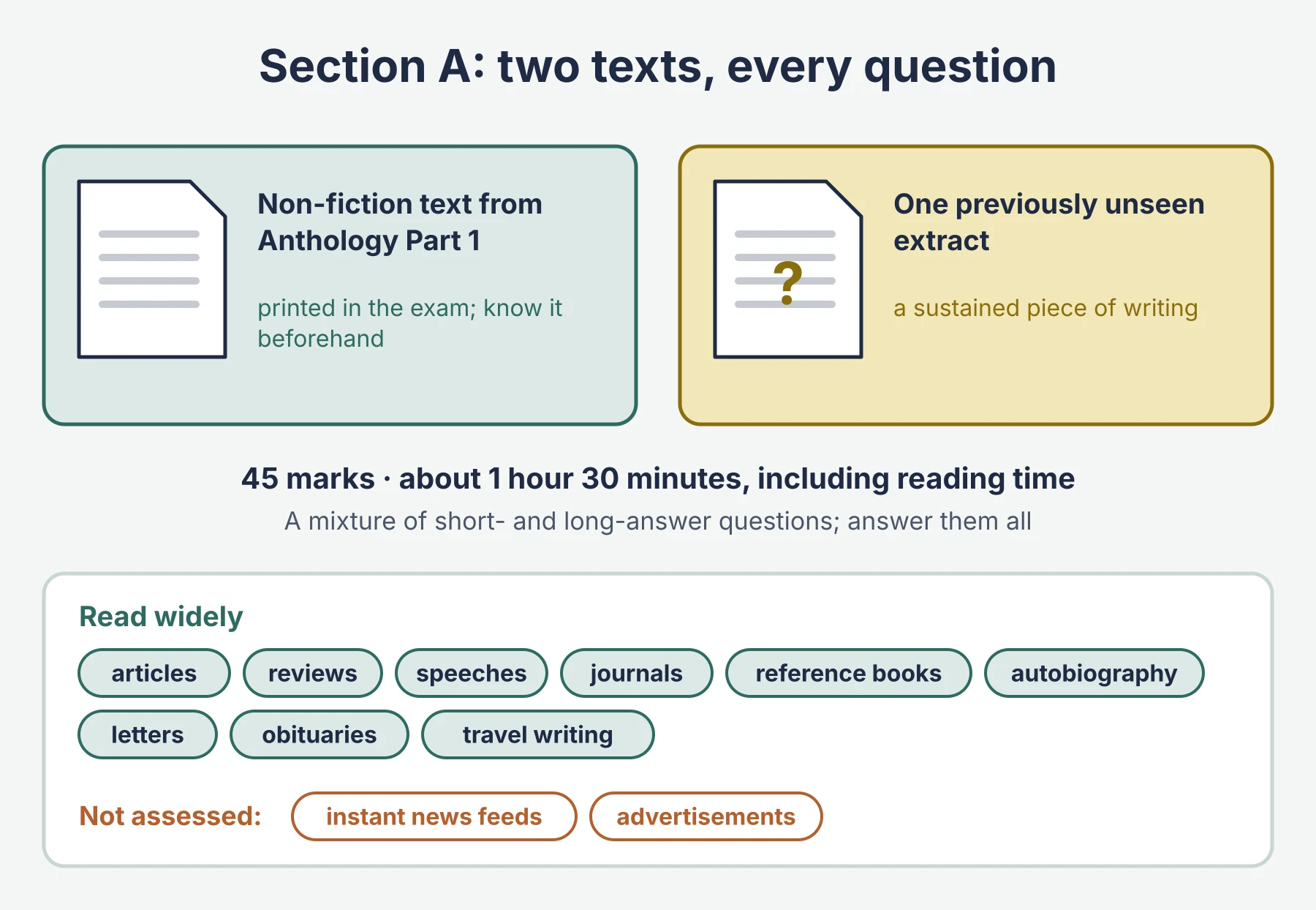
| Texts | One Part 1 anthology text (printed in the exam) and one previously unseen extract |
| Questions | A mixture of short- and long-answer questions; answer all of them |
| Marks | 45 of the paper’s 90 |
| Advised time | About 1 hour 30 minutes, including reading time |
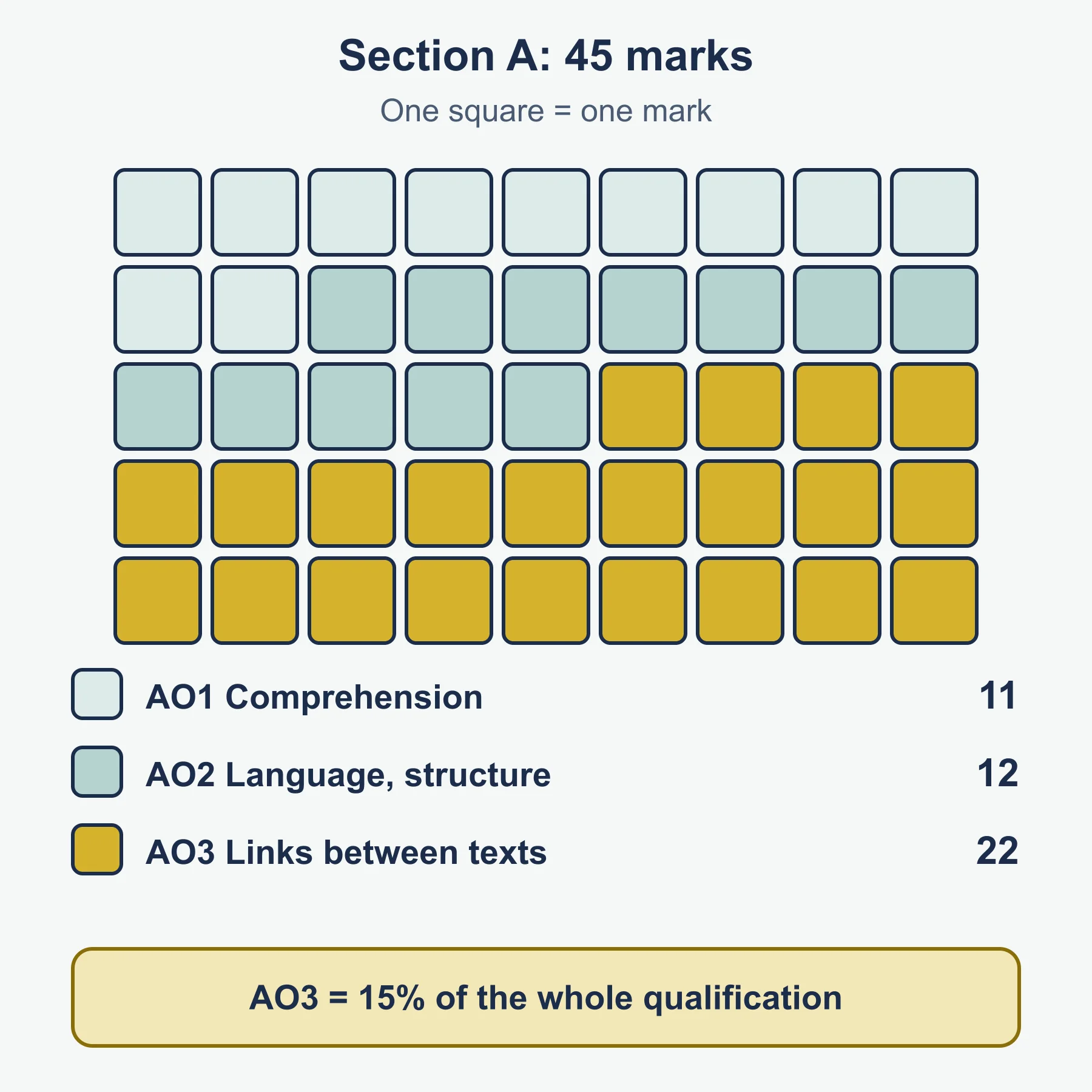
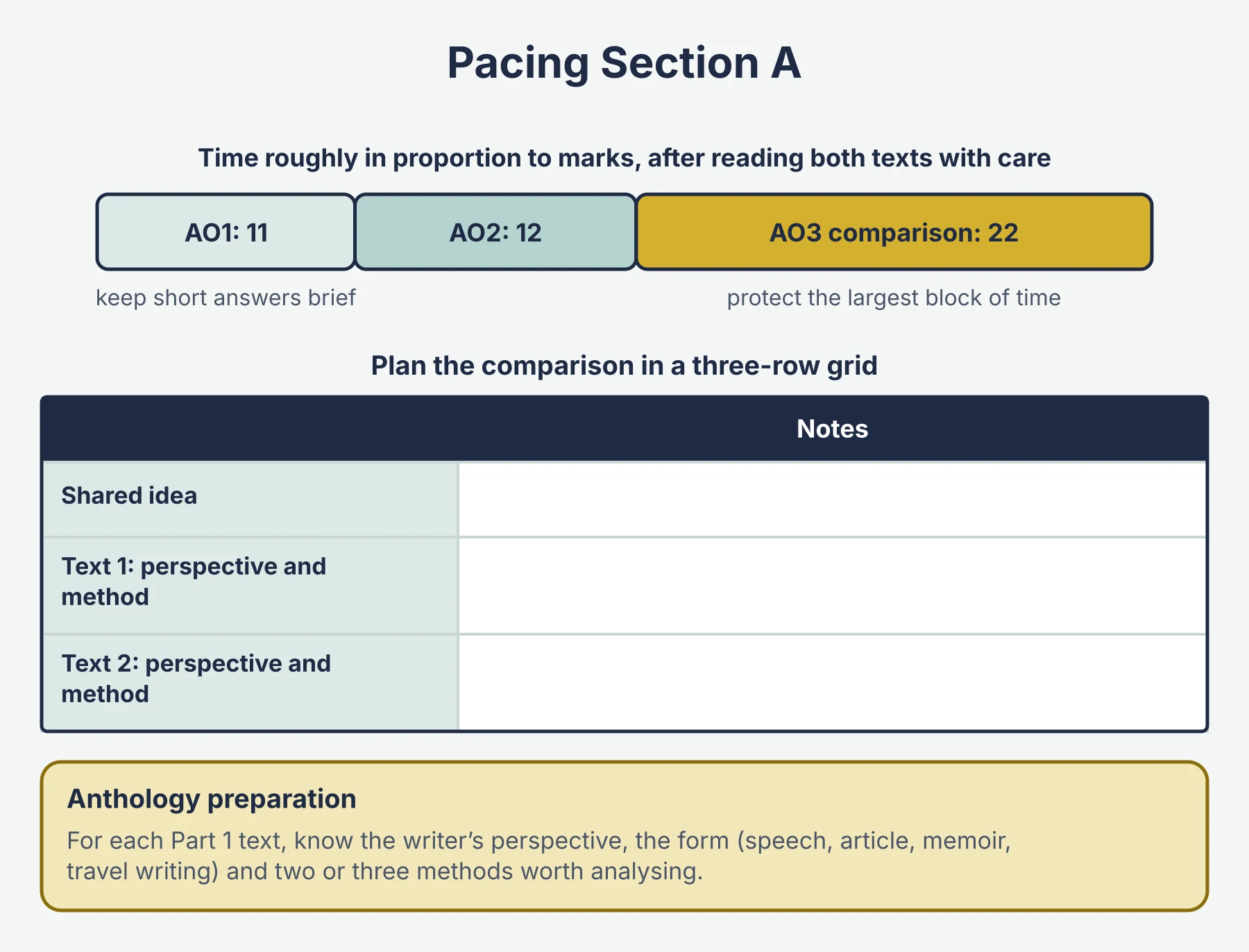
| AOs | AO1 (11 marks), AO2 (12 marks), AO3 (22 marks) |
The paper lasts 2 hours 15 minutes in total; Section B transactional writing takes the remaining 45 minutes, so overrunning Section A costs writing marks.
Part 1 anthology texts to know
| Text | Writer | Form to remember |
|---|---|---|
| The Danger of a Single Story | Chimamanda Ngozi Adichie | Speech (talk) |
| A Passage to Africa | George Alagiah | Journalist’s memoir |
| The Explorer’s Daughter | Kari Herbert | Travel writing / memoir |
| Explorers, or boys messing about? Either way, taxpayer gets rescue bill | Steven Morris | Newspaper article |
| 127 Hours: Between a Rock and a Hard Place | Aron Ralston | Autobiography |
| Young and Dyslexic? You’ve got it going on | Benjamin Zephaniah | Newspaper article (personal) |
| A Game of Polo with a Headless Goat | Emma Levine | Travel writing |
| Beyond the Sky and Earth: A Journey into Bhutan | Jamie Zeppa | Travel memoir |
| H is for Hawk | Helen Macdonald | Memoir / nature writing |
| Chinese Cinderella | Adeline Yen Mah | Autobiography |
For each text, revise: the writer’s perspective, the form, two or three methods, and one idea it shares with at least two other texts. The list is fixed by specification issue, so check the current one with your teacher.
The three skills
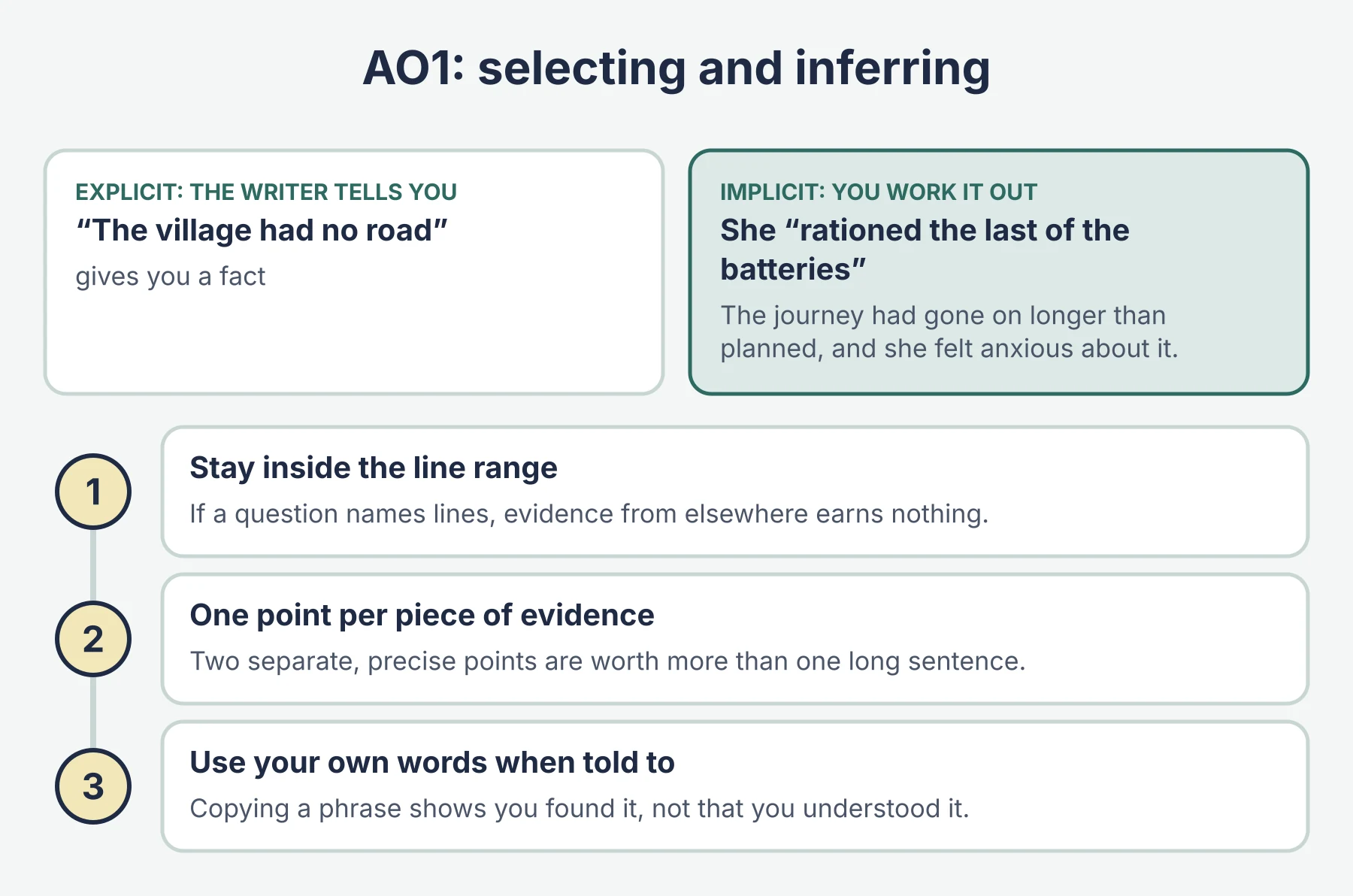
AO1: select and interpret. Find explicit information; infer implicit attitudes. Keep to the line range. One precise point per piece of evidence.
AO2: analyse language and structure. Method, short quotation, effect on the reader, link to purpose. Cover structure (openings, shifts, endings, chronology) as well as word choice.
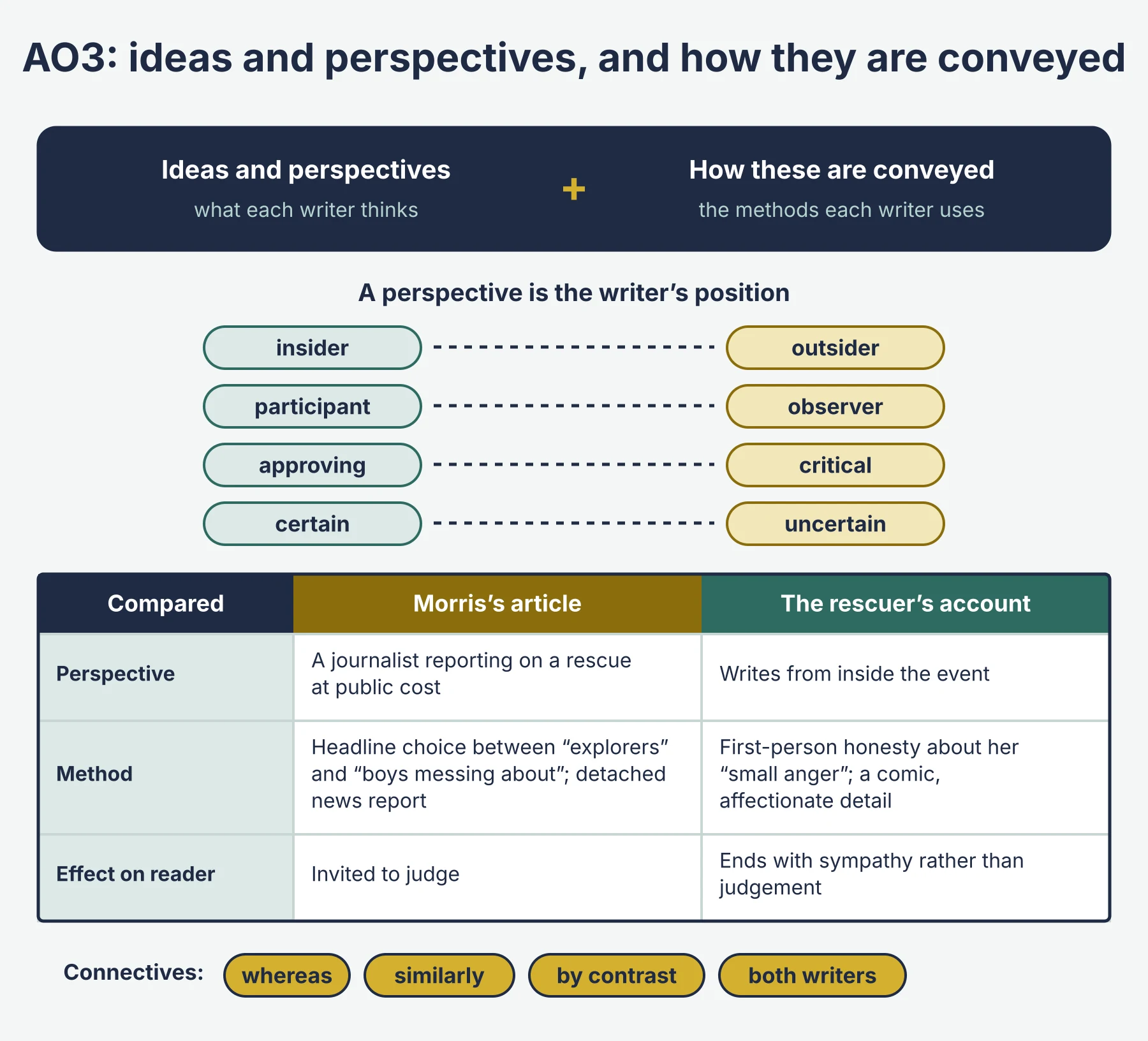
AO3: compare ideas and perspectives. The specification adds “as well as how these are conveyed”, so compare methods too. Integrate both texts in every paragraph.
Key terms
| Term | Meaning | Why it matters in Section A |
|---|---|---|
| Explicit | Stated directly | Basis of straightforward AO1 answers |
| Implicit | Suggested; must be inferred | Basis of higher AO1 answers |
| Perspective | The writer’s viewpoint or position | Central to AO1 and AO3 |
| Purpose | What the text sets out to do (inform, persuade, entertain, reflect) | Explains why a method is used |
| Register | Level of formality and tone | Shifts often mark a change in purpose |
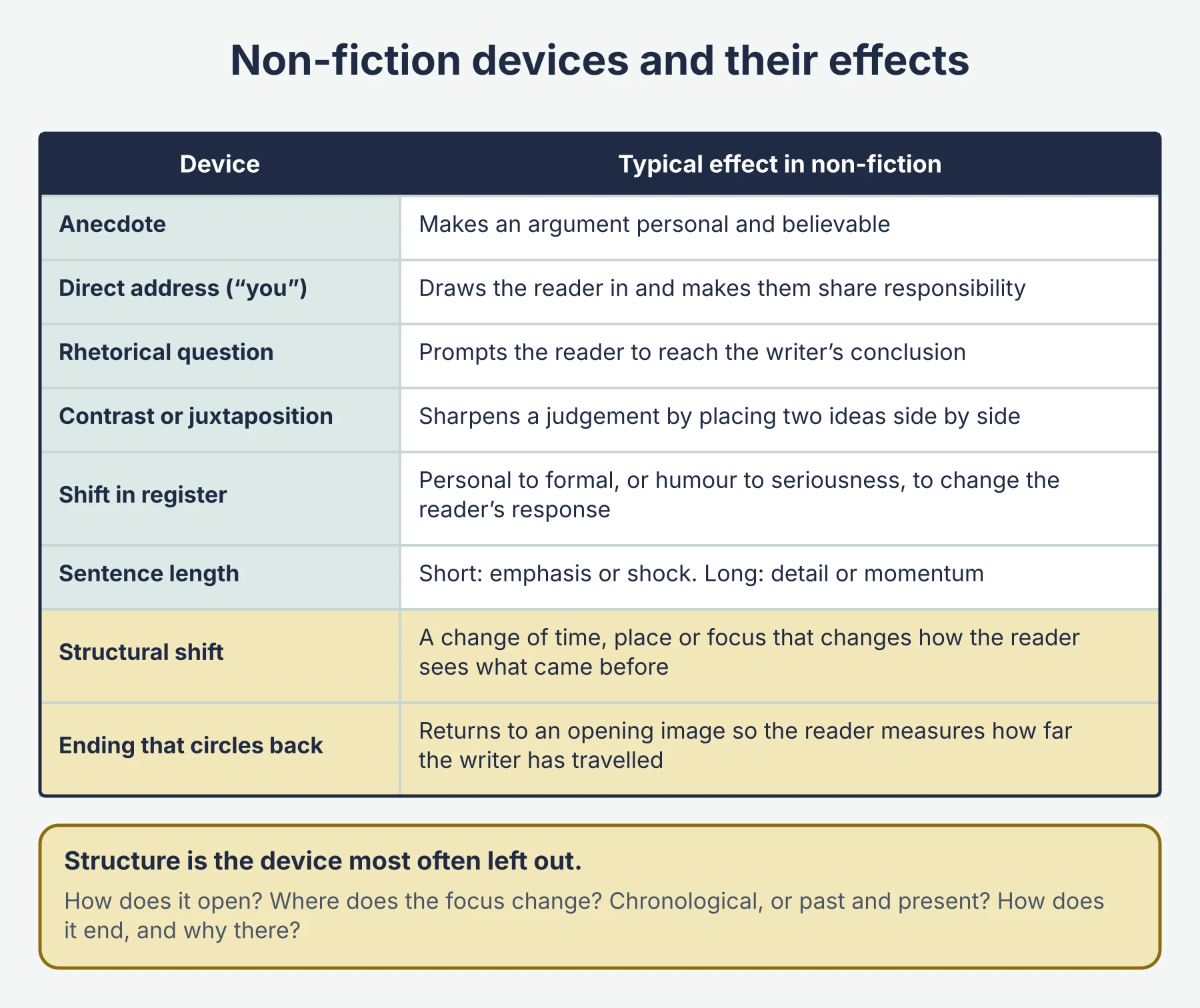
| Anecdote | A short personal story | Makes an argument vivid and credible |
| Juxtaposition | Placing contrasting ideas together | Sharpens a judgement |
| Hyperbole | Deliberate exaggeration | Creates humour or emphasis |
| Rhetorical question | A question needing no answer | Steers the reader’s conclusion |
| Cyclical structure | Ending returns to the opening | Shows change or reinforces a message |
| Retrospective narration | Looking back on past events | Lets the writer comment with hindsight |
| Connective | Linking word such as whereas or similarly | Makes comparison visible |
Methods worth spotting in any non-fiction text
- Openings: a scene, a question, a statistic, a bold claim.
- Viewpoint: first person (intimacy, honesty) or third person (distance, authority).
- Time: present tense for immediacy; past tense for reflection; flashback for contrast.
- Voices: quotations from other people add authority or a second perspective.
- Sentence variety: a short sentence after a long one lands as a judgement or a shock.
- Endings: a reflection, a call to the reader, or an image left unexplained.
A comparison plan in three rows
| Row | Text 1 | Text 2 |
|---|---|---|
| Shared idea | e.g. facing danger | e.g. facing danger |
| Perspective | participant, reflective | observer, sceptical |
| Methods | anecdote, short sentences | headline, quotation, contrast |
Three or four rows like this become three or four integrated paragraphs.
Exam traps
- Quoting long passages: short, precise quotations are easier to analyse.
- Spending too long on the short AO1 questions, which carry fewer marks than the comparison.
- Naming a device without its effect.
- Writing about structure as “the text uses paragraphs”.
- Comparing only the topic and not the writers’ perspectives and methods.
- Leaving the comparison until the last ten minutes: it is worth almost half the section.
- Forgetting the anthology text is printed in the paper: re-read the relevant part rather than writing from memory.
Self-test
- How many marks is Section A worth, and how long are you advised to spend on it?
- Which two texts appear in Section A?
- What is the AO1, AO2 and AO3 split in marks?
- What is the difference between an explicit and an implicit point?
- Name two non-fiction forms the specification expects you to have read.
- Which text types does the specification say will not be assessed?
- What does “perspective” mean?
- What does AO3 add after “ideas and perspectives”?
- Give the four steps of a mark-earning AO2 point.
- Name two structural features you could analyse in a non-fiction text.
- Why is a “Text 1 then Text 2” essay weak for AO3?
- What should you revise about each Part 1 anthology text?
Answers: 1. 45 marks; about 1 hour 30 minutes including reading time. 2. One non-fiction text from Part 1 of the anthology and one previously unseen extract. 3. AO1 11, AO2 12, AO3 22. 4. An explicit point is stated directly; an implicit point is inferred from clues. 5. Any two of journalism (articles, reviews), speeches, journals, reference-book extracts, autobiography, letters, obituaries, travel writing. 6. Transient texts such as instant news feeds and advertisements. 7. The writer’s viewpoint or position on the subject. 8. “As well as how these are conveyed”, so methods must be compared too. 9. Name the method, give short evidence, explain the effect, link it to the writer’s purpose. 10. Any two of the opening, a shift in time or focus, chronology, sentence length, the ending, a cyclical structure. 11. Comparison appears only at the end, so connections are not explored throughout. 12. Perspective, form, two or three methods, and ideas it shares with other texts.
Related pages
Related resources
-
Revision notes
Edexcel IGCSE English Language: Non-fiction Texts and Transactional Writing — Revision Notes
Condensed recall notes on reading non-fiction, language analysis, comparison and transactional writing for Edexcel International GCSE English Language 4EA1.
English · Pearson Edexcel · IGCSE
Revise topic -
Study guides
Pearson Edexcel IGCSE English Language (4EA1): Section B Transactional Writing
The six transactional forms, AO4 and AO5, planning and an annotated model opening for 4EA1 Paper 1 Section B, with the mistakes that cost writing marks.
English · Pearson Edexcel · IGCSE
Read guide -
Practice questions
Pearson Edexcel IGCSE English Language (4EA1): Section B Transactional Writing – Practice Questions
Original transactional writing practice for 4EA1 Paper 1 Section B: short form and register drills plus full 45-mark tasks with AO4 and AO5 guidance.
English · Pearson Edexcel · IGCSE
Try questions
Get free revision emails (optional)
Occasional emails with practice questions, worked explanations and links to free resources for the qualification and subjects you choose. No spam, and you can unsubscribe from any email. The free tools on this site never need an email.