
Revision Notes
Pearson Edexcel IGCSE English Language (4EA1): Section B Transactional Writing – Revision Notes
Quick-recall notes on 4EA1 Paper 1 transactional writing: the six forms and their conventions, AO4 and AO5, register, planning, traps and a self-test.
- Subject
- English
- Level
- IGCSE
- Topic
- Component 1 – Non-fiction Texts and Transactional Writing
- Author
- Marlbridge Academic Team
- Updated
- Reviewed by
- Ammar Bilal (what this means)
Aligned to Pearson Edexcel IGCSE English (4EA1), For first teaching 2016 (Issue 7, August 2025). Official specification .
Syllabus page (what it covers and how it is assessed): Pearson Edexcel IGCSE English Language.
Found an error? Report a correction.
Need help with this topic? Request a free trial class for IGCSE English Language (4EA1).
Condensed notes for the writing section of Component 1 in Pearson Edexcel International GCSE English Language A (4EA1). For full explanations and an annotated model, use the Section B Transactional Writing study guide.
The task in one box
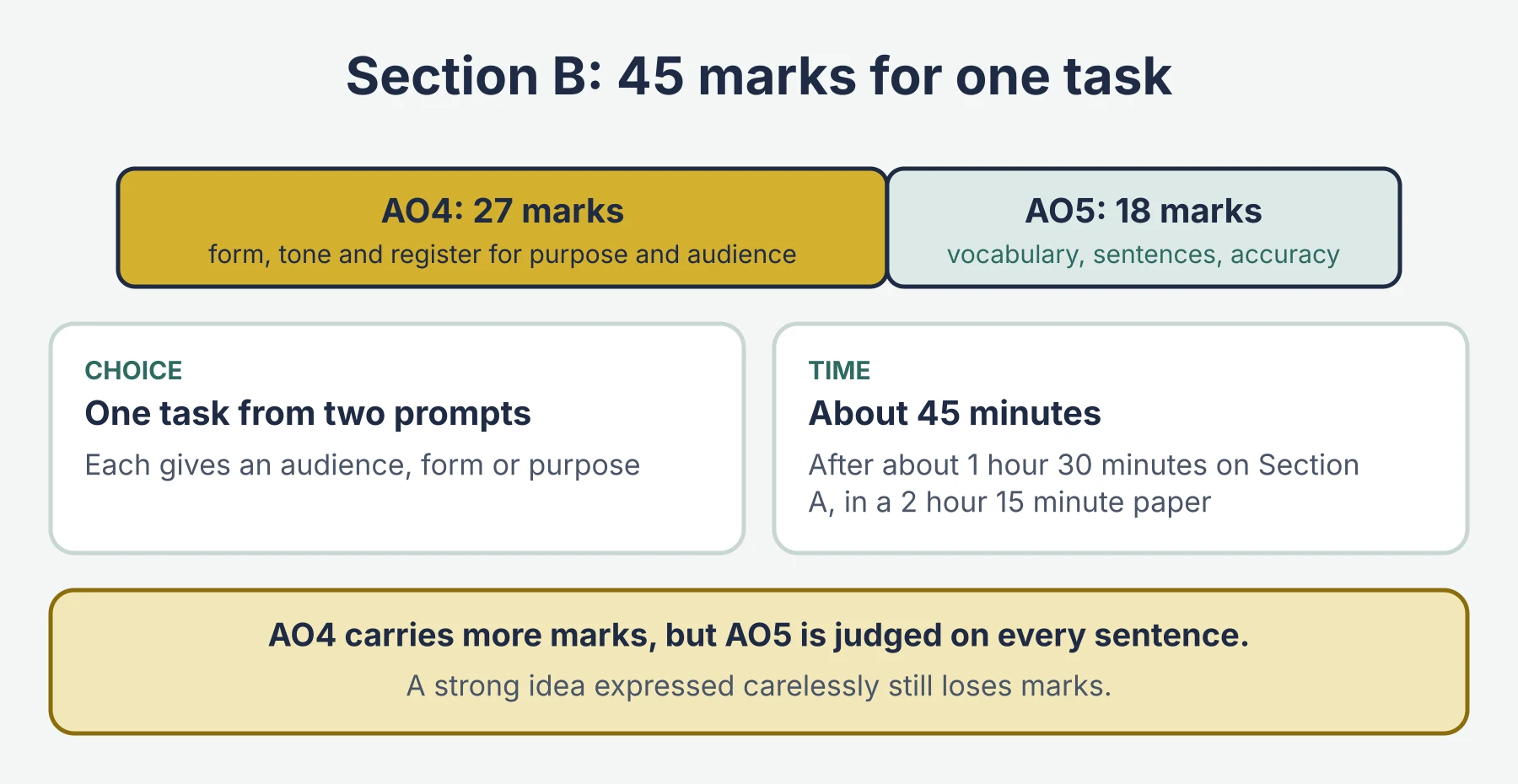
| Detail | Section B: Transactional Writing |
|---|---|
| Task | One piece of writing, chosen from two prompts |
| Prompt gives | An audience, form or purpose |
| Marks | 45: AO4 27, AO5 18 |
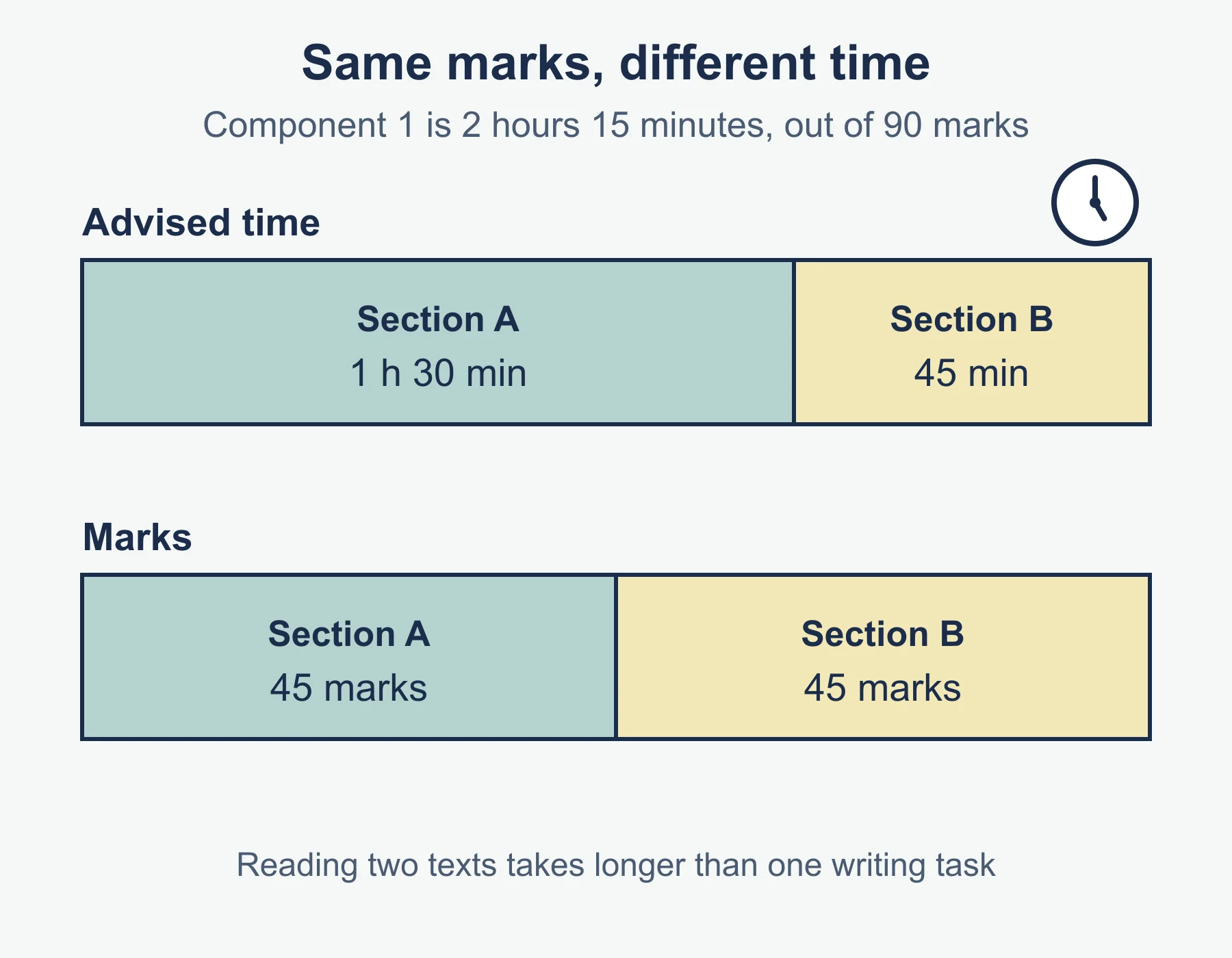
| Advised time | About 45 minutes |
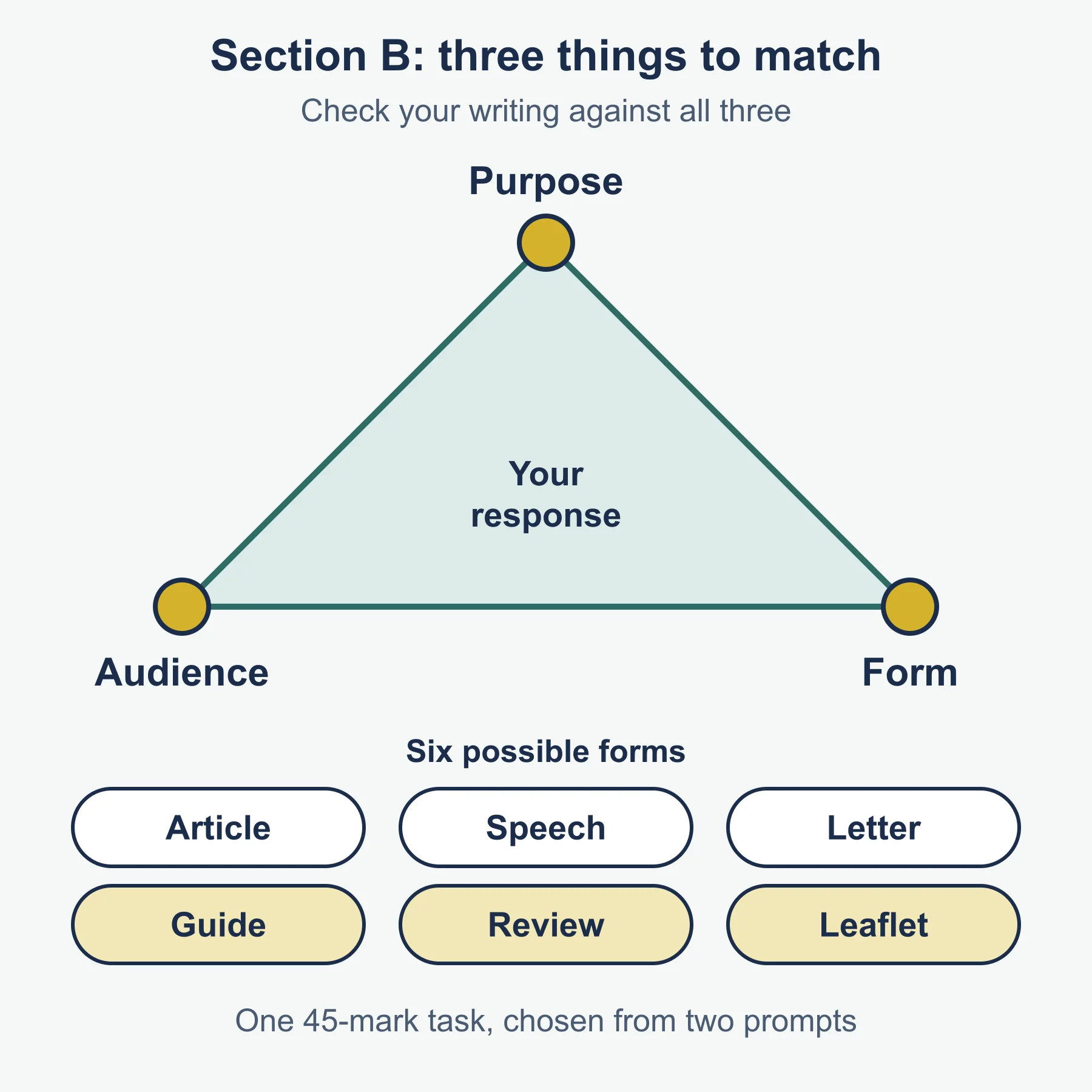
| Forms named in the specification | Article (magazine or newspaper), speech, letter, guide, review, text of a leaflet |
A question may refer to a digital location for the text, such as a website.
AO4 and AO5 in a sentence each
- AO4: does the writing fit its purpose and reader, with form, tone and register adapted to them?
- AO5: is it clear, varied and accurate, with deliberate sentence structures, precise vocabulary, paragraphing and correct spelling, grammar and punctuation?
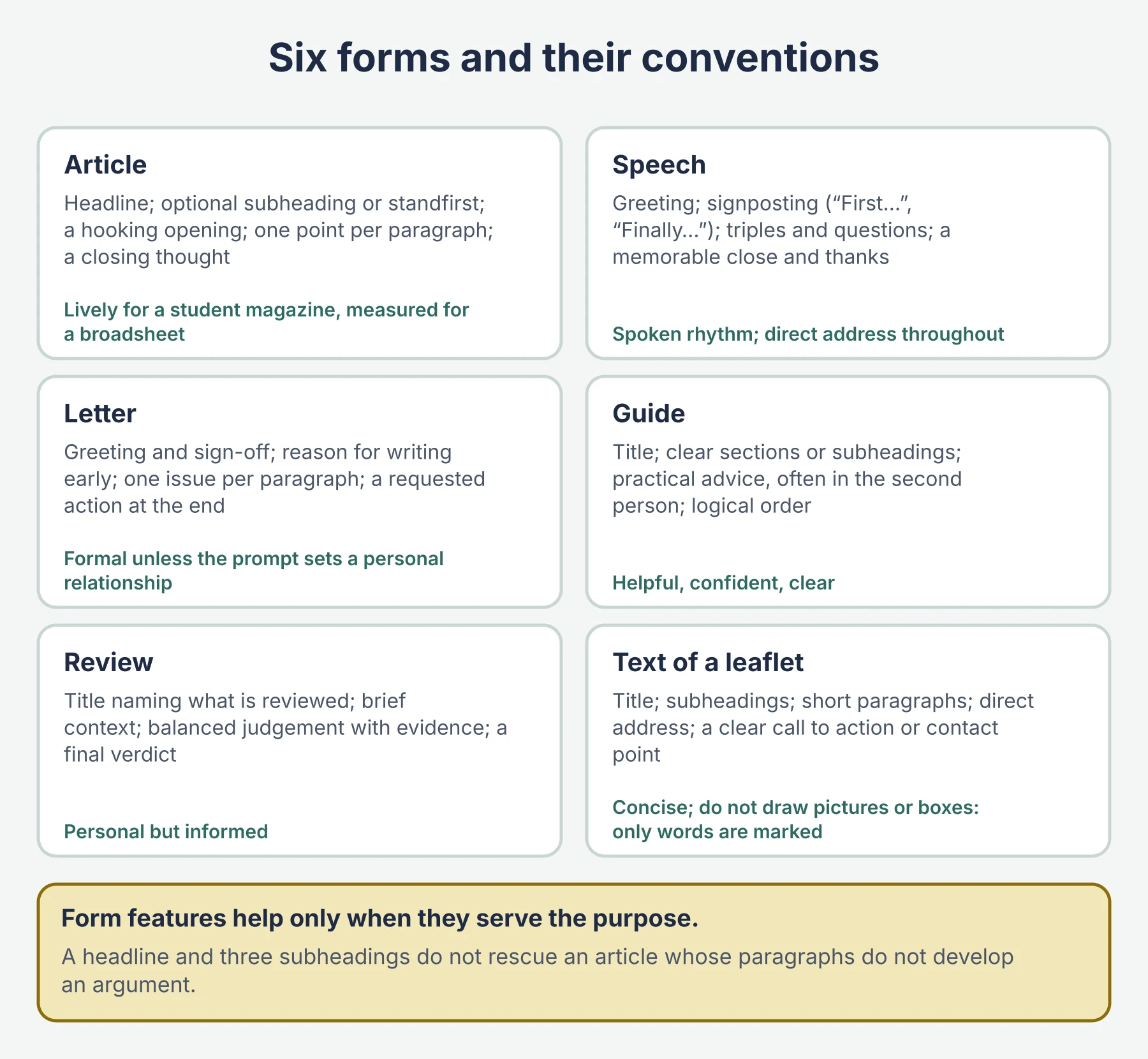
Form conventions at a glance
| Form | Must-haves | Avoid |
|---|---|---|
| Article | Headline, engaging opening, developed paragraphs, closing thought | Writing a speech with a headline on top |
| Speech | Greeting, signposting, direct address, memorable ending | Long written-style sentences with no spoken rhythm |
| Letter | Greeting and sign-off matched in formality, reason for writing early, requested action | Slang in a formal letter; forgetting who the recipient is |
| Guide | Title, clear sections, practical second-person advice, logical order | Opinion essay with no advice |
| Review | Context, specific evidence, balanced judgement, verdict | Plot summary with a one-line opinion |
| Leaflet text | Title, subheadings, short sections, call to action | Drawings, boxes and columns; only words earn marks |
Register ladder
| Audience | Register | Example opening |
|---|---|---|
| Friend or younger students | Informal, warm | “Let’s be honest: Monday mornings are hard.” |
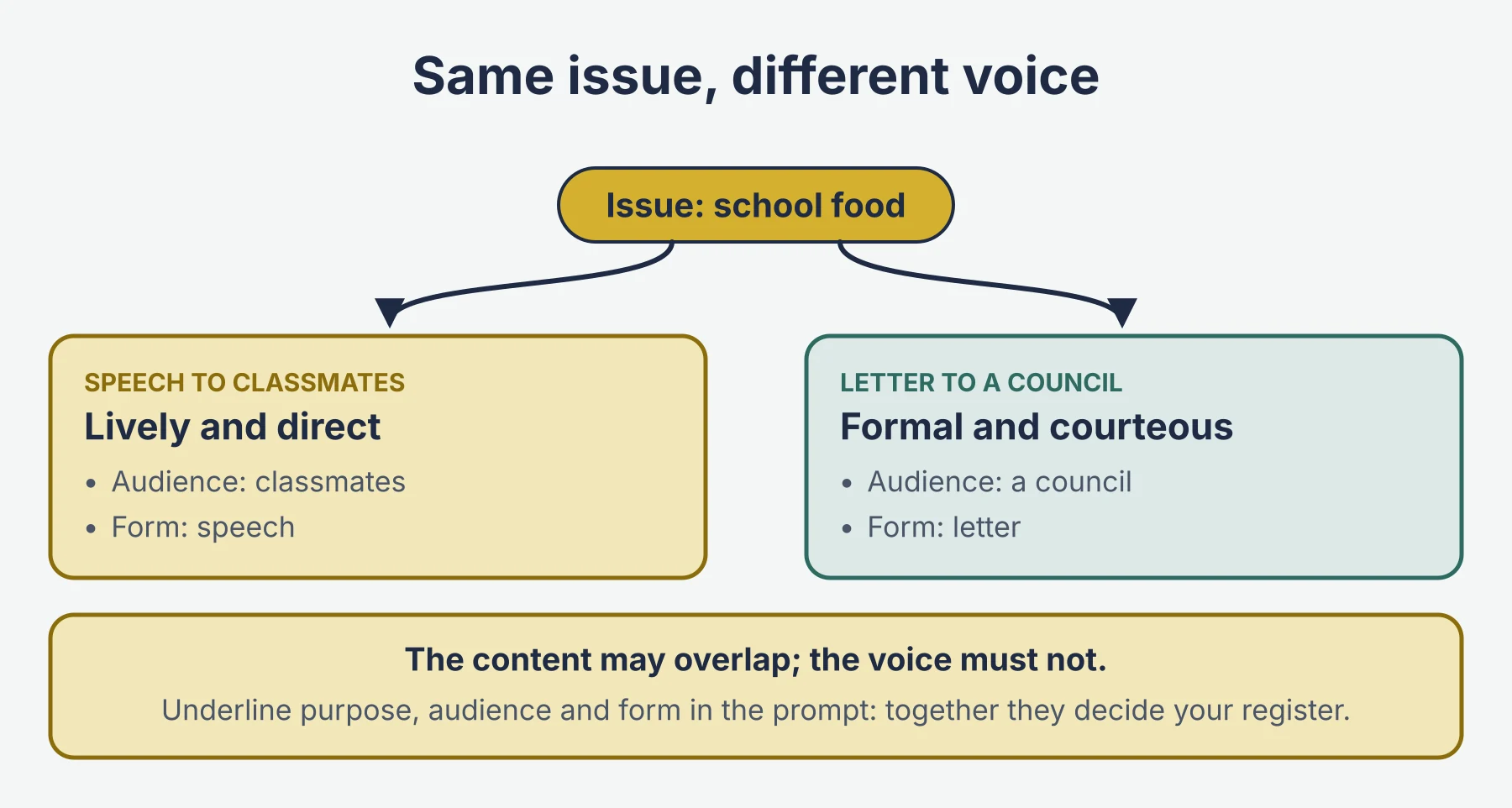
| Fellow students in assembly | Direct, lively but respectful | “Good morning, everyone. Look around this hall.” |
| Readers of a local newspaper | Measured, persuasive | “Our town has a choice to make about its library.” |
| Headteacher, council, company | Formal, courteous | “I am writing to request that the council reconsider…” |
Persuasive and advisory methods
| Method | Use it to |
|---|---|
| Anecdote | Open with a real-feeling moment |
| Direct address | Make the reader feel involved |
| Rule of three | Give a point rhythm and finality |
| Counter-argument and rebuttal | Show balance, then strengthen your case |
| Contrast (before and after) | Show the difference your idea makes |
| Rhetorical question | Lead the reader towards your conclusion |
| Imperatives | Give clear advice or a call to action |
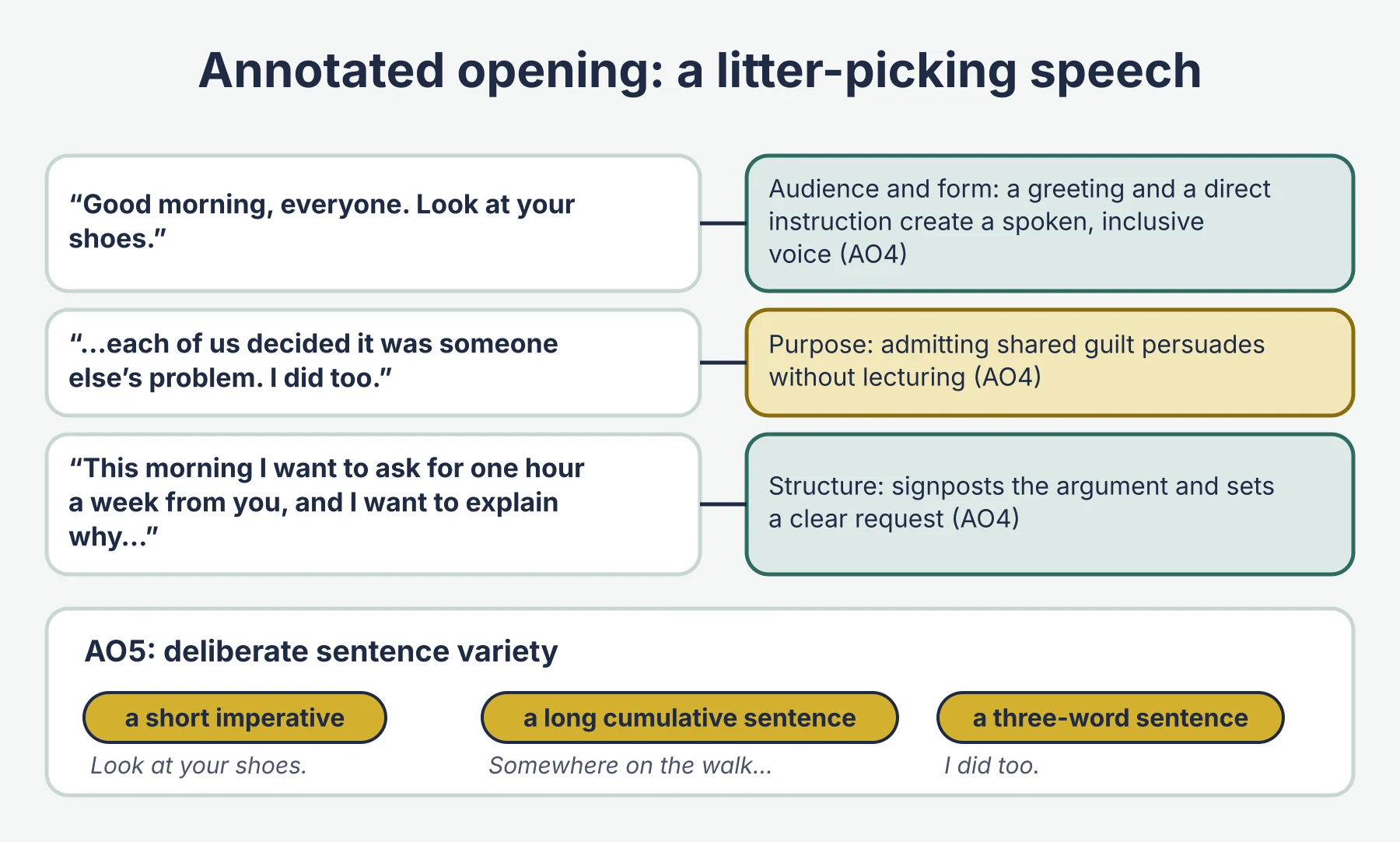
| Cyclical ending | Return to the opening image for a sense of completion |
Use a method when it does a job; three well-placed devices are more convincing than ten.
A five-minute plan
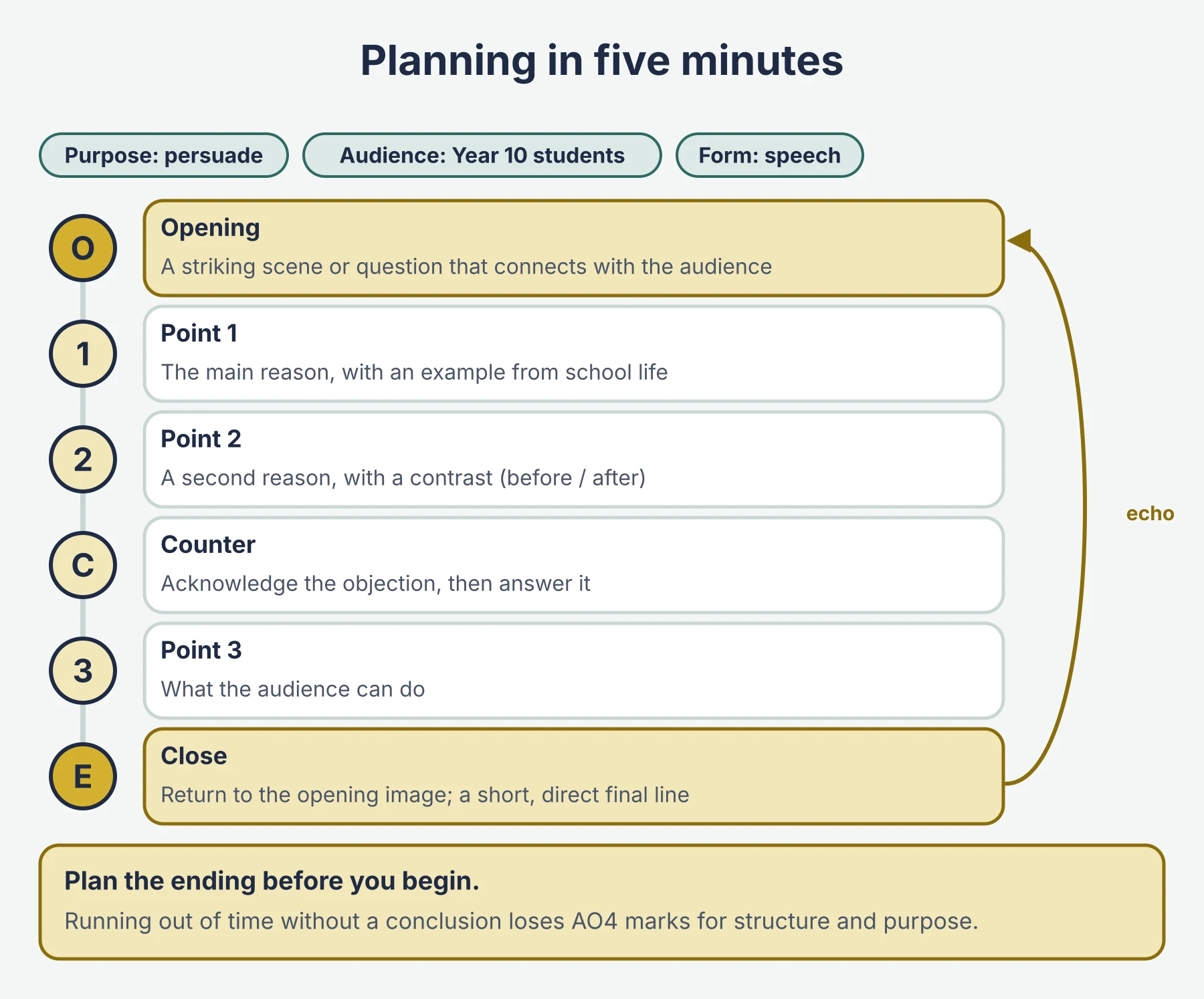
- Purpose, audience, form in the margin.
- Opening hook.
- Three or four developed points, each with an example.
- Counter-argument and answer (for argument or persuasion).
- Ending planned before you start.
AO5 checklist for the last three minutes
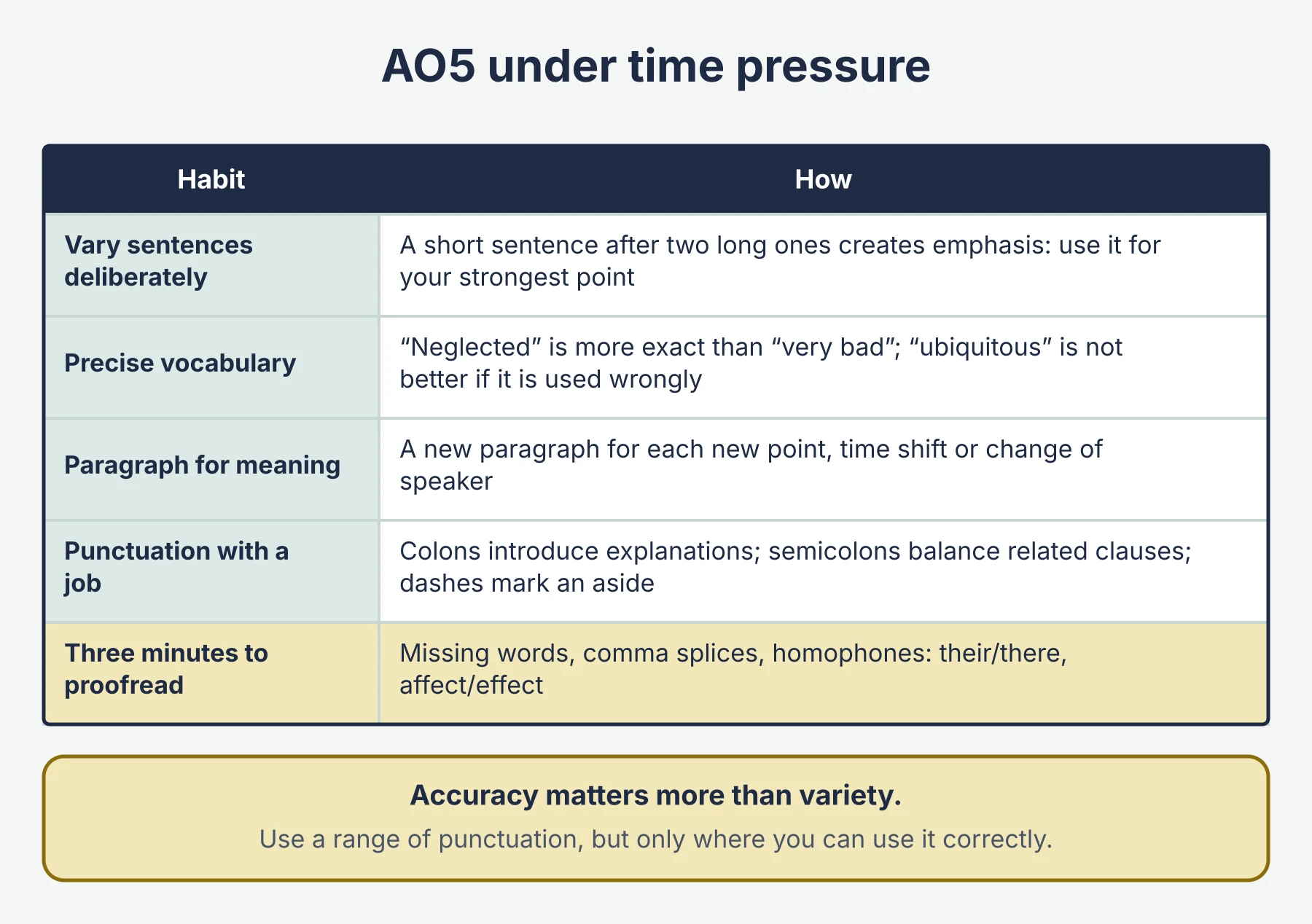
- Every sentence has a main verb; no comma splices.
- Apostrophes for possession and contraction only.
- Homophones: their/there/they’re, your/you’re, affect/effect.
- Paragraph breaks at each new point.
- At least one deliberate short sentence and one controlled complex sentence.
Key terms
| Term | Meaning |
|---|---|
| Transactional writing | Writing for a real purpose and reader, such as to persuade or advise |
| Register | The level of formality chosen for the audience |
| Tone | The attitude the writing conveys (urgent, warm, ironic, serious) |
| Standfirst | A short summary under an article’s headline |
| Signposting | Words that guide the reader through the structure (“Firstly”, “Finally”) |
| Call to action | A closing instruction telling the reader what to do |
| Rebuttal | Answering an opposing argument |
| Comma splice | Two main clauses joined only by a comma: an AO5 error |
Exam traps
- Choosing the prompt with the more interesting topic rather than the one you can develop.
- One register for every form.
- Lists of points without development.
- No conclusion because there was no plan.
- Decorating a leaflet instead of writing it.
- Over-ambitious vocabulary used inaccurately.
- Forgetting to proofread: AO5 is 18 marks.
Self-test
- How many marks are available for AO4 and AO5 in Section B?
- How long should you spend on Section B?
- Name the six forms listed in the specification.
- What three things should you identify in every prompt?
- What is the difference between tone and register?
- Give two conventions of a speech.
- Why should you not draw boxes for a leaflet?
- What is a rebuttal, and why use one?
- What should you plan before you start writing?
- Give two common AO5 errors to check for.
- How does a review differ from a summary?
- How can Section A help with Section B?
Answers: 1. AO4 27, AO5 18 (45 in total). 2. About 45 minutes. 3. Article for a magazine or newspaper, speech, letter, guide, review, text of a leaflet. 4. Purpose, audience and form. 5. Tone is the attitude conveyed; register is the level of formality. 6. Any two: greeting, direct address, signposting, spoken rhythm, a memorable close. 7. Only the words are marked; layout earns nothing and takes time. 8. Answering an opposing view; it shows balance and strengthens your own case. 9. The ending (as well as the points in between). 10. Any two: comma splices, apostrophe misuse, homophone errors, missing words, tense slips. 11. A review gives an evaluative judgement backed by evidence and a verdict, not just an account of content. 12. Techniques analysed in the non-fiction texts can be reused deliberately in your own writing.
Related pages
Related resources
-
Revision notes
Edexcel IGCSE English Language: Non-fiction Texts and Transactional Writing — Revision Notes
Condensed recall notes on reading non-fiction, language analysis, comparison and transactional writing for Edexcel International GCSE English Language 4EA1.
English · Pearson Edexcel · IGCSE
Revise topic -
Practice questions
Edexcel IGCSE English Language: Non-fiction Texts and Transactional Writing — Practice Questions
Original practice with worked answers on non-fiction analysis, comparison and transactional writing for Pearson Edexcel IGCSE English Language A 4EA1 Paper 1.
English · Pearson Edexcel · IGCSE
Try questions -
Study guides
Edexcel IGCSE English Language: Component 1 (4EA1)
The two sections of Component 1 – Non-fiction Texts and Transactional Writing – for Pearson Edexcel International GCSE English Language A (4EA1).
English · Pearson Edexcel · IGCSE
Read guide
Get free revision emails (optional)
Occasional emails with practice questions, worked explanations and links to free resources for the qualification and subjects you choose. No spam, and you can unsubscribe from any email. The free tools on this site never need an email.