
Study Guides
Pearson Edexcel International GCSE Physics (4PH1): Energy transfers
Energy stores and pathways, efficiency, Sankey diagrams, conduction, convection, radiation and the thermal practicals for Edexcel IGCSE Physics 4PH1, 4b.
- Subject
- Physics
- Level
- IGCSE
- Topic
- Energy resources and energy transfers
- Author
- Marlbridge Academic Team
- Updated
- Reviewed by
- Hassan (what this means)
Aligned to Pearson Edexcel IGCSE Physics (4PH1), Issue 4. Official specification .
Syllabus page (what it covers and how it is assessed): Pearson Edexcel IGCSE Physics.
Syllabus points this page covers
4PH1
- 4b Energy transfers
Found an error? Report a correction.
Need help with this topic? Request a free trial class for IGCSE Physics (4PH1).
This guide covers sub-topic 4(b) Energy transfers, statements 4.2 to 4.10 of the Pearson Edexcel International GCSE in Physics (4PH1), Issue 4. All of it is core content, so it can appear on Paper 1 or Paper 2. The Energy Resources and Energy Transfers study guide gives the overview of Topic 4; this page goes further into describing transfers, drawing and reading Sankey diagrams, explaining convection in everyday situations and carrying out the thermal energy practical.
Describing a transfer: store, pathway, store
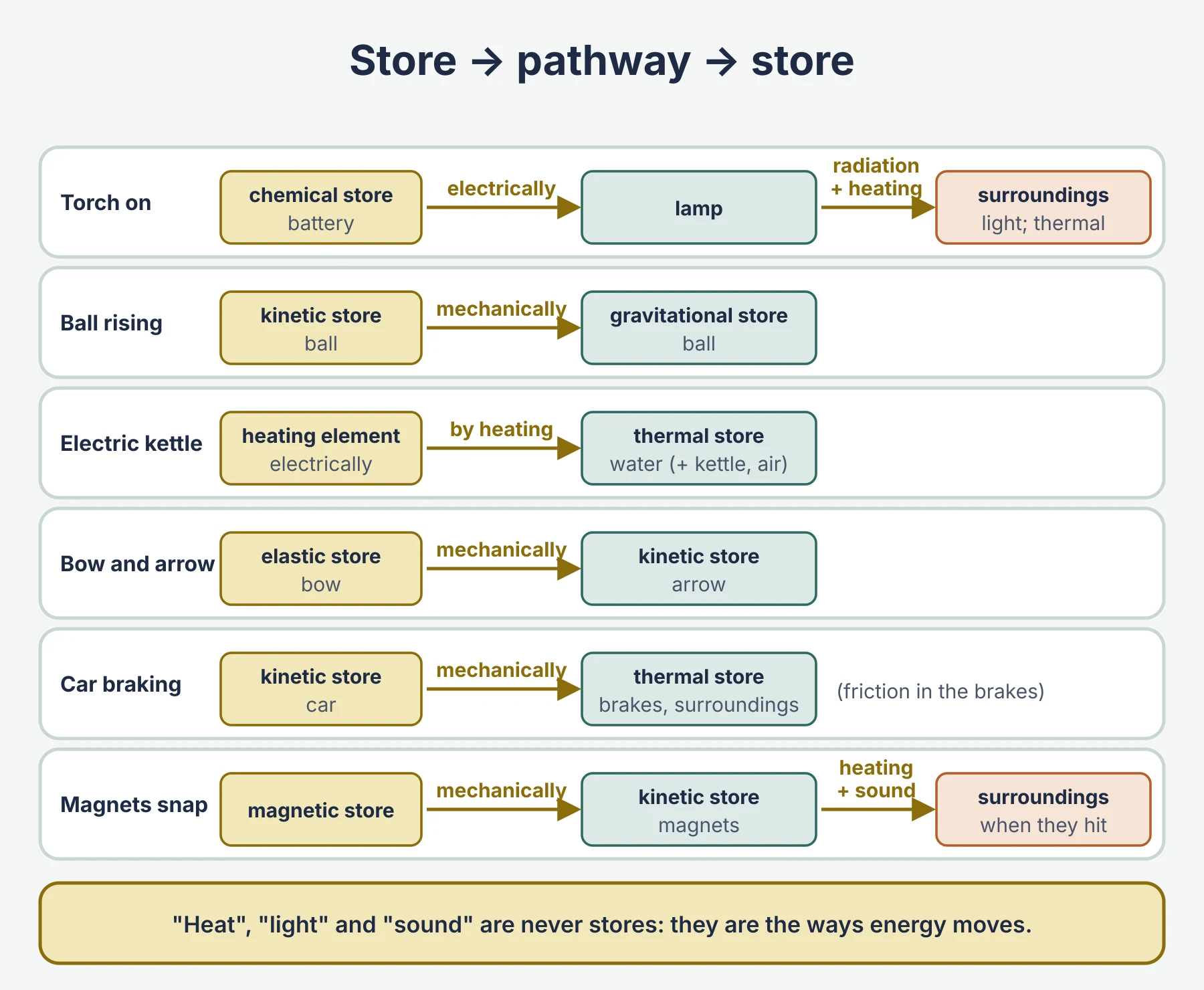
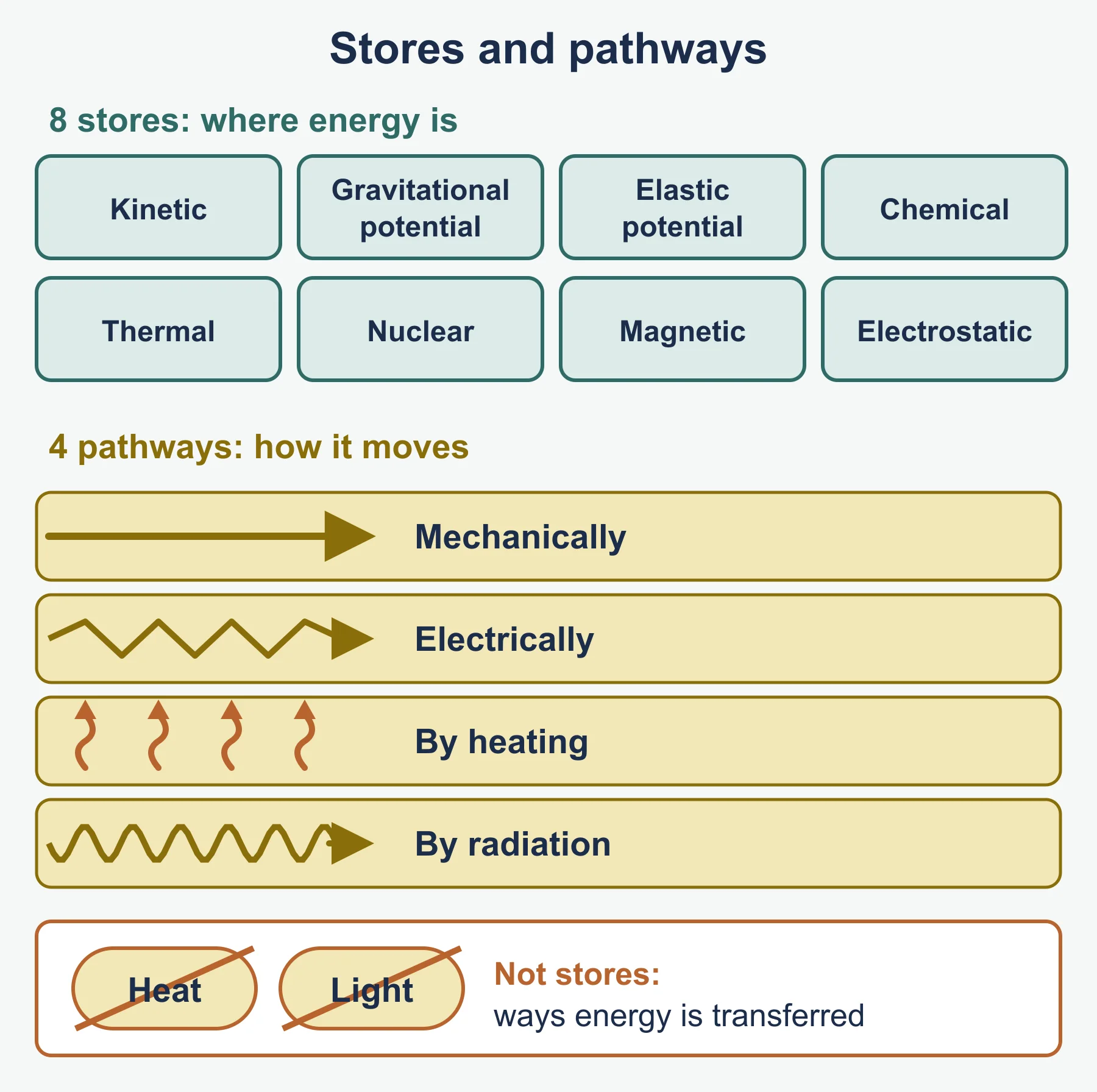
Statement 4.2 lists eight energy stores (chemical, kinetic, gravitational, elastic, thermal, magnetic, electrostatic, nuclear) and four ways energy is transferred between them: mechanically (a force moving through a distance), electrically (a current), by heating, and by radiation (light and sound). A full description names the store energy leaves, the pathway, and the store it ends up in, including the wasted part.
| Situation | Description |
|---|---|
| Torch switched on | Chemical store of the battery → electrically → lamp → by radiation (light) to the surroundings, and by heating to the thermal store of the surroundings |
| Ball thrown upwards, rising | Kinetic store of the ball → mechanically (work done against gravity) → gravitational store of the ball |
| Electric kettle | Electrically → heating element → by heating → thermal store of the water (some to the thermal store of the kettle and air) |
| Bow firing an arrow | Elastic store of the bow → mechanically → kinetic store of the arrow |
| Car braking | Kinetic store of the car → mechanically (friction in the brakes) → thermal store of the brakes and surroundings |
| Two magnets released near each other, snapping together | Magnetic store → mechanically → kinetic store of the magnets, then by heating and sound when they hit |
“Heat”, “light” and “sound” are never stores; they are the ways energy moves.
Conservation of energy and efficiency (4.3, 4.4)
Energy cannot be created or destroyed. In any transfer, the total energy output equals the total energy put in, so a calculation can always be checked: the useful part and the wasted parts must add up to the total. The specification writes efficiency in terms of outputs:
efficiency = (useful energy output / total energy output) × 100%Because the total energy output equals the energy supplied, you can use either figure as the bottom line.
Worked example 1. A lamp transfers 200 J in total, of which 80 J is useful light. The rest heats the surroundings.
efficiency = 80 / 200 × 100% = 40%
wasted energy = 200 − 80 = 120 J (to the thermal store of the surroundings)
Worked example 2 (working backwards). A power station is 35% efficient and delivers 700 MJ of electrical energy. Find the total energy output and the energy wasted.
0.35 = 700 / total        total = 700 / 0.35 = 2000 MJ
wasted = 2000 − 700 = 1300 MJ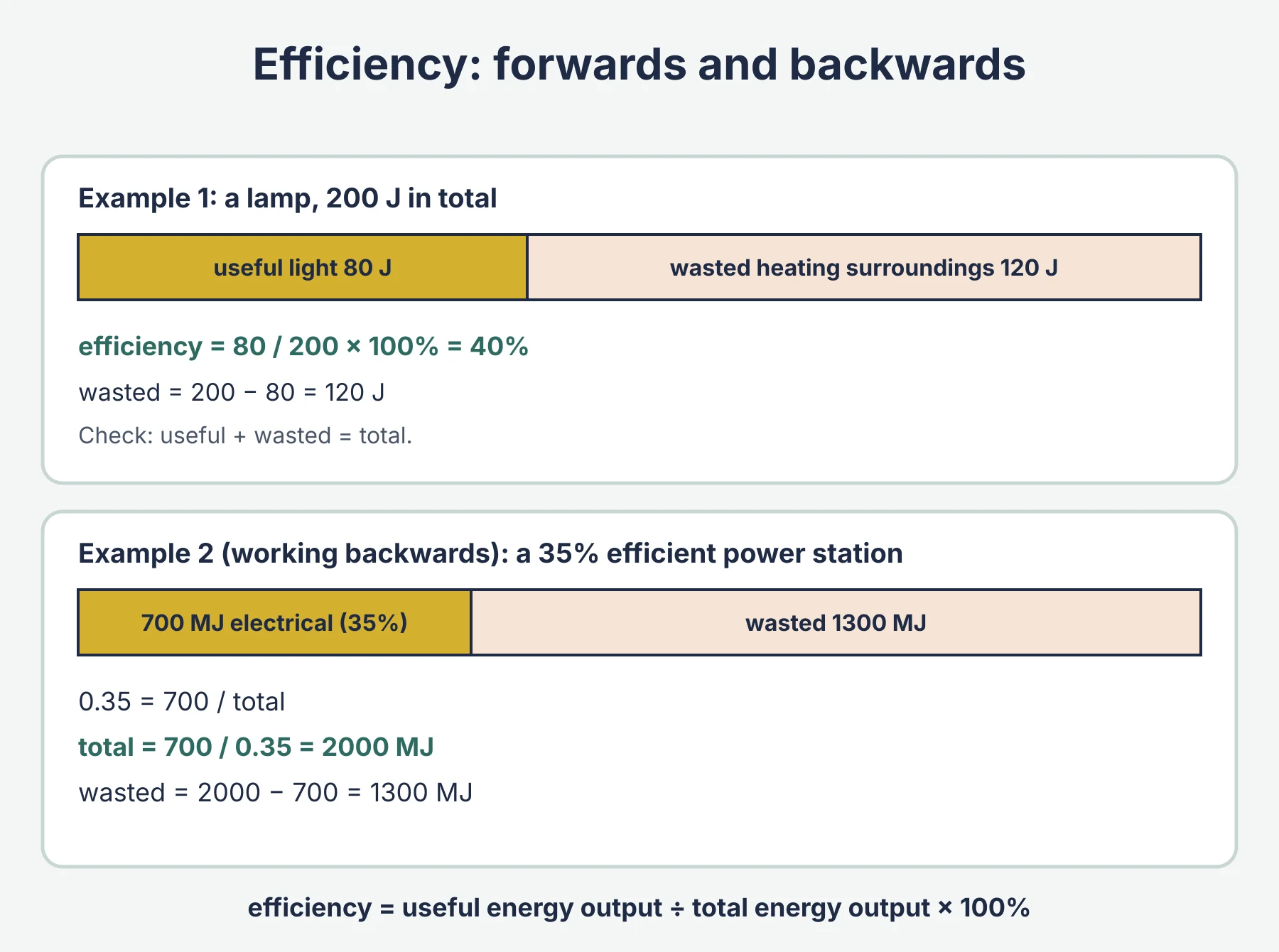
Sankey diagrams (4.5)
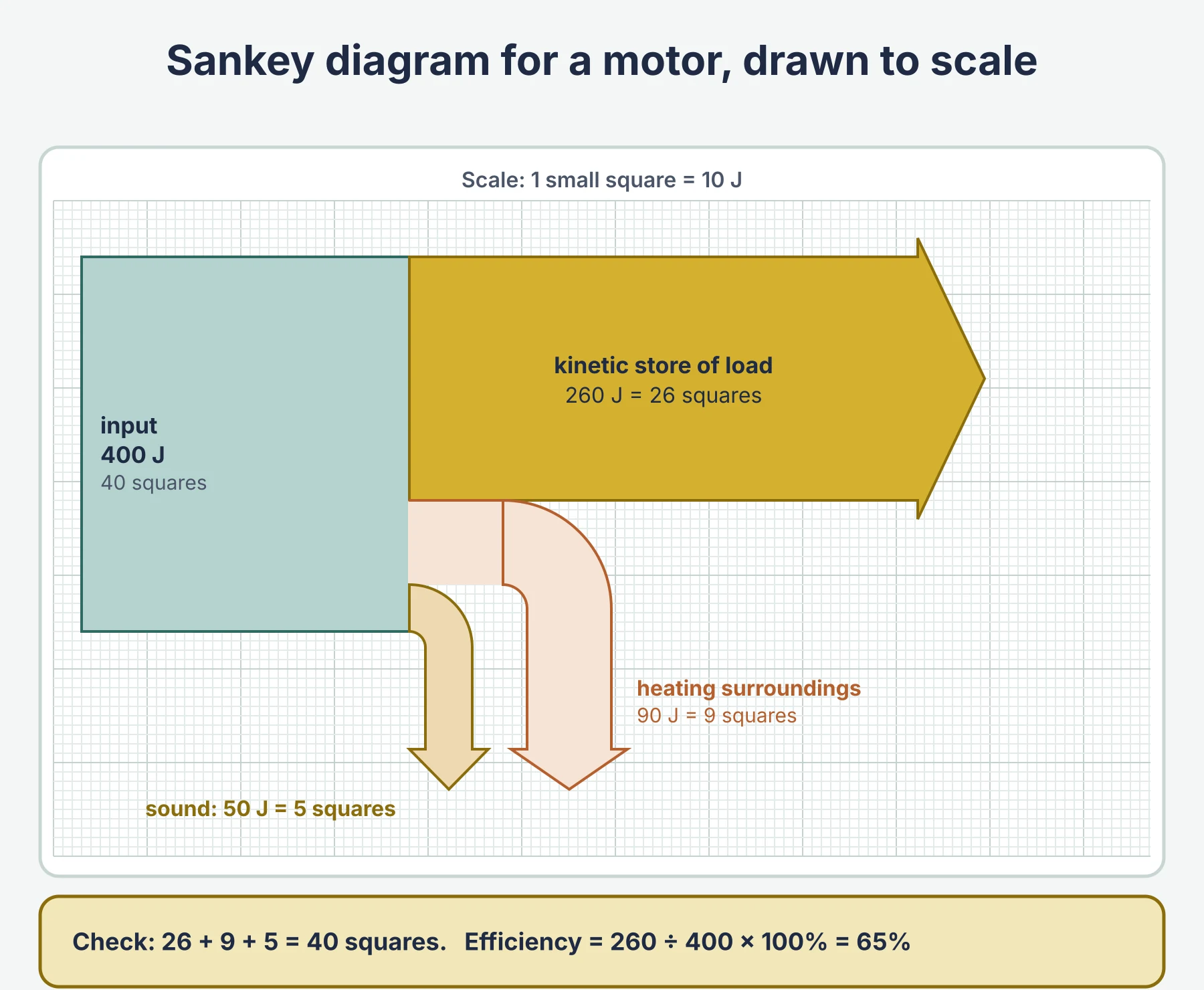
A Sankey diagram is drawn to scale: the width of each arrow is proportional to the energy it represents. The input arrow enters from the left; the useful output continues straight on; wasted outputs bend away (usually downwards).
Worked example 3. An electric motor is supplied with 400 J. It transfers 260 J to the kinetic store of the load, 90 J by heating to the surroundings and 50 J as sound. Using a scale of 1 small square = 10 J:
- input arrow: 40 squares wide;
- useful arrow (kinetic): 26 squares;
- thermal arrow: 9 squares; sound arrow: 5 squares.
The widths check: 26 + 9 + 5 = 40. Efficiency = 260 ÷ 400 × 100% = 65%.
When reading a Sankey diagram, count squares across each arrow, multiply by the scale, and check the outputs add up to the input before you calculate anything.
Thermal energy transfer (4.6)
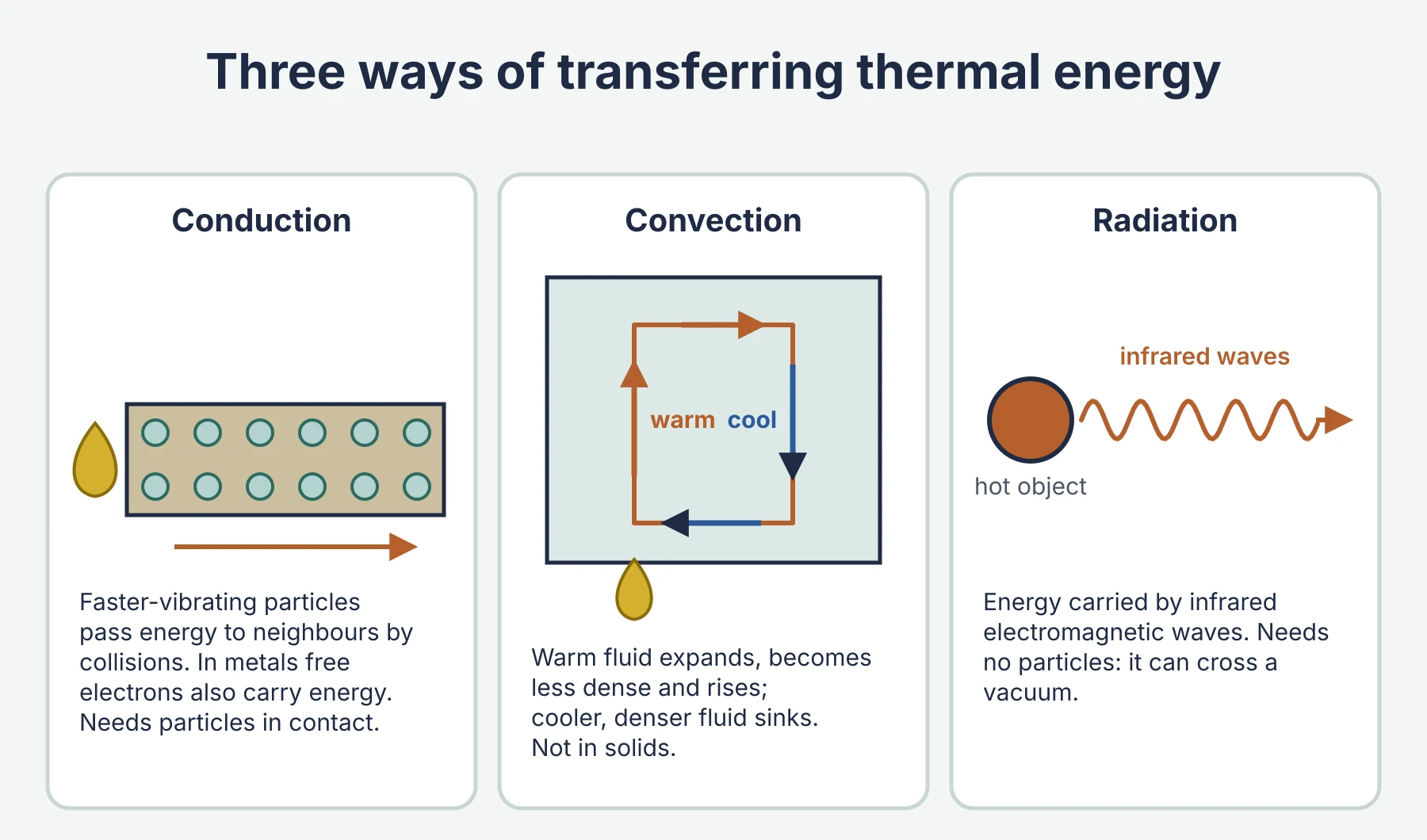
- Conduction: particles vibrating faster pass energy to their neighbours through collisions. In metals, free electrons also move through the structure and carry energy quickly, which is why metals are good conductors. Conduction needs particles in contact, so it is fastest in solids and slow in gases.
- Convection: a fluid (liquid or gas) near a heat source warms, expands and becomes less dense, so it rises. Cooler, denser fluid sinks to take its place and is heated in turn. This circulation is a convection current. It cannot happen in a solid, where particles cannot move from place to place.
- Radiation: energy carried by infrared electromagnetic waves. It needs no particles and can cross a vacuum.
Convection in everyday phenomena (4.7)
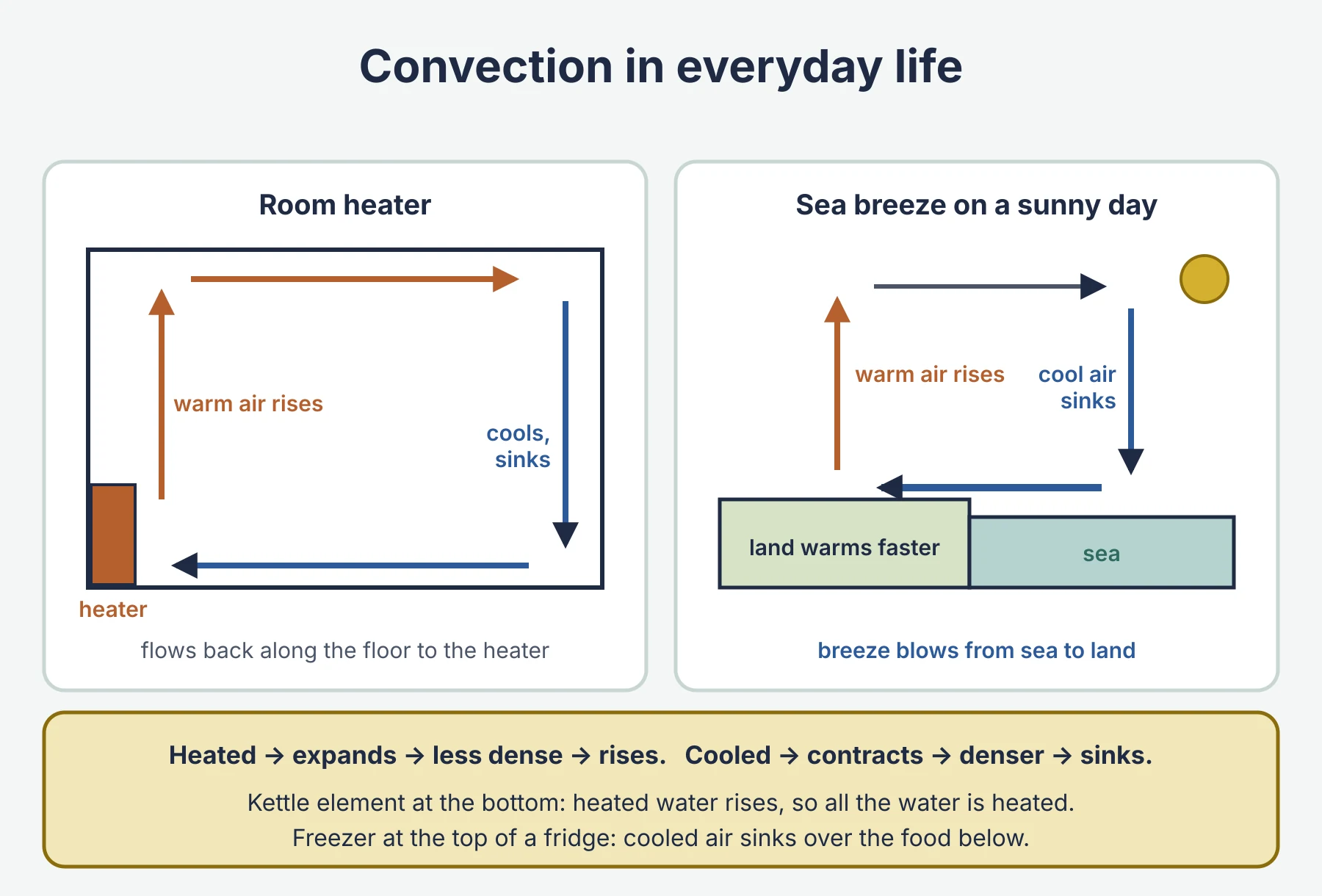
A full answer follows the density chain: heated → expands → less dense → rises; cooled → contracts → denser → sinks.
- A room heater. Air next to the heater warms and rises to the ceiling, spreads across, cools and sinks on the far side, then flows back along the floor to the heater.
- Sea breeze on a sunny day. The land warms up faster than the sea. Air over the land warms, becomes less dense and rises; cooler, denser air from over the sea moves in to replace it, so the breeze blows from sea to land.
- Kettle element at the bottom. Water heated at the bottom rises and cooler water sinks to the element, so all the water is heated. An element at the top would heat only the top layer.
- Freezer compartment at the top of a fridge. Air cooled at the top becomes denser and sinks, cooling the food below, while warmer air rises to be cooled.
Radiation, surface and temperature (4.8)
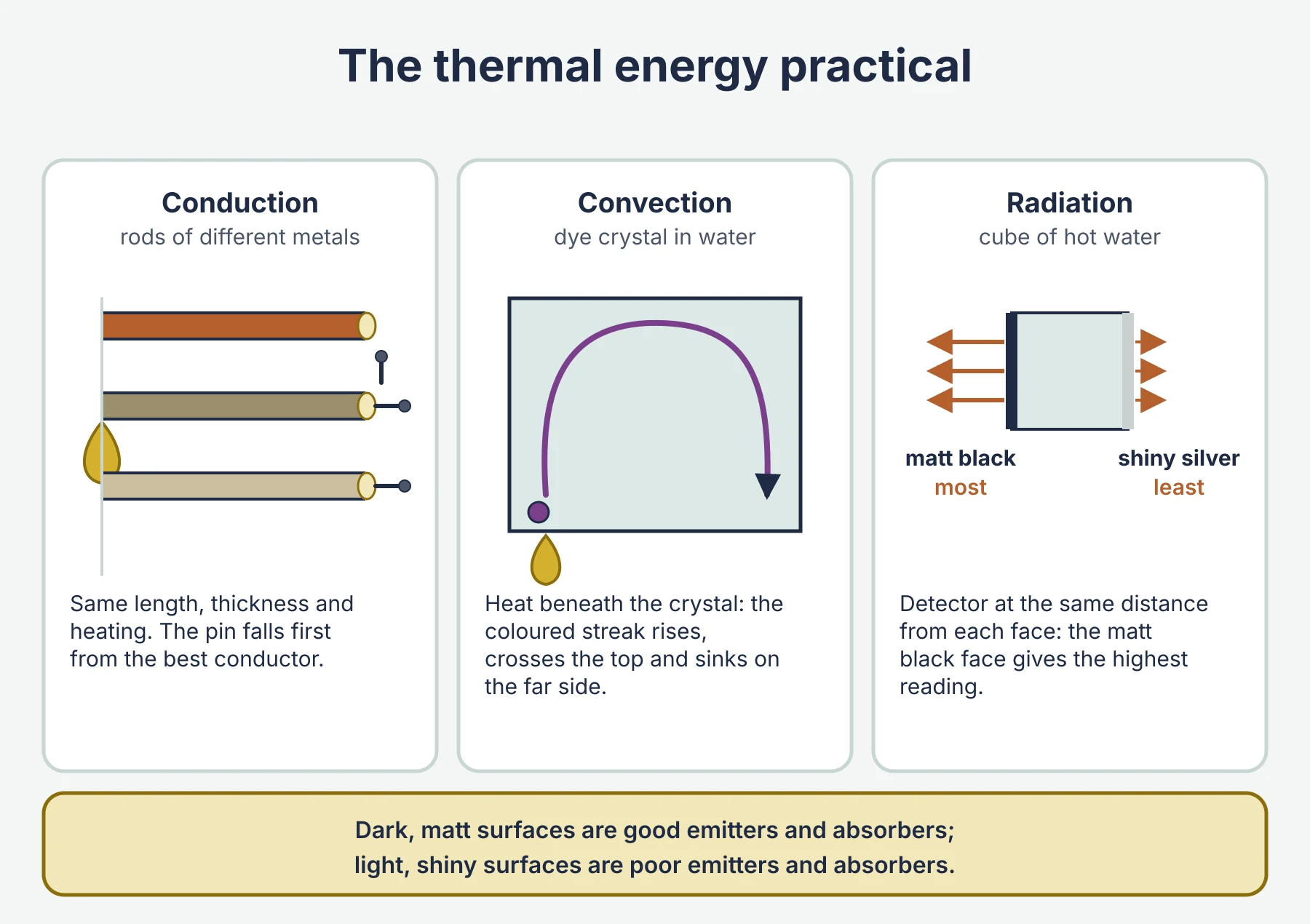
Every object emits infrared radiation, and a hotter object emits more each second than a cooler one. The surface matters: dark, matt surfaces are good emitters and good absorbers; light, shiny surfaces are poor emitters and poor absorbers, because they reflect most of the radiation that falls on them. Solar water panels are painted matt black; emergency blankets are shiny.
The thermal energy practical (4.9)
- Conduction: take rods of different metals of the same length and thickness. Fix a small pin to the far end of each with wax and heat the near ends equally. The pin falls first from the best conductor. Keep the length, thickness and heating the same so only the material changes.
- Convection: drop a small crystal of a coloured dye (such as potassium permanganate) at the bottom of a beaker of water, against one side. Heat gently beneath the crystal. The coloured streak rises above the flame, crosses the top and sinks on the far side, tracing the convection current.
- Radiation: fill a metal cube with faces of different finishes (matt black, shiny silver, matt white, shiny black) with hot water. Hold an infrared detector or thermometer the same distance from each face. The matt black face gives the highest reading. Alternatively, fill identical cans with different surfaces with the same volume of hot water and record their temperatures as they cool.
Reducing unwanted transfer (4.10)
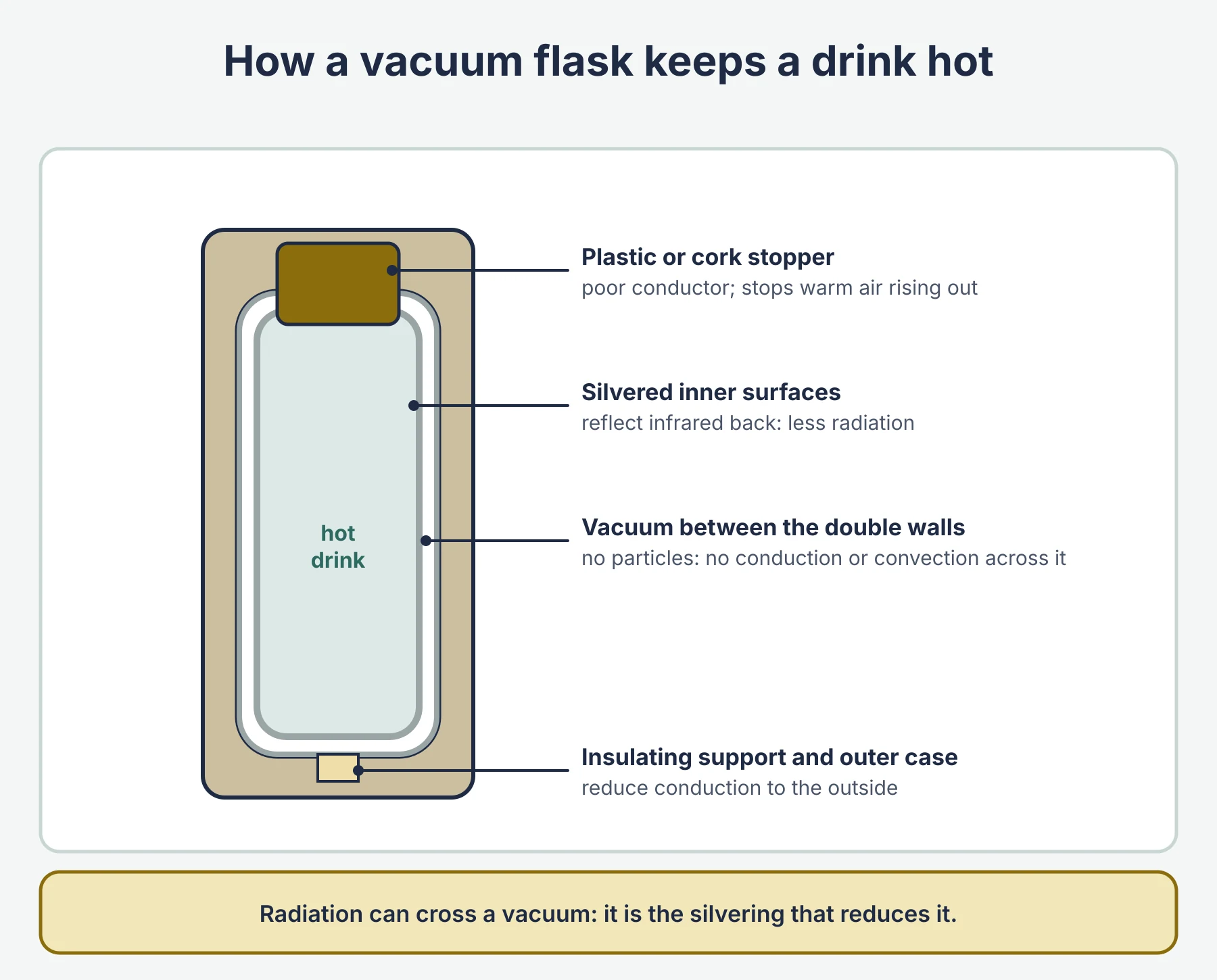
The vacuum flask is the classic “explain” example because each feature tackles a different method:
- vacuum between the double walls: no particles, so no conduction or convection across it;
- silvered inner surfaces: reflect infrared back, reducing transfer by radiation;
- stopper made of plastic or cork: a poor conductor, and it stops warm air rising out by convection;
- insulating supports and outer case: reduce conduction to the outside.
The same thinking explains lagging on a hot water tank (trapped air is a poor conductor and cannot circulate) and plastic handles on saucepans (plastic is a poor conductor).
Common mistakes
- Writing “light energy” or “heat energy” as a store.
- Saying energy is “used up” or “lost”. It is transferred, usually to the thermal store of the surroundings.
- Saying “heat rises”. It is the warmer, less dense fluid that rises.
- Explaining a vacuum flask with “the vacuum stops radiation”. Radiation crosses a vacuum; the silvering reduces it.
- Drawing a Sankey diagram whose output widths do not add up to the input.
Exam technique
- Describe the energy transfers: store → pathway → store, for the useful and the wasted energy.
- Explain convection: use the full density chain and say where the fluid rises and sinks.
- Calculate efficiency: write the equation, substitute, give a decimal or percentage with no unit.
- Evaluate a practical: name the control variables and one improvement, such as repeating readings.
Keep going
- Energy transfers revision notes
- Energy transfers practice questions
- Energy practice questions for the whole of Topic 4
Written against the Pearson Edexcel International GCSE in Physics (4PH1) specification, Issue 4. Always check the current specification for your examination year.
Related resources
-
Practice questions
Pearson Edexcel International GCSE Physics (4PH1): Energy transfers – Practice Questions
Original 4PH1 questions on energy stores, efficiency, Sankey diagrams, convection, radiation practicals and the vacuum flask, with full mark-scheme answers.
Physics · Pearson Edexcel · IGCSE
Try questions -
Revision notes
Pearson Edexcel International GCSE Physics (4PH1): Energy transfers – Revision Notes
Recall notes for 4PH1 sub-topic 4b: stores and pathways, efficiency, Sankey diagrams, conduction, convection, radiation, the practical and a self-test.
Physics · Pearson Edexcel · IGCSE
Revise topic -
Study guides
Pearson Edexcel International GCSE Physics (4PH1): Units for Energy Resources and Energy Transfers
The units of Topic 4 in Edexcel IGCSE Physics 4PH1: kg, J, m, m/s, m/s², N, s and W, how they link, prefixes and converting data before you calculate.
Physics · Pearson Edexcel · IGCSE
Read guide
Related articles
Get free revision emails (optional)
Occasional emails with practice questions, worked explanations and links to free resources for the qualification and subjects you choose. No spam, and you can unsubscribe from any email. The free tools on this site never need an email.