
Revision Notes
Pearson Edexcel International GCSE Physics (4PH1): Energy transfers – Revision Notes
Recall notes for 4PH1 sub-topic 4b: stores and pathways, efficiency, Sankey diagrams, conduction, convection, radiation, the practical and a self-test.
- Subject
- Physics
- Level
- IGCSE
- Topic
- Energy resources and energy transfers
- Author
- Marlbridge Academic Team
- Updated
- Reviewed by
- Hassan (what this means)
Aligned to Pearson Edexcel IGCSE Physics (4PH1), Issue 4. Official specification .
Syllabus page (what it covers and how it is assessed): Pearson Edexcel IGCSE Physics.
Syllabus points this page covers
4PH1
- 4b Energy transfers
Found an error? Report a correction.
Need help with this topic? Request a free trial class for IGCSE Physics (4PH1).
These notes condense sub-topic 4(b) Energy transfers (statements 4.2 to 4.10) of Pearson Edexcel International GCSE Physics 4PH1, Issue 4. For the full explanations and worked examples, use the Energy transfers study guide; for exam-style questions, the Energy transfers practice questions.
Stores and pathways
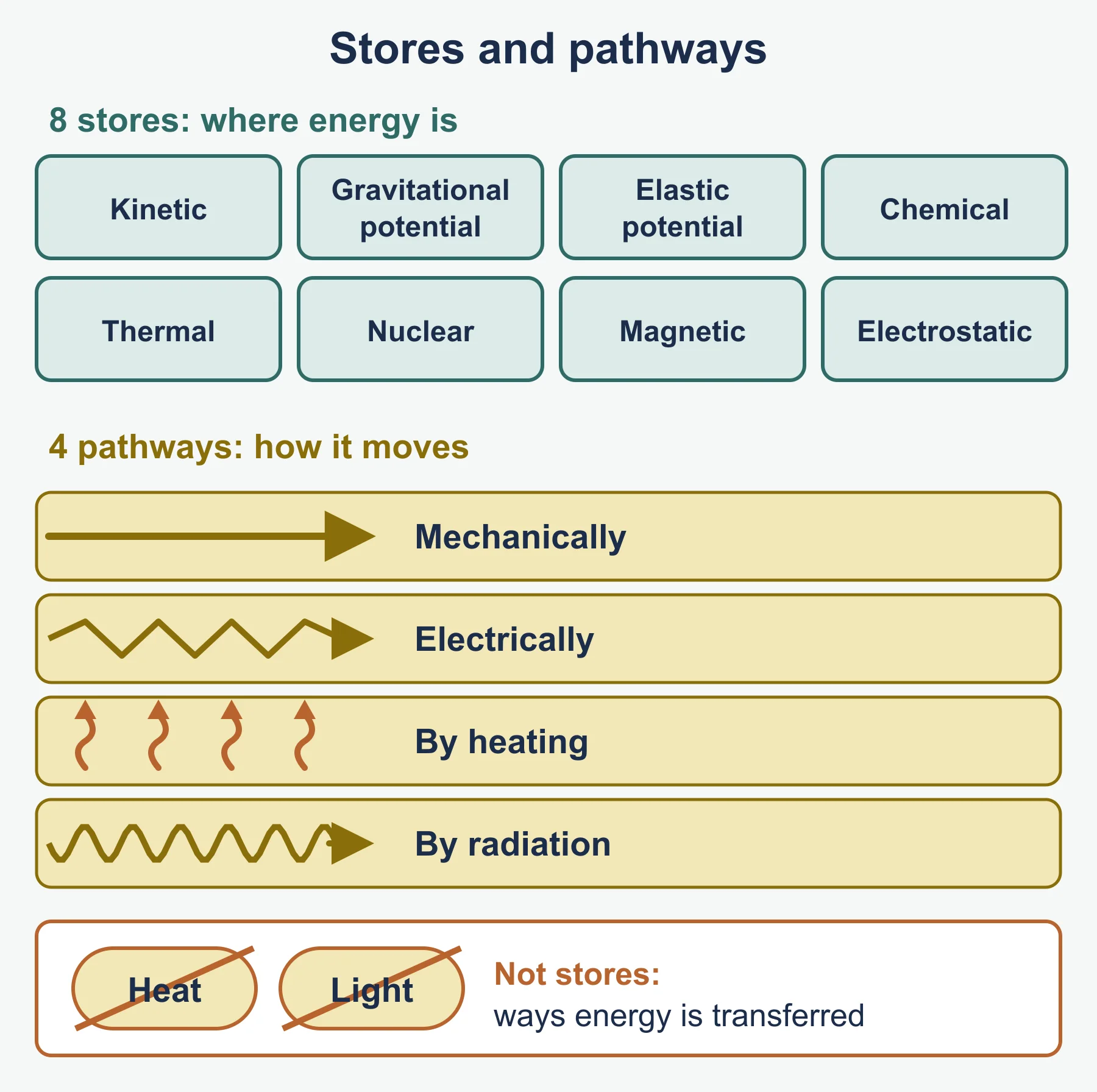
Eight stores: chemical, kinetic, gravitational, elastic, thermal, magnetic, electrostatic, nuclear. Four pathways: mechanically, electrically, by heating, by radiation (light and sound).
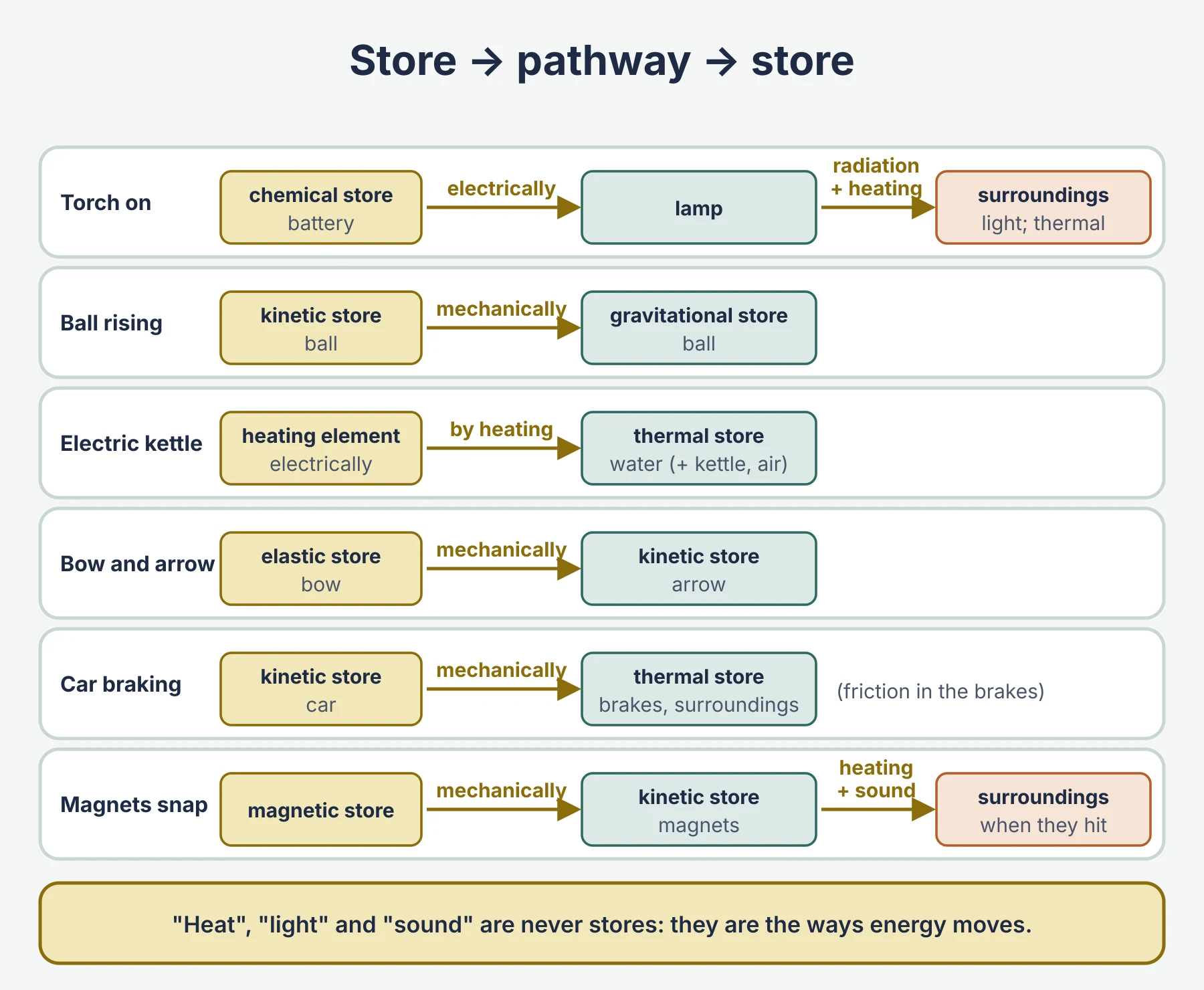
Template for any “describe the energy transfers” question:
[store] → [pathway] → [store] (then the same for the wasted energy)Example: a falling apple, gravitational store → mechanically (gravity does work) → kinetic store; a little to the thermal store of the air through air resistance.
Conservation and efficiency
- Energy is never created or destroyed: total energy output = total energy supplied.
- Wasted energy usually ends in the thermal store of the surroundings, spread out and no longer useful.
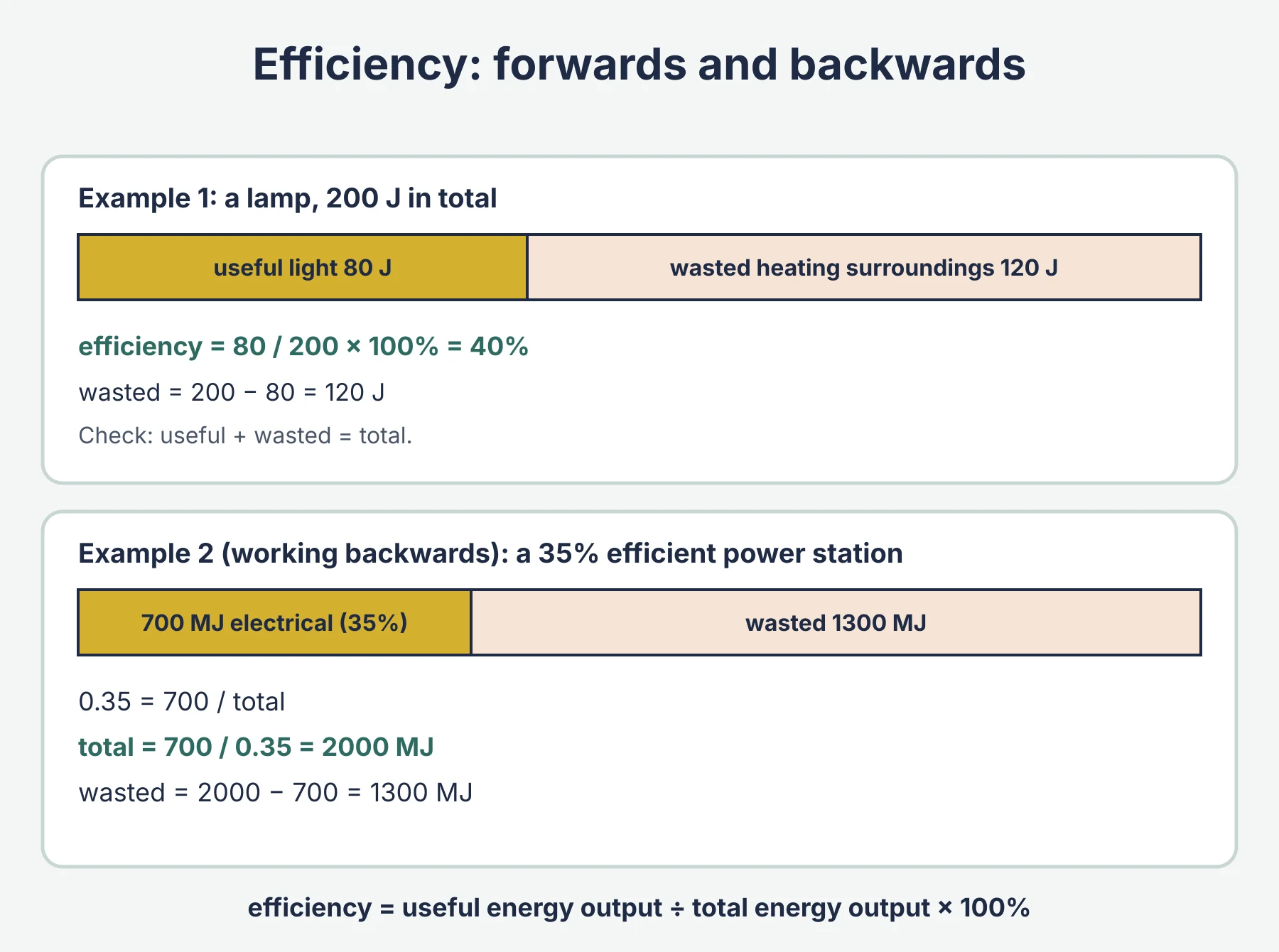
efficiency = (useful energy output / total energy output) × 100%
useful = efficiency × total        total = useful / efficiency
Efficiency is never above 100% (or 1) and has no unit.
Sankey diagrams
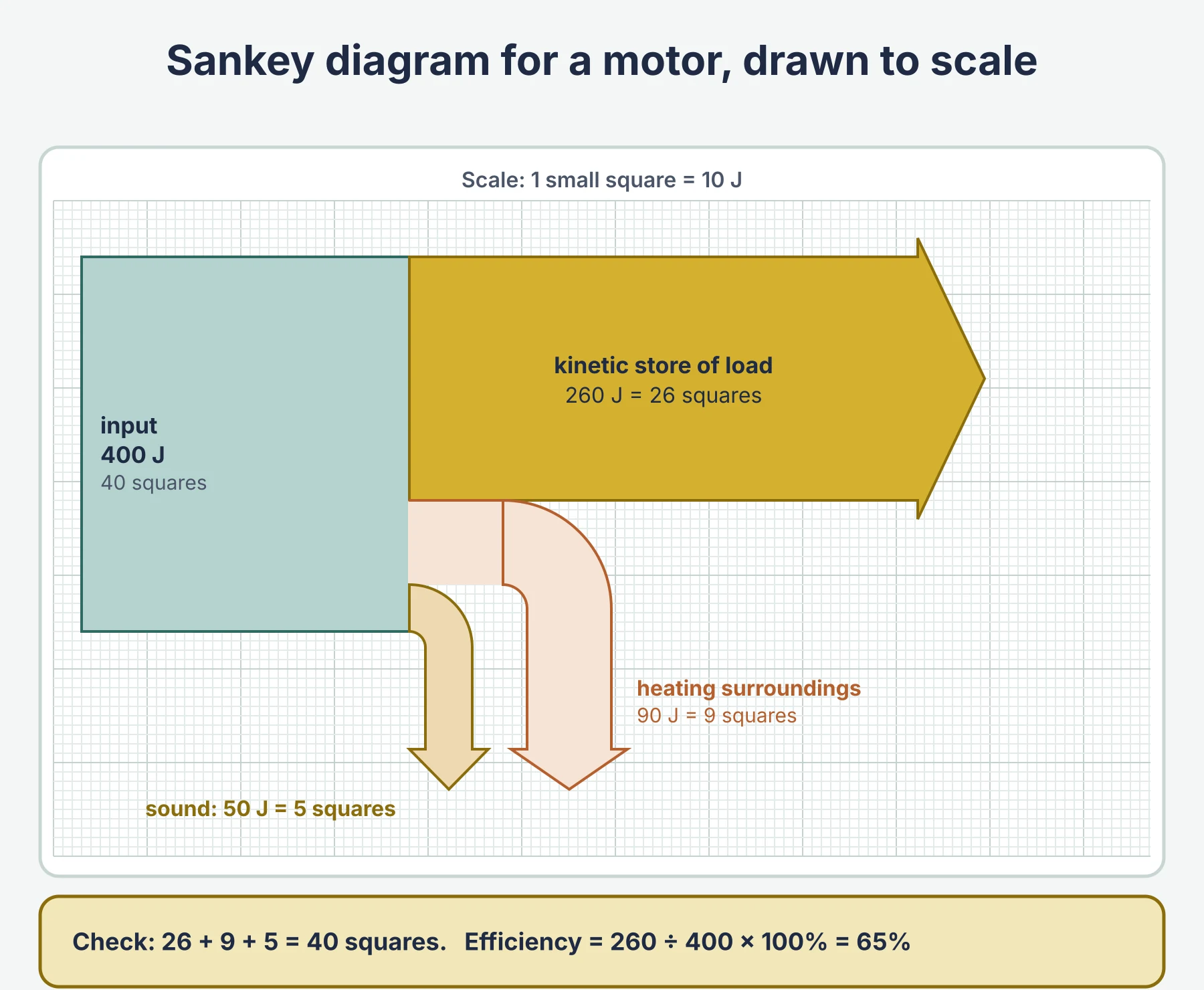
- Arrow width ∝ energy; one scale for the whole diagram.
- Input enters on the left; useful output goes straight on; wasted outputs curve away.
- Check: sum of output widths = input width.
- To read: count squares across each arrow × scale.
Thermal transfer
| Method | How | Where |
|---|---|---|
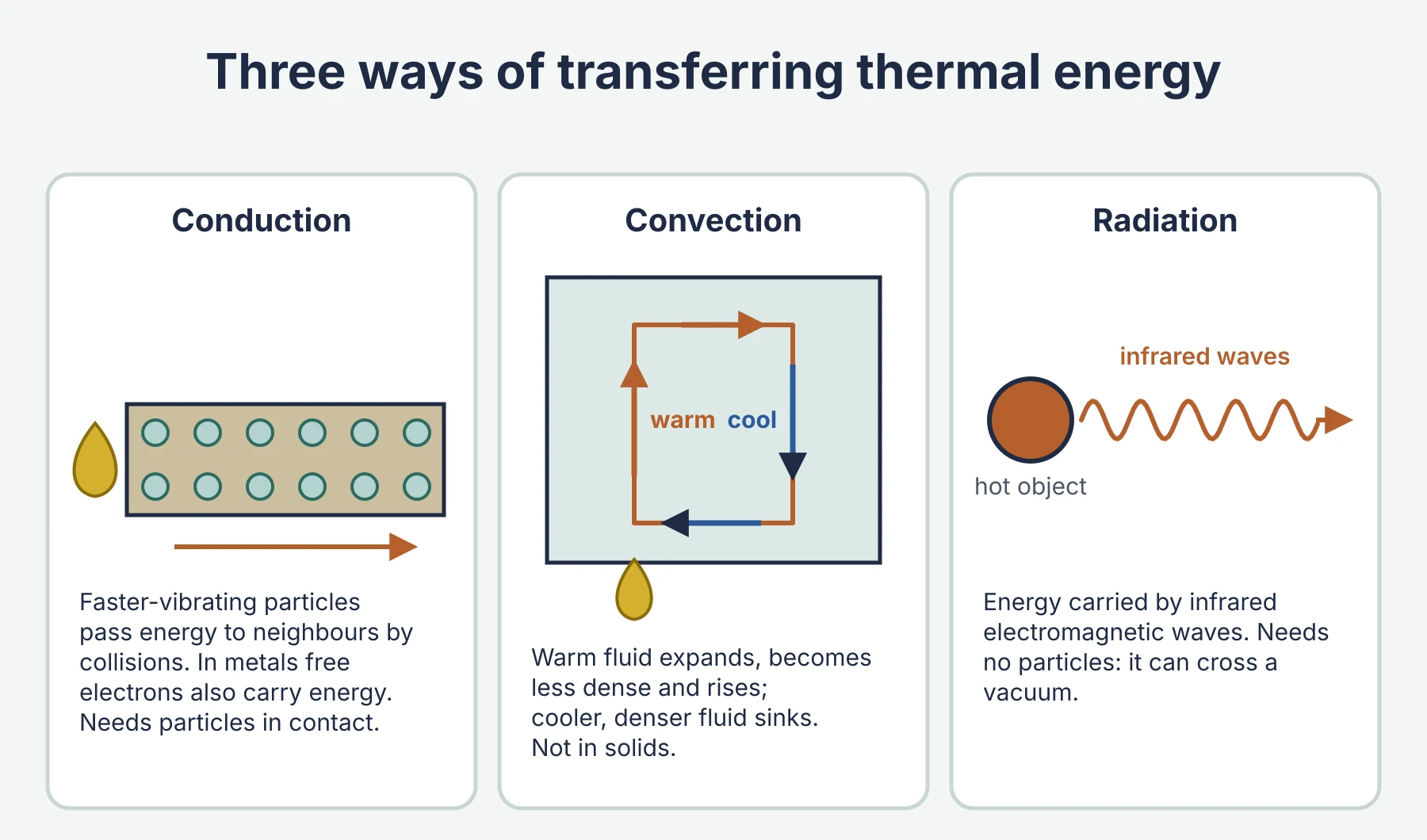
| Conduction | Vibrating particles pass energy to neighbours; free electrons carry it fast in metals | Mainly solids |
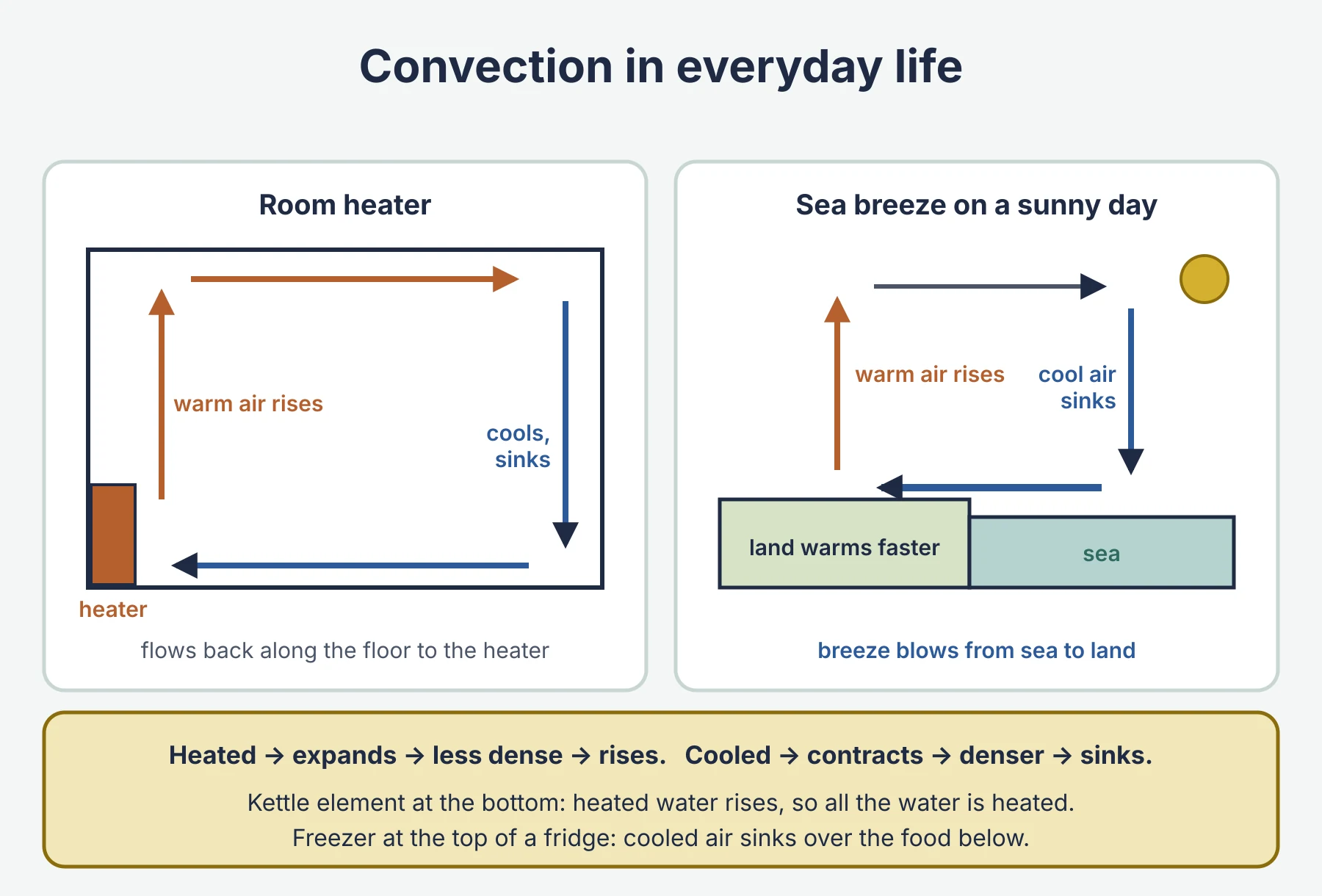
| Convection | Heated fluid expands, becomes less dense and rises; cooler denser fluid sinks; a convection current forms | Liquids and gases only |
| Radiation | Infrared electromagnetic waves | Anywhere, including a vacuum |
Convection chain: heated → expands → less dense → rises; cooled → denser → sinks. Everyday convection: room heaters; sea breezes (land warms faster, air rises over land, cooler sea air moves in); kettle element at the bottom; freezer compartment at the top of a fridge.
Radiation rules:
- hotter objects emit more radiation per second;
- dark matt surfaces: best emitters and best absorbers;
- light shiny surfaces: poorest emitters and absorbers (best reflectors).
The practical (4.9)
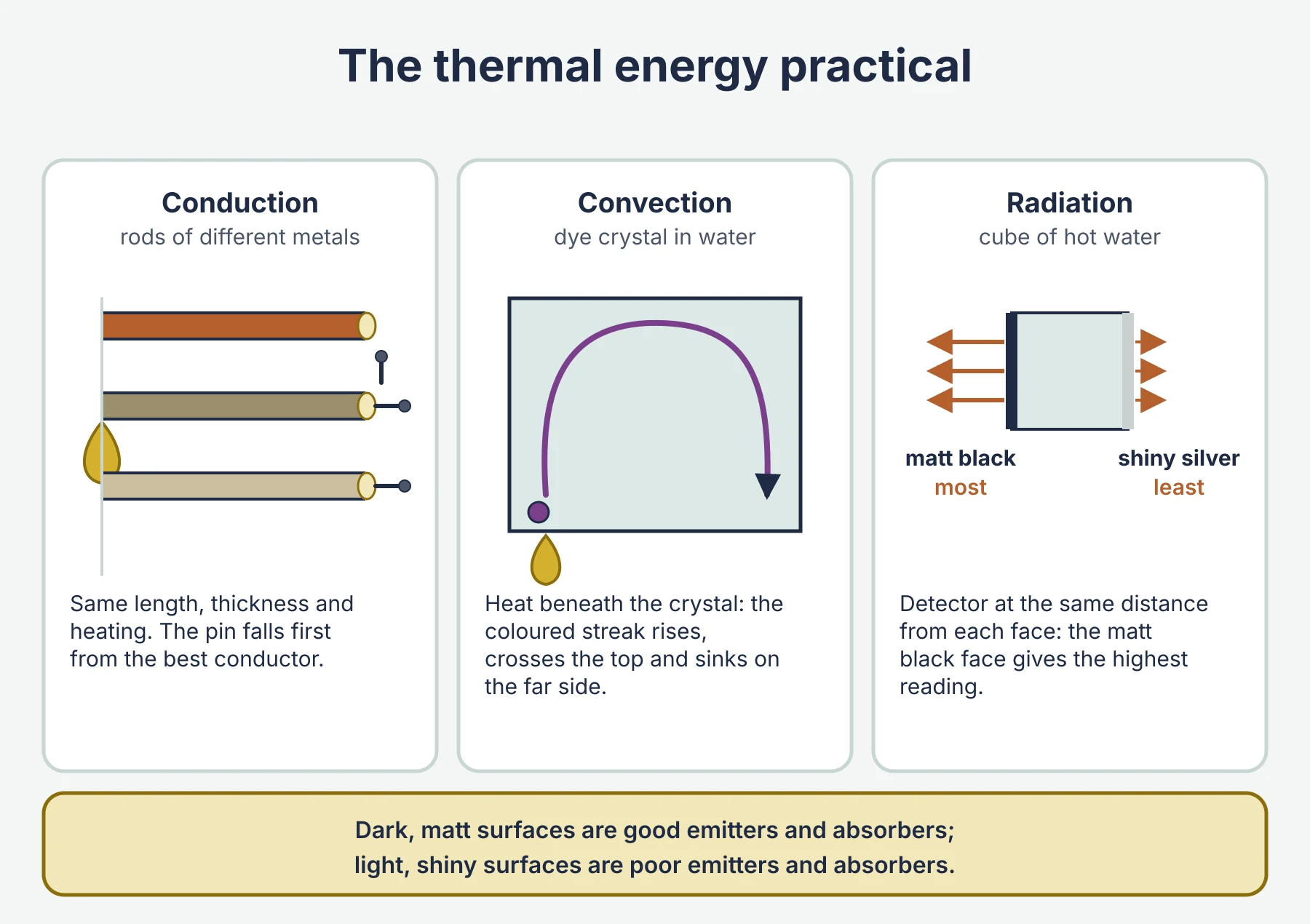
- Conduction: equal rods of different metals, wax-fixed pins at the far ends, heat the near ends equally; first pin to fall marks the best conductor.
- Convection: coloured crystal at the bottom edge of a beaker of water, heat gently below it; the colour traces the current.
- Radiation: cube with different faces filled with hot water, infrared detector or thermometer at equal distance from each face; or identical cans with different surfaces cooling.
- Control variables: same size and shape, same starting temperature, same distance, same heating.
Reducing unwanted transfer
| Feature | Method it reduces | Why |
|---|---|---|
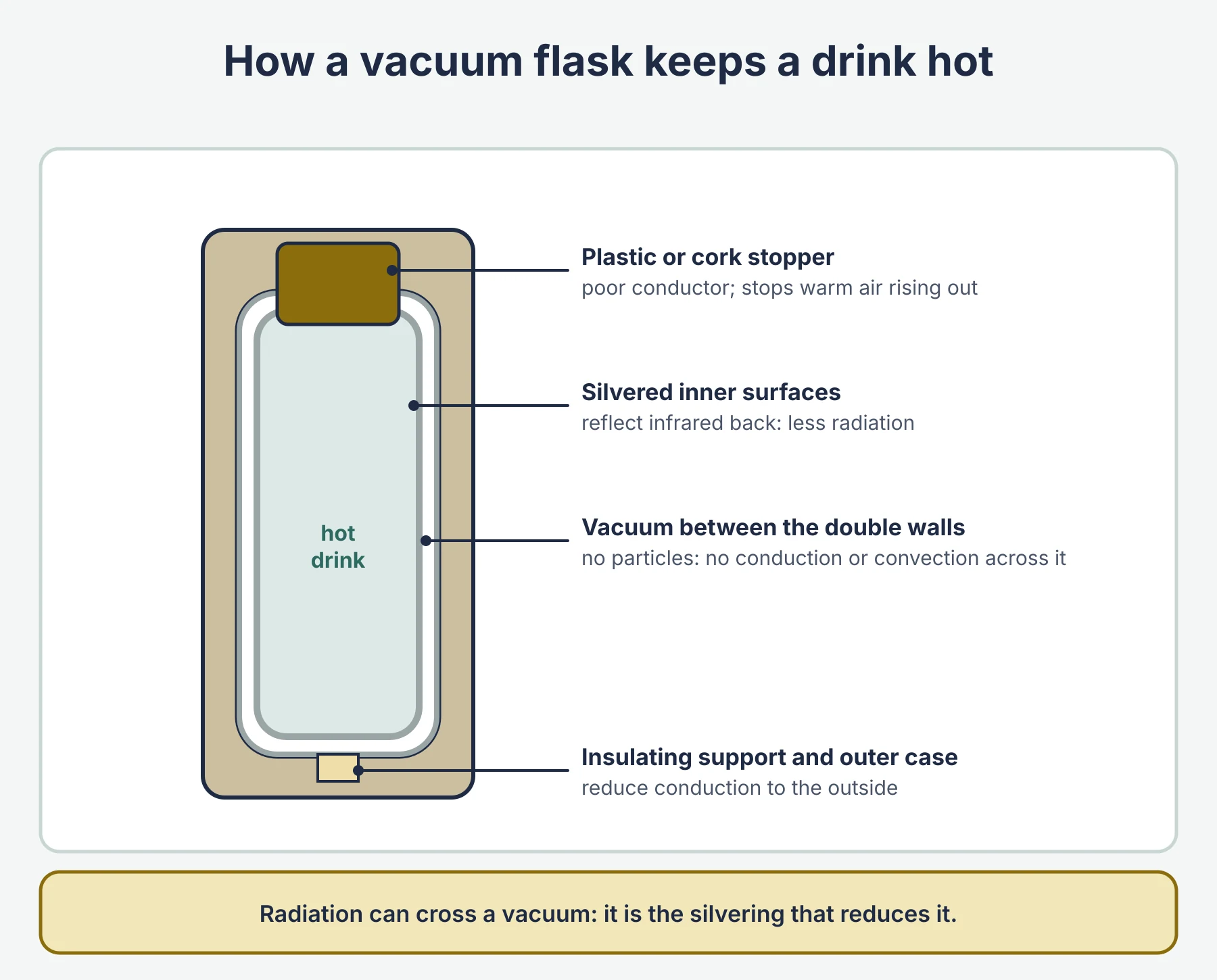
| Vacuum between walls | Conduction and convection | No particles in a vacuum |
| Silvered surfaces | Radiation | Shiny surfaces reflect infrared |
| Stopper | Convection (and conduction) | Stops warm air leaving; poor conductor |
| Trapped air (lagging, clothing, fleece) | Conduction and convection | Air is a poor conductor and cannot circulate when trapped |
| Plastic handle | Conduction | Plastic is a poor conductor |
Key terms
| Term | Meaning |
|---|---|
| Energy store | Where energy is held, such as the kinetic store of a moving object |
| Energy transfer | Movement of energy between stores: mechanically, electrically, by heating or by radiation |
| Conservation of energy | Energy cannot be created or destroyed, only transferred |
| Dissipated energy | Energy spread into the surroundings, usually as thermal energy, where it is no longer useful |
| Efficiency | Fraction of the total energy output that is useful, as a decimal or percentage |
| Sankey diagram | Diagram whose arrow widths show energy amounts to scale |
| Convection current | Circulating flow of a fluid caused by density differences from heating |
| Infrared radiation | Electromagnetic radiation emitted by all objects; more from hotter ones |
Exam traps
- “Light energy” or “heat energy” as stores.
- “Energy is lost”. Write “transferred to the thermal store of the surroundings”.
- “Heat rises” instead of “the warmer, less dense air (or water) rises”.
- Saying “particles expand” in convection: the fluid expands because its particles move further apart.
- Saying the vacuum in a flask stops radiation.
- Efficiency above 100%, or with a unit.
- A Sankey diagram whose outputs do not add up to the input.
Self-test
- Name the store and the pathway as a stretched catapult fires a stone.
- Describe the energy transfers when a battery-powered fan is switched on.
- A device has a total energy output of 500 J and wastes 150 J. Calculate its efficiency.
- A motor is 60% efficient and transfers 240 J usefully. Calculate the total energy output.
- In a Sankey diagram drawn at 1 square = 20 J, the input arrow is 25 squares wide. What energy is supplied?
- Why does convection not happen in a solid?
- Explain why a sea breeze blows from sea to land on a sunny day.
- Which surface is the best absorber of infrared radiation?
- Why are metals better conductors than non-metals?
- Explain why the vacuum in a vacuum flask reduces energy transfer.
- Name two variables to control in the conduction practical.
- State the principle of conservation of energy.
Answers: 1. Elastic store of the catapult → mechanically → kinetic store of the stone. 2. Chemical store of the battery → electrically → motor → mechanically → kinetic store of the blades and air; wasted to the thermal store of the surroundings by heating and as sound. 3. useful = 500 − 150 = 350 J; efficiency = 350 ÷ 500 × 100% = 70%. 4. total = 240 ÷ 0.60 = 400 J. 5. 25 × 20 = 500 J. 6. The particles cannot move from place to place, so no fluid can flow. 7. The land warms faster than the sea; air above the land warms, becomes less dense and rises; cooler, denser air from over the sea flows in to replace it. 8. A dark, matt surface (matt black). 9. Metals contain free electrons that move through the metal and carry energy quickly, in addition to particle vibrations. 10. A vacuum has no particles, so energy cannot be transferred across it by conduction or convection. 11. Any two: length of rod, thickness of rod, heating (same flame and distance), starting temperature. 12. Energy cannot be created or destroyed, only transferred from one store to another.
Related resources
-
Study guides
Pearson Edexcel International GCSE Physics (4PH1): Units for Energy Resources and Energy Transfers
The units of Topic 4 in Edexcel IGCSE Physics 4PH1: kg, J, m, m/s, m/s², N, s and W, how they link, prefixes and converting data before you calculate.
Physics · Pearson Edexcel · IGCSE
Read guide -
Practice questions
Pearson Edexcel International GCSE Physics (4PH1): Units for Energy Resources and Energy Transfers – Practice Questions
Original 4PH1 practice on Topic 4 units: converting g, cm, minutes, km/h, kW and MJ, unit checks and energy and power calculations, with full answers.
Physics · Pearson Edexcel · IGCSE
Try questions -
Revision notes
Pearson Edexcel International GCSE Physics (4PH1): Units for Energy Resources and Energy Transfers – Revision Notes
Recall notes for 4PH1 sub-topic 4a: the Topic 4 units, how J, N and W link, prefixes, time and speed conversions, unit traps and a 12-question self-test.
Physics · Pearson Edexcel · IGCSE
Revise topic
Related articles
Get free revision emails (optional)
Occasional emails with practice questions, worked explanations and links to free resources for the qualification and subjects you choose. No spam, and you can unsubscribe from any email. The free tools on this site never need an email.