
Study Guides
Pearson Edexcel International GCSE Physics (4PH1): Work and power
Work done, GPE, kinetic energy, the energy link between them and power as a rate, with multi-step worked examples, for Edexcel IGCSE Physics 4PH1, 4c.
- Subject
- Physics
- Level
- IGCSE
- Topic
- Energy resources and energy transfers
- Author
- Marlbridge Academic Team
- Updated
- Reviewed by
- Hassan (what this means)
Aligned to Pearson Edexcel IGCSE Physics (4PH1), Issue 4. Official specification .
Syllabus page (what it covers and how it is assessed): Pearson Edexcel IGCSE Physics.
Syllabus points this page covers
4PH1
- 4c Work and power
Found an error? Report a correction.
Need help with this topic? Request a free trial class for IGCSE Physics (4PH1).
This guide covers sub-topic 4(c) Work and power, statements 4.11 to 4.17 of the Pearson Edexcel International GCSE in Physics (4PH1), Issue 4. It is core content, so it can be examined on either paper. The Energy Resources and Energy Transfers study guide introduces the equations; this page concentrates on applying them, especially statement 4.15, which links gravitational potential energy, kinetic energy and work in multi-step problems.
The four relationships
work done = force × distance moved              W = F × d           (4.11)
GPE = mass × gravitational field strength × height    GPE = m × g × h     (4.13)
kinetic energy = ½ × mass × speed²              KE = ½ × m × v²     (4.14)
power = work done / time taken                  P = W / t           (4.17)
The first three are in the specification’s list of relationships you must recall (statements 4.11, 4.13 and 4.14 say “know and use”). Statement 4.17 says only “use” for the power relationship and it is not in that list, but you will need it so often that it is worth learning. Work, GPE and KE are in joules (J); power is in watts (W).
Work done is energy transferred (4.11, 4.12)
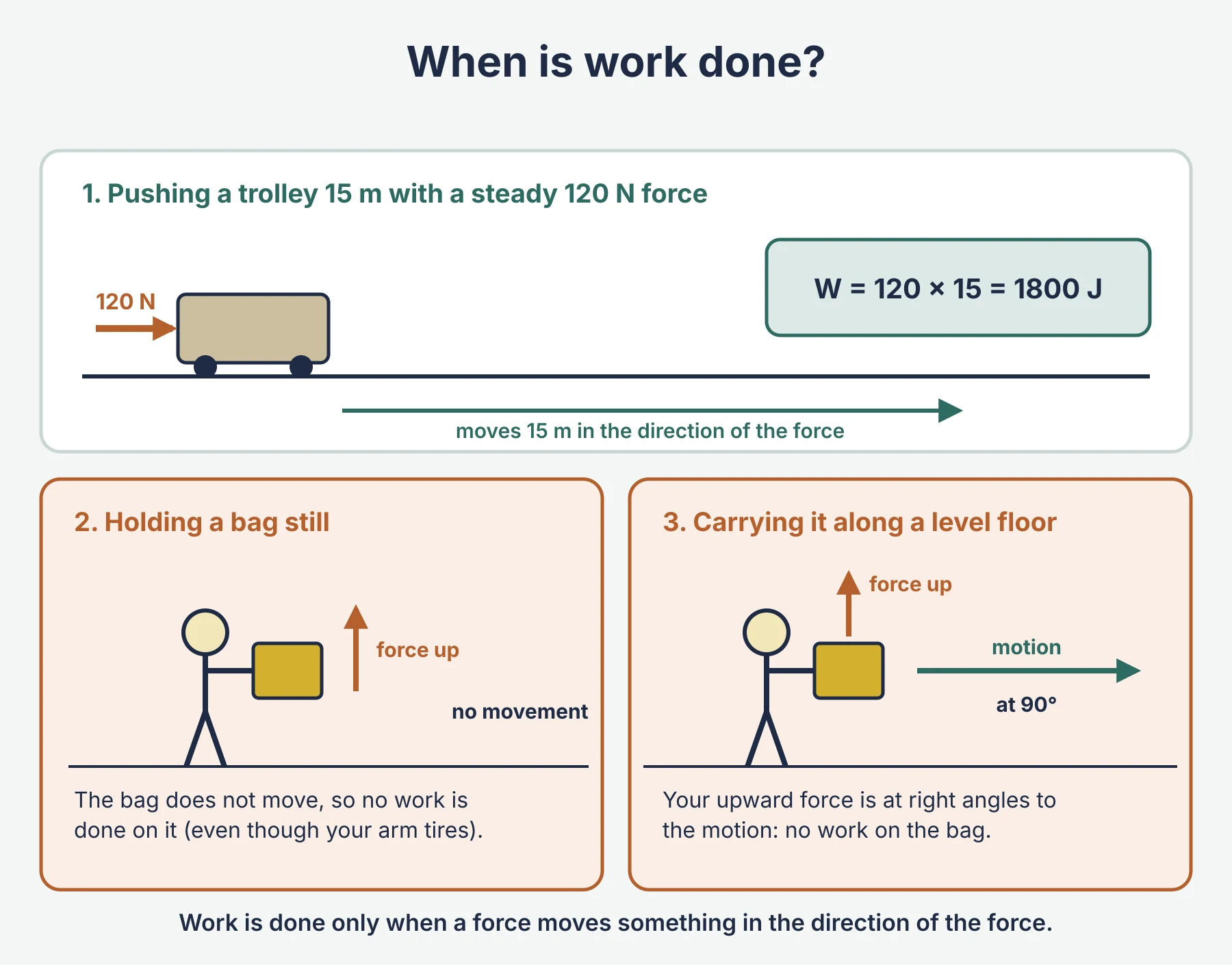
Work is done when a force moves something in the direction of the force. The work done equals the energy transferred, so “calculate the work done” and “calculate the energy transferred” are the same calculation.
Three cases test whether you understand the “in the direction of the force” part:
- Pushing a trolley 15 m with a steady 120 N force:
W = 120 × 15 = 1800 J. The energy goes into the kinetic store (if it speeds up) and the thermal store of the wheels and floor (friction). - Holding a heavy bag still: your arm muscles tire, but the bag does not move, so no work is done on the bag.
- Carrying a bag along a level corridor: your upward force on the bag is at right angles to the motion, so it does no work on the bag. The bag’s gravitational store does not change.
Gravitational potential energy and kinetic energy (4.13, 4.14)
GPE = m × g × h gives the energy transferred to (or from) an object’s gravitational store when its height changes by
h. Use the change in height, not the height above some arbitrary point you have not been asked about.
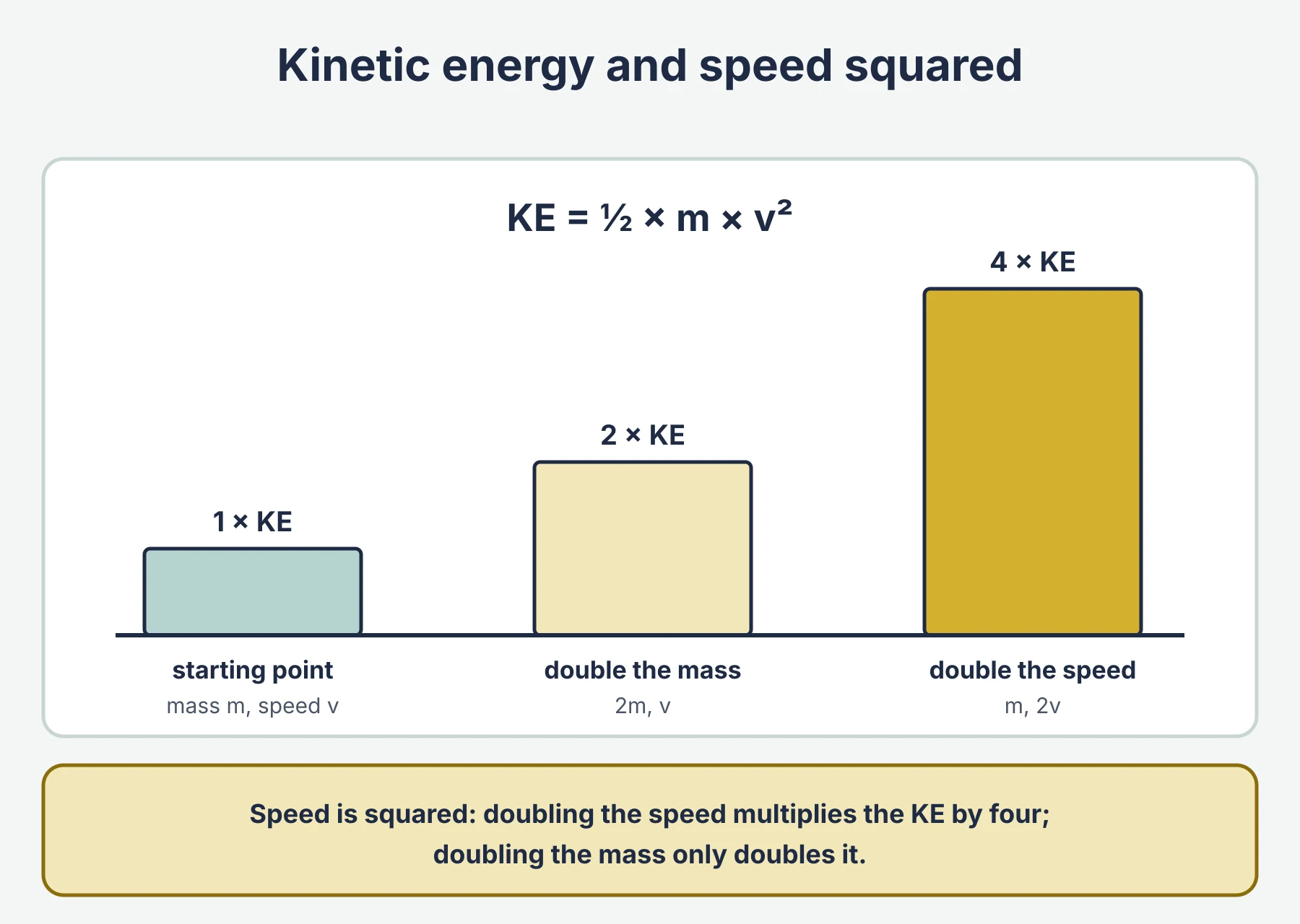
KE = ½ × m × v² depends on the square of the speed: doubling the speed multiplies the kinetic energy by four, while
doubling the mass only doubles it.
Conservation links GPE, KE and work (4.15)
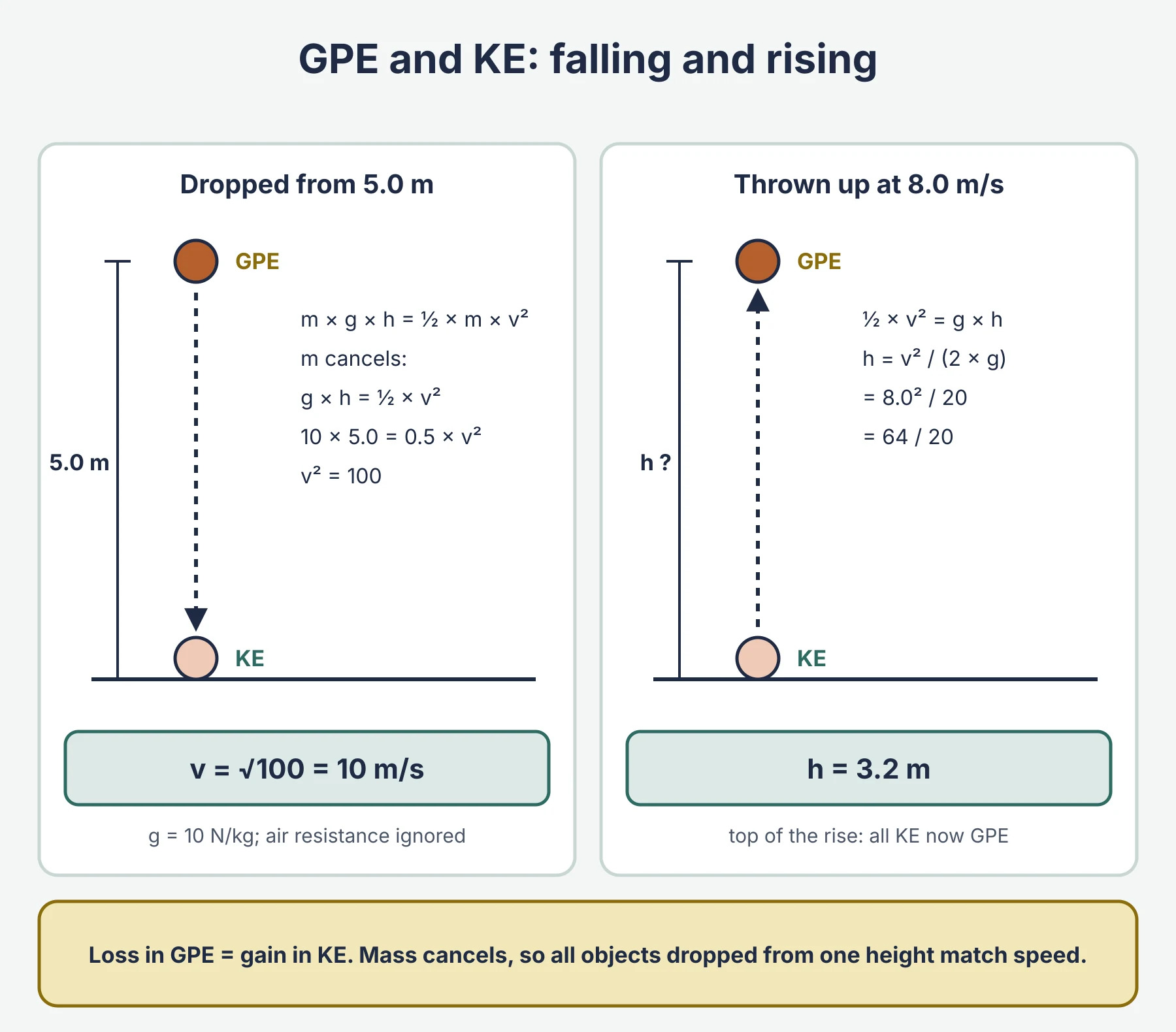
When an object falls freely, the work done by gravity transfers energy from its gravitational store to its kinetic store. If air resistance is small enough to ignore:
loss in GPE = gain in KE
m × g × h = ½ × m × v²
The mass appears on both sides and cancels, so all objects dropped from the same height reach the same speed (if air resistance is negligible).
Worked example 1: a falling ball. A ball is dropped from 5.0 m (g = 10 N/kg). Find its speed just before it hits the ground.
g × h = ½ × v²
10 × 5.0 = 0.5 × v²
v² = 100        v = 10 m/s
Worked example 2: a ball thrown upwards. A ball leaves your hand upwards at 8.0 m/s. How high does it rise?
½ × v² = g × h
h = v² / (2 × g) = 8.0² / 20 = 64 / 20 = 3.2 m
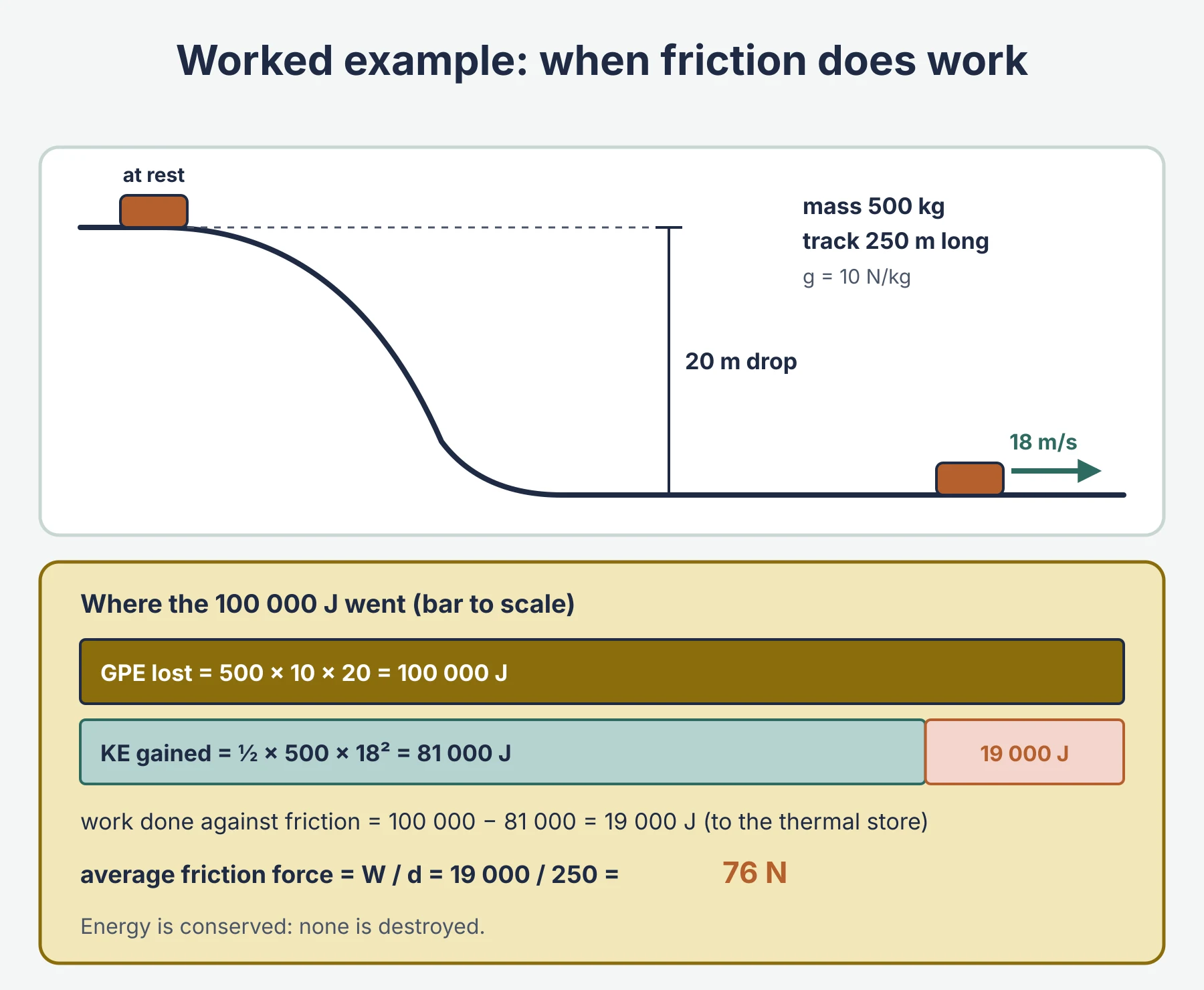
Worked example 3: when friction does work. A roller-coaster car of mass 500 kg starts from rest at the top of a 20 m drop and reaches the bottom at 18 m/s (g = 10 N/kg). The track is 250 m long. Find the work done against friction and the average frictional force.
GPE lost = m × g × h = 500 × 10 × 20 = 100 000 J
KE gained = ½ × 500 × 18² = 0.5 × 500 × 324 = 81 000 J
work done against friction = 100 000 − 81 000 = 19 000 J
average friction force = W / d = 19 000 / 250 = 76 N
Conservation of energy is still obeyed: the 19 000 J has been transferred to the thermal store of the car, track and air, not destroyed.
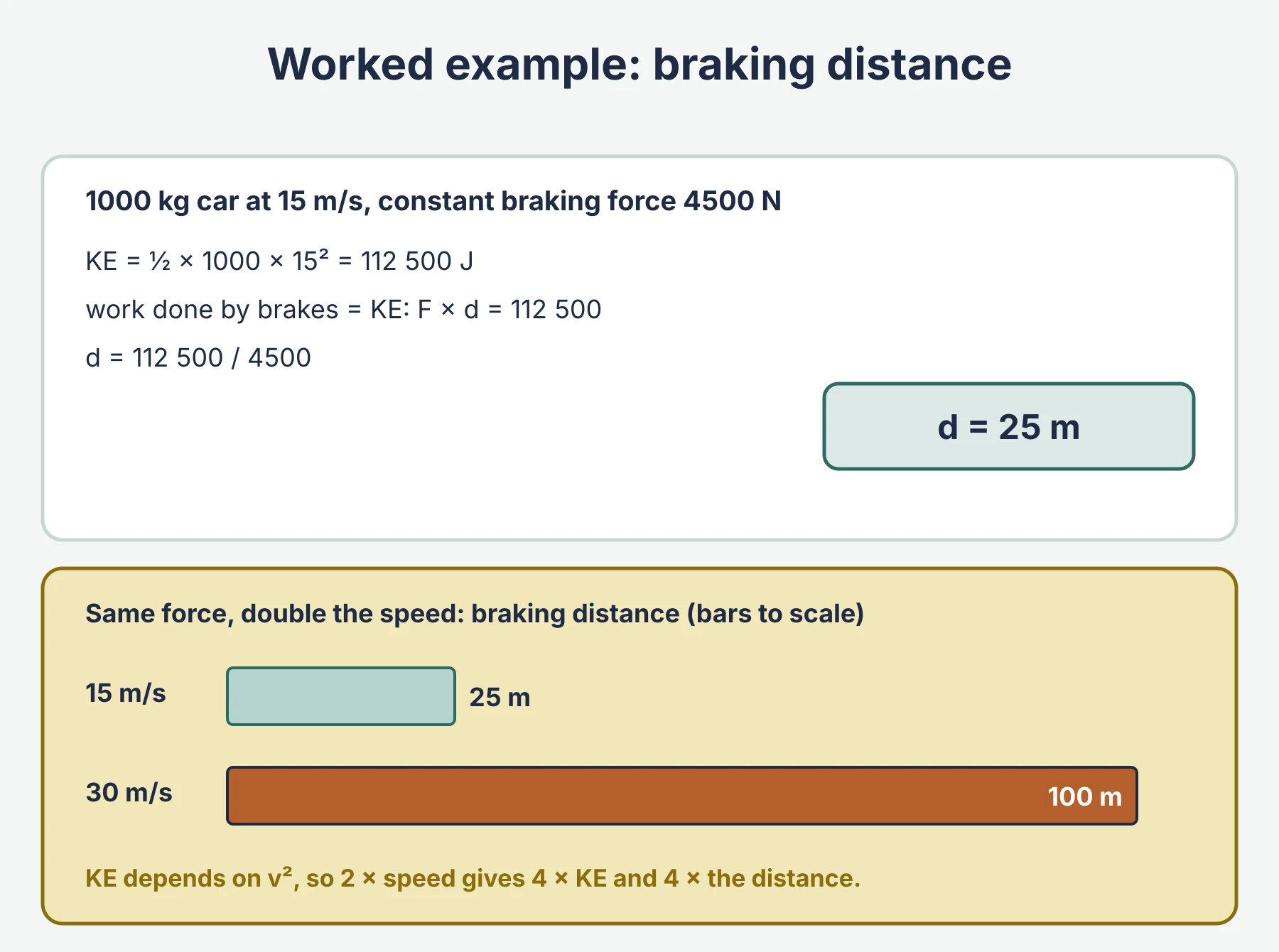
Worked example 4: braking. A 1000 kg car travelling at 15 m/s brakes with a constant force of 4500 N. Find the braking distance.
KE = ½ × 1000 × 15² = 112 500 J
work done by brakes = KE, so F × d = 112 500
d = 112 500 / 4500 = 25 m
Because KE depends on v², doubling the speed to 30 m/s would make the braking distance four times longer (100 m) with the same force.
Power is a rate (4.16, 4.17)
Power is the rate of transferring energy, or the rate of doing work: the energy transferred each second. One watt is one joule per second. Two people who lift identical boxes onto the same shelf do the same work; the one who does it in half the time develops twice the power.
Worked example 5: running up stairs. A 60 kg student runs up a flight of stairs with a vertical height of 4.5 m in 5.4 s (g = 10 N/kg).
work done against gravity = m × g × h = 60 × 10 × 4.5 = 2700 J
P = W / t = 2700 / 5.4 = 500 W
To measure this yourself you need a bathroom scale (mass), a tape measure (the vertical height of the stairs, not the length along the slope) and a stopwatch. The value found is the power used to gain GPE; the body’s total power is higher because some energy also heats the body.
Worked example 6: a water pump. A pump lifts 300 kg of water through a height of 8.0 m every minute.
work done per minute = 300 × 10 × 8.0 = 24 000 J
P = 24 000 / 60 = 400 W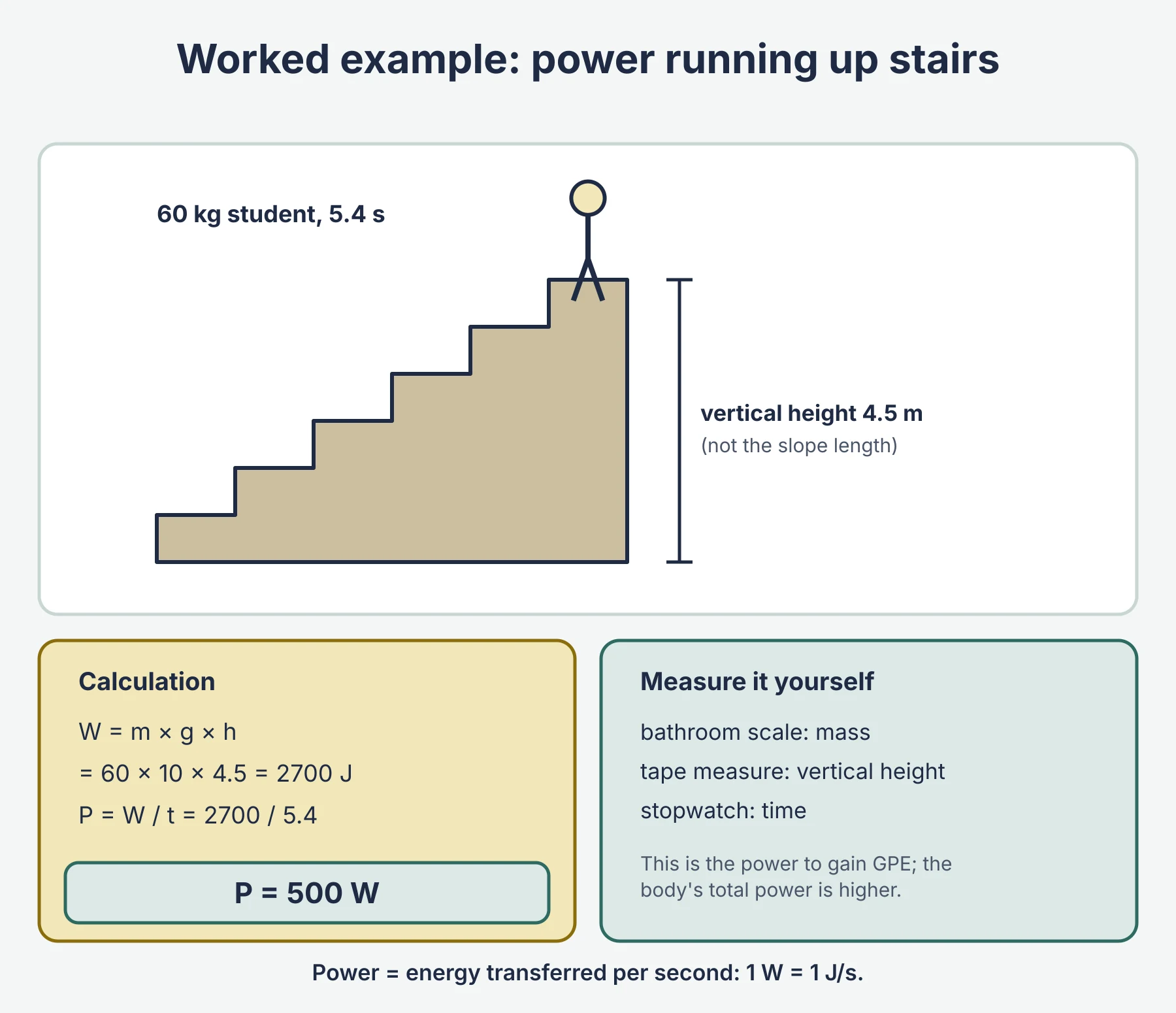
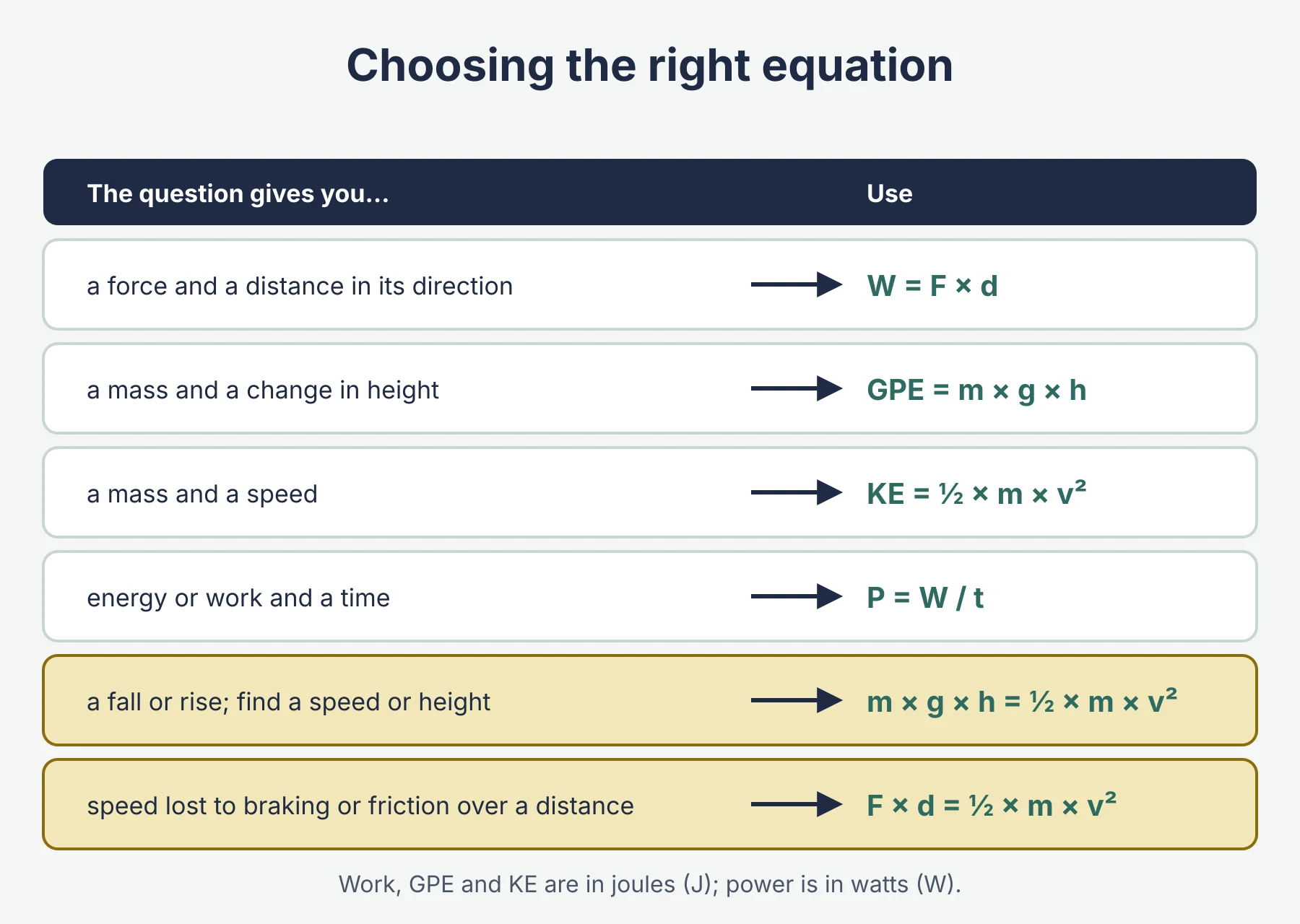
Choosing the right equation
| The question gives you… | Use |
|---|---|
| a force and a distance in its direction | W = F × d |
| a mass and a change in height | GPE = m × g × h |
| a mass and a speed | KE = ½ × m × v² |
| energy or work and a time | P = W / t |
| a fall or a rise, and asks for a speed or height | m × g × h = ½ × m × v² |
| a speed lost to braking or friction over a distance | F × d = ½ × m × v² |
Common mistakes
- Using the distance along a slope in
GPE = m × g × h;his the vertical height change. - Forgetting to square the speed, or squaring ½ × v instead of v alone.
- Taking the square root too early or forgetting it: in example 1,
v² = 100is not the answer. - Saying work is done holding an object still.
- Using time in minutes in
P = W / t. - Writing “power is energy”. Power is energy per second.
Exam technique
- Calculate: write the equation in symbols or words, substitute with units converted, and give the unit. In a two-step problem, label each line (“GPE lost =”, “KE gained =”) so an examiner can follow your method.
- Show that: give every step and a final value more precise than the one in the question, so you are not just copying it.
- Explain why a measured value differs from a calculated one: name the energy that was not counted, such as work done against friction or air resistance, transferred to the thermal store of the surroundings.
- Describe an experiment to measure power: list what you measure, with which instrument, and the equation you use.
Keep going
- Work and power revision notes
- Work and power practice questions
- Units for Topic 4, for converting data before substituting
Written against the Pearson Edexcel International GCSE in Physics (4PH1) specification, Issue 4. Always check the current specification for your examination year.
Related resources
-
Practice questions
Pearson Edexcel International GCSE Physics (4PH1): Work and power – Practice Questions
Original 4PH1 questions on work done, GPE, kinetic energy, the energy link, braking distances and power, including a stair-climbing practical.
Physics · Pearson Edexcel · IGCSE
Try questions -
Revision notes
Pearson Edexcel International GCSE Physics (4PH1): Work and power – Revision Notes
Recall notes for 4PH1 sub-topic 4c: W = Fd, GPE = mgh, KE = ½mv², P = W/t, the GPE-KE-work link, equation choice, traps and a 12-question self-test.
Physics · Pearson Edexcel · IGCSE
Revise topic -
Practice questions
Edexcel IGCSE Physics: Energy Resources and Energy Transfers — Practice Questions
Original practice questions with worked answers on energy stores, efficiency, thermal energy transfer and energy resources for Edexcel IGCSE Physics 4PH1.
Physics · Pearson Edexcel · IGCSE
Try questions
Related articles
Get free revision emails (optional)
Occasional emails with practice questions, worked explanations and links to free resources for the qualification and subjects you choose. No spam, and you can unsubscribe from any email. The free tools on this site never need an email.