
Study Guides
Pearson Edexcel International GCSE Physics (4PH1): Units for Energy Resources and Energy Transfers
The units of Topic 4 in Edexcel IGCSE Physics 4PH1: kg, J, m, m/s, m/s², N, s and W, how they link, prefixes and converting data before you calculate.
- Subject
- Physics
- Level
- IGCSE
- Topic
- Energy resources and energy transfers
- Author
- Marlbridge Academic Team
- Updated
- Reviewed by
- Hassan (what this means)
Aligned to Pearson Edexcel IGCSE Physics (4PH1), Issue 4. Official specification .
Syllabus page (what it covers and how it is assessed): Pearson Edexcel IGCSE Physics.
Syllabus points this page covers
4PH1
- 4a Units
Found an error? Report a correction.
Need help with this topic? Request a free trial class for IGCSE Physics (4PH1).
This guide covers sub-topic 4(a) Units of Topic 4, Energy resources and energy transfers, in the Pearson Edexcel International GCSE in Physics (4PH1), Issue 4. Statement 4.1 asks you to “use the following units: kilogram (kg), joule (J), metre (m), metre/second (m/s), metre/second² (m/s²), newton (N), second (s) and watt (W)”. For the physics these units measure, see the Energy Resources and Energy Transfers study guide.
What “use” means here
Units are not a separate topic you can learn once and forget. In Topic 4 they decide whether a calculation is right before you even press a button. Using the units well means three things:
- knowing which unit belongs to which quantity in each Topic 4 equation;
- converting given data (grams, centimetres, minutes, kilojoules, kilowatts) into the base units before substituting;
- writing the correct unit, with the correct capital or lower-case letter, after every answer.
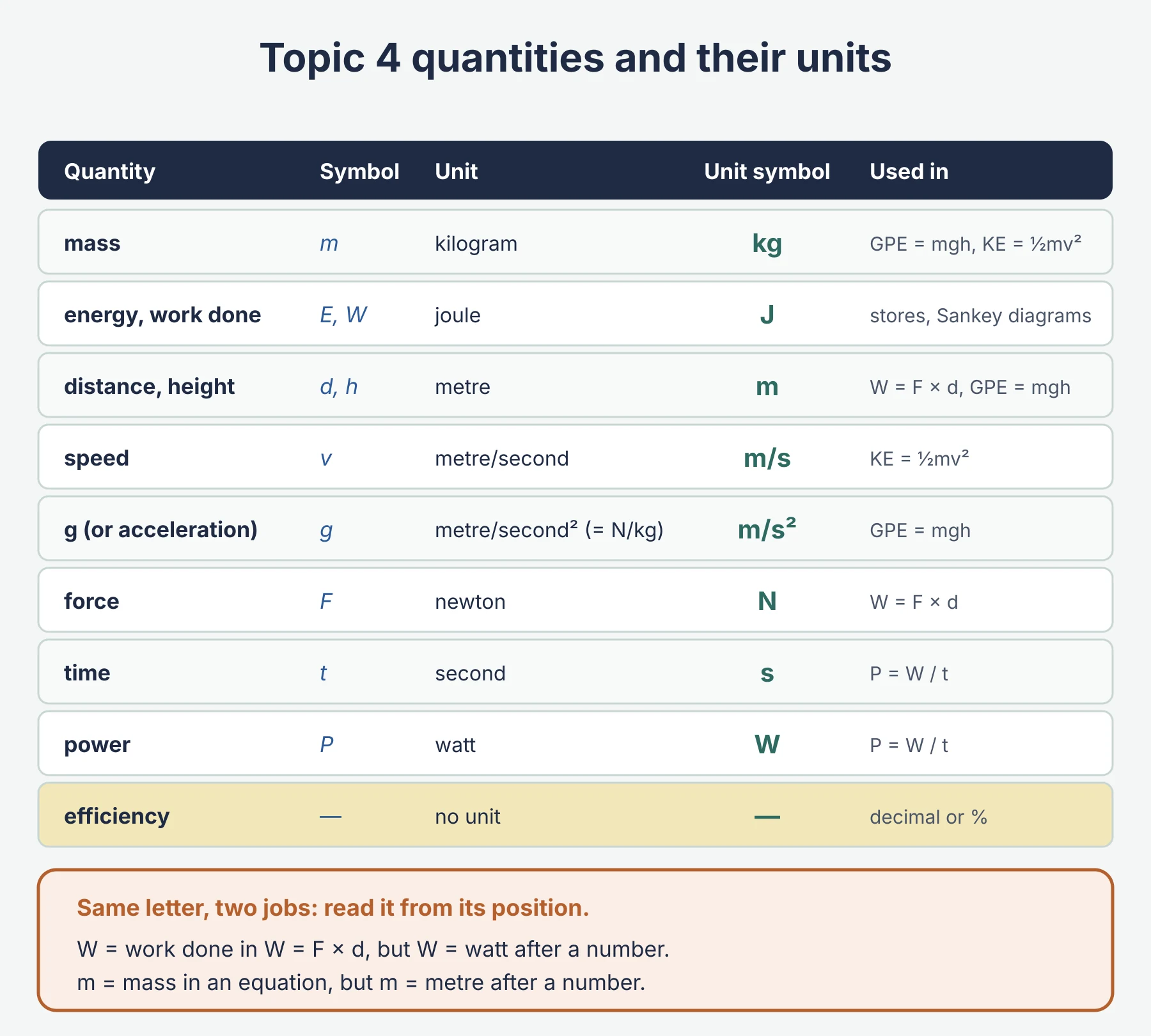
Which unit goes with which quantity
| Quantity | Symbol in equations | Unit | Unit symbol | Where it appears in Topic 4 |
|---|---|---|---|---|
| Mass | m | kilogram | kg | GPE = m × g × h, KE = ½ × m × v² |
| Energy, work done | E, W | joule | J | every energy store, work done, Sankey diagrams |
| Distance, height | d, h | metre | m | W = F × d, GPE = m × g × h |
| Speed | v | metre/second | m/s | KE = ½ × m × v² |
| Gravitational field strength (or acceleration) | g | metre/second² (same as N/kg) | m/s² | GPE = m × g × h |
| Force | F | newton | N | W = F × d |
| Time | t | second | s | P = W / t |
| Power | P | watt | W | P = W / t |
| Efficiency | none | no unit | (decimal or %) | efficiency = useful energy output / total energy output × 100% |
Two letters cause most of the trouble. W is the symbol for work done in W = F × d and also the unit symbol for
the watt. m is the symbol for mass and the unit symbol for the metre. Read each one from its position: in an
equation it stands for a quantity; after a number it is a unit.
How the units connect
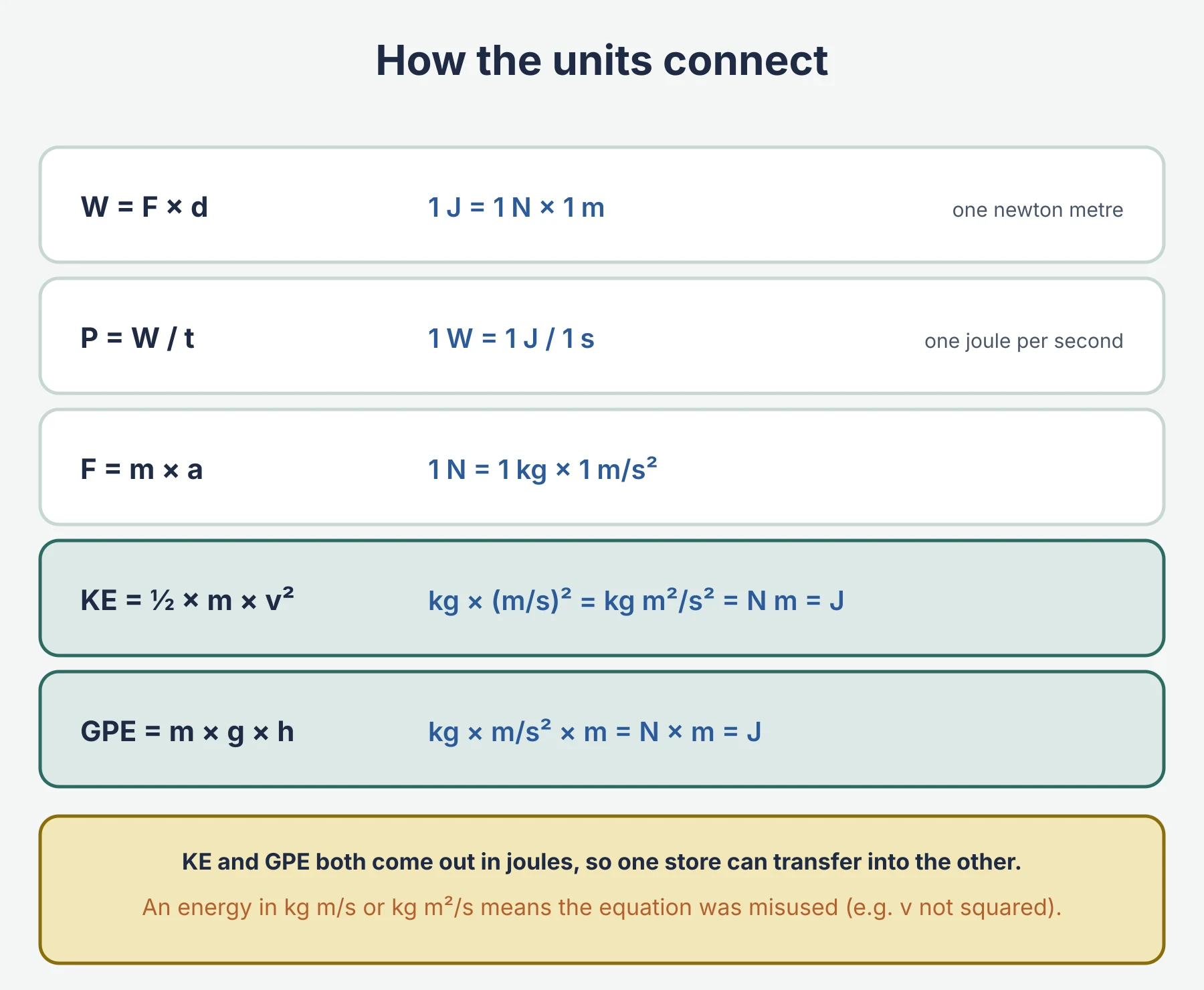
Each Topic 4 unit can be built from the others, which is why an answer’s unit can be checked.
work done = force × distance        so   1 J = 1 N × 1 m  (one newton metre)
power = work done / time            so   1 W = 1 J / 1 s  (one joule per second)
force = mass × acceleration         so   1 N = 1 kg × 1 m/s²
KE = ½ × m × v²                     so   kg × (m/s)² = kg m²/s² = N m = J
GPE = m × g × h                     so   kg × m/s² × m = N × m = J
The last two lines show that kinetic energy and gravitational potential energy both come out in joules, as they must if
one store can transfer into the other. If your working gives kg m/s or kg m²/s for an energy, the equation has been
misused (for example, v not squared).
Prefixes and conversions
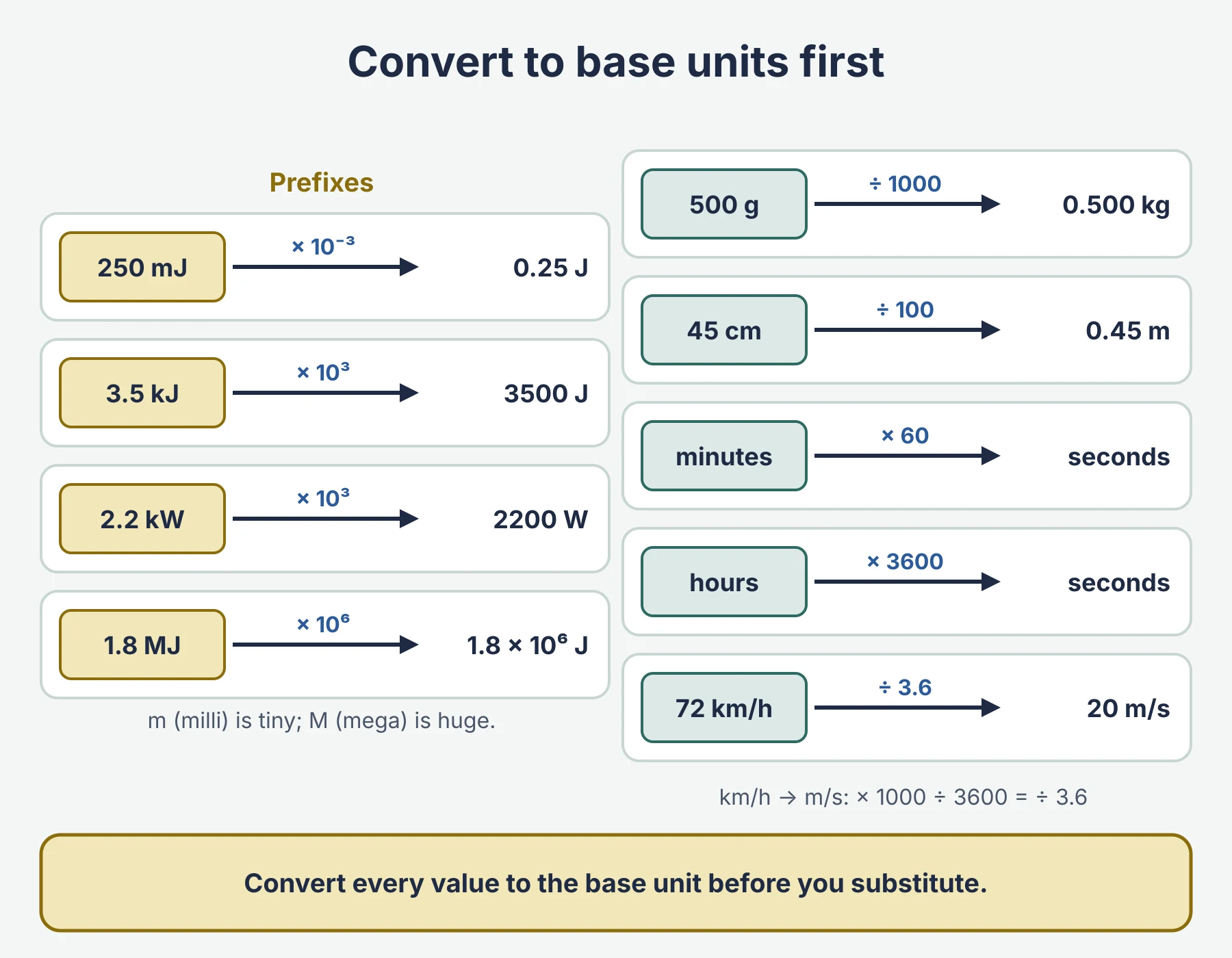
Data in Topic 4 questions is often given in multiples of the base unit. Convert before you substitute.
| Prefix | Symbol | Multiply by | Example |
|---|---|---|---|
| milli | m | 10⁻³ | 250 mJ = 0.25 J |
| kilo | k | 10³ | 3.5 kJ = 3500 J; 2.2 kW = 2200 W |
| mega | M | 10⁶ | 1.8 MJ = 1 800 000 J = 1.8 × 10⁶ J |
Case matters: m (milli) is a thousand times smaller and M (mega) a million times bigger. A kilogram is already the base unit of mass, so grams must be divided by 1000: 500 g = 0.500 kg.
Other conversions you will meet:
- centimetres to metres: divide by 100 (45 cm = 0.45 m);
- minutes to seconds: multiply by 60; hours to seconds: multiply by 3600;
- km/h to m/s: multiply by 1000 then divide by 3600, which is the same as dividing by 3.6 (72 km/h = 20 m/s).
Worked examples
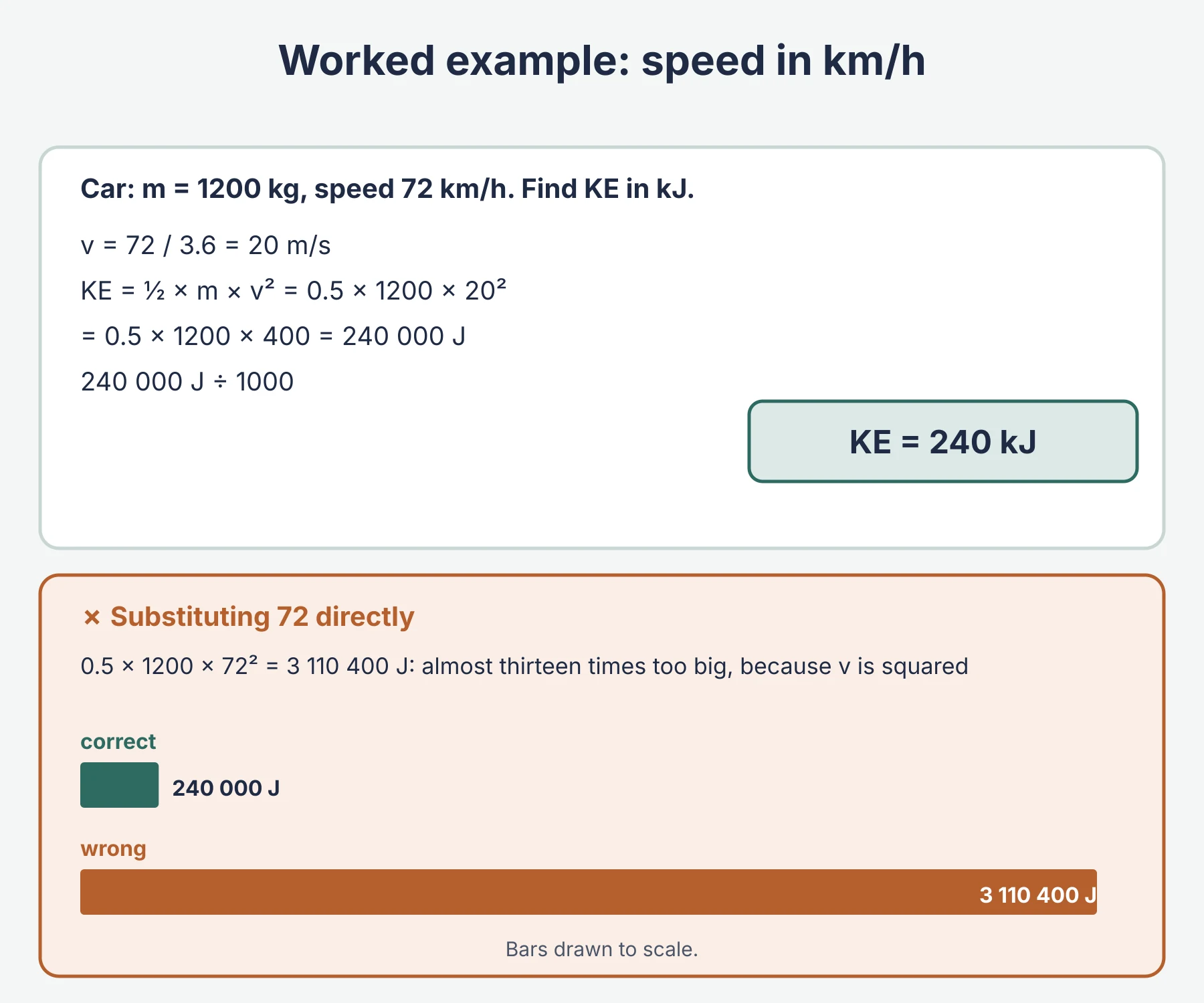
Worked example 1: a speed in km/h. A car of mass 1200 kg travels at 72 km/h. Calculate its kinetic energy in kJ.
v = 72 / 3.6 = 20 m/s
KE = ½ × m × v² = 0.5 × 1200 × 20² = 0.5 × 1200 × 400 = 240 000 J
240 000 J ÷ 1000 = 240 kJ
Substituting 72 directly would give 3 110 400 J, almost thirteen times too big, because the speed is squared.
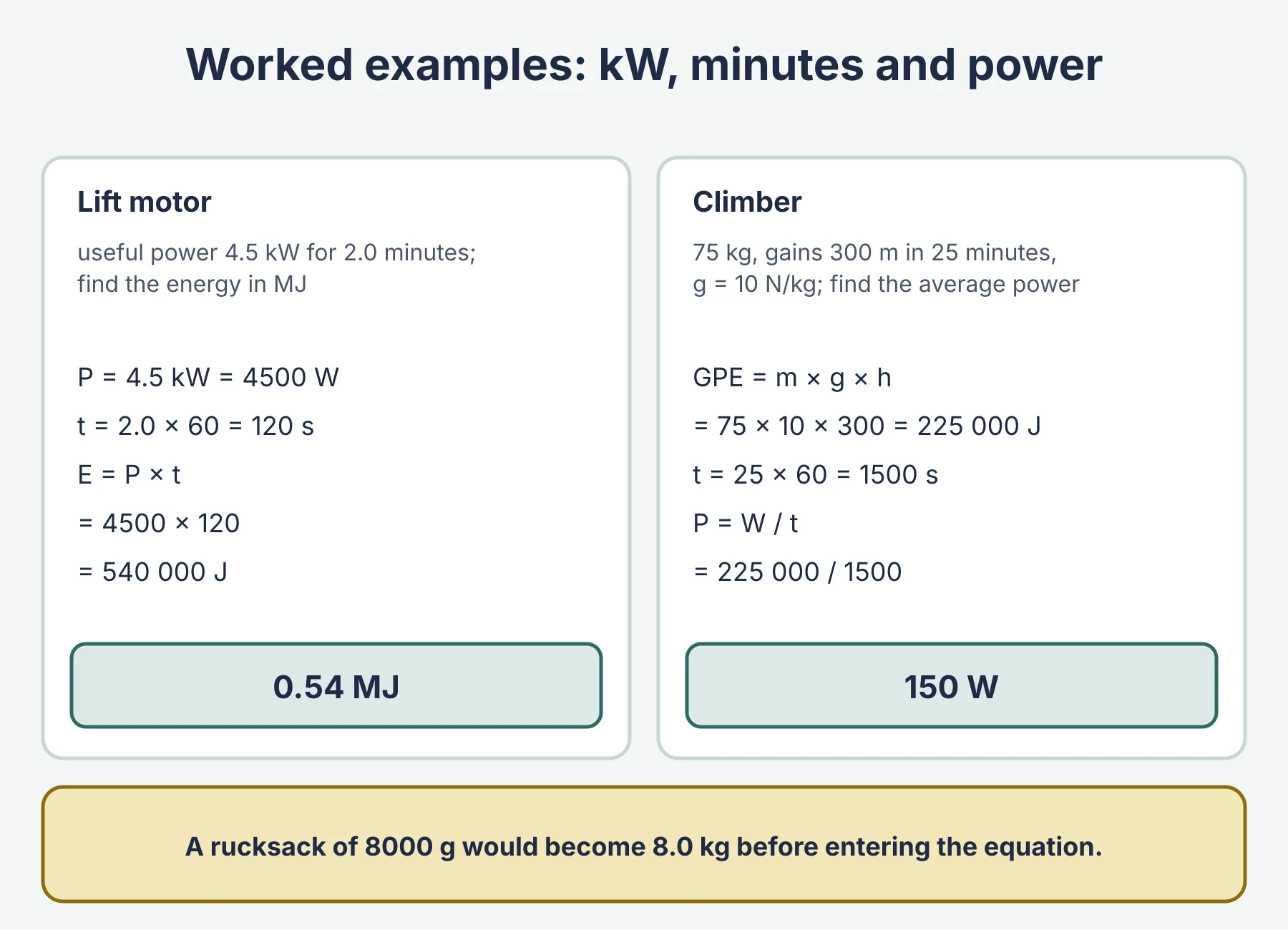
Worked example 2: power in kW and time in minutes. A lift motor with a useful power output of 4.5 kW runs for 2.0 minutes. Calculate the useful energy transferred, in MJ.
P = 4.5 kW = 4500 W        t = 2.0 × 60 = 120 s
energy transferred = P × t = 4500 × 120 = 540 000 J = 0.54 MJ
Worked example 3: grams and a power answer. A climber of mass 75 kg gains 300 m in height in 25 minutes (g = 10 N/kg). Calculate the average useful power for lifting her body.
GPE gained = m × g × h = 75 × 10 × 300 = 225 000 J
t = 25 × 60 = 1500 s
P = W / t = 225 000 / 1500 = 150 W
If a question had given her rucksack as 8000 g, it would become 8.0 kg before entering the equation.
Checking an answer with units
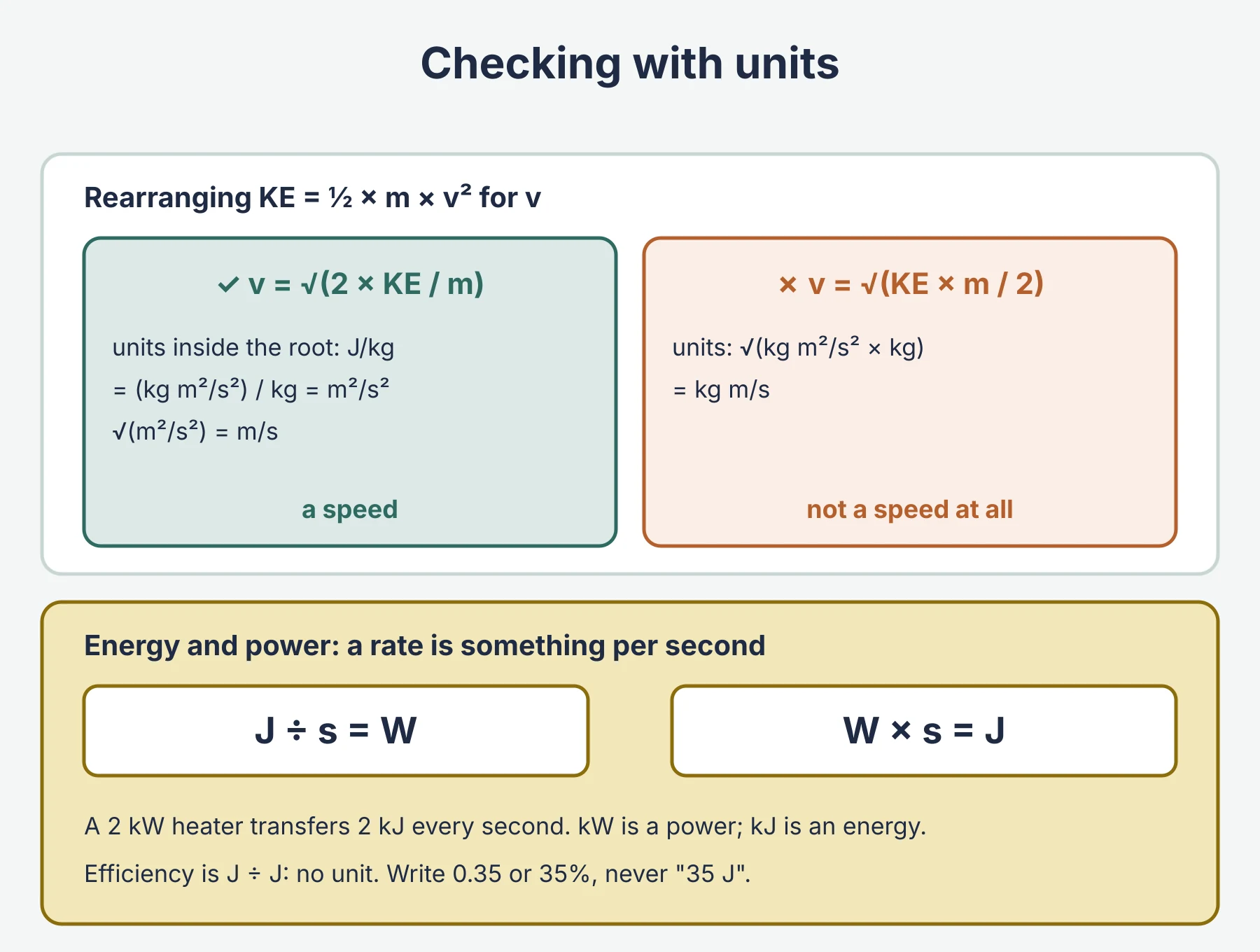
Units let you test a rearranged equation. Rearranging KE = ½ × m × v² for speed gives v = √(2 × KE / m). The units
inside the root are J/kg, which is (kg m²/s²)/kg = m²/s², and the square root of that is m/s, a speed. A wrong
rearrangement such as v = √(KE × m / 2) would give kg m/s, which is not a speed at all.
The same habit catches power and energy mix-ups: a quantity divided by a time in seconds is a rate. Joules divided by seconds is watts; watts multiplied by seconds is joules.
Significant figures and standard form
Give your answer to the same number of significant figures as the least precise data, usually 2 or 3. Very large energies are clearer in standard form or with a prefix: 3 600 000 J is better written 3.6 × 10⁶ J or 3.6 MJ. Efficiency is a ratio of two energies in joules, so the units cancel. Write it as a decimal (0.35) or a percentage (35%), never as “35 J”.
Common mistakes
- Using grams in
KE = ½ × m × v²orGPE = m × g × h. - Forgetting to square the speed, or squaring the ½ as well.
- Leaving time in minutes when calculating power, which makes the power 60 times too large.
- Writing “w” or “j” in lower case. The watt (W), joule (J) and newton (N) are named after people, so the symbol is a capital letter, while the unit written in full (watt, joule, newton) is not.
- Giving efficiency a unit, or giving an efficiency above 100%, which would mean energy had been created.
- Confusing kW (a power) with kJ (an energy). A 2 kW heater transfers 2 kJ every second.
Exam technique
- Calculate means show working and reach a number. If the unit is printed on the answer line, your answer must be in that unit, so convert at the end if needed (J to kJ, W to kW). If it is not printed, write the unit yourself.
- State the unit wants a unit, given as its symbol or its name (“J” or “joule”). Naming the quantity (“energy”) answers a different question.
- When data is given with mixed units, write each converted value on its own line before substituting. It shows the examiner your method even if you slip later.
- Keep unrounded values in your calculator until the final step, then round once.
Keep going
- Units for Topic 4 revision notes with a key-terms table and self-test
- Units for Topic 4 practice questions with full mark-scheme answers
- Energy revision notes for the rest of Topic 4
Written against the Pearson Edexcel International GCSE in Physics (4PH1) specification, Issue 4. Always check the current specification for your examination year.
Related resources
-
Practice questions
Pearson Edexcel International GCSE Physics (4PH1): Units for Energy Resources and Energy Transfers – Practice Questions
Original 4PH1 practice on Topic 4 units: converting g, cm, minutes, km/h, kW and MJ, unit checks and energy and power calculations, with full answers.
Physics · Pearson Edexcel · IGCSE
Try questions -
Revision notes
Pearson Edexcel International GCSE Physics (4PH1): Units for Energy Resources and Energy Transfers – Revision Notes
Recall notes for 4PH1 sub-topic 4a: the Topic 4 units, how J, N and W link, prefixes, time and speed conversions, unit traps and a 12-question self-test.
Physics · Pearson Edexcel · IGCSE
Revise topic -
Study guides
Pearson Edexcel International GCSE Physics (4PH1): Work and power
Work done, GPE, kinetic energy, the energy link between them and power as a rate, with multi-step worked examples, for Edexcel IGCSE Physics 4PH1, 4c.
Physics · Pearson Edexcel · IGCSE
Read guide
Related articles
Get free revision emails (optional)
Occasional emails with practice questions, worked explanations and links to free resources for the qualification and subjects you choose. No spam, and you can unsubscribe from any email. The free tools on this site never need an email.