
Revision Notes
Pearson Edexcel International GCSE Physics (4PH1): Units for Energy Resources and Energy Transfers – Revision Notes
Recall notes for 4PH1 sub-topic 4a: the Topic 4 units, how J, N and W link, prefixes, time and speed conversions, unit traps and a 12-question self-test.
- Subject
- Physics
- Level
- IGCSE
- Topic
- Energy resources and energy transfers
- Author
- Marlbridge Academic Team
- Updated
- Reviewed by
- Hassan (what this means)
Aligned to Pearson Edexcel IGCSE Physics (4PH1), Issue 4. Official specification .
Syllabus page (what it covers and how it is assessed): Pearson Edexcel IGCSE Physics.
Syllabus points this page covers
4PH1
- 4a Units
Found an error? Report a correction.
Need help with this topic? Request a free trial class for IGCSE Physics (4PH1).
These notes condense sub-topic 4(a) Units of Pearson Edexcel International GCSE Physics 4PH1, Issue 4: statement 4.1, “use the following units: kilogram (kg), joule (J), metre (m), metre/second (m/s), metre/second² (m/s²), newton (N), second (s) and watt (W)”. The full explanation and worked examples are in the Units for Topic 4 study guide; exam-style questions are in the Units for Topic 4 practice questions.
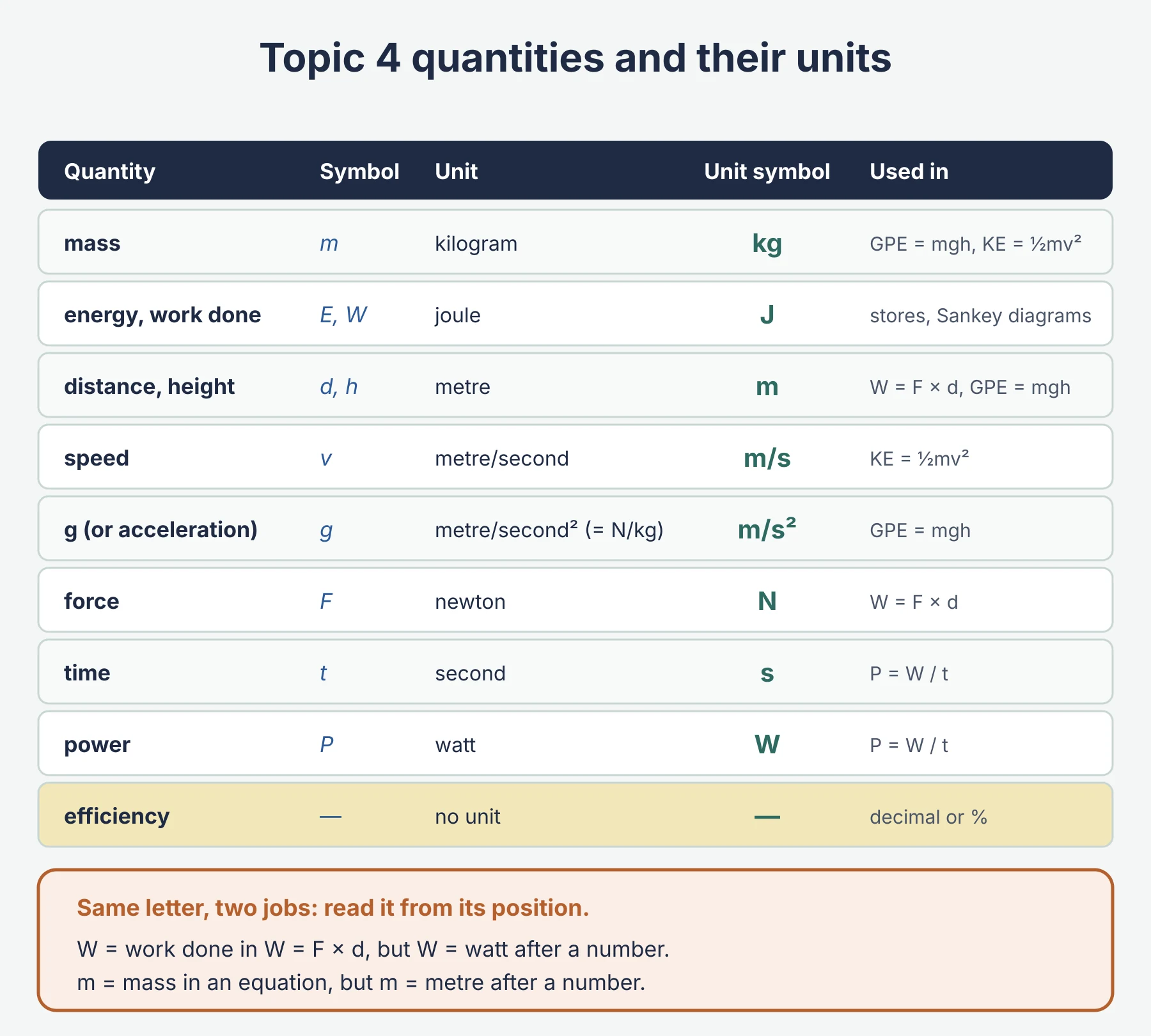
The eight units and their jobs
| Unit | Symbol | Measures in Topic 4 |
|---|---|---|
| kilogram | kg | mass (in GPE and KE) |
| joule | J | energy in any store; work done; energy transferred |
| metre | m | distance moved in the direction of a force; height |
| metre/second | m/s | speed (in KE) |
| metre/second² | m/s² | gravitational field strength g (10 m/s² = 10 N/kg) |
| newton | N | force (in work done) |
| second | s | time (in power) |
| watt | W | power: rate of transferring energy or doing work |
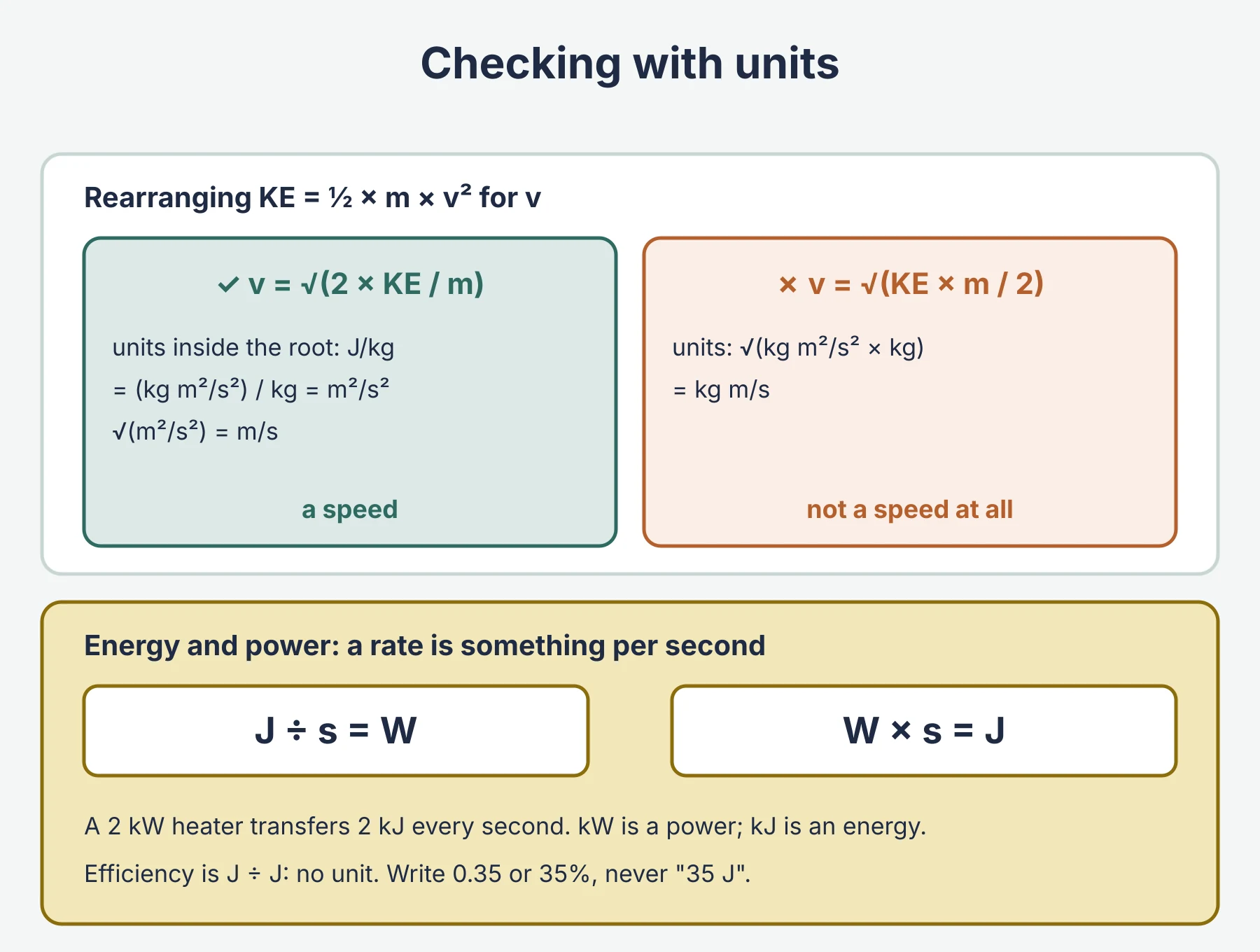
Efficiency has no unit: J ÷ J cancels. Give it as a decimal or a percentage.
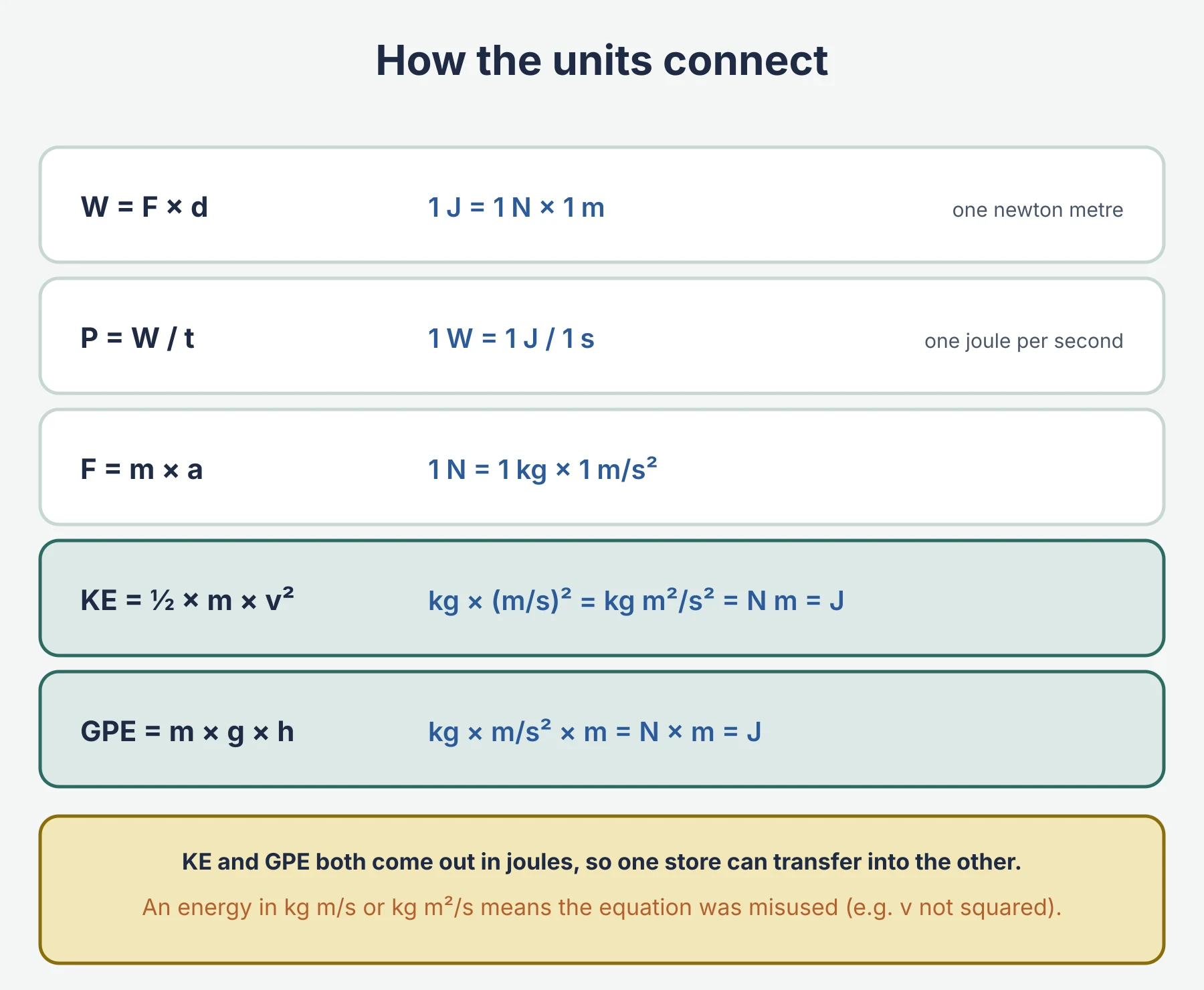
How they link
1 J = 1 N × 1 m          (work done = force × distance)
1 W = 1 J/s              (power = work done / time)
1 N = 1 kg m/s²          (force = mass × acceleration)
1 J = 1 kg m²/s²         (from KE = ½ m v² or GPE = m g h)
A watt is a joule per second, so a 40 W device transfers 40 J every second. Power × time gives energy; energy ÷ time gives power.
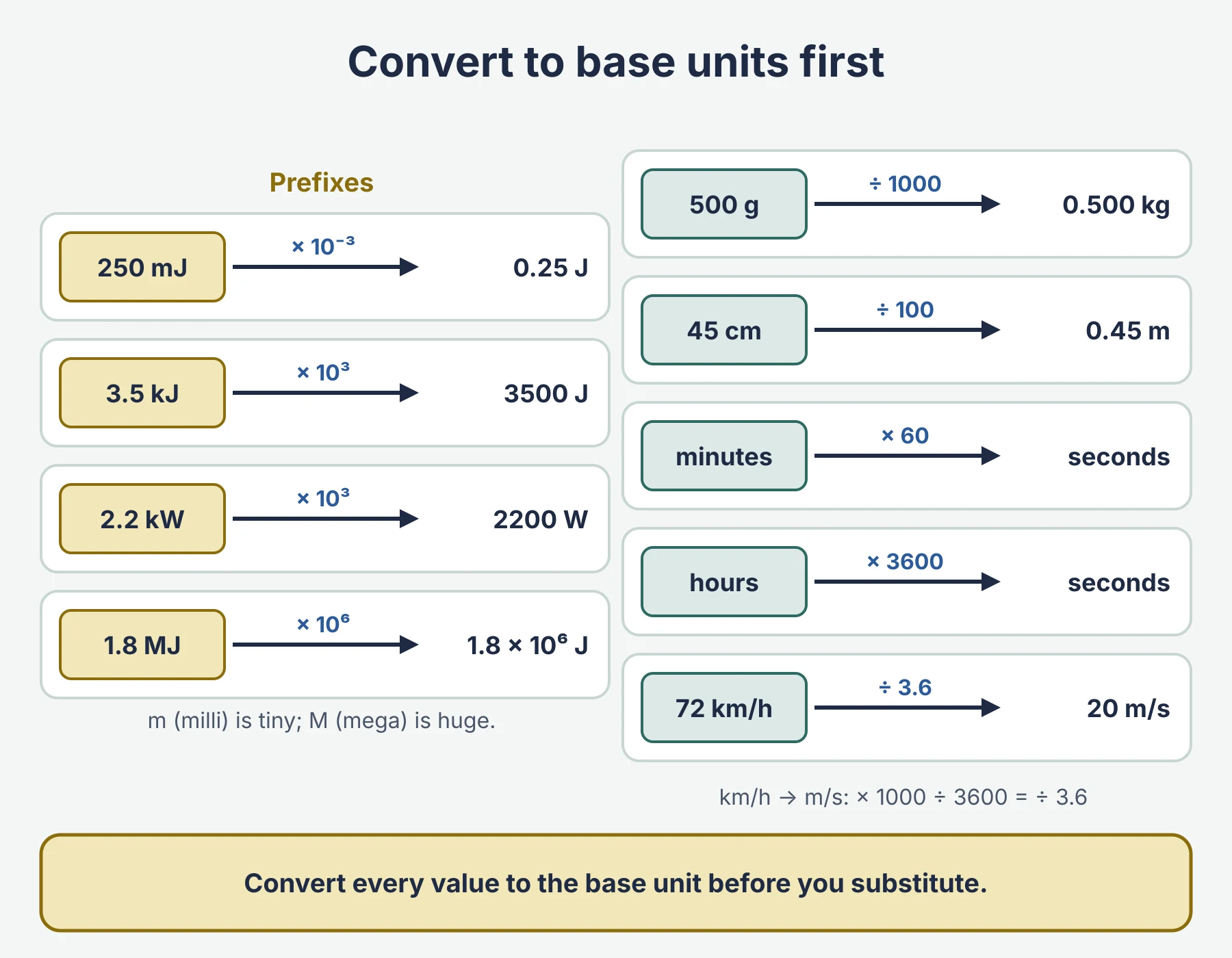
Conversions to do before substituting
| Given | Convert to | How |
|---|---|---|
| g (grams) | kg | ÷ 1000 |
| cm | m | ÷ 100 |
| mm | m | ÷ 1000 |
| minutes | s | × 60 |
| hours | s | × 3600 |
| km/h | m/s | ÷ 3.6 |
| kJ, kW | J, W | × 1000 (× 10³) |
| MJ, MW | J, W | × 1 000 000 (× 10⁶) |
| mJ | J | ÷ 1000 (× 10⁻³) |
Quick check: after converting, the number for a mass in kg should be smaller than the number in g; a time in s should be bigger than the same time in minutes.
Units that look alike
- W = work done (a quantity, in an equation) or watt (a unit, after a number).
- m = mass (a quantity) or metre (a unit) or milli (a prefix in front of a unit, as in mJ).
- M = mega. MJ is a million joules; mJ is a thousandth of a joule.
- kW is a power, kJ is an energy. They are not interchangeable.
- N m (newton metre) is the same size as a joule. In Topic 4, call the unit of work done and energy the joule.
Key terms
| Term | Meaning |
|---|---|
| Base unit | The unit a quantity must be in before it goes into a Topic 4 equation (kg, m, s) |
| Derived unit | A unit built from others, such as J (N m), W (J/s) and N (kg m/s²) |
| Prefix | A letter in front of a unit that multiplies it, such as k (10³) or M (10⁶) |
| Standard form | A number written as a × 10ⁿ with a between 1 and 10, such as 2.4 × 10⁵ J |
| Significant figures | The digits that carry meaning; match the least precise data, usually 2 or 3 |
| Unit check | Working out the unit of your answer from the units of the data to confirm the equation was used correctly |
Exam traps
- Grams in KE or GPE: the answer is 1000 times too big.
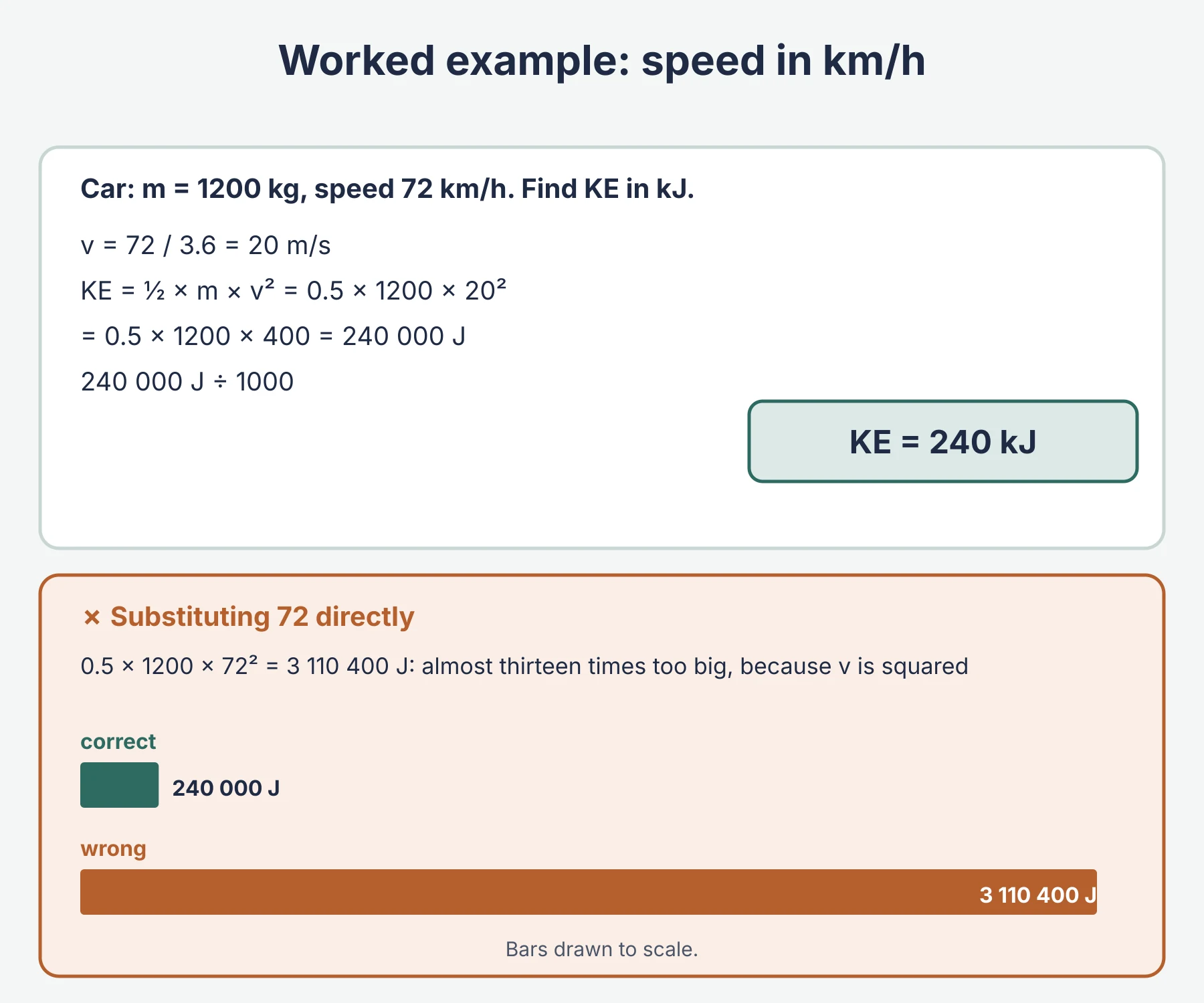
- Speed not converted from km/h before squaring: the error is squared too.
- Minutes left in P = W/t: the power comes out 60 times too big.
- Writing “35% J” or “0.35 W” for an efficiency.
- Lower-case “j”, “w” or “n” for unit symbols named after people; they take a capital.
- Answer line says “kJ” but the answer is left in J. Convert at the end.
- Using height in cm in
m × g × h. A 75 cm lift is 0.75 m. - Rounding in the middle of a two-step calculation, then losing a significant figure at the end.
Self-test
- Convert 650 g to kg.
- Write 3.2 MJ in joules, in standard form.
- Convert 54 km/h to m/s.
- A 1.5 kW heater runs for 4.0 minutes. Calculate the energy transferred in kJ.
- Express the watt in terms of the joule and the second.
- Show that the joule is the same as kg m²/s².
- A 0.20 kg ball moves at 15 m/s. Calculate its kinetic energy.
- A 400 g book is lifted 75 cm (g = 10 N/kg). Calculate the gravitational potential energy it gains.
- Explain why efficiency has no unit.
- A 60 W lamp is on for 1.0 hour. Calculate the energy transferred in MJ.
- State another unit equivalent to m/s² for gravitational field strength.
- Which is larger: 0.5 MJ or 450 kJ?
Answers: 1. 0.65 kg. 2. 3.2 × 10⁶ J. 3. 54 ÷ 3.6 = 15 m/s. 4. E = P × t = 1500 × 240 = 360 000 J = 360 kJ. 5. 1 W = 1 J/s. 6. From W = F × d, 1 J = 1 N m, and from F = m × a, 1 N = 1 kg m/s², so 1 J = 1 kg m/s² × m = 1 kg m²/s². 7. KE = 0.5 × 0.20 × 15² = 0.5 × 0.20 × 225 = 22.5 J (23 J to 2 s.f.). 8. GPE = 0.400 × 10 × 0.75 = 3.0 J. 9. It is a ratio of two energies, both in joules, so the units cancel. 10. E = 60 × 3600 = 216 000 J = 0.216 MJ (0.22 MJ to 2 s.f.). 11. N/kg. 12. 0.5 MJ = 500 kJ, so 0.5 MJ is larger.
Related resources
-
Study guides
Pearson Edexcel International GCSE Physics (4PH1): Work and power
Work done, GPE, kinetic energy, the energy link between them and power as a rate, with multi-step worked examples, for Edexcel IGCSE Physics 4PH1, 4c.
Physics · Pearson Edexcel · IGCSE
Read guide -
Practice questions
Pearson Edexcel International GCSE Physics (4PH1): Work and power – Practice Questions
Original 4PH1 questions on work done, GPE, kinetic energy, the energy link, braking distances and power, including a stair-climbing practical.
Physics · Pearson Edexcel · IGCSE
Try questions -
Revision notes
Pearson Edexcel International GCSE Physics (4PH1): Work and power – Revision Notes
Recall notes for 4PH1 sub-topic 4c: W = Fd, GPE = mgh, KE = ½mv², P = W/t, the GPE-KE-work link, equation choice, traps and a 12-question self-test.
Physics · Pearson Edexcel · IGCSE
Revise topic
Related articles
Get free revision emails (optional)
Occasional emails with practice questions, worked explanations and links to free resources for the qualification and subjects you choose. No spam, and you can unsubscribe from any email. The free tools on this site never need an email.