
Revision Notes
Pearson Edexcel International GCSE Physics (4PH1): Work and power – Revision Notes
Recall notes for 4PH1 sub-topic 4c: W = Fd, GPE = mgh, KE = ½mv², P = W/t, the GPE-KE-work link, equation choice, traps and a 12-question self-test.
- Subject
- Physics
- Level
- IGCSE
- Topic
- Energy resources and energy transfers
- Author
- Marlbridge Academic Team
- Updated
- Reviewed by
- Hassan (what this means)
Aligned to Pearson Edexcel IGCSE Physics (4PH1), Issue 4. Official specification .
Syllabus page (what it covers and how it is assessed): Pearson Edexcel IGCSE Physics.
Syllabus points this page covers
4PH1
- 4c Work and power
Found an error? Report a correction.
Need help with this topic? Request a free trial class for IGCSE Physics (4PH1).
These notes condense sub-topic 4(c) Work and power (statements 4.11 to 4.17) of Pearson Edexcel International GCSE Physics 4PH1, Issue 4. For explanations and six worked examples, use the Work and power study guide; for exam-style questions, the Work and power practice questions.
Equations
W = F × d                (work done; d is in the direction of the force)
GPE = m × g × h          (h is the vertical change in height)
KE = ½ × m × v²
P = W / t                (power: work done or energy transferred per second)
Rearranged forms you will need:
F = W / d       d = W / F
h = GPE / (m × g)       m = GPE / (g × h)
v = √(2 × KE / m)       m = 2 × KE / v²
W = P × t       t = W / P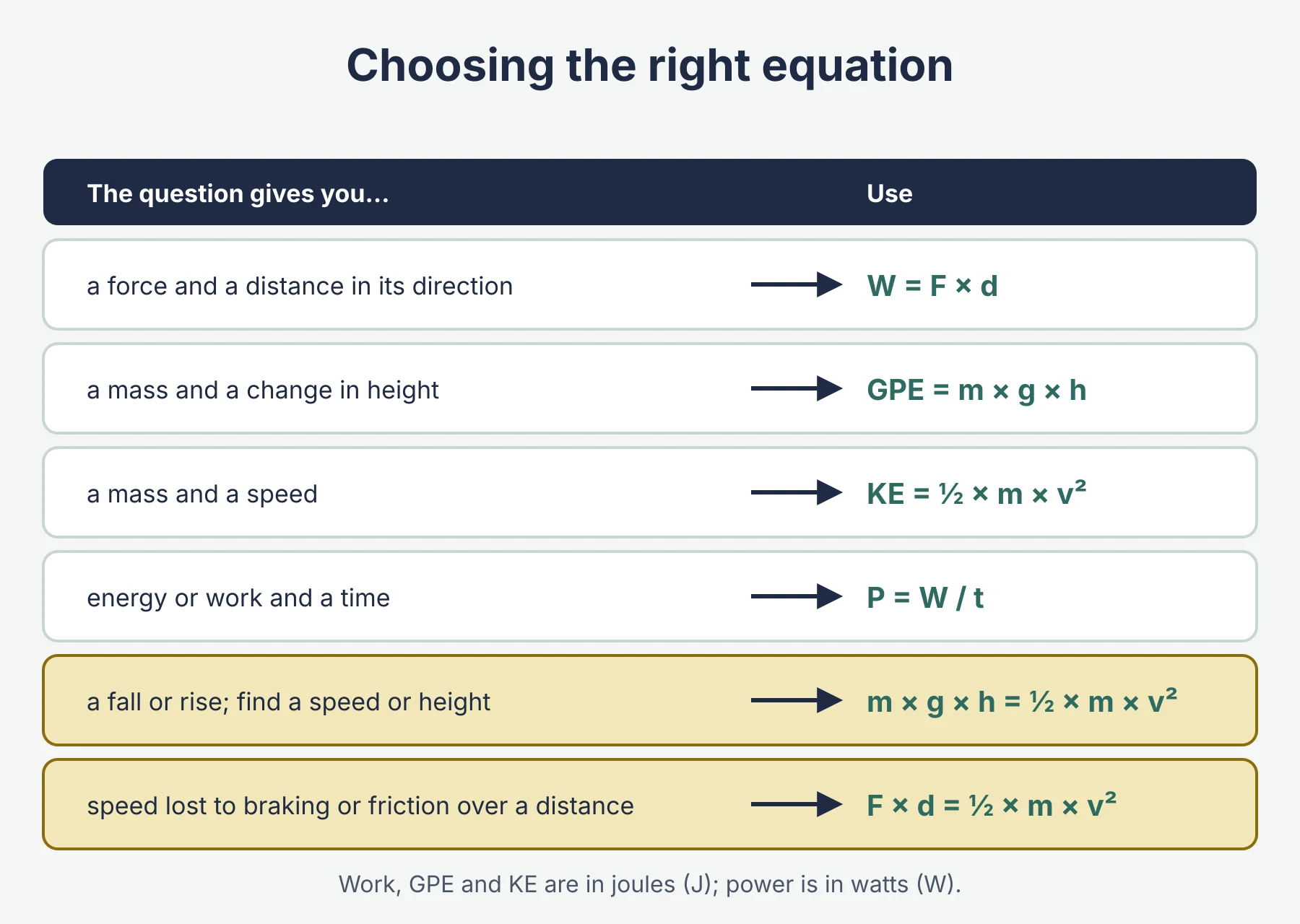
Facts to recall
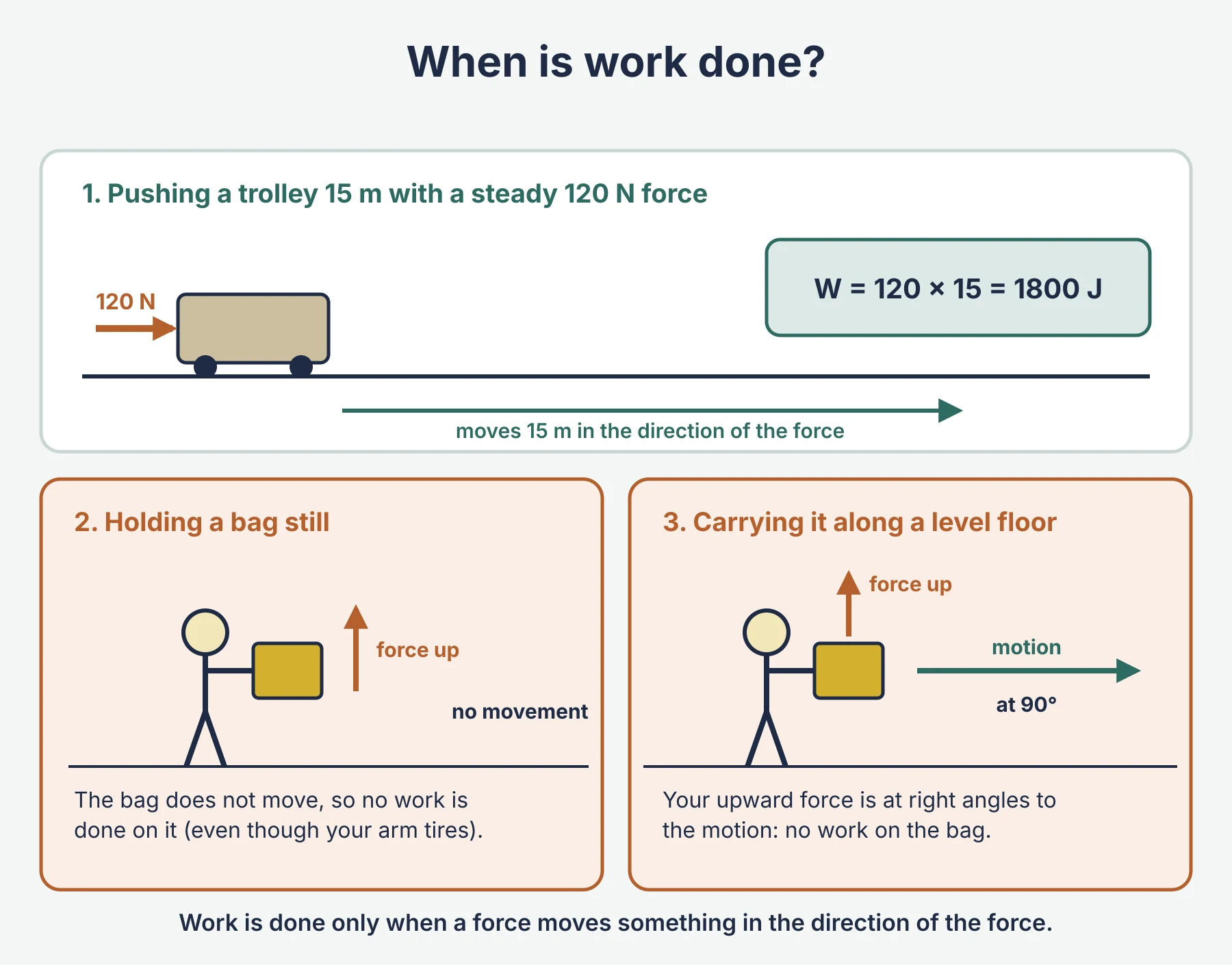
- Work done = energy transferred (4.12). Both in joules.
- No work is done if the object does not move, or moves at right angles to the force.
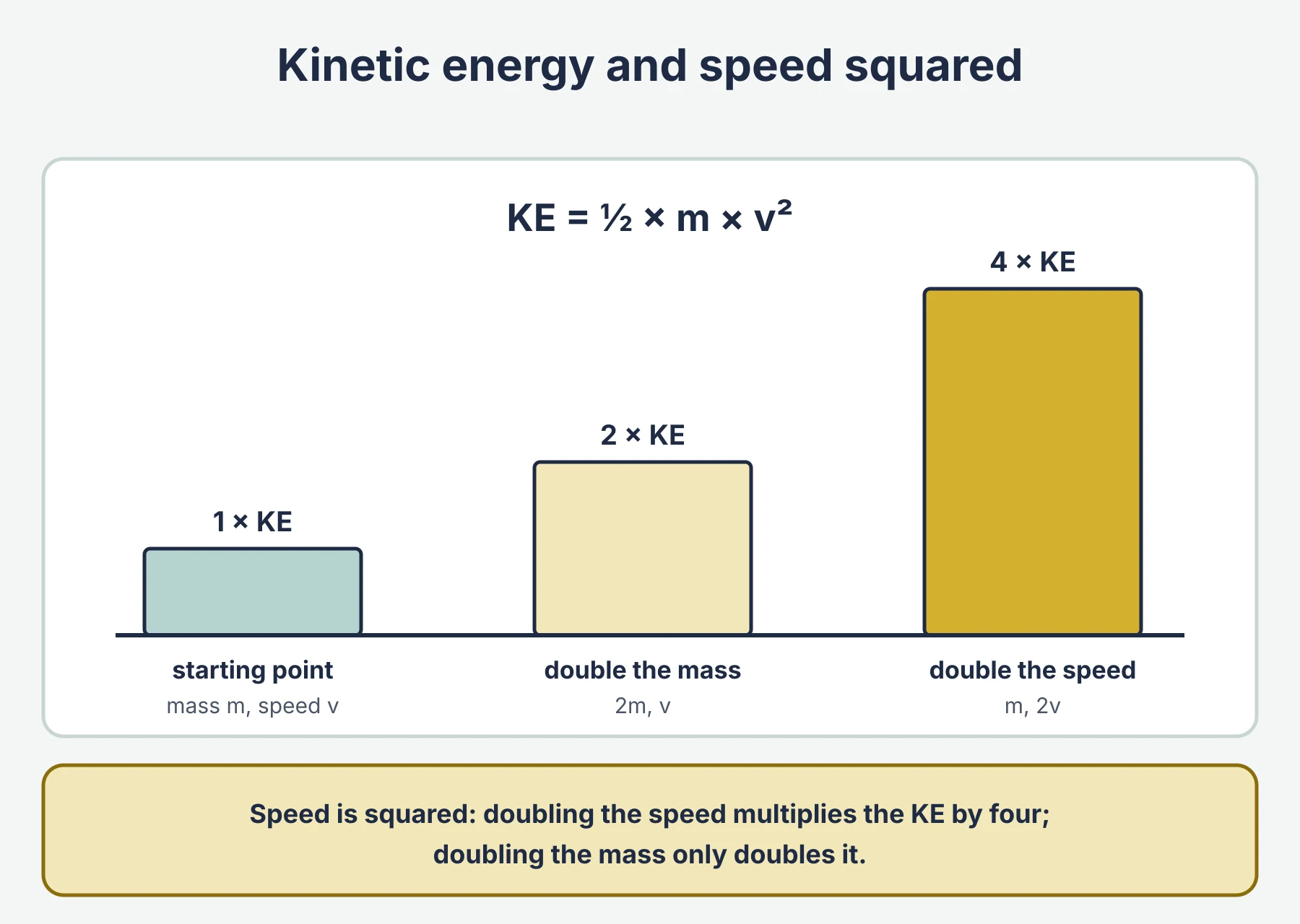
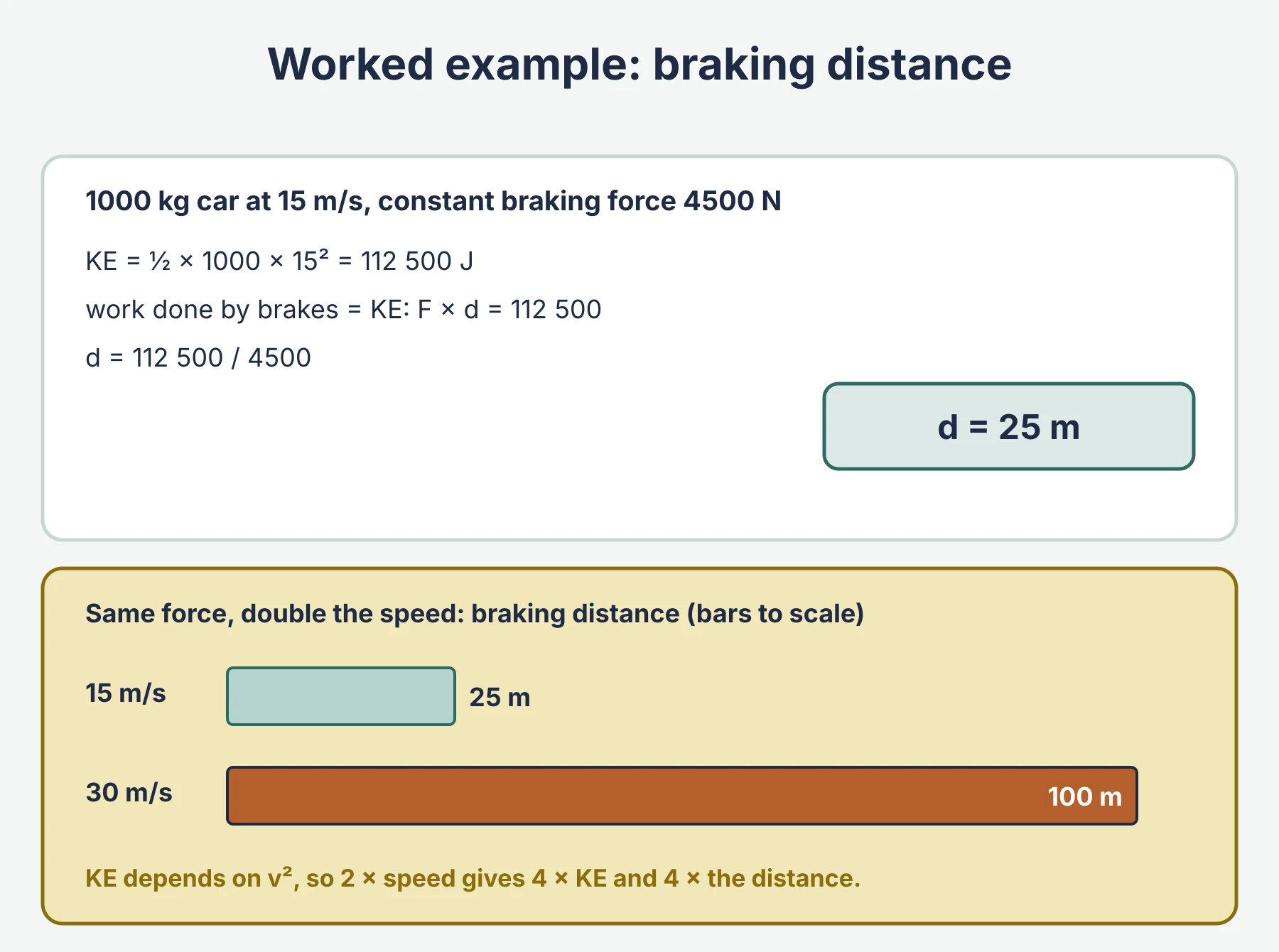
- KE ∝ v²: double the speed, four times the KE; triple the speed, nine times the KE.
- GPE ∝ h and ∝ m.
- Power is the rate of energy transfer or of doing work (4.16). 1 W = 1 J/s.
- Same work in less time = more power.
The energy link (4.15)
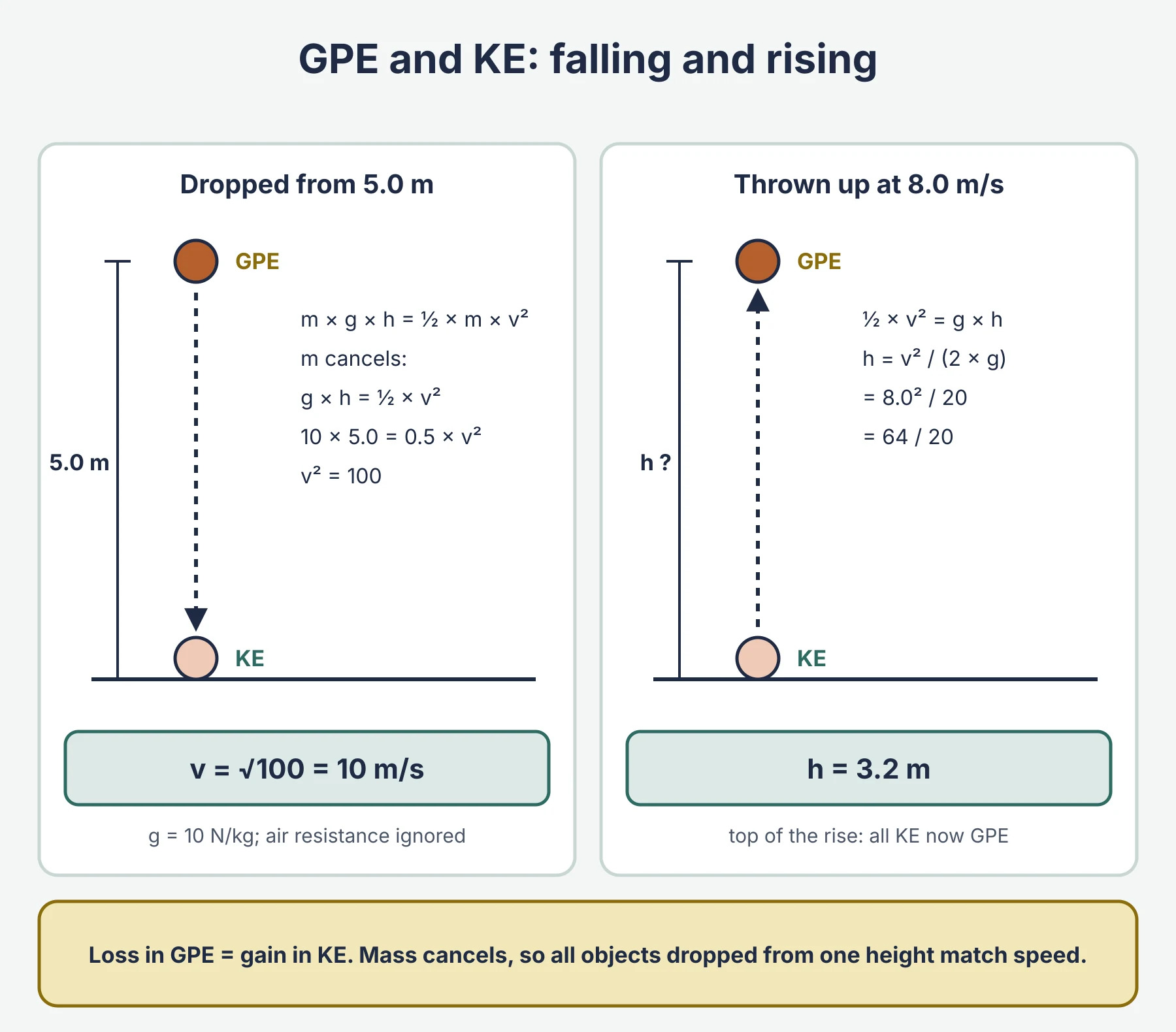
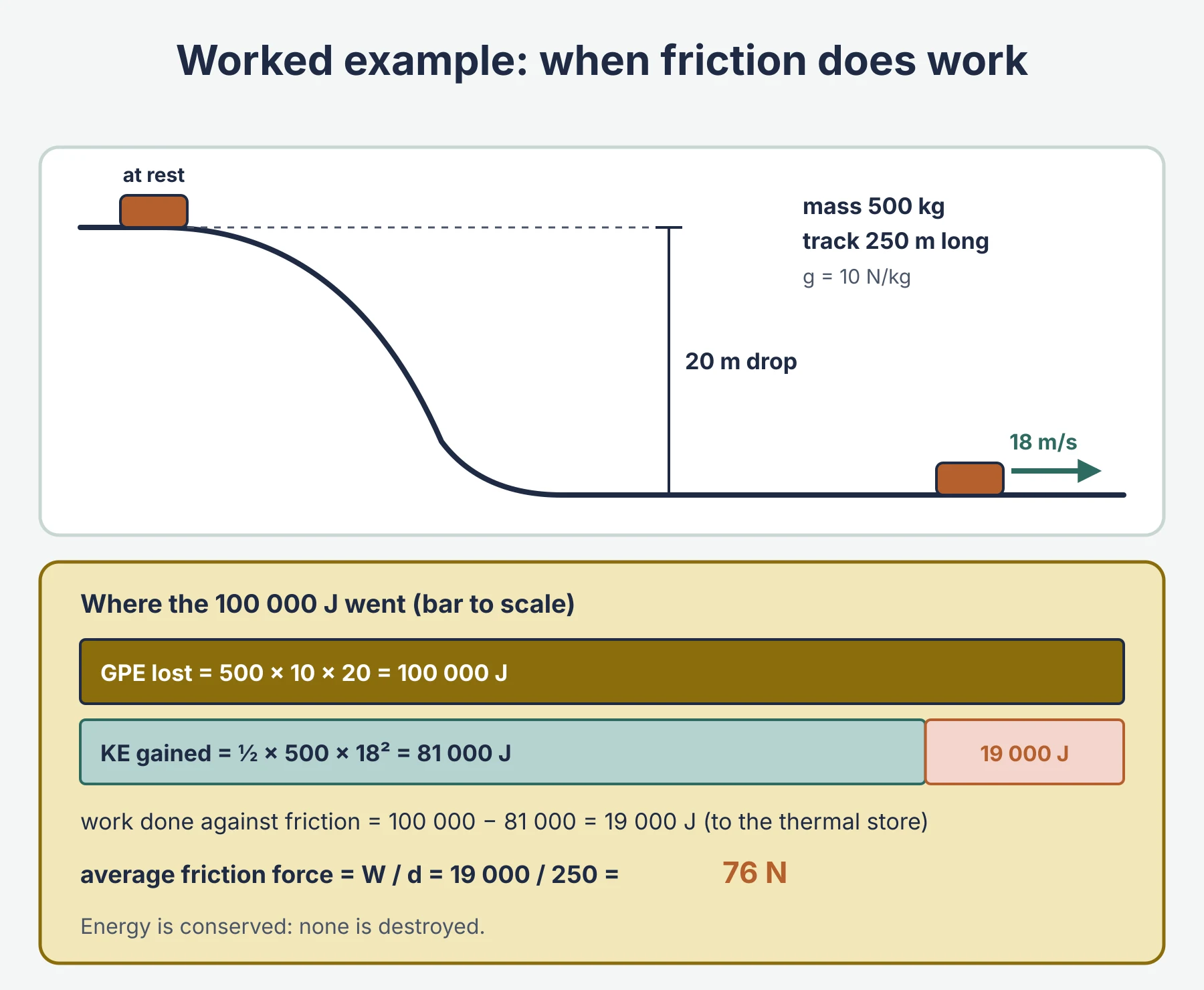
For a free fall (no air resistance): GPE lost = KE gained, so m g h = ½ m v².
- Mass cancels:
v = √(2 g h)andh = v² / (2 g). - With friction or air resistance: GPE lost = KE gained + work done against friction.
- For braking on a level road: work done by brakes = KE lost, so
F × d = ½ m v².
| Situation | Energy statement |
|---|---|
| Object falls, no air resistance | m g h = ½ m v² |
| Object falls, with drag or friction | m g h = ½ m v² + work against friction |
| Thrown up, reaches top | ½ m v² = m g h |
| Brakes stop a car | F × d = ½ m v² |
| Lifting at steady speed | work done by the lifting force = m g h |
Measuring personal power (stairs)
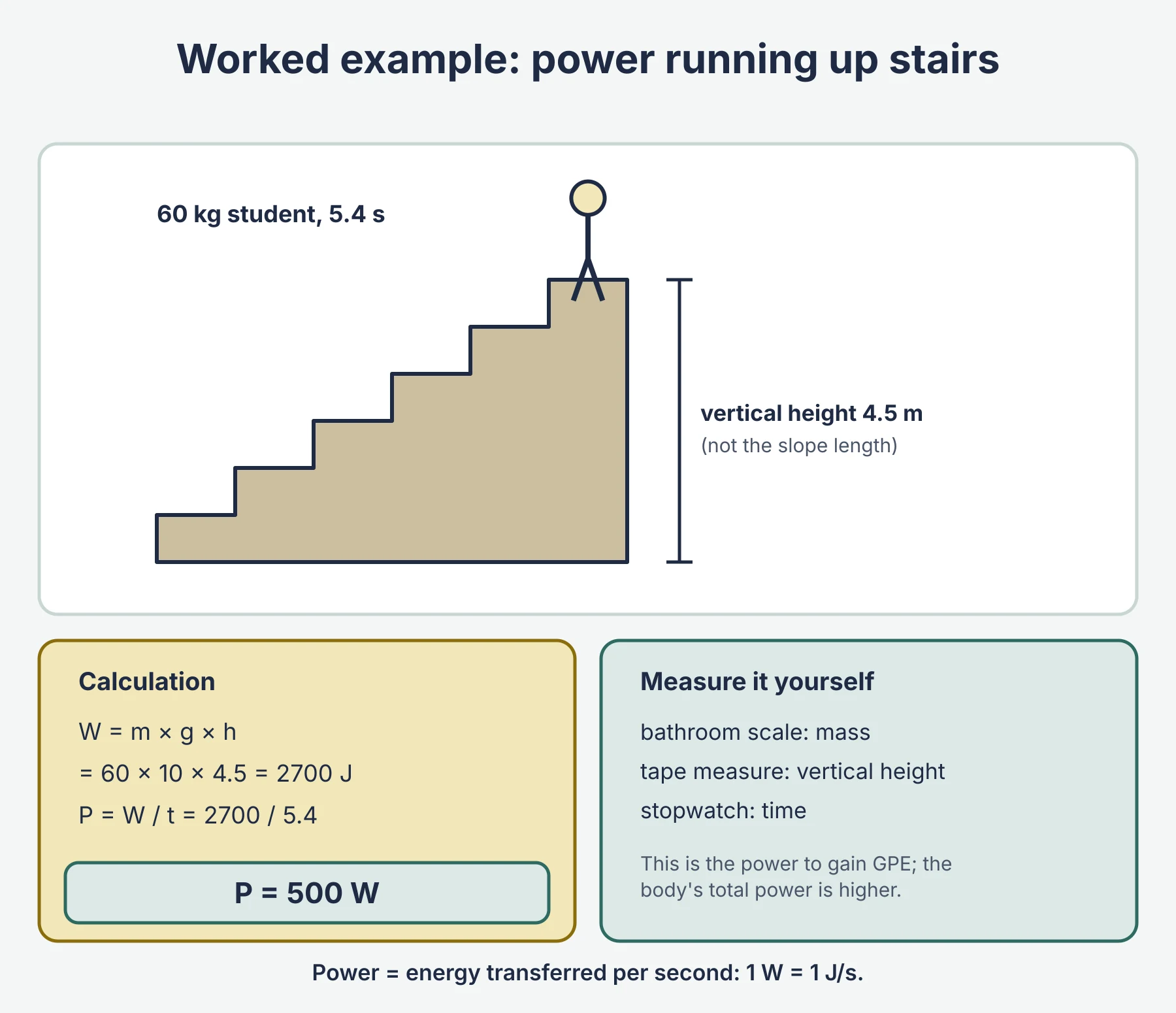
Measure mass (scales), vertical height of the stairs (tape measure, step height × number of steps) and time (stopwatch). Work done = m g h; power = m g h / t. The result underestimates the body’s total power, because some energy heats the body.
Key terms
| Term | Meaning |
|---|---|
| Work done | Energy transferred when a force moves an object in the direction of the force |
| Joule (J) | Work done when a 1 N force moves through 1 m |
| Gravitational potential energy | Energy in the gravitational store, changed by m g h when height changes by h |
| Kinetic energy | Energy in the kinetic store of a moving object, ½ m v² |
| Gravitational field strength, g | Force per kilogram from gravity (about 10 N/kg on Earth) |
| Power | Rate of doing work or transferring energy |
| Watt (W) | One joule per second |
| Work done against friction | Energy transferred to the thermal store of the surroundings by friction |
Exam traps
- Using the slope length instead of the vertical height in m g h.
- Squaring ½ × v, or forgetting to square v at all.
- Stopping at v² and forgetting the square root.
- Saying holding a weight still “does work on it”.
- Time in minutes in P = W / t.
- In a friction question, setting GPE lost equal to KE gained: friction takes some of the energy.
- Writing “power is the energy” rather than “the energy transferred per second”.
Self-test
Take g = 10 N/kg.
- A 250 N force pushes a box 3.0 m along the floor. Calculate the work done.
- Calculate the GPE gained by a 2.0 kg bag lifted through 1.2 m.
- Calculate the KE of a 0.50 kg ball moving at 12 m/s.
- An apple falls 1.8 m from a tree. Calculate its speed just before landing (ignore air resistance).
- A ball is thrown straight up at 6.0 m/s. Calculate the maximum height it reaches.
- A motor does 4800 J of work in 1.0 minute. Calculate its power.
- A car’s speed triples. By what factor does its kinetic energy change?
- Explain why no work is done on a box that is held still.
- State what is meant by power.
- A 1200 W motor runs for 30 s. Calculate the energy it transfers.
- A car of mass 800 kg at 20 m/s brakes with a constant 4000 N force. Calculate its braking distance.
- A child’s speed at the bottom of a slide is lower than the value calculated from m g h = ½ m v². Explain why.
Answers: 1. W = 250 × 3.0 = 750 J. 2. GPE = 2.0 × 10 × 1.2 = 24 J. 3. KE = 0.5 × 0.50 × 12² = 36 J. 4. v = √(2 × 10 × 1.8) = √36 = 6.0 m/s. 5. h = 6.0² ÷ (2 × 10) = 36 ÷ 20 = 1.8 m. 6. P = 4800 ÷ 60 = 80 W. 7. It increases nine times (3²). 8. The box does not move, so there is no distance moved in the direction of the force and no energy is transferred to it. 9. The rate of doing work, or the energy transferred per second. 10. W = P × t = 1200 × 30 = 36 000 J. 11. KE = 0.5 × 800 × 20² = 160 000 J; d = 160 000 ÷ 4000 = 40 m. 12. Some of the GPE is transferred by work done against friction (and air resistance) to the thermal store of the slide, child and air, so less than the full GPE becomes kinetic energy.
Related resources
-
Practice questions
Edexcel IGCSE Physics: Energy Resources and Energy Transfers — Practice Questions
Original practice questions with worked answers on energy stores, efficiency, thermal energy transfer and energy resources for Edexcel IGCSE Physics 4PH1.
Physics · Pearson Edexcel · IGCSE
Try questions -
Study guides
Energy Resources and Energy Transfers
Energy stores, efficiency, thermal transfer, work and power, and electricity generation: Topic 4 of Pearson Edexcel International GCSE Physics (4PH1).
Physics · Pearson Edexcel · IGCSE
Read guide -
Revision notes
Edexcel IGCSE Physics: Energy Resources and Energy Transfers — Revision Notes
Condensed recall notes on energy stores, conservation, efficiency, thermal transfer and energy resources for Edexcel International GCSE Physics 4PH1.
Physics · Pearson Edexcel · IGCSE
Revise topic
Related articles
Get free revision emails (optional)
Occasional emails with practice questions, worked explanations and links to free resources for the qualification and subjects you choose. No spam, and you can unsubscribe from any email. The free tools on this site never need an email.