
Study Guides
Pearson Edexcel International GCSE Physics (4PH1): Energy resources and electricity generation
Energy transfers when electricity is generated from wind, water, geothermal, solar, fossil and nuclear resources, and their pros and cons, for 4PH1.
- Subject
- Physics
- Level
- IGCSE
- Topic
- Energy resources and energy transfers
- Author
- Marlbridge Academic Team
- Updated
- Reviewed by
- Hassan (what this means)
Aligned to Pearson Edexcel IGCSE Physics (4PH1), Issue 4. Official specification .
Syllabus page (what it covers and how it is assessed): Pearson Edexcel IGCSE Physics.
Syllabus points this page covers
4PH1
- 4d Energy resources and electricity generation
Found an error? Report a correction.
Need help with this topic? Request a free trial class for IGCSE Physics (4PH1).
This guide covers sub-topic 4(d) Energy resources and electricity generation of the Pearson Edexcel International GCSE in Physics (4PH1), Issue 4. Both statements are Physics-only, so they are assessed only on Paper 2:
- 4.18P describe the energy transfers involved in generating electricity using wind, water, geothermal resources, solar heating systems, solar cells, fossil fuels and nuclear power;
- 4.19P describe the advantages and disadvantages of methods of large-scale electricity production from various renewable and non-renewable resources.
The Energy Resources and Energy Transfers study guide introduces the renewable and non-renewable split. This page goes through each named resource in turn and shows how to build a balanced, well-argued comparison.
The common chain: turbine and generator
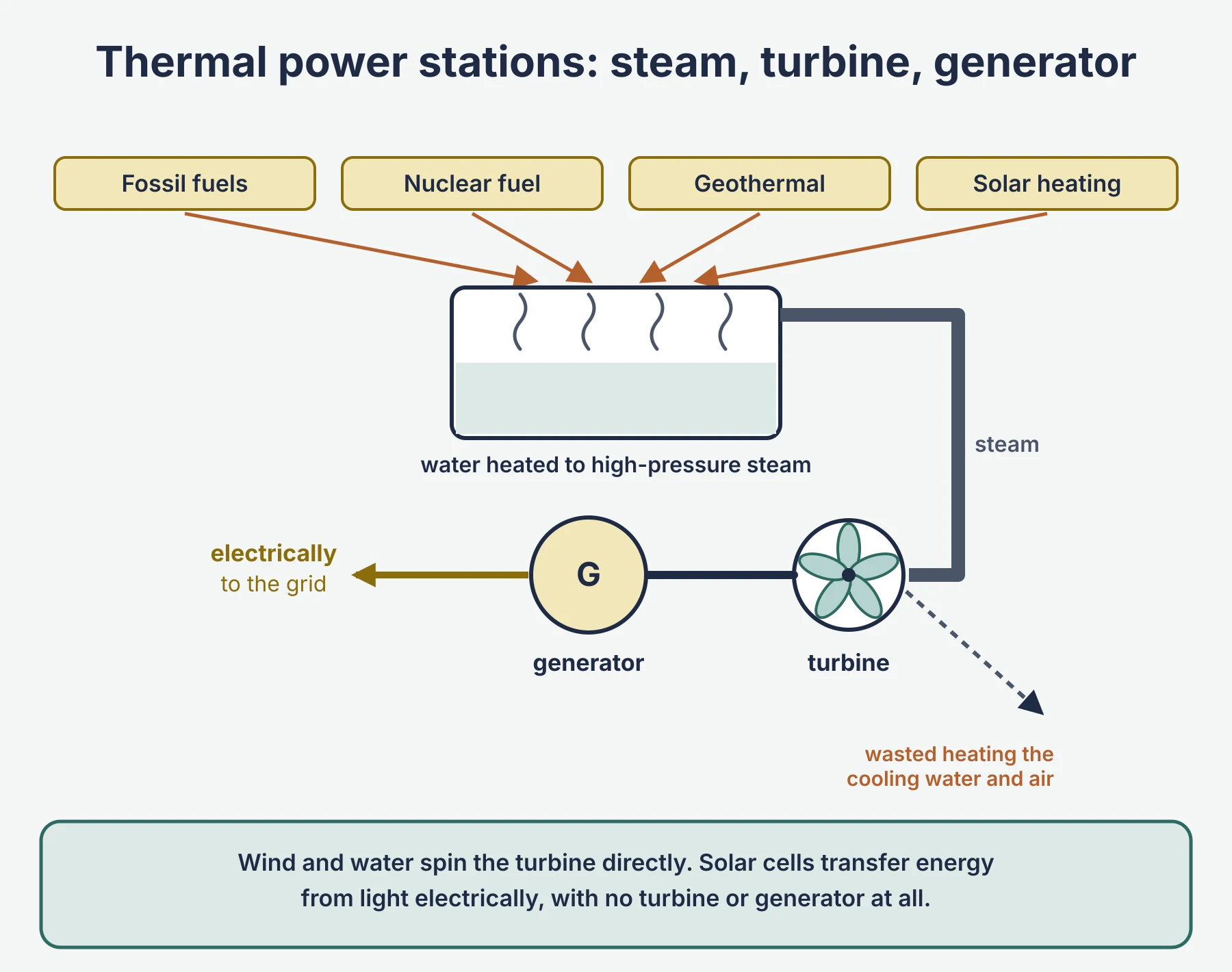
Most power stations share the same final stages. Something makes a turbine spin, the turbine turns a generator, and the generator transfers energy electrically to the grid. Inside the generator, a magnet rotates inside coils of wire (or coils rotate in a magnetic field), inducing a voltage, which is the electromagnetic induction of Topic 6. What differs between resources is what drives the turbine:
- thermal power stations (fossil fuel, nuclear, geothermal, and solar heating at large scale) heat water to make high-pressure steam, and the steam drives the turbine;
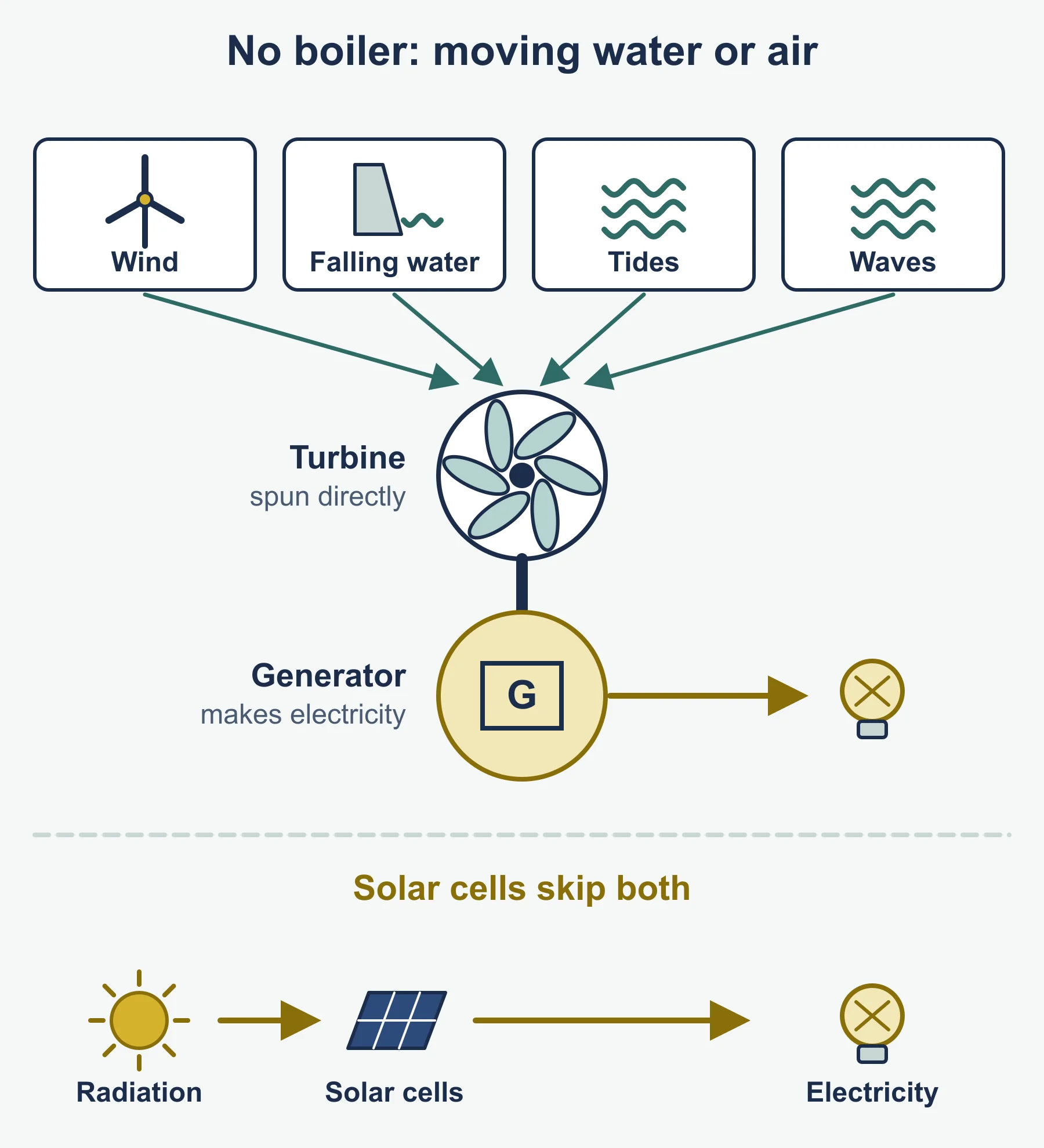
- wind and water drive the turbine directly with moving air or water;
- solar cells are the exception: they transfer energy from light directly electrically, with no turbine or generator.
The energy transfers, resource by resource (4.18P)
| Resource | Energy transfers to describe |
|---|---|
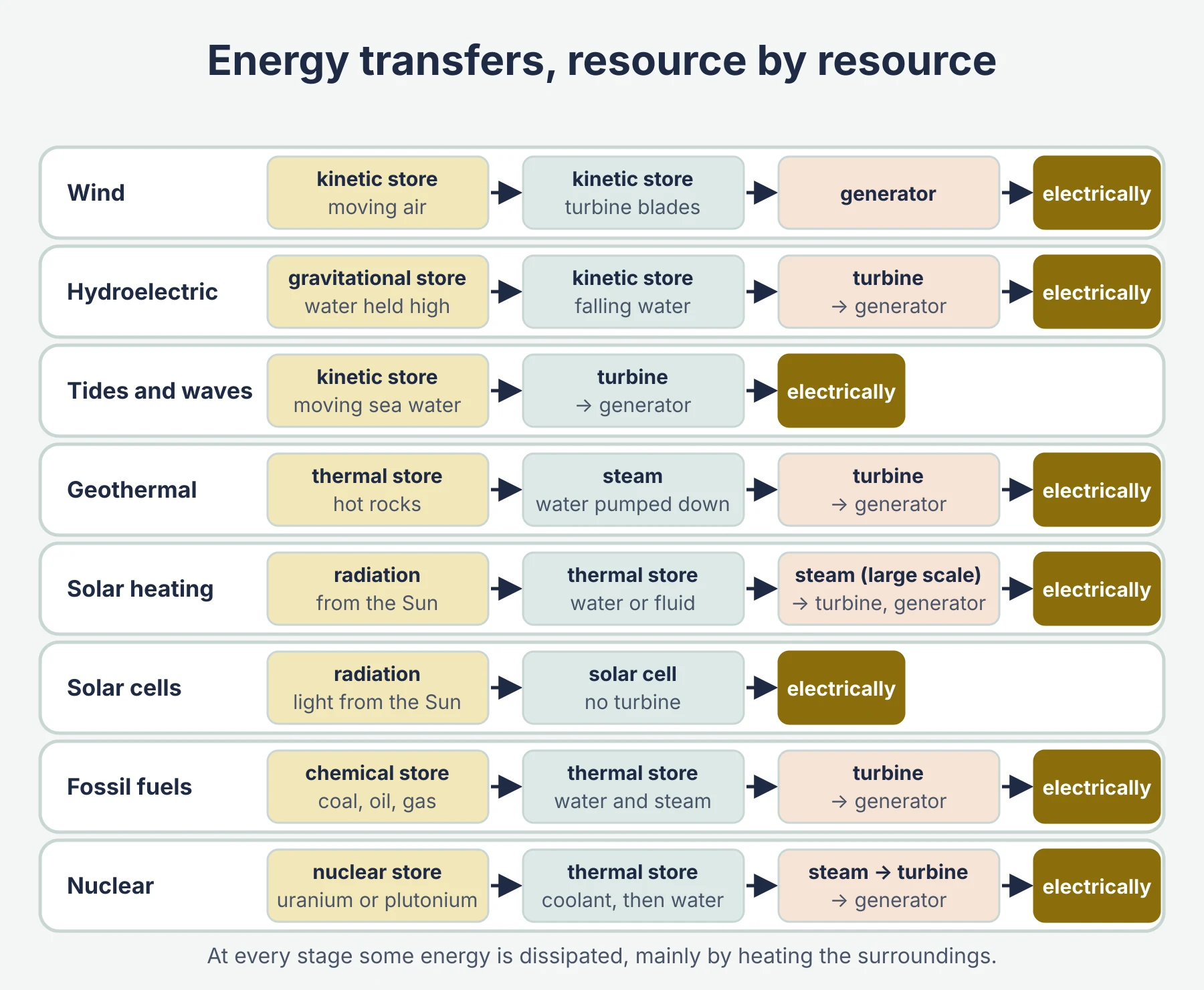
| Wind | Kinetic store of moving air → mechanically → kinetic store of the turbine blades → generator → electrically |
| Water: hydroelectric | Gravitational store of water held high in a reservoir → water falls → kinetic store of the water → turbine → generator → electrically |
| Water: tides and waves | Kinetic store of moving sea water (tides rising and falling, or wave motion) → turbine → generator → electrically |
| Geothermal | Thermal store of hot rocks underground → by heating → thermal store of water pumped down, which returns as steam → kinetic store of the turbine → generator → electrically |
| Solar heating systems | Radiation from the Sun → absorbed by dark collectors (or focused by mirrors) → thermal store of water or another fluid; at large scale this makes steam → turbine → generator → electrically |
| Solar cells | Radiation (light) from the Sun → solar cell → electrically, directly |
| Fossil fuels (coal, oil, gas) | Chemical store of the fuel → burning → by heating → thermal store of water and steam → kinetic store of the turbine → generator → electrically |
| Nuclear power | Nuclear store of uranium or plutonium fuel → fission in the reactor → thermal store of the coolant and then water → steam → turbine → generator → electrically |
At each stage some energy is dissipated, mainly by heating the surroundings. In thermal power stations a large part of the energy from the fuel is wasted in the cooling water and air, which is why their efficiency is well below 100%.
Weighing the resources (4.19P)
Strong answers compare resources on several criteria rather than repeating “renewable is good”. Useful criteria:
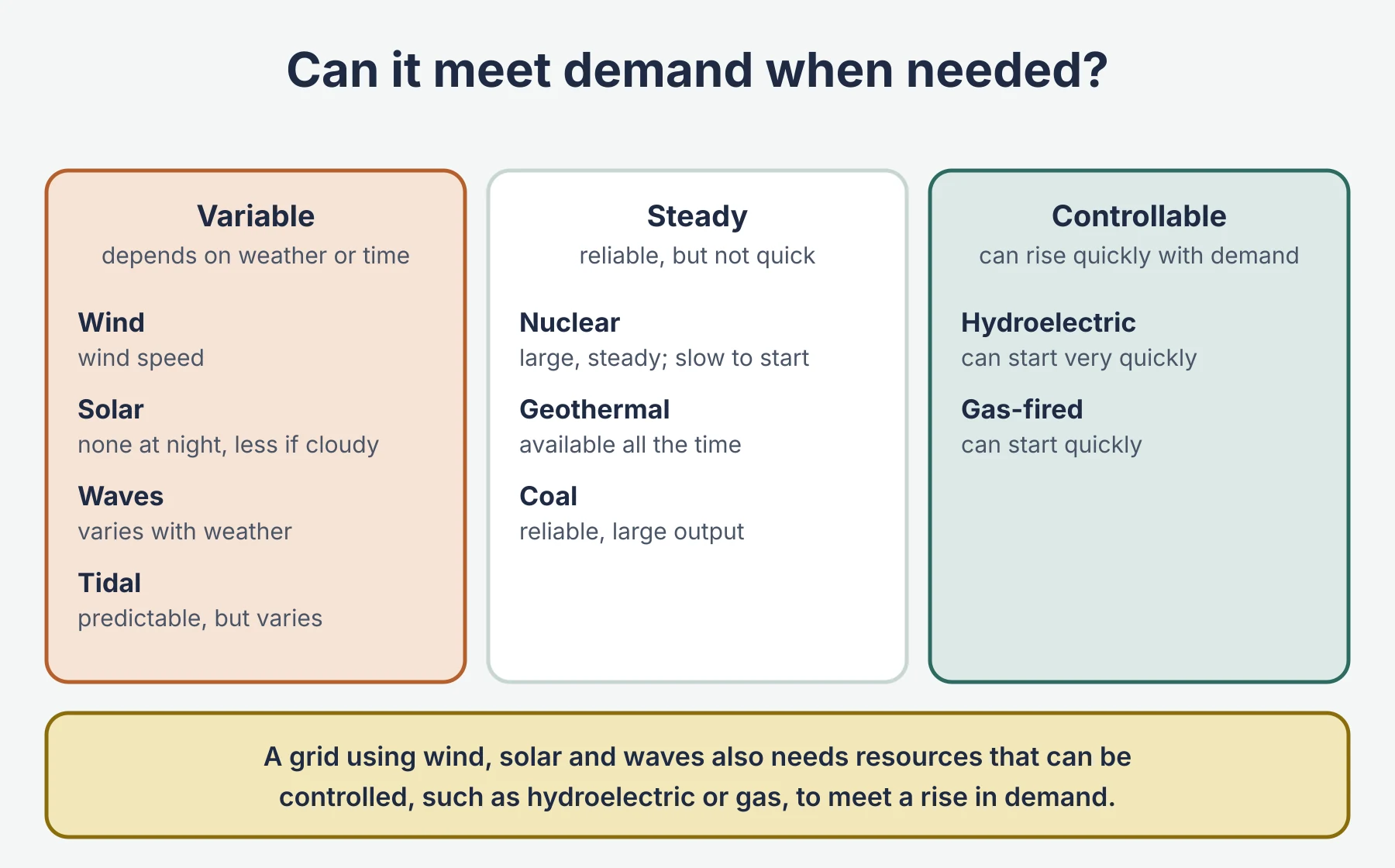
- Reliability: is the output available when needed, or does it depend on the weather or time of day?
- Control: can the output be raised or lowered quickly to match demand?
- Environmental effects: carbon dioxide (a greenhouse gas linked to climate change), other pollution, waste, effects on habitats and landscapes.
- Costs: building, fuel, running and, for nuclear power, decommissioning.
- Location: many resources only work at suitable sites.
- Renewable or not: will the resource run out?
| Resource | Advantages | Disadvantages |
|---|---|---|
| Wind | Renewable; no fuel cost; no carbon dioxide while operating | Output depends on wind speed, so unreliable; many turbines needed for a large output; visual impact and noise |
| Hydroelectric | Renewable; reliable while the reservoir holds water; can start very quickly when demand rises | Flooding a valley destroys habitats and may displace people; high building cost; needs a suitable valley and rainfall |
| Tidal | Renewable; tides are predictable | Few suitable estuaries; barrages affect wildlife habitats; output varies through the day |
| Wave | Renewable; no fuel cost | Output varies with the weather; equipment can be damaged by storms |
| Geothermal | Renewable; available all the time; no fuel cost | Only practical in regions with hot rocks near the surface; drilling is expensive |
| Solar heating and solar cells | Renewable; no fuel cost; solar cells have no moving parts and suit remote places | No output at night and less in cloudy weather; large areas of panels needed for a large output |
| Fossil fuels | Reliable; large output; gas-fired stations can start quickly | Non-renewable; burning releases carbon dioxide; coal also releases sulfur dioxide, which causes acid rain |
| Nuclear | Reliable; very large output from a small mass of fuel; no carbon dioxide released while generating | Non-renewable fuel; radioactive waste must be stored safely for a very long time; risk of accidents; high building and decommissioning costs; slow to start up |
A key idea for evaluation: the variable renewables (wind, solar, waves) cannot be switched on when demand rises, so a grid that uses them also needs resources that can be controlled, such as hydroelectric or gas.
Worked example: an efficiency calculation
This sub-topic sits inside Topic 4, so a question can ask for an efficiency (statement 4.4) in a power-station context. The figures here are invented for practice.
A coal-fired power station has a total energy output of 2500 MJ each second. Of this, 900 MJ is transferred electrically to the grid.
efficiency = 900 / 2500 × 100% = 36%
energy wasted each second = 2500 − 900 = 1600 MJ, mainly by heating the cooling water and air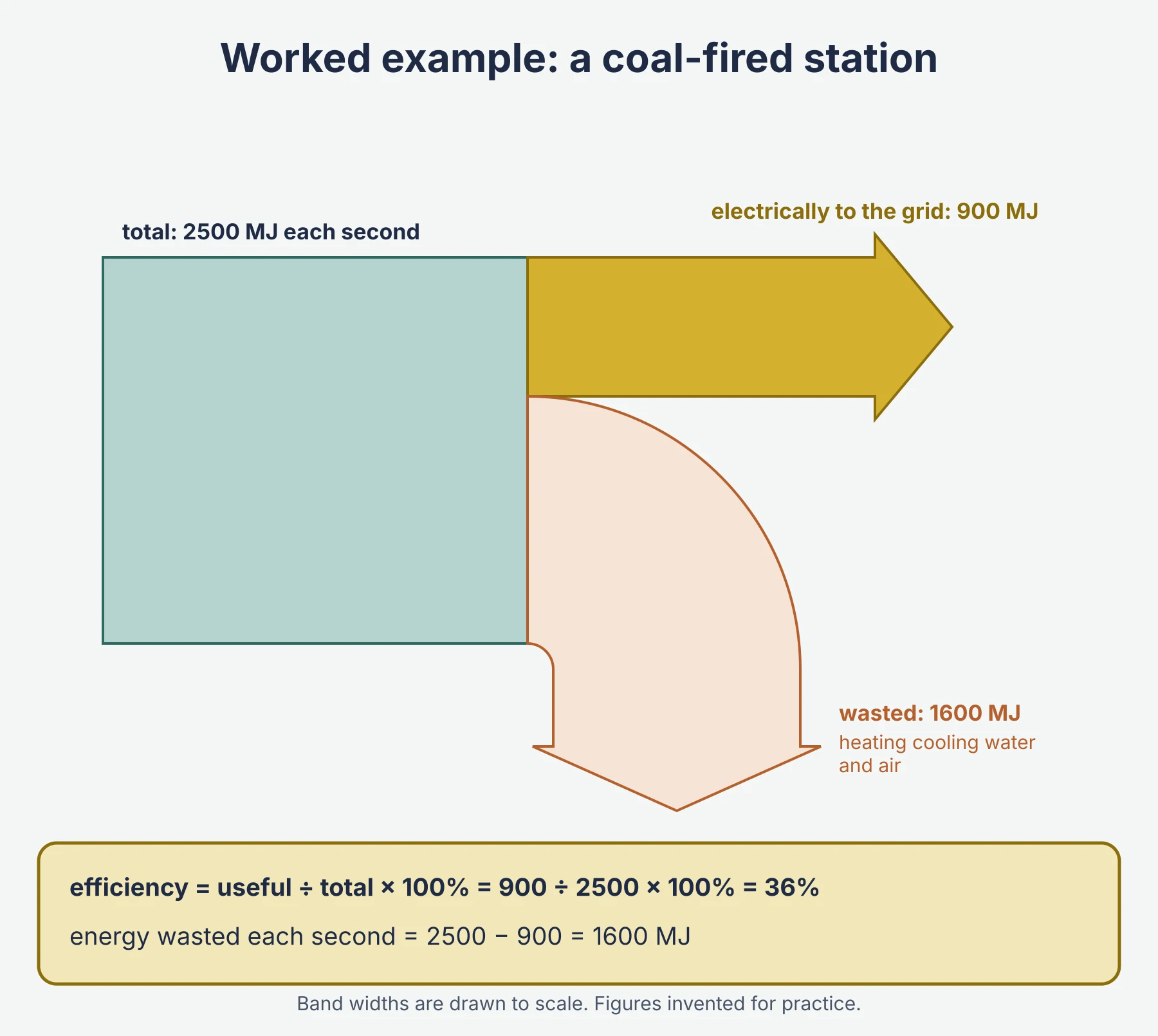
Annotated model answer
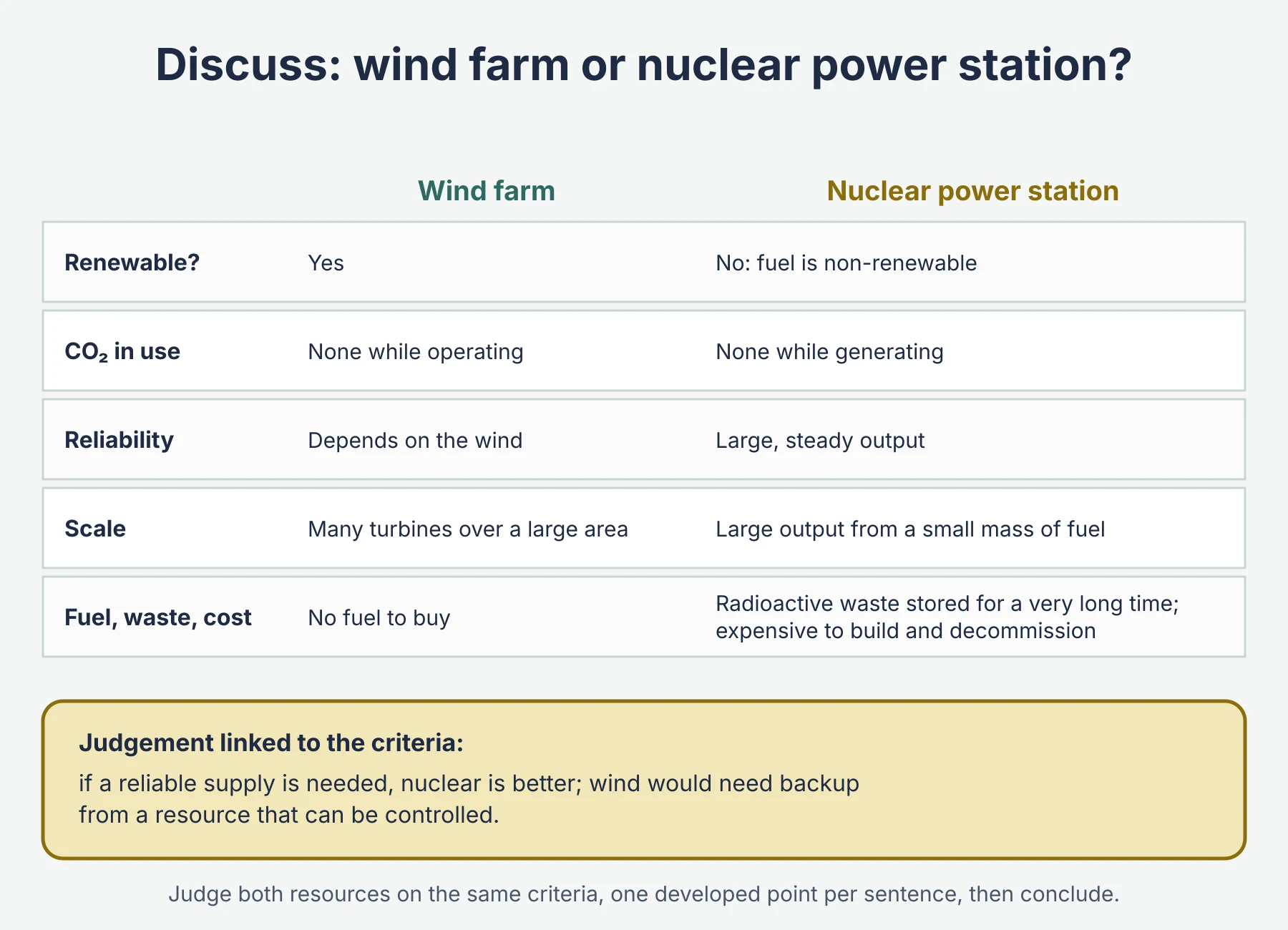
Question. A country wants to build new large-scale electricity generation. Discuss the advantages and disadvantages of building a wind farm compared with a nuclear power station.
A wind farm uses a renewable resource and releases no carbon dioxide while it operates, and there is no fuel to buy. (two advantages, each a separate point) However, its output depends on the wind, so it cannot guarantee electricity when demand is high, and many turbines spread over a large area are needed to match one large power station. (reliability and scale) A nuclear power station gives a large, steady output from a small mass of fuel and also releases no carbon dioxide while generating. (fair comparison on the same criterion) But its fuel is non-renewable, it produces radioactive waste that must be stored safely for a very long time, and it is expensive to build and to decommission. (three disadvantages, covering environment and cost) If the country needs a reliable supply, nuclear power is better, but wind would need backup from a resource that can be controlled. (a judgement linked back to the criteria)
Notice that each sentence makes one developed point, both resources are judged on the same criteria, and the answer ends with a conclusion. That matches the specification’s meaning of “discuss”: explore all aspects of the issue and reason about them.
Common mistakes
- Saying a resource “creates energy”. Energy is transferred from a store; it is never made.
- Calling nuclear power renewable, or calling it a fossil fuel. It is non-renewable and not a fossil fuel.
- Describing solar cells with a turbine. They transfer energy electrically without any moving parts.
- Writing “it is bad for the environment” with no reason. Name the effect: carbon dioxide, habitat loss, radioactive waste.
- Listing only advantages of renewables and only disadvantages of fossil fuels; a discussion needs both sides.
- Forgetting the generator: the turbine alone does not produce electricity.
Exam technique
- Describe the energy transfers: start at the original store, name each stage and end with “electrically”. Include the wasted energy if the question asks for all the transfers.
- Describe advantages and disadvantages: give at least one of each for each resource, with a reason attached.
- Discuss / Evaluate: compare on the same criteria and finish with a judgement that follows from your points.
Keep going
- Energy resources and electricity generation revision notes
- Energy resources and electricity generation practice questions
- Magnetism and Electromagnetism study guide, for how a generator induces a voltage
Written against the Pearson Edexcel International GCSE in Physics (4PH1) specification, Issue 4. Always check the current specification for your examination year.
Related resources
-
Practice questions
Pearson Edexcel International GCSE Physics (4PH1): Energy resources and electricity generation – Practice Questions
Original 4PH1 questions on energy transfers in power stations, geothermal, solar, hydroelectric and nuclear generation, with a six-mark discussion.
Physics · Pearson Edexcel · IGCSE
Try questions -
Revision notes
Pearson Edexcel International GCSE Physics (4PH1): Energy resources and electricity generation – Revision Notes
Recall notes for 4PH1 sub-topic 4d: transfer chains for each energy resource, pros and cons for large-scale generation and a 12-question self-test.
Physics · Pearson Edexcel · IGCSE
Revise topic -
Study guides
Pearson Edexcel International GCSE Physics (4PH1): Energy transfers
Energy stores and pathways, efficiency, Sankey diagrams, conduction, convection, radiation and the thermal practicals for Edexcel IGCSE Physics 4PH1, 4b.
Physics · Pearson Edexcel · IGCSE
Read guide
Related articles
Get free revision emails (optional)
Occasional emails with practice questions, worked explanations and links to free resources for the qualification and subjects you choose. No spam, and you can unsubscribe from any email. The free tools on this site never need an email.