
Revision Notes
Pearson Edexcel International GCSE Physics (4PH1): Energy resources and electricity generation – Revision Notes
Recall notes for 4PH1 sub-topic 4d: transfer chains for each energy resource, pros and cons for large-scale generation and a 12-question self-test.
- Subject
- Physics
- Level
- IGCSE
- Topic
- Energy resources and energy transfers
- Author
- Marlbridge Academic Team
- Updated
- Reviewed by
- Hassan (what this means)
Aligned to Pearson Edexcel IGCSE Physics (4PH1), Issue 4. Official specification .
Syllabus page (what it covers and how it is assessed): Pearson Edexcel IGCSE Physics.
Syllabus points this page covers
4PH1
- 4d Energy resources and electricity generation
Found an error? Report a correction.
Need help with this topic? Request a free trial class for IGCSE Physics (4PH1).
These notes condense sub-topic 4(d) Energy resources and electricity generation (statements 4.18P and 4.19P) of Pearson Edexcel International GCSE Physics 4PH1, Issue 4. Both statements are Physics-only and are assessed only on Paper 2. For the full explanations and an annotated model answer, use the Energy resources and electricity generation study guide; for exam-style questions, the practice questions.
The seven named resources
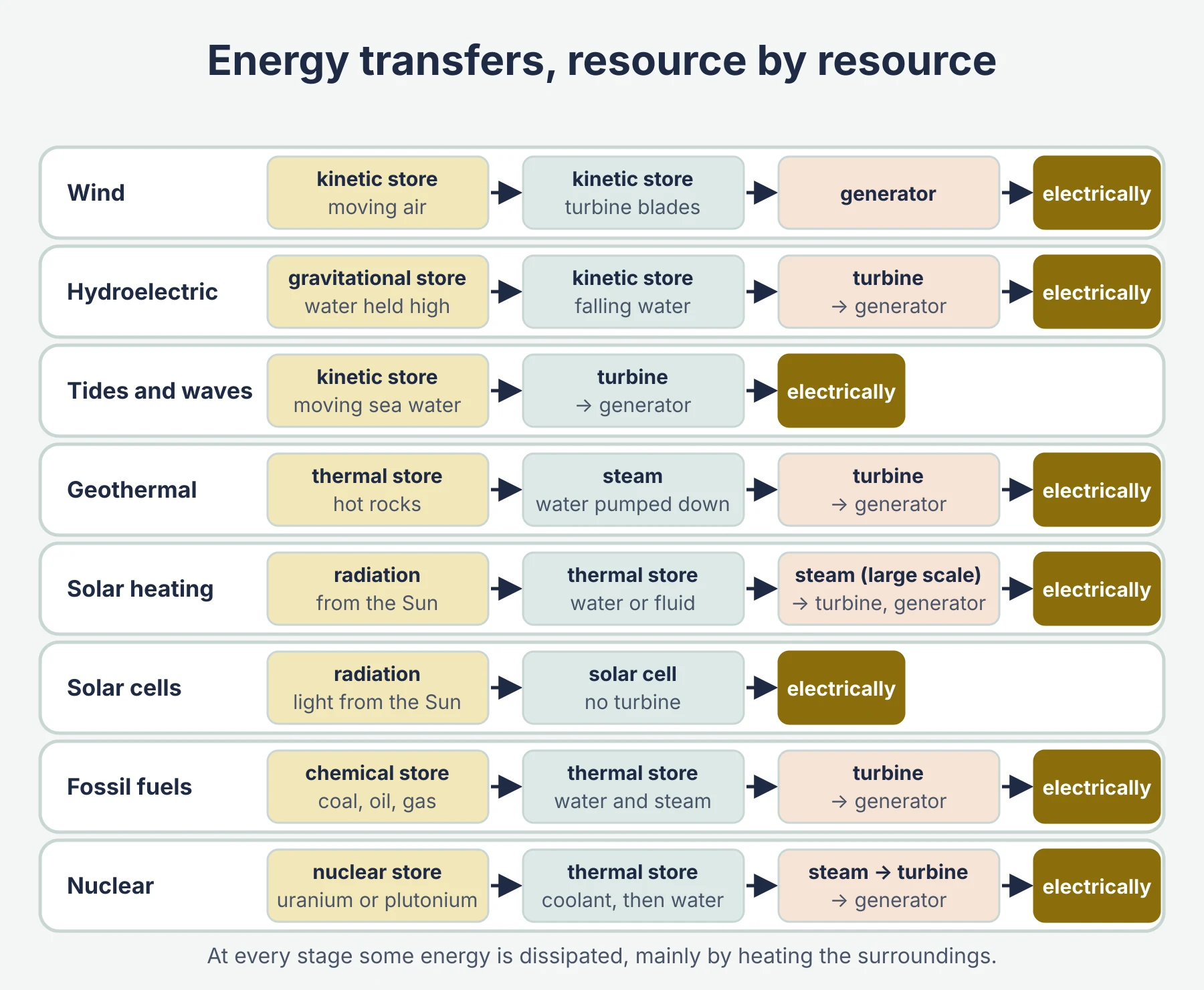
Statement 4.18P names: wind, water, geothermal resources, solar heating systems, solar cells, fossil fuels and nuclear power. Learn one transfer chain for each.
Transfer chains
Wind:        KE store of air → turbine → generator → electrically
Hydro:       GPE store of raised water → KE store of water → turbine → generator → electrically
Tidal/wave:  KE store of sea water → turbine → generator → electrically
Geothermal:  thermal store of hot rocks → heats water to steam → turbine → generator → electrically
Solar heat:  radiation → thermal store of water/fluid (→ steam → turbine → generator at large scale)
Solar cell:  radiation (light) → electrically, directly (no turbine)
Fossil fuel: chemical store → burning → thermal store of steam → turbine → generator → electrically
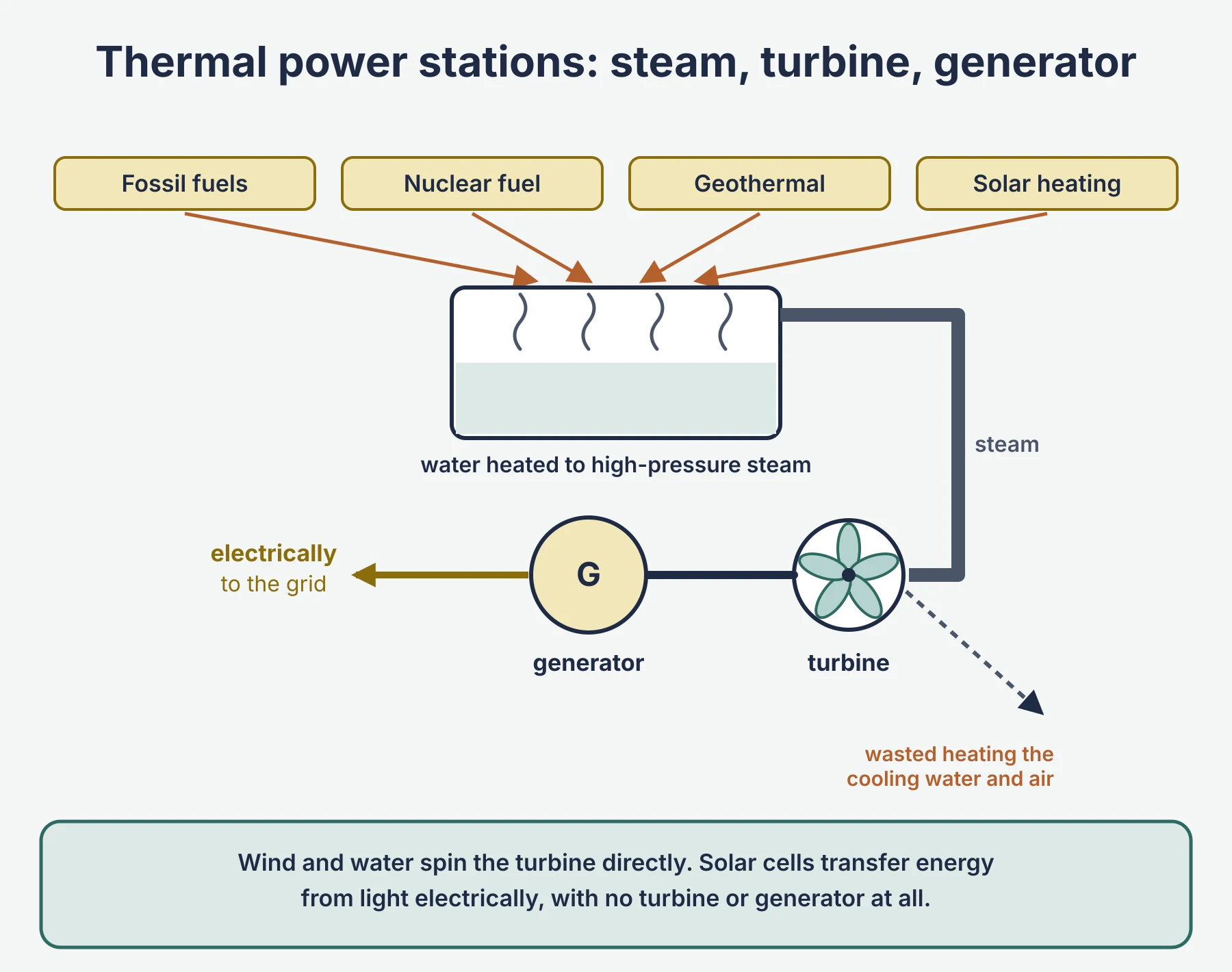
Nuclear: nuclear store → fission → thermal store of steam → turbine → generator → electrically- Thermal power stations (fossil, nuclear, geothermal, large-scale solar heating) all boil water to drive a steam turbine.
- The generator works by electromagnetic induction: a magnet rotating in coils (or coils in a field) induces a voltage.
- Energy is dissipated at each stage, mostly by heating the surroundings and cooling water.
Renewable or non-renewable
| Renewable (will not run out) | Non-renewable (will run out) |
|---|---|
| Wind, water (hydroelectric, tidal, wave), geothermal, solar heating, solar cells | Fossil fuels (coal, oil, gas), nuclear fuel (uranium, plutonium) |
Nuclear is non-renewable and is not a fossil fuel.
Advantages and disadvantages at a glance
| Resource | Main advantage | Main disadvantage |
|---|---|---|
| Wind | Renewable, no fuel, no carbon dioxide while operating | Unreliable (depends on wind); many turbines needed |
| Hydroelectric | Reliable when water is stored; fast start-up | Flooded valleys destroy habitats; needs specific sites |
| Tidal | Predictable | Few sites; affects estuary habitats |
| Wave | Renewable | Variable output; storm damage |
| Geothermal | Available continuously | Only in suitable volcanic or hot-rock regions |
| Solar (heating and cells) | No fuel; cells have no moving parts | Nothing at night; less in cloud; large area needed |
| Fossil fuels | Reliable, controllable, large output | Carbon dioxide (climate change); sulfur dioxide from coal (acid rain); will run out |
| Nuclear | Large reliable output from little fuel; no carbon dioxide while generating | Long-lived radioactive waste; accident risk; high build and decommissioning costs; slow start-up |
Six criteria for any comparison
- Reliability (weather and time of day).
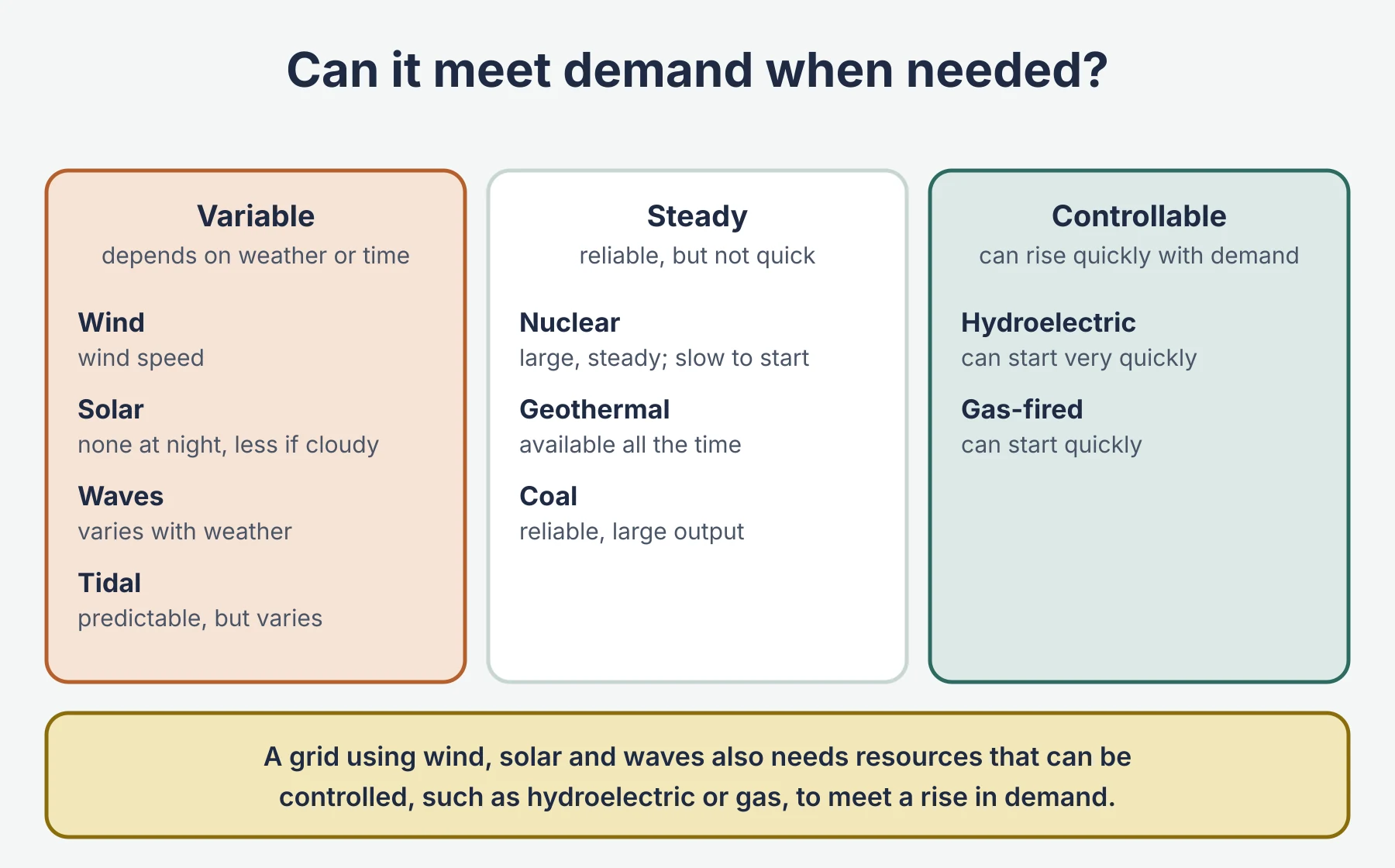
- Control (can output follow demand quickly?).
- Environmental effects (carbon dioxide, other pollutants, waste, habitats, landscape).
- Costs (building, fuel, running, decommissioning).
- Location (suitable sites).
- Renewable or non-renewable.
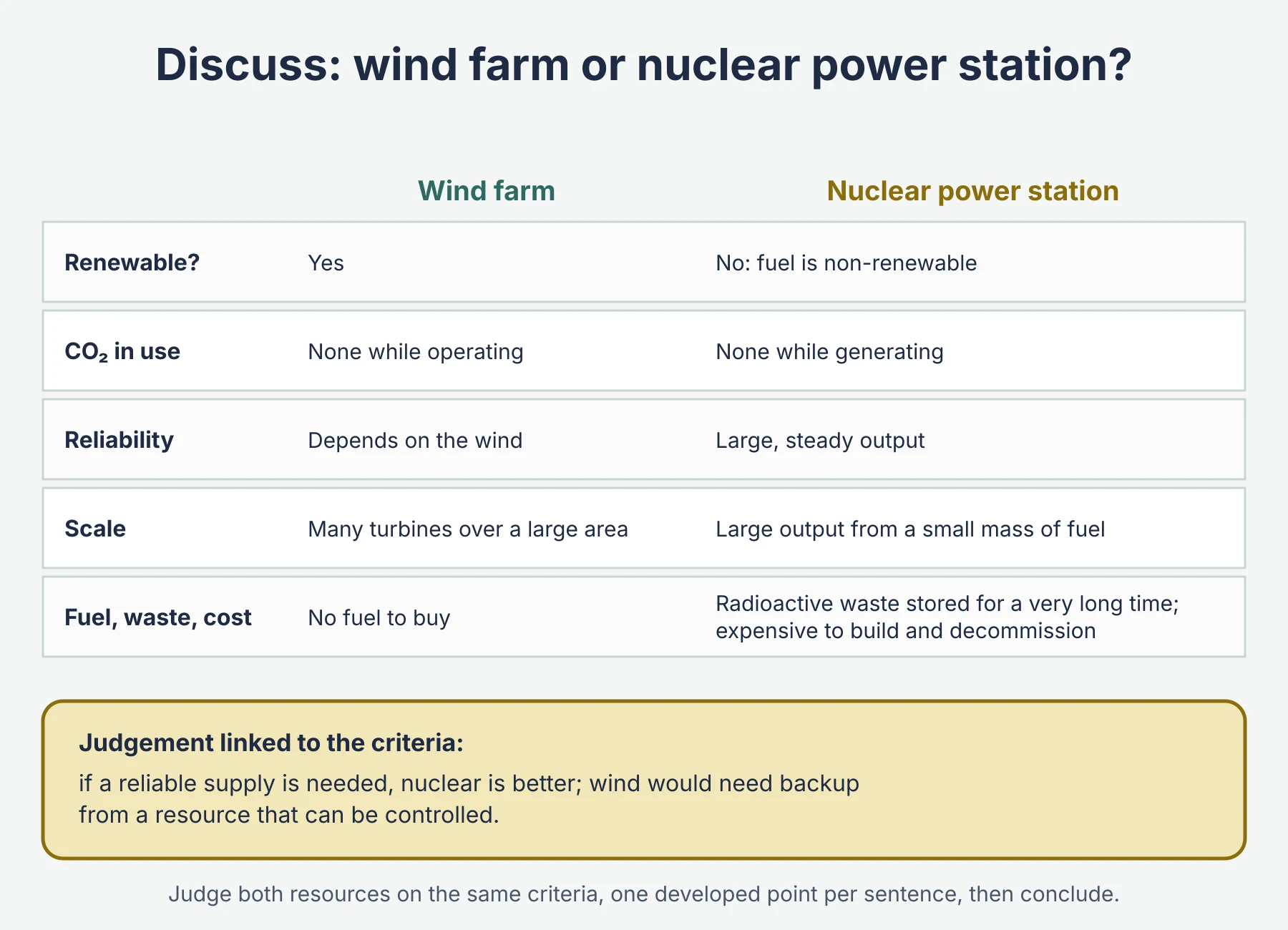
Judge both resources on the same criteria, then reach a conclusion.
Key terms
| Term | Meaning |
|---|---|
| Renewable resource | One that is replaced naturally and will not run out |
| Non-renewable resource | One that is used up faster than it can be replaced, so will run out |
| Turbine | Device turned by moving steam, air or water |
| Generator | Device that transfers energy electrically when turned, by electromagnetic induction |
| Fossil fuel | Coal, oil or natural gas, storing energy in a chemical store |
| Fission | Splitting of large nuclei in a reactor, transferring energy from the nuclear store |
| Solar cell | Device that transfers energy from light directly electrically |
| Decommissioning | Safely shutting down and dismantling a power station at the end of its life |
Exam traps
- “Wind creates electricity”. Energy is transferred, not created.
- Solar cells drawn or described with a turbine.
- Nuclear described as renewable, or as burning fuel.
- Hydroelectric described as using the kinetic store only: the water starts in a gravitational store.
- Vague environmental points (“it is polluting”) with no named pollutant or effect.
- Comparing two resources on different criteria, or giving no conclusion in a “discuss” or “evaluate” answer.
Self-test
- Name the energy store that wind power uses.
- Describe the energy transfers in a hydroelectric power station.
- Which named resource generates electricity without a turbine?
- Name three resources whose power stations heat water to make steam.
- Is nuclear power renewable? Is it a fossil fuel?
- Give one advantage and one disadvantage of geothermal power.
- Why can a country not rely on solar cells alone for its electricity?
- Name the gas released by burning fossil fuels that is linked to climate change.
- State one advantage of a gas-fired power station over a nuclear one.
- Give two disadvantages of nuclear power.
- Why does a hydroelectric station suit sudden rises in demand?
- A power station has a total energy output of 3000 MJ each second and supplies 1200 MJ electrically. Calculate its efficiency.
Answers: 1. The kinetic store of moving air. 2. Water held high in a reservoir has energy in its gravitational store; as it falls, this is transferred to its kinetic store; the moving water turns a turbine, which turns a generator, which transfers energy electrically. 3. Solar cells. 4. Any three: coal, oil, gas, nuclear, geothermal, large-scale solar heating. 5. No; no. 6. Advantage: renewable, or available continuously, or no fuel cost. Disadvantage: only possible where hot rocks are near the surface, or drilling is expensive. 7. Solar cells give no output at night and less in cloudy weather, so other controllable resources are needed. 8. Carbon dioxide. 9. It can start up quickly (or it is cheaper to build and decommission, or it produces no radioactive waste). 10. Any two: radioactive waste must be stored safely for a very long time; risk of accidents; high building and decommissioning costs; fuel is non-renewable. 11. Water can be released from the reservoir to turn the turbines very quickly. 12. efficiency = 1200 ÷ 3000 × 100% = 40%.
Related resources
-
Study guides
Pearson Edexcel International GCSE Physics (4PH1): Energy transfers
Energy stores and pathways, efficiency, Sankey diagrams, conduction, convection, radiation and the thermal practicals for Edexcel IGCSE Physics 4PH1, 4b.
Physics · Pearson Edexcel · IGCSE
Read guide -
Practice questions
Pearson Edexcel International GCSE Physics (4PH1): Energy transfers – Practice Questions
Original 4PH1 questions on energy stores, efficiency, Sankey diagrams, convection, radiation practicals and the vacuum flask, with full mark-scheme answers.
Physics · Pearson Edexcel · IGCSE
Try questions -
Revision notes
Pearson Edexcel International GCSE Physics (4PH1): Energy transfers – Revision Notes
Recall notes for 4PH1 sub-topic 4b: stores and pathways, efficiency, Sankey diagrams, conduction, convection, radiation, the practical and a self-test.
Physics · Pearson Edexcel · IGCSE
Revise topic
Related articles
Get free revision emails (optional)
Occasional emails with practice questions, worked explanations and links to free resources for the qualification and subjects you choose. No spam, and you can unsubscribe from any email. The free tools on this site never need an email.