
Study Guides
Pearson Edexcel International GCSE Physics (4PH1): Magnetism
Magnetic forces, hard and soft materials, field lines, induced magnetism, the field-pattern practical and uniform fields for Edexcel 4PH1 sub-topic 6b.
- Subject
- Physics
- Level
- IGCSE
- Topic
- Magnetism and electromagnetism
- Author
- Marlbridge Academic Team
- Updated
- Reviewed by
- Hassan (what this means)
Aligned to Pearson Edexcel IGCSE Physics (4PH1), Issue 4. Official specification .
Syllabus page (what it covers and how it is assessed): Pearson Edexcel IGCSE Physics.
Syllabus points this page covers
4PH1
- 6b Magnetism
Found an error? Report a correction.
Need help with this topic? Request a free trial class for IGCSE Physics (4PH1).
This guide covers sub-topic 6(b) Magnetism of the Pearson Edexcel International GCSE in Physics (4PH1), Issue 4 specification: statements 6.2 to 6.7. None of these statements carries a “P” reference, so all of this content can be assessed on Paper 1P as well as Paper 2P. For the whole of Topic 6 in one place, use the Magnetism and Electromagnetism study guide.
What the specification asks for
- 6.2 know that magnets repel and attract other magnets and attract magnetic substances
- 6.3 describe the properties of magnetically hard and soft materials
- 6.4 understand the term “magnetic field line”
- 6.5 know that magnetism is induced in some materials when they are placed in a magnetic field
- 6.6 practical: investigate the magnetic field pattern for a permanent bar magnet and between two bar magnets
- 6.7 describe how to use two permanent magnets to produce a uniform magnetic field pattern
Forces between magnets and magnetic substances
Every magnet has two poles, a north-seeking (N) pole and a south-seeking (S) pole. The forces between poles follow one rule: like poles repel, unlike poles attract. The force is strongest close to the poles and falls off quickly as the magnets are moved apart.
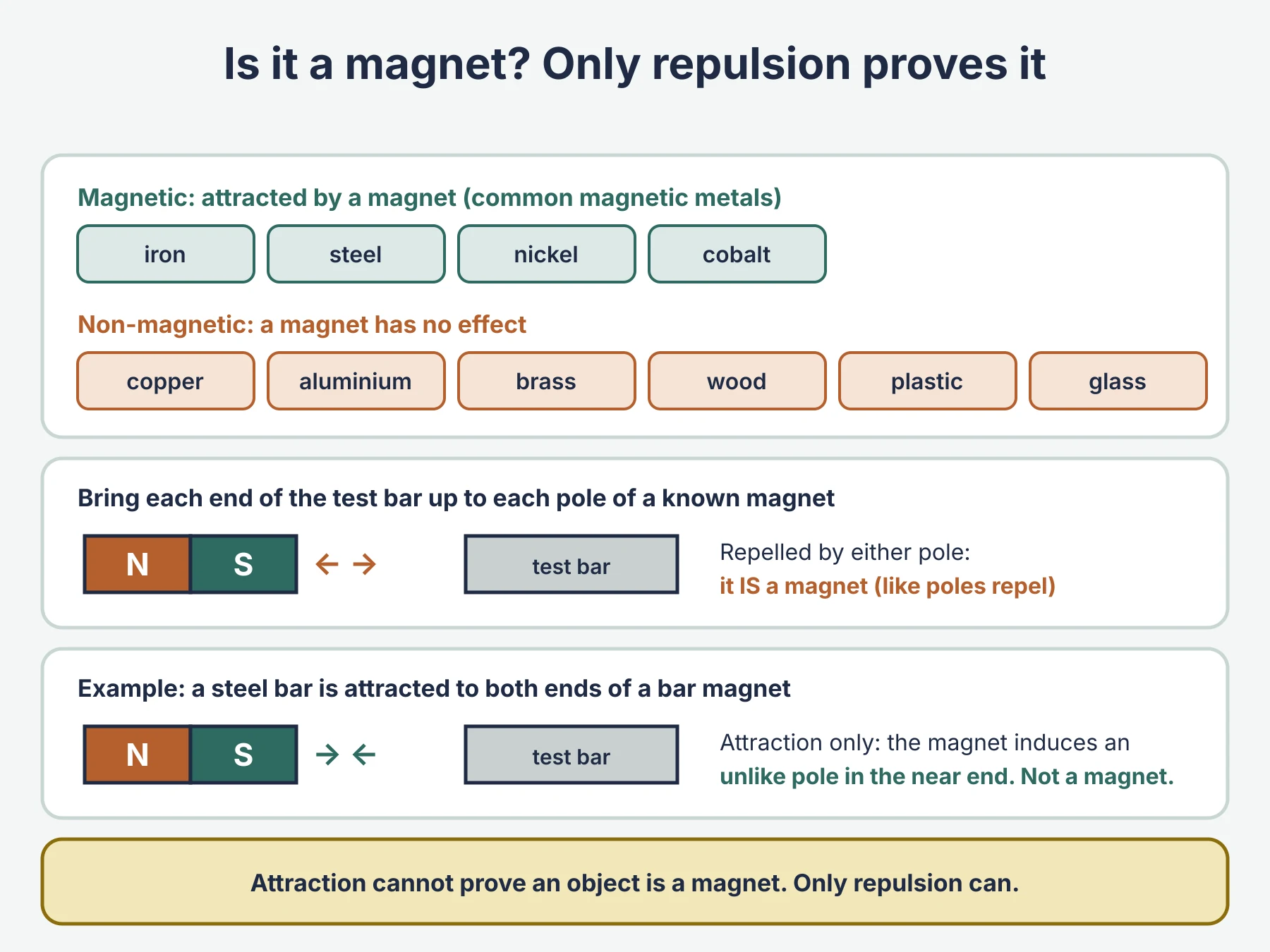
A magnetic substance is a material that is attracted to a magnet but is not itself a permanent magnet unless it has been magnetised. The common magnetic metals are iron, steel, nickel and cobalt. Most other materials (copper, aluminium, brass, wood, plastic, glass) are non-magnetic: a magnet has no effect on them.
This gives a standard test. Attraction cannot tell you whether a metal bar is a magnet, because a magnet attracts both a magnet’s unlike pole and an unmagnetised piece of iron. Repulsion is the only proof that an object is a magnet. Bring one end of the bar up to each pole of a known magnet in turn: if either end is repelled, the bar is magnetised.
Magnetically hard and soft materials
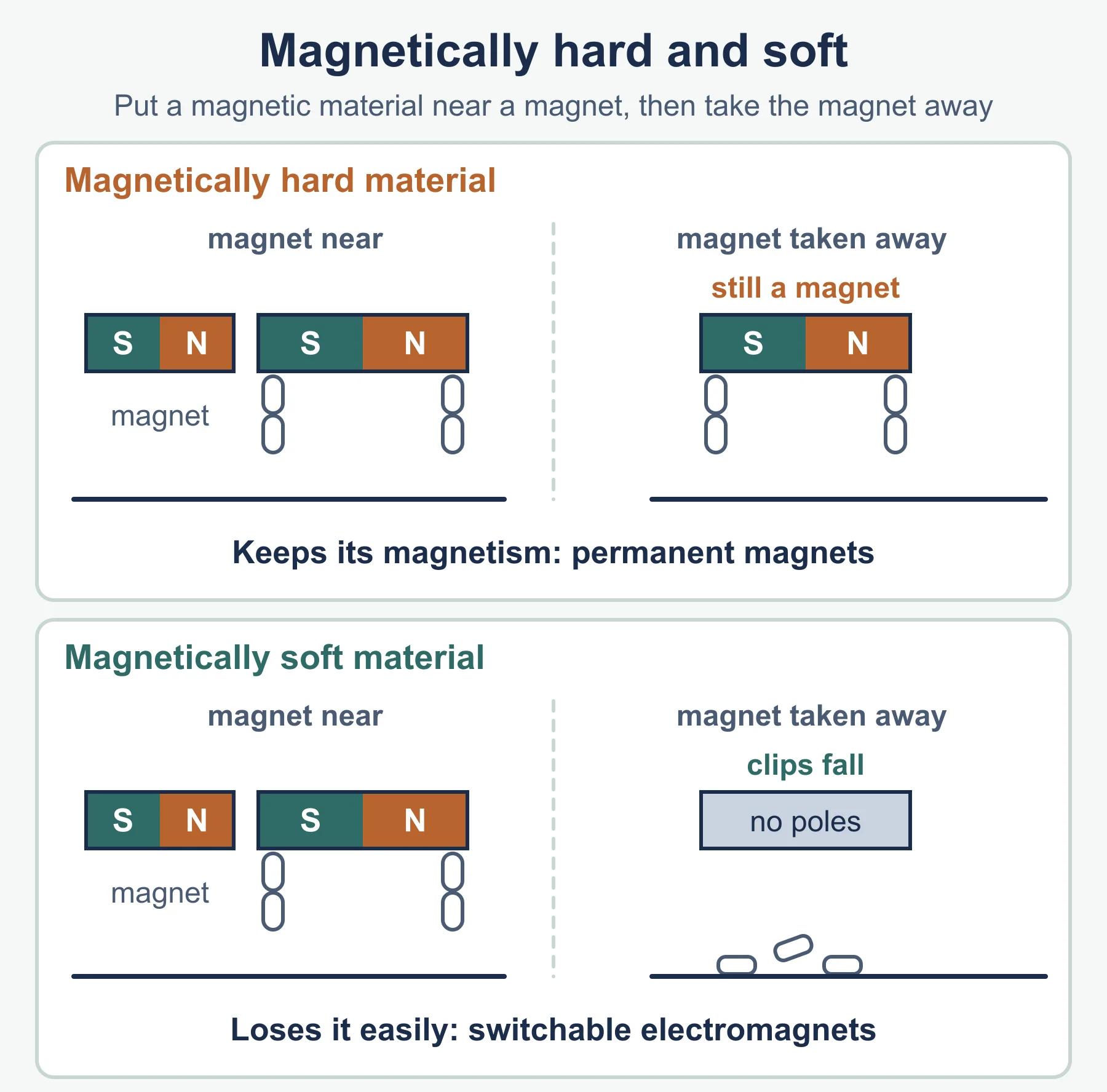
| Property | Magnetically hard (e.g. steel) | Magnetically soft (e.g. iron) |
|---|---|---|
| Ease of magnetising | Harder to magnetise | Magnetised easily |
| Behaviour when the field is removed | Keeps its magnetism | Loses its magnetism almost at once |
| Typical use | Permanent magnets, compass needles | Electromagnet cores, transformer cores |
The words “hard” and “soft” describe magnetic behaviour, not how the material feels. In a description question, a full answer gives both halves of the property (how easily it is magnetised and whether it keeps the magnetism) and links the property to the use. Iron is chosen for an electromagnet core because the magnetism must switch off when the current is switched off; steel would stay magnetised and keep holding the load.
Magnetic field lines
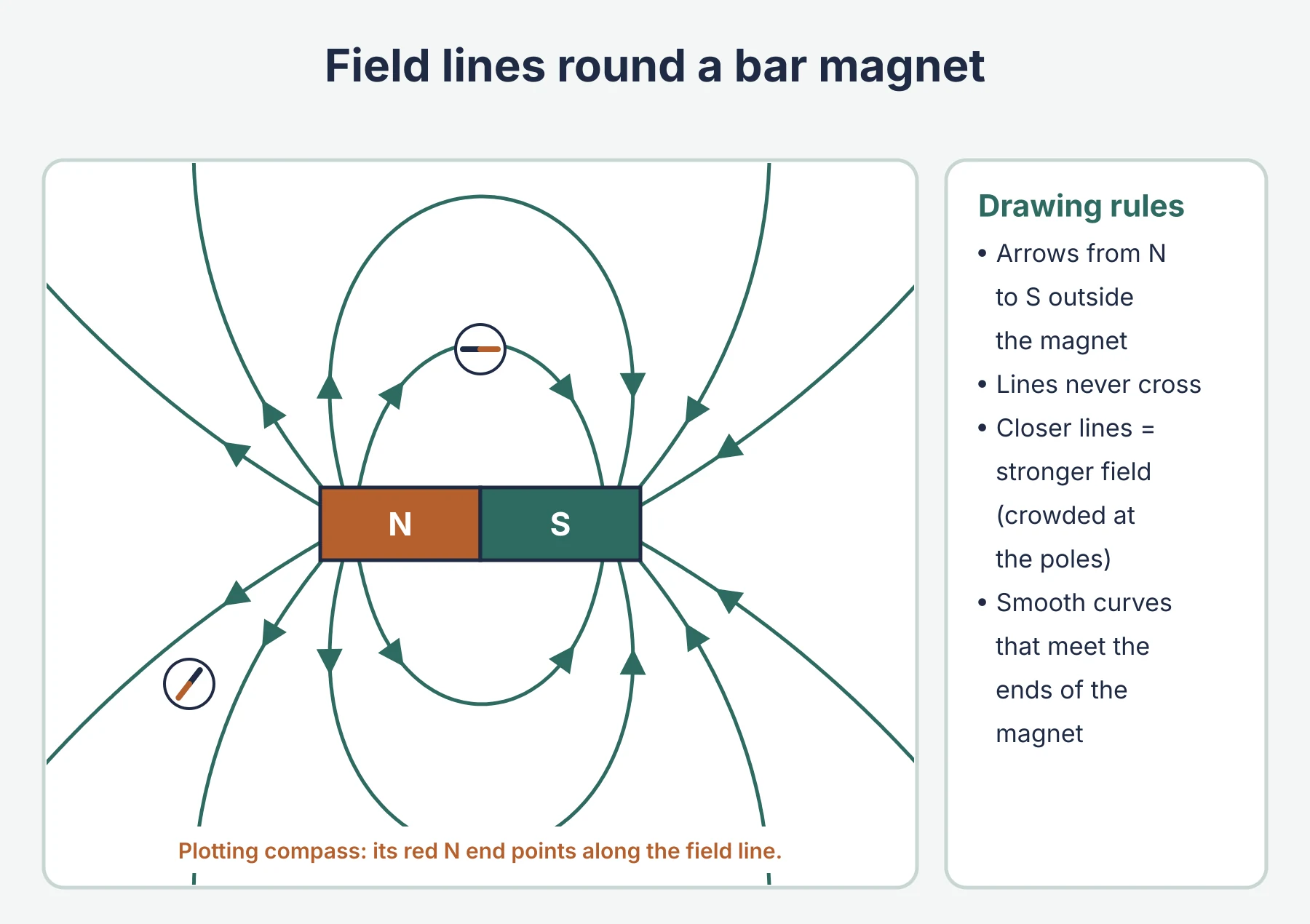
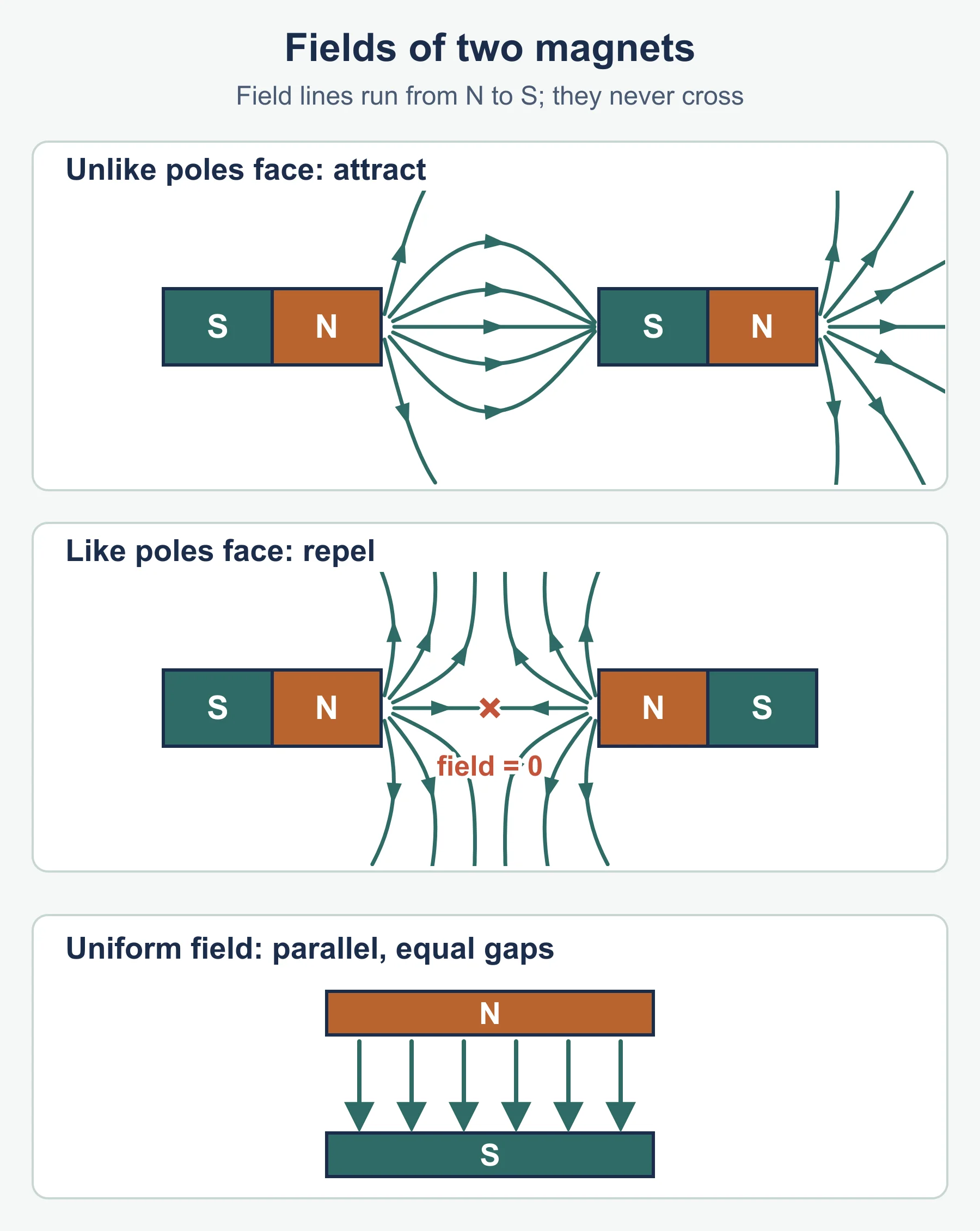
A magnetic field is the region around a magnet where a magnetic substance or another magnet experiences a force. A magnetic field line shows the direction of the force that would act on a north pole placed at that point. The rules for drawing them are:
- Lines run from the N pole to the S pole outside the magnet, with arrows to show this.
- Lines never cross: the field at any point has only one direction.
- Lines that are closer together show a stronger field, so lines are most crowded at the poles.
- Lines should meet the end of the magnet, and should be smooth curves, not straight segments joined at corners.
A plotting compass placed in the field lines up along the field line, with its N end pointing in the direction of the arrow. This is why Earth’s magnetic field makes a compass point north: the compass is lining up with Earth’s field lines.
Induced magnetism
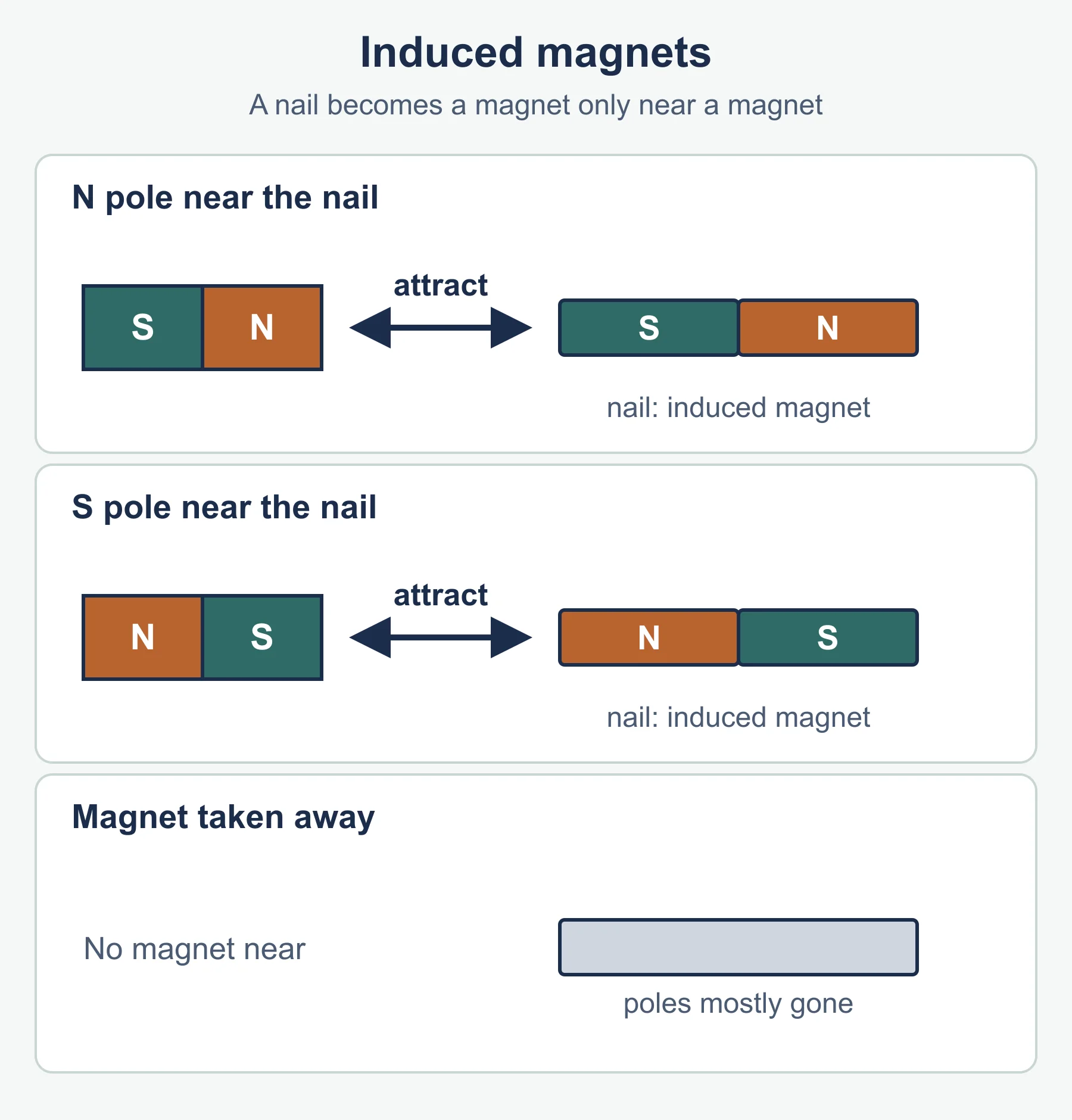
When a piece of magnetic material is placed in a magnetic field, it becomes a magnet itself. This is induced magnetism. The end of an iron nail nearest the N pole of a bar magnet becomes an induced S pole, and the far end becomes an induced N pole. Because the nearest poles are unlike, induced magnetism always causes attraction. This is the reason a magnet attracts unmagnetised iron at all.
Induced magnetism also explains a chain of paper clips hanging from a magnet: each clip becomes magnetised by the field and holds the next one. If the clips are iron (magnetically soft), the chain falls apart when the magnet is removed. If they are steel, some magnetism stays and the clips may still cling together weakly.
Required practical: field patterns (6.6)
The specification asks you to investigate the field pattern for one bar magnet and between two bar magnets. Two methods are used.
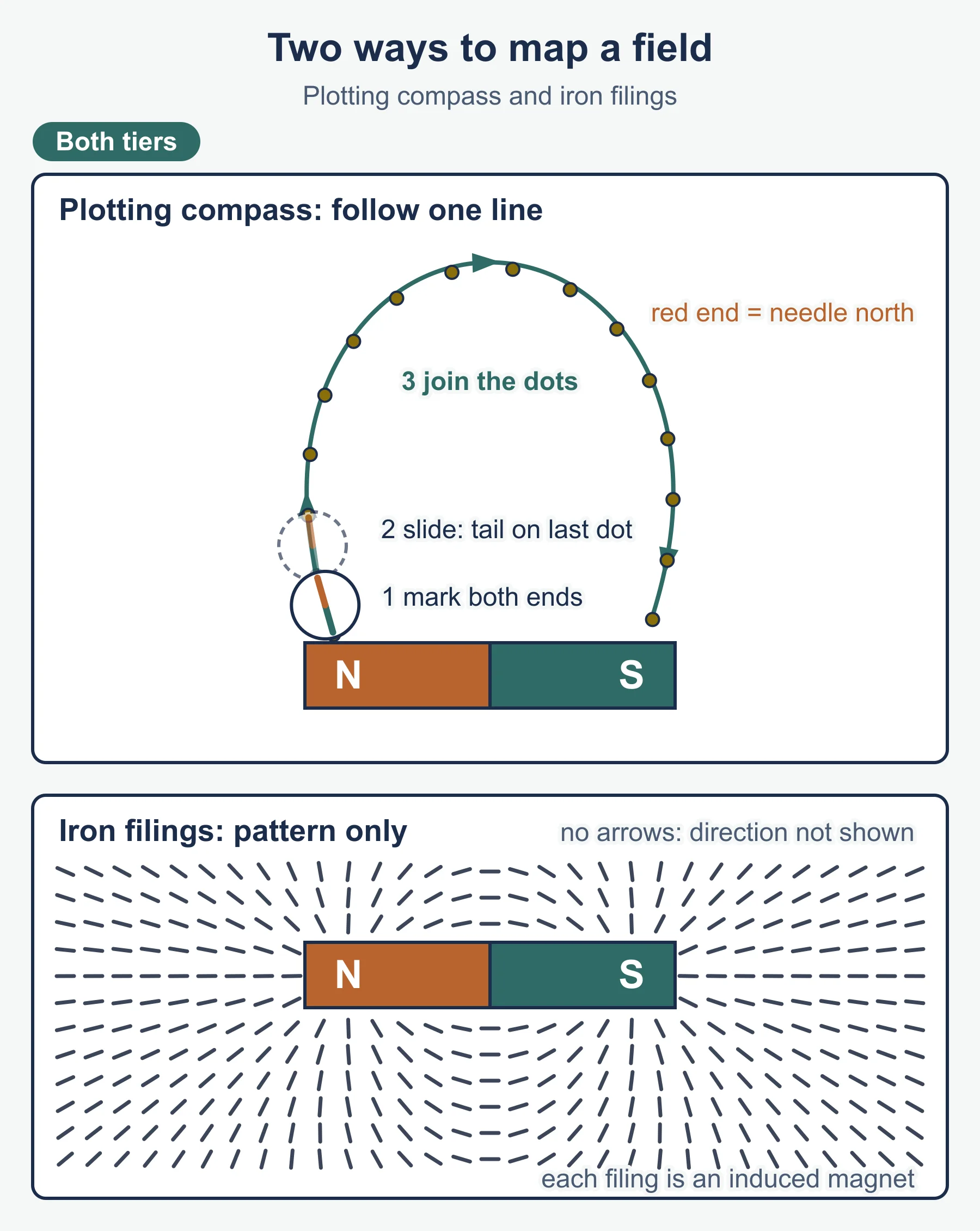
Plotting compass method
- Place the bar magnet in the centre of a sheet of paper and draw round it.
- Place a small plotting compass near one pole. Mark a dot at the end the needle points to.
- Move the compass so that its tail is over that dot, and mark the new position of the needle’s point.
- Repeat until you reach the other pole, then join the dots with a smooth curve and add an arrow from N to S.
- Start again from a different point near the pole to draw further lines.
Iron filings method
Place a sheet of paper or card over the magnet, sprinkle iron filings thinly and tap the card gently. Each filing becomes a tiny induced magnet and lines up with the field. This shows the shape of the whole pattern quickly, but it does not show the direction of the field; you need a compass for the arrows.
Two bar magnets
- Unlike poles facing (N to S): field lines pass straight across the gap from one magnet to the other. The magnets attract.
- Like poles facing (N to N): field lines from each pole curve away sideways. Midway between the poles there is a neutral point, where the two fields cancel and a compass shows no preferred direction. The magnets repel.
Work on a flat surface away from steel objects and other magnets, since either distorts the pattern.
Producing a uniform field (6.7)
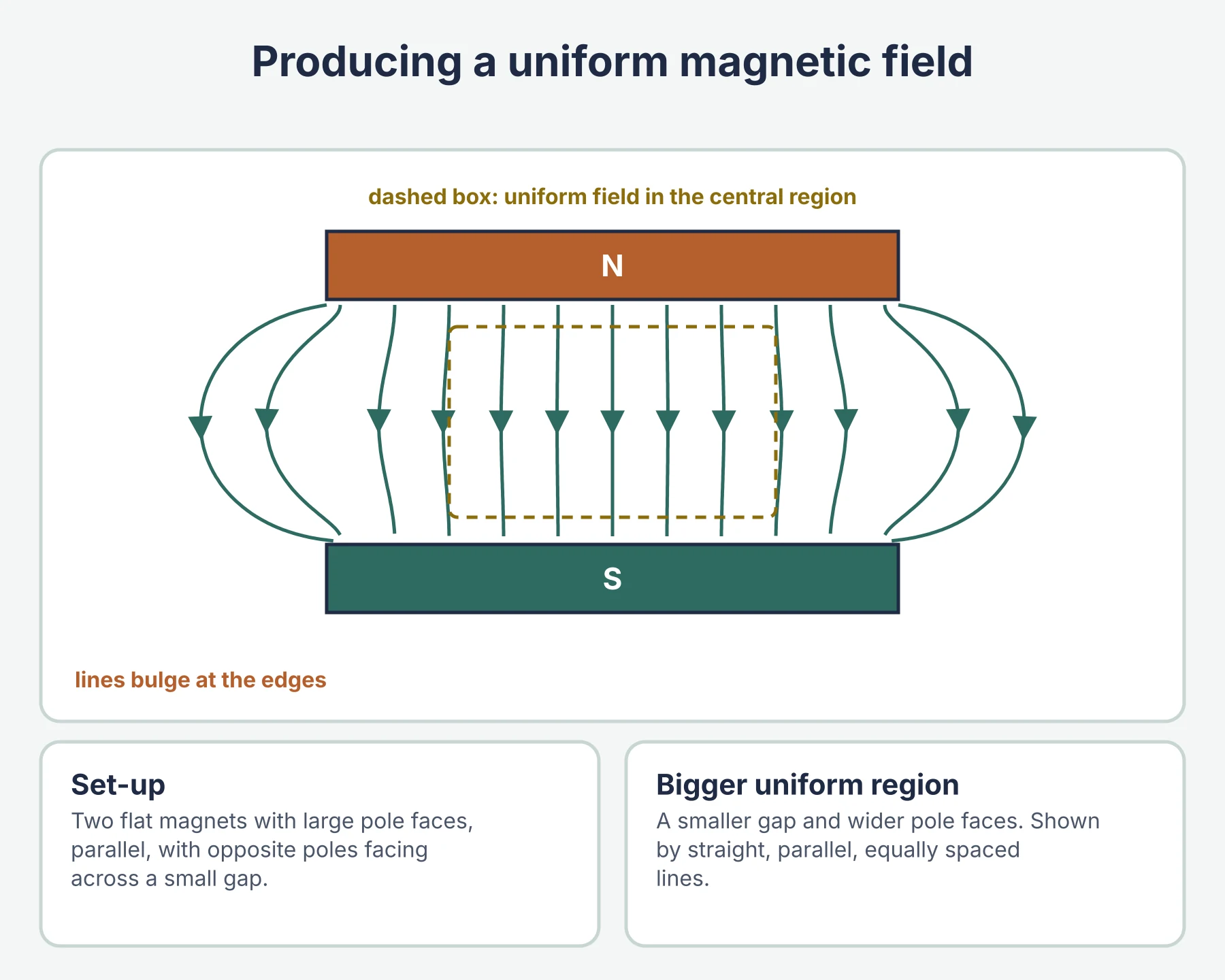
A uniform magnetic field has the same strength and direction everywhere in a region. On a diagram it is shown by straight, parallel, equally spaced field lines, all with arrows the same way.
To produce one with two permanent magnets:
- Use two flat (slab-shaped) magnets with large pole faces.
- Place them parallel to each other with opposite (unlike) poles facing across a small gap.
- In the gap, away from the edges, the field lines run straight across from N to S, equally spaced.
Near the edges of the gap the lines bulge outwards, so the field is only uniform in the central region. A smaller gap and wider pole faces make the uniform region a larger fraction of the space between the magnets. This arrangement is the field used later in the motor effect, which is why diagrams of motors and loudspeakers show parallel lines between the poles.
Worked examples
Example 1 (describe). Describe how a student could use a plotting compass to find the direction of the field at a point near a bar magnet.
Model answer: place the compass at the point [1]; the needle lines up with the field [1]; the direction the N end of the needle points is the direction of the field at that point [1].
Example 2 (explain). A steel bar is attracted to both ends of a bar magnet. A student concludes that the steel bar is not a magnet. Explain whether the conclusion is justified.
Model answer: the conclusion is justified [1]. If the steel bar were a magnet, one of its ends would be repelled by one pole of the bar magnet, because like poles repel [1]. Attraction to both poles is what an unmagnetised magnetic material shows, because the magnet induces an unlike pole in the nearest end of the bar [1].
Common mistakes
- Using attraction as evidence that an object is a magnet.
- Calling a material “soft” because it is easy to bend, or describing only one half of the property.
- Drawing field lines that cross, start in mid-air, or have arrows from S to N outside the magnet.
- Drawing curved lines between opposite poles when the question asks for a uniform field.
- Saying iron filings show the direction of the field.
- Forgetting the neutral point when sketching the field between two like poles.
Exam technique
- Describe (for example, the field-pattern practical): give the steps in order, with enough detail that someone else could follow them. Name the equipment.
- Draw: use a sharp pencil, smooth curves, at least three lines each side of the magnet, and arrows on every line.
- Explain (for example, why an iron nail is attracted): include a reason, here that magnetism is induced with an unlike pole nearest the magnet.
- State/Give: short recall, such as naming a magnetic metal. One word can be enough.
More resources on this topic
- Magnetism revision notes for quick recall and a self-test
- Magnetism practice questions with mark-scheme-style answers
- Electromagnetism study guide, the next sub-topic
Written against the Pearson Edexcel International GCSE in Physics (4PH1) specification, Issue 4. Always check the current specification for your examination year.
Related resources
-
Practice questions
Pearson Edexcel International GCSE Physics (4PH1): Magnetism – Practice Questions
Original practice questions with mark-scheme answers on poles, magnetic materials, field lines, induced magnetism and uniform fields (Edexcel 4PH1, 6b).
Physics · Pearson Edexcel · IGCSE
Try questions -
Revision notes
Pearson Edexcel International GCSE Physics (4PH1): Magnetism – Revision Notes
Condensed recall for Edexcel 4PH1 sub-topic 6b: poles, hard and soft materials, field line rules, induced magnetism and uniform fields, with a self-test.
Physics · Pearson Edexcel · IGCSE
Revise topic -
Study guides
Pearson Edexcel International GCSE Physics (4PH1): Units for Magnetism and Electromagnetism
The units of Topic 6 in Edexcel IGCSE Physics 4PH1: amperes, volts and watts in electromagnets, induction and transformers, with worked examples.
Physics · Pearson Edexcel · IGCSE
Read guide
Related articles
Get free revision emails (optional)
Occasional emails with practice questions, worked explanations and links to free resources for the qualification and subjects you choose. No spam, and you can unsubscribe from any email. The free tools on this site never need an email.