
Study Guides
Pearson Edexcel International GCSE Physics (4PH1): Electromagnetism
Fields around currents, electromagnets, the motor effect, the left-hand rule, d.c. motors and loudspeakers for Edexcel IGCSE Physics 4PH1 sub-topic 6c.
- Subject
- Physics
- Level
- IGCSE
- Topic
- Magnetism and electromagnetism
- Author
- Marlbridge Academic Team
- Updated
- Reviewed by
- Hassan (what this means)
Aligned to Pearson Edexcel IGCSE Physics (4PH1), Issue 4. Official specification .
Syllabus page (what it covers and how it is assessed): Pearson Edexcel IGCSE Physics.
Syllabus points this page covers
4PH1
- 6c Electromagnetism
Found an error? Report a correction.
Need help with this topic? Request a free trial class for IGCSE Physics (4PH1).
This guide covers sub-topic 6(c) Electromagnetism of the Pearson Edexcel International GCSE in Physics (4PH1), Issue 4 specification: statements 6.8 to 6.14. Statements 6.9P, 6.10P and 6.11P are Physics-only content, assessed on Paper 2P. The rest is core. For a summary of all of Topic 6, see the Magnetism and Electromagnetism study guide; this page assumes the field-line rules from the Magnetism study guide.
What the specification asks for
- 6.8 know that an electric current in a conductor produces a magnetic field around it
- 6.9P describe the construction of electromagnets
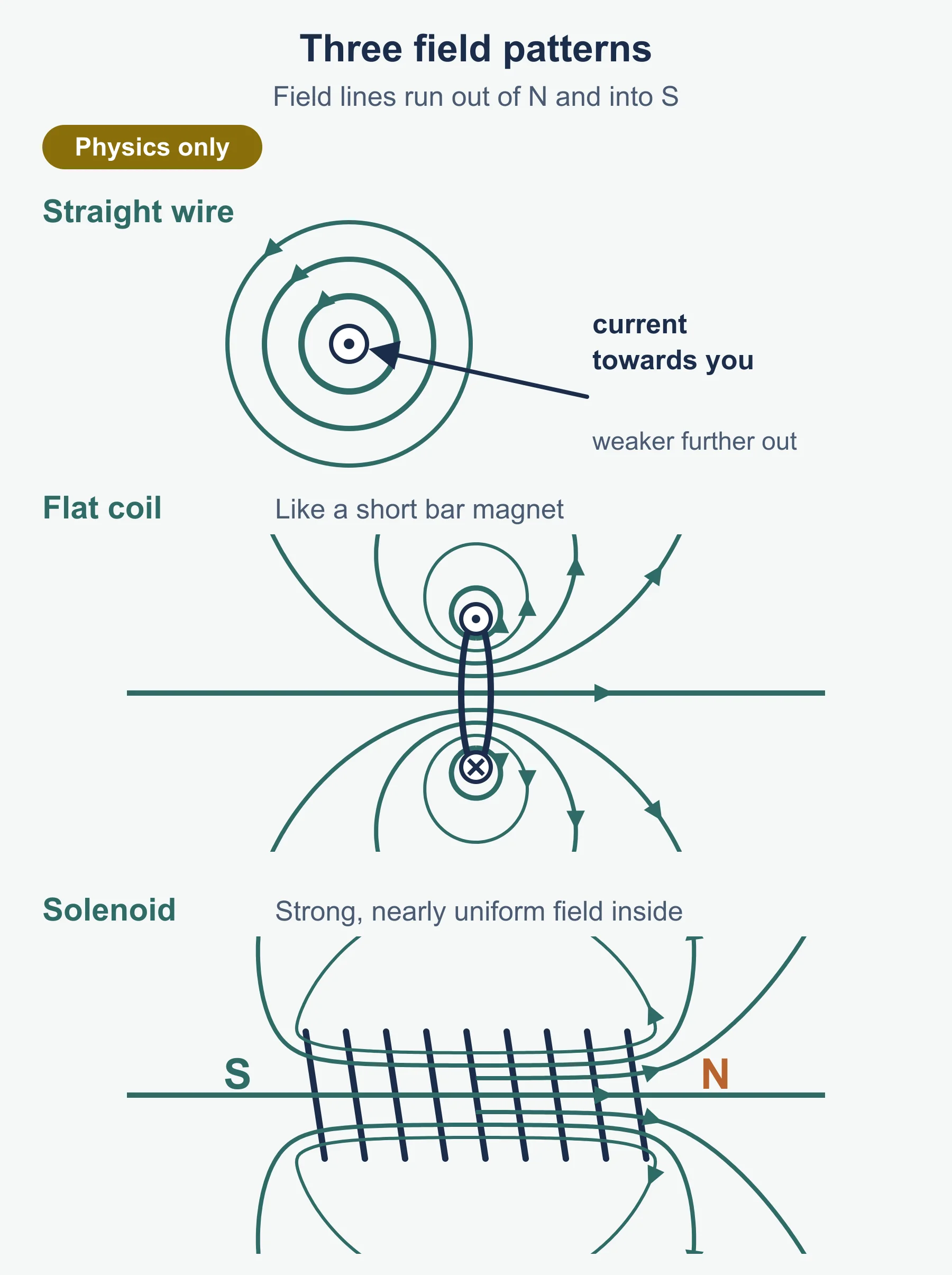
- 6.10P draw magnetic field patterns for a straight wire, a flat circular coil and a solenoid when each is carrying a current
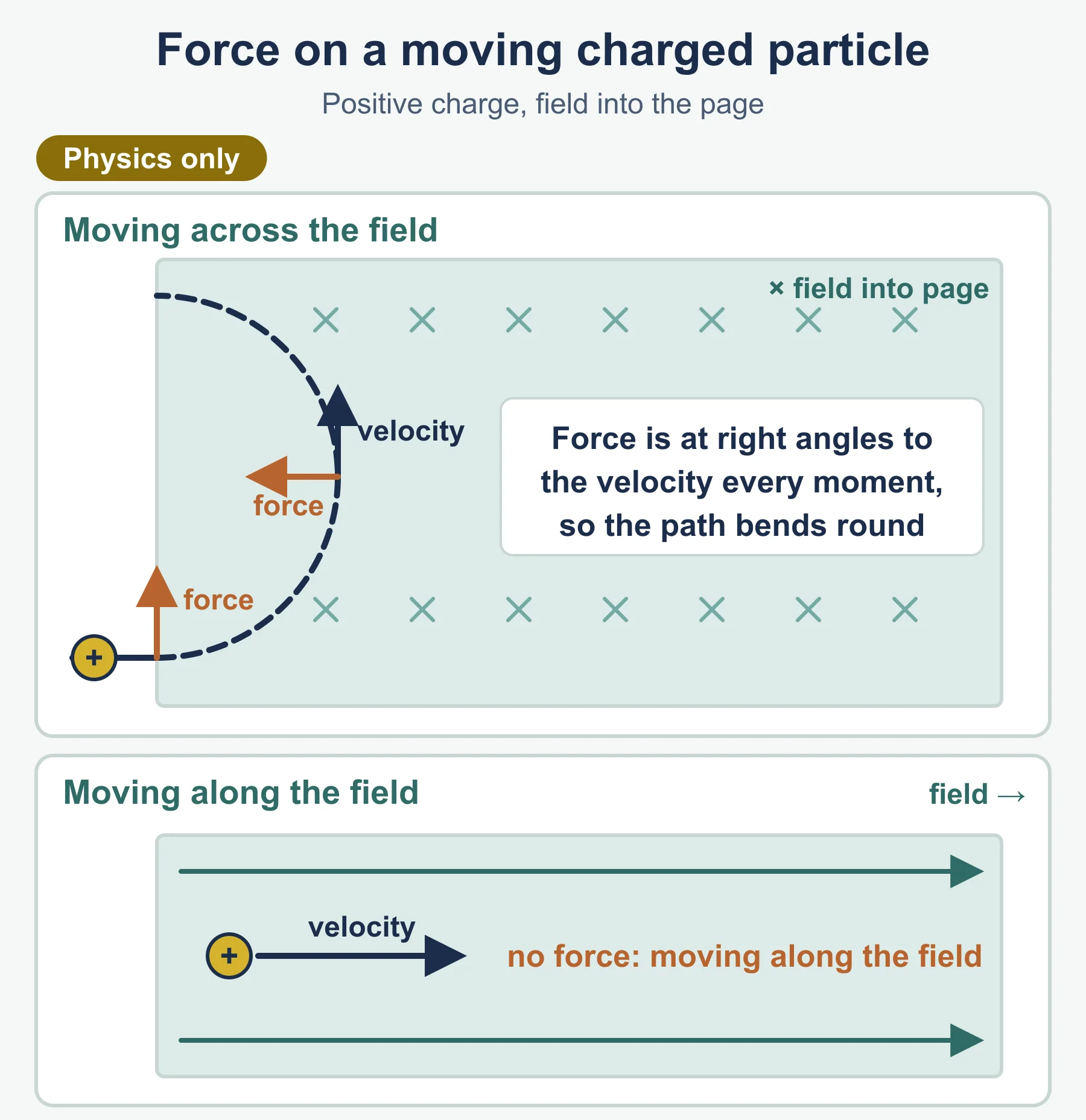
- 6.11P know that there is a force on a charged particle when it moves in a magnetic field as long as its motion is not parallel to the field
- 6.12 understand why a force is exerted on a current-carrying wire in a magnetic field and how this effect is applied in simple d.c. electric motors and loudspeakers
- 6.13 use the left-hand rule to predict the direction of the resulting force when a wire carries a current perpendicular to a magnetic field
- 6.14 describe how the force on a current-carrying conductor in a magnetic field changes with the magnitude and direction of the field and current
A current produces a magnetic field (6.8)
Whenever charge flows through a conductor, a magnetic field is set up around it. Switch the current off and the field disappears; reverse the current and the field reverses. A compass placed beside a wire deflects when the current is switched on, which is the simplest evidence for 6.8.
Field patterns (6.10P)
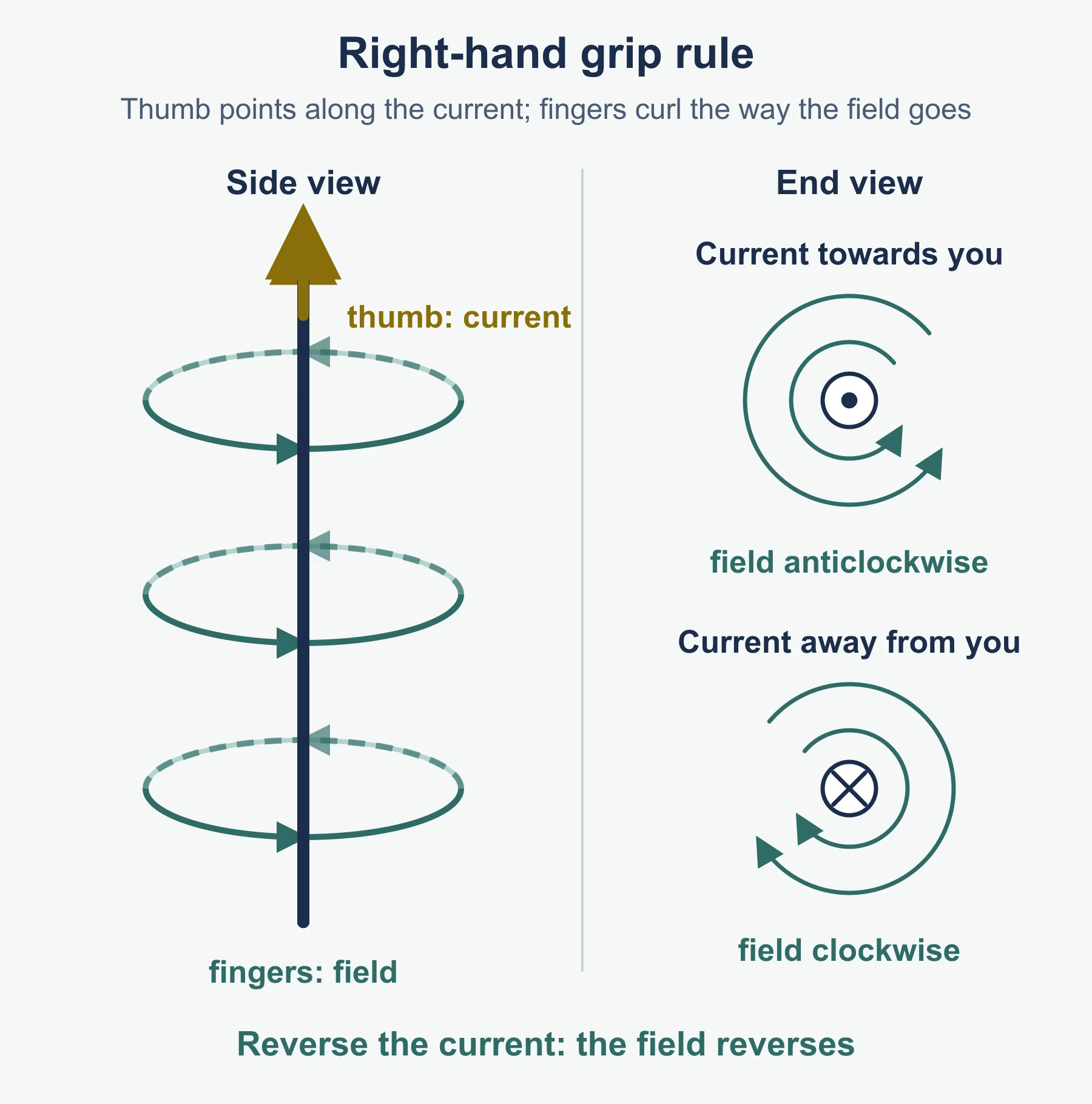
Straight wire. The field lines are concentric circles centred on the wire, in a plane at right angles to it. The circles are closer together near the wire, because the field is strongest there, and get further apart moving outwards. To find the direction, use the right-hand grip rule: grip the wire with your right hand, thumb pointing in the direction of the conventional current; your curled fingers show the direction of the field lines. On a diagram looking along the wire, a dot (⊙) means current coming towards you (field anticlockwise) and a cross (⊗) means current going away from you (field clockwise).
Flat circular coil. Each side of the coil has circular lines round it, as for a straight wire. In the centre of the coil, the fields from all parts of the loop point the same way and add together, giving almost straight lines through the middle. Outside, the lines loop round.
Solenoid. A long coil gives a pattern like a bar magnet. Inside, the lines are straight, parallel and equally spaced: the field is strong and nearly uniform. Outside, the lines spread out and loop round from one end to the other, just as for a bar magnet. One end acts as a N pole (where lines come out) and the other as a S pole. Reversing the current swaps the poles.
When drawing any of these, apply the field-line rules: arrows on every line, no crossing lines, and closer spacing where the field is stronger.
Electromagnets (6.9P)
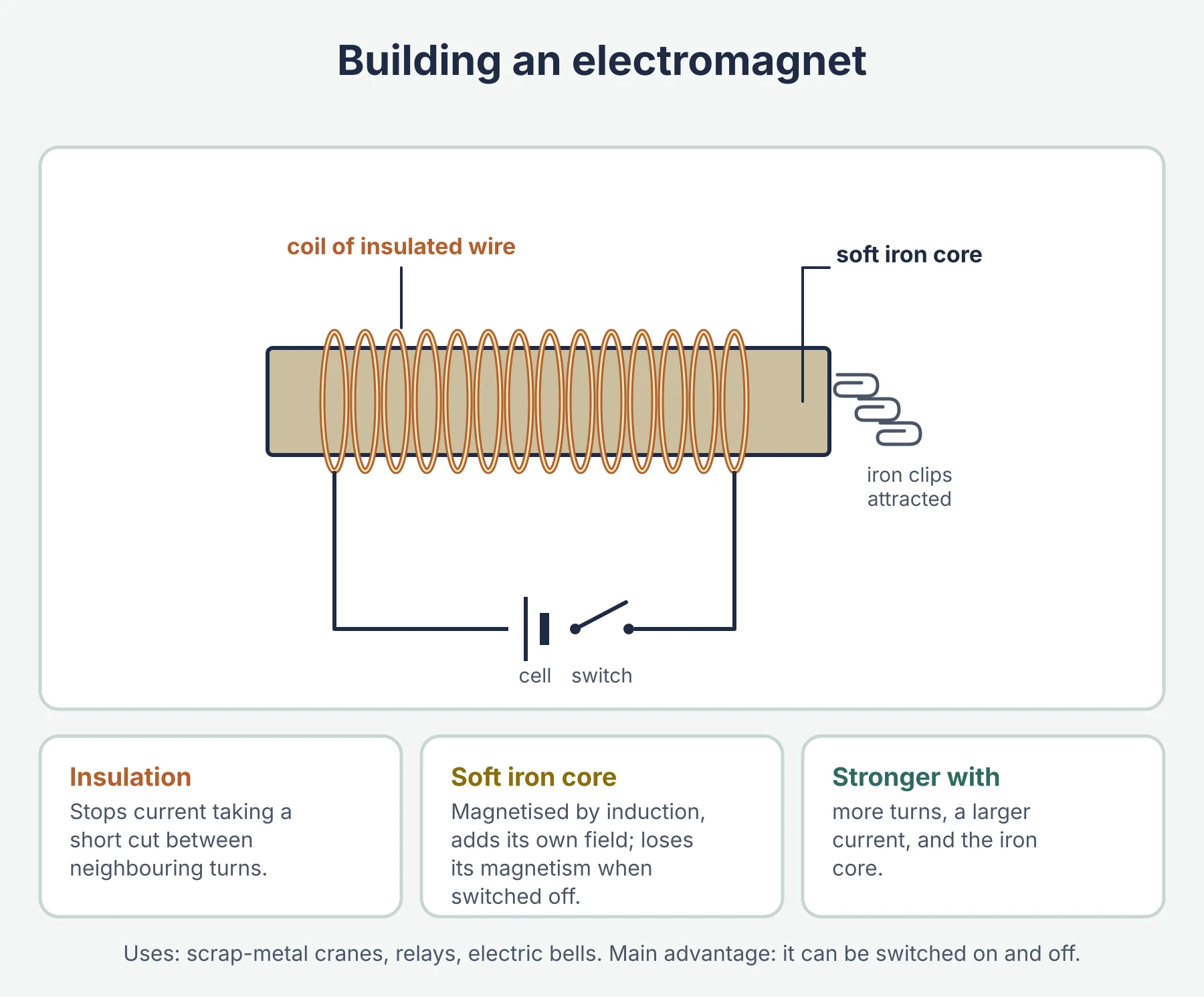
An electromagnet is a coil of insulated wire (usually a solenoid) wound round a soft iron core, connected to a supply through a switch.
- The insulation stops current taking a short cut between neighbouring turns.
- The soft iron core is magnetised by induction and adds its own field, making the electromagnet much stronger than the coil alone.
- Because iron is magnetically soft, the magnetism disappears almost completely when the current is switched off. This is the main advantage over a permanent magnet: the field can be switched on and off.
The strength increases with more turns on the coil, a larger current, and the presence of the iron core. Electromagnets are used in scrap-metal cranes, relays and electric bells.
Force on a moving charged particle (6.11P)
A charged particle moving through a magnetic field experiences a force, as long as its motion is not parallel to the field. If it moves along a field line there is no force at all; the force is largest when it moves at right angles to the field. This force acts at right angles to both the motion and the field, so it changes the particle’s direction, which is why a beam of electrons is deflected by a magnet.
For the direction, treat the moving charge as a current. A positive particle’s motion is the current direction. Electrons are negative, so the conventional current is opposite to the direction the electrons move.
The motor effect (6.12, 6.13, 6.14)
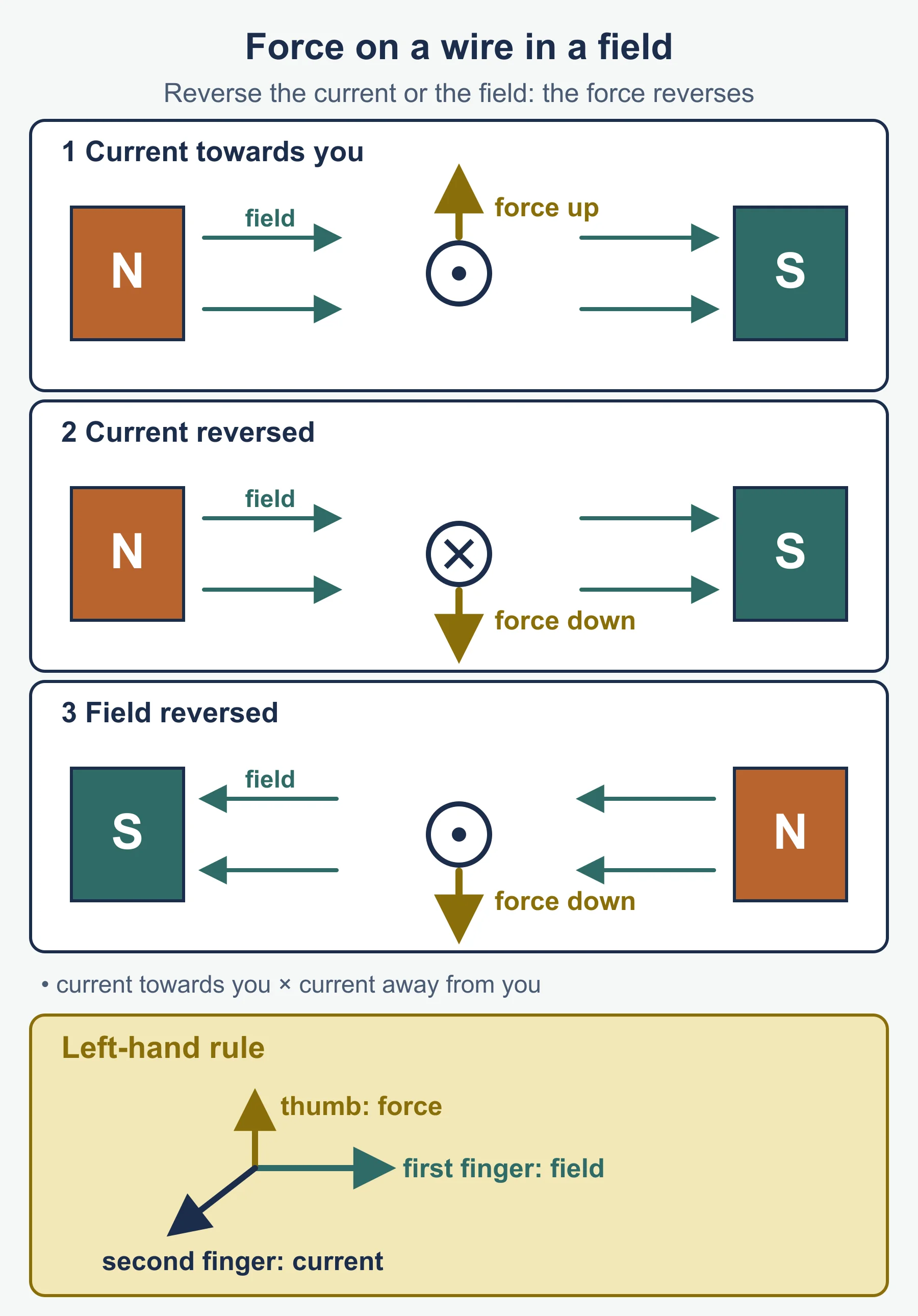
Why there is a force. A current in a wire is a flow of charged particles, each of which feels a force in the magnet’s field, so the wire as a whole feels a force. Another way to express it: the magnetic field around the wire interacts with the field of the magnet, and the combined field pushes the wire.
Fleming’s left-hand rule (6.13) gives the direction when the current is perpendicular to the field. Hold the thumb, first finger and second finger of the left hand at right angles to each other:
- First finger: Field (N to S)
- Second finger: Current (conventional, + to −)
- Thumb: Motion (the force)
What changes the force (6.14):
| Change | Effect on the force |
|---|---|
| Larger current | Larger force |
| Stronger magnetic field | Larger force |
| Reverse the current | Force reverses |
| Reverse the field | Force reverses |
| Reverse both | Force in the original direction |
| Wire parallel to field | No force |
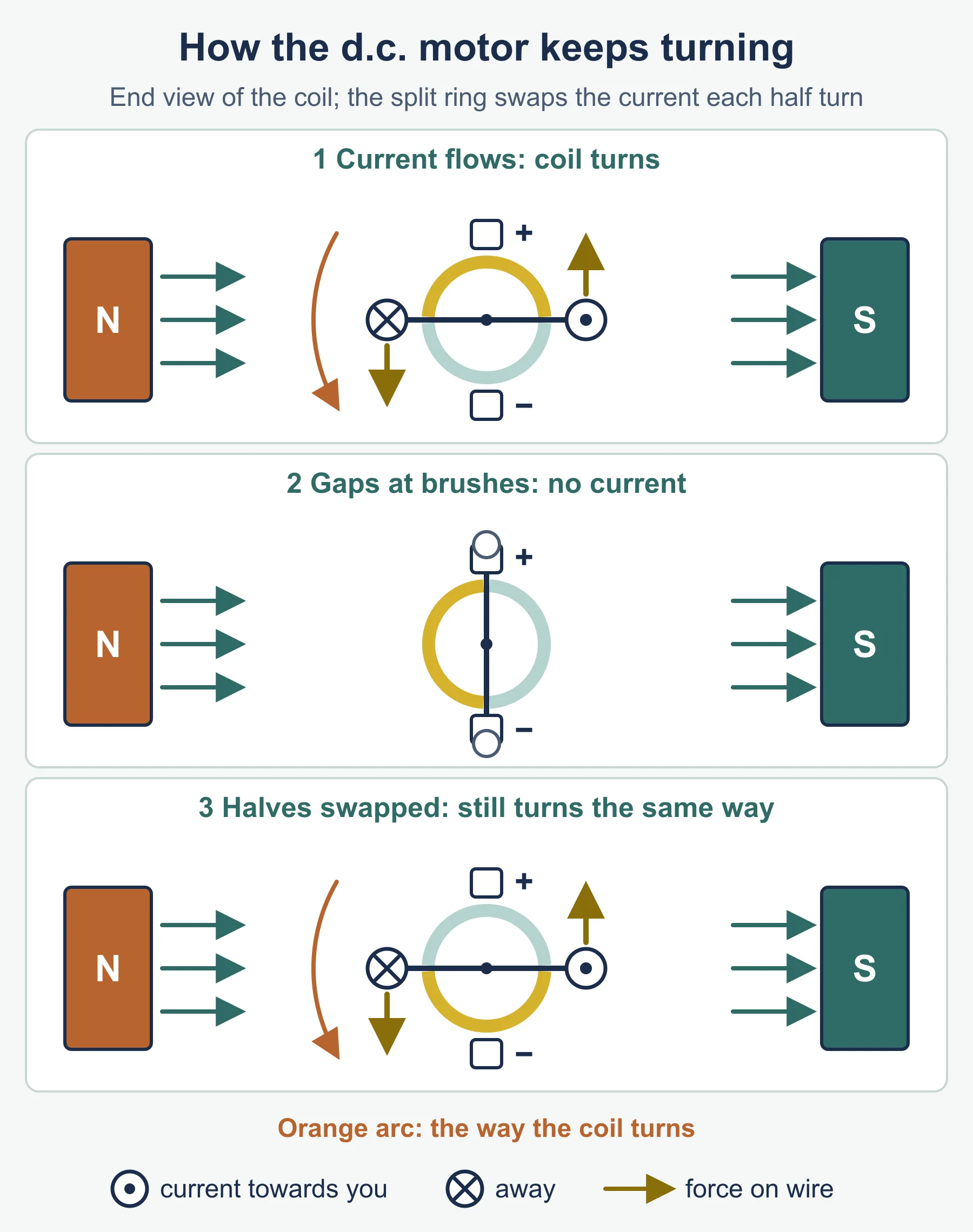
The simple d.c. motor. A rectangular coil sits between the poles of a magnet and can rotate on an axle. Current flows in opposite directions along the two sides of the coil that are perpendicular to the field, so one side is pushed up and the other down. This produces a turning effect. A split-ring commutator, connected to the supply through brushes, reverses the current in the coil every half turn, as the coil passes the vertical, so the forces keep turning the coil the same way. The motor turns faster or with a greater turning effect with a larger current, a stronger field, or more turns on the coil. Reversing the current or the field reverses the direction of rotation.
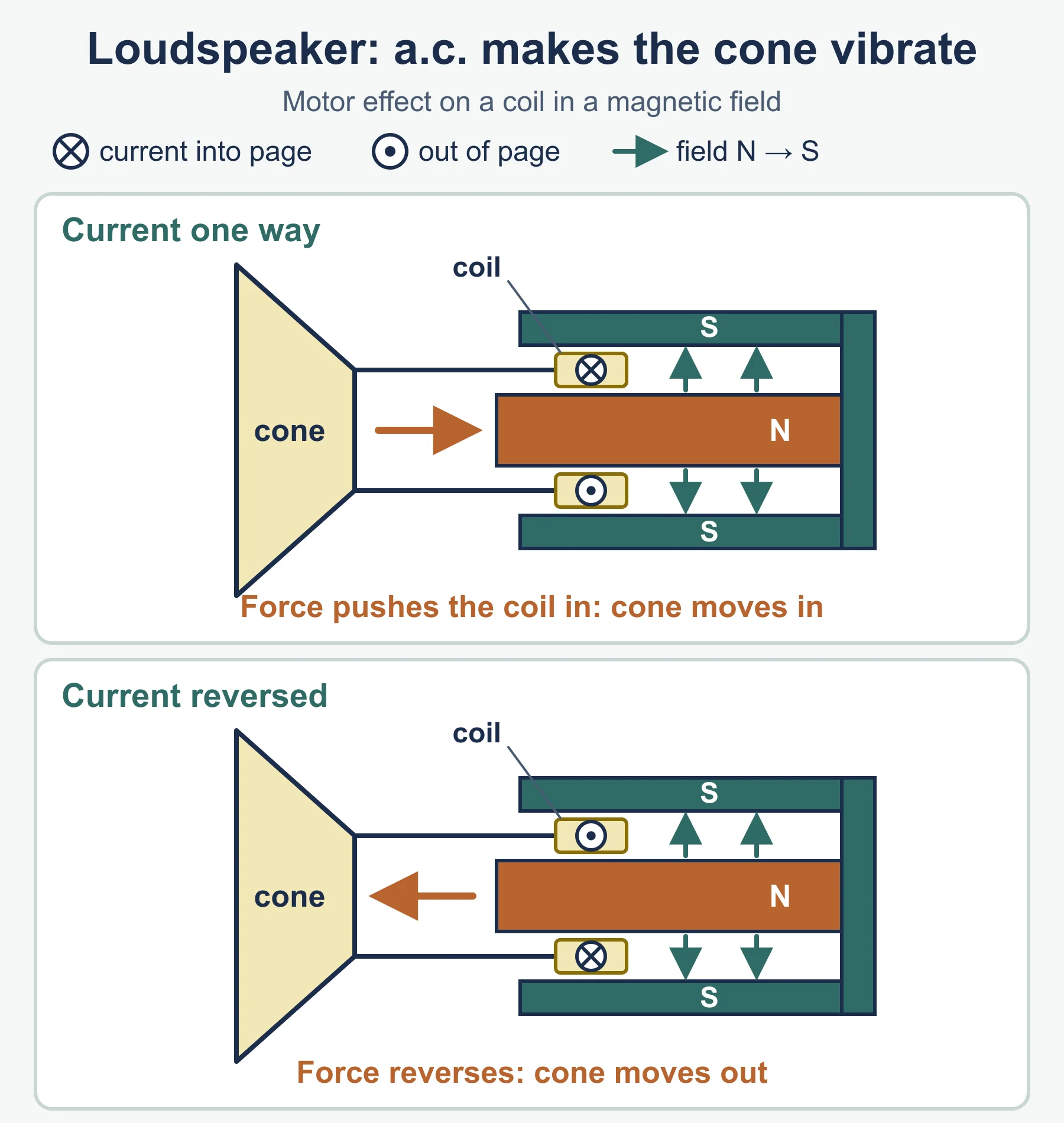
The loudspeaker. A coil of wire is fixed to a paper or plastic cone and sits in the field of a permanent magnet. An alternating current from the amplifier passes through the coil. The force on the coil reverses each time the current reverses, so the coil and cone are pushed in and out, vibrating at the frequency of the current. The vibrating cone pushes on the air and produces a sound wave of the same frequency. A larger current gives a larger force, larger vibrations and a louder sound.
Worked examples
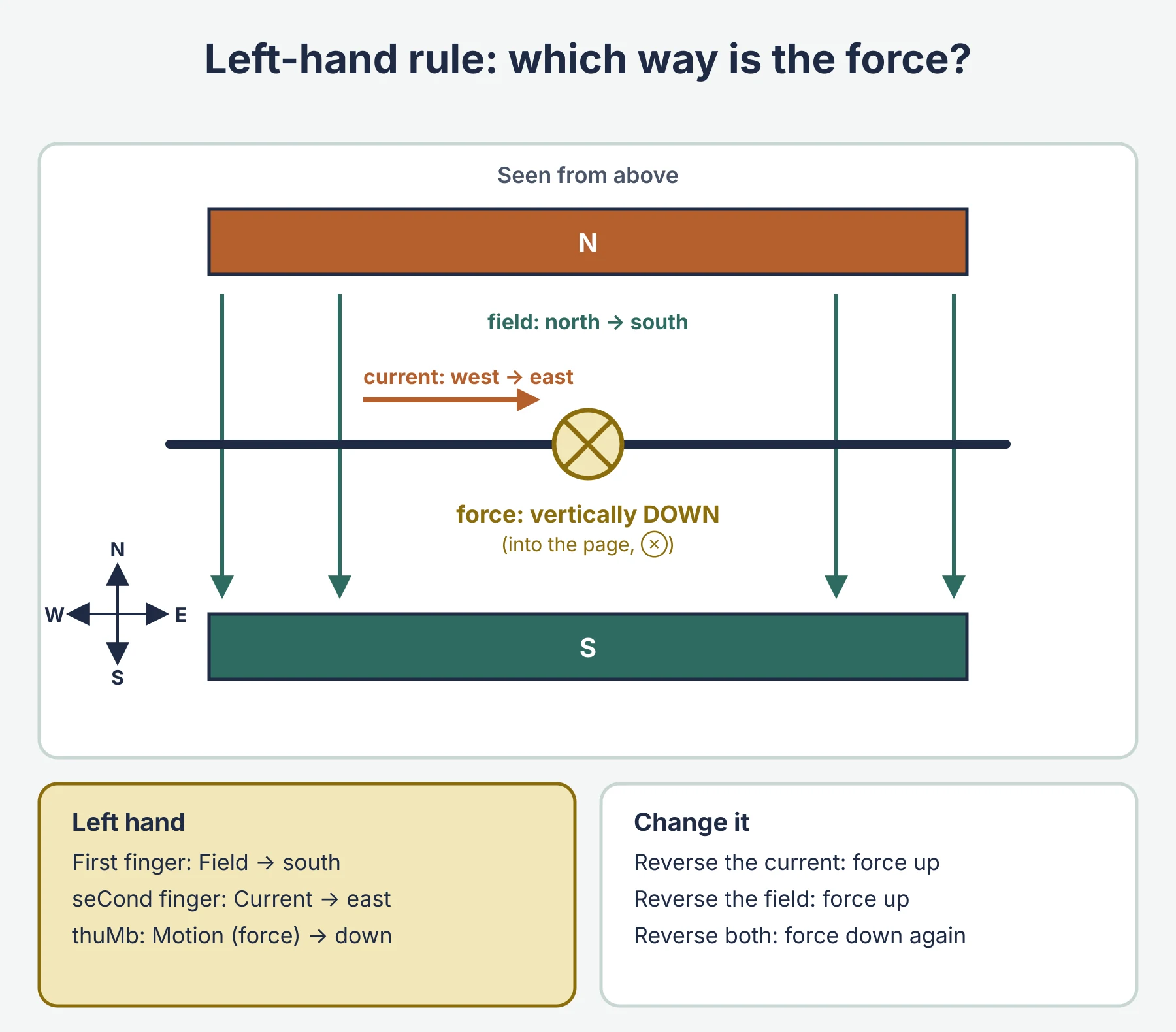
Example 1 (left-hand rule). A horizontal wire runs from west to east between the poles of a magnet. The field points from north to south, horizontally. The conventional current is from west to east. State the direction of the force.
First finger points south (field); second finger points east (current). With the left hand held this way, the thumb points vertically downwards. The force on the wire is downwards. If the current were reversed, the force would be upwards; reversing both the current and the field would leave it downwards.
Example 2 (explain, 4 marks). Explain why the cone of a loudspeaker vibrates when an alternating current passes through its coil.
Model answer: the current in the coil is in the magnetic field of the permanent magnet, so there is a force on the coil (the motor effect) [1]. The current is alternating, so it keeps reversing direction [1]; each time it reverses, the force on the coil reverses [1]. The coil, and the cone attached to it, are pushed backwards and forwards, so the cone vibrates at the frequency of the current [1].
Common mistakes
- Using the right hand for the force (the right-hand grip rule is for the field around a wire, not for the motor effect).
- Using electron flow as “current” in the left-hand rule; it needs conventional current.
- Saying a charged particle moving along a field line is deflected.
- Drawing the field around a straight wire as lines running parallel to the wire.
- Writing that the commutator “reverses the coil” or “reverses the field”; it reverses the current in the coil.
- Describing an electromagnet with a steel core, or forgetting that the wire is insulated.
Exam technique
- Draw (6.10P): use a ruler for straight parallel lines inside a solenoid; draw concentric circles for a wire, with spacing increasing outwards; add arrows.
- Explain (motors and loudspeakers): build a chain of linked steps. Each mark usually needs a cause and its effect, as in Example 2.
- Describe (6.14): state the direction of the change, such as “larger current, larger force”, not “the current affects the force”.
- Predict (6.13): state the direction in words that match the diagram, such as “into the page” or “upwards”.
More resources on this topic
- Electromagnetism revision notes for fast recall and a self-test
- Electromagnetism practice questions with mark-scheme answers
- Electromagnetic induction study guide, the next sub-topic
Written against the Pearson Edexcel International GCSE in Physics (4PH1) specification, Issue 4. Always check the current specification for your examination year.
Related resources
-
Practice questions
Pearson Edexcel International GCSE Physics (4PH1): Electromagnetism – Practice Questions
Original questions with full answers on field patterns, electromagnets, the left-hand rule, moving charges, motors and loudspeakers for Edexcel 4PH1 6c.
Physics · Pearson Edexcel · IGCSE
Try questions -
Revision notes
Pearson Edexcel International GCSE Physics (4PH1): Electromagnetism – Revision Notes
Quick recall for Edexcel 4PH1 sub-topic 6c: field patterns, electromagnets, force on moving charges, the left-hand rule, motors and loudspeakers.
Physics · Pearson Edexcel · IGCSE
Revise topic -
Study guides
Pearson Edexcel International GCSE Physics (4PH1): Magnetism
Magnetic forces, hard and soft materials, field lines, induced magnetism, the field-pattern practical and uniform fields for Edexcel 4PH1 sub-topic 6b.
Physics · Pearson Edexcel · IGCSE
Read guide
Related articles
Get free revision emails (optional)
Occasional emails with practice questions, worked explanations and links to free resources for the qualification and subjects you choose. No spam, and you can unsubscribe from any email. The free tools on this site never need an email.