
Revision Notes
Pearson Edexcel International GCSE Physics (4PH1): Electromagnetism – Revision Notes
Quick recall for Edexcel 4PH1 sub-topic 6c: field patterns, electromagnets, force on moving charges, the left-hand rule, motors and loudspeakers.
- Subject
- Physics
- Level
- IGCSE
- Topic
- Magnetism and electromagnetism
- Author
- Marlbridge Academic Team
- Updated
- Reviewed by
- Hassan (what this means)
Aligned to Pearson Edexcel IGCSE Physics (4PH1), Issue 4. Official specification .
Syllabus page (what it covers and how it is assessed): Pearson Edexcel IGCSE Physics.
Syllabus points this page covers
4PH1
- 6c Electromagnetism
Found an error? Report a correction.
Need help with this topic? Request a free trial class for IGCSE Physics (4PH1).
Condensed notes for sub-topic 6(c) Electromagnetism (statements 6.8 to 6.14) of Pearson Edexcel International GCSE Physics (4PH1). Items marked (P) are Physics-only and assessed on Paper 2P. Full explanations and worked examples are in the Electromagnetism study guide.
Current makes a field
- Any current in a conductor produces a magnetic field around it.
- No current, no field. Reverse the current, reverse the field.
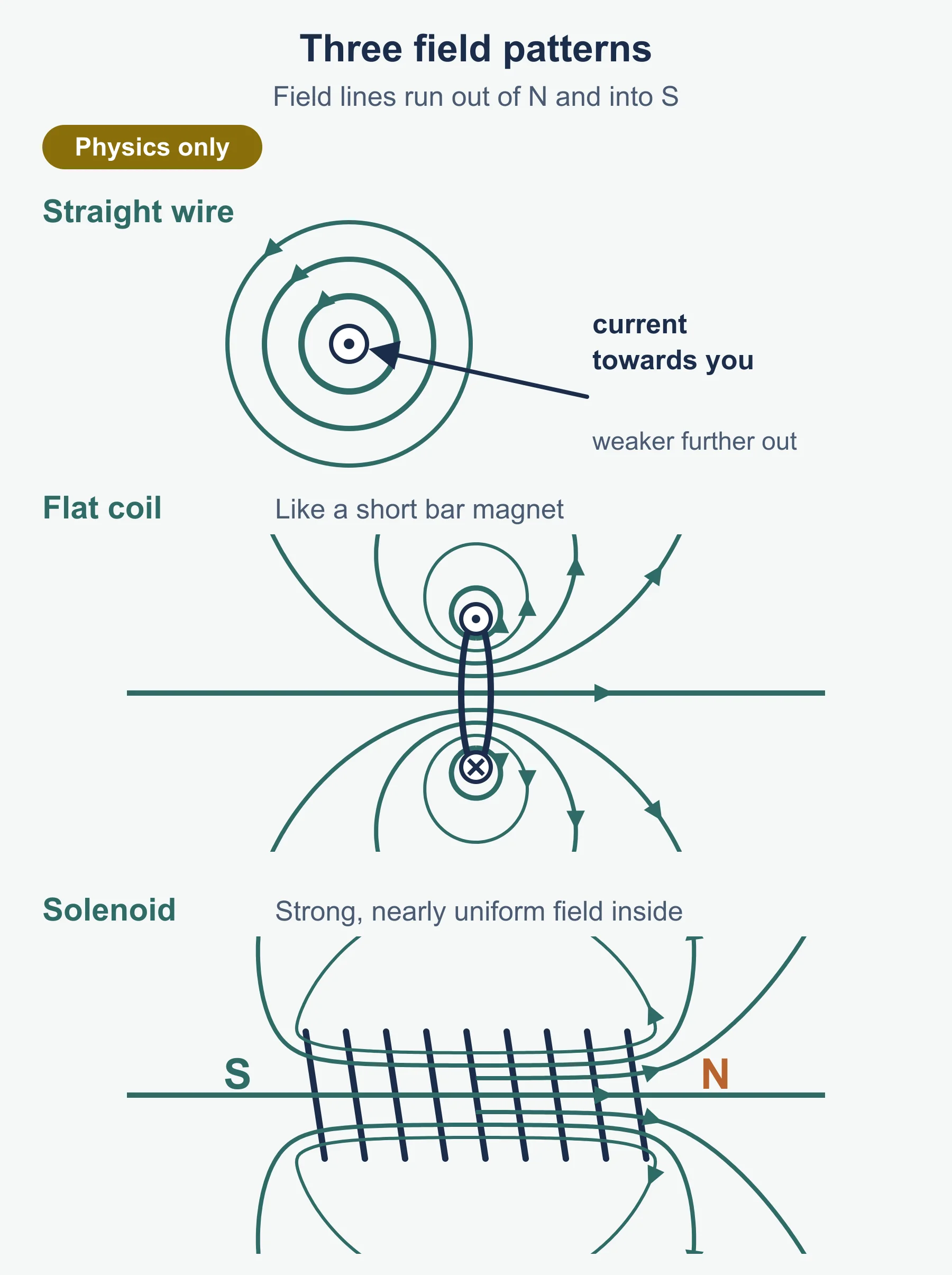
Field patterns (P)
| Conductor | Pattern | Strongest where |
|---|---|---|
| Straight wire | Concentric circles round the wire, spacing increasing outwards | Next to the wire |
| Flat circular coil | Circles round each side; almost straight lines through the centre | Through the centre of the coil |
| Solenoid | Straight, parallel, equally spaced inside; bar-magnet shape outside | Inside (nearly uniform) |
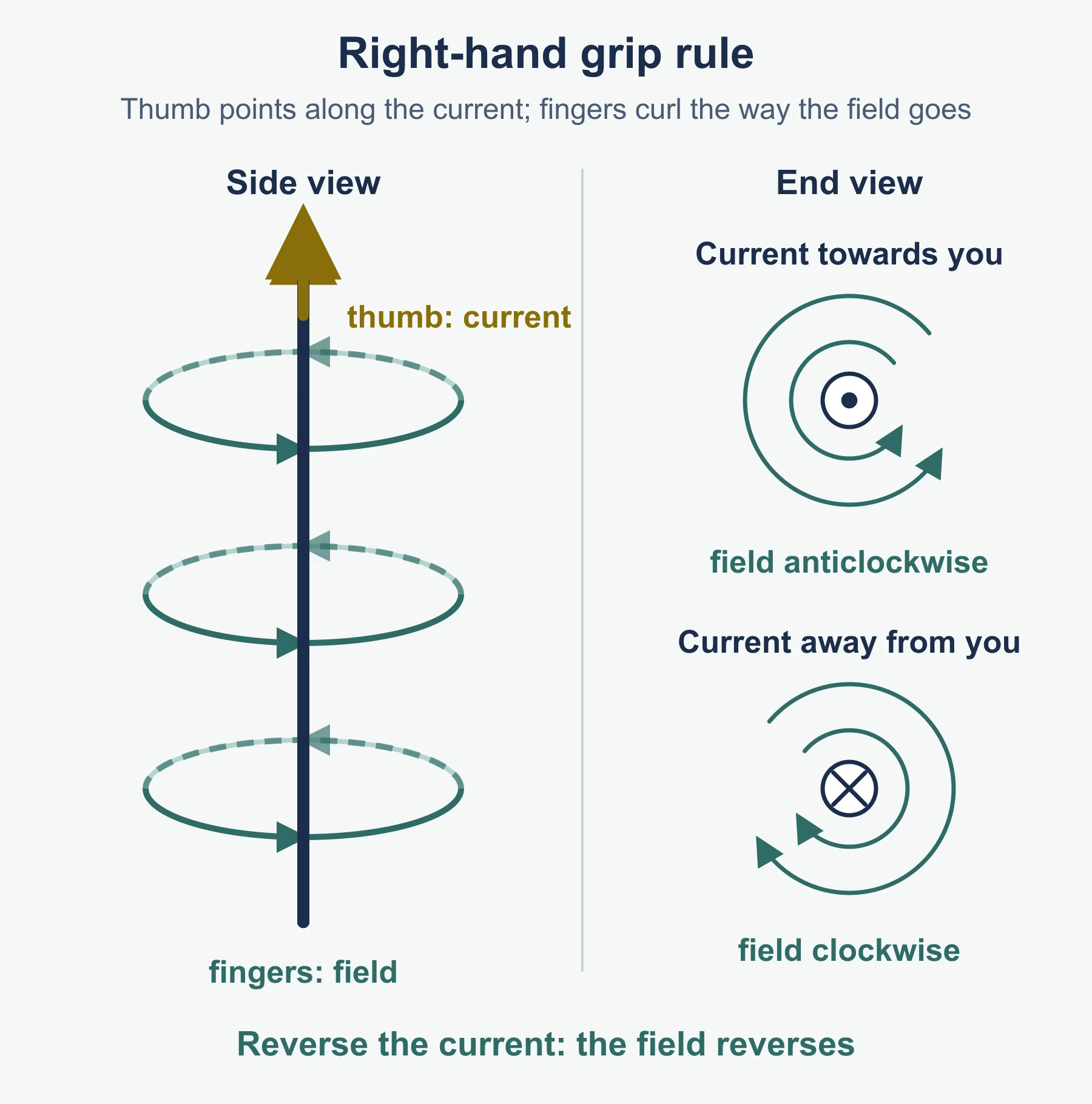
- Right-hand grip rule: thumb along conventional current, fingers curl in the field direction.
- ⊙ = current out of the page (field anticlockwise); ⊗ = current into the page (field clockwise).
- Solenoid end where lines emerge = N pole. Reverse current = swap poles.
Electromagnets (P)
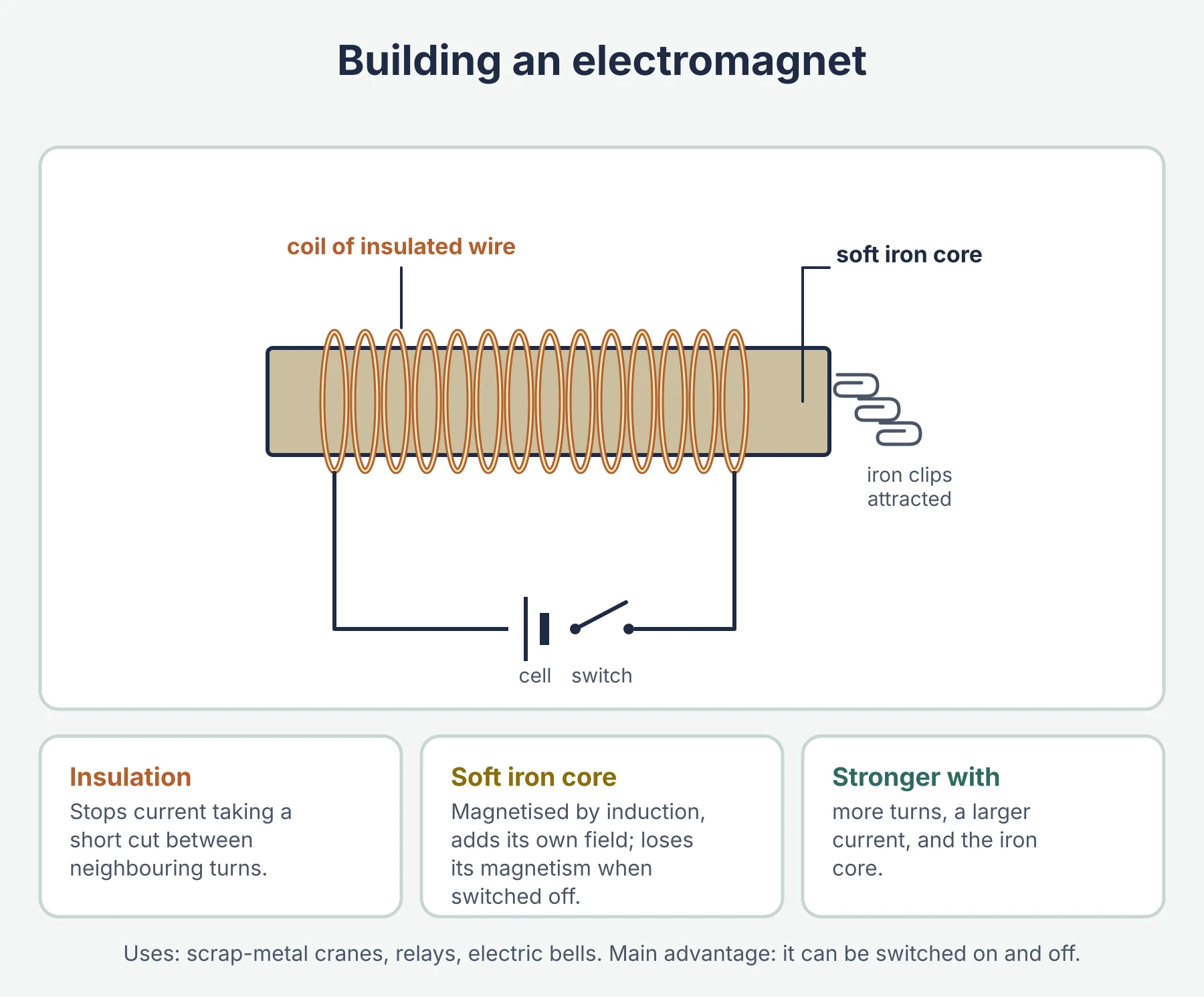
- Coil of insulated wire round a soft iron core.
- Stronger with: more turns; larger current; iron core present.
- Soft iron loses magnetism when the current stops, so the magnet can be switched off.
- Uses: lifting magnets, relays, electric bells.
Force on a moving charge (P)
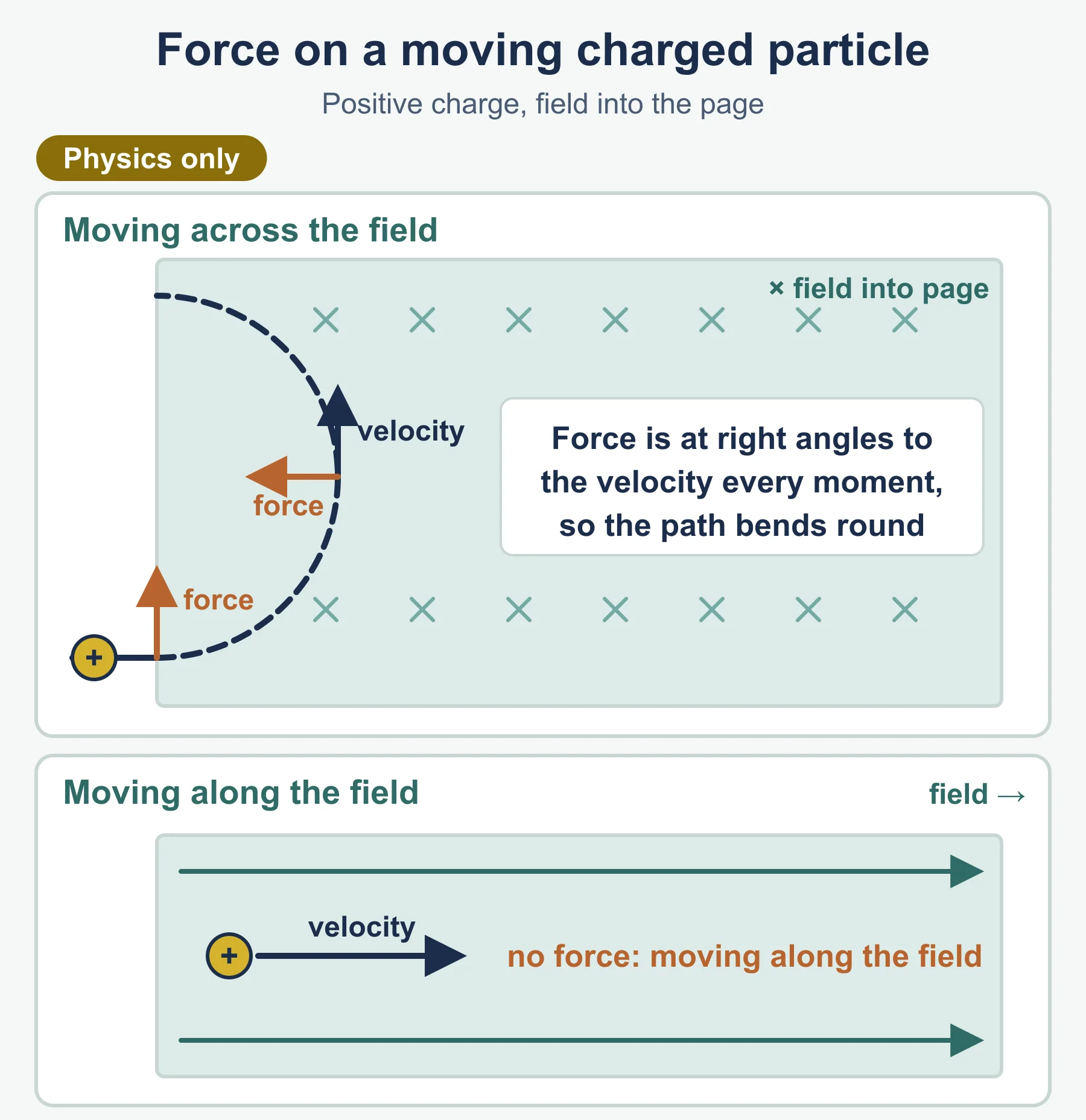
- Force acts if the particle moves not parallel to the field.
- Zero force when moving along the field; maximum when perpendicular.
- Force is at right angles to both motion and field, so it changes direction, not speed along the path.
- Electrons: conventional current is opposite to their motion.
The motor effect
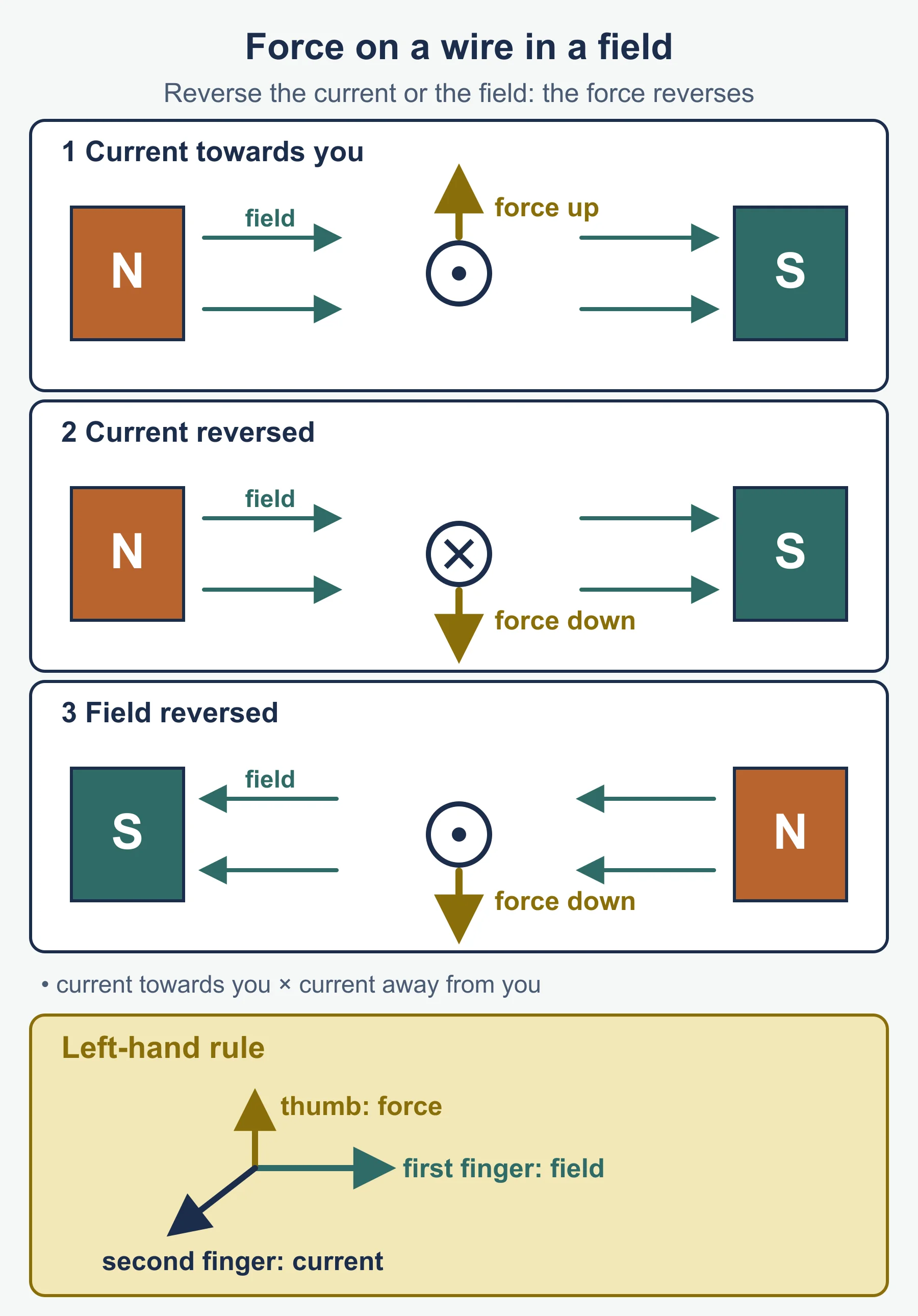
- Current-carrying wire in a magnetic field feels a force: moving charges in the wire each feel a force.
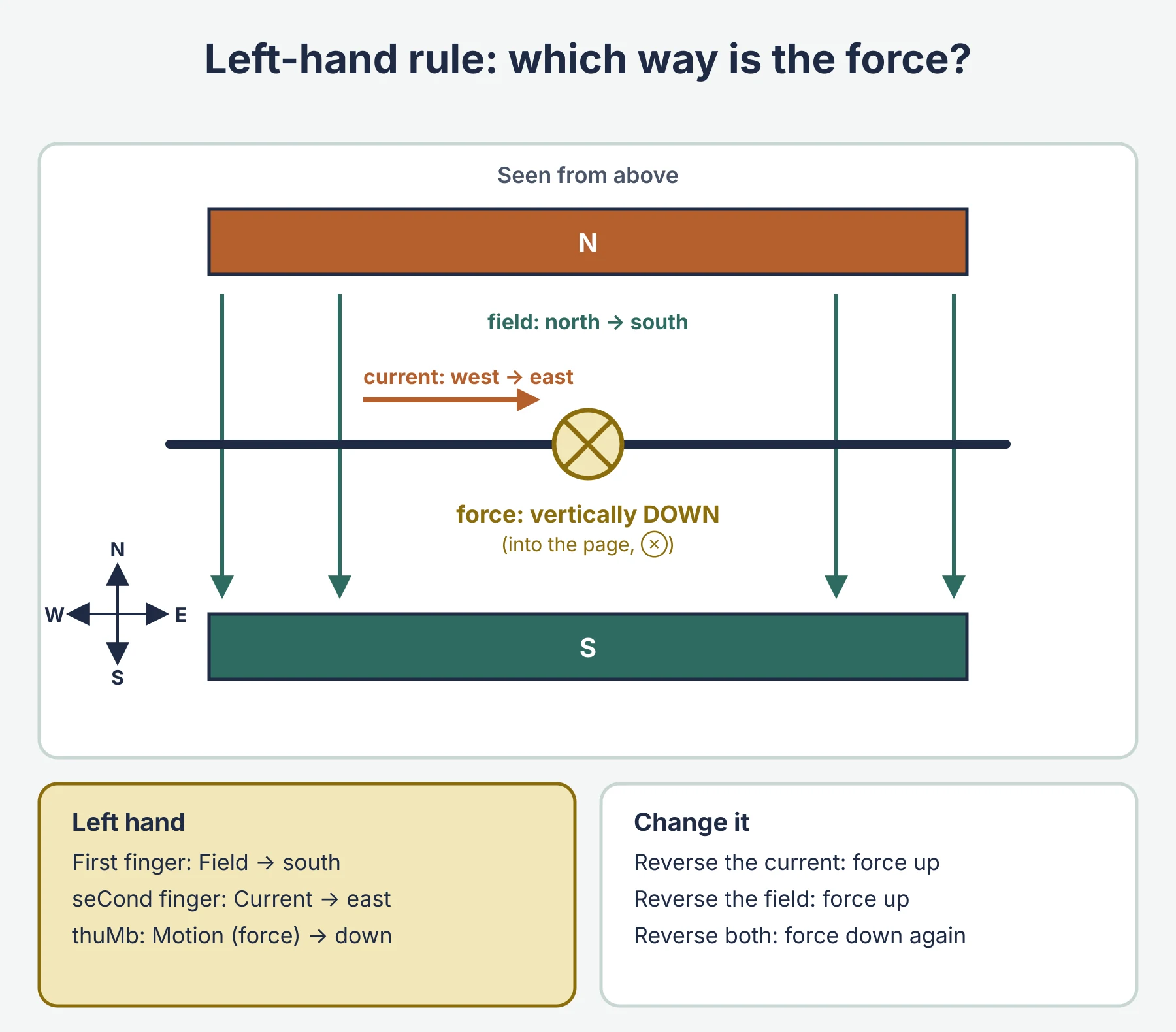
- Fleming’s left-hand rule: First finger = Field; seCond finger = Current; thuMb = Motion.
- Bigger current or stronger field = bigger force.
- Reverse current or field = force reverses. Reverse both = no change in direction.
- Wire parallel to field = no force.
d.c. motor
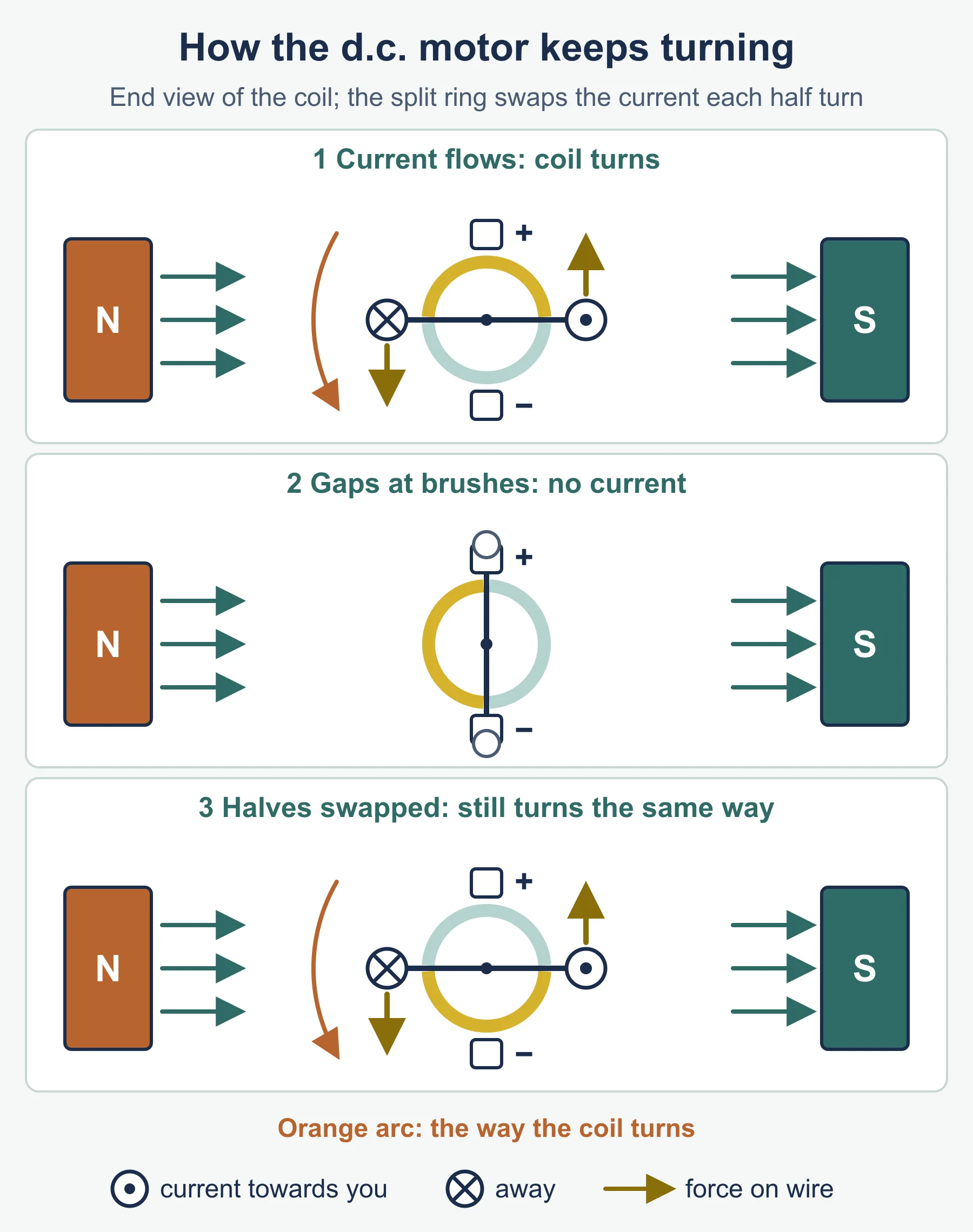
- Coil on an axle between magnet poles; opposite sides carry current in opposite directions, so forces are opposite: a turning effect.
- Split-ring commutator reverses the current in the coil every half turn so rotation continues in one direction.
- Brushes make sliding contact between the supply and the commutator.
- Faster (or more turning effect): larger current, stronger field, more turns.
- Reverse rotation: reverse current or reverse field.
Loudspeaker
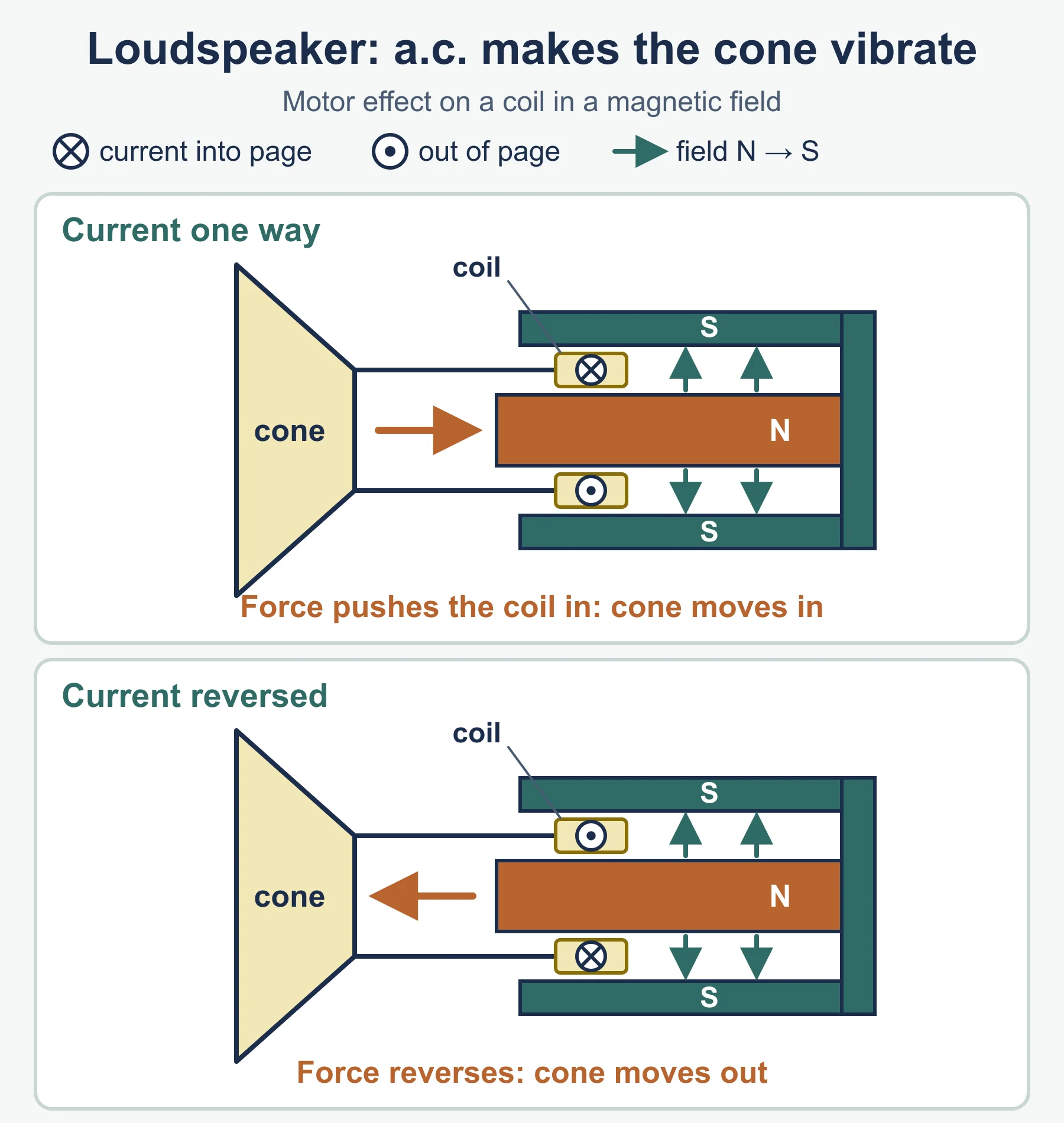
- Coil attached to a cone, in the field of a permanent magnet.
- a.c. in coil → force on coil reverses each time the current reverses → coil and cone vibrate.
- Cone vibrates at the frequency of the current → sound wave of that frequency.
- Bigger current → bigger force → larger amplitude → louder.
Key terms
| Term | Meaning |
|---|---|
| Electromagnet | Coil of insulated wire round a soft iron core, magnetic only while current flows |
| Solenoid | Long coil of wire; its field resembles a bar magnet’s |
| Motor effect | Force on a current-carrying conductor in a magnetic field |
| Conventional current | Direction from + to − round a circuit; opposite to electron flow |
| Left-hand rule | Rule linking field, current and force directions at right angles |
| Split-ring commutator | Rotating switch that reverses the coil current each half turn |
| Brushes | Contacts (often carbon) pressing on the commutator |
Exam traps
- Left hand for force; right hand for the field around a wire. Do not swap them.
- Use conventional current, not electron flow, in the left-hand rule.
- “The commutator reverses the coil” is wrong: it reverses the current in the coil.
- A wire or charge moving parallel to the field: no force. Many students still draw one.
- Straight-wire fields are circles round the wire, not lines along it.
- Loudspeakers need a.c. to vibrate; a steady d.c. would just push the cone to one position.
Self-test
- What evidence shows that a current produces a magnetic field?
- Describe the field pattern around a long straight wire.
- Describe the field inside a current-carrying solenoid.
- State three ways to make an electromagnet stronger.
- Why is the core of an electromagnet made of iron rather than steel?
- When does a charged particle moving in a magnetic field feel no force?
- In Fleming’s left-hand rule, what does each finger represent?
- State the effect on the force of reversing both the current and the field.
- What is the job of the split-ring commutator in a d.c. motor?
- State two ways of reversing the direction of rotation of a d.c. motor.
- Explain why a loudspeaker cone vibrates.
- An electron beam moves left to right. Which way is the conventional current?
Answers
- A compass placed near the wire is deflected when the current is switched on.
- Concentric circles centred on the wire, getting further apart with distance from the wire.
- Strong and nearly uniform: straight, parallel, equally spaced field lines.
- More turns on the coil; a larger current; a soft iron core.
- Iron is magnetically soft, so it loses its magnetism when the current is switched off.
- When it moves parallel to the field (or is not moving).
- First finger: field; second finger: current; thumb: motion (force).
- The force stays in its original direction.
- It reverses the current in the coil every half turn so the coil keeps turning the same way.
- Reverse the current (swap the supply connections); reverse the magnetic field (swap the magnet’s poles).
- The alternating current in the coil, which is in a magnetic field, causes a force that keeps reversing, so the coil and cone move backwards and forwards.
- Right to left, opposite to the electron motion.
Frequently asked questions
Is the d.c. motor Physics-only content in 4PH1? No. Statement 6.12, which covers motors and loudspeakers, has no “P” reference, so it is core content. Field patterns, electromagnet construction and the force on a moving charge are the Physics-only parts.
Do I need an equation for the size of the force? No. Statement 6.14 asks you to describe how the force changes with the size and direction of the field and current, not to calculate it.
Test yourself further with the Electromagnetism practice questions.
Related resources
-
Study guides
Pearson Edexcel International GCSE Physics (4PH1): Magnetism
Magnetic forces, hard and soft materials, field lines, induced magnetism, the field-pattern practical and uniform fields for Edexcel 4PH1 sub-topic 6b.
Physics · Pearson Edexcel · IGCSE
Read guide -
Practice questions
Pearson Edexcel International GCSE Physics (4PH1): Magnetism – Practice Questions
Original practice questions with mark-scheme answers on poles, magnetic materials, field lines, induced magnetism and uniform fields (Edexcel 4PH1, 6b).
Physics · Pearson Edexcel · IGCSE
Try questions -
Revision notes
Pearson Edexcel International GCSE Physics (4PH1): Magnetism – Revision Notes
Condensed recall for Edexcel 4PH1 sub-topic 6b: poles, hard and soft materials, field line rules, induced magnetism and uniform fields, with a self-test.
Physics · Pearson Edexcel · IGCSE
Revise topic
Related articles
Get free revision emails (optional)
Occasional emails with practice questions, worked explanations and links to free resources for the qualification and subjects you choose. No spam, and you can unsubscribe from any email. The free tools on this site never need an email.