
Revision Notes
Pearson Edexcel International GCSE Physics (4PH1): Stellar evolution – Revision Notes
Recall notes for Edexcel 4PH1 sub-topic 8c: star colour and temperature, life cycles by mass, absolute magnitude and the HR diagram, with a self-test.
- Subject
- Physics
- Level
- IGCSE
- Topic
- Astrophysics
- Author
- Marlbridge Academic Team
- Updated
- Reviewed by
- Hassan (what this means)
Aligned to Pearson Edexcel IGCSE Physics (4PH1), Issue 4. Official specification .
Syllabus page (what it covers and how it is assessed): Pearson Edexcel IGCSE Physics.
Syllabus points this page covers
4PH1
- 8c Stellar evolution
Found an error? Report a correction.
Need help with this topic? Request a free trial class for IGCSE Physics (4PH1).
Condensed notes for sub-topic 8(c) Stellar evolution (statements 8.7 to 8.12P) of Pearson Edexcel International GCSE Physics (4PH1). Items marked (P) are Physics-only, assessed on Paper 2P. Full explanations are in the Stellar evolution study guide.
Colour and temperature
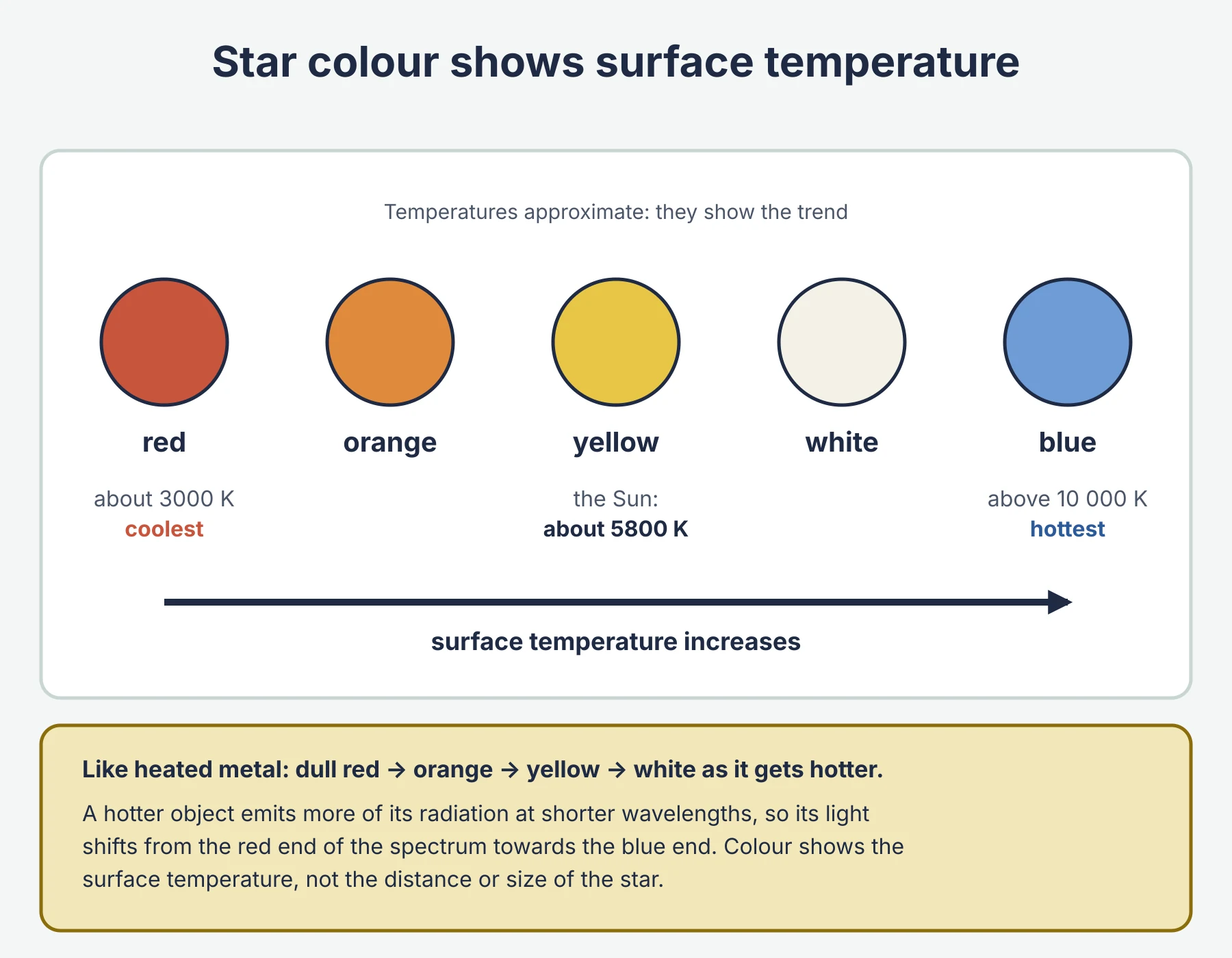
- Stars are classified by colour.
- Colour depends on surface temperature.
- Coolest → hottest: red, orange, yellow, white, blue.
- The Sun is a yellow star (surface about 5800 K).
- Hotter surface → more radiation at shorter wavelengths → bluer.
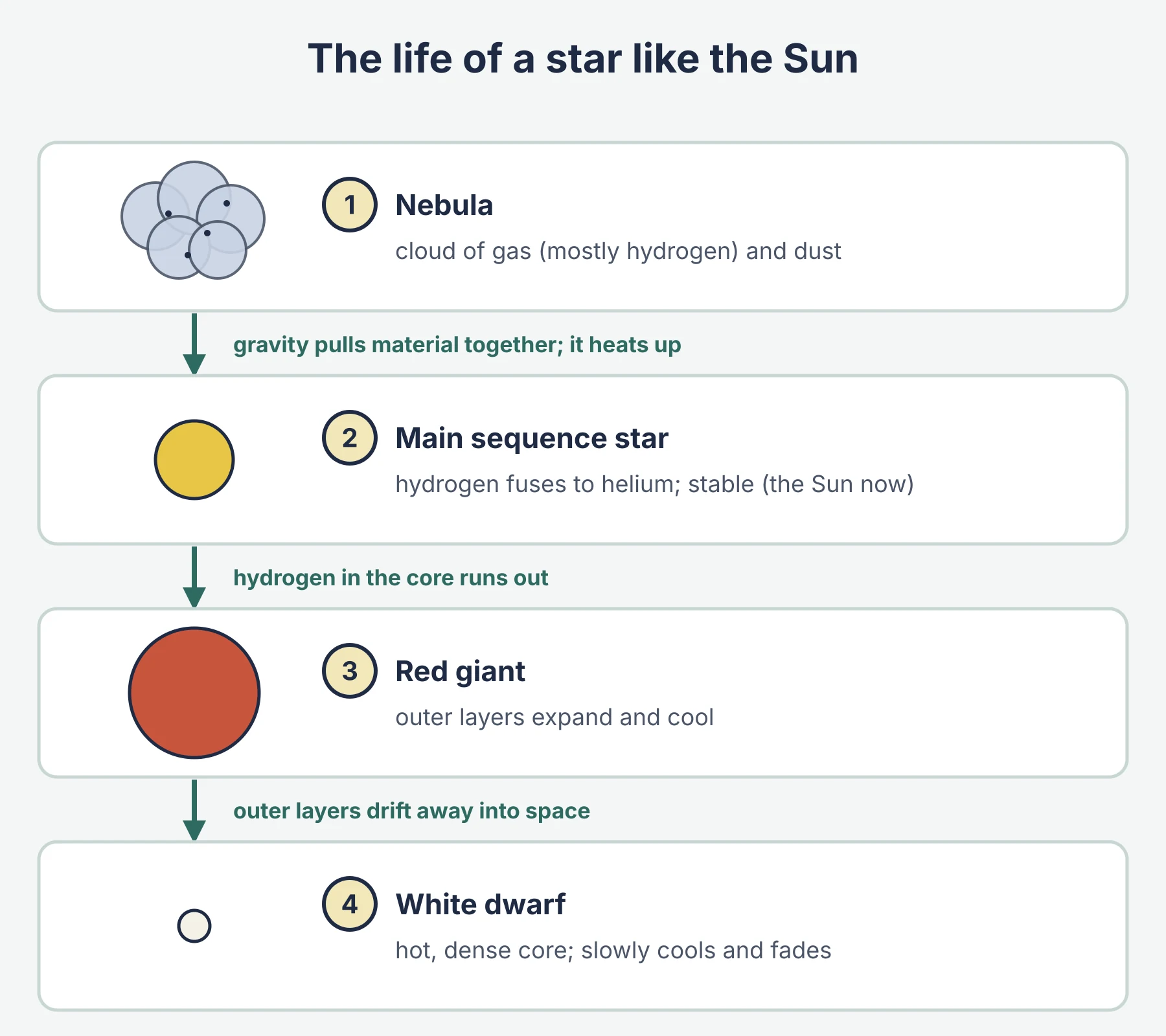
Sun-like star (named stages in 8.9)
nebula → main sequence star → red giant → white dwarf| Stage | What happens |
|---|---|
| Nebula | Cloud of gas and dust collapses under gravity and heats up |
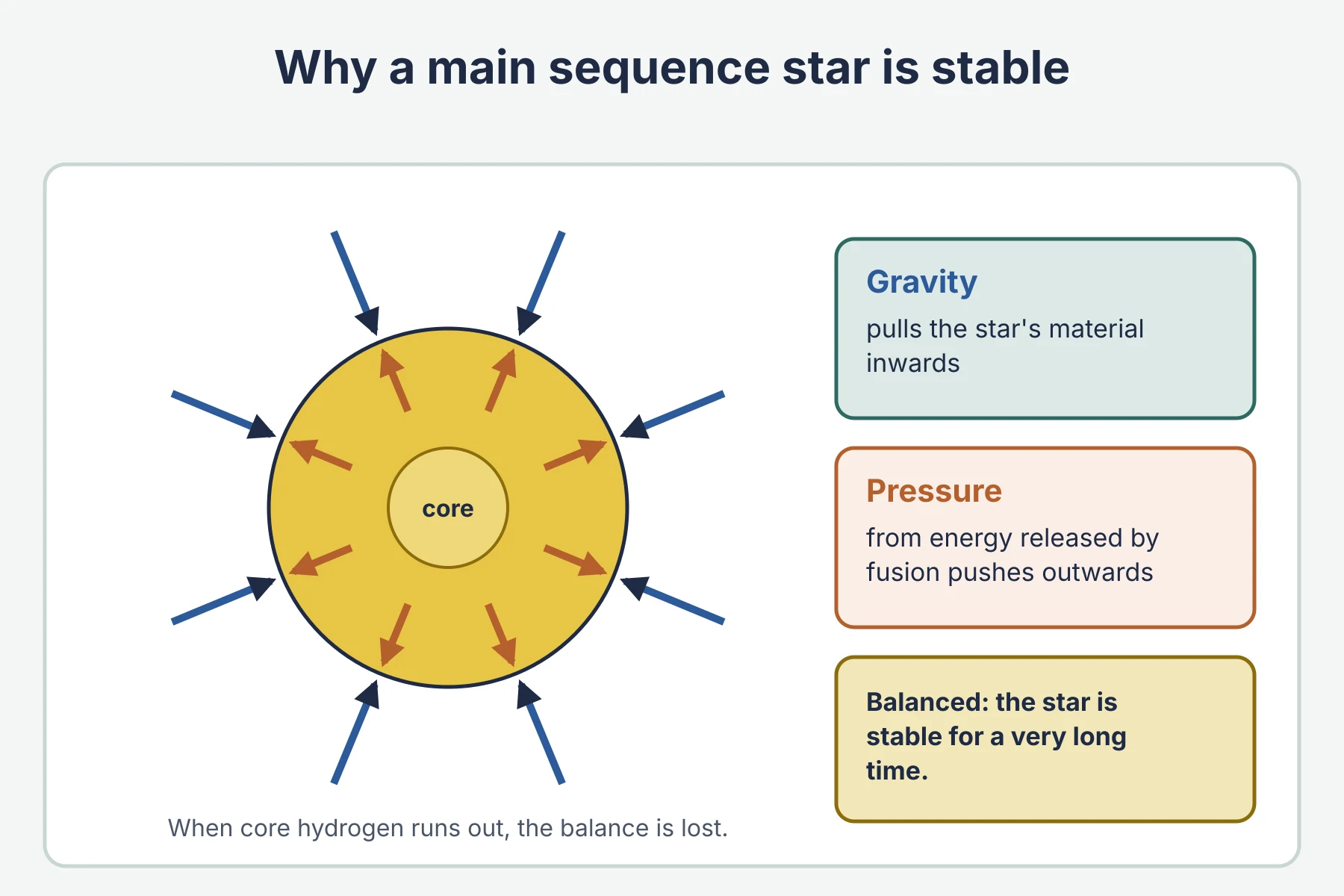
| Main sequence | Hydrogen fuses to helium in the core; gravity (in) balances pressure from fusion energy (out); long and stable |
| Red giant | Core hydrogen runs out; core contracts; outer layers expand and cool |
| White dwarf | Outer layers drift away; small, hot, dense core remains, no fusion, cools slowly |
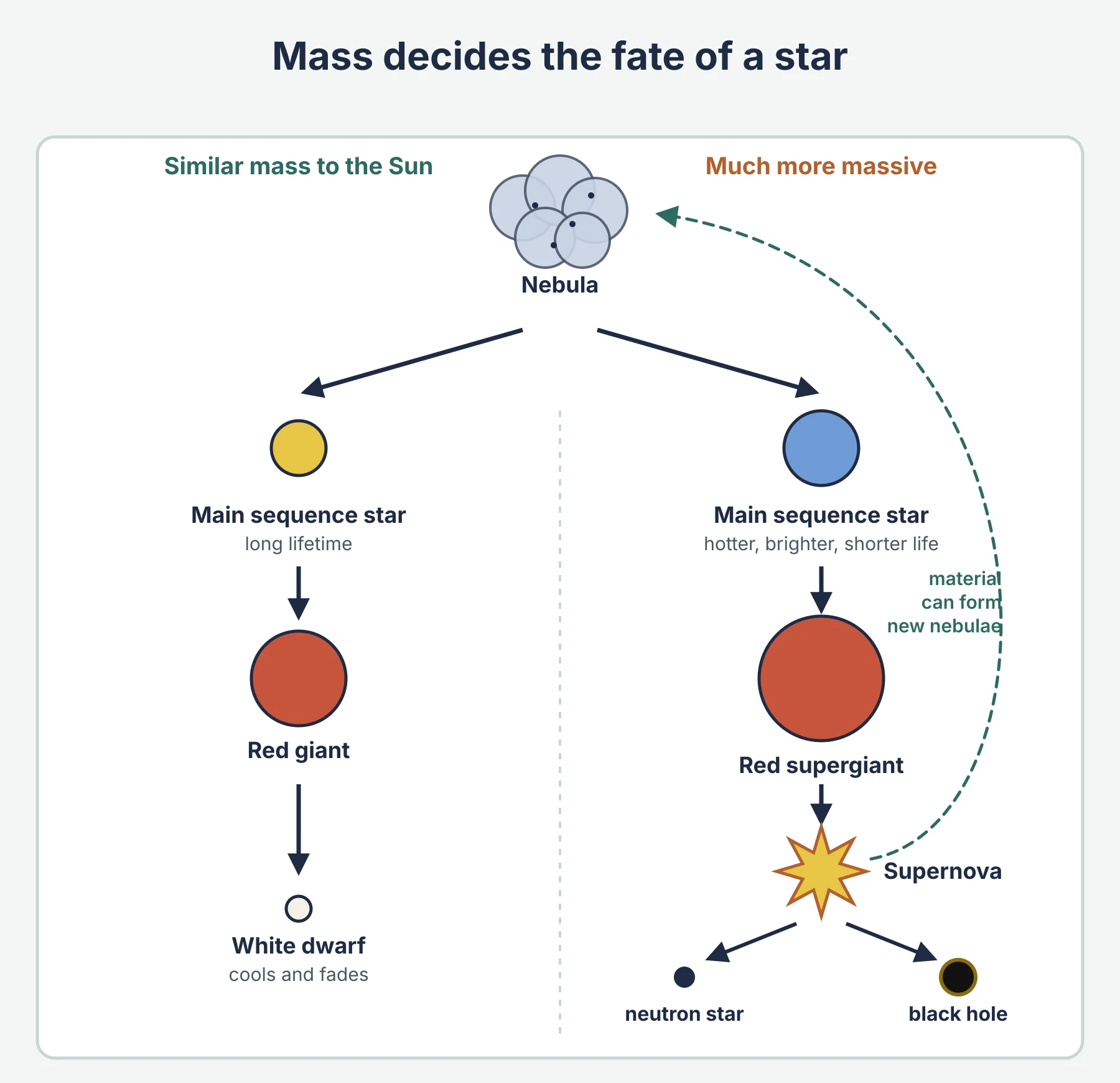
Much more massive star (8.10)
nebula → main sequence star → red supergiant → supernova → neutron star or black hole- More massive → hotter, brighter, shorter main-sequence life.
- Supernova: core collapses, star explodes, material scattered into space.
- Remnant: neutron star, or black hole for the most massive.
- Mass decides the fate.
Absolute magnitude (P)
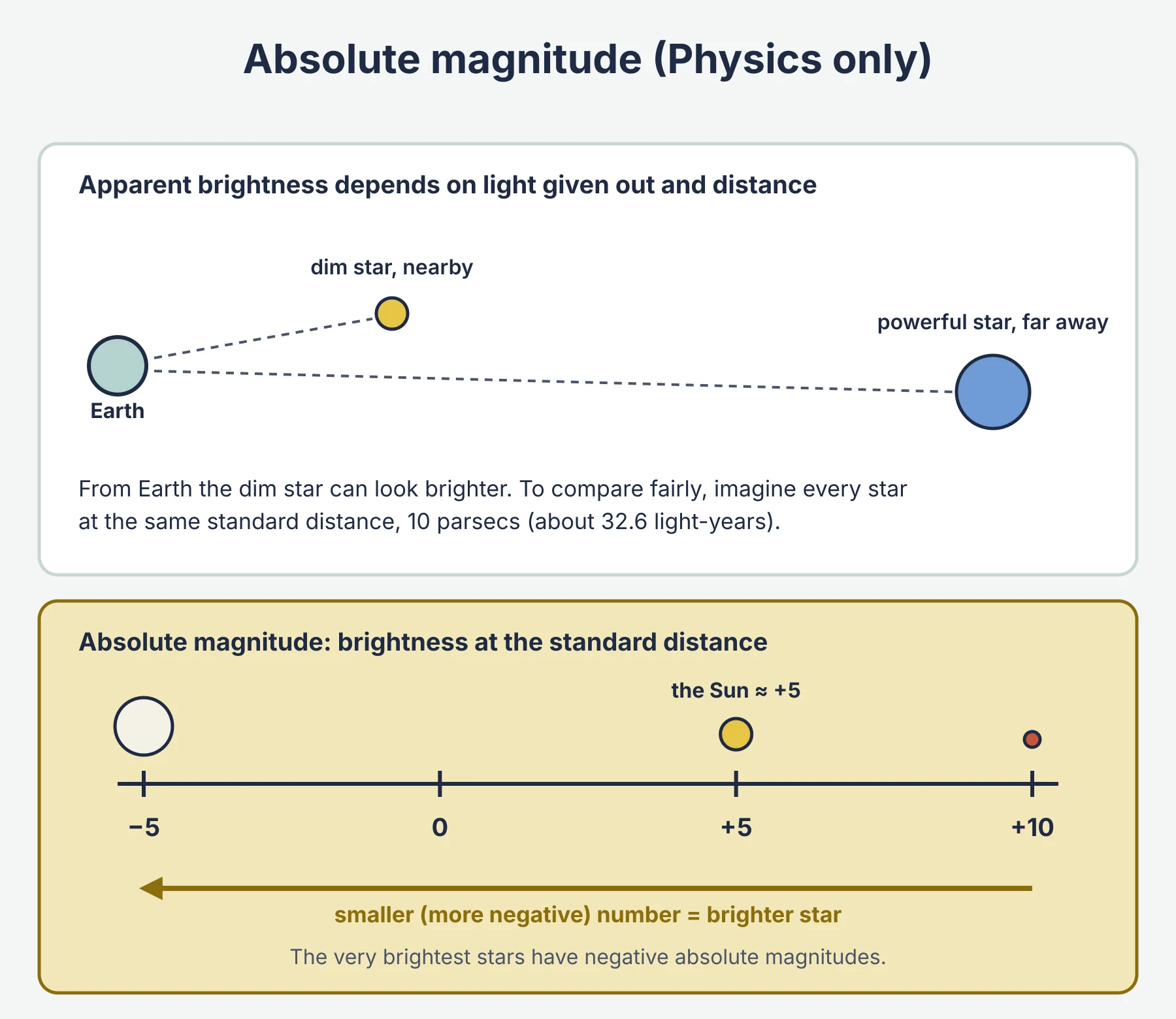
- Apparent brightness depends on light output and distance.
- Absolute magnitude = brightness of the star at a standard distance (10 parsecs).
- Allows a fair comparison of stars.
- Lower (more negative) number = brighter.
- Sun ≈ +5.
HR diagram (P)
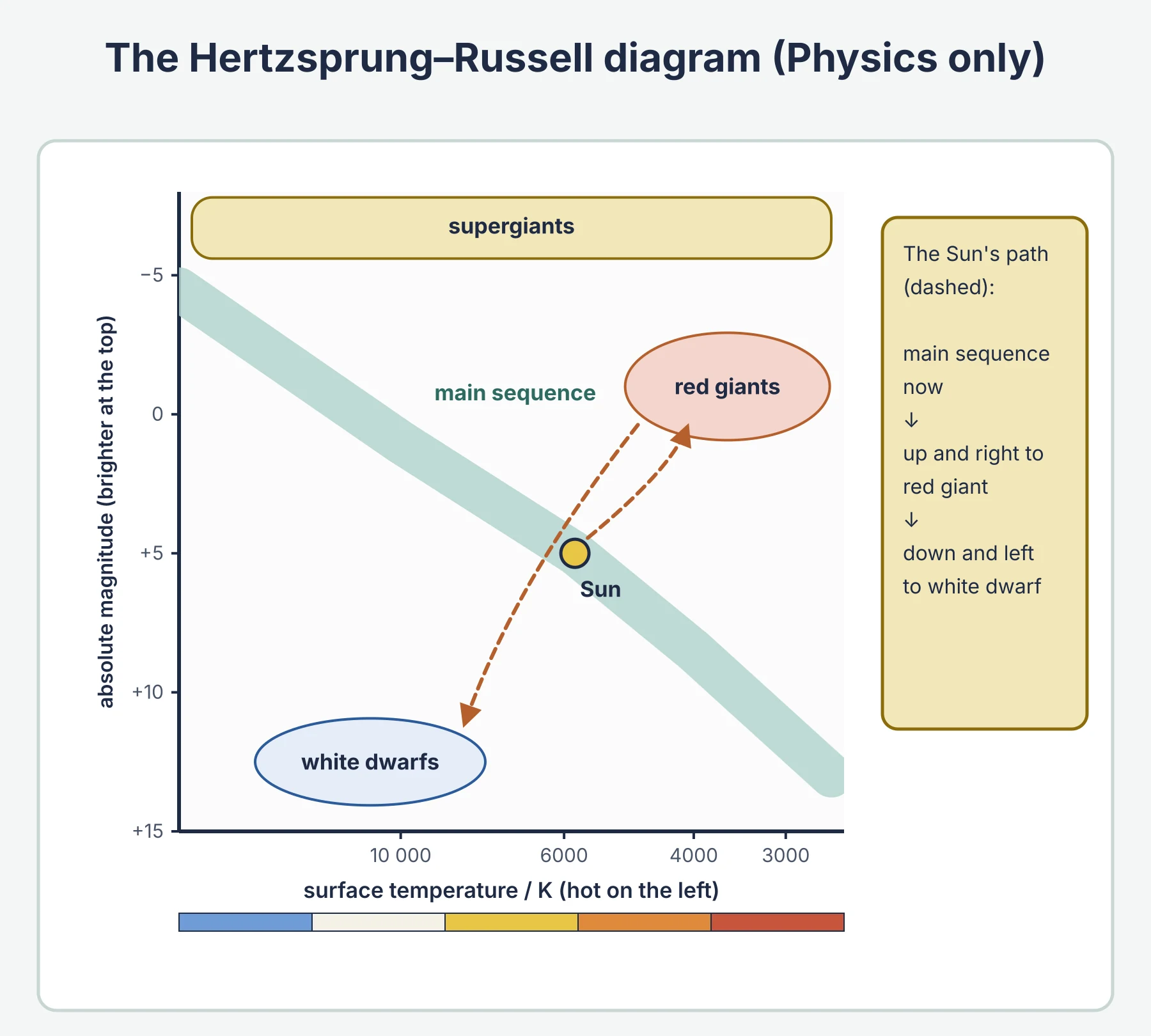
Axes
- y: absolute magnitude (or luminosity); bright at the top (negative magnitudes at the top).
- x: surface temperature (or colour); hot on the left, cool on the right; blue to red.
Regions
| Region | Position | Stars are |
|---|---|---|
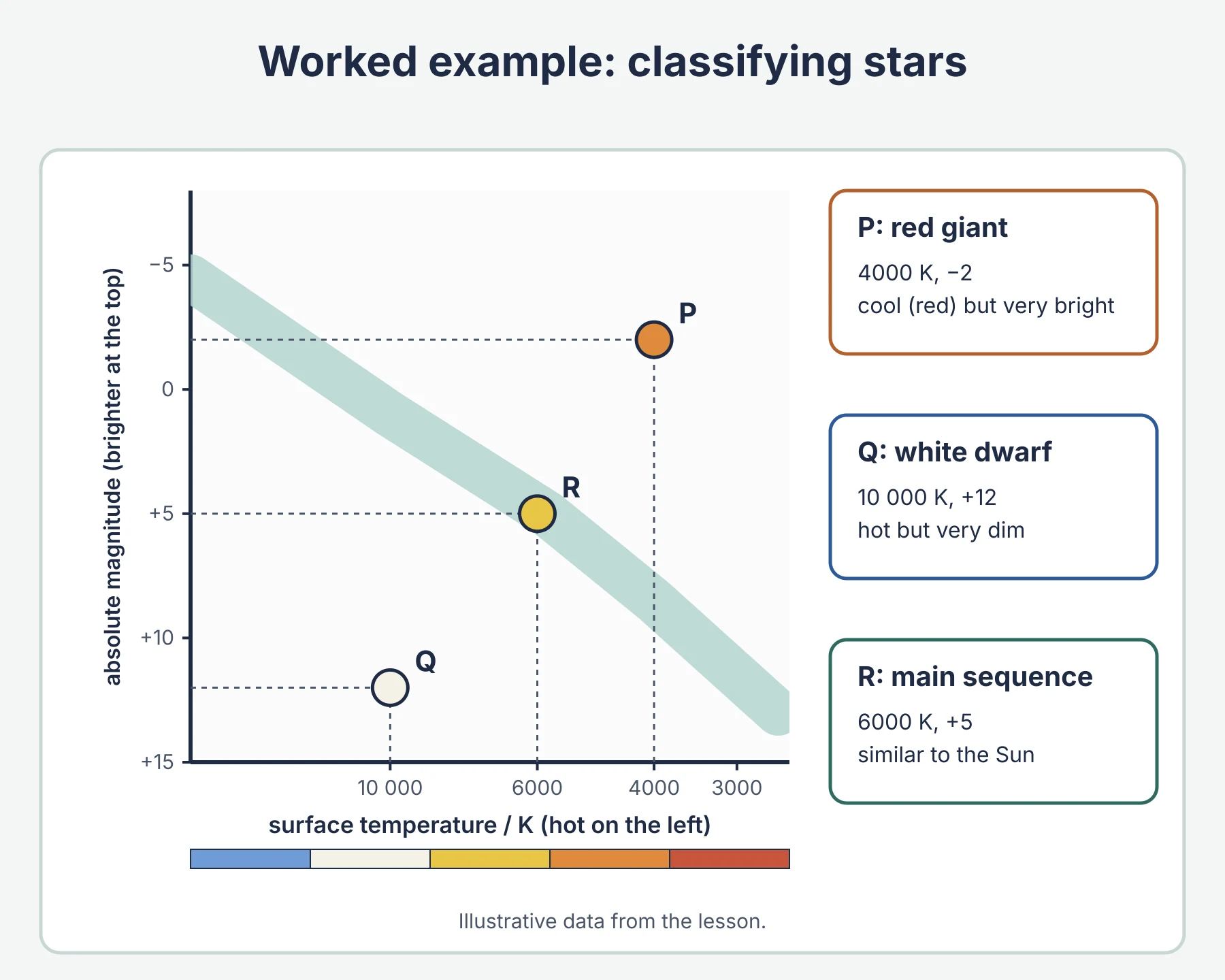
| Main sequence | Diagonal band, top left to bottom right | Most stars, including the Sun |
| Red giants | Upper right, above the main sequence | Cool but bright (large) |
| Supergiants | Across the top | Brightest |
| White dwarfs | Lower left | Hot but dim (small) |
Sun’s path: main sequence → up and right (red giant) → down and left (white dwarf).
Reading positions: top = bright, bottom = dim, left = hot, right = cool. A cool star that is bright must be large (giant); a hot star that is dim must be small (white dwarf).
Key terms
| Term | Meaning |
|---|---|
| Nebula | Cloud of gas and dust in which stars form |
| Main sequence star | Stable star fusing hydrogen into helium in its core |
| Red giant | Large, cool, bright star formed when core hydrogen runs out in a Sun-like star |
| White dwarf | Small, hot, dense remnant core of a Sun-like star |
| Red supergiant | Very large star formed from a massive star after its main sequence |
| Supernova | Explosion of a massive star when its core collapses |
| Neutron star | Extremely dense remnant of a supernova |
| Black hole | Remnant so dense that not even light can escape |
| Absolute magnitude | Brightness a star would have at a standard distance |
Exam traps
- Red = coolest, blue = hottest.
- Absolute magnitude ≠ apparent brightness.
- Negative magnitudes are brighter, not dimmer.
- HR temperature axis runs backwards (hot on the left).
- The Sun will not become a supernova or black hole.
- A stage change needs its cause, such as “hydrogen in the core runs out”.
- Main-sequence stability needs both forces named and “balanced”.
Self-test
- What does the colour of a star tell you?
- Put in order of increasing surface temperature: white, red, blue, yellow.
- Name the four stages of the life of a star like the Sun, in order.
- Why is a main sequence star stable?
- What causes a Sun-like star to become a red giant?
- Describe a white dwarf.
- Name the stage after the main sequence for a star much more massive than the Sun.
- What two objects can be left after a supernova?
- Define absolute magnitude.
- Star A has absolute magnitude −3; star B has +8. Which is brighter?
- On an HR diagram, where are white dwarfs found, and why?
- Which way does temperature increase along the horizontal axis of an HR diagram?
Answers
- Its surface temperature.
- Red, yellow, white, blue.
- Nebula, main sequence star, red giant, white dwarf.
- The inward force of gravity is balanced by the outward pressure from the energy released by fusion.
- The hydrogen in its core runs out, so the core contracts and the outer layers expand and cool.
- A small, hot, dense star: the leftover core of a Sun-like star, no longer fusing, slowly cooling.
- Red supergiant.
- A neutron star or a black hole.
- The brightness a star would have if it were at a standard distance from Earth.
- Star A (the lower number is brighter).
- At the lower left: they are hot (left) but dim (bottom) because they are very small.
- From right to left (hot stars are on the left).
Frequently asked questions
Does 4PH1 name the stages for massive stars? No. Statement 8.10 asks you to describe the evolution of stars with a mass larger than the Sun without listing stages; red supergiant, supernova, neutron star and black hole are the standard sequence used to answer it.
Do I have to know the standard distance used for absolute magnitude? The specification says only “a standard distance”. Knowing that it is 10 parsecs is useful background, not a requirement of the statement.
Practise next with the Stellar evolution practice questions.
Related resources
-
Study guides
Pearson Edexcel International GCSE Physics (4PH1): Units in astrophysics
Using kg, m, m/s, m/s², N, s and N/kg in weight, orbital speed and red-shift calculations, with conversions, for Edexcel IGCSE Physics 4PH1 sub-topic 8a.
Physics · Pearson Edexcel · IGCSE
Read guide -
Practice questions
Pearson Edexcel International GCSE Physics (4PH1): Units in astrophysics – Practice Questions
Original questions with worked answers on mass and weight, g in N/kg and m/s², and unit conversions for orbital speed and red-shift, for Edexcel 4PH1 8a.
Physics · Pearson Edexcel · IGCSE
Try questions -
Revision notes
Pearson Edexcel International GCSE Physics (4PH1): Units in astrophysics – Revision Notes
Recall notes for Edexcel 4PH1 sub-topic 8a: mass, weight and g, N/kg and m/s², conversions for orbital speed and red-shift units, with a self-test.
Physics · Pearson Edexcel · IGCSE
Revise topic
Related articles
Get free revision emails (optional)
Occasional emails with practice questions, worked explanations and links to free resources for the qualification and subjects you choose. No spam, and you can unsubscribe from any email. The free tools on this site never need an email.