
Study Guides
IB DP Business Management: Communication and Industrial/employee relations (HL only)
Study guide to IB DP Business Management 2.6 communication and HL-only 2.7 industrial/employee relations: methods, barriers, conflict, resolution.
- Subject
- Business
- Level
- IB
- Topic
- Unit 2: Human resource management
- Author
- Marlbridge Academic Team
- Updated
- Reviewed by
- Salman Ahmad (what this means)
Aligned to International Baccalaureate IB Diploma Programme Business (DP Business Management), First assessment 2024. Official specification .
Syllabus page (what it covers and how it is assessed): IB Diploma Programme Business.
Syllabus points this page covers
DP Business Management
- 2.6 Communication
- 2.7 Industrial/employee relations (HL only)
Found an error? Report a correction.
Need help with this topic? Request a free trial class for IB Diploma Programme Business (DP Business Management).
This guide covers sections 2.6 (Communication) and 2.7 (Industrial/employee relations) in Unit 2, Human resource management, of the IB Business management guide, first assessment 2024. Section 2.6 applies to both SL and HL. Section 2.7 is labelled HL only in the guide. The guide lists these points briefly, so where it names an idea without defining it, this page gives the standard textbook account and says so.
Related pages: the Business Management hub, the printable checklist, the revision notes and the practice questions. To find weak spots first, try the free diagnostics.
What sections 2.6 and 2.7 ask you to know
| Content point in the guide | Depth of teaching (as the guide labels it) | Level |
|---|---|---|
| Formal and informal methods of communication for an organization in a given situation | AO3 | SL and HL |
| Barriers to communication | AO2 | SL and HL |
| Sources of conflict in the workplace | AO2 | HL only |
| Approaches to conflict by employees: collective bargaining, work-to-rule, strike action | AO3 | HL only |
| Approaches to conflict by employers: collective bargaining, threats of redundancies, changes of contract, closure, lockouts | AO3 | HL only |
| Conflict resolution: conciliation and arbitration; employee participation and industrial democracy; no-strike agreement; single-union agreement | AO3 | HL only |
AO2 means application and analysis: use the idea on the business in front of you. AO3 means synthesis and evaluation: weigh options and reach a judgement. So for methods of communication, and for every approach to conflict and its resolution, you must be ready to compare, weigh and recommend, not just describe. The guide gives no formulas. Numbers appear only as case data, such as a pay claim, which you may be asked to use.
2.6 Communication
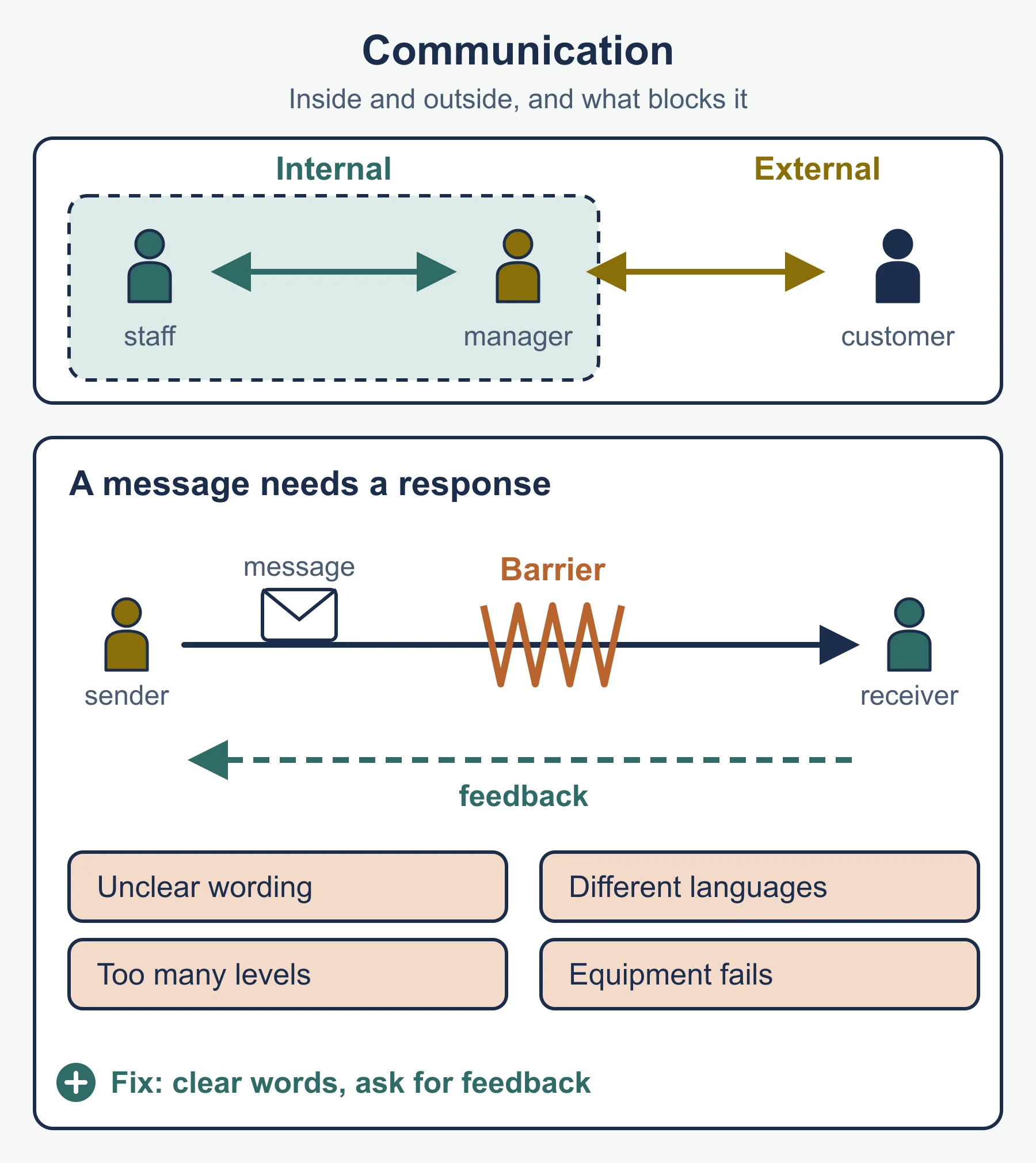
Communication (standard account) is the transfer of information, ideas or instructions from a sender to a receiver, with the aim that the message is understood. In a business it supports coordination, motivation and decisions. Good communication needs a clear message, a suitable channel and, ideally, feedback showing it was understood.
Formal methods
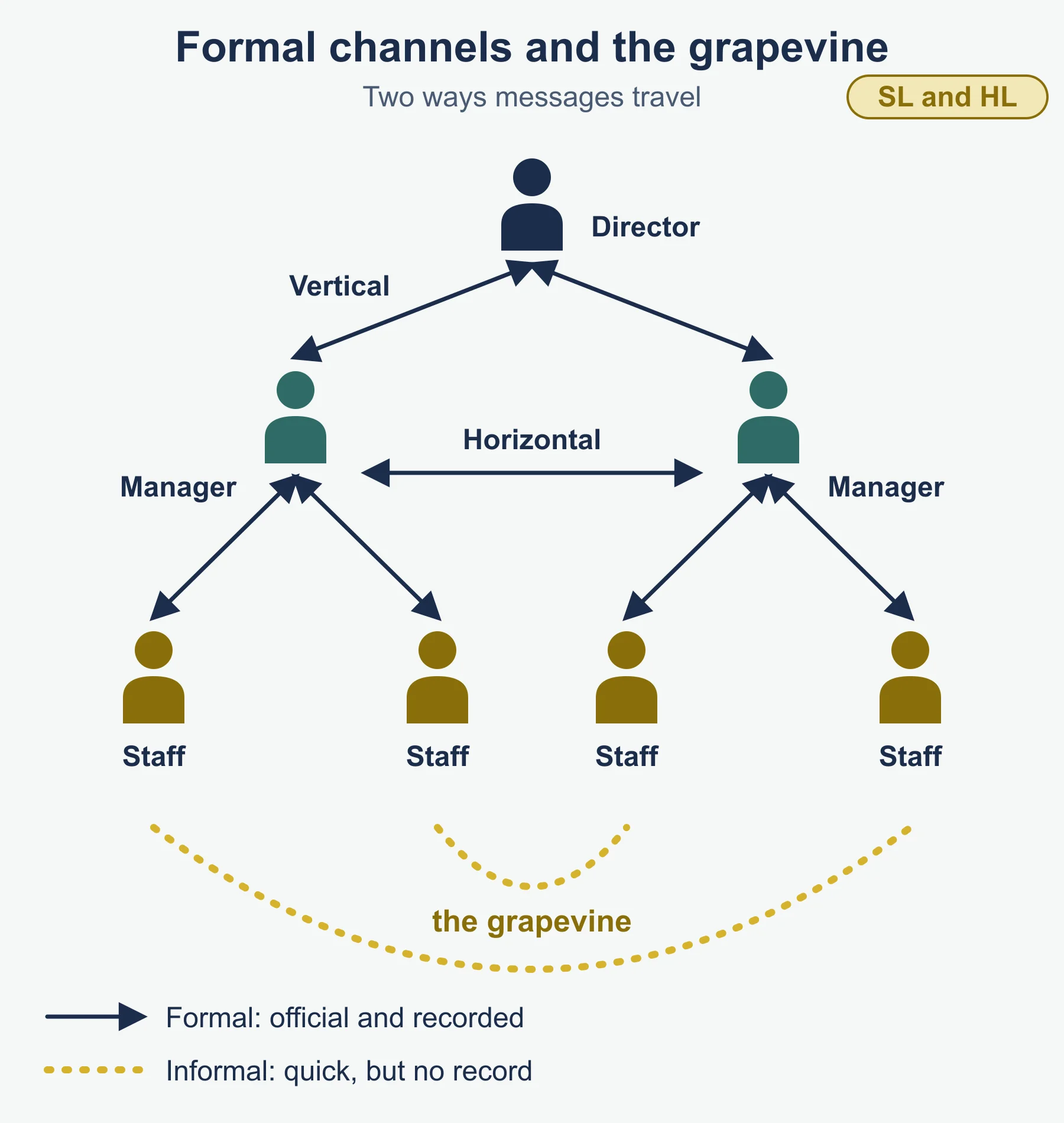
Formal communication follows the organization’s official channels, often through the chain of command. It is usually planned, recorded and traceable. Typical examples are:
- Meetings with an agenda and minutes.
- Emails, memos and written reports.
- Notice boards, newsletters and the intranet.
- Presentations, briefings and appraisal interviews.
- Formal team or company-wide announcements.
Strengths: a clear record, consistency, accountability and lower risk of distortion. Limits: it can be slow, impersonal and one-way, and rigid channels may discourage staff from raising concerns.
Informal methods
Informal communication happens outside official channels. Examples are conversations in corridors or at lunch, instant-messaging chat between colleagues, social events and the grapevine (the unofficial network through which rumour and news travel). Strengths: speed, flexibility, and a sense of belonging that can support morale. Limits: no record, a risk of rumour or distortion, and messages that reach some staff but not others.
Choosing a method for a given situation
The guide asks for methods “for an organization in a given situation”, at AO3. That means you must judge fit, not list. Useful questions are:
- How urgent is the message?
- How sensitive or complex is it?
- How many people must receive it, and where are they?
- Is a record needed, for example for safety or legal reasons?
- Do you need feedback, so that two-way communication is better than one-way?
- What do the staff prefer, and what does the culture expect?
Direction is also worth naming: vertical communication moves up or down the hierarchy, and horizontal communication moves between colleagues at the same level. Both can be formal or informal.
Worked example 1: choosing a method
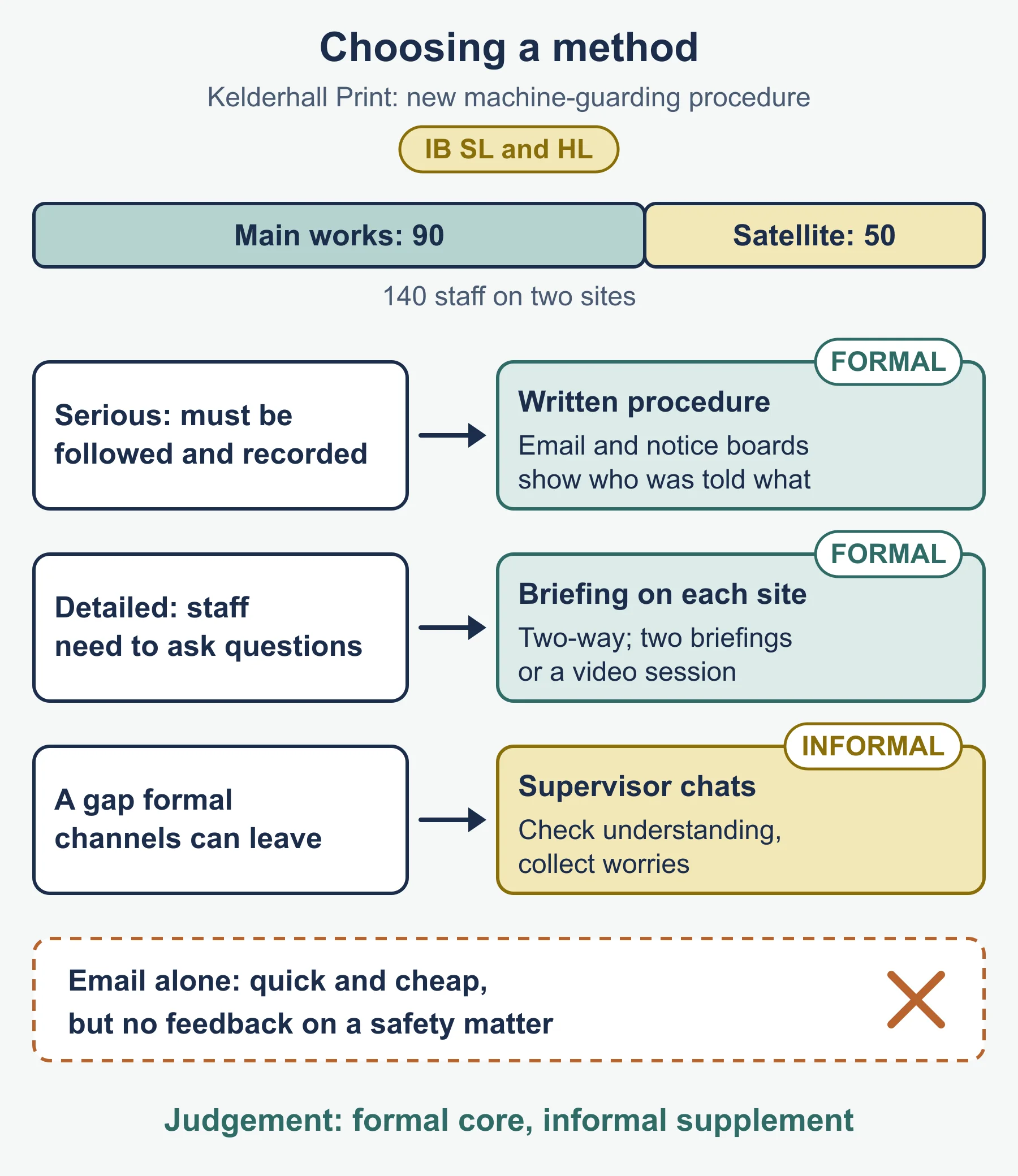
Kelderhall Print has 140 staff on two sites, 90 at the main works and 50 at a satellite unit. It must introduce a revised machine-guarding procedure next month. Staff must follow it exactly, and the managers want to hear any practical problems.
- The message is serious and must be recorded, so a written formal method is needed. A procedure document sent by email and posted on notice boards gives a trace of who was told what.
- The procedure is detailed and changes behavior, so writing alone is weak. A short formal briefing on each site lets staff ask questions, which gives two-way communication.
- Two sites make one large meeting impractical, so two briefings or a video session suit better.
- Supervisors can use informal chats on the shop floor to check understanding and collect worries, and they pass on what they hear. This covers a gap formal channels can leave.
- Judgement: a formal written document plus formal briefings is the core, with informal supervisor conversations as a supplement. An email alone would be quick and cheap but would give no feedback on a safety matter.
Barriers to communication
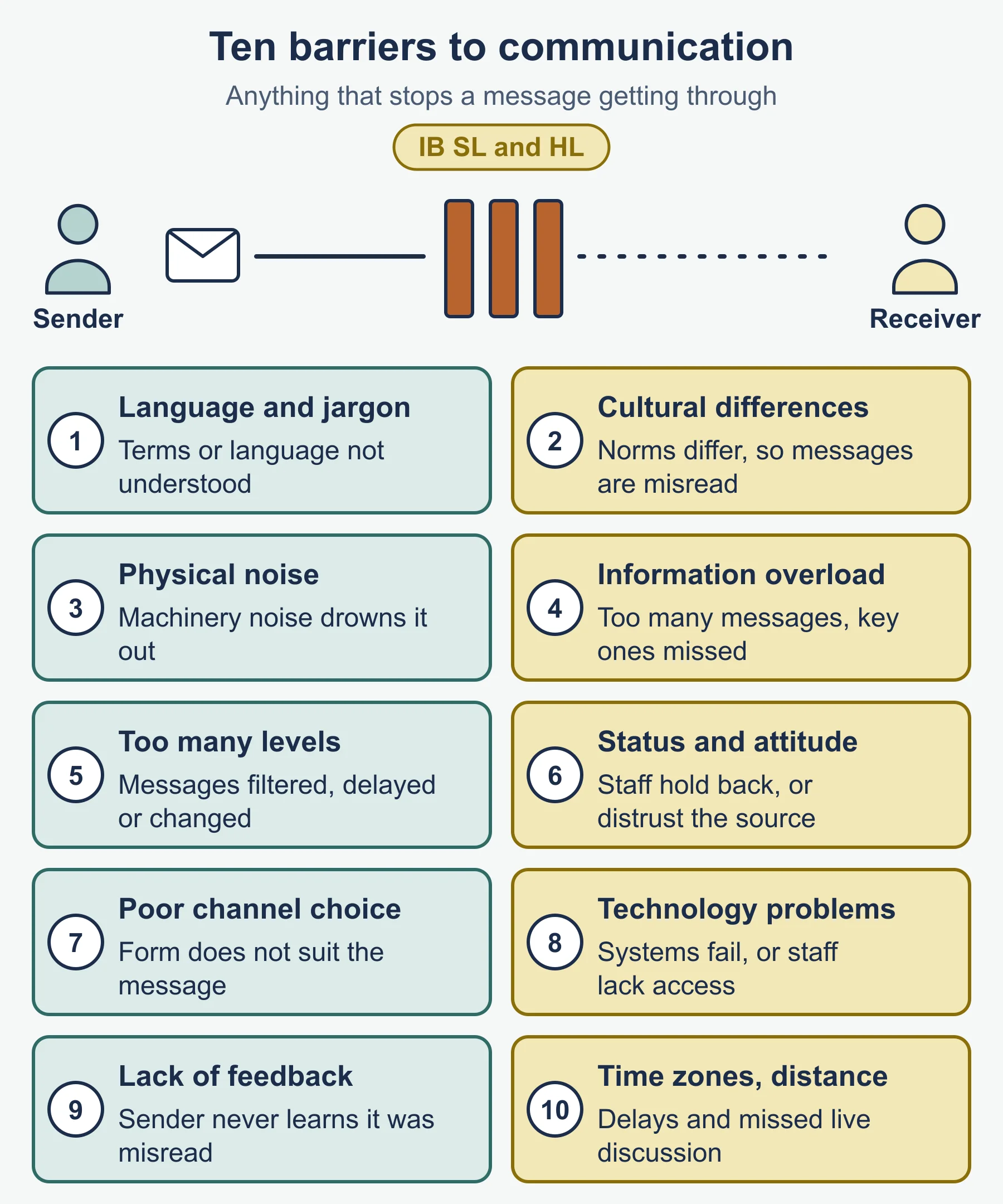
A barrier (standard account) is anything that stops a message being sent, received or understood as intended. The guide names the topic at AO2, so apply barriers to the case and explain the effect. Common barriers:
| Barrier | How it blocks the message |
|---|---|
| Language and jargon | Receivers do not understand technical terms or a second language |
| Cultural differences | Different norms about directness, status, gestures or silence cause misreading |
| Physical noise and distraction | Machinery, open-plan noise or interruptions stop messages being heard |
| Information overload | Too many messages, so important ones are missed |
| Too many levels of hierarchy | Messages are filtered, delayed or changed as they pass through each layer |
| Status and attitude | Staff hold back from speaking up to senior managers, or ignore messages from sources they distrust |
| Poor channel choice | A complex or sensitive message sent in a form that does not suit it |
| Technology problems | Failed systems, or staff without access to the system used |
| Lack of feedback | The sender never learns that the message was misunderstood |
| Time zones and distance | Delays and missed live discussion between sites or remote workers |
Worked example 2: a barrier in context
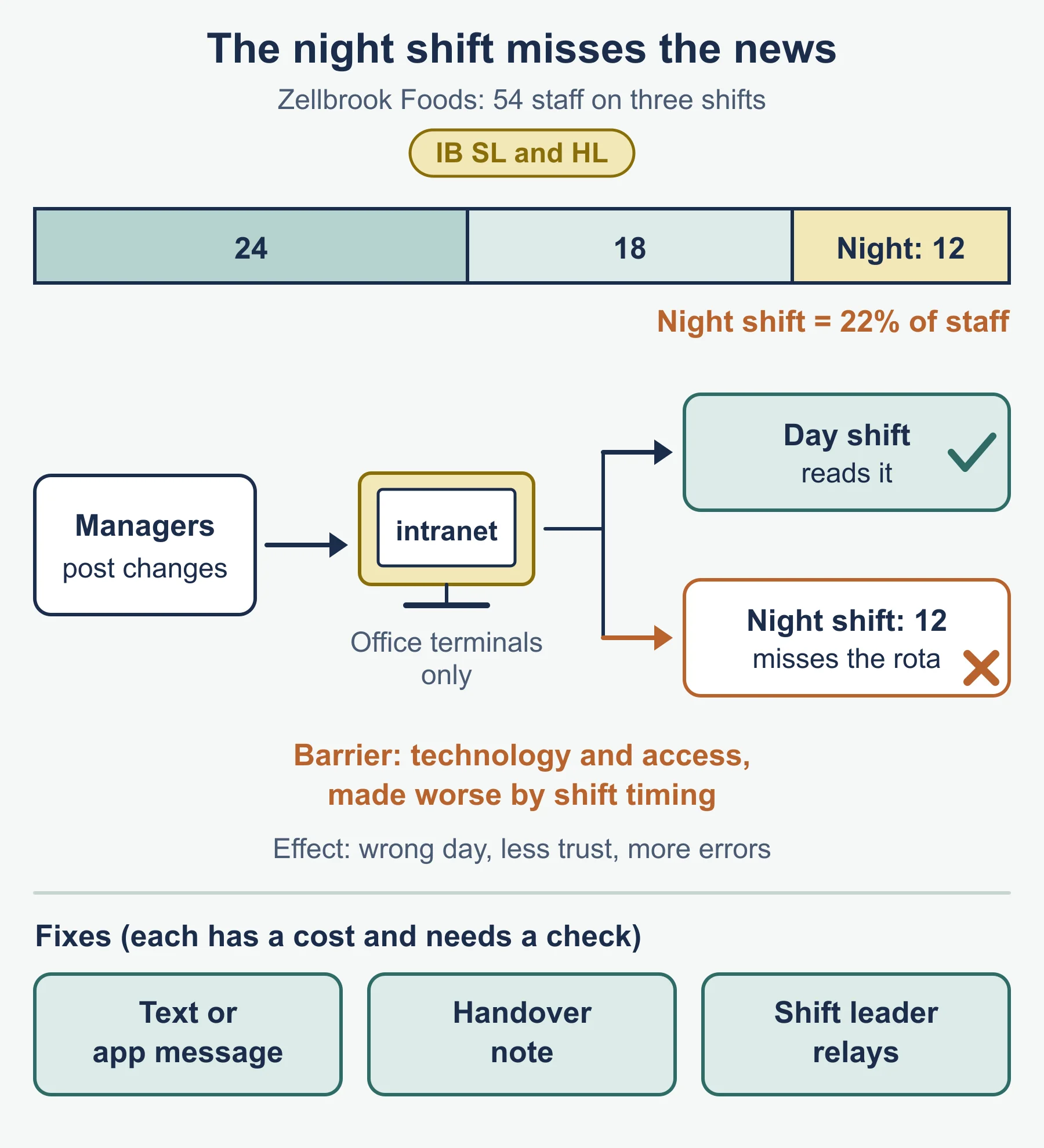
Zellbrook Foods runs three shifts of 24, 18 and 12 staff, 54 in all. Managers post all changes on an intranet page that staff can open only at the office terminals, used mostly in the day shift. The night shift of 12 staff, which is 22% of the total, repeatedly misses rota changes.
- Identify: technology and access barrier, worsened by shift patterns (distance in time).
- Effect: night staff turn up on the wrong day, trust in managers falls, and errors rise.
- Response (AO2): send changes by text or messaging app, add a short handover note between shifts, and use shift leaders as relays. Each fix has a cost and needs a check that the message was understood.
2.7 Industrial/employee relations (HL only)
Industrial (employee) relations (standard account) means the relationship between employers and employees, often through representatives such as a trade union. Conflict can arise when the interests of the two sides differ.
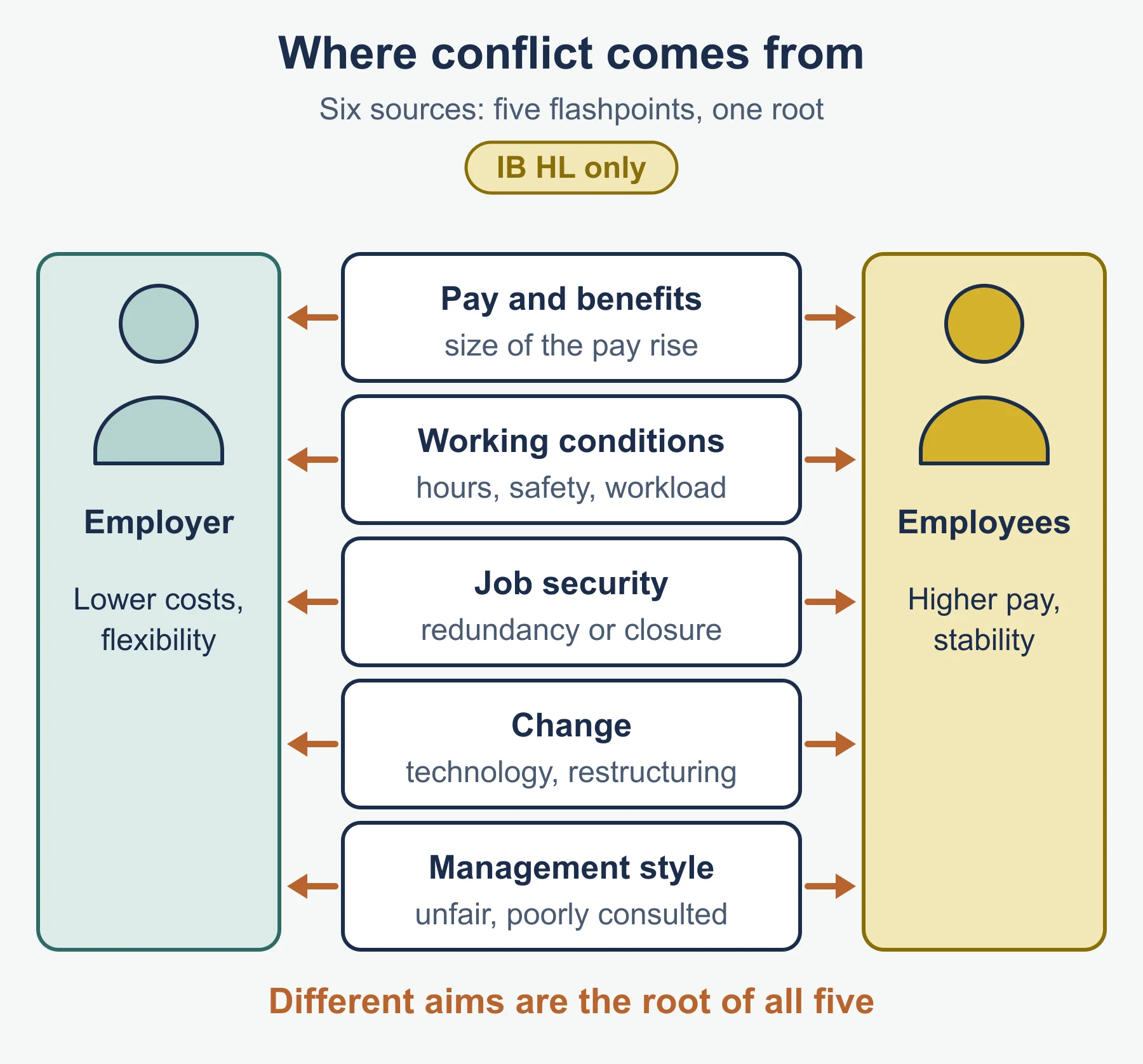
Sources of conflict
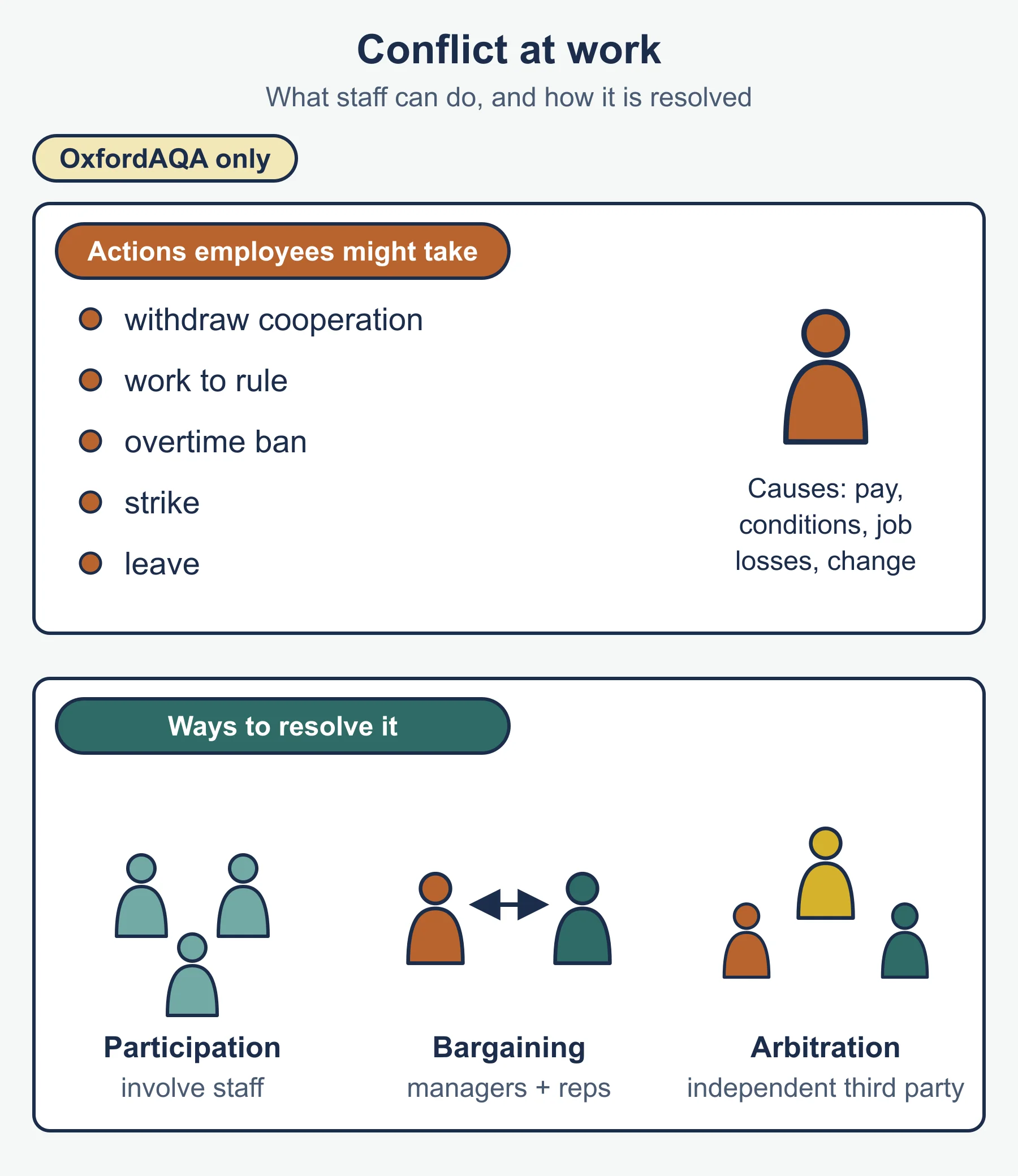
- Pay and benefits: the level of pay, or the size of a pay rise.
- Working conditions: hours, rotas, safety and workload.
- Job security: fear of redundancies or closure.
- Change: new technology, restructuring or new working practices.
- Management style: perceived unfairness, poor consultation or poor communication.
- Differences in aims: employers often want lower costs and flexibility, employees want higher pay and stability.
Approaches by employees
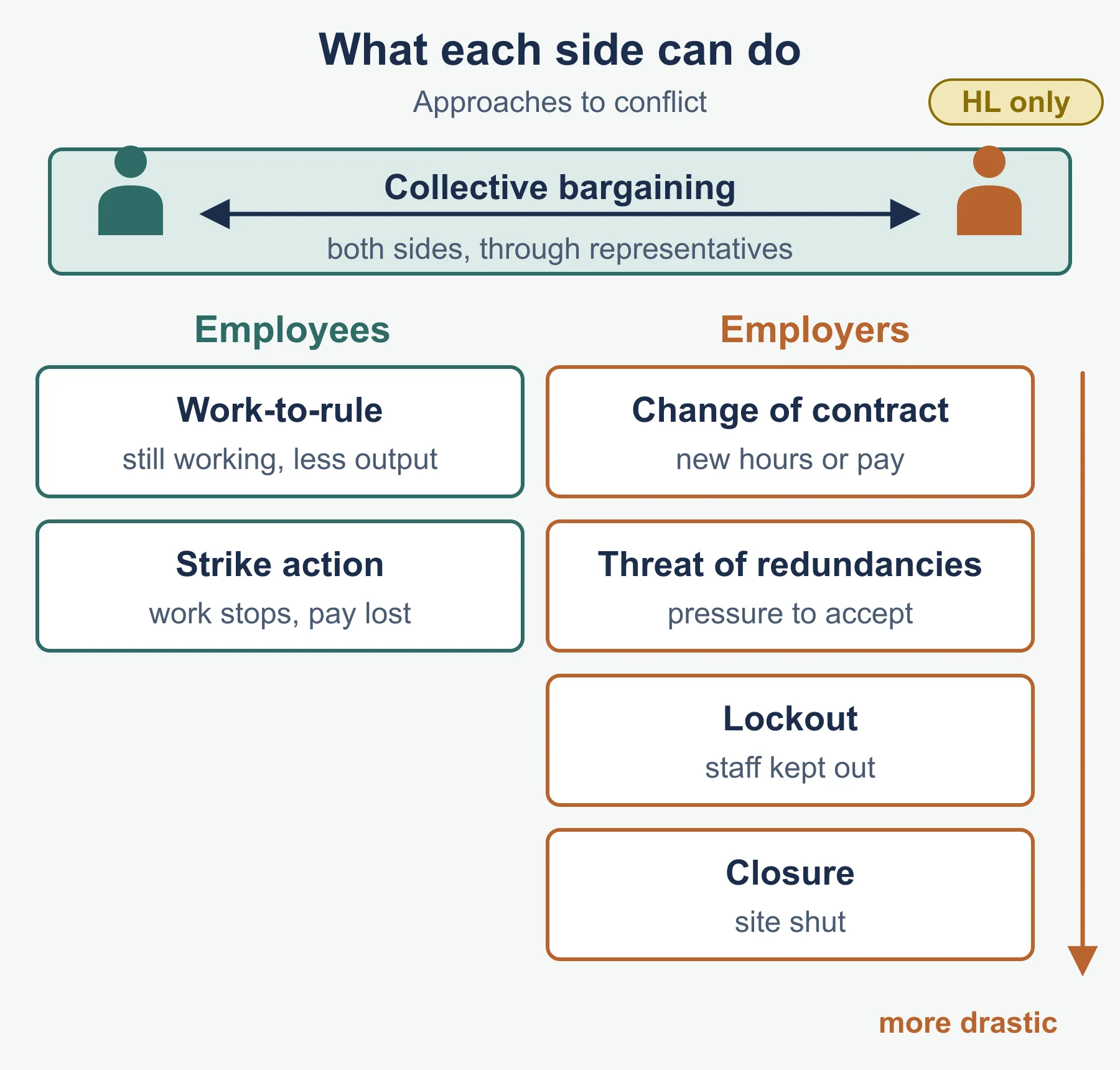
- Collective bargaining: employees negotiate as a group through representatives, rather than one by one. It gives them more bargaining power.
- Work-to-rule: staff do exactly what their contract and rules require and no more, giving up goodwill such as unpaid extra hours. Output falls but pay continues, and it is less costly to staff than a strike.
- Strike action: staff stop work completely. It puts the heaviest pressure on the employer but staff normally lose pay, and trust may suffer.
Approaches by employers
- Collective bargaining: the employer negotiates with employee representatives.
- Threats of redundancies: used to pressure staff into accepting terms. It may work in the short term but it damages trust and may lose skilled staff.
- Changes of contract: altering terms such as hours or pay. It can force a change, but it can also provoke strikes.
- Closure: shutting a site. It is a drastic option with high costs of its own.
- Lockouts: the employer stops staff from entering the workplace until they accept terms. Output stops, so it is costly for both sides.
Conflict resolution
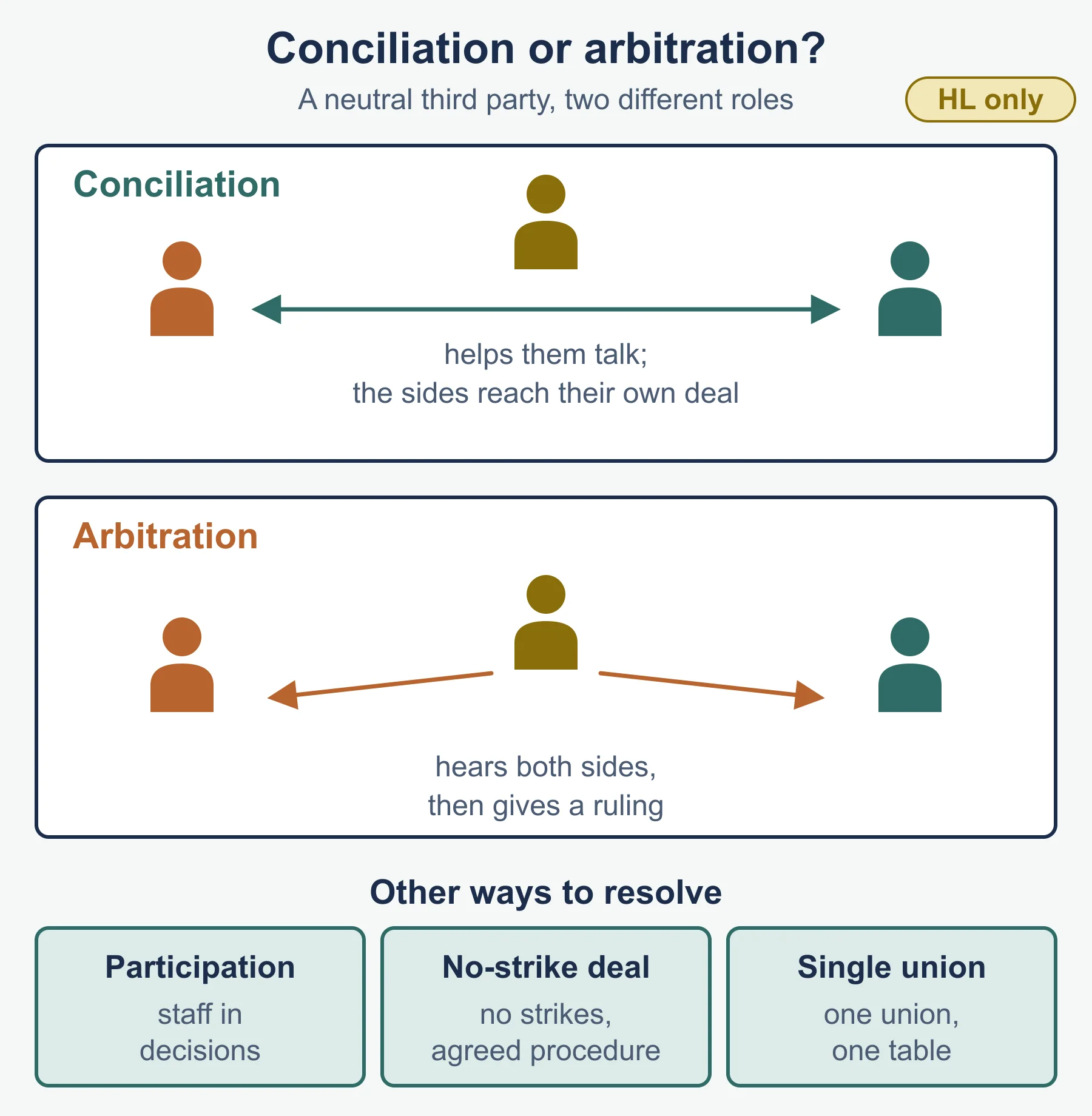
- Conciliation: a neutral third party helps both sides to talk and reach their own agreement. The third party does not impose a decision.
- Arbitration: a neutral third party hears both sides and gives a ruling. In standard textbook accounts the sides agree beforehand to accept it, but check how your case describes it.
- Employee participation and industrial democracy: employees take part in decisions through works councils, suggestion schemes, consultation or representation at senior level. This can reduce conflict because staff feel heard, but decisions may slow down.
- No-strike agreement: unions agree not to strike, typically in return for an agreed way of settling disputes. It protects continuity of output but limits employees’ strongest tool.
- Single-union agreement: the employer deals with one union for all employees, not several. Bargaining is simpler, but one union may not represent every group fairly.
Worked example 3: pay dispute
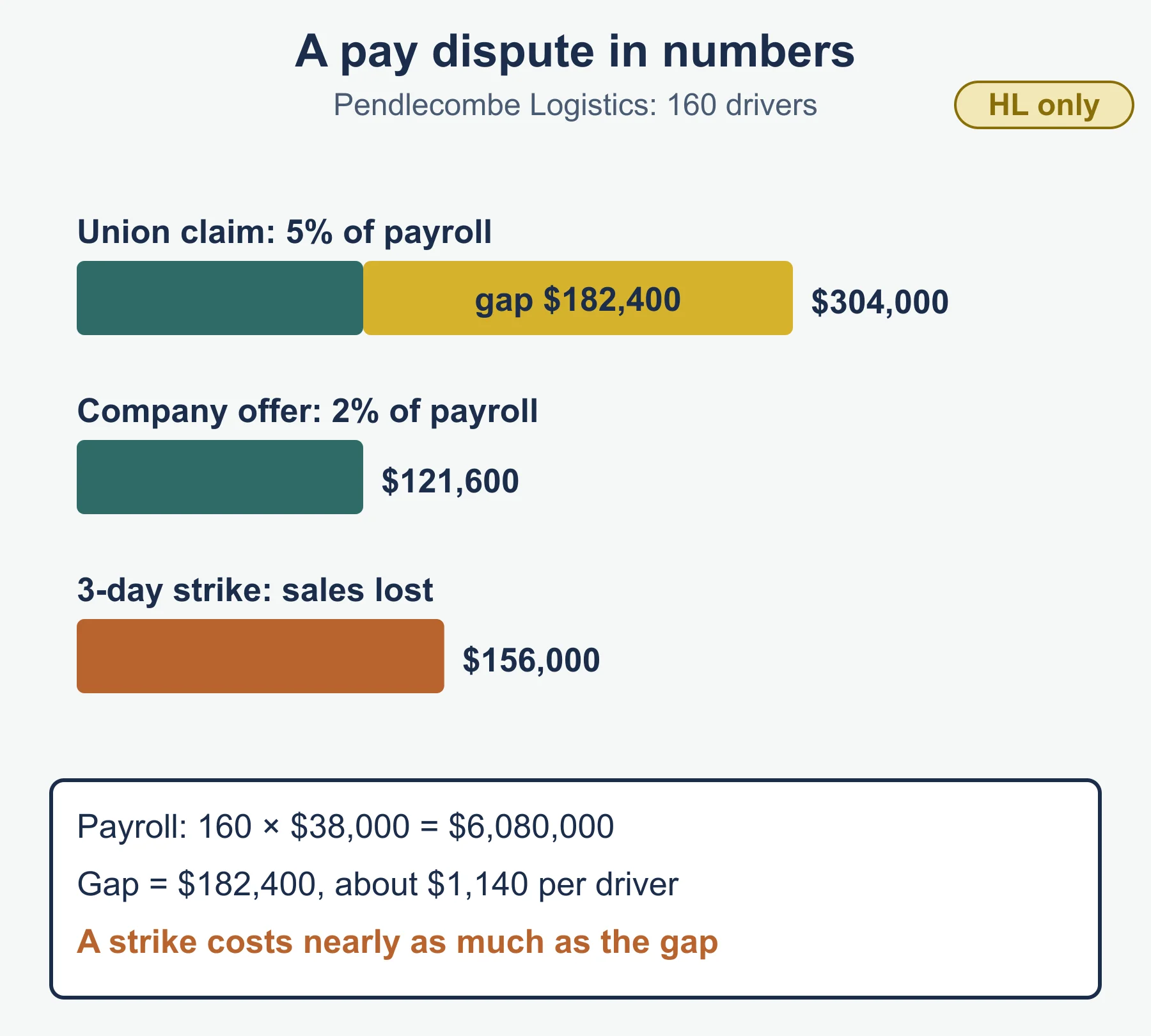
Pendlecombe Logistics employs 160 drivers on an average of $38,000 a year. The union claims 5% and the company offers 2%. Daily sales are 52,000 dollars.
Payroll is 160 × 38,000 = 6,080,000. The claim costs 5% of this, 304,000, and the offer costs 121,600. The gap is 182,400, or 1,140 a driver. A three-day strike would lose 3 × 52,000 = 156,000 of sales, which is close to the gap, so a deal near the middle is rational for the employer. Judgement: conciliation first, then arbitration if talks stall. Lockouts or redundancy threats would raise the cost to both sides and would likely harden attitudes. A no-strike agreement tied to a settlement could protect delivery after the deal.
Common errors
- Listing methods of communication without saying which suits the situation.
- Treating informal communication as always bad. It can be fast and useful.
- Mixing up conciliation (helps agreement) and arbitration (gives a ruling).
- Calling work-to-rule a strike. Staff are still working.
- Presenting a lockout as an employee action. It is an employer action.
- Giving only one side. AO3 points need strengths and limits, then a judgement.
Next steps
Use the revision notes for recall and the practice questions to test yourself. Check the course hub, the checklist and the diagnostics.
Frequently asked questions
What are the main barriers to communication in a business? Common barriers include language and jargon, cultural differences, noise and distraction, information overload, many levels of hierarchy, poor channel choice, technology problems, lack of feedback, and distance or time zones. In IB Business Management section 2.6 barriers are taught at AO2, so you must apply them to the case and explain their effect.
What is a no-strike agreement? A no-strike agreement is a deal in which a union agrees not to strike, typically in return for an agreed way of settling disputes. It protects continuity of output but removes employees’ strongest form of pressure.
What is a single-union agreement and why might an employer want one? A single-union agreement means the employer deals with one union for all employees rather than several. Bargaining is simpler and quicker, but one union may not represent every group of workers fairly.
What is industrial democracy in IB Business Management? Employee participation and industrial democracy mean staff take part in decisions through works councils, suggestion schemes, consultation or representation at senior level. It can reduce conflict because staff feel heard, though decisions may slow down.
Official syllabus
IB Business management guide, first assessment 2024, International Baccalaureate Organization: sections 2.6 and 2.7 (2.7 is HL only).
Get free revision emails (optional)
Occasional emails with practice questions, worked explanations and links to free resources for the qualification and subjects you choose. No spam, and you can unsubscribe from any email. The free tools on this site never need an email.
Related resources
-
Practice questions
IB DP Business Management: Communication and Industrial/employee relations (HL only) – Practice Questions
Original practice questions with worked answers on IB DP Business Management 2.6 communication and HL-only 2.7 industrial/employee relations.
Business · International Baccalaureate · IB
Try questions -
Revision notes
IB DP Business Management: Communication and Industrial/employee relations (HL only) – Revision Notes
Condensed revision notes for IB DP Business Management 2.6 communication and HL-only 2.7 employee relations, with a self-test and common mark losses.
Business · International Baccalaureate · IB
Revise topic -
Study guides
IB DP Business Management: Introduction to human resource management and Organizational structure
Study guide to IB DP Business Management sections 2.1 and 2.2: the role of HRM, resistance to change, organizational structure terms and charts.
Business · International Baccalaureate · IB
Read guide
Related articles
-
teaching
A Level tuition in Dubai: Cambridge or Pearson Edexcel International A Level?
Schools in Dubai and Abu Dhabi teach either Cambridge International AS & A Level or Pearson Edexcel International A Level. How the two are structured, why it matters for tuition, and how online classes from Lahore work.
9 October 2026
-
curriculum guides
Choosing subjects at IGCSE and A Level
How subject choices at 14 and 16 affect university options later, and how to keep pathways open without overloading a timetable.
28 July 2026
Studying this with a teacher
Working through Business IB?
This page is free and stays free. If you would rather be taught it, Marlbridge runs Business classes one-to-one, online in your own time zone. The first trial class is free. WhatsApp replies within an hour (8am–11pm Pakistan time, every day); email the same day.
IB Business teachers at Marlbridge

