
Study Guides
IB DP Business Management: Introduction to human resource management and Organizational structure
Study guide to IB DP Business Management sections 2.1 and 2.2: the role of HRM, resistance to change, organizational structure terms and charts.
- Subject
- Business
- Level
- IB
- Topic
- Unit 2: Human resource management
- Author
- Marlbridge Academic Team
- Updated
- Reviewed by
- Salman Ahmad (what this means)
Aligned to International Baccalaureate IB Diploma Programme Business (DP Business Management), First assessment 2024. Official specification .
Syllabus page (what it covers and how it is assessed): IB Diploma Programme Business.
Syllabus points this page covers
DP Business Management
- 2.1 Introduction to human resource management
- 2.2 Organizational structure
Found an error? Report a correction.
Need help with this topic? Request a free trial class for IB Diploma Programme Business (DP Business Management).
This guide covers sections 2.1 (Introduction to human resource management) and 2.2 (Organizational structure) of the IB Business management guide, first assessment 2024. Both sections are for SL and HL, apart from one HL-only point in 2.2 that is flagged below. It is written for candidates sitting the examinations that follow this guide.
Use it with the revision notes and the practice questions. The course page is IB DP Business Management, the printable list is the checklist, and you can test yourself first with the free diagnostics.
What the two sections ask for
| Section | Content | Depth |
|---|---|---|
| 2.1 | Role of human resource management | AO2 |
| 2.1 | Internal and external factors that influence human resource planning | AO2 |
| 2.1 | Reasons for resistance to change in the workplace | AO2 |
| 2.1 | Human resource strategies for reducing the impact of change and resistance to change | AO3 |
| 2.2 | Terminology: delegation, span of control, levels of the hierarchy, chain of command, bureaucracy, centralization, decentralization, delayering, matrix structure | AO2 |
| 2.2 | Organization charts: flat or horizontal, tall or vertical, by product, function or region | AO2, AO4 |
| 2.2 | Appropriateness of different structures given a change in external factors | AO3 |
| 2.2 | Changes in structure, for example project-based organization and Handy’s “Shamrock Organization” | AO3, HL only |
The guide lists force field analysis (HL only), descriptive statistics, SWOT analysis, STEEPLE analysis and Hofstede’s cultural dimensions (HL only) as suggested tools for Unit 2. Where they help, they appear below.
2.1 Role of human resource management
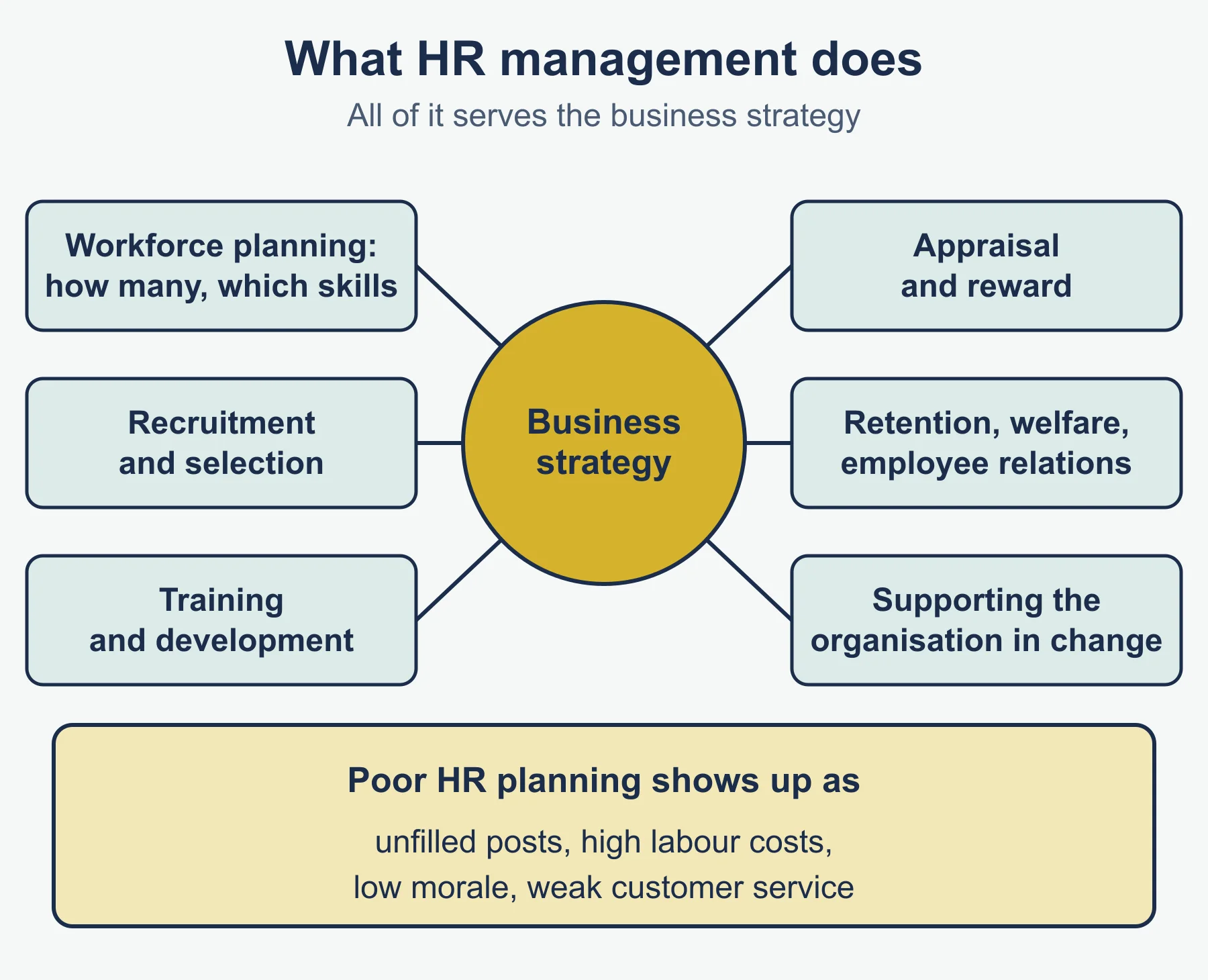
Human resource management (HRM) is the part of a business that plans for, recruits, develops, rewards and looks after its people so that the organization can reach its objectives. In practice that covers:
- workforce planning: how many people, with which skills, and when
- recruitment and selection
- training and development
- performance appraisal and reward
- retention, welfare and employee relations
- supporting the organization through change
The key point is that HRM serves the strategy of the whole business. A hotel chain planning to open in three new cities needs HRM to forecast the staff it will need, recruit them in time and train them to the same standard. Poor HR planning shows up as unfilled posts, high labour costs, low morale and weak customer service.
Internal and external factors in human resource planning
Human resource planning is the process of forecasting the number and type of employees a business will need and matching that to the people it has. Factors fall into two groups.
Internal factors come from inside the business:
- business objectives and growth plans, such as launching a new product
- the existing workforce: ages, skills, expected retirements and labour turnover
- budget available for wages and training
- organizational structure and culture
- working patterns the business offers, such as flexi-time
External factors come from outside:
- demographic change: an ageing population shrinks the pool of young workers and raises demand for health services; a falling birth rate does the same to future recruitment
- change in labour mobility: how easily workers move between jobs, regions or countries
- immigration: can fill skills shortages but depends on rules the business does not control
- the gig economy: platform-based, short-term or freelance work
- other factors from a STEEPLE analysis (social, technological, economic, environmental, political, legal, ethical)
Flexi-time is listed among the factors. Under flexi-time, employees complete agreed hours but choose when they start and finish, usually around core hours. It affects planning because the business must make sure that enough people are present at busy times. It can also help recruitment and retention, because it suits parents, carers and long-distance commuters.
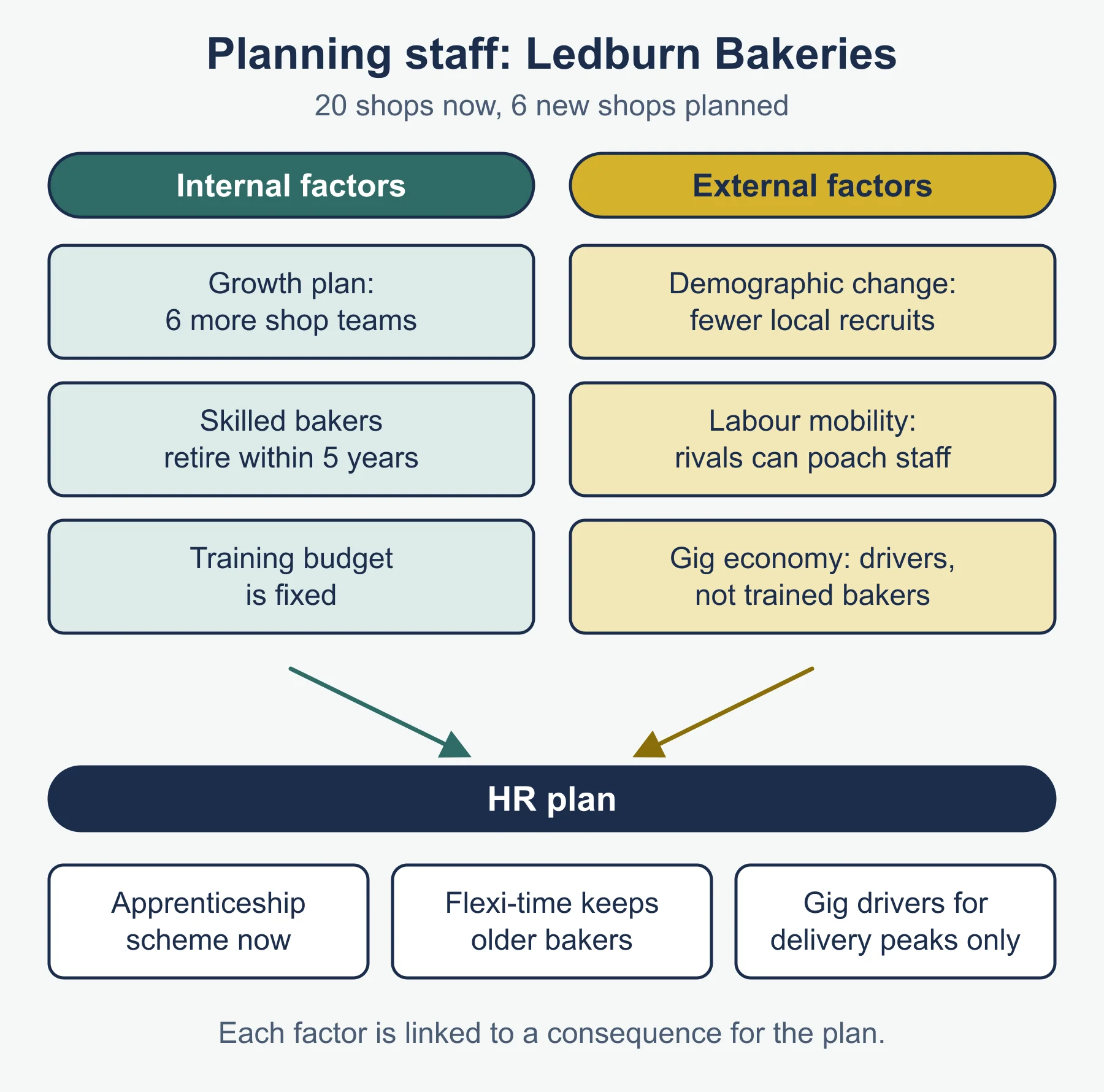
Worked example: Ledburn Bakeries
Ledburn Bakeries runs 20 shops in a region where the working-age population is falling and many bakers are near retirement. Management plans 6 new shops.
- Internal factors: expansion needs about 6 more shop teams; several skilled bakers will retire within five years; the training budget is fixed.
- External factors: demographic change reduces local recruits; better public transport raises labour mobility, so rivals can attract Ledburn’s staff; the gig economy offers part-time delivery drivers, but not bakers trained in the company’s methods.
- HR plan: start an apprenticeship scheme now, offer flexi-time to keep older bakers longer, and use gig drivers only for delivery peaks.
This answer works at AO2 because each factor is linked to a consequence for the plan, not just named.
Reasons for resistance to change
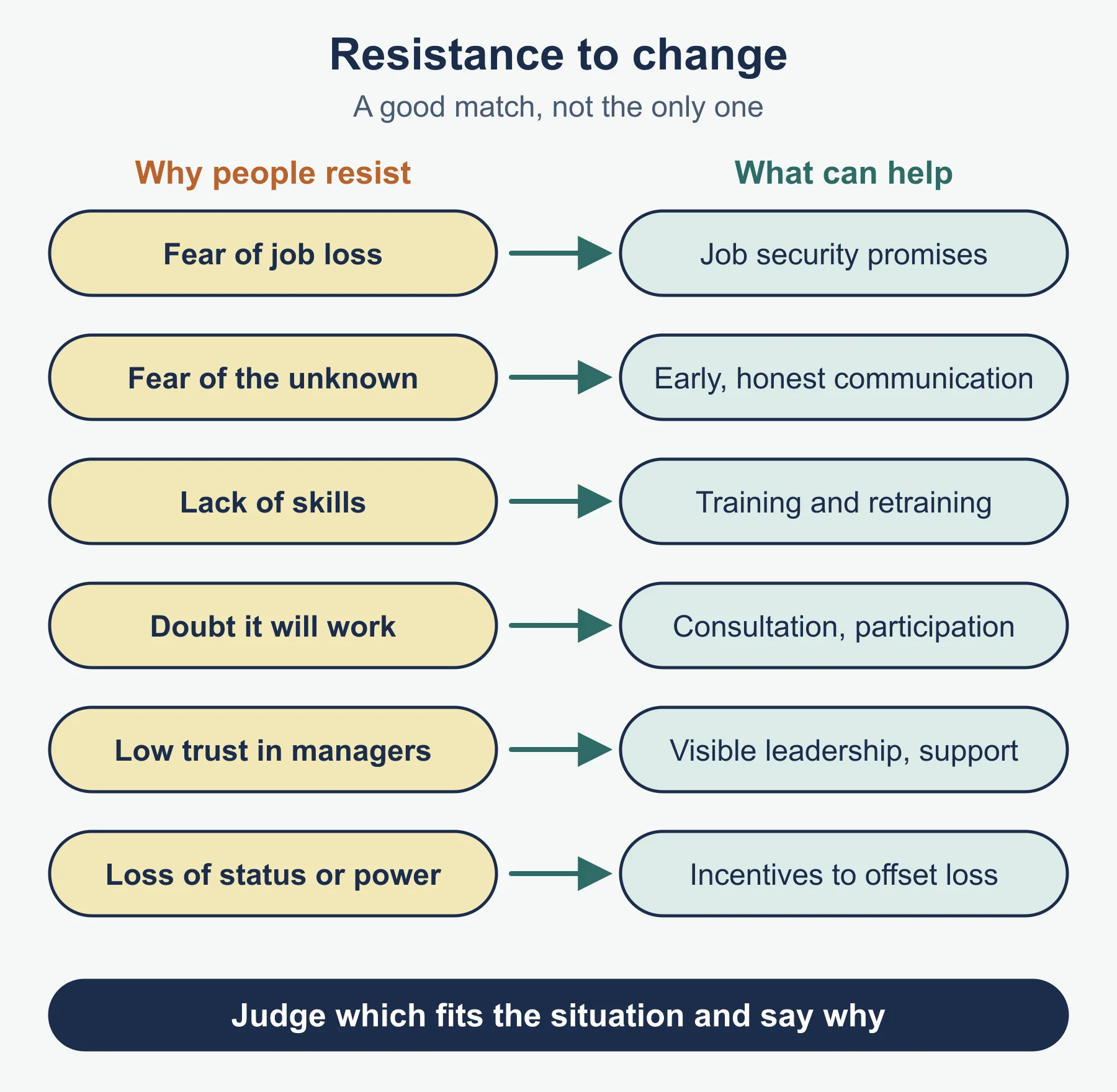
Resistance means employees (or managers) oppose or slow a change. Common reasons (the guide names the content point but not the items, so this list is our own wording):
- fear of job loss or reduced hours
- fear of the unknown and loss of routine
- loss of status, power or responsibility, which often affects managers
- lack of skills or confidence to work in the new way
- low trust in management or poor earlier experience of change
- disagreement that the change is needed or that it will work
- extra workload during the transition
- loss of social groups when teams are broken up
To reach AO2 you should connect the reason to the context. A supervisor whose team is about to be merged is more likely to resist because of lost status. A shop-floor worker told only that the factory is “moving to automation” is more likely to resist because of fear of redundancy.
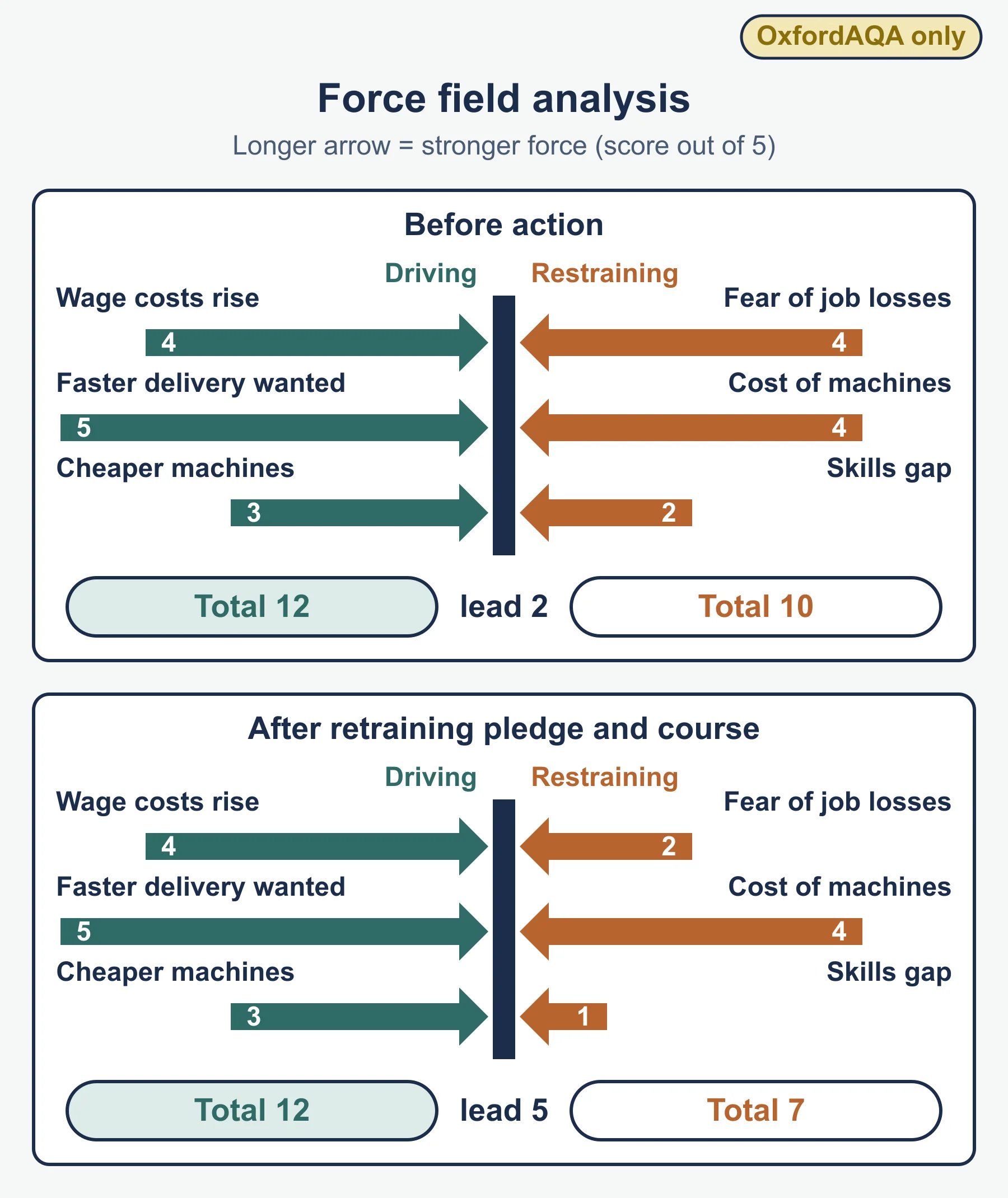
Force field analysis (HL only) lists the driving forces for a change and the restraining forces against it, then weighs them. Resistance is one restraining force. Reducing restraining forces is usually more effective than adding more pressure.
HR strategies for reducing the impact of change and resistance
This content is assessed at AO3, so you need to judge, not just list. Strategies include the following (our own wording, as the guide gives no list):
| Strategy | How it helps | Limitation |
|---|---|---|
| Early, honest communication | Reduces rumours and fear of the unknown | Time-consuming; bad news may still upset people |
| Consultation and participation | Employees help design the change, so they own it | Slows decisions; management may not accept the ideas |
| Training and retraining | Removes skills-based fear | Costs money and time |
| Phased introduction or pilot | Lets problems be fixed on a small scale | Delays benefits; uneven treatment |
| Incentives and job security promises | Offsets personal loss | Promises can be hard to keep |
| Redeployment, voluntary redundancy or support for those leaving | Treats people fairly and protects reputation | Costly |
| Visible leadership and support | Builds trust | Needs consistent behavior |
A good evaluation chooses between these. If the change is urgent, such as a sudden market collapse, full consultation may be impossible and clear communication plus support may be the realistic choice. If the change is long-term and the workforce is highly skilled, participation is likely to bring better ideas as well as less resistance. State the condition that decides your judgement.
2.2 Organizational structure: terminology
An organizational structure is how a business arranges its people into roles, reporting lines and groups. The guide lists the nine terms below without definitions, so these are standard forms.
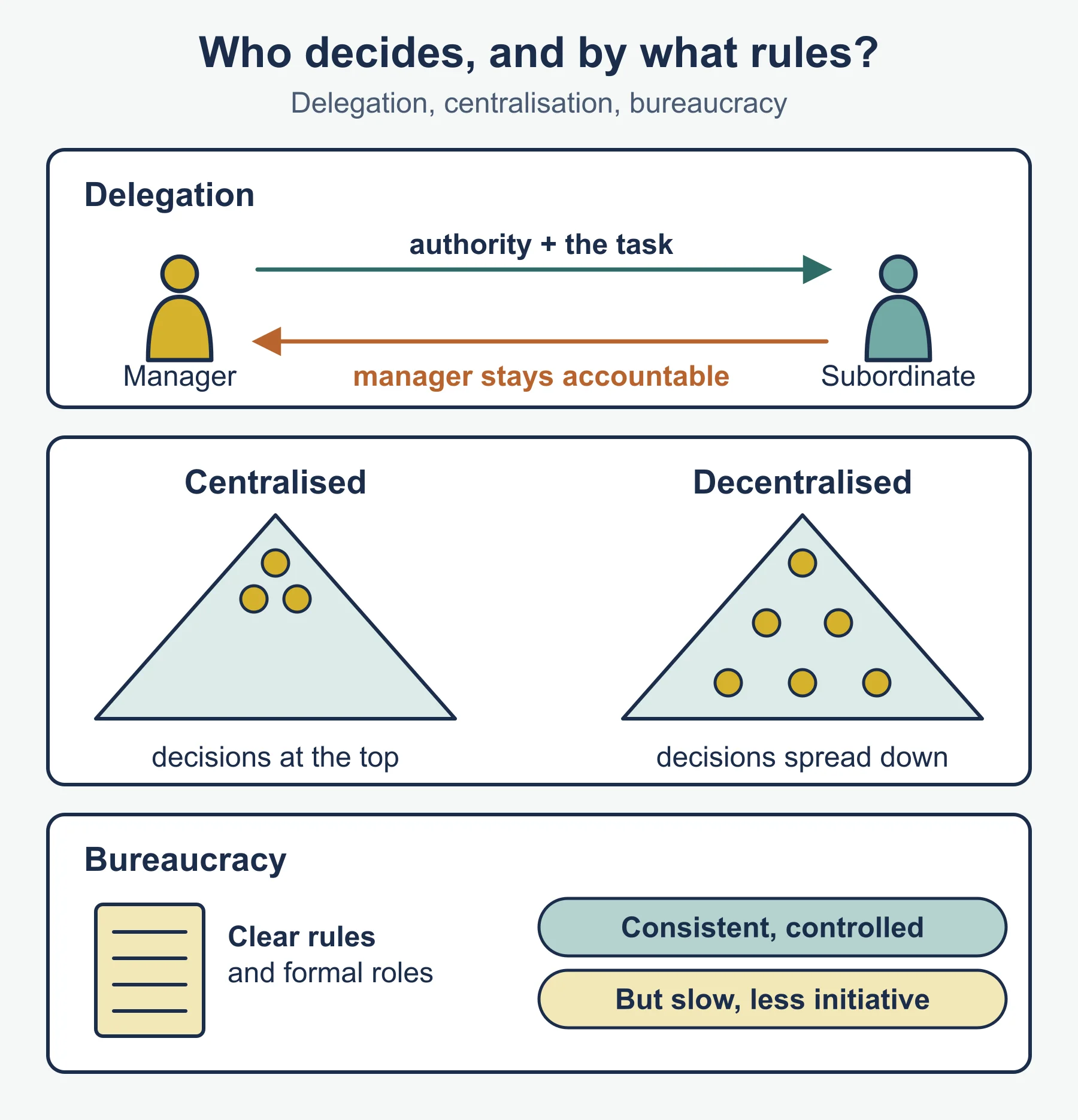
- Delegation: passing authority to carry out a task, with the responsibility for doing it, to a subordinate. The manager remains accountable for the outcome.
- Span of control: the number of subordinates who report directly to one manager.
- Levels of the hierarchy: the layers of authority from top to bottom.
- Chain of command: the line of authority and communication from the top of the organization to each employee.
- Bureaucracy: a system of clear rules, procedures and formal roles. It gives consistency and control but can slow decisions and discourage initiative.
- Centralization: decision-making kept at the top or head office.
- Decentralization: decision-making passed to lower levels, branches or departments.
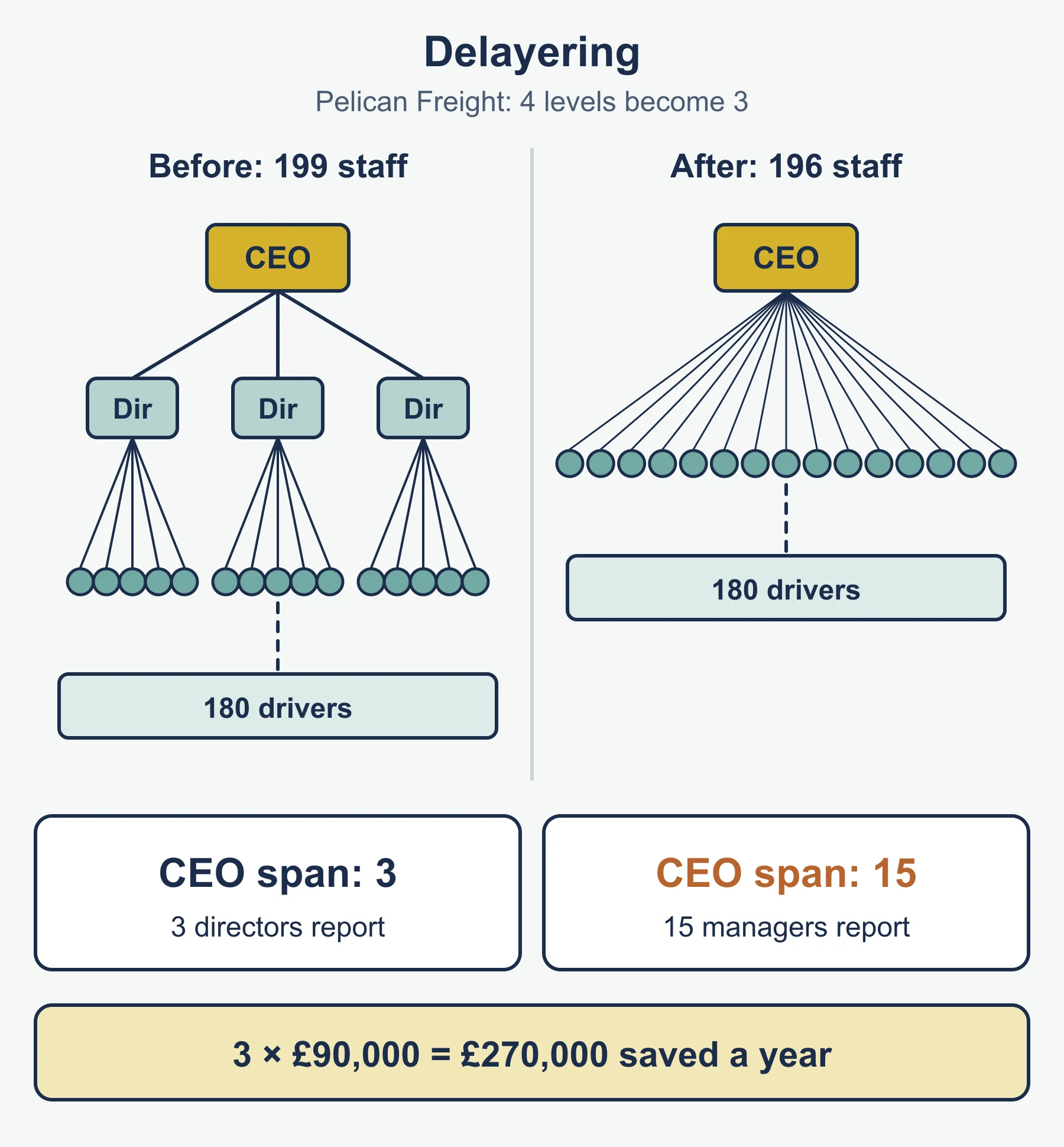
- Delayering: removing one or more levels of the hierarchy, usually middle management.
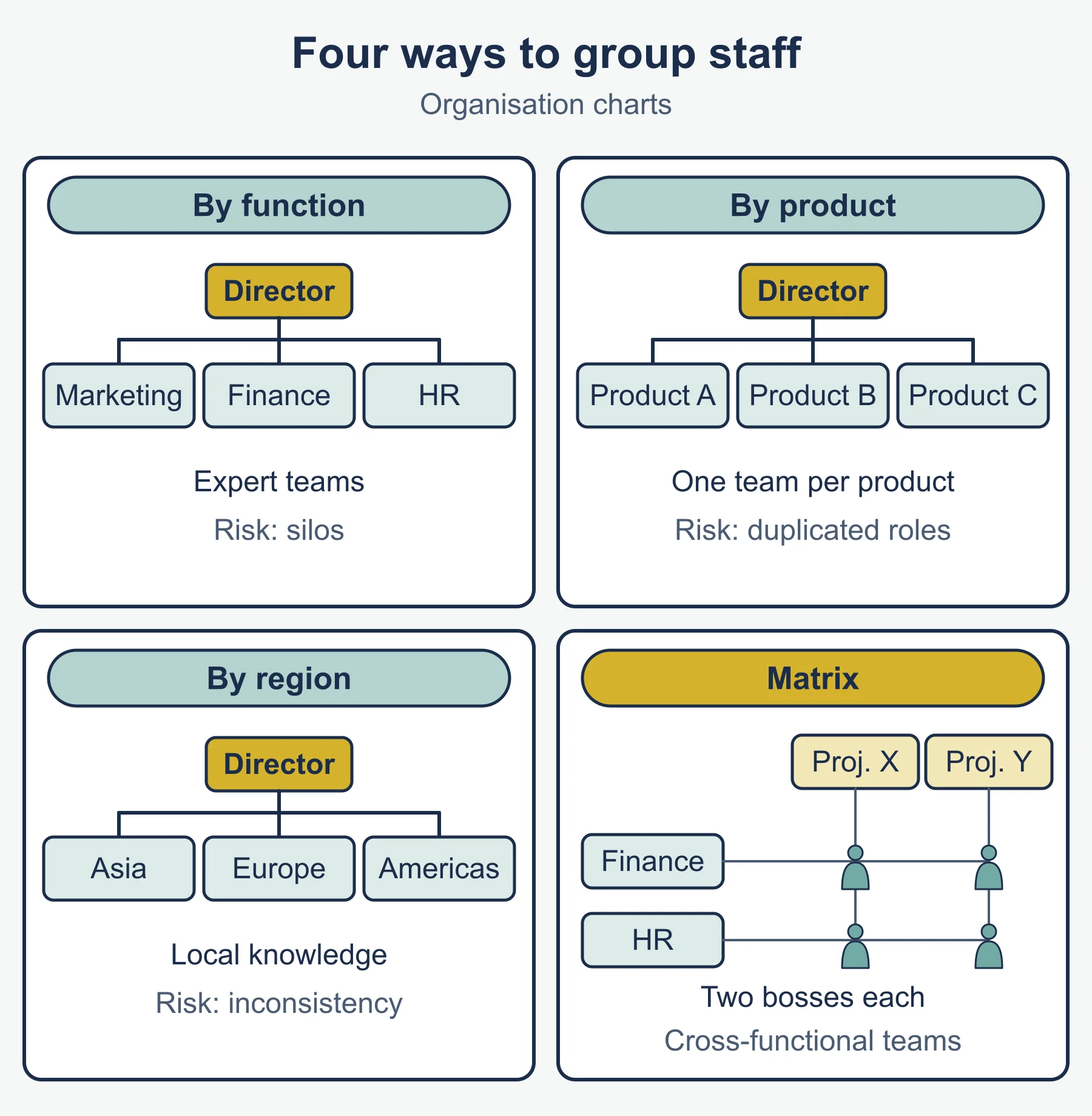
- Matrix structure: employees report to two managers at once, for example a functional manager and a project manager, so that cross-functional teams can be formed.
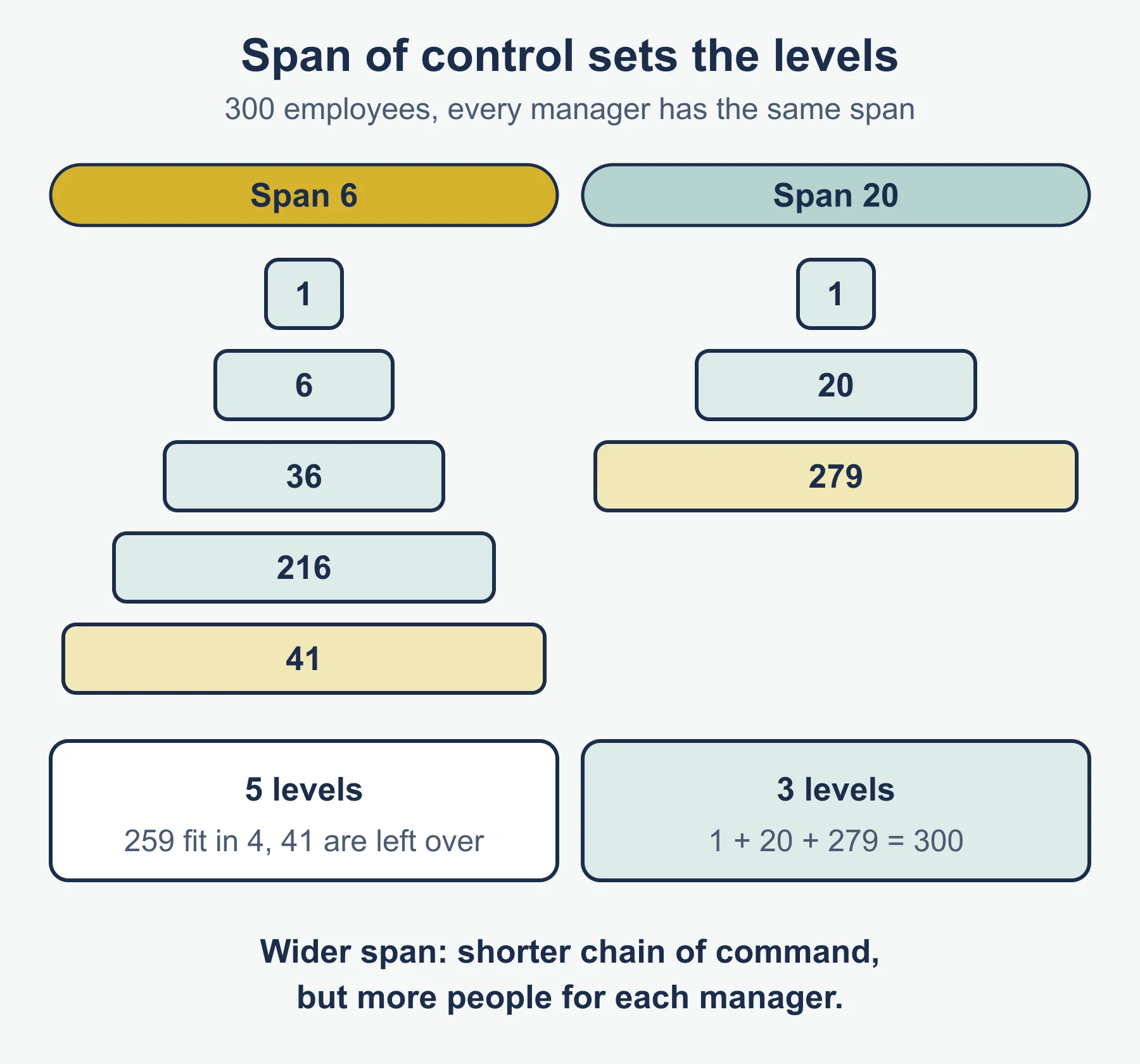
Relationships between these matter. A wide span of control means fewer levels and a flatter structure. Delegation makes decentralization possible. A long chain of command slows communication and makes it more likely that messages are distorted.
Worked example: levels and span
Suppose a business has 300 employees and every manager has exactly 6 direct reports. Layers hold 1, 6, 36 and 216 people. Four levels hold only 259, so at least five levels are needed. If the span rises to 20 across the board, 1, 20 and 400 people fit in three layers, so three levels are enough. The wider span cuts the chain of command, but each manager supervises more people.
Organization charts
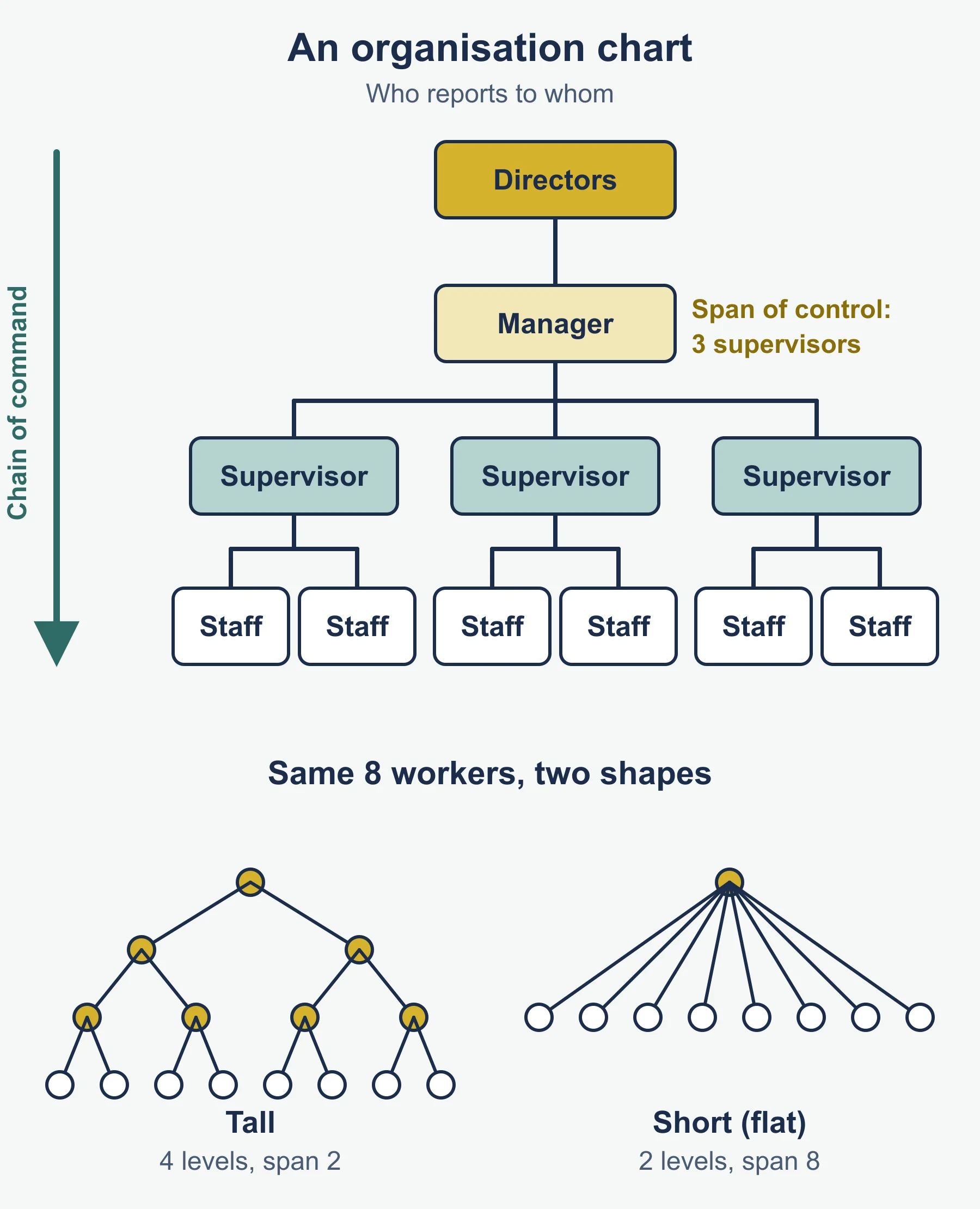
A chart is a diagram of positions and reporting lines.
Tall (vertical) structure: many levels, narrow spans, long chain of command. Close supervision and clear promotion steps, but higher management cost and slow communication.
Flat (horizontal) structure: few levels, wide spans. Faster communication and lower management cost, and employees gain more responsibility; but managers can be overloaded and promotion routes are limited.
Sketch of each, in words:
Tall:    Director
         -> 3 managers
            -> 4 supervisors each
               -> 5 staff each

Flat:    Director
         -> 12 team leaders and staff directly
Charts can also group by function (marketing, finance, operations, HR), by product (each product line has its own team) or by region (each geographic area has its own team).
- By function builds specialist expertise but can create silos.
- By product suits a firm with distinct product lines but duplicates roles.
- By region suits international or multi-location firms and local knowledge, but risks inconsistency between regions.
AO4 means you should be able to read a chart and calculate from it, such as span at each level or how many people sit below a given manager.
Appropriateness of structures when external factors change
AO3 needs a judgement with reasons. Use this approach: identify the change, state what it demands of the organization, then compare structures against that demand.
- Fast technological change or unstable markets favour a flat, decentralized or matrix structure that can react quickly.
- Expansion into other countries often favours structure by region, with more local decision-making.
- Tight legal or safety rules favour bureaucracy and centralization so that compliance is consistent.
- A sharp economic downturn often triggers delayering to cut costs, but too much cutting can overload managers.
- A shift toward remote work or the gig economy may make a flat structure, or an HL-only project-based one, more suitable than a tall one.
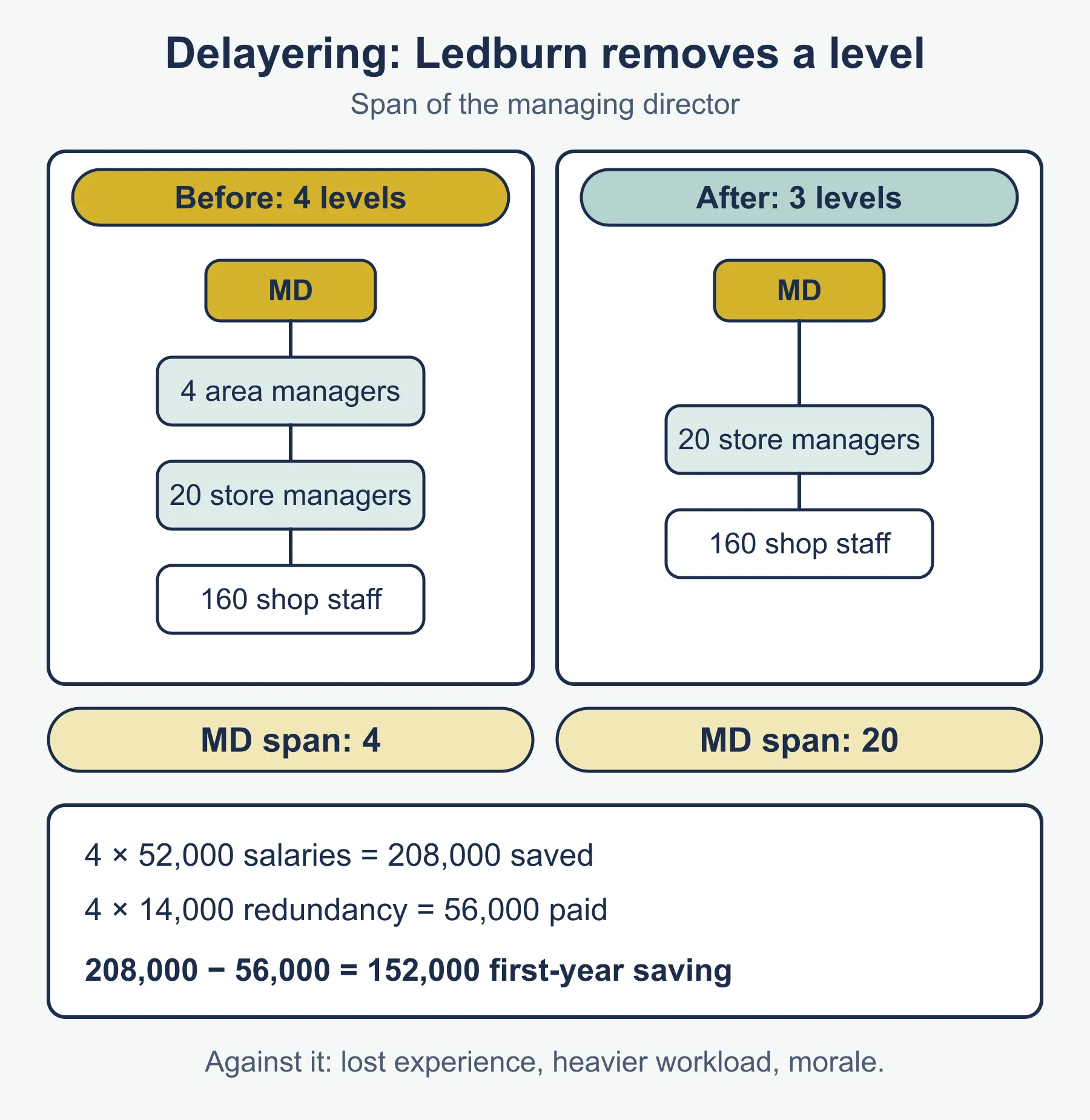
Example: Ledburn Bakeries has a managing director, 4 area managers, 20 store managers and 160 shop staff, so the MD has a span of 4. Online ordering suddenly doubles demand for same-day delivery. Removing the 4 area managers would give the MD a span of 20, which is probably too wide. A better answer might decentralize delivery decisions to store managers while keeping area managers for a smaller group of stores.
Delayering also has a cost side. If each area manager earns 52,000 and four are removed, annual salary savings are 208,000. If each receives a 14,000 redundancy payment, the first-year net saving is 152,000. Against this, set lost experience, a heavier workload on those who remain and possible damage to morale.
HL only: changes in organizational structure
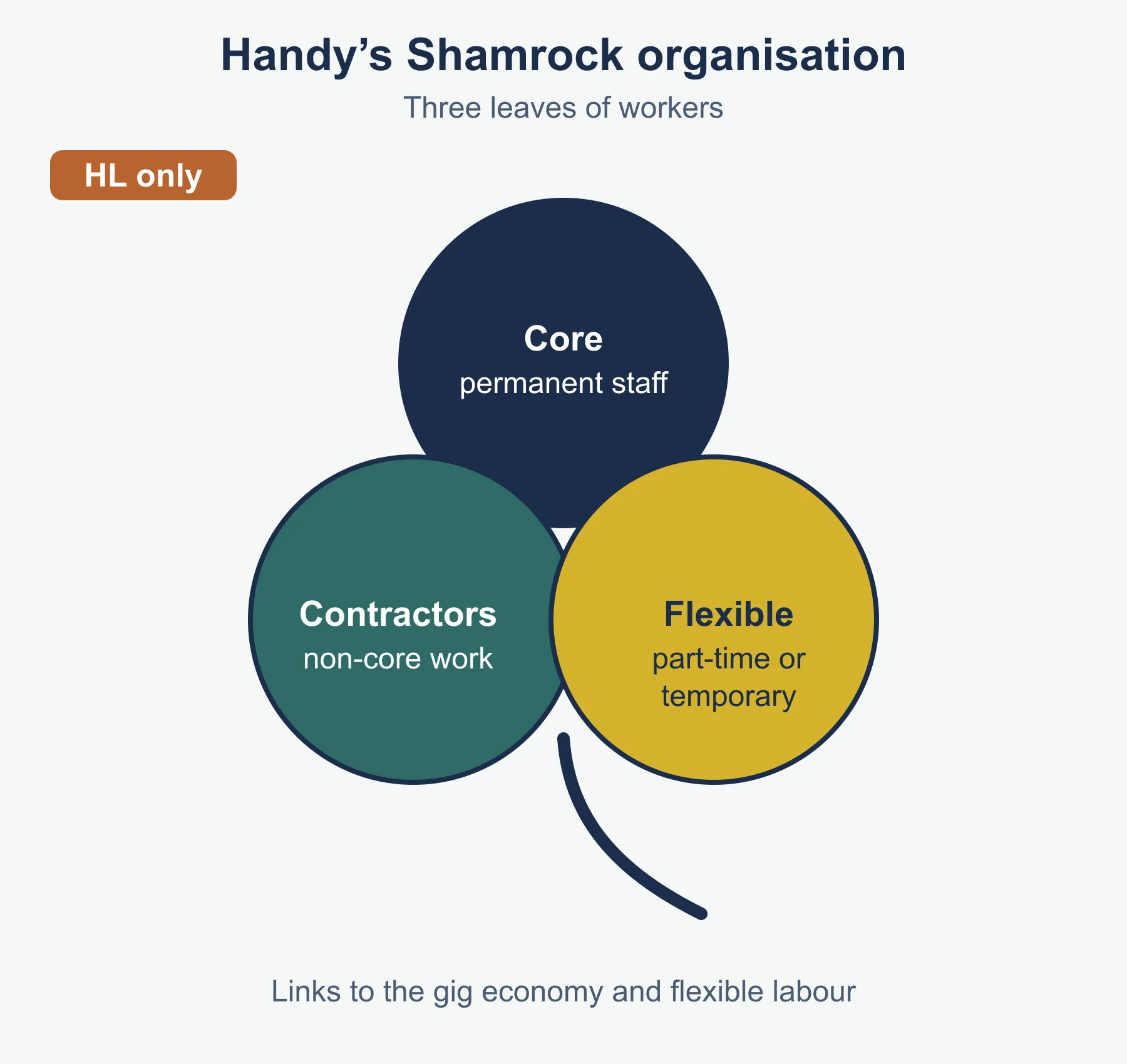
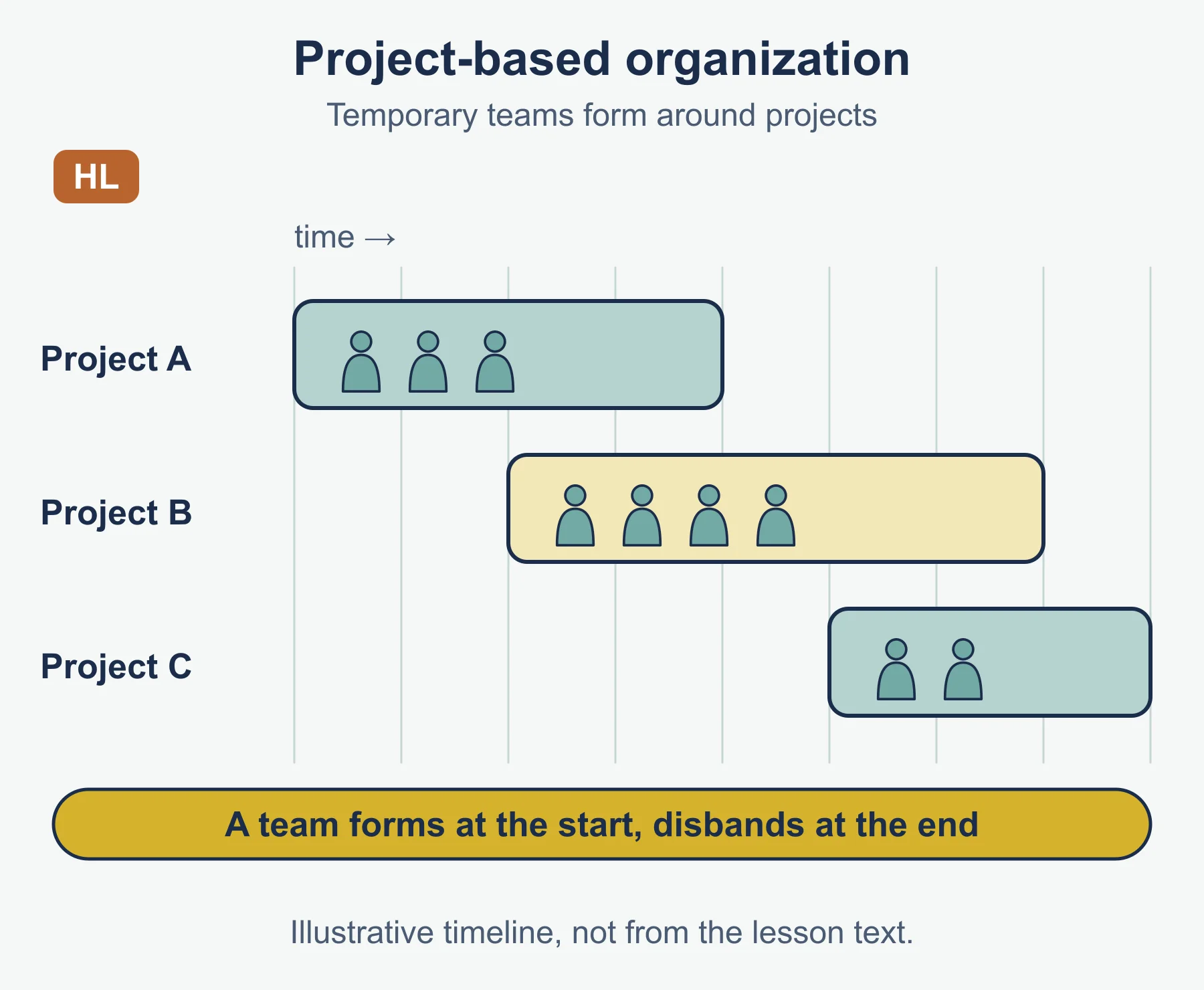
Content for HL only includes examples such as the project-based organization, in which temporary teams form around projects, and Charles Handy’s “Shamrock Organization”. Handy’s model splits the organization into three leaves: a core of essential, permanent staff; contractors who do non-core work; and a flexible, often part-time or temporary workforce. It links directly to the gig economy and flexible labour in section 2.1.
Common errors
- Defining span of control as the total number of employees rather than direct reports.
- Saying delayering “removes workers” when it removes levels, usually of management.
- Calling every flat structure better. Fit with the external environment decides.
- Describing resistance only as laziness. Most employee concerns are rational.
- Listing HR strategies with no judgement, when the content is AO3.
- Mixing up centralization (decisions kept at the top) with a tall hierarchy (many levels). They often go together but are different ideas.
Frequently asked questions
What is human resource planning? Human resource planning is forecasting the number and type of employees a business will need and matching them to the staff available. It is influenced by internal factors such as growth plans and the existing workforce, and external factors such as demographic change, labour mobility, immigration and the gig economy.
What is the difference between a tall and a flat organizational structure? A tall structure has many levels, narrow spans of control and a long chain of command, giving close supervision. A flat structure has few levels and wide spans, giving faster communication and lower management cost.
What is a matrix structure? In a matrix structure employees report to two managers at once, such as a functional manager and a project manager. It shares skills across projects but can lead to conflicting orders and unclear accountability.
How can HR reduce resistance to change? Strategies include early, honest communication, consultation and participation, training, and support such as job security promises or redeployment. Because this content is assessed at AO3, choose the strategy that fits the cause of resistance and state its limitation.
Official syllabus
IB Diploma Programme Business management guide, first assessment 2024, International Baccalaureate Organization, sections 2.1 and 2.2.
Get free revision emails (optional)
Occasional emails with practice questions, worked explanations and links to free resources for the qualification and subjects you choose. No spam, and you can unsubscribe from any email. The free tools on this site never need an email.
Related resources
-
Practice questions
IB DP Business Management: Introduction to human resource management and Organizational structure – Practice Questions
Original IB DP Business Management practice questions with worked answers on HR planning, resistance to change and organizational structure (2.1, 2.2).
Business · International Baccalaureate · IB
Try questions -
Revision notes
IB DP Business Management: Introduction to human resource management and Organizational structure – Revision Notes
Condensed revision notes for IB DP Business Management sections 2.1 and 2.2: HR planning, resistance to change, structure terms, charts and a self-test.
Business · International Baccalaureate · IB
Revise topic -
Study guides
IB DP Business Management: Leadership and management
Study guide to IB DP Business Management 2.3: management and leadership, five leadership styles, and scientific and intuitive thinking (HL only).
Business · International Baccalaureate · IB
Read guide
Related articles
-
teaching
A Level tuition in Dubai: Cambridge or Pearson Edexcel International A Level?
Schools in Dubai and Abu Dhabi teach either Cambridge International AS & A Level or Pearson Edexcel International A Level. How the two are structured, why it matters for tuition, and how online classes from Lahore work.
9 October 2026
-
curriculum guides
Choosing subjects at IGCSE and A Level
How subject choices at 14 and 16 affect university options later, and how to keep pathways open without overloading a timetable.
28 July 2026
Studying this with a teacher
Working through Business IB?
This page is free and stays free. If you would rather be taught it, Marlbridge runs Business classes one-to-one, online in your own time zone. The first trial class is free. WhatsApp replies within an hour (8am–11pm Pakistan time, every day); email the same day.
IB Business teachers at Marlbridge

