
Revision Notes
IB DP Business Management: Introduction to human resource management and Organizational structure – Revision Notes
Condensed revision notes for IB DP Business Management sections 2.1 and 2.2: HR planning, resistance to change, structure terms, charts and a self-test.
- Subject
- Business
- Level
- IB
- Topic
- Unit 2: Human resource management
- Author
- Marlbridge Academic Team
- Updated
- Reviewed by
- Salman Ahmad (what this means)
Aligned to International Baccalaureate IB Diploma Programme Business (DP Business Management), First assessment 2024. Official specification .
Syllabus page (what it covers and how it is assessed): IB Diploma Programme Business.
Syllabus points this page covers
DP Business Management
- 2.1 Introduction to human resource management
- 2.2 Organizational structure
Found an error? Report a correction.
Need help with this topic? Request a free trial class for IB Diploma Programme Business (DP Business Management).
These notes condense sections 2.1 (Introduction to human resource management) and 2.2 (Organizational structure) of the IB Business management guide, first assessment 2024. Both are SL and HL, except the HL-only point marked below. Full explanations and worked examples are in the study guide.
Then try the practice questions, tick off topics on the checklist, see the course page and find weak spots with the free diagnostics.
2.1 at a glance
| Point | One-line summary |
|---|---|
| Role of HRM | Plan, recruit, develop, reward and retain the workforce so it supports business strategy; supports change |
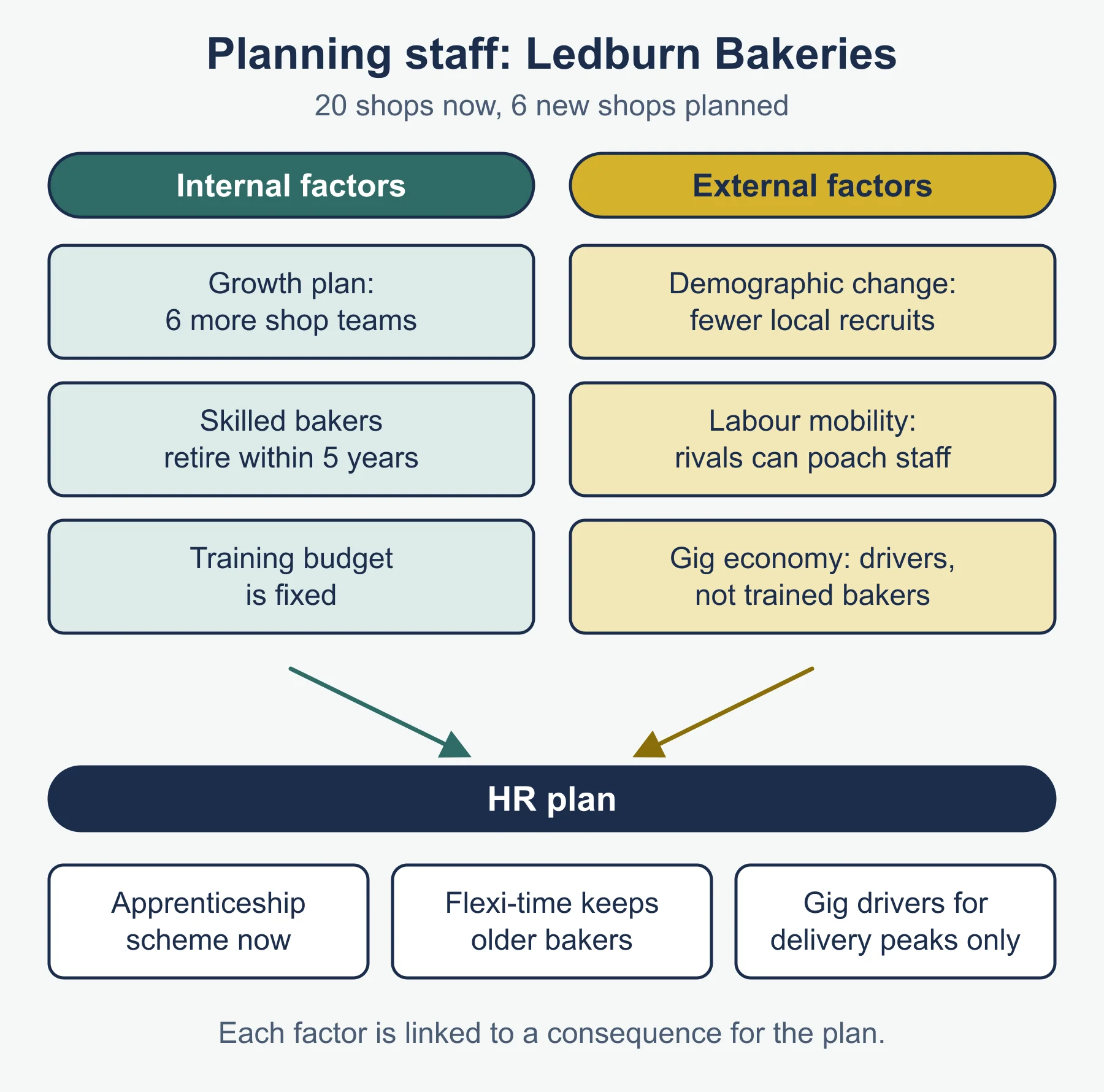
| Internal factors | Objectives and growth plans, current workforce, budget, structure, culture, working patterns |
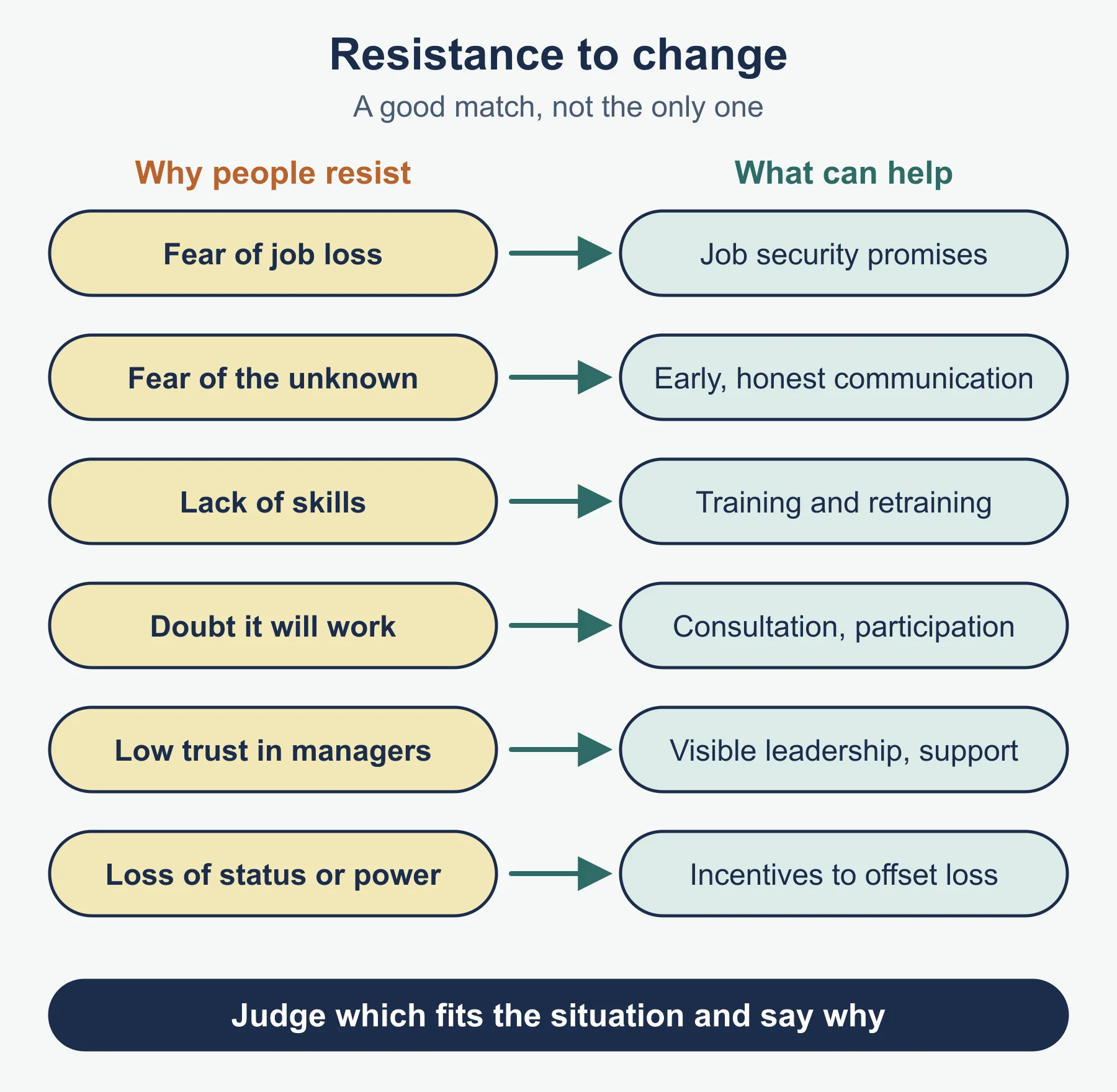
| External factors | Demographic change, labour mobility, immigration, flexi-time and the gig economy as listed; also any STEEPLE factor |
| Resistance to change | Fear of job loss or the unknown, lost status, skills gaps, low trust, disagreement, extra workload |
| HR strategies | Communication, consultation, training, phasing, incentives, support, redeployment |
Definitions to learn
The guide lists these factors without definitions, so these are standard forms. The reason and strategy lists below are our own wording.
- Human resource planning: forecasting the numbers and skills of staff needed and matching them to staff available.
- Demographic change: shifts in population features such as age profile or birth rate.
- Labour mobility: ease with which workers move between jobs, places or countries.
- Immigration: people moving into a country to live or work; can ease shortages.
- Flexi-time: employees choose start and finish times around core hours.
- Gig economy: short-term, task-based or freelance work, often arranged through digital platforms.
Method: planning question
- Name the factor and say whether it is internal or external.
- State its effect on numbers, skills or cost of staff.
- Say what HRM should do about it.
- For AO2, tie it to the business in the stem.
Tool link: a STEEPLE analysis sorts external factors; a SWOT analysis places workforce strengths and weaknesses in the internal half.
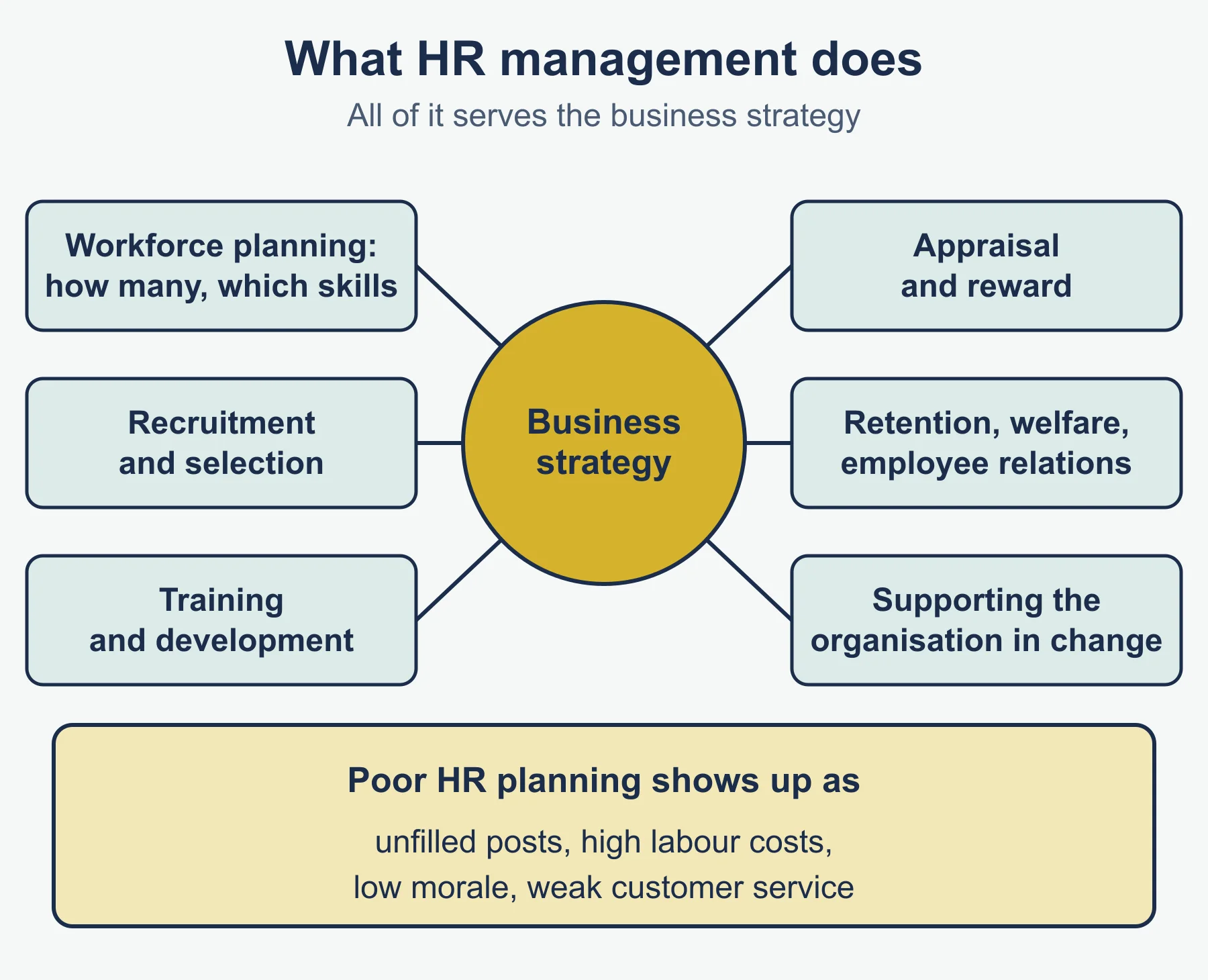
Method: strategies for change (AO3)
- Name the cause of resistance in the case.
- Pick the strategy that answers that cause.
- Give a benefit and a limitation.
- Decide, and state what the decision depends on, such as urgency, size of the change or skill of the workforce.
Match reason to remedy:
| Cause | Fitting strategy |
|---|---|
| Fear of job loss | Job security promise, redeployment, honest information |
| Skills gap | Training and mentoring |
| Lost status | Role in designing the change, new responsibilities |
| Distrust | Visible leadership, consultation |
| Scale of change | Phased introduction or pilot |
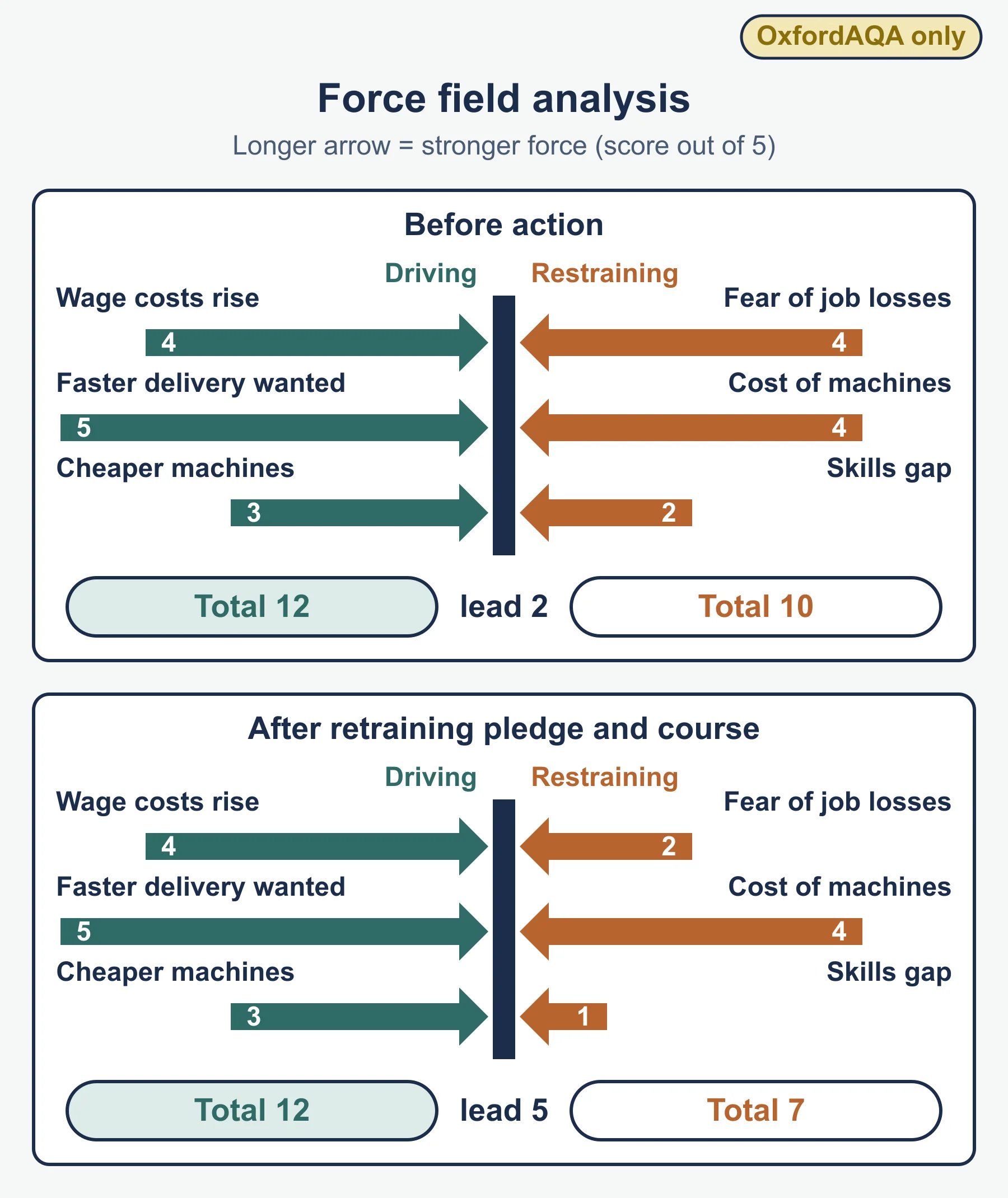
Force field analysis (HL only): list driving and restraining forces for a change, then weigh them. Resistance sits on the restraining side.
2.2 at a glance
The guide lists these nine terms without definitions; the meanings are standard forms.
| Term | Meaning in one line |
|---|---|
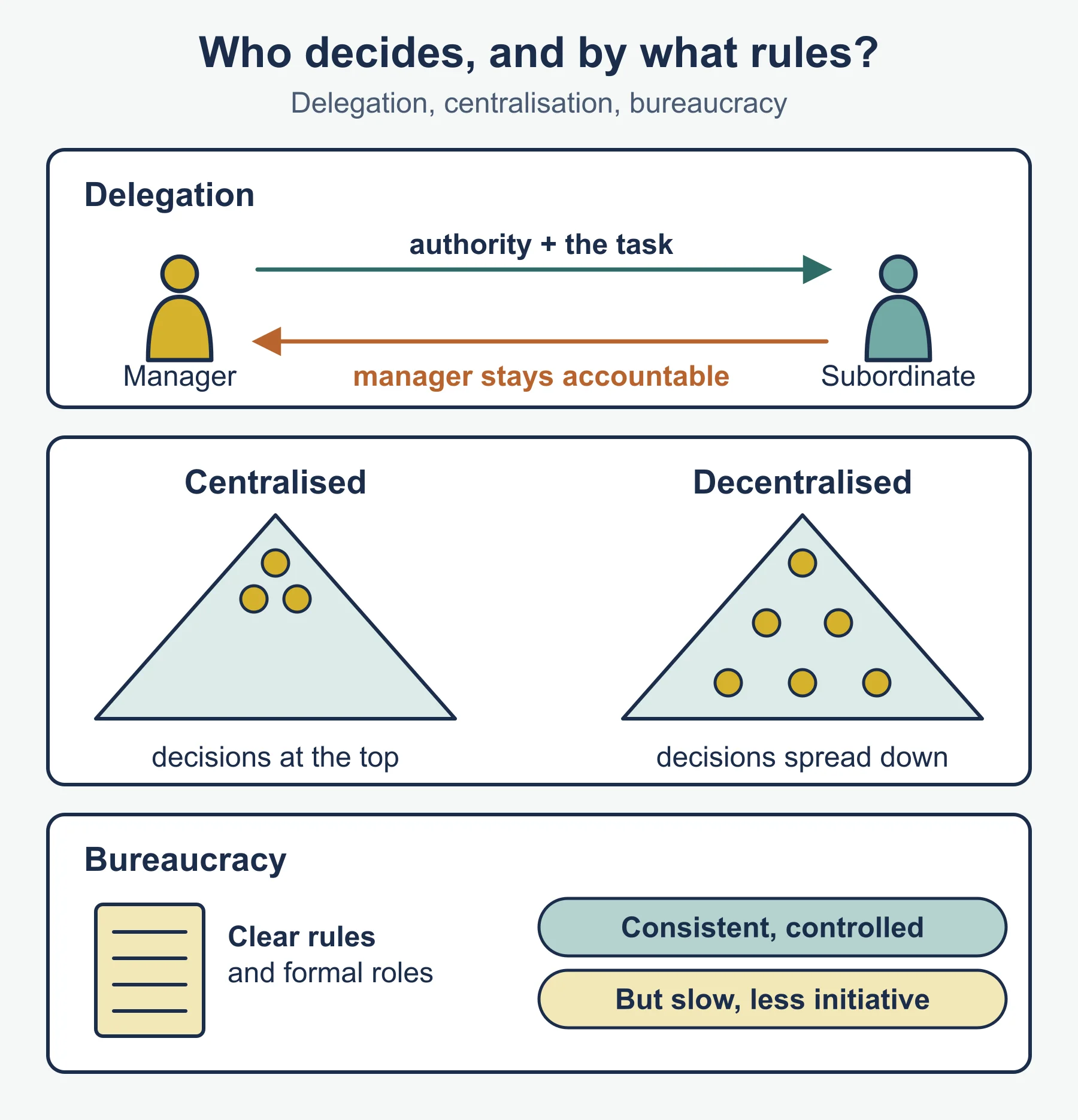
| Delegation | Passing authority for a task to a subordinate; the manager stays accountable |
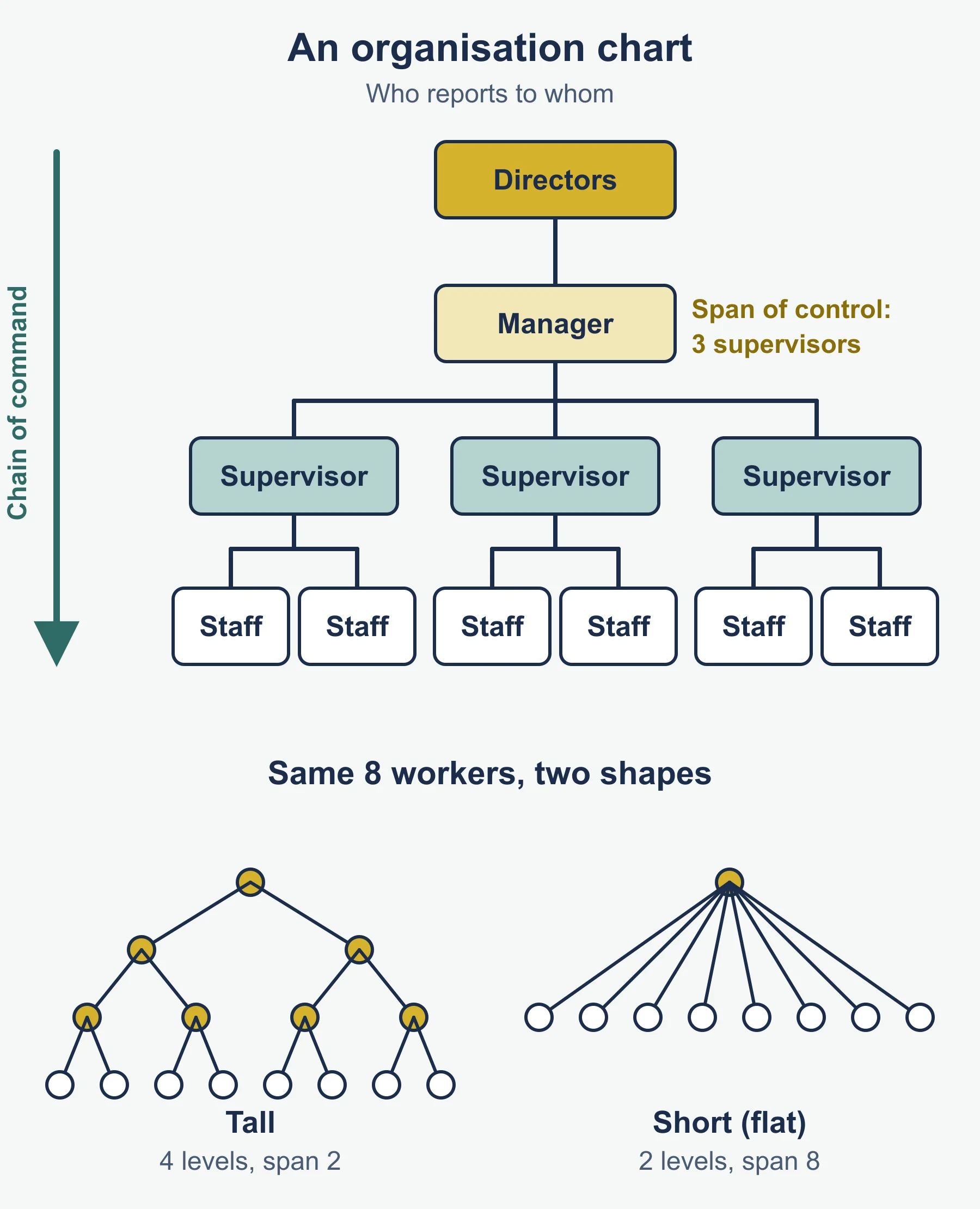
| Span of control | Number of subordinates reporting directly to one manager |
| Levels of the hierarchy | Layers of authority from top to bottom |
| Chain of command | Line of authority from the top to each employee |
| Bureaucracy | Formal rules, procedures and roles |
| Centralization | Decisions made at the top or head office |
| Decentralization | Decisions passed down to lower levels or branches |
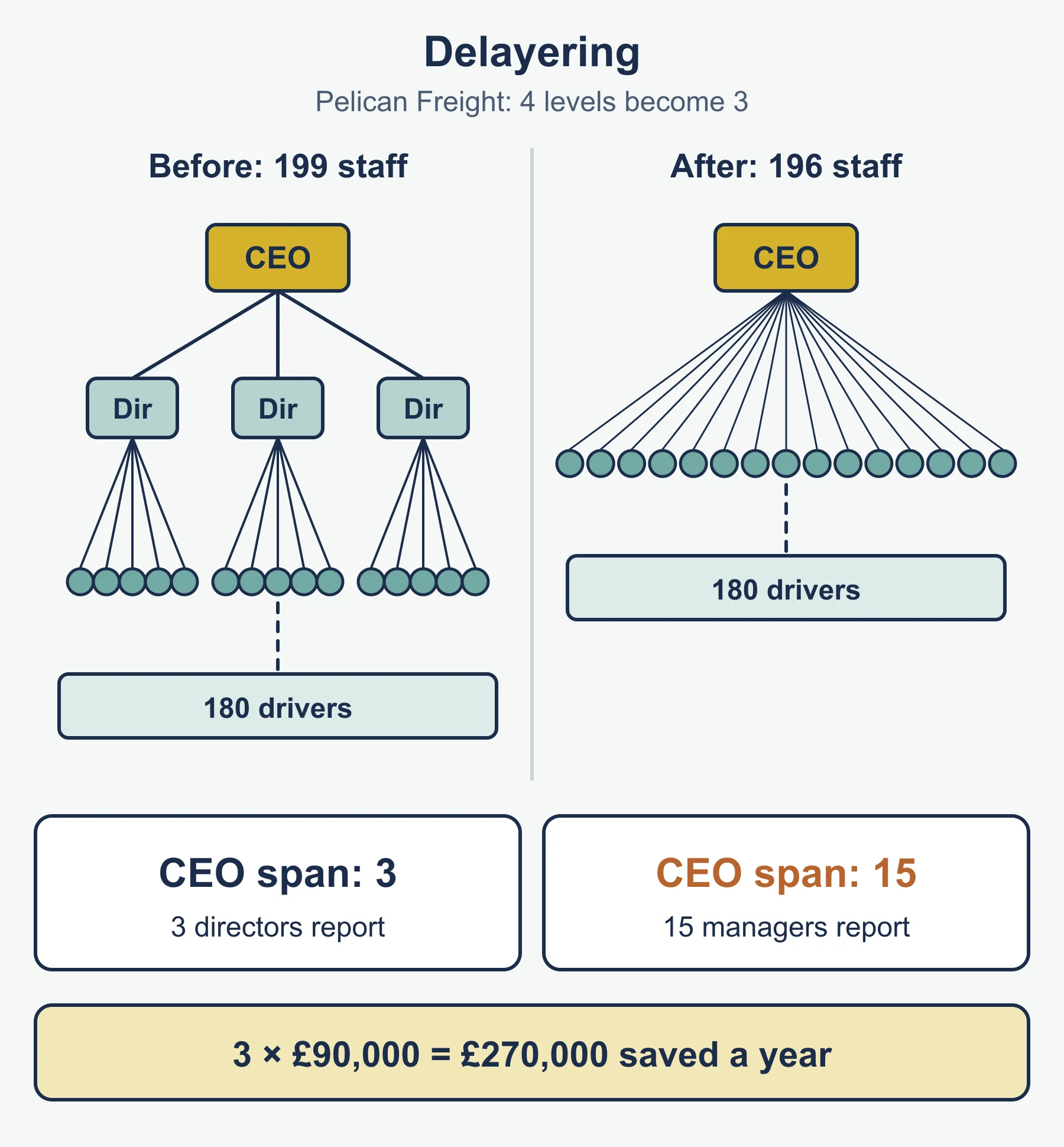
| Delayering | Removing one or more levels of the hierarchy |
| Matrix structure | Employees report to two managers, such as function and project |
Tall versus flat
| Tall (vertical) | Flat (horizontal) | |
|---|---|---|
| Levels | Many | Few |
| Span of control | Narrow | Wide |
| Chain of command | Long | Short |
| Communication | Slower, may be distorted | Faster |
| Supervision | Close | Looser, more delegation |
| Management cost | Higher | Lower |
| Promotion routes | Many steps | Few steps |
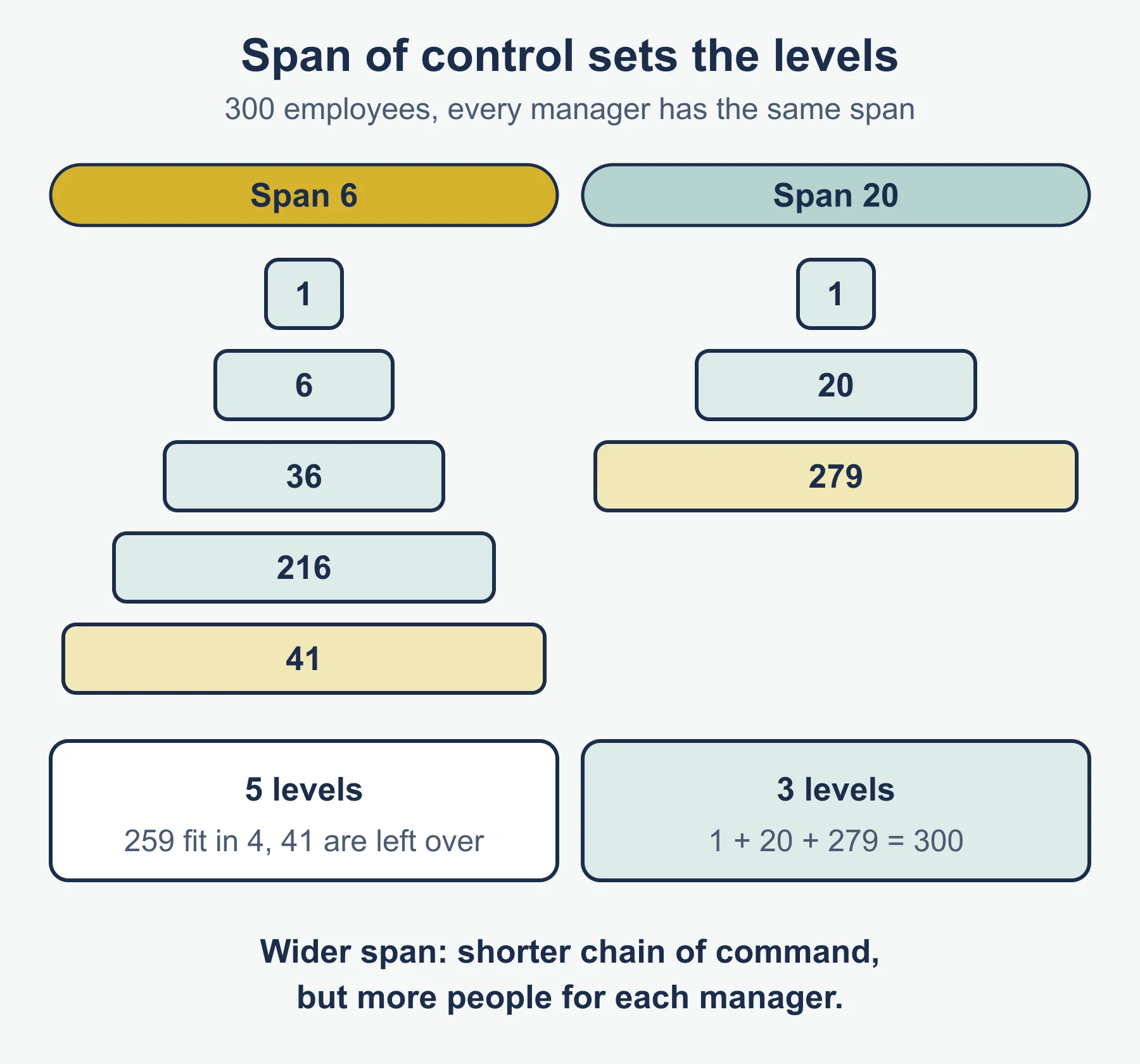
Rule: for a fixed workforce, wider spans mean fewer levels.
Chart groupings
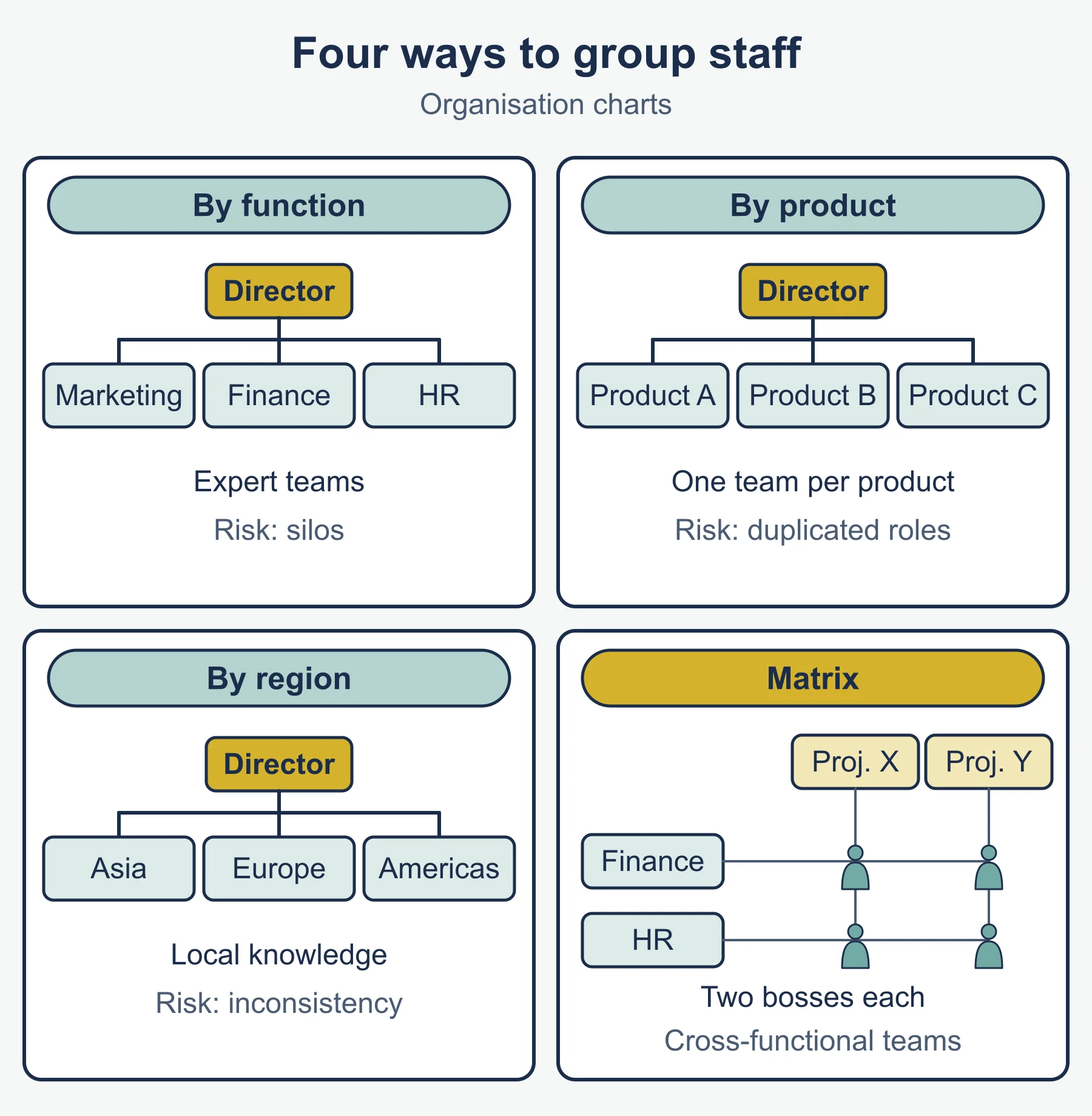
| Grouping | Strength | Weakness |
|---|---|---|
| By function | Specialist expertise | Silos between departments |
| By product | Focus on each product line | Duplicated roles and cost |
| By region | Local knowledge and speed | Inconsistency across regions |
Matrix structure
- Advantages: shares skills across projects, better communication across functions, flexible teams.
- Disadvantages: two bosses can give conflicting orders, confusion over accountability, possible conflict between managers.
Centralization versus decentralization
| Centralization | Decentralization | |
|---|---|---|
| Decisions | Top | Lower levels |
| Consistency | High | Lower |
| Speed of local response | Slow | Fast |
| Motivation | Can be low | Often higher through empowerment |
| Risk | Overloaded top team | Poor decisions, loss of control |
Delayering reminders
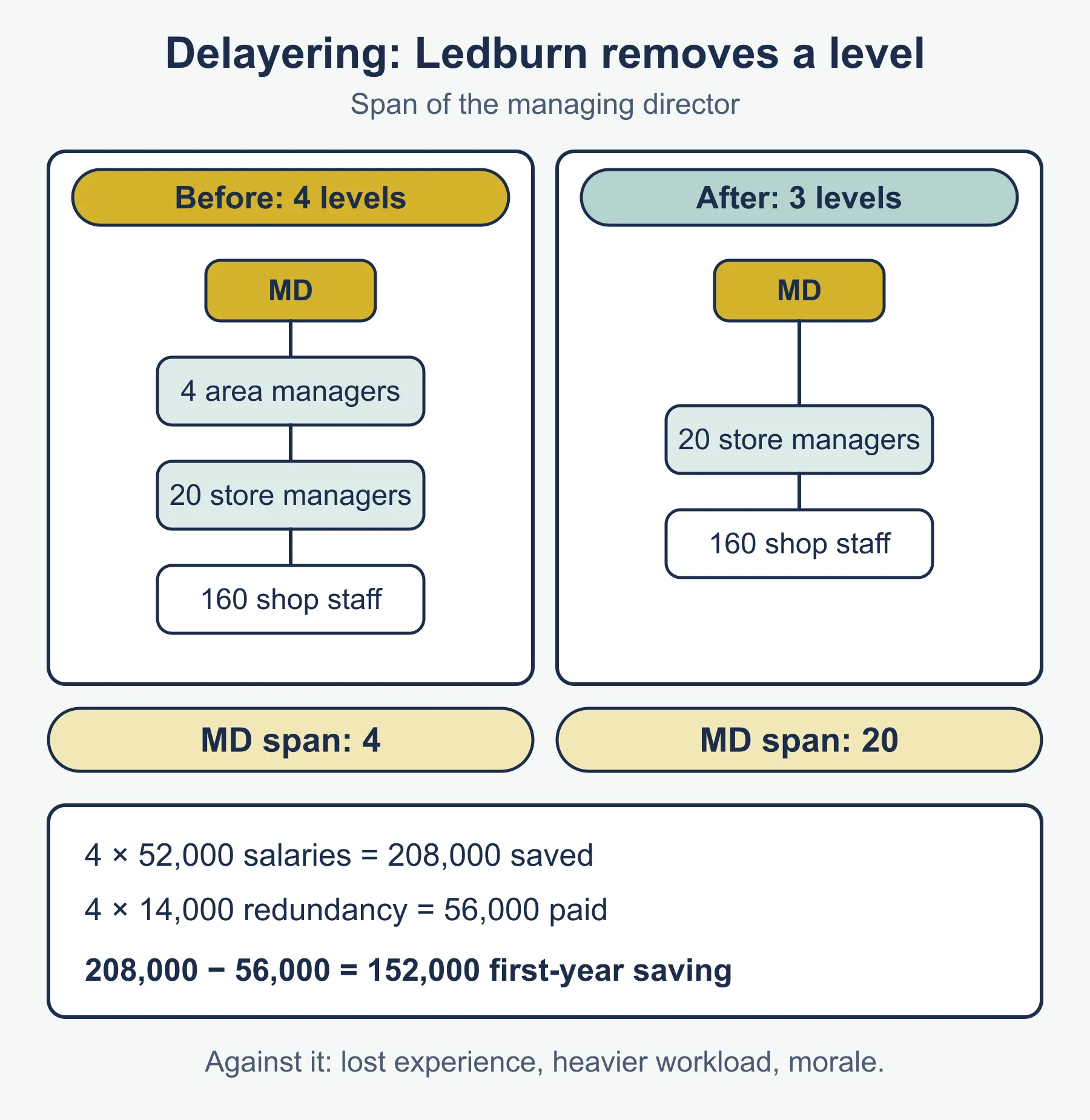
- Saves wages, shortens the chain of command and speeds communication.
- Widens spans, so remaining managers carry more.
- Costs include redundancy payments, lost experience and lower morale. A saving net of one-off payments is a first-year figure only.
Appropriateness given external change
Build your answer as: change, demand it creates, structure that meets the demand, drawback.
- Rapid technological change or unstable markets: flatter, decentralized or matrix.
- Expansion abroad: grouping by region, more local authority.
- Strict legal or safety demands: bureaucracy and centralization.
- Recession: delayering to cut costs, with a warning about overload.
- Remote and flexible work: flatter teams (project-based organization is HL only).
HL only: changes in structure
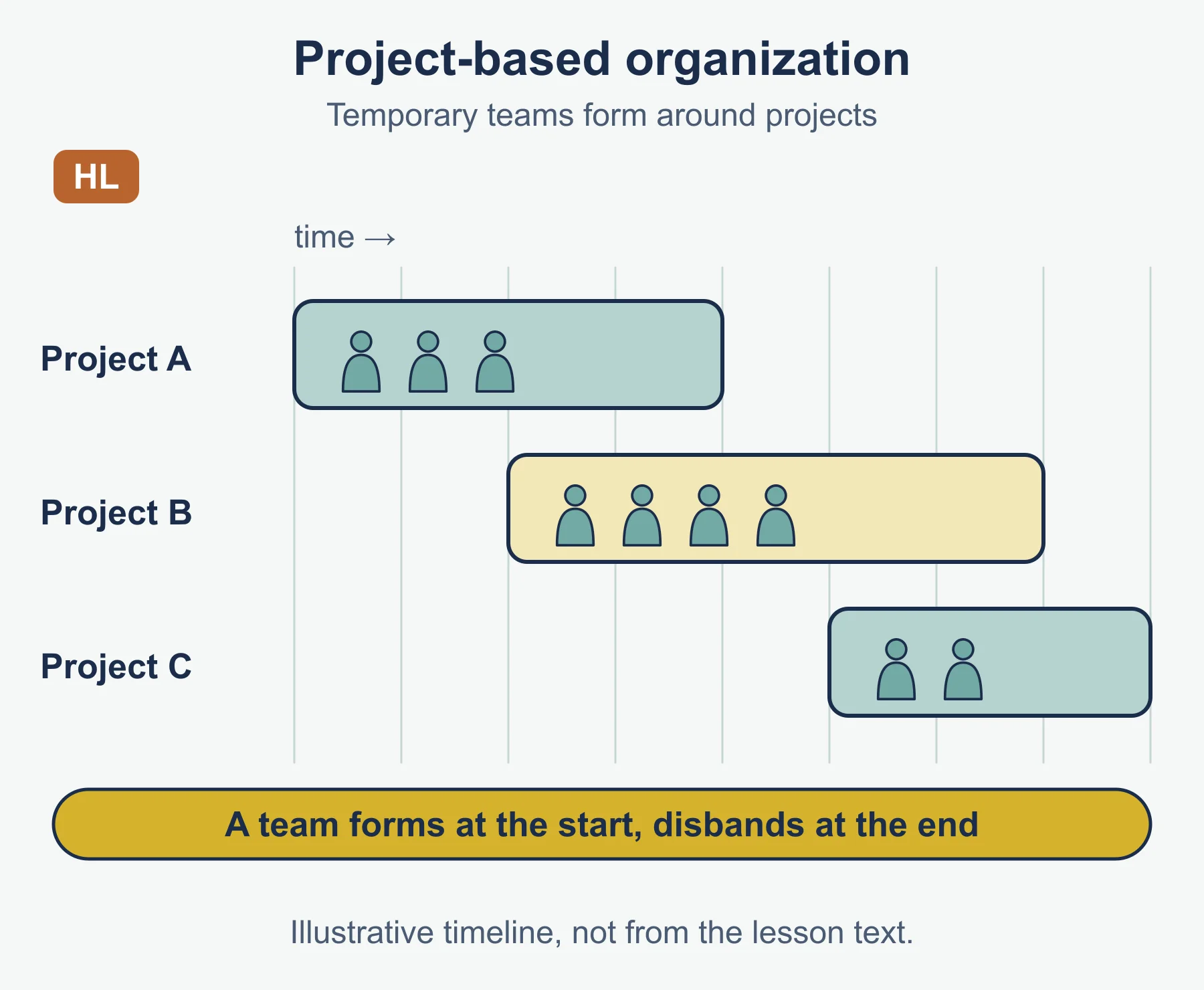
- Project-based organization: temporary teams formed around a project, then disbanded.
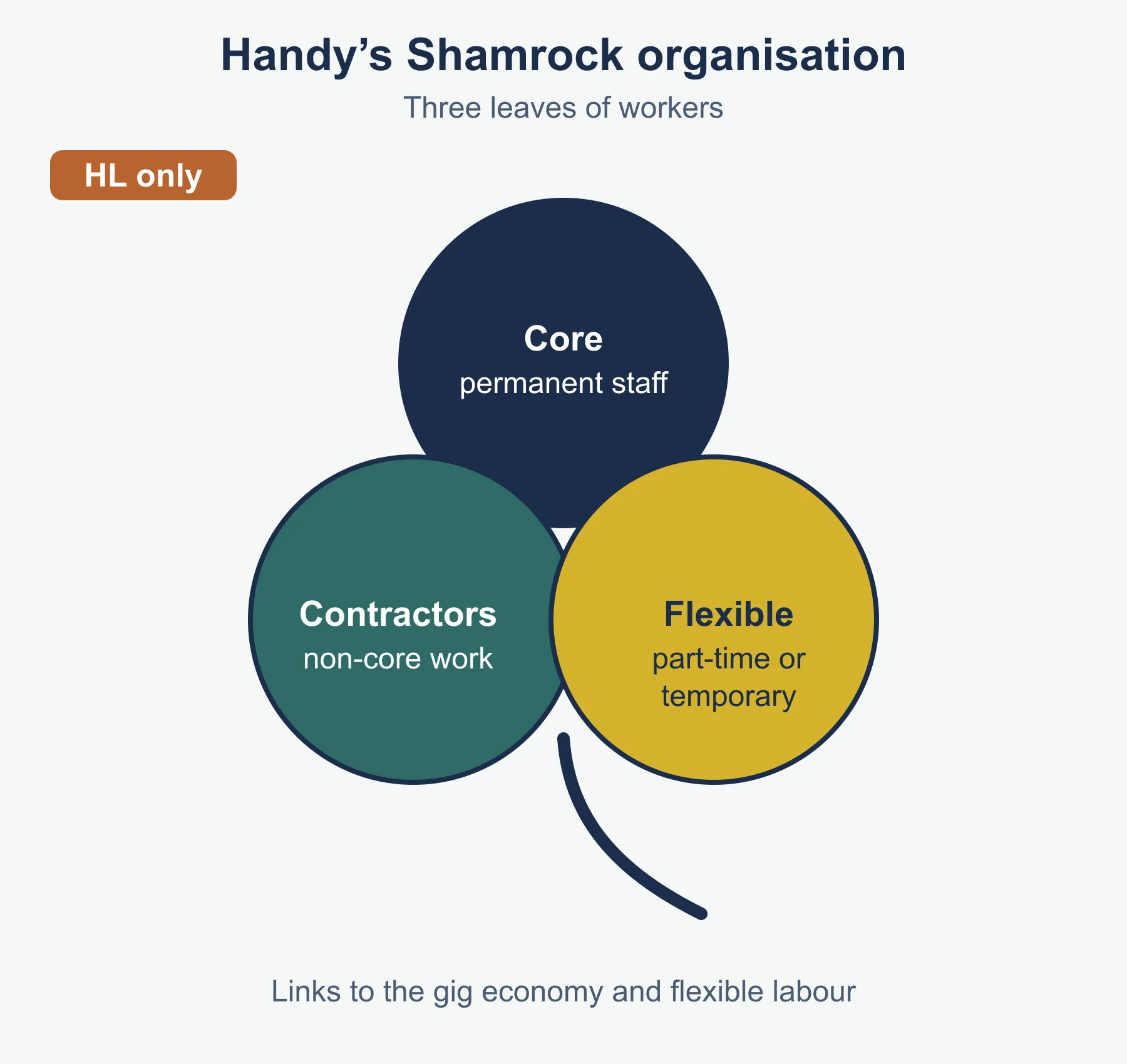
- Handy’s “Shamrock Organization”: three leaves. Core staff (essential, permanent), contractors (non-core tasks) and a flexible workforce (part-time or temporary).
Must-know distinctions
- Delegation versus decentralization: delegation is one manager passing a task and its authority to a subordinate; decentralization is an organization-wide pattern of decisions made lower down.
- Delayering versus downsizing: delayering removes a level of the hierarchy; downsizing cuts the number of employees at any level.
- Chain of command versus span of control: the first is the path of authority (length), the second is the width at one manager.
- Bureaucracy versus tall structure: bureaucracy is about rules and formal procedures; tall is about the number of levels. A flat firm can still be bureaucratic.
- Internal versus external factor: if management can change it directly, it is internal; if it comes from the wider environment, it is external. Flexi-time is a policy the business chooses, but the wider trend toward flexible work is an external pressure on it.
- Resistance versus ordinary disagreement: resistance is behavior that slows or blocks a change, such as absence, slow work or leaving.
Command words in this unit
- Define / state / identify: short, precise answers, no explanation needed.
- Calculate: show the working, for example span from a chart, or net saving from delayering.
- Explain / analyse: give a reason and its consequence in the context of the stem.
- Evaluate / justify / recommend: weigh both sides, make a decision and say what the decision depends on.
Worked reminders
Span and levels. A manager has 9 direct reports: span of control is 9. Business with 150 staff and equal span 5: layers hold 1, 5, 25, 125 = 156, so four levels are enough.
Descriptive statistics. Duneford Cabinets has ten departments with spans of control 4, 6, 6, 7, 9, 5, 6, 12, 8, 7. Mean = 70 / 10 = 7. Sorted: 4, 5, 6, 6, 6, 7, 7, 8, 9, 12; median = (6 + 7) / 2 = 6.5. Range = 12 - 4 = 8. The department with 12 may be overloaded; the mean hides it.
Chain of command. In a structure with span 3 and five levels, the layers hold 1, 3, 9, 27 and 81 people, 121 in total.
Quick self-test
- Define span of control.
- Name two external factors that influence human resource planning.
- Give two reasons employees resist change.
- State one HR strategy for reducing resistance, with a limitation.
- A manager supervises 40 staff through 5 supervisors, each with 8. What is the manager’s span?
- What is delayering?
- Name the three types of grouping for an organization chart.
- A business has 3 levels and every span is 10, with one person at the top. How many employees are there in total?
- Give one disadvantage of a matrix structure.
- Which structure usually suits a business whose market is changing fast, and why?
- (HL only) Name the three leaves of Handy’s Shamrock Organization.
- Find the median of spans 3, 5, 8, 4, 10.
Answers
- The number of subordinates who report directly to one manager.
- Any two: demographic change, labour mobility, immigration, gig economy, plus other STEEPLE factors.
- Any two: fear of job loss, fear of the unknown, lost status, skills gap, distrust, disagreement, extra workload.
- For example, consultation: it builds ownership, but slows decisions.
- The manager’s span is 5 (the supervisors), not 40.
- Removing one or more levels of the hierarchy, usually middle management.
- By product, by function, by region.
- 1 + 10 + 100 = 111 people.
- Employees have two bosses, so orders may conflict or accountability may be unclear.
- A flatter, decentralized or matrix structure, because quick local decisions and cross-team working help it adapt.
- Core staff, contractors, flexible workforce.
- Sorted: 3, 4, 5, 8, 10, so the median is 5.
Where marks are usually lost
- Writing “span of control” as total staff, not direct reports.
- Listing factors for human resource planning without saying what they do to the plan.
- Naming a strategy for resistance with no limitation or decision, when AO3 is the depth.
- Treating a flat structure as good and a tall one as bad in every case.
- Mixing up centralization with tall hierarchy.
- Forgetting that delayering has costs as well as savings.
- Misreading an organization chart and counting people at the wrong level.
- Using a general answer when the stem names a specific business and its change.
Frequently asked questions
What is the difference between delegation and decentralization? Delegation is one manager passing a task and the authority for it to a subordinate, while the manager stays accountable. Decentralization is passing decision-making to lower levels, branches or departments across the organization.
What is the difference between delayering and downsizing? Delayering removes one or more levels of the hierarchy, usually middle management. Downsizing cuts the number of employees.
What are the three leaves of Handy’s Shamrock Organization? The three leaves are core staff (essential and permanent), contractors (for non-core tasks) and the flexible workforce. This is an HL only part of section 2.2.
What is the gig economy? The gig economy is short-term, task-based or freelance work, often arranged through digital platforms. It is one of the external factors that can influence human resource planning in section 2.1.
Official syllabus
IB Diploma Programme Business management guide, first assessment 2024, International Baccalaureate Organization, sections 2.1 and 2.2.
Get free revision emails (optional)
Occasional emails with practice questions, worked explanations and links to free resources for the qualification and subjects you choose. No spam, and you can unsubscribe from any email. The free tools on this site never need an email.
Related resources
-
Study guides
IB DP Business Management: Leadership and management
Study guide to IB DP Business Management 2.3: management and leadership, five leadership styles, and scientific and intuitive thinking (HL only).
Business · International Baccalaureate · IB
Read guide -
Practice questions
IB DP Business Management: Leadership and management – Practice Questions
Original practice questions with worked answers on IB DP Business Management 2.3: leadership, five styles, and HL scientific and intuitive thinking.
Business · International Baccalaureate · IB
Try questions -
Revision notes
IB DP Business Management: Leadership and management – Revision Notes
Revision notes for IB DP Business Management 2.3: management versus leadership, five leadership styles and HL scientific and intuitive thinking.
Business · International Baccalaureate · IB
Revise topic
Related articles
-
teaching
A Level tuition in Dubai: Cambridge or Pearson Edexcel International A Level?
Schools in Dubai and Abu Dhabi teach either Cambridge International AS & A Level or Pearson Edexcel International A Level. How the two are structured, why it matters for tuition, and how online classes from Lahore work.
9 October 2026
-
curriculum guides
Choosing subjects at IGCSE and A Level
How subject choices at 14 and 16 affect university options later, and how to keep pathways open without overloading a timetable.
28 July 2026
Studying this with a teacher
Working through Business IB?
This page is free and stays free. If you would rather be taught it, Marlbridge runs Business classes one-to-one, online in your own time zone. The first trial class is free. WhatsApp replies within an hour (8am–11pm Pakistan time, every day); email the same day.
IB Business teachers at Marlbridge

