
Revision Notes
IB DP Business Management: Leadership and management – Revision Notes
Revision notes for IB DP Business Management 2.3: management versus leadership, five leadership styles and HL scientific and intuitive thinking.
- Subject
- Business
- Level
- IB
- Topic
- Unit 2: Human resource management
- Author
- Marlbridge Academic Team
- Updated
- Reviewed by
- Salman Ahmad (what this means)
Aligned to International Baccalaureate IB Diploma Programme Business (DP Business Management), First assessment 2024. Official specification .
Syllabus page (what it covers and how it is assessed): IB Diploma Programme Business.
Syllabus points this page covers
DP Business Management
- 2.3 Leadership and management
Found an error? Report a correction.
Need help with this topic? Request a free trial class for IB Diploma Programme Business (DP Business Management).
These revision notes condense section 2.3, Leadership and management, from Unit 2 of the IB Business management guide, first assessment 2024. Scientific and intuitive thinking/management is marked HL only in the guide; everything else applies to SL and HL. For full explanations and worked examples, read the study guide. Test yourself with the practice questions, see the course hub and the checklist, and use the diagnostics to find gaps.
The official text names each idea but gives no definitions. The wording below is the standard textbook form and is labelled “standard” where it matters.
The three content points
| Point | Depth in the guide | Level |
|---|---|---|
| Scientific and intuitive thinking/management | AO2 | HL only |
| Management and leadership | AO2 | SL and HL |
| Leadership styles (five named) | AO3 | SL and HL |
AO2 means apply and analyse. AO3 means weigh up and reach a judgement. There are no calculations in this section.
Management versus leadership
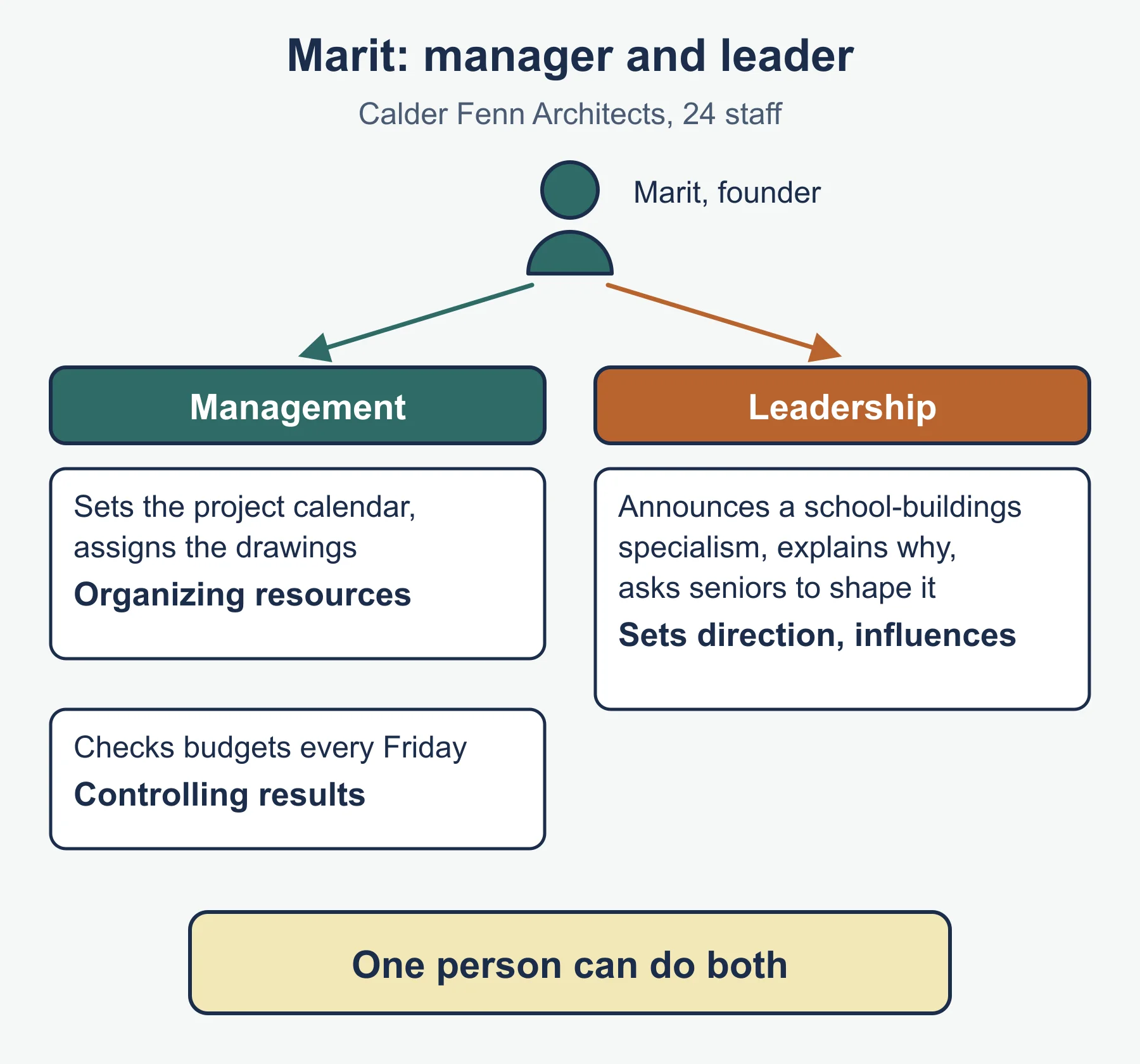
Management (standard): organizing resources and people to reach objectives, through planning, directing, coordinating and controlling.
Leadership (standard): influencing and guiding people toward a vision or goal.
| Management | Leadership |
|---|---|
| Tasks and systems | People and direction |
| Authority from position | Influence from trust and example |
| How are we doing it? | Where are we going and why? |
| Keeps operations steady | Drives change |
Must-know: the roles overlap. One person can do both, and businesses need both.
Method in steps for a “distinguish” or “explain” question:
- Define each term in one line.
- State one real difference, not a rewording of the same idea.
- Use a detail from the stem to show which one the person is doing.
- Say how the two work together.
The five leadership styles
| Style | Decision made by | Staff involvement | Best suited to | Main drawback |
|---|---|---|---|---|
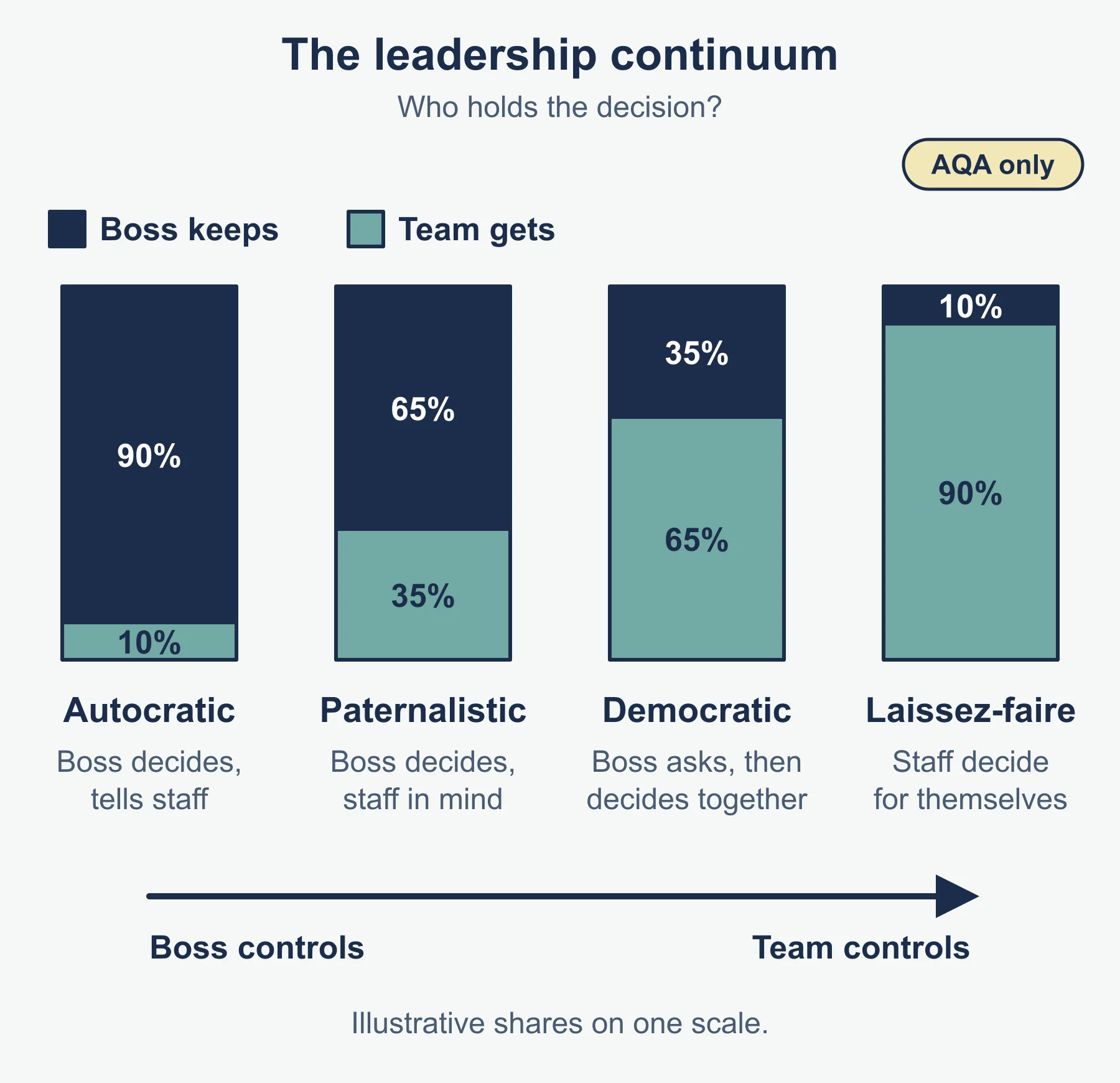
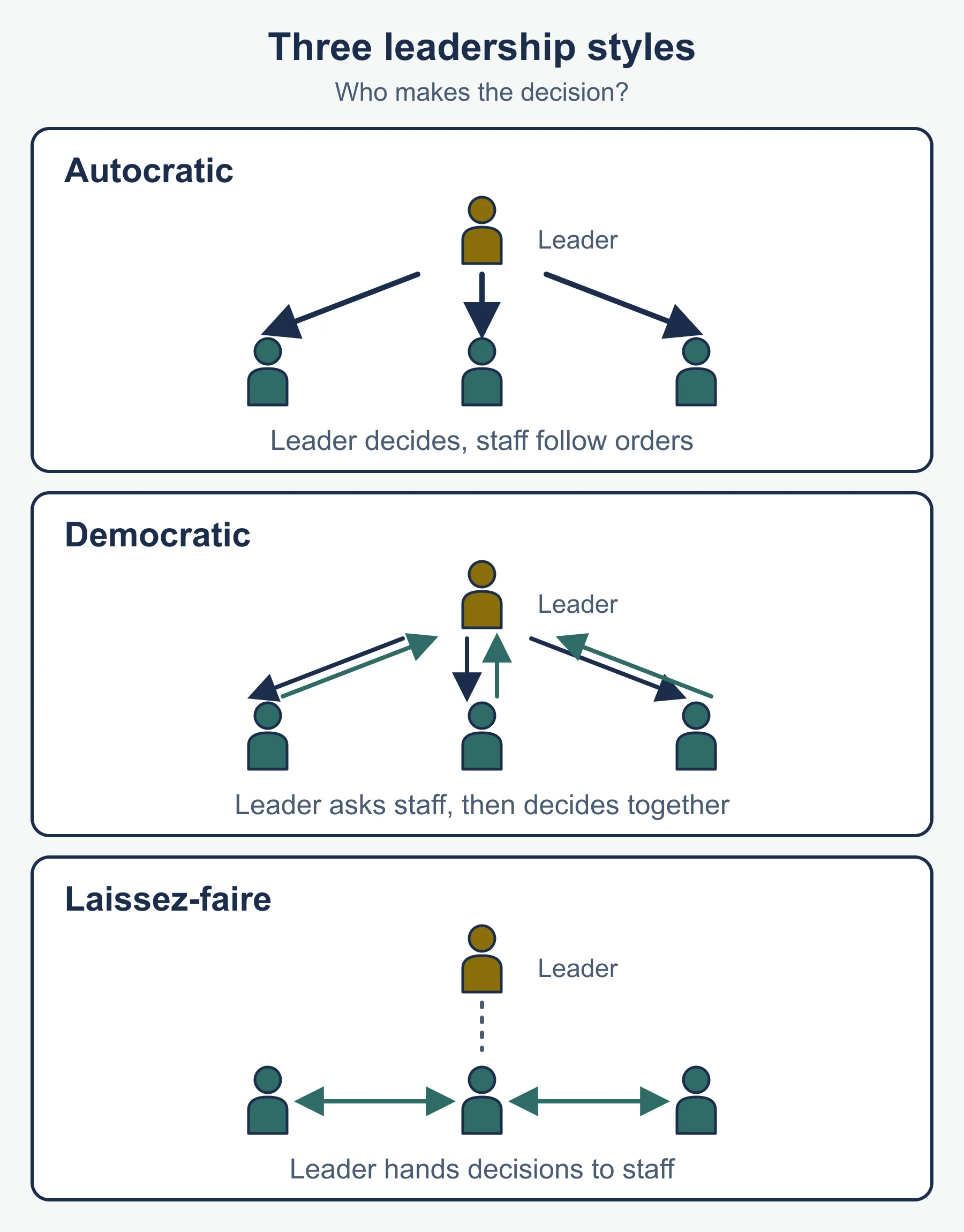
| Autocratic | Leader alone | Minimal | Crisis, routine or unskilled work | Low morale, staff may leave |
| Paternalistic | Leader, claiming to act for staff | Low, but welfare valued | Loyalty-based firms | Staff may resent being managed “for their own good” |
| Democratic | Group, consulted or voted | High | Complex work, skilled staff | Slow, may compromise |
| Laissez-faire | Staff | Very high | Experts needing freedom | No direction, uneven results |
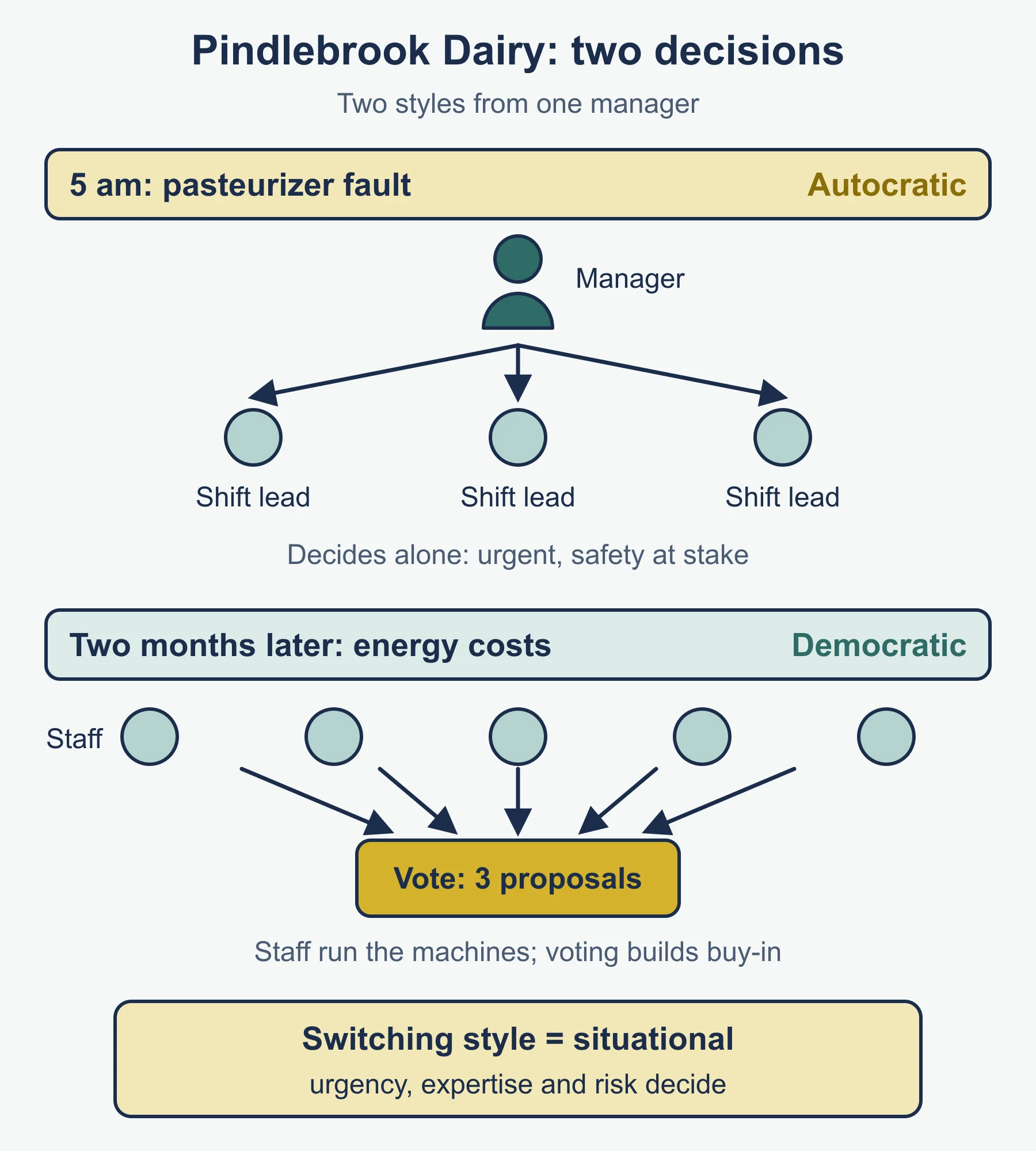
| Situational | Leader picks the style to fit | Varies | Changing conditions | Can look inconsistent |
Spotting a style from clues
- “Announced without consulting anyone” points to autocratic.
- “Explained the decision and offered extra benefits” points to paternalistic.
- “Held a vote” or “asked teams to propose” points to democratic.
- “Left the team to decide how to meet the goal” points to laissez-faire.
- “Acted differently in an emergency than in planning” points to situational.
Style or a mix?
Real leaders rarely fit one box. If a stem shows mixed behavior, say which style dominates and why. Do not force a label.
Situational leadership
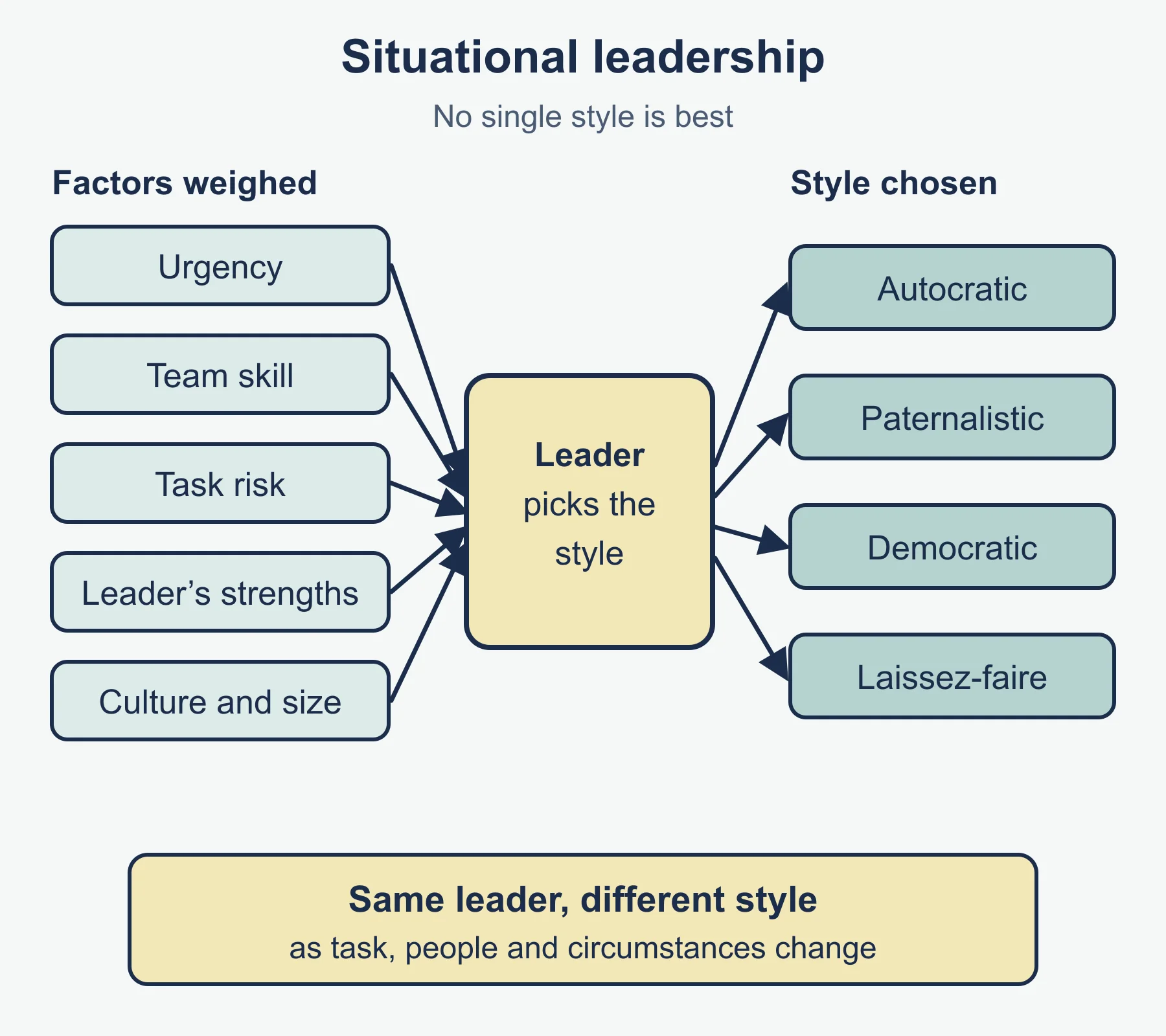
- Standard account: no single best style. The leader adapts to the task, the team and the circumstances.
- The guide lists it as a style but names no particular model, so describe it generally.
- Factors that shape the choice: urgency, team skill and experience, risk if the task goes wrong, the leader’s strengths, organizational culture.
- Evaluation point: flexibility is its main strength. Its risk is that staff may feel unsure what to expect.
Scientific and intuitive thinking/management (HL only)
| Scientific | Intuitive | |
|---|---|---|
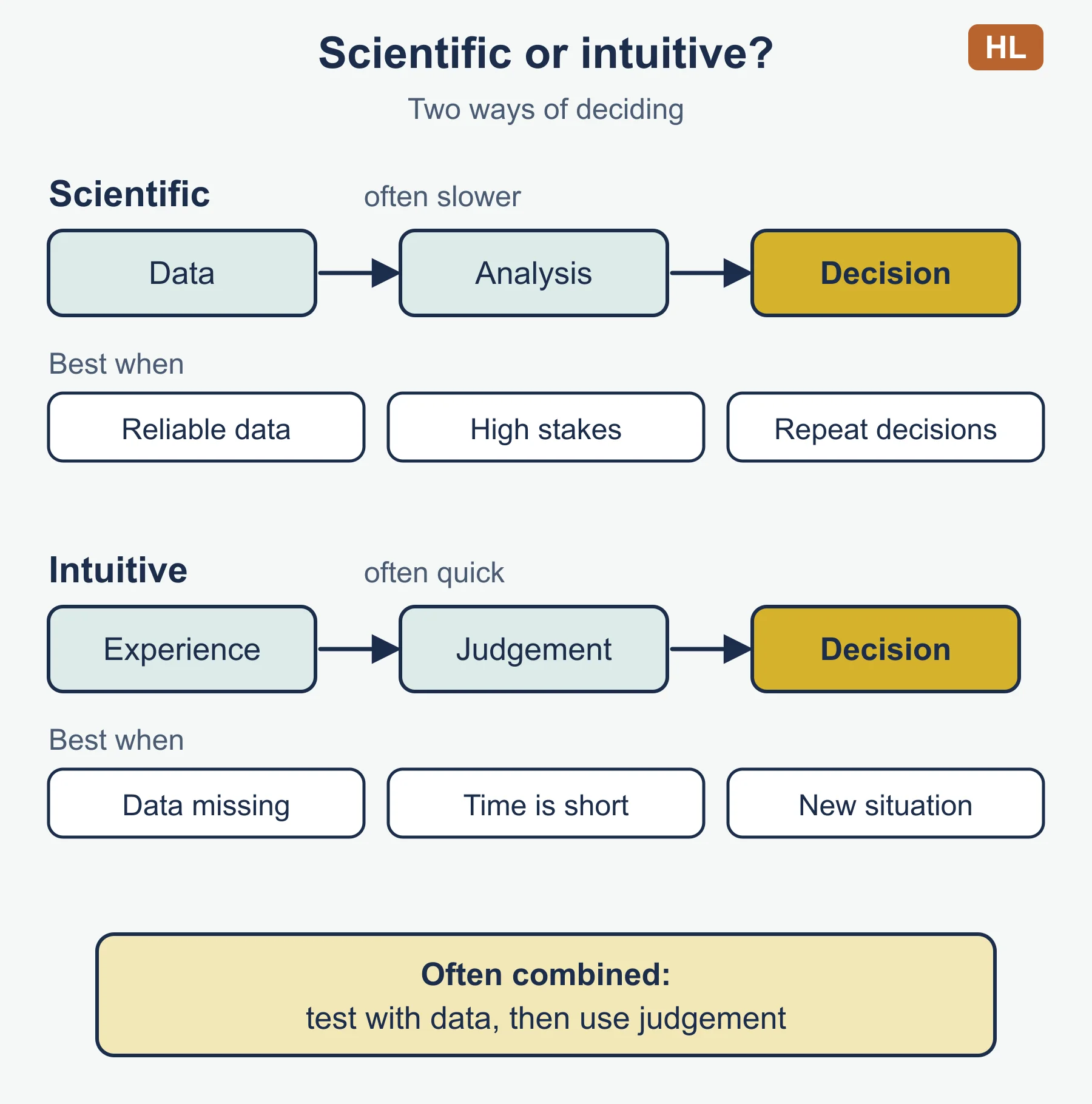
| Basis | Data, analysis, testing | Experience, judgement, instinct |
| Strength | Evidence-based, repeatable | Fast, works with little data |
| Weakness | Slow, relies on good data | Bias, hard to justify |
| Best when | Data exist, stakes are high | Time is short, situation is new |
Must-know: the strongest answers say managers often combine both, and that the better choice depends on the data available and the time allowed.
Linking style to staff effects
| Style | Likely effect on motivation | Likely effect on staff turnover | Likely effect on speed |
|---|---|---|---|
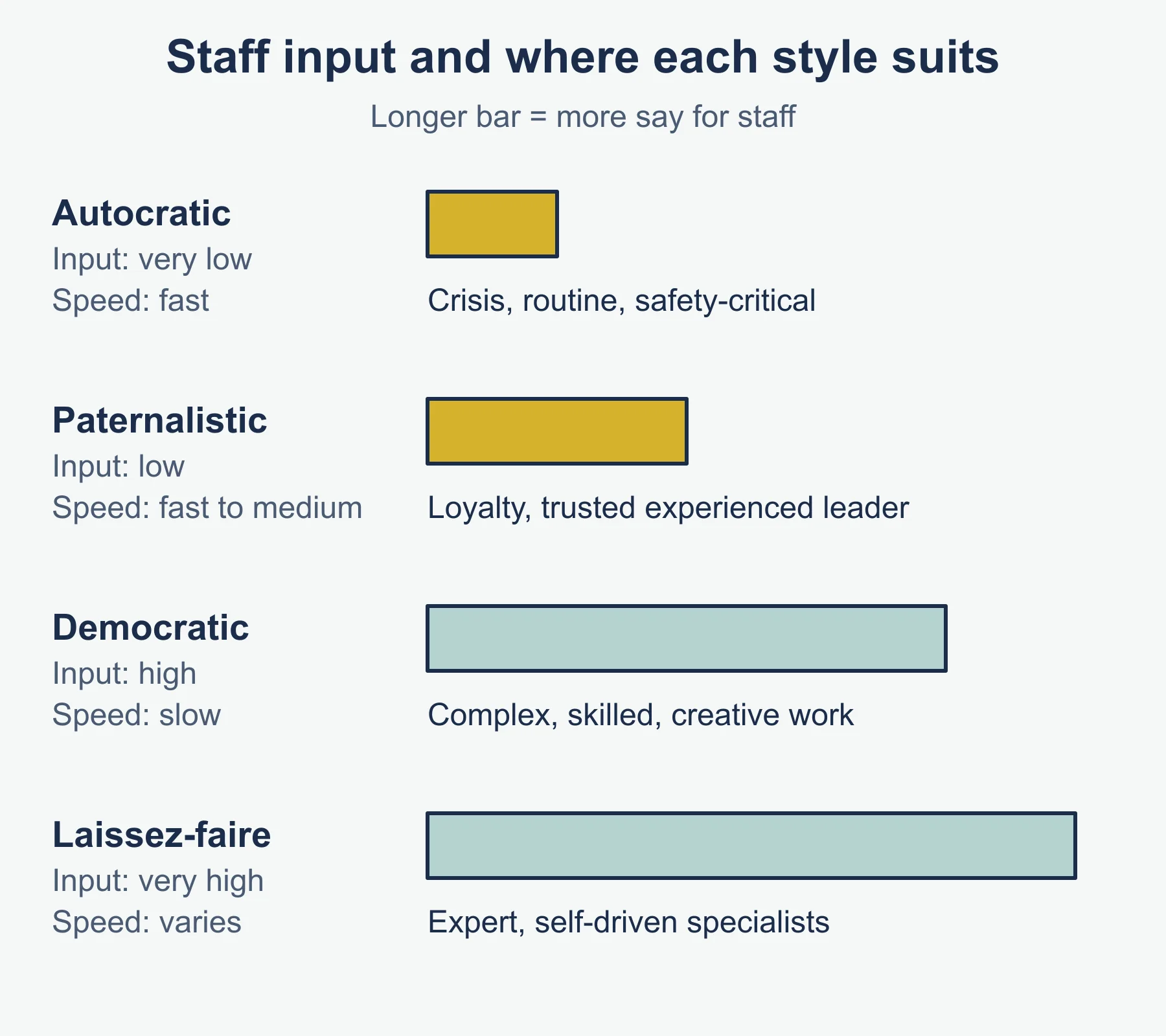
| Autocratic | Falls if staff want a voice | May rise | Fast |
| Paternalistic | Can rise through security and care, can fall if staff feel controlled | May fall | Fast to medium |
| Democratic | Often rises through involvement | May fall | Slower |
| Laissez-faire | Rises for self-driven experts, falls for those wanting guidance | Depends on staff | Varies |
| Situational | Depends on how well the leader explains changes | Depends | Varies |
These are tendencies, not rules. Write “may” or “could” and add the condition that makes the effect likely in the case you are given.
Must-know distinctions
- Paternalistic versus autocratic. Both leaders decide. The paternalistic leader explains and shows concern for welfare. The autocratic leader simply instructs.
- Democratic versus laissez-faire. In a democratic style the leader still guides the discussion. In laissez-faire the leader steps back.
- Laissez-faire versus no leadership. The leader still sets goals and is available for support.
- Situational versus mixed style. Situational is a deliberate choice that depends on circumstances, not an accident.
- Management versus leadership. One is about running a system, the other about moving people toward a direction.
Small worked reminders
Reminder 1: naming a style from a stem. The head of a small bakery asks each baker to suggest changes to the weekend recipe list, then the team votes. Style: democratic. Reason: the leader consults and the group decides. Limitation worth adding: voting takes time before a busy weekend.
Reminder 2: a short paternalistic answer. A workshop owner pays for staff lunches and gives loans in hardship, but chooses all work schedules himself. Style: paternalistic. Reason: he decides alone, yet his stated concern is staff welfare. A possible drawback is that staff may feel they have no voice, even though they are well looked after.
Reminder 3: one-line situational link. An emergency repair calls for direct instructions, whereas planning next year’s product range suits discussion with skilled staff. A leader who moves between the two is applying situational leadership.
Reminder 4 (HL): choosing between thinking types. Pricing a bulk order from known costs and past sales suits scientific thinking. Picking which of two promising apprentices to coach may rely on intuitive thinking because little hard data exists.
Command words that appear with this topic
The guide classes command terms by assessment objective. These are the ones most likely to attach to leadership content.
| Command term | Level in the guide | What the answer needs |
|---|---|---|
| Define | AO1 | The precise meaning |
| State, identify, outline | AO1 | A short answer or brief account |
| Distinguish, explain | AO2 | A clear difference, or a detailed account with reasons |
| Analyse | AO2 | Break the idea into parts and show how they relate |
| Evaluate | AO3 | Weigh strengths and limitations |
| Justify | AO3 | Valid reasons or evidence for a conclusion |
| Recommend | AO3 | An advisable course of action with supporting reasons |
Evaluation toolkit for AO3 answers
Judge any style against these criteria, then decide:
- Urgency of the decision.
- Skill and experience of the staff.
- Risk and cost of mistakes.
- Effect on motivation and turnover.
- Fit with the organization’s culture and size.
A strong conclusion reads like this: “On balance a [style] approach is best here because [criterion] outweighs [criterion], though this could change if [condition].”
Quick self-test
- State what the guide treats as the five leadership styles.
- Give one difference between management and leadership.
- A principal announces a new timetable without consulting teachers. Which style fits best, and why?
- A factory owner pays for staff medical checks but keeps every decision for herself. Which style?
- Give one situation where a laissez-faire style is appropriate.
- State one disadvantage of a democratic style.
- Explain why a situational leader may appear inconsistent.
- Which content point in 2.3 is HL only?
- (HL) State one advantage and one disadvantage of intuitive management.
- Why does the verb “evaluate” need more than a list of advantages?
Answers
- Autocratic, paternalistic, democratic, laissez-faire and situational.
- For example, management concentrates on tasks and systems, while leadership concentrates on influencing people toward a direction.
- Autocratic: the decision is made alone, with no staff input, and passed down.
- Paternalistic: she shows care for welfare, but she keeps control of the decisions.
- A research team of highly skilled scientists who need freedom and little supervision.
- Decisions can be slow, or can end in a compromise nobody likes.
- Because they change style as circumstances change, staff may not know what to expect unless the reasons are explained.
- Scientific and intuitive thinking/management.
- Advantage: fast and usable when data are missing. Disadvantage: it can be biased and hard to justify to others.
- “Evaluate” means weighing strengths against limitations. A list is not enough; you must reach a judgement with reasons.
Where marks are usually lost
- Defining leadership and management in almost the same words, so no difference appears.
- Naming a style without quoting evidence from the stem.
- Writing “democratic is best because staff are happy” with no reference to time, skill or risk.
- Describing a paternalistic leader as simply “nice” and ignoring that the leader still takes the decision.
- Treating laissez-faire as having no leader at all.
- Presenting only one side in an “evaluate” or “justify” response.
- Skipping a conclusion, or repeating the introduction as one.
- Writing about scientific and intuitive thinking at SL when it is not required, or leaving it out at HL.
Frequently asked questions
What is the difference between paternalistic and autocratic leadership? In both styles the leader makes the decision. A paternalistic leader explains the decision and shows concern for staff welfare, while an autocratic leader simply expects decisions to be followed.
What is the difference between democratic and laissez-faire leadership? In a democratic style the leader involves staff in decisions but still guides the discussion. In a laissez-faire style the leader sets goals and then gives staff wide freedom to decide how to work, with minimal direction.
Are there calculations in IB Business Management section 2.3? No. Section 2.3, Leadership and management, has no calculations, although a question may give figures such as staff turnover for you to use as evidence.
What criteria should you use to evaluate a leadership style? Judge a style against the urgency of the decision, the skill and experience of the staff, the risk and cost of mistakes, its effect on motivation and turnover, and its fit with the organization’s culture and size. Then reach a clear judgement.
Official syllabus
IB Diploma Programme Business management guide, first assessment 2024, published by the International Baccalaureate Organization. This page covers section 2.3, Leadership and management.
Get free revision emails (optional)
Occasional emails with practice questions, worked explanations and links to free resources for the qualification and subjects you choose. No spam, and you can unsubscribe from any email. The free tools on this site never need an email.
Related resources
-
Study guides
IB DP Business Management: Motivation and demotivation
Study guide to section 2.4 of IB DP Business Management: motivation theories, rewards, training, and the HL points on turnover, appraisal and recruitment.
Business · International Baccalaureate · IB
Read guide -
Practice questions
IB DP Business Management: Motivation and demotivation – Practice Questions
Original practice questions with worked answers on IB DP Business Management 2.4: motivation theories, rewards, training, turnover and appraisal.
Business · International Baccalaureate · IB
Try questions -
Revision notes
IB DP Business Management: Motivation and demotivation – Revision Notes
Condensed revision notes for IB DP Business Management section 2.4: motivation theories, rewards, training, labour turnover, appraisal and recruitment.
Business · International Baccalaureate · IB
Revise topic
Related articles
-
teaching
A Level tuition in Dubai: Cambridge or Pearson Edexcel International A Level?
Schools in Dubai and Abu Dhabi teach either Cambridge International AS & A Level or Pearson Edexcel International A Level. How the two are structured, why it matters for tuition, and how online classes from Lahore work.
9 October 2026
-
curriculum guides
Choosing subjects at IGCSE and A Level
How subject choices at 14 and 16 affect university options later, and how to keep pathways open without overloading a timetable.
28 July 2026
Studying this with a teacher
Working through Business IB?
This page is free and stays free. If you would rather be taught it, Marlbridge runs Business classes one-to-one, online in your own time zone. The first trial class is free. WhatsApp replies within an hour (8am–11pm Pakistan time, every day); email the same day.
IB Business teachers at Marlbridge

