
Revision Notes
IB DP Business Management: Motivation and demotivation – Revision Notes
Condensed revision notes for IB DP Business Management section 2.4: motivation theories, rewards, training, labour turnover, appraisal and recruitment.
- Subject
- Business
- Level
- IB
- Topic
- Unit 2: Human resource management
- Author
- Marlbridge Academic Team
- Updated
- Reviewed by
- Salman Ahmad (what this means)
Aligned to International Baccalaureate IB Diploma Programme Business (DP Business Management), First assessment 2024. Official specification .
Syllabus page (what it covers and how it is assessed): IB Diploma Programme Business.
Syllabus points this page covers
DP Business Management
- 2.4 Motivation and demotivation
Found an error? Report a correction.
Need help with this topic? Request a free trial class for IB Diploma Programme Business (DP Business Management).
These notes condense section 2.4, Motivation and demotivation, from Unit 2 (Human resource management) of the IB Business management guide, first assessment 2024. Full explanations and worked examples are in the study guide. Items marked HL only are labelled that way in the guide. Where the guide names an idea but gives no definition or formula, the wording here is the standard textbook form. Other pages: the Business Management hub, the printable checklist, the practice questions and the free diagnostics. Money amounts are in dollars.
Key definitions
| Term | Meaning |
|---|---|
| Motivation | The drive that makes someone put effort into work |
| Demotivation | Loss of that drive, often shown by absence, errors or resignation |
| Intrinsic motivation | Drive from the task itself (interest, achievement) |
| Extrinsic motivation | Drive from outside rewards (pay, bonuses) |
| Hygiene factor | In Herzberg’s theory, a factor that prevents dissatisfaction but does not motivate |
| Motivator | In Herzberg’s theory, a factor that creates satisfaction |
| Labour turnover (HL only) | How many employees leave in a period, as a percentage of the average workforce |
The three core theories (SL and HL)
| Theory | Core claim | Business use | Main criticism |
|---|---|---|---|
| Taylor | Pay motivates; design jobs scientifically | Piece rate, specialized tasks, close supervision | Ignores social needs; boredom; quality may fall |
| Maslow | Five needs met in order; unmet need motivates | Match rewards to employee’s current level | Order varies; hard to test |
| Herzberg | Hygiene factors and motivators are separate | Fix hygiene factors, then enrich jobs | Based on a limited sample; ignores individuals who value pay |
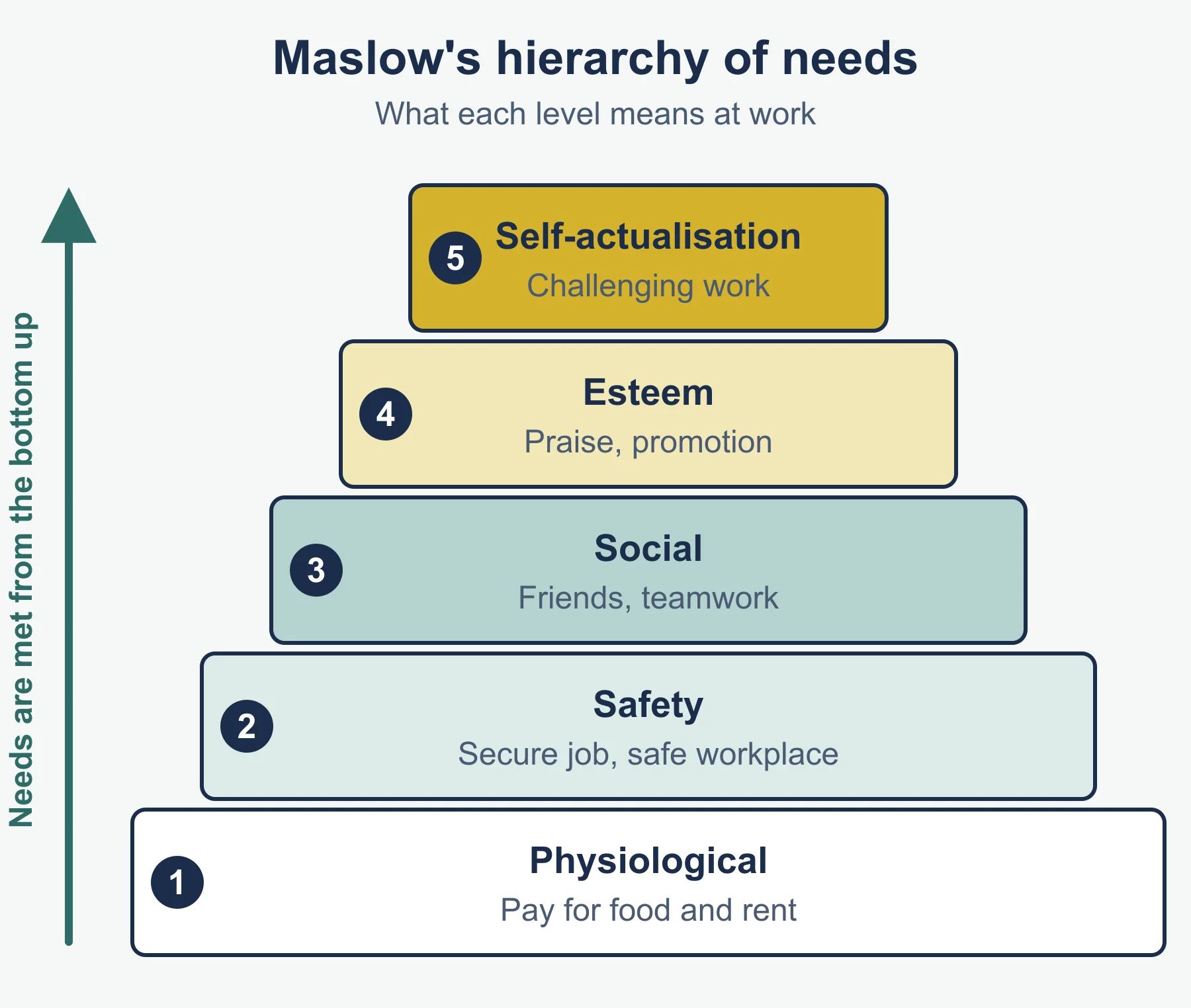
Maslow’s five levels, lowest to highest
- Physiological
- Safety
- Love/belonging (social)
- Esteem
- Self-actualization
Herzberg sorting
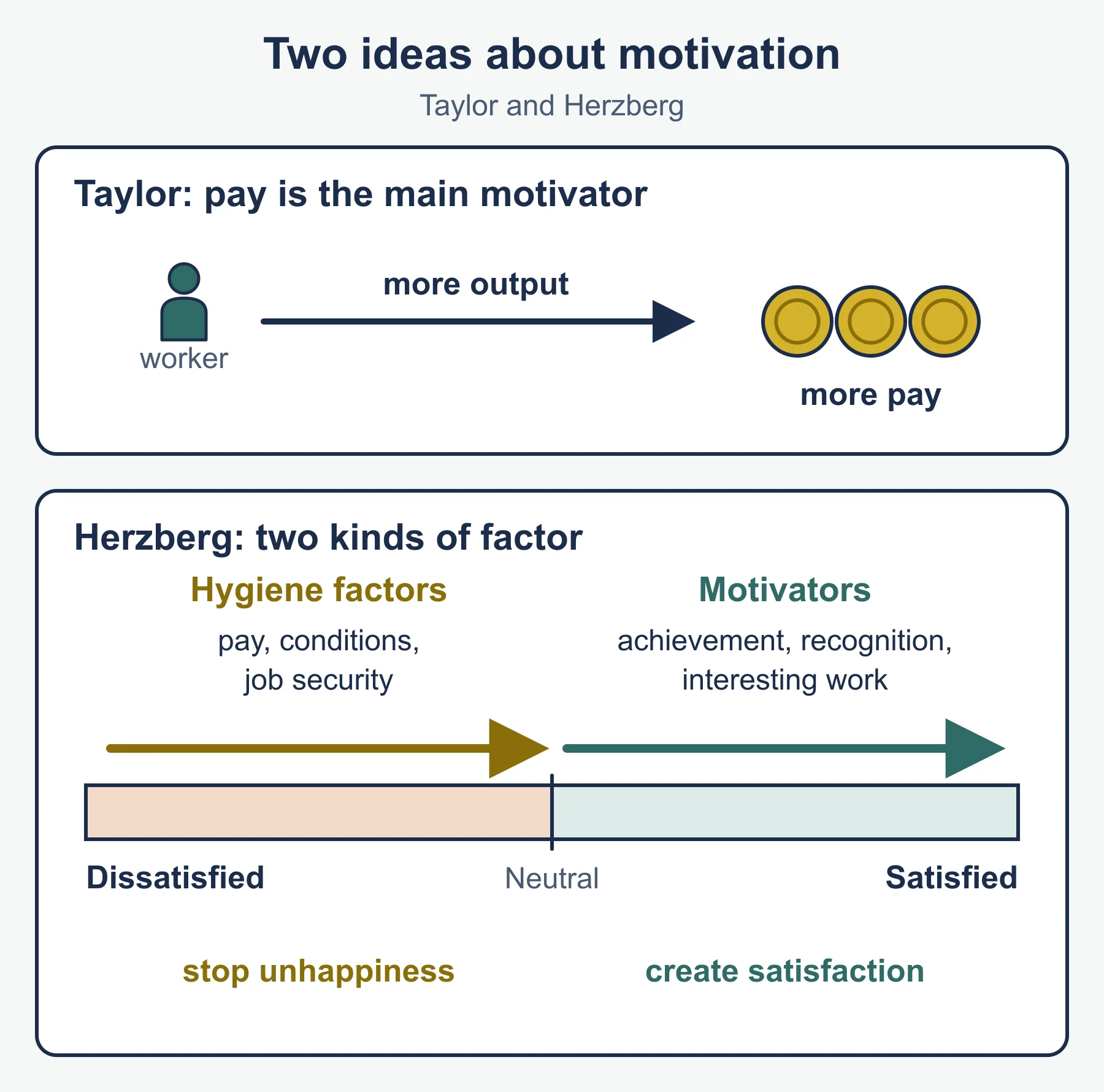
- Hygiene factors: pay, working conditions, policy, supervision, job security.
- Motivators: achievement, recognition, responsibility, the work itself, advancement.
Must-know distinction: a pay rise removes a source of complaint (hygiene). Responsibility and recognition create commitment (motivators).
HL only: other theories
| Theory | Key terms | One-line application |
|---|---|---|
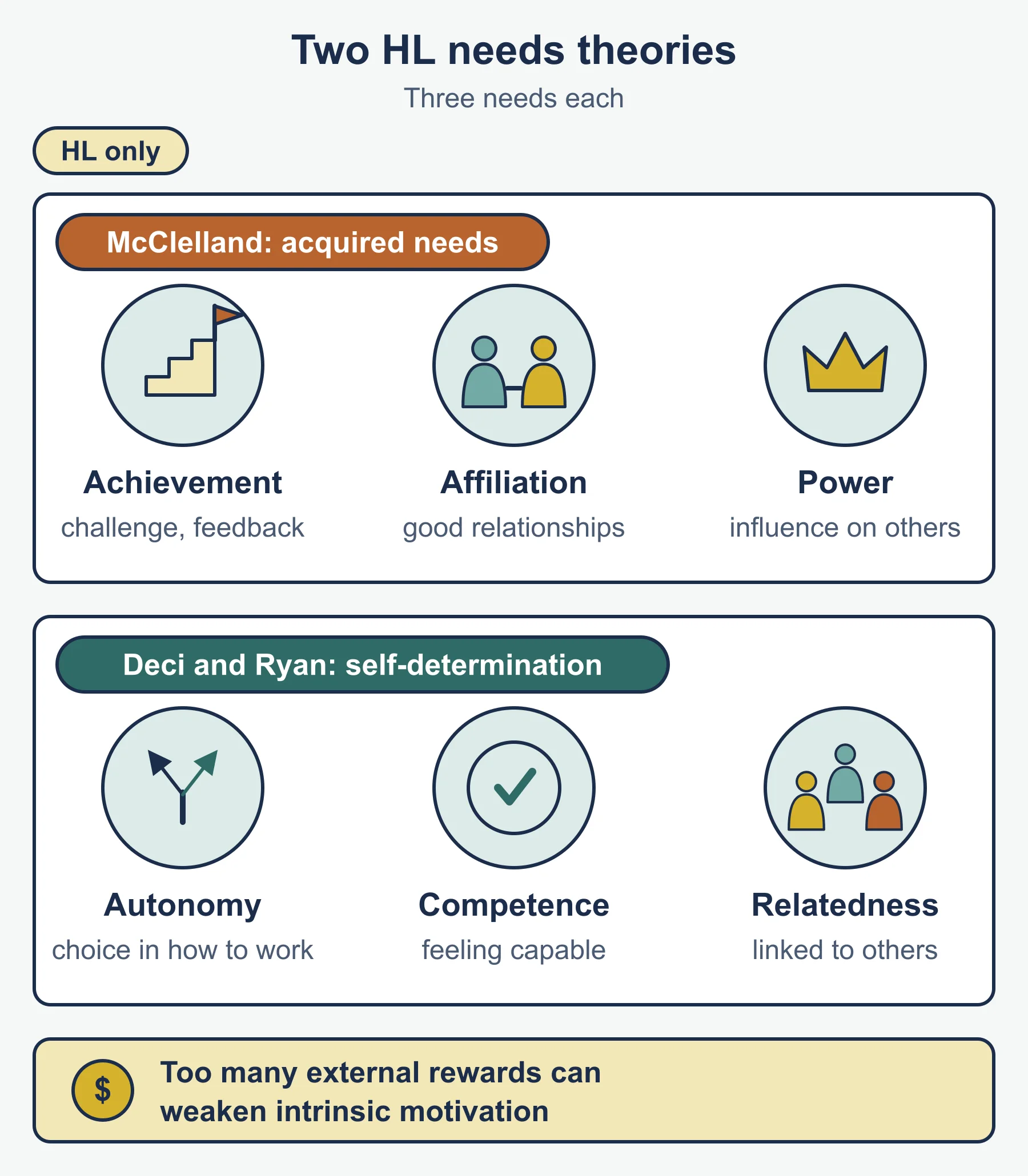
| McClelland’s acquired needs | Achievement, affiliation, power | Give a high-achievement employee stretching targets with feedback |
| Deci and Ryan’s self-determination | Autonomy, competence, relatedness | Let staff choose how they meet a goal and give training |
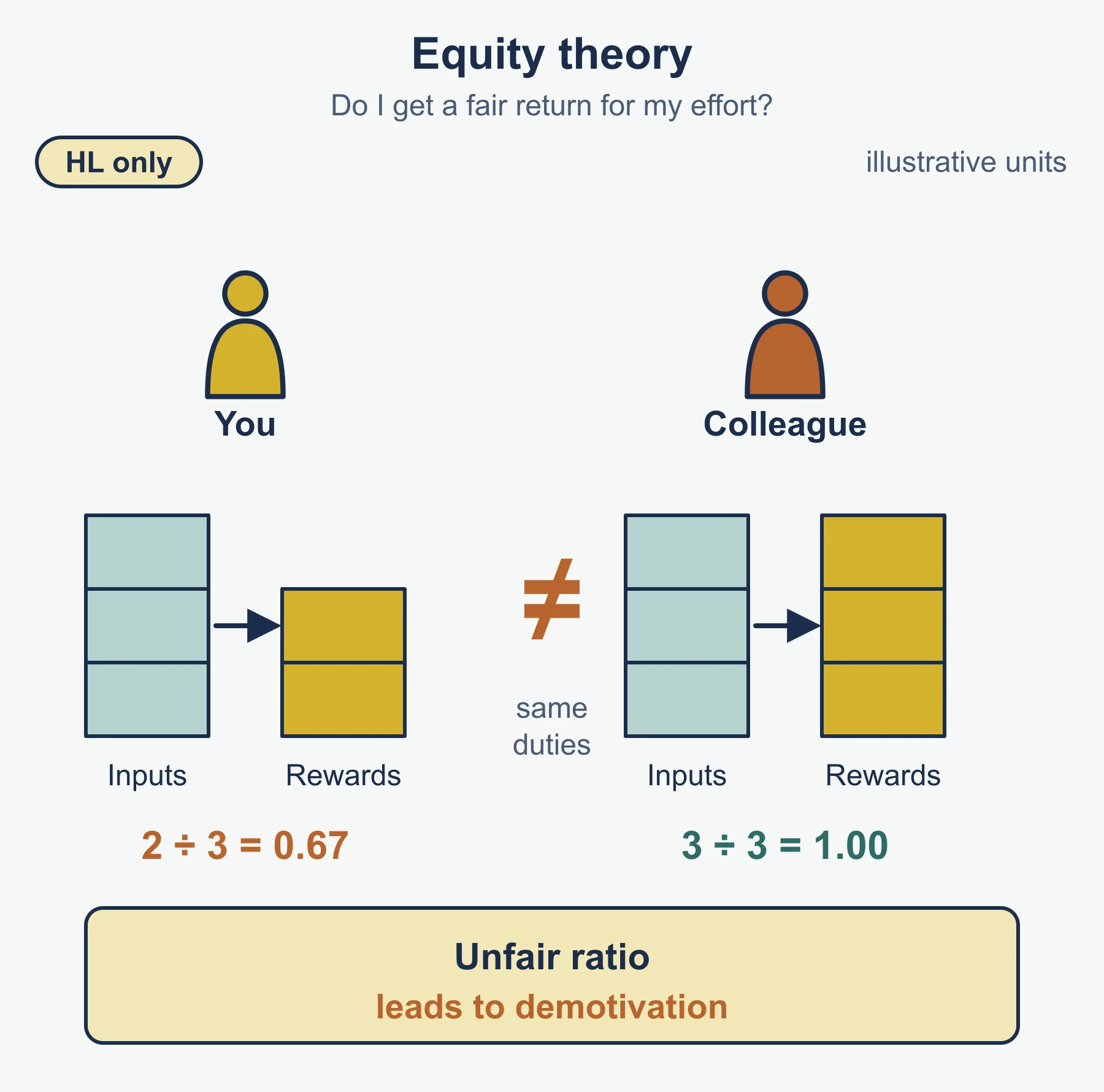
| Equity theory | Fair comparison of inputs and rewards with others | Publish a clear pay structure |
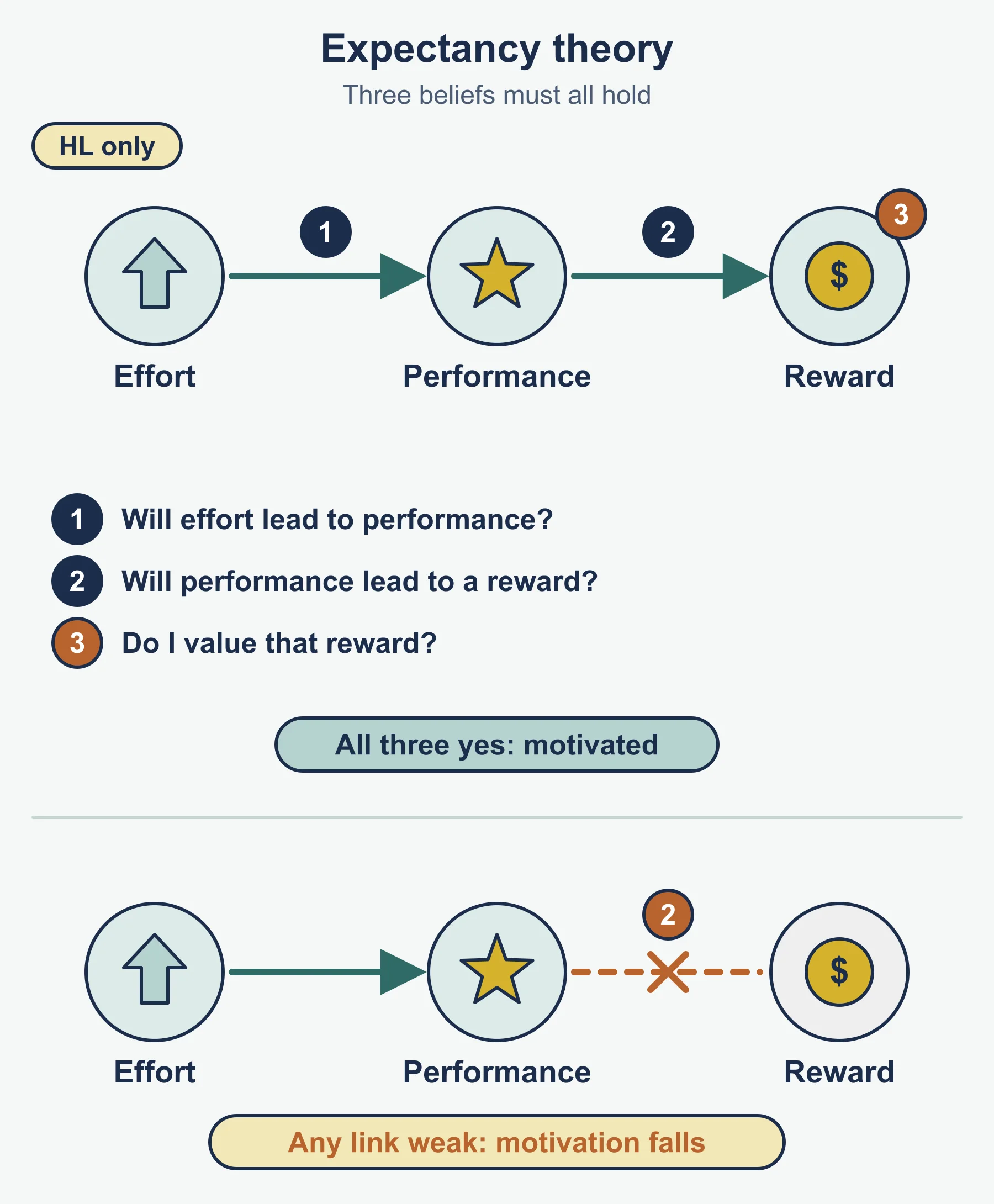
| Expectancy theory | Effort leads to performance, performance leads to reward, reward is valued | Make targets reachable and rewards visible and wanted |
Equity and expectancy are named together in the guide with no detail. The key terms above are the standard ones.
HL only: labour turnover
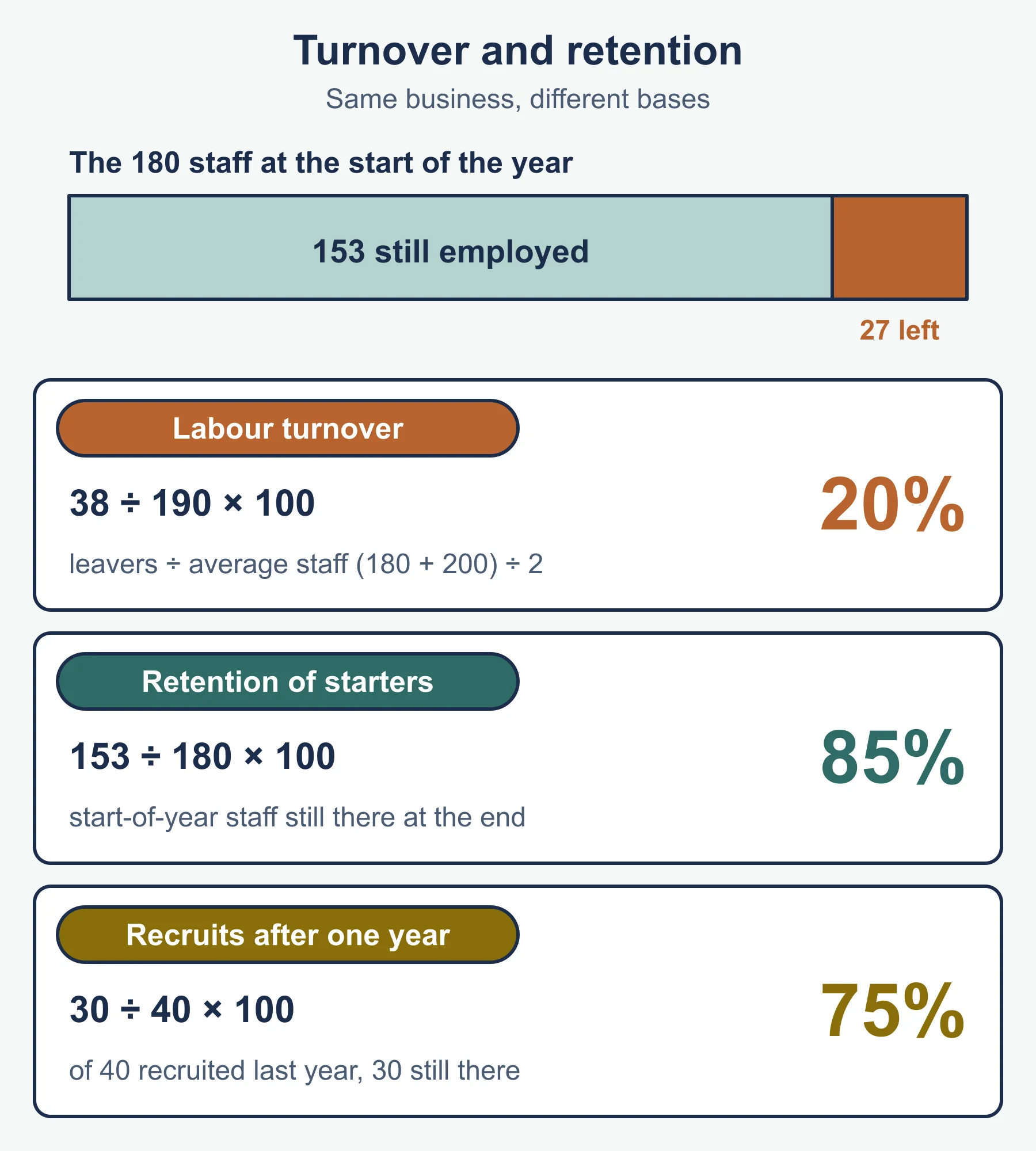
Standard form: labour turnover (%) = leavers in the period ÷ average number of employees × 100.
Method:
- Find the average number of employees (opening plus closing, divided by 2, if both are given).
- Divide leavers by that average.
- Multiply by 100 and state the unit.
Reminders:
- 9 leavers from an average of 72 staff: 9 ÷ 72 × 100 = 12.5%.
- Opening staff 80, closing staff 100, leavers 27: average = 90, so turnover = 27 ÷ 90 × 100 = 30%.
- If each replacement costs 2,500 and there are 9 leavers, the replacement cost is 22,500.
Causes: low pay, poor management, no promotion, weak training, poor working conditions. Effects: recruitment and training costs, lost experience, lower morale. A low rate is not always good, because new staff can bring new ideas.
HL only: appraisal
| Type | Purpose | Timing |
|---|---|---|
| Formative | Development, coaching | Ongoing |
| Summative | Judge performance (pay, promotion) | End of period |
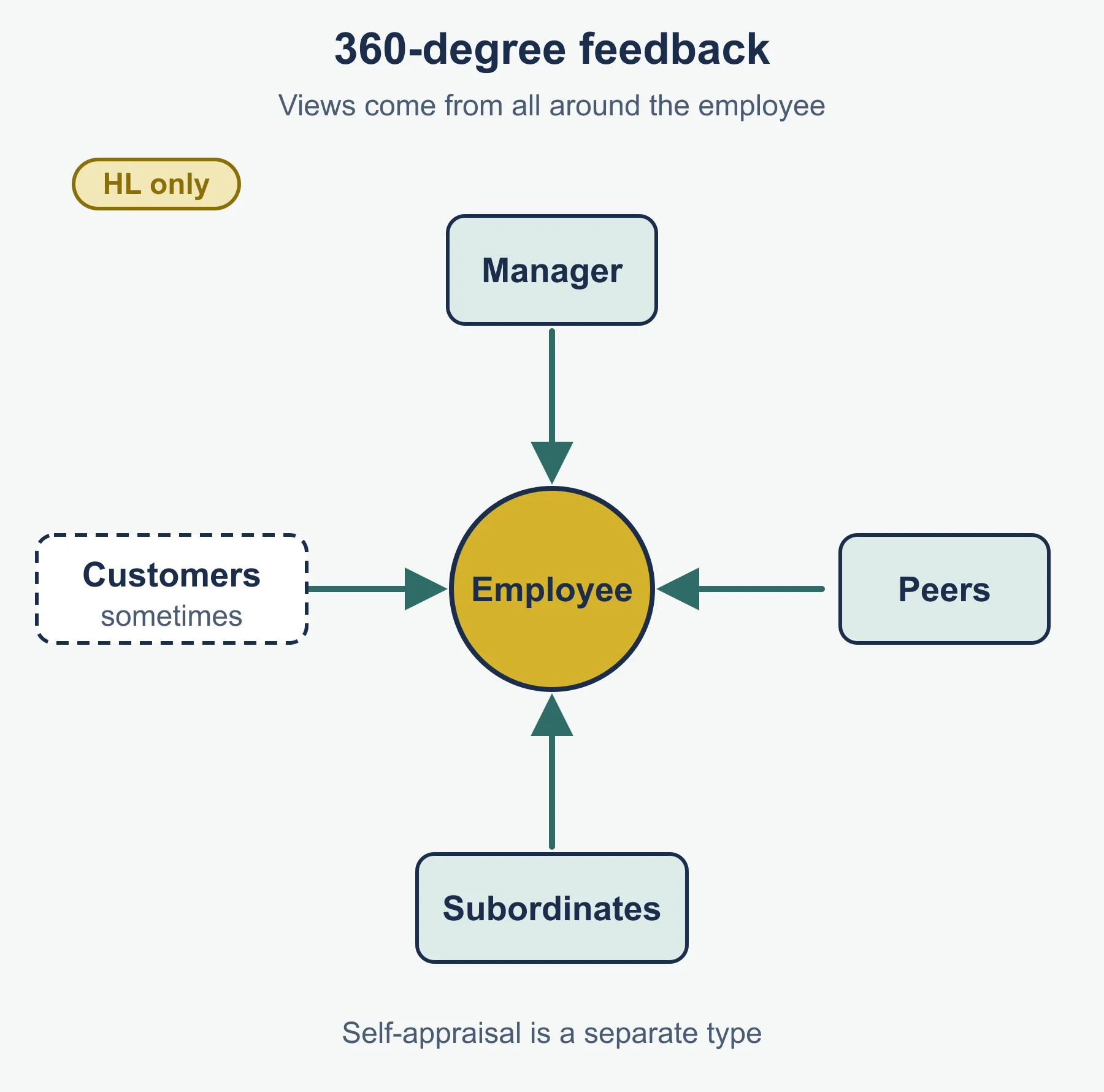
| 360-degree feedback | Views from managers, peers, subordinates, sometimes customers | Usually periodic |
| Self-appraisal | Employee reviews own performance | Before a meeting with the manager |
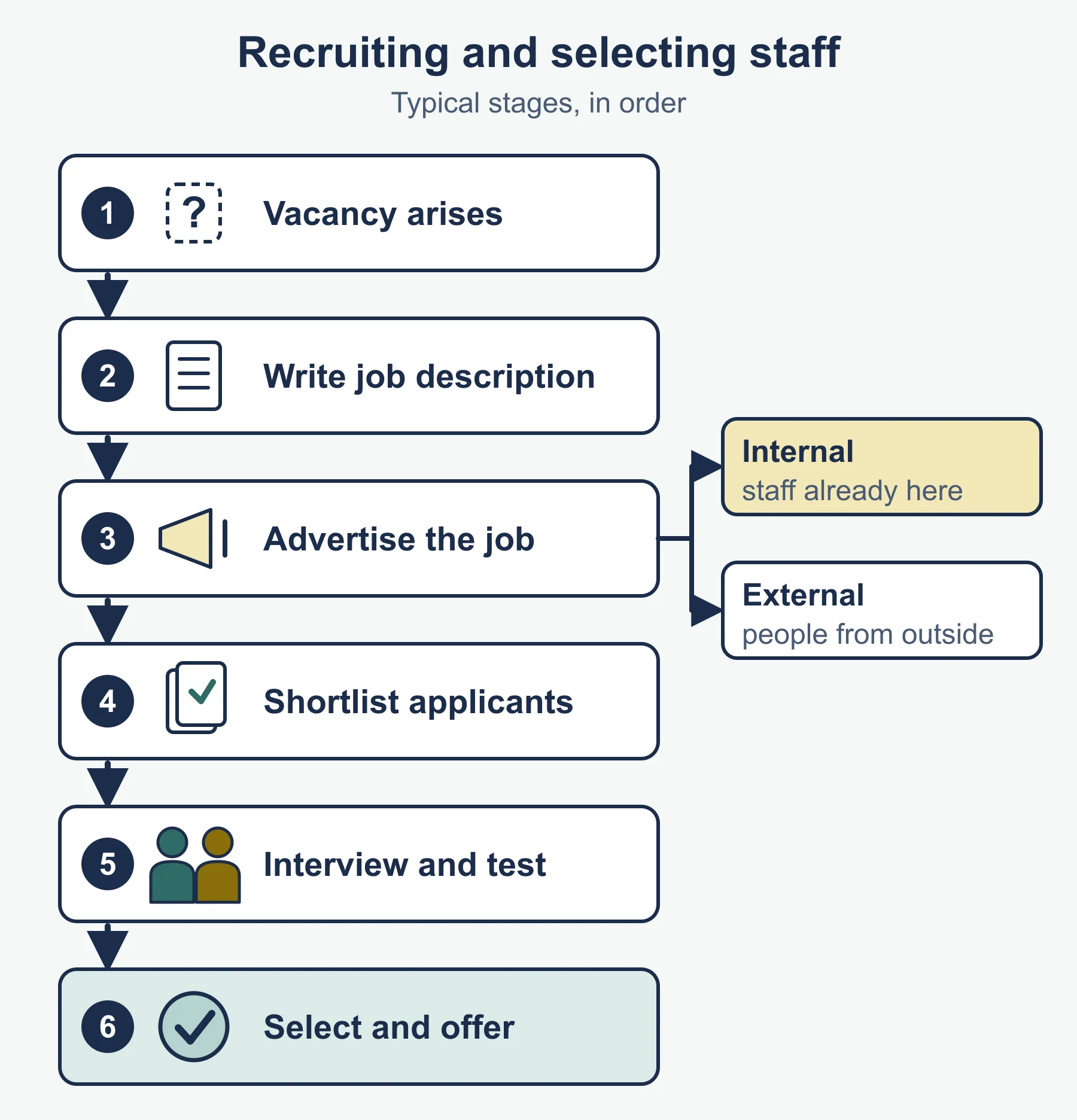
HL only: recruitment
Standard methods: job advertisement, recruitment agency, headhunting, employee referral.
| Internal | External | |
|---|---|---|
| For | Cheaper, faster, known person, promotion prospects | Larger pool, new skills and ideas |
| Against | Small pool, few new ideas, creates another vacancy | Costly, slower, longer induction, may upset existing staff |
Financial rewards (SL and HL)
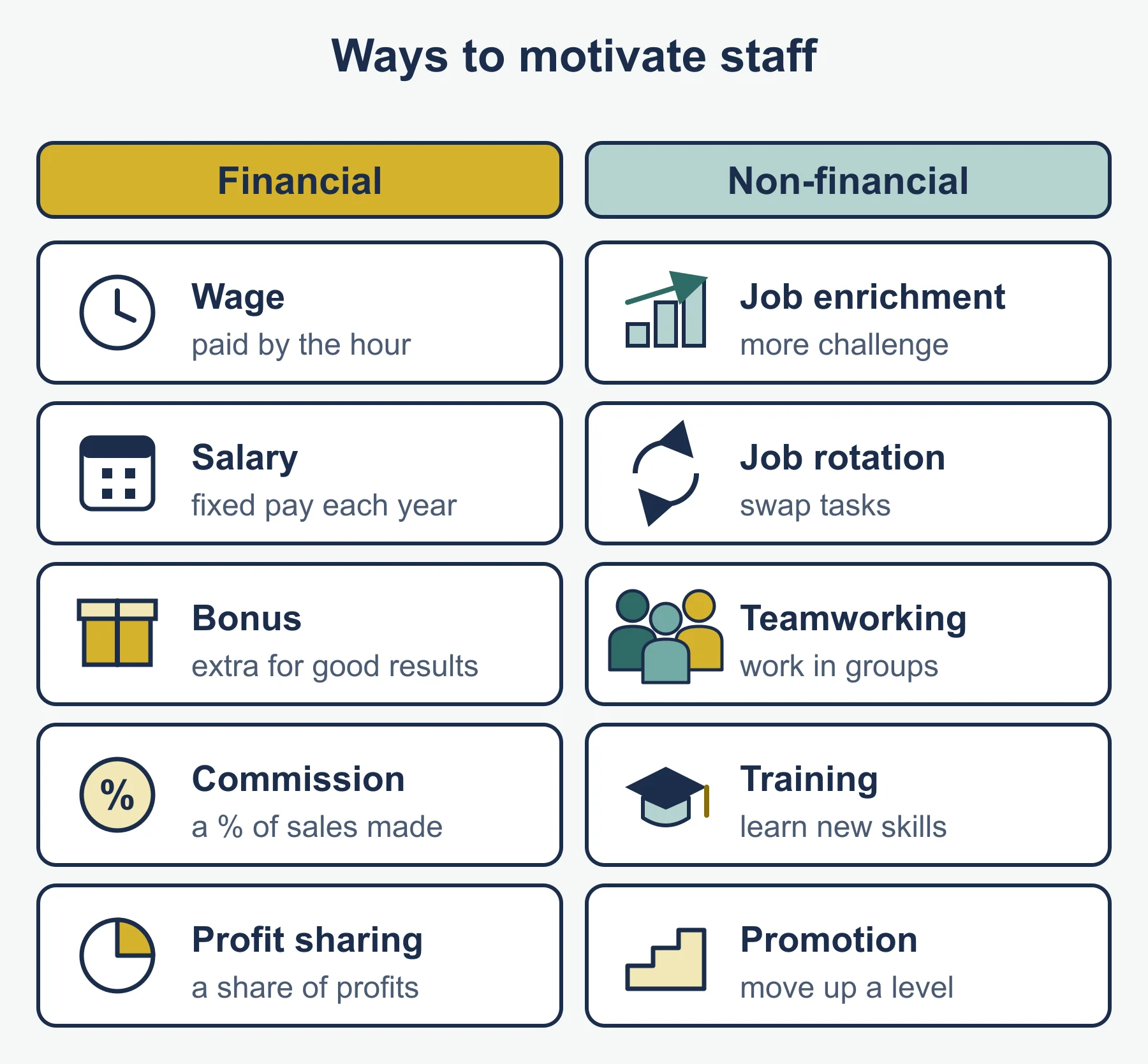
| Reward | Detail | Watch for |
|---|---|---|
| Salary | Fixed annual amount | Not linked to effort |
| Wages | Time rate (per hour) or piece rate (per unit) | Rushing under piece rate |
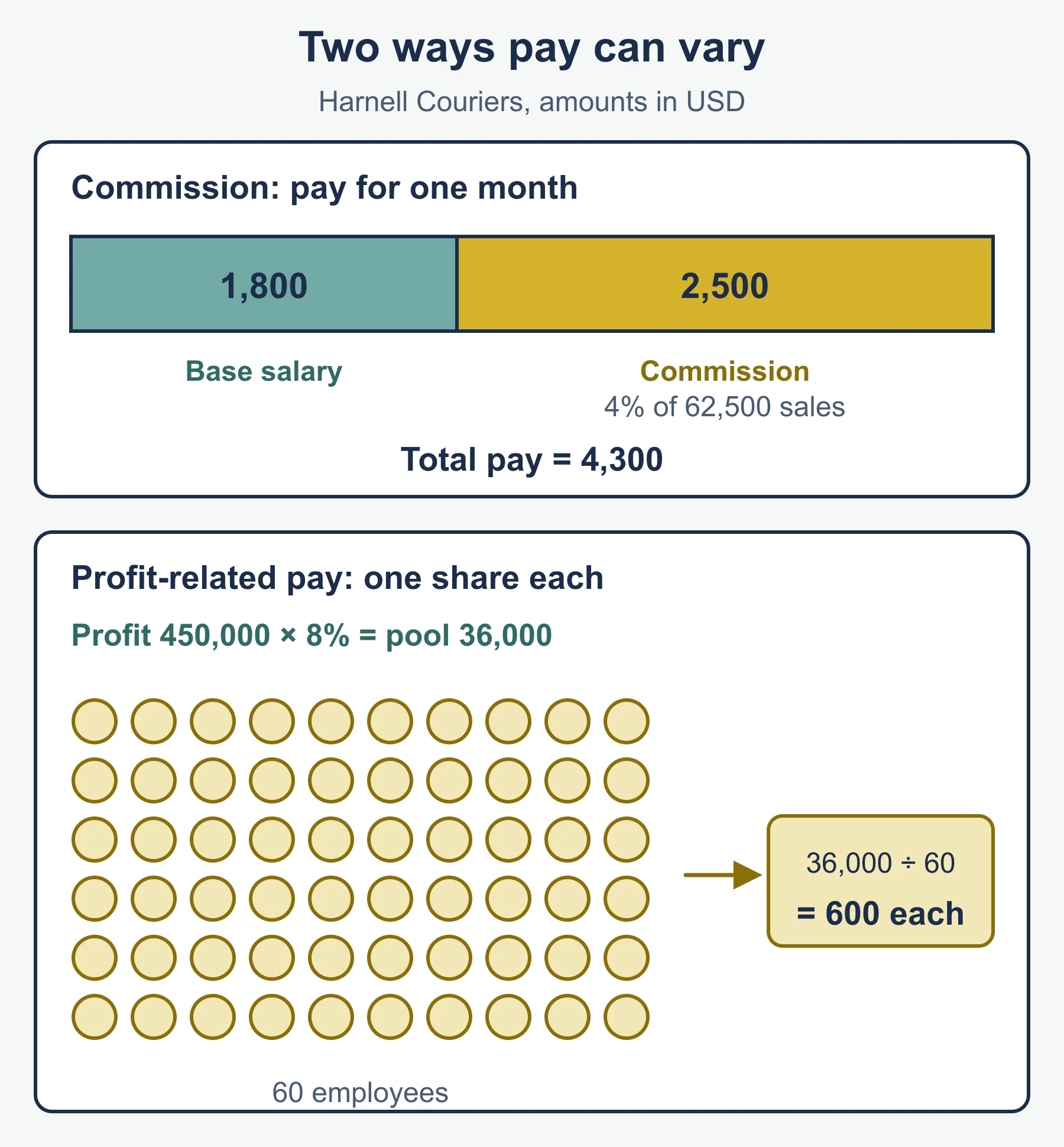
| Commission | Percentage of sales | Pressure selling |
| Performance-related pay (PRP) | Linked to targets | Fair measurement |
| Profit-related pay | Share of profit | Depends on factors staff cannot control |
| Employee share ownership schemes | Employees hold shares | Value can fall |
| Fringe payments | Benefits in kind | Not tied to effort |
Method for pay calculations:
- Identify the pay type.
- Calculate each part (rate × quantity, or percentage × base).
- Add the parts and compare.
Reminders:
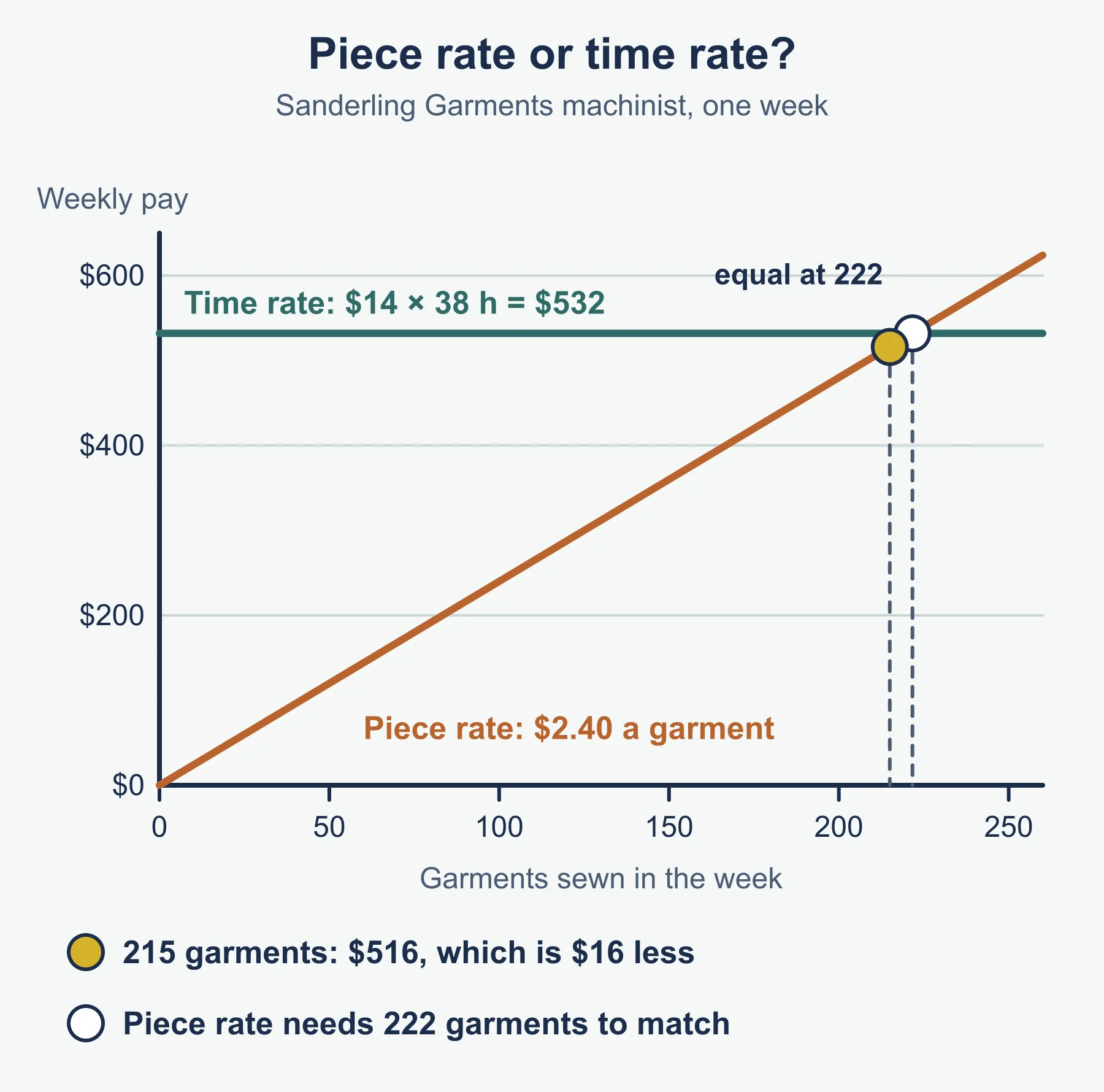
- Piece rate 3.10 for 180 units gives 558. Time rate 11.50 for 40 hours gives 460.
- Commission of 6% on sales of 48,000 gives 2,880.
- A profit-related pool of 5% of 320,000 is 16,000. Shared among 40 staff, it gives 400 each.
Non-financial rewards (SL and HL)
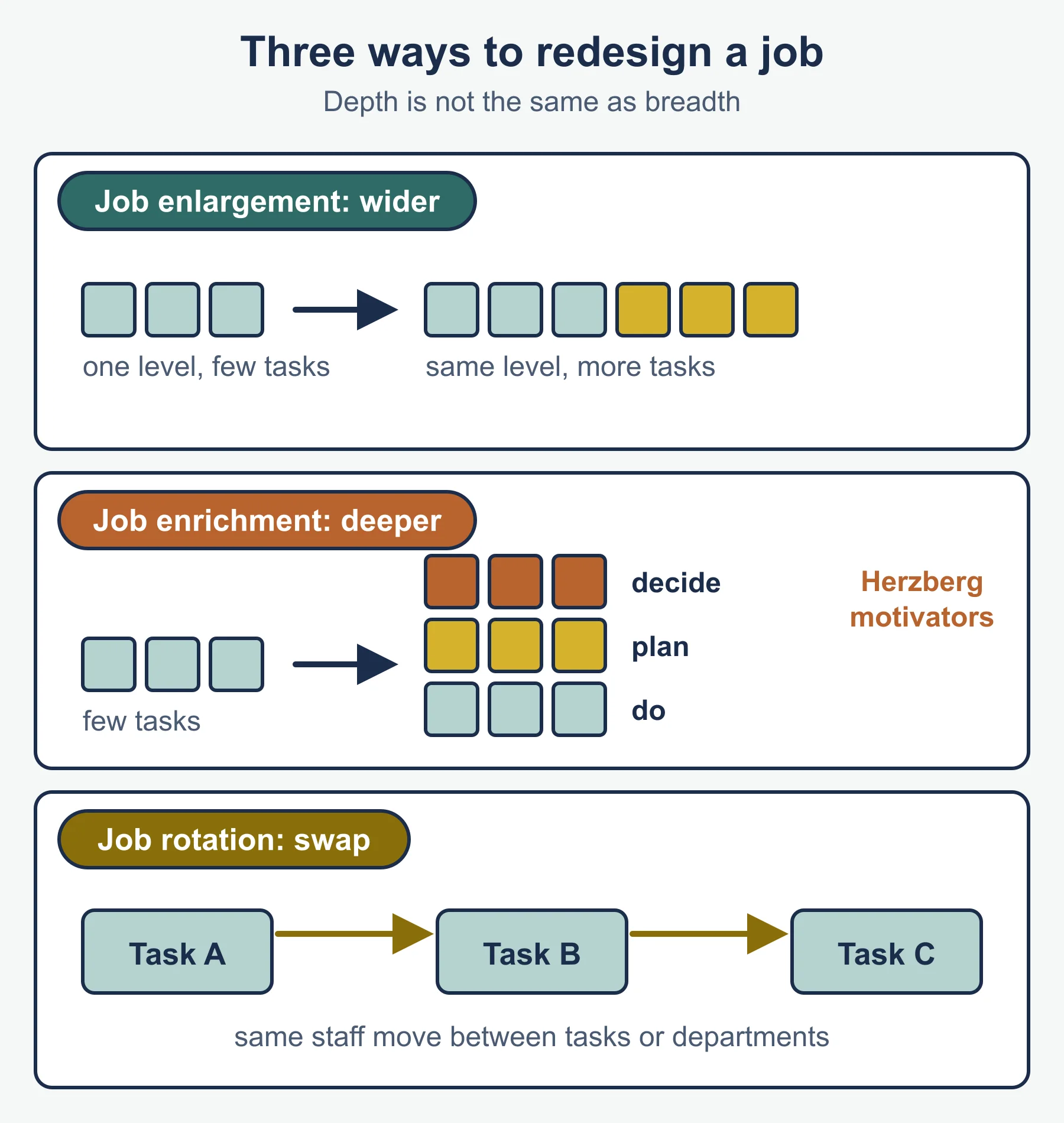
| Reward | Meaning | Direction |
|---|---|---|
| Job enrichment | More responsibility and challenge | Vertical |
| Job enlargement | More tasks of similar level | Horizontal |
| Job rotation | Moving between tasks | Variety and skill |
| Empowerment | Authority to decide | Autonomy |
| Purpose/opportunity to make a difference | Work linked to a worthwhile outcome | Meaning |
| Teamwork | Shared tasks and group goals | Belonging |
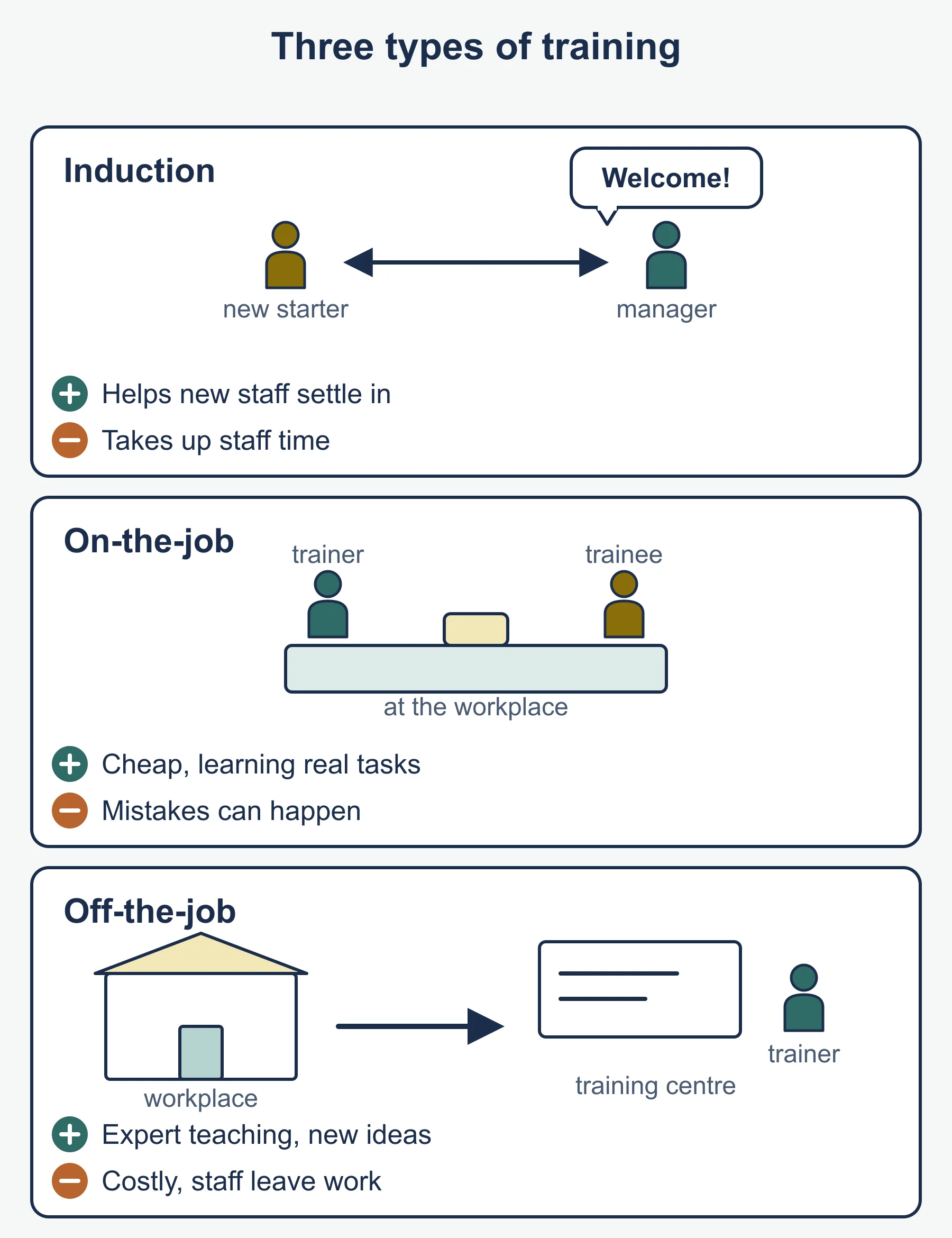
Training (SL and HL)
| Type | Strength | Weakness |
|---|---|---|
| Induction | Settles new staff, covers safety and rules | Takes time; weak if rushed |
| On the job | Cheap, relevant | Depends on the trainer; may disrupt work |
| Off the job | Wider skills, expert input | Costly; time away from work |
Linking rewards to theories
| Reward or method | Theory it fits best | Reason |
|---|---|---|
| Piece rate | Taylor | Pay rises with output |
| Fringe payments such as health cover | Maslow (safety), Herzberg (hygiene) | Meets security needs without creating drive |
| Job enrichment | Herzberg | Adds responsibility and achievement |
| Empowerment | Herzberg, and self-determination (HL only) | Gives autonomy and trust |
| Teamwork | Maslow (belonging) | Meets social needs |
| Promotion and recognition | Maslow (esteem) | Status and respect |
| Employee share ownership | Equity theory (HL only) | Staff share in the gains they help produce |
Signs and causes of demotivation
Signs: absence, lateness, falling output, more complaints, more errors, resignations.
Causes to link to a case:
- Pay seen as unfair compared with colleagues (equity, HL only).
- Boring, repetitive work with no say in how it is done.
- Poor supervision or no feedback.
- No route to promotion.
- Unsafe or uncomfortable conditions.
- Targets that feel impossible, so effort seems pointless (expectancy, HL only).
Possible responses: raise pay if it is clearly below the market, redesign jobs, add training, improve appraisal, and set fair targets. Always match the response to the cause the case describes.
Short answer routine
- Define the term or name the theory in one line.
- Apply it to the business with a fact from the case.
- Explain the effect on motivation, and say who gains or loses.
- For “evaluate” or “justify”, add a counter-argument and a judgment.
Quick self-test
- Name Maslow’s highest level.
- Is job security a hygiene factor or a motivator in Herzberg’s theory?
- Which type of pay did Taylor favor?
- Distinguish job enrichment from job enlargement in one sentence each.
- Calculate piece-rate pay: 3.10 per unit, 180 units.
- (HL only) Calculate labour turnover: 9 leavers, average workforce 72.
- (HL only) Opening 80, closing 100, 27 leavers. Calculate labour turnover.
- Calculate commission at 6% on sales of 48,000.
- (HL only) State the three needs in McClelland’s theory.
- (HL only) Which appraisal type is linked to pay and promotion decisions?
- State one advantage of off the job training and one disadvantage.
Answers
- Self-actualization.
- Hygiene factor.
- Piece rate.
- Enrichment gives more responsibility and challenge. Enlargement gives more tasks at the same level.
- 3.10 × 180 = 558.
- 9 ÷ 72 × 100 = 12.5%.
- Average = 90, so 27 ÷ 90 × 100 = 30%.
- 0.06 × 48,000 = 2,880.
- Achievement, affiliation and power.
- Summative appraisal.
- Advantage: wider skills from experts. Disadvantage: higher cost, or time away from work.
Evaluation prompts
- Which theory fits the case best, and what evidence in the case supports it?
- Would the reward still work for a different type of employee?
- What are the costs and the time frame?
- What is the risk of demotivation if the reward is removed or seems unfair?
Where marks are usually lost
- Describing Maslow or Herzberg in general terms but never tying them to the named firm in the stem.
- Treating job enrichment and job enlargement as the same thing.
- Using the opening headcount rather than the average in labour turnover.
- Forgetting the unit (percent or currency) in a calculation.
- Giving only one side in an “evaluate” or “justify” answer.
- Listing rewards without linking them to a theory or to the employees concerned.
- Saying pay “does not matter” because of Herzberg. His claim is that pay does not create lasting motivation, not that it is irrelevant.
- Answering an SL question with HL content that is not asked for.
Frequently asked questions
What is the difference between hygiene factors and motivators? In Herzberg’s theory, hygiene factors such as pay, working conditions, policy, supervision and job security prevent dissatisfaction. Motivators such as achievement, recognition, responsibility, the work itself and advancement create lasting satisfaction.
What are the five levels of Maslow’s hierarchy of needs? From lowest to highest, the levels are physiological, safety, love/belonging (social), esteem and self-actualization.
What is the difference between formative and summative appraisal? Formative appraisal is ongoing feedback aimed at development, such as coaching. Summative appraisal is a review at the end of a period that judges performance, often linked to pay or promotion; appraisal is HL only in section 2.4.
What are the signs of demotivation at work? Signs include absence, lateness, falling output, more complaints, more errors and resignations. Link them to a cause in the case, such as pay seen as unfair, repetitive work or no route to promotion.
Official syllabus
IB Diploma Programme Business management guide, first assessment 2024, International Baccalaureate Organization. Section 2.4, Motivation and demotivation, in Unit 2: Human resource management.
Get free revision emails (optional)
Occasional emails with practice questions, worked explanations and links to free resources for the qualification and subjects you choose. No spam, and you can unsubscribe from any email. The free tools on this site never need an email.
Related resources
-
Study guides
IB DP Business Management: Organizational (corporate) culture (HL only)
Study guide to IB DP Business Management 2.5 (HL only): organizational culture, Handy's Gods of management and cultural clashes in change.
Business · International Baccalaureate · IB
Read guide -
Practice questions
IB DP Business Management: Organizational (corporate) culture (HL only) – Practice Questions
Original practice questions with worked answers on IB DP Business Management 2.5 (HL only): culture, Handy's types, Hofstede and cultural clashes.
Business · International Baccalaureate · IB
Try questions -
Revision notes
IB DP Business Management: Organizational (corporate) culture (HL only) – Revision Notes
Condensed revision notes for IB DP Business Management 2.5 (HL only): definitions, Handy's four cultures, Hofstede and cultural clashes, with a self-test.
Business · International Baccalaureate · IB
Revise topic
Related articles
-
teaching
A Level tuition in Dubai: Cambridge or Pearson Edexcel International A Level?
Schools in Dubai and Abu Dhabi teach either Cambridge International AS & A Level or Pearson Edexcel International A Level. How the two are structured, why it matters for tuition, and how online classes from Lahore work.
9 October 2026
-
curriculum guides
Choosing subjects at IGCSE and A Level
How subject choices at 14 and 16 affect university options later, and how to keep pathways open without overloading a timetable.
28 July 2026
Studying this with a teacher
Working through Business IB?
This page is free and stays free. If you would rather be taught it, Marlbridge runs Business classes one-to-one, online in your own time zone. The first trial class is free. WhatsApp replies within an hour (8am–11pm Pakistan time, every day); email the same day.
IB Business teachers at Marlbridge

