
Study Guides
IB DP Business Management: Organizational (corporate) culture (HL only)
Study guide to IB DP Business Management 2.5 (HL only): organizational culture, Handy's Gods of management and cultural clashes in change.
- Subject
- Business
- Level
- IB
- Topic
- Unit 2: Human resource management
- Author
- Marlbridge Academic Team
- Updated
- Reviewed by
- Salman Ahmad (what this means)
Aligned to International Baccalaureate IB Diploma Programme Business (DP Business Management), First assessment 2024. Official specification .
Syllabus page (what it covers and how it is assessed): IB Diploma Programme Business.
Syllabus points this page covers
DP Business Management
- 2.5 Organizational (corporate) culture (HL only)
Found an error? Report a correction.
Need help with this topic? Request a free trial class for IB Diploma Programme Business (DP Business Management).
This guide covers section 2.5, Organizational (corporate) culture, in Unit 2 (Human resource management) of the IB Business management guide, first assessment 2024. The whole section is HL only. SL candidates do not need it, and the guide’s assessment outline places HL extension topics in Paper 2 and Paper 3 for HL, not in Paper 1.
Use it with the revision notes and the practice questions. The course hub is IB DP Business Management, the printable list is the syllabus checklist, and the free diagnostics show where to start. Related pages: leadership and management, organizational structure and growth and evolution.
What 2.5 asks you to know
| Content point | Depth of teaching in the guide | Level |
|---|---|---|
| Organizational culture | AO1, knowledge and understanding | HL only |
| Types of organizational culture, for example Charles Handy’s “Gods of management” | AO2, application and analysis | HL only |
| Cultural clashes when organizations change, including growth, mergers and changes of leadership style | AO3, synthesis and evaluation | HL only |
The guide also lists Hofstede’s cultural dimensions as an HL only tool linked to Unit 2, so this guide uses it for culture differences between countries. The depth labels tell you how to write. A “define” or “state” question wants a precise statement. An “explain” or “analyse” question wants a type of culture applied to the business in the case. An “evaluate”, “discuss” or “recommend” question on clashes wants arguments on both sides and a judgement.
Organizational culture
The guide names the term without a definition, so this is the standard form. Organizational culture (also called corporate culture) is the set of shared values, beliefs, attitudes and accepted ways of behaving that shape how people in a business think and act. A common short version is “the way we do things here”.
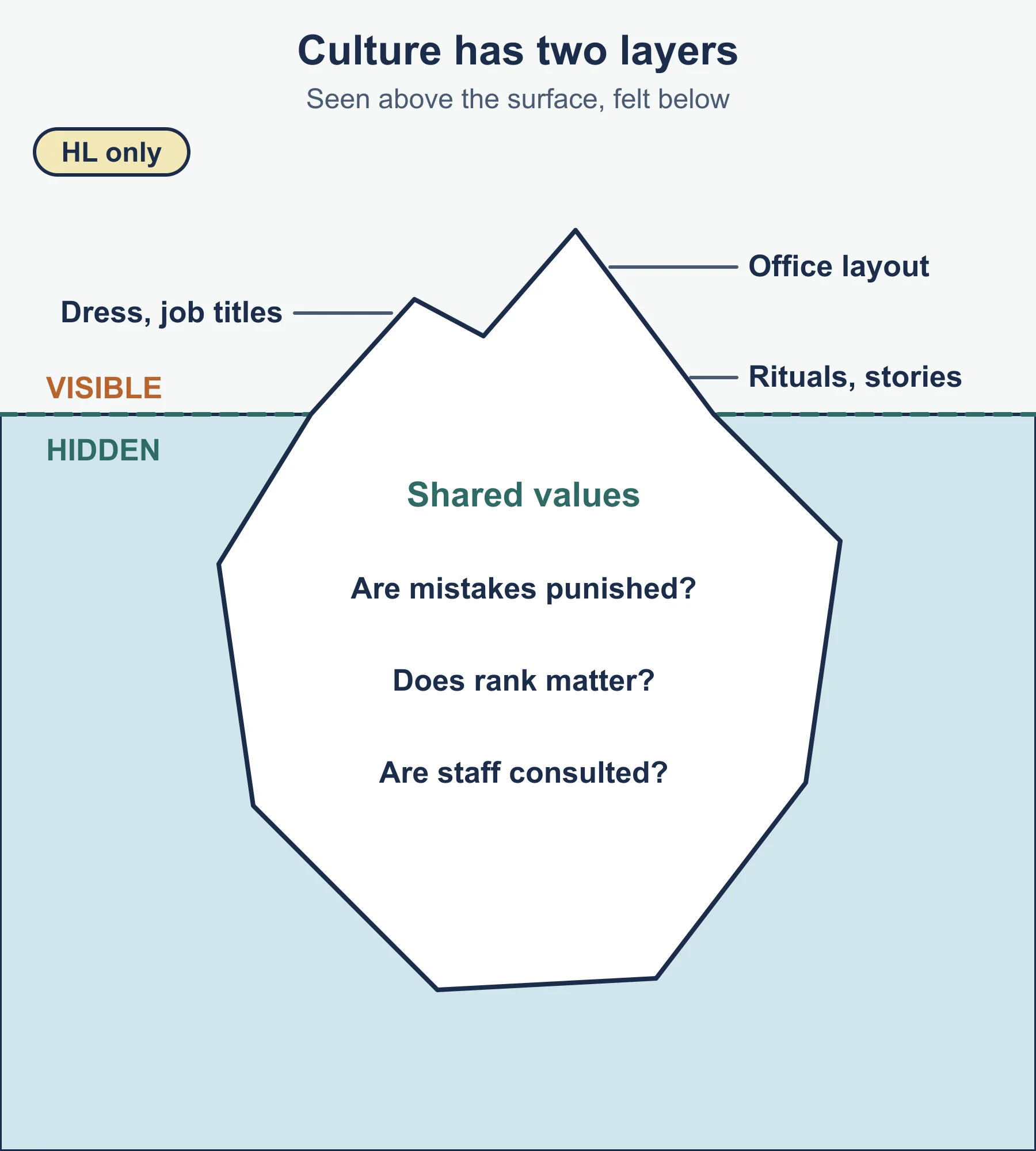
Culture has a visible layer and a hidden layer.
- Visible: dress, office layout, job titles, rituals such as a Friday review, the stories people tell about the founder, and how fast e-mails get answered.
- Hidden: the values underneath, such as whether mistakes are punished or used for learning, whether rank matters, and whether staff expect to be consulted.
Several things shape a culture: the founder’s beliefs, the leadership style, the history of the business, its structure, its industry, the countries it works in, its size, and the people it chooses to hire. Culture is not fixed. It moves slowly, which is why change is hard.
Why it matters to a business:
- Motivation and retention. Staff who share the values of the firm are more likely to stay.
- Recruitment. A clear culture attracts people who fit it and puts off those who do not.
- Decision speed. A culture of sign-offs slows action, and a culture of trust speeds it.
- Customer service. Culture shows up in how staff treat customers when nobody is watching.
- Change. A culture that resists new ideas makes any change harder.
A strong culture is one that most employees share and act on. It brings consistency, but it can also make a firm slow to adapt. A subculture is a distinct set of values within one part of the business, for example the sales team versus the engineers.
Handy’s Gods of management
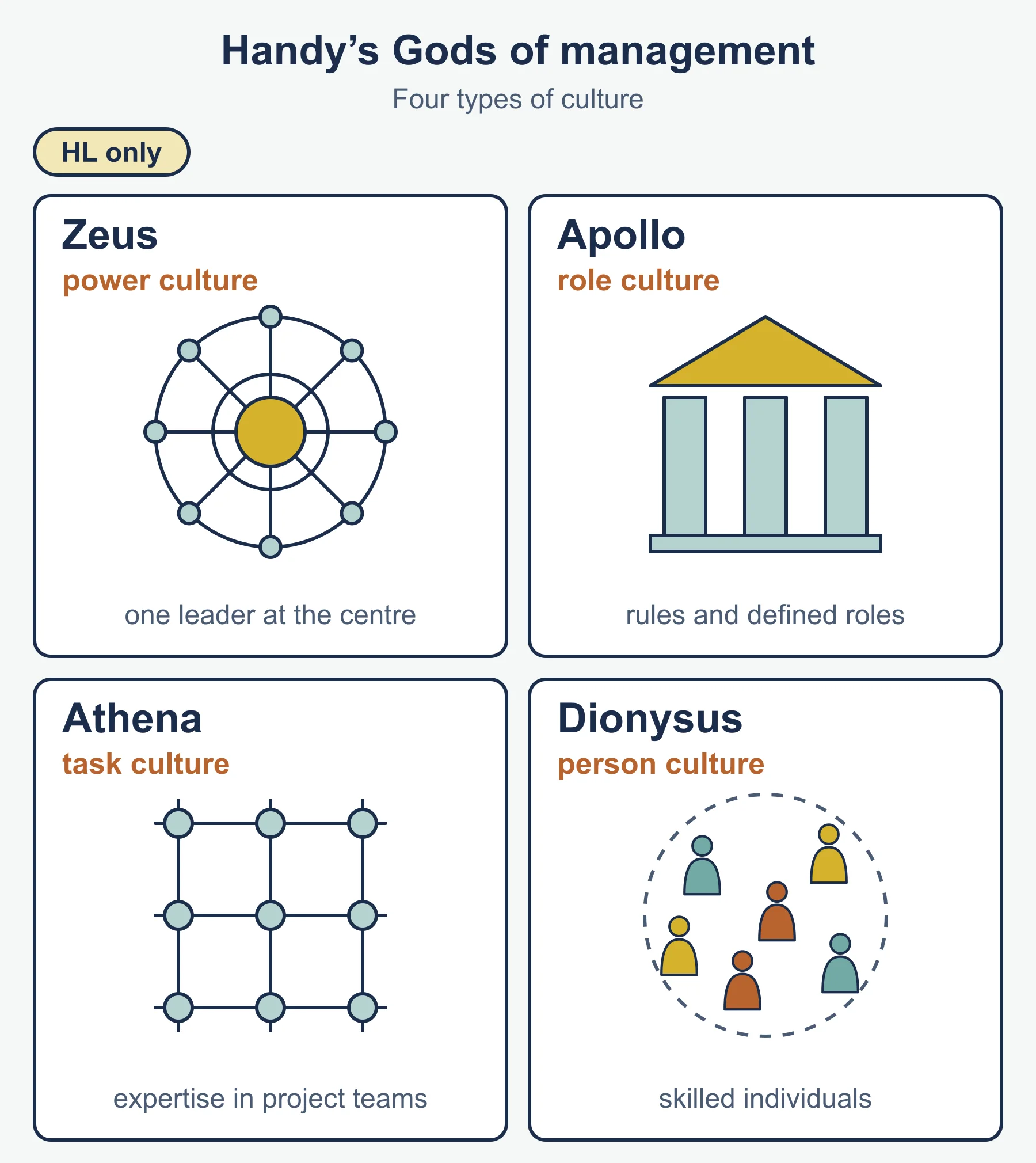
Charles Handy described four types of culture and gave each the name of a Greek god. The guide gives this as an example, so you may meet other classifications, but this is the one to know well.
| Culture | Source of power | Typical structure | Strengths | Weaknesses |
|---|---|---|---|---|
| Zeus (power culture) | One person or a small group at the centre | Web with the leader in the middle | Fast decisions, strong direction | Depends on the leader; others have little say |
| Apollo (role culture) | Rules and defined roles | Hierarchy of departments | Stable, clear, efficient in predictable conditions | Slow to change, bureaucratic |
| Athena (task culture) | Expertise and the task | Teams formed for projects, like a net or matrix | Flexible, creative, teams own results | Can be hard to control; resources compete between teams |
| Dionysus (existential or person culture) | The individual professional | Loose group of specialists | High autonomy for skilled people | Hard to manage; the group exists to serve its members |
Applying the types
Copperfold Studio (invented) is a design business with 12 staff. The founder approves every proposal and chooses every hire. Staff say “ask Mara”. That is a Zeus culture. It works at this size because decisions are quick and the vision is clear.
A regional tax authority (invented, generic) runs on job descriptions, approval forms and promotion by length of service. That is an Apollo culture, which suits work where accuracy and consistency matter more than speed.
A product team at a software firm that forms around each launch, with members chosen for skill rather than rank, shows an Athena culture.
A partnership of consultants, where each partner brings their own clients and the firm provides shared offices, is closer to Dionysus.
Most real businesses mix types. A hospital may be Apollo for its administration, Athena for a surgical team and Dionysus for senior consultants. In the exam, name the dominant type, give evidence from the case, and say whether it fits the business’s situation.
Fit between culture and situation
Culture is not good or bad in itself. Judge the fit.
- Stable, high-volume work with safety or accuracy risks suits Apollo.
- Fast-changing markets and project work suit Athena.
- A very small business with a strong founder can run on Zeus, but it becomes risky as the business grows.
- Highly skilled individual professionals may expect Dionysus-style freedom.
Hofstede’s cultural dimensions (HL only tool)
The guide does not list the dimensions, so this is the standard form. Hofstede compared national cultures on a number of dimensions, including power distance (how far people accept unequal power), individualism versus collectivism, uncertainty avoidance (comfort with ambiguity), masculinity versus femininity, and long-term orientation. Later work added indulgence versus restraint. It is about national culture, not company culture, but it is useful when a firm expands into another country or merges across borders.
Worked example: comparing two cultures
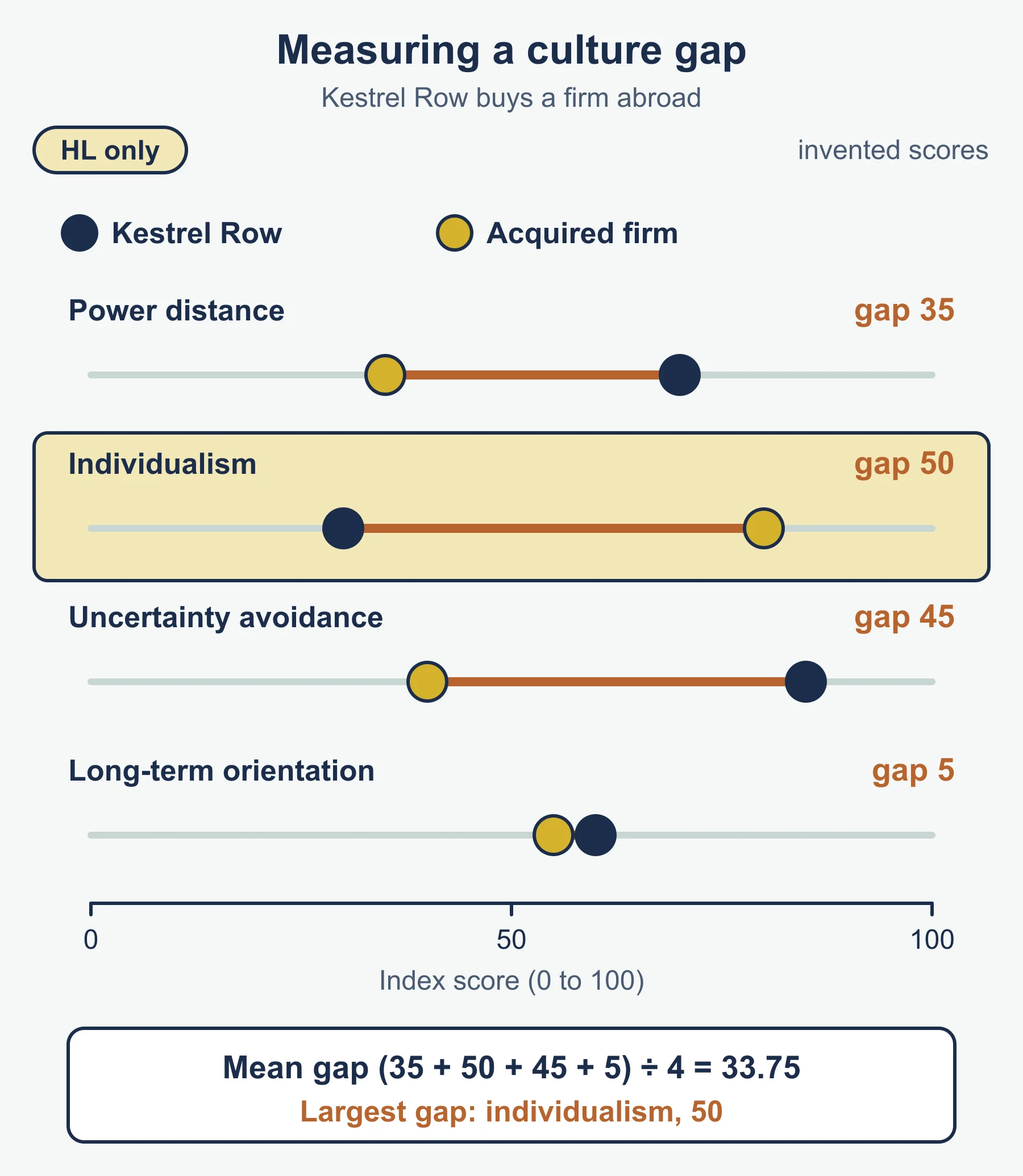
Kestrel Row Foods (invented, home country) plans to buy a small producer abroad. The table uses invented index scores from 0 to 100.
| Dimension | Kestrel Row | Acquired firm | Gap |
|---|---|---|---|
| Power distance | 70 | 35 | 35 |
| Individualism | 30 | 80 | 50 |
| Uncertainty avoidance | 85 | 40 | 45 |
| Long-term orientation | 60 | 55 | 5 |
The mean gap is (35 + 50 + 45 + 5) / 4 = 135 / 4 = 33.75. The largest gap is individualism (50). Kestrel Row’s staff are used to hierarchy, group loyalty and detailed rules. The acquired firm’s staff expect to make personal decisions with less supervision. Likely friction: the acquired staff may resist rigid approval chains, while Kestrel Row managers may see the new team as undisciplined. The small gap in long-term orientation suggests planning horizons are not a problem.
Limits of the tool: scores describe averages for countries, not individuals; firms and teams vary; and scores can age. Use them as a starting hypothesis, then check with evidence from the case.
Cultural clashes when organizations change
A cultural clash happens when groups with different values, rules or expectations have to work together, or when an established culture is disturbed. The guide names three triggers, “including but not limited to” them.
1. Growth
As a firm grows, the informal culture of a small team often cannot cope. Copperfold Studio might grow to 85 staff. The founder can no longer approve everything. Managers are hired and rules are introduced, so a Zeus culture drifts towards Apollo. Original staff may feel the “family feel” has gone, and newcomers may not understand the old unwritten habits. Opening a second site or going international adds geographic and national differences.
2. Mergers and takeovers
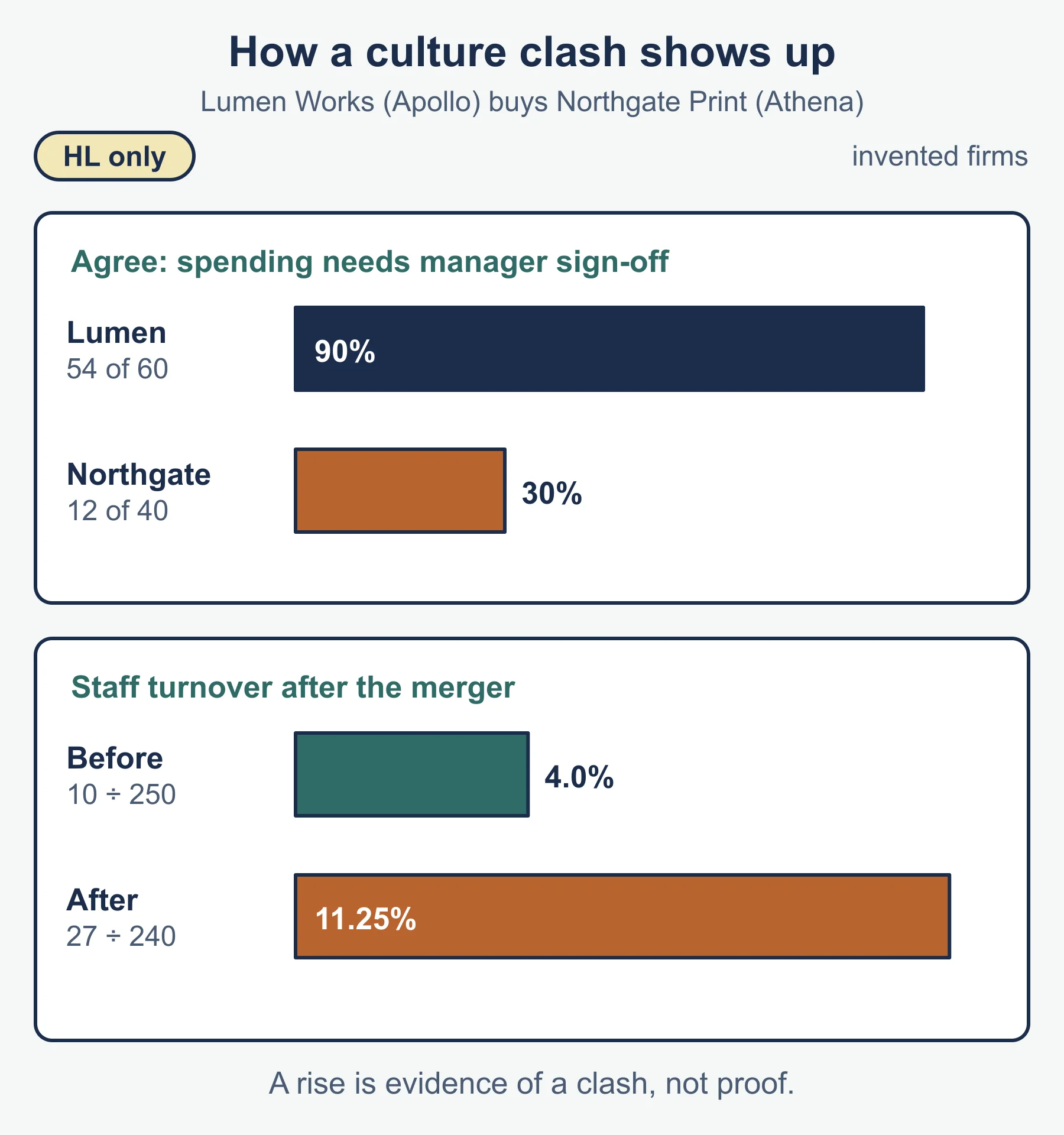
When two firms merge, or one buys another, two cultures meet. Lumen Works (invented, Apollo) buys Northgate Print (invented, Athena). In a staff survey, 54 of 60 Lumen staff (90%) agreed with “spending needs manager sign-off”, against 12 of 40 Northgate staff (30%). Northgate’s teams are used to deciding in the project group, so the new approval steps feel like distrust. Typical consequences:
- an “us and them” attitude between the two groups
- loss of key staff, particularly from the acquired firm
- slower decisions and lower morale
- extra costs in recruitment and training
- failure to achieve the benefits the merger planned
Staff turnover rate is the standard form: leavers in the period divided by average staff, times 100. If 27 staff leave a firm that averaged 240 employees, turnover is 27 / 240 x 100 = 11.25%, compared with 10 / 250 x 100 = 4.0% a year earlier. A rise like this, after a merger, is evidence of a clash, though you must say other causes are possible.
3. Change of leadership style
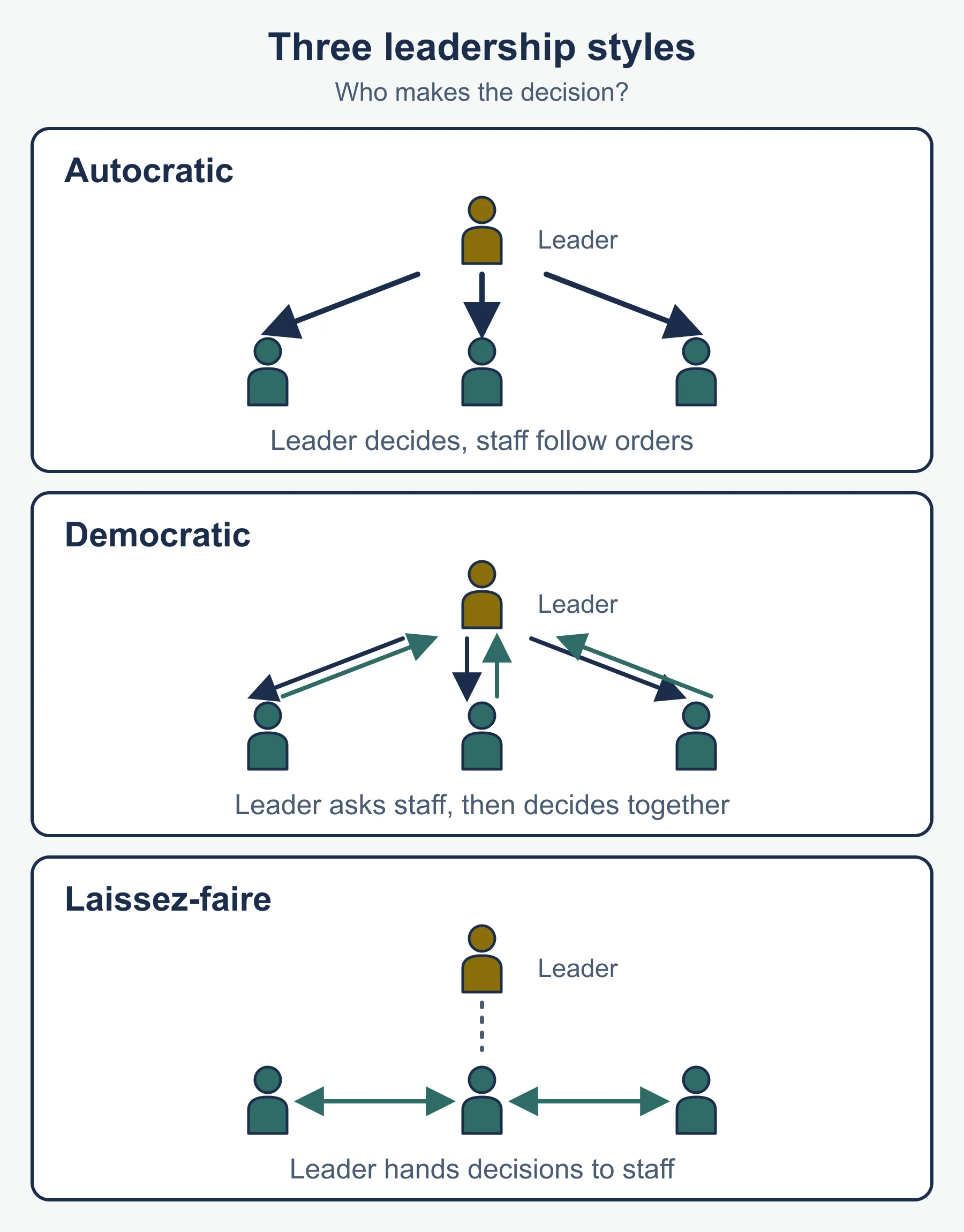
If a new chief executive replaces an autocratic leader with a democratic one, staff used to clear orders may feel unsure what is expected. Moving the other way, from a participative style to tight control, can feel like a loss of trust and fall hard on motivation. See leadership and management for the styles. The same effect arises when a new manager is promoted from outside and does things differently.
Managing a clash
Options a business can use:
- Culture audit. Survey and interview staff before a merger to find the gaps. Then plan around them.
- Clear communication. Explain why the change is happening and what stays the same.
- Involve staff. Mixed teams, joint workshops and consultation reduce resistance.
- Lead by example. Senior managers must follow the new values.
- Training and induction. Teach new routines and the values behind them.
- Choose an approach. Either one culture dominates, a blended culture is built, or the two units are kept separate for a time.
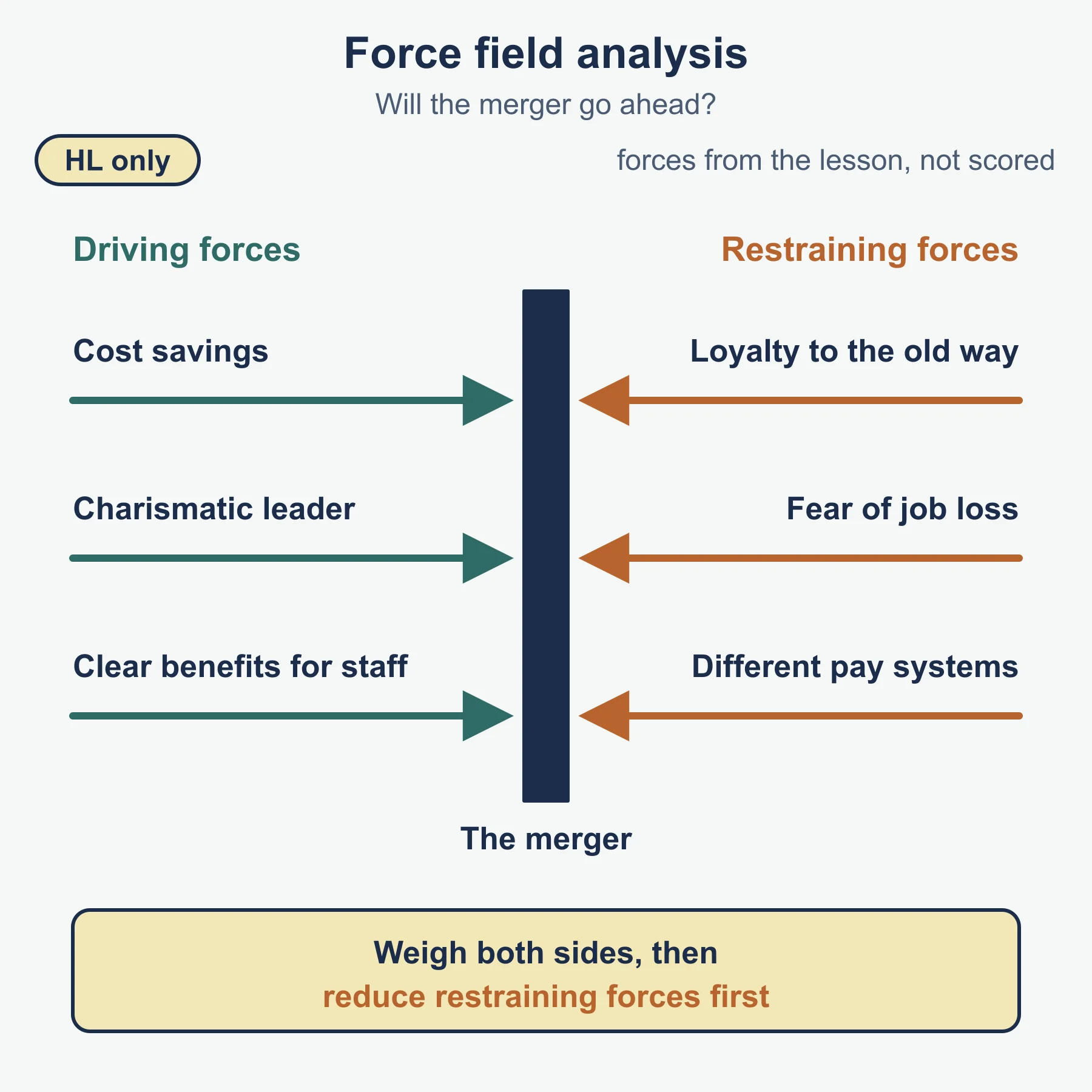
Force field analysis (HL only, a suggested Unit 2 tool) fits here. List driving forces (cost savings, a charismatic leader, clear benefits for staff) and restraining forces (loyalty to the old way, fear of job loss, different pay systems). Weighing the two sides shows whether the change will go ahead and which restraining forces to reduce first.
To evaluate, weigh the points. A strong, consistent culture can be an asset, but changing it quickly can cost key staff. A slow integration protects morale but delays savings. Judgement depends on how large the gap is, how skilled the staff are (and so how easy they are to replace), and how urgent the change is.
Common errors
- Describing culture as only the rules or the dress code. It also includes unwritten values.
- Naming a Handy type without evidence from the case.
- Calling one type “best” without considering the business’s situation.
- Treating Hofstede scores as facts about every person in a country.
- Listing clash problems without a judgement on how serious they are or how to manage them.
- Writing “Apollo” when you mean “Athena”. Remember the pairs: role and rules, task and teams.
Frequently asked questions
What is organizational culture? Organizational (corporate) culture is the shared values, beliefs and accepted behaviour in a business, often summed up as “the way we do things here”. It has a visible layer, such as dress and rituals, and a hidden layer of values underneath.
Why does organizational culture matter to a business? Culture affects motivation and retention, recruitment, decision speed, customer service and how easily the business can change. A culture that resists new ideas makes any change harder.
What causes a cultural clash? In section 2.5 the main triggers are growth, mergers and takeovers, and a change of leadership style. Each brings together groups with different values, rules or expectations.
Is one of Handy’s culture types the best? No. Culture is judged by fit: stable, high-volume work with safety risks suits Apollo, fast-changing project work suits Athena, a very small firm can run on Zeus, and highly skilled professionals may expect Dionysus-style freedom.
Official syllabus
IB Diploma Programme Business management guide (first assessment 2024), International Baccalaureate Organization, Unit 2, section 2.5 Organizational (corporate) culture (HL only). Test yourself with the practice questions.
Get free revision emails (optional)
Occasional emails with practice questions, worked explanations and links to free resources for the qualification and subjects you choose. No spam, and you can unsubscribe from any email. The free tools on this site never need an email.
Related resources
-
Practice questions
IB DP Business Management: Organizational (corporate) culture (HL only) – Practice Questions
Original practice questions with worked answers on IB DP Business Management 2.5 (HL only): culture, Handy's types, Hofstede and cultural clashes.
Business · International Baccalaureate · IB
Try questions -
Revision notes
IB DP Business Management: Organizational (corporate) culture (HL only) – Revision Notes
Condensed revision notes for IB DP Business Management 2.5 (HL only): definitions, Handy's four cultures, Hofstede and cultural clashes, with a self-test.
Business · International Baccalaureate · IB
Revise topic -
Study guides
IB DP Business Management: Communication and Industrial/employee relations (HL only)
Study guide to IB DP Business Management 2.6 communication and HL-only 2.7 industrial/employee relations: methods, barriers, conflict, resolution.
Business · International Baccalaureate · IB
Read guide
Related articles
-
teaching
A Level tuition in Dubai: Cambridge or Pearson Edexcel International A Level?
Schools in Dubai and Abu Dhabi teach either Cambridge International AS & A Level or Pearson Edexcel International A Level. How the two are structured, why it matters for tuition, and how online classes from Lahore work.
9 October 2026
-
curriculum guides
Choosing subjects at IGCSE and A Level
How subject choices at 14 and 16 affect university options later, and how to keep pathways open without overloading a timetable.
28 July 2026
Studying this with a teacher
Working through Business IB?
This page is free and stays free. If you would rather be taught it, Marlbridge runs Business classes one-to-one, online in your own time zone. The first trial class is free. WhatsApp replies within an hour (8am–11pm Pakistan time, every day); email the same day.
IB Business teachers at Marlbridge

