
Study Guides
IB DP Business Management: Growth and evolution and Multinational companies (MNCs)
Study guide to IB DP Business Management sections 1.5 and 1.6: economies of scale, growth methods, franchising and the impact of MNCs on host countries.
- Subject
- Business
- Level
- IB
- Topic
- Unit 1: Introduction to business management
- Author
- Marlbridge Academic Team
- Updated
- Reviewed by
- Salman Ahmad (what this means)
Aligned to International Baccalaureate IB Diploma Programme Business (DP Business Management), First assessment 2024. Official specification .
Syllabus page (what it covers and how it is assessed): IB Diploma Programme Business.
Syllabus points this page covers
DP Business Management
- 1.5 Growth and evolution
- 1.6 Multinational companies (MNCs)
Found an error? Report a correction.
Need help with this topic? Request a free trial class for IB Diploma Programme Business (DP Business Management).
This guide covers sections 1.5 (Growth and evolution) and 1.6 (Multinational companies (MNCs)) of Unit 1 in the IB Business management guide, first assessment 2024. The guide gives no HL-only label to either section, so read them as content for both SL and HL. Use it with the syllabus guide, the revision notes and the practice questions. The course page is IB DP Business Management, the printable list is the checklist, and the free diagnostics show where to start.
All businesses in this guide are invented. Where the guide names a topic but gives no definition, the wording here is the standard textbook form, and it is flagged as such.
What you must be able to do
| Section | Point the guide lists | Depth |
|---|---|---|
| 1.5 | Internal and external economies and diseconomies of scale | AO2 |
| 1.5 | The difference between internal and external growth | AO2 |
| 1.5 | Reasons for businesses to grow | AO3 |
| 1.5 | Reasons for businesses to stay small | AO3 |
| 1.5 | External growth methods: mergers and acquisitions (M&As), takeovers, joint ventures, strategic alliances, franchising | AO3 |
| 1.6 | The impact of MNCs on the host countries | AO3 |
AO2 points ask you to apply and analyse. AO3 points ask you to weigh up and reach a judgement, so expect “evaluate”, “justify”, “recommend” and “to what extent” on them. The guide also lists the Ansoff Matrix among the suggested tools for Unit 1; it appears briefly below because it links growth direction to growth method.
Economies and diseconomies of scale
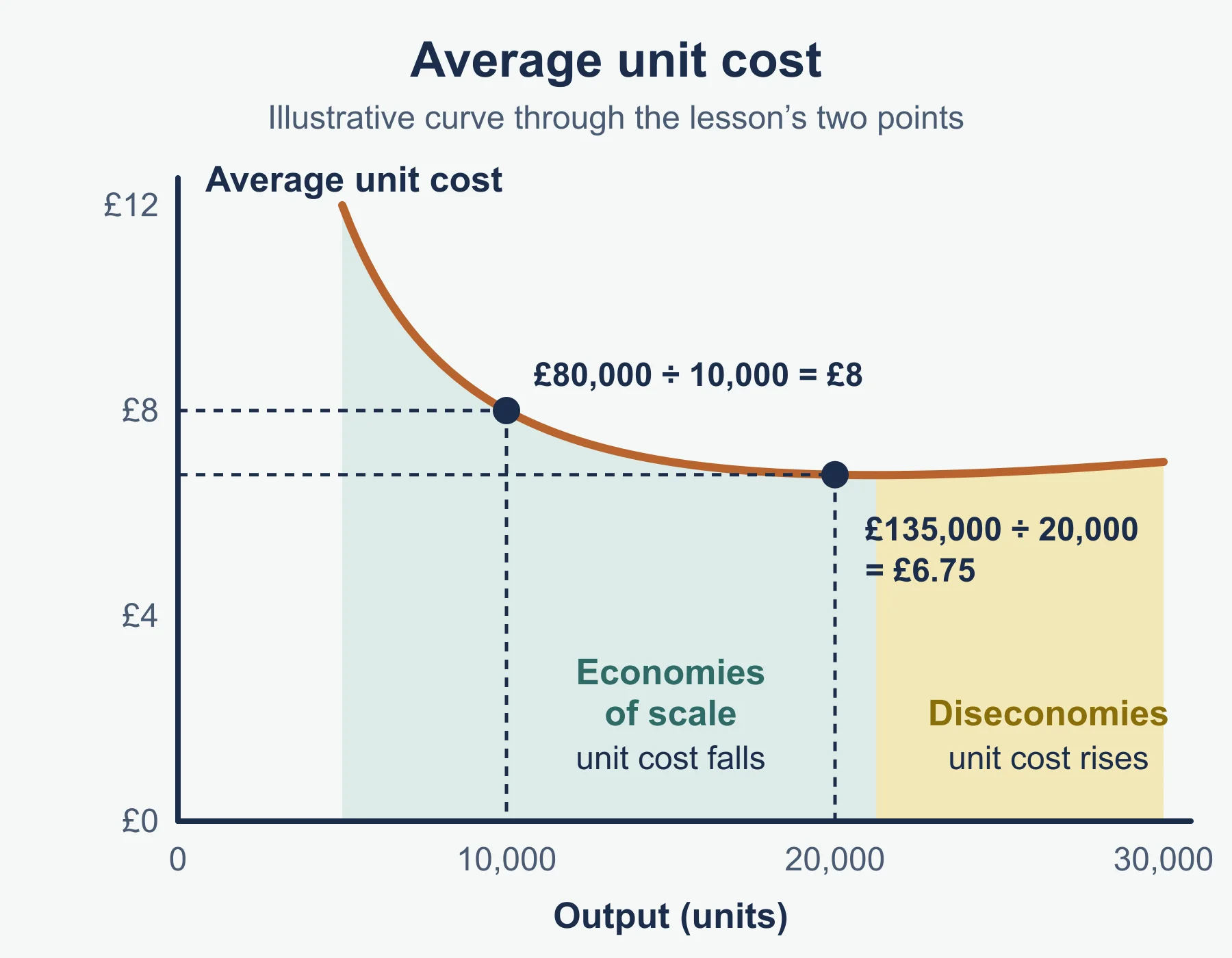
The size of a business’s operations is its scale. Dividing total cost by output gives average (unit) cost. When output rises and average cost falls, the business enjoys economies of scale. When output rises and average cost rises, it suffers diseconomies of scale.
Internal economies and diseconomies
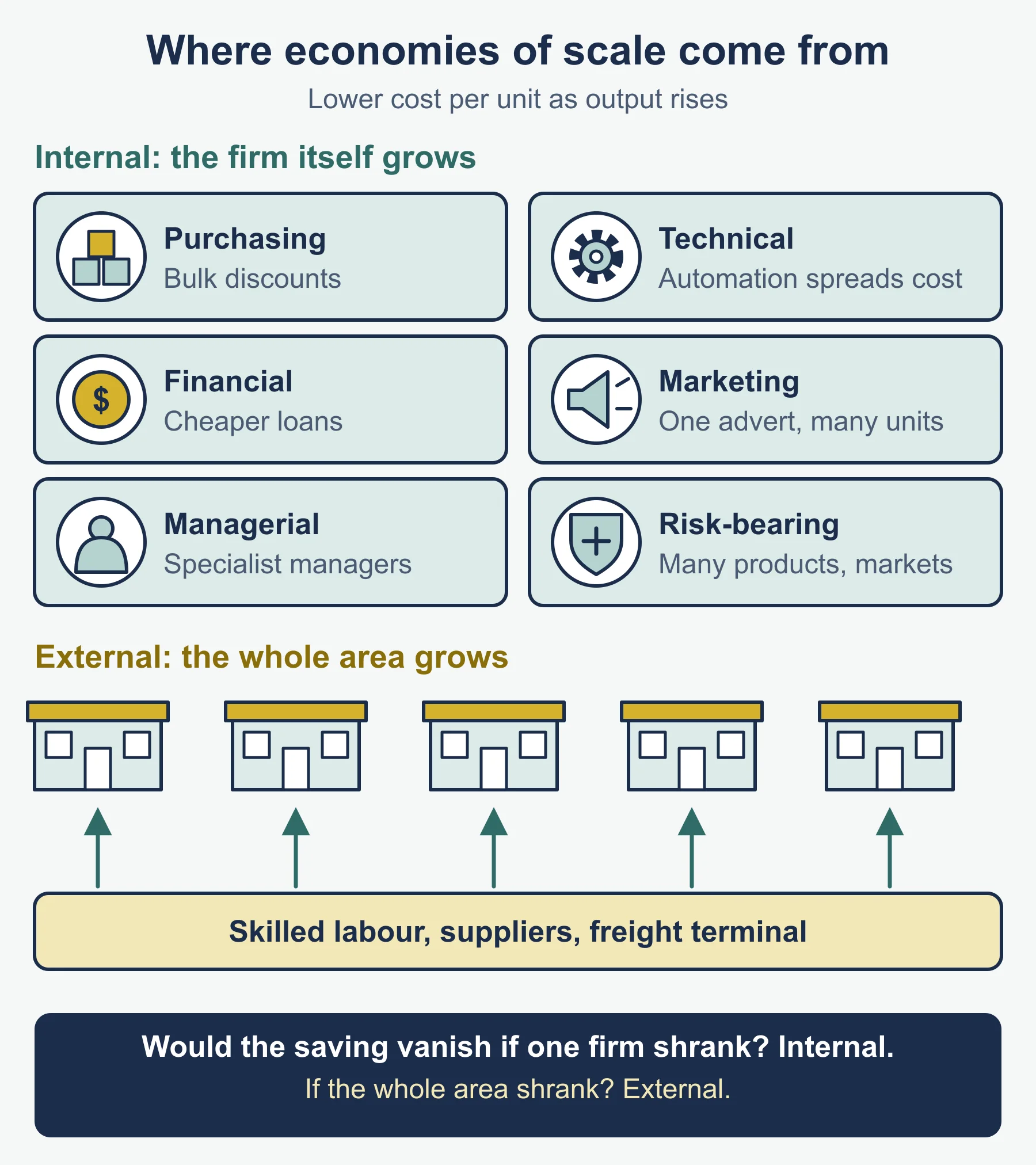
Internal ones arise because the business itself has become larger. These are the standard categories.
- Purchasing: bulk orders win discounts from suppliers.
- Technical: larger plant, automation or specialist machines spread their cost over more units.
- Financial: lenders see a large, established firm as safer, so its loans can carry a lower rate.
- Marketing: the cost of one advertising campaign is shared across many units.
- Managerial: specialist managers become affordable.
- Risk-bearing: a wider range of products or markets cushions a failure.
Internal diseconomies are the mirror image. Communication slows through more layers of management. Coordination across sites becomes harder. Motivation can fall when workers feel remote from decisions, which raises absenteeism and staff turnover and so raises cost per unit.
External economies and diseconomies
External ones depend on how big the industry or area has become, whatever any single firm does. If many firms in one sector cluster in a region, a pool of skilled labor develops, specialist suppliers arrive, and shared infrastructure such as a freight terminal is built. Every firm in the cluster gains. External diseconomies occur when the cluster grows too dense: road congestion, rising rents and wages, and competition for the same workers push every firm’s costs up.
The test for “internal or external” is simple. Ask: would the saving disappear if this one firm shrank, or if the whole area shrank?
Worked example: finding the pattern
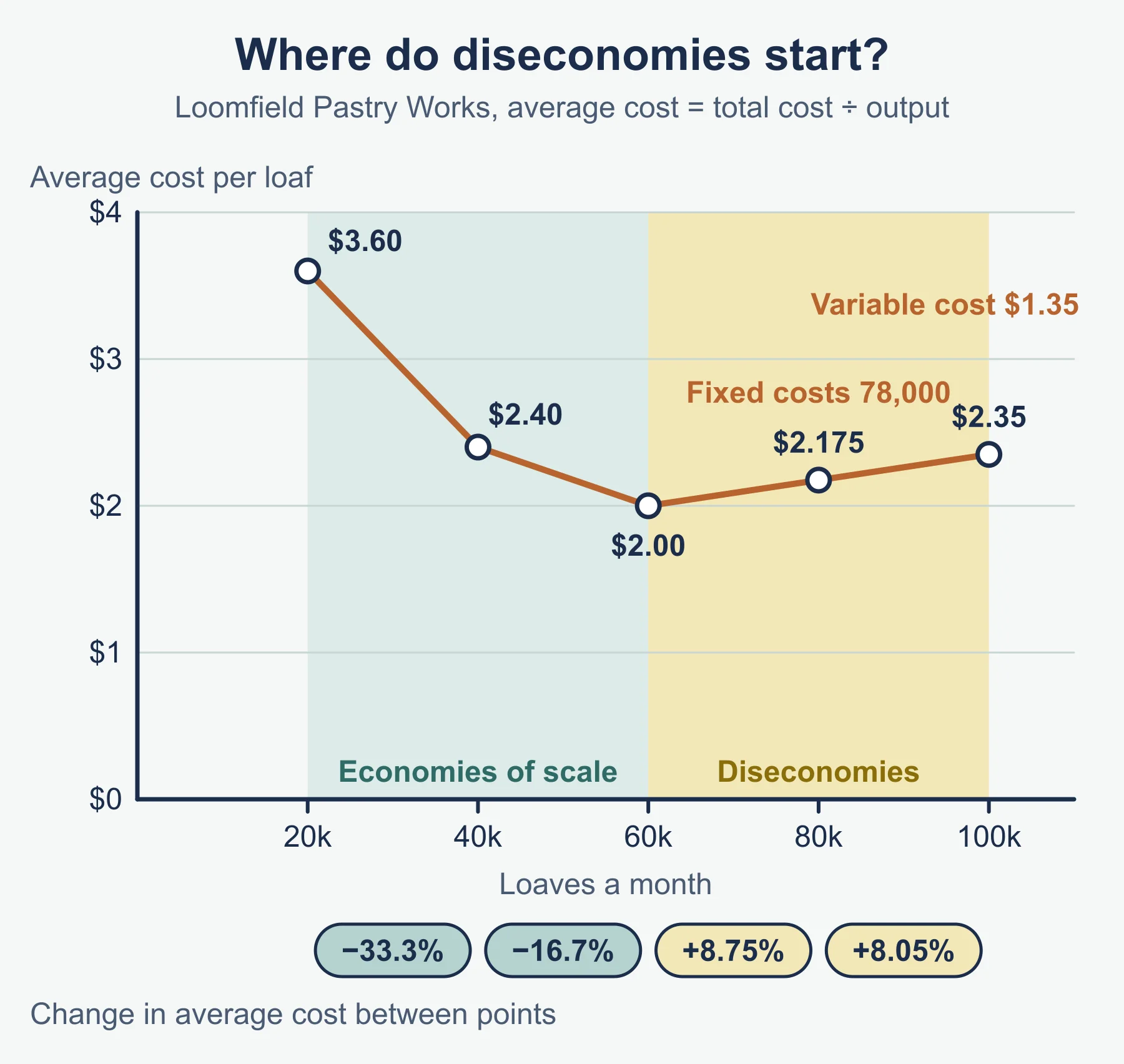
Loomfield Pastry Works bakes loaves. Monthly fixed costs and variable cost per loaf change as it expands. All figures are in $.
| Output (loaves) | Fixed costs | Variable cost per loaf | Total cost | Average cost |
|---|---|---|---|---|
| 20,000 | 48,000 | 1.20 | 72,000 | 3.60 |
| 40,000 | 48,000 | 1.20 | 96,000 | 2.40 |
| 60,000 | 48,000 | 1.20 | 120,000 | 2.00 |
| 80,000 | 78,000 | 1.20 | 174,000 | 2.175 |
| 100,000 | 100,000 | 1.35 | 235,000 | 2.35 |
Method: total cost = fixed costs + (output x variable cost per loaf). Average cost = total cost / output. For 60,000 loaves: 48,000 + 72,000 = 120,000, and 120,000 / 60,000 = 2.00.
Analysis: average cost falls by 33.3% from 20,000 to 40,000 loaves, and by a further 16.7% to 60,000. These are economies of scale, because the fixed costs are spread over more loaves. Past 60,000 loaves average cost rises, by 8.75% at 80,000 and by a further 8.0% at 100,000, so diseconomies have started. The jump in fixed costs at 80,000 suggests a second site, and the higher variable cost at 100,000 suggests waste and slower coordination. Both are internal diseconomies. A good answer names the range, quotes the figures, and links each change to a cause.
Internal and external growth
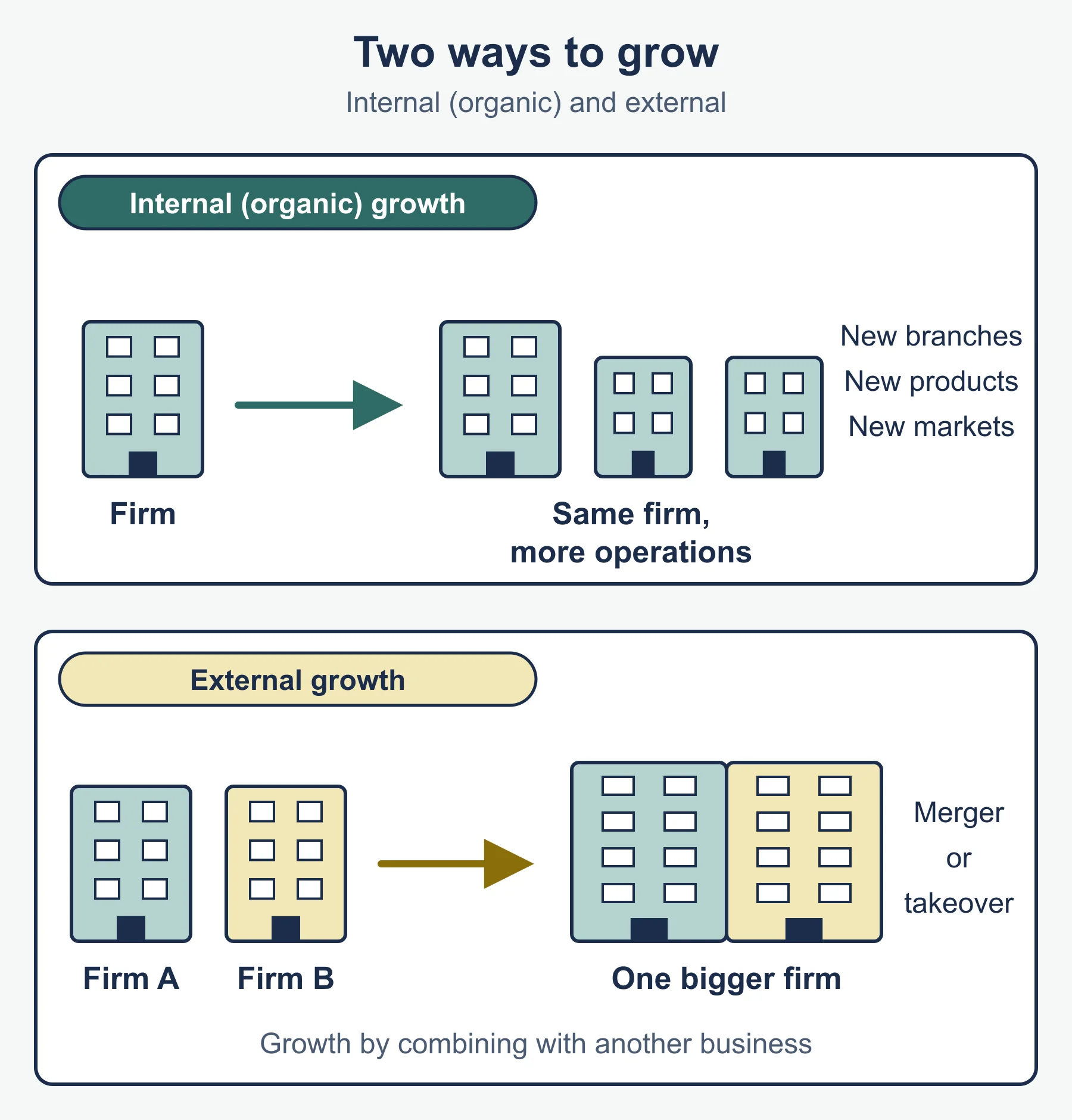
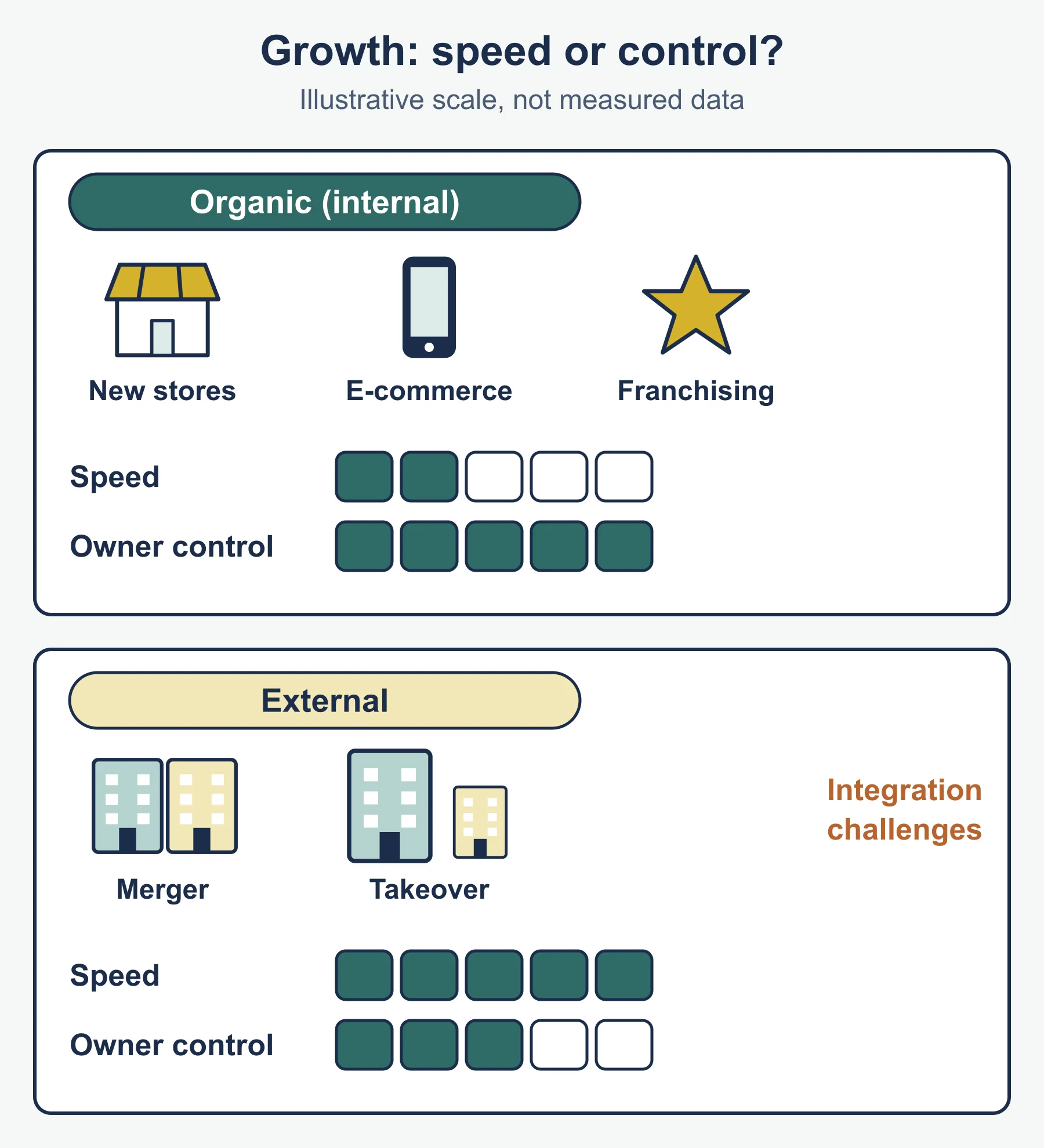
Internal (organic) growth is expansion using the business’s own resources: selling more of existing products, launching new products, opening new outlets or entering new markets by itself. External (inorganic) growth is expansion by involving another business: buying it, combining with it, or contracting with it.
| Feature | Internal growth | External growth |
|---|---|---|
| Speed | Usually slower | Can be fast |
| Cost and risk | Spread over time, lower risk of overpaying | Large sums, risk of a poor fit |
| Control | Keeps the existing culture | Two cultures must be joined |
| Finance | Retained profit, new loans | Share issues, big loans, sale of assets |
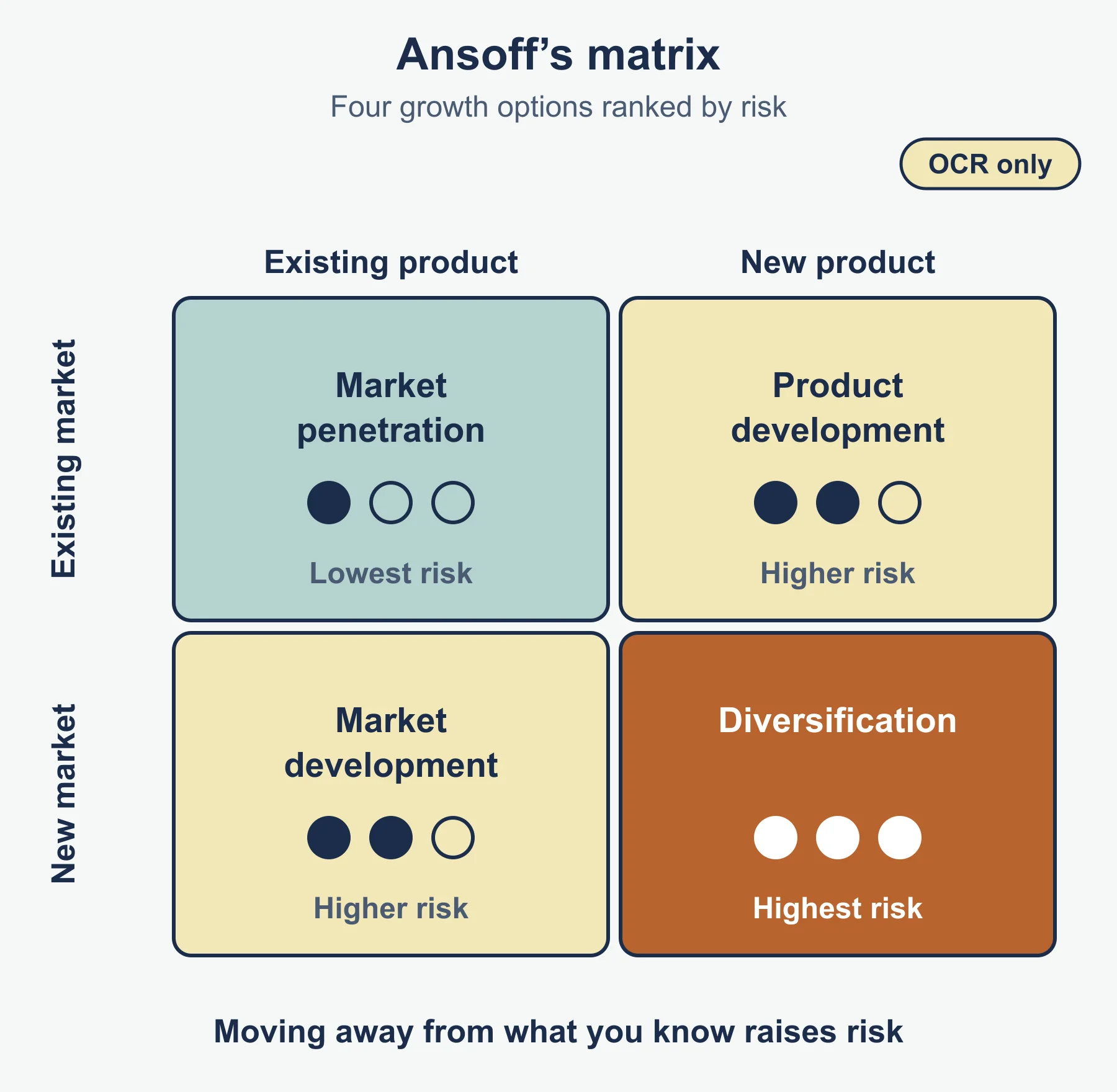
The Ansoff Matrix sorts growth by direction: existing products in existing markets (market penetration), new products in existing markets (product development), existing products in new markets (market development) and new products in new markets (diversification). Each can be pursued internally or by one of the external methods below. A firm moving into an unfamiliar market often chooses a partner, because it lacks local knowledge.
Reasons to grow and reasons to stay small
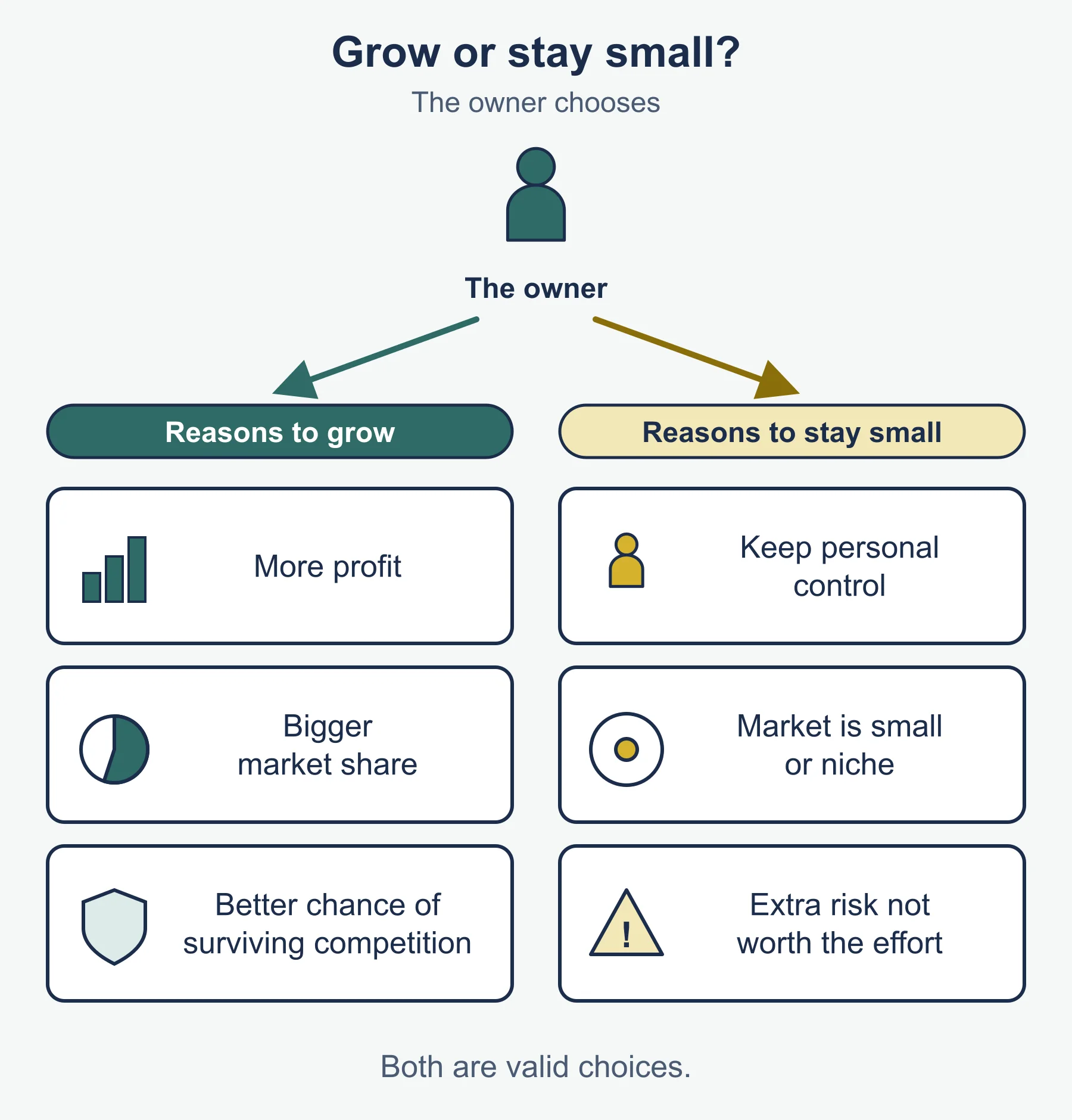
Reasons to grow
- Reach economies of scale and lower unit cost.
- Increase market share and pricing power.
- Spread risk across products or countries.
- Raise profit and shareholder value (see 1.3).
- Improve survival odds, since larger firms can absorb a bad year.
- Satisfy managers’ ambition for status and pay.
Reasons to stay small
- Keep personal control and a close relationship with customers.
- Serve a niche that is too small for large firms.
- Stay flexible and avoid diseconomies of scale.
- Avoid the stress, risk and debt that come with expansion.
- Lack finance or access to suitable premises, staff or suppliers.
- Meet owner objectives that are not about profit, such as lifestyle or a social aim.
For an AO3 answer, tie the reason to the case. A bespoke bicycle workshop that sells on reputation may lose its selling point if it doubles in size, so staying small is rational. A supermarket chain that sells identical goods competes on price, so growth is almost essential.
External growth methods
Mergers and acquisitions (M&As)
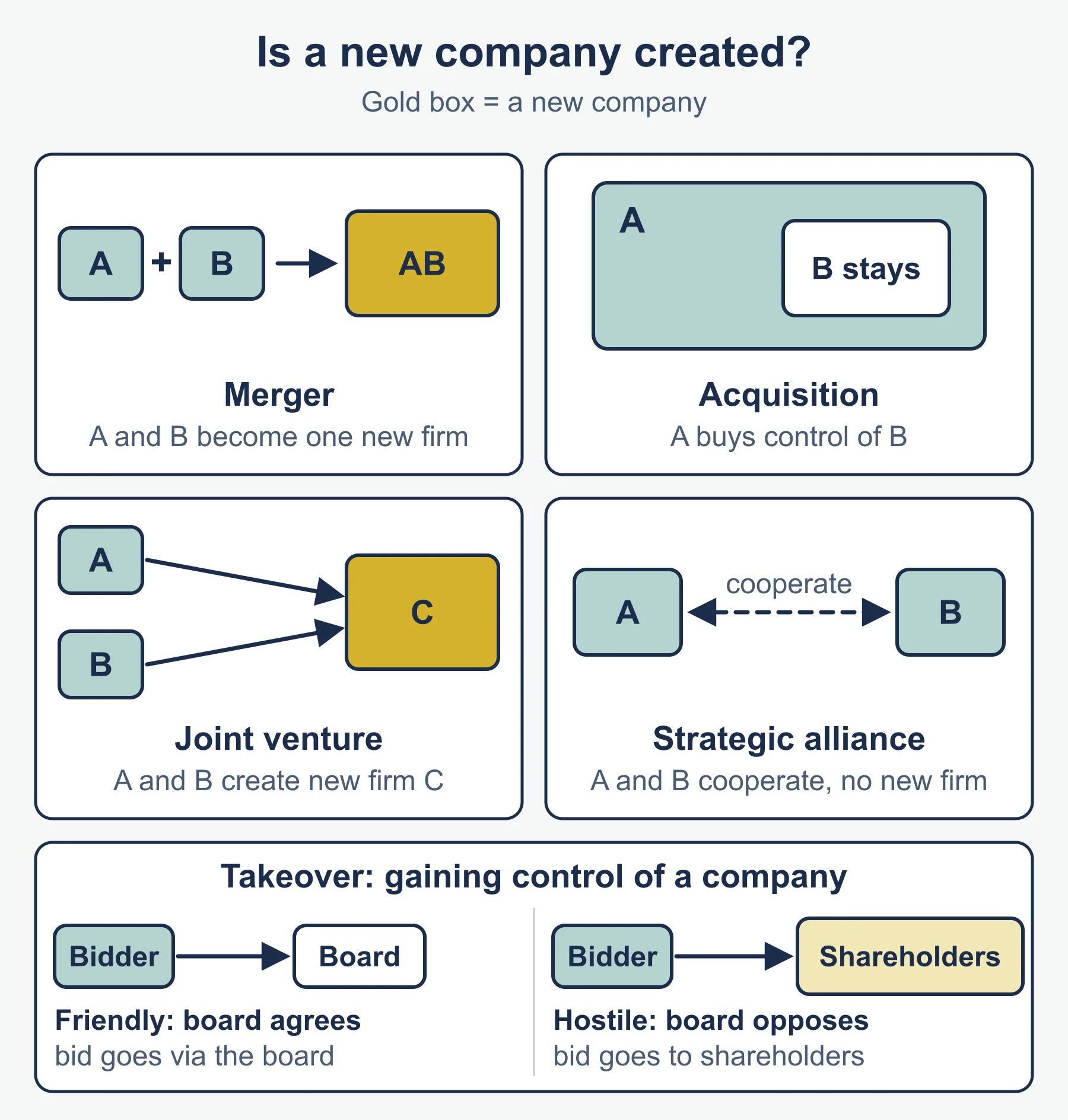
In the standard form, a merger takes place when two firms consent to combine as a single new business; an acquisition is when one business buys a controlling share of another, which stays in some form. In practice the terms are often used together. Benefits include cost savings, market share and access to skills. Drawbacks include clashing cultures, job losses, price paid above value, and the risk that the expected savings never appear.
Takeovers
A takeover (standard form) is an acquisition of control of a company, often by buying enough of its shares. A friendly takeover has the agreement of the target’s board. A hostile takeover goes directly to shareholders against the board’s wishes. Hostile bids tend to cost more and damage morale.
Worked example: acquisition against organic growth
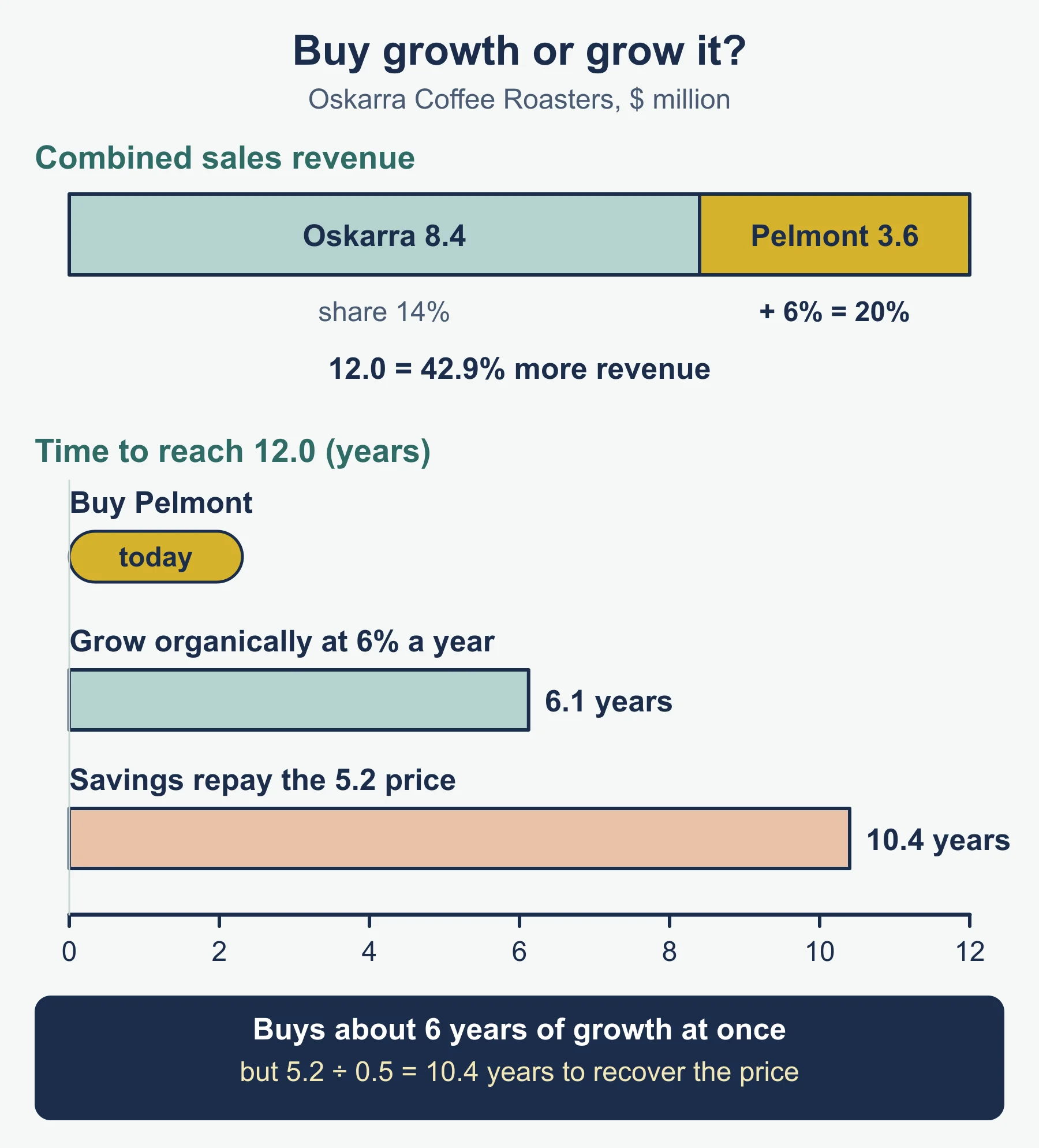
Oskarra Coffee Roasters has sales revenue of 8.4m in a market worth 60.0m (all in $), so its market share is 14%. It acquires Pelmont Beans, with sales revenue of 3.6m (6% share), for 5.2m. Expected annual cost savings are 0.5m.
- Combined sales revenue: 8.4 + 3.6 = 12.0m. Combined share: 12.0 / 60.0 = 20%.
- Revenue growth: (12.0 - 8.4) / 8.4 = 42.9%.
- Organic alternative at 6% growth a year: it takes about 6.1 years to reach 12.0m.
- Cost savings recover the price in 5.2 / 0.5 = 10.4 years.
Judgement: the takeover buys six years of growth at once, but a 10.4-year recovery period is long. The case for it depends on whether the savings are realistic and whether Pelmont’s customers stay.
Joint ventures
In a joint venture, two or more businesses create a separate new entity and share ownership, cost, risk and profit in agreed proportions, often for a specific project or market. It suits entry to a new country with a local partner. The risks are disputes over control, and the loss of know-how to the partner.
Strategic alliances
In a strategic alliance, businesses agree to cooperate on shared goals, such as joint research or shared distribution, but stay legally separate and do not form a new company. Alliances are quicker and easier to leave than a joint venture, but they bind the partners less tightly and may carry a weaker commitment.
Franchising
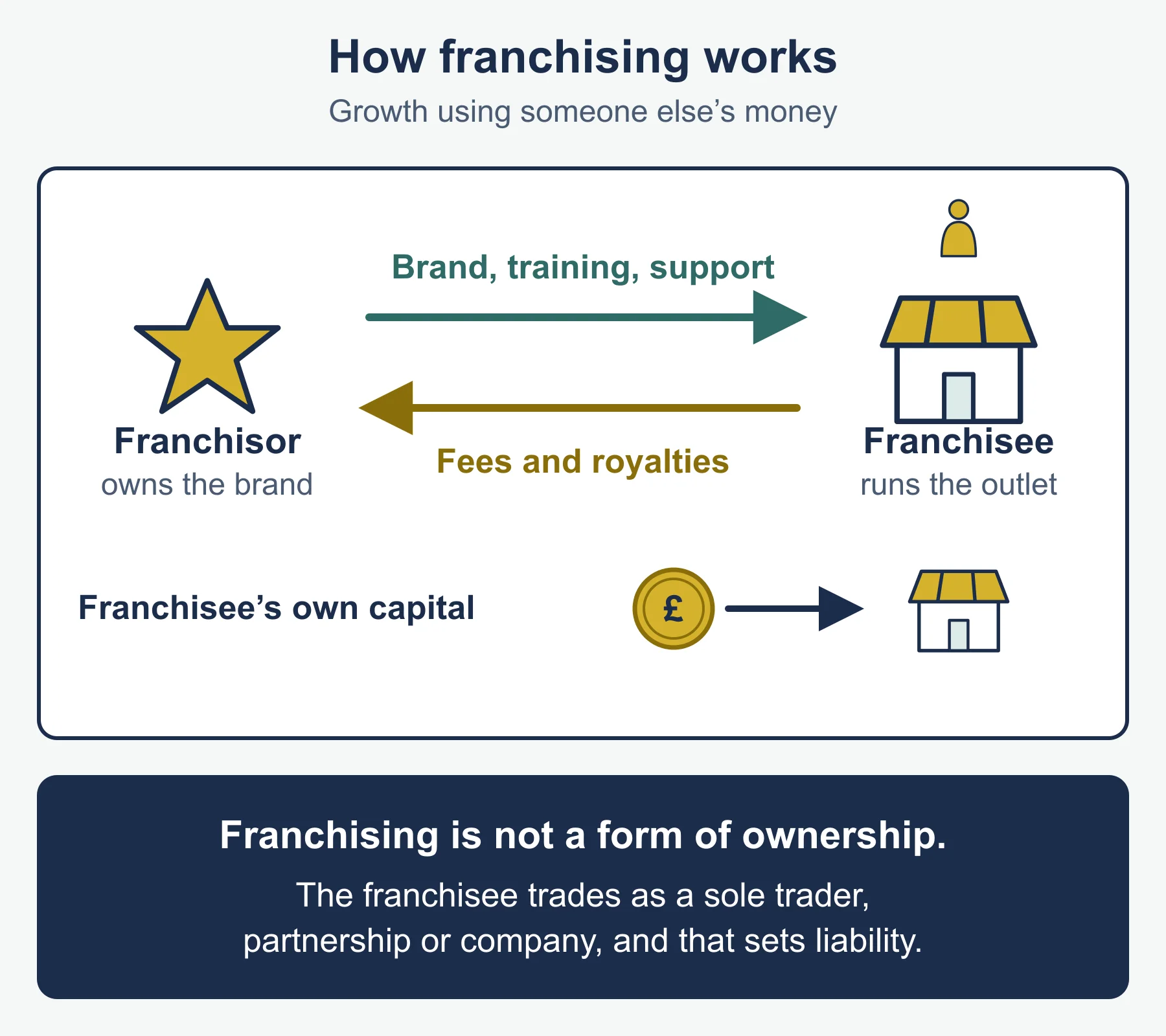
In franchising, the franchisor lets a franchisee operate under its brand, with its products and methods, in return for an initial fee and usually a royalty on sales. The franchisor grows quickly using other people’s capital. The franchisee gets a proven brand but loses freedom and must follow standards. The franchisor risks damage to its brand if one outlet performs badly.
Worked example: franchise economics
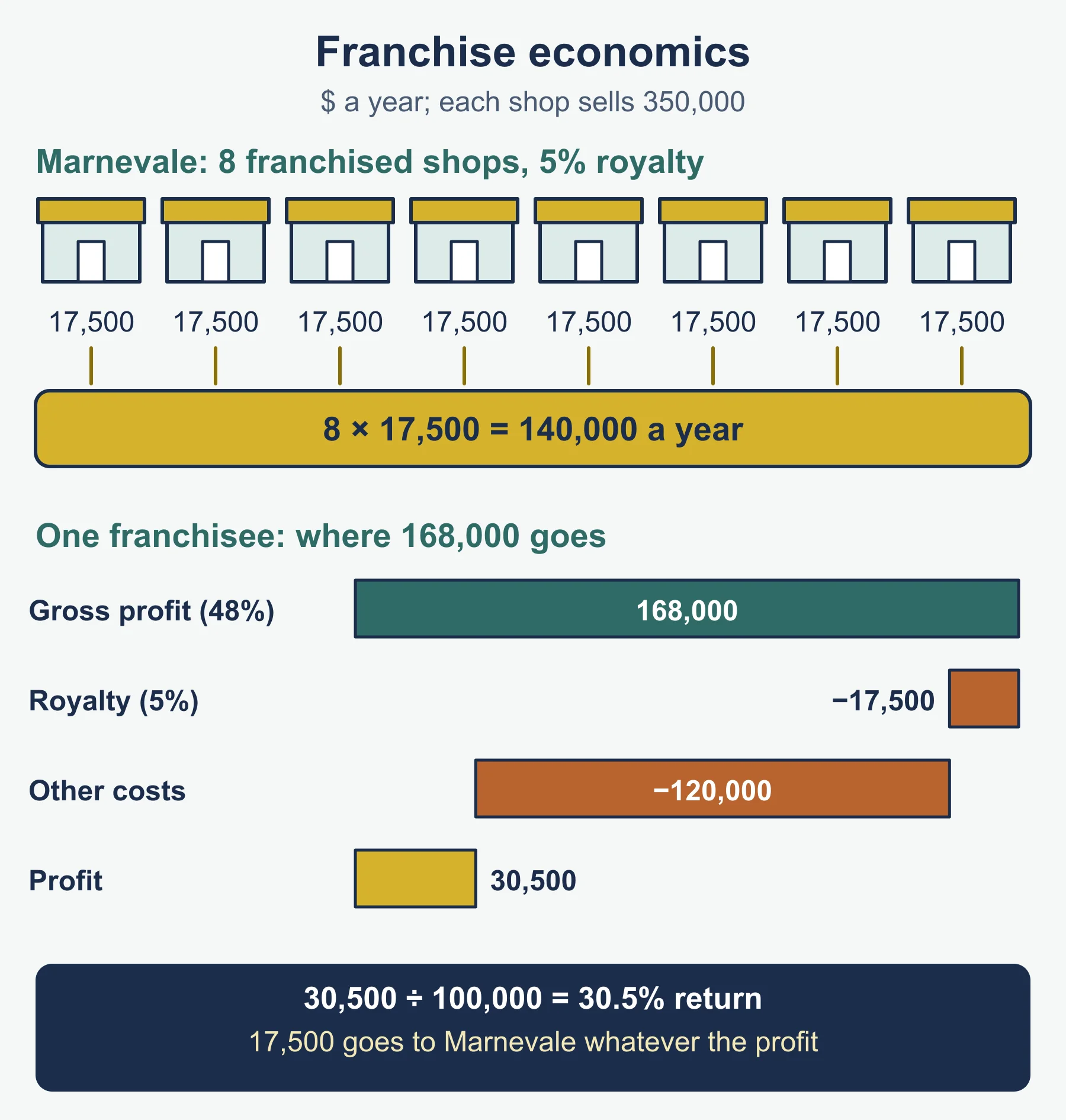
Marnevale Cycles has eight franchised shops, each with annual sales of 350,000 (all in $). The royalty is 5% of sales.
- Franchisor royalty income: 8 x 350,000 x 5% = 140,000 a year.
- One franchisee: gross profit at a 48% margin is 168,000. The royalty is 17,500. Other costs are 120,000. Profit is 168,000 - 17,500 - 120,000 = 30,500.
- With 100,000 invested, the franchisee’s return is 30.5%.
Marnevale gains steady income with little capital. The franchisee earns a decent return, yet 17,500 a year goes to the franchisor whatever the profit.
Multinational companies and host countries
A multinational company (MNC) is, in standard form, a business with operations or production facilities in more than one country. The host country is where it operates, as opposed to its home country. The guide requires you to assess the impact on host countries, so give both sides and then judge.
| Possible benefits | Possible costs |
|---|---|
| Jobs and wages, directly and in suppliers | Profits sent abroad (repatriated) |
| Investment, new technology, skills and training | Local firms driven out by stronger competitors |
| Tax revenue and export earnings | Pressure on wages, poor working conditions, environmental damage |
| Wider consumer choice and often lower prices | Cultural change, and dependence on a foreign decision-maker who may relocate |
Worked example: weighing an MNC
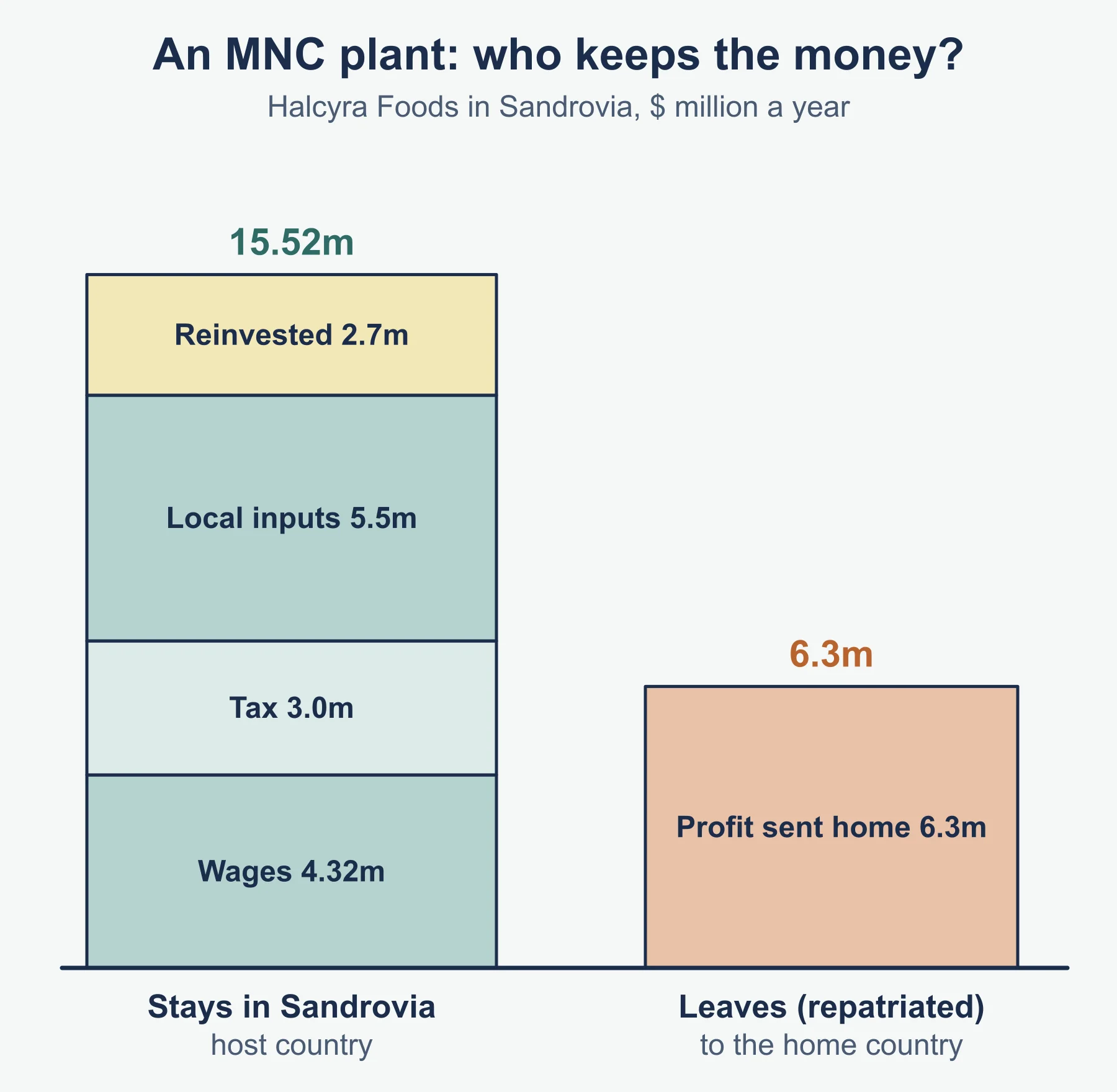
Halcyra Foods opens a plant in Sandrovia. It employs 600 local workers at an average of 7,200 a year each, pays 25% tax on a profit of 12.0m, and buys 5.5m of inputs locally (all in $). It sends 70% of after-tax profit to its home country.
- Payroll: 600 x 7,200 = 4.32m.
- Tax: 12.0m x 25% = 3.0m, so after-tax profit is 9.0m.
- Repatriated: 9.0m x 70% = 6.3m. Reinvested locally: 2.7m.
Wages, tax and local purchases keep over 12m a year in Sandrovia, while 6.3m leaves. A balanced answer weighs these, adds non-financial factors such as training and environmental standards, and judges which carries more weight in the case. The result depends on the host country’s circumstances, so state your criteria.
Common errors
- Writing “economies of scale” without a cause. Name the type and link it to the case.
- Calling any cost fall an economy of scale when output did not rise.
- Treating “internal” as “inside the firm’s building”. It means arising from the firm’s own size.
- Mixing up a joint venture (new entity) with a strategic alliance (no new entity).
- Listing MNC effects with no judgement. Evaluate by who gains, how large, and over what period.
Frequently asked questions
What are economies of scale? Economies of scale are falls in average (unit) cost as a business’s output rises. Internal types include purchasing, technical, financial, marketing, managerial and risk-bearing economies.
Why might a business choose to stay small? Owners may want to keep personal control and close customer relationships, serve a niche that is too small for large firms, stay flexible, avoid the risk and debt of expansion, or pursue non-profit aims such as lifestyle.
What is the difference between a joint venture and a strategic alliance? In a joint venture two or more businesses create a separate new entity and share its ownership, cost, risk and profit. In a strategic alliance they agree to cooperate on shared goals but stay legally separate, with no new entity.
How does franchising work? The franchisor lets a franchisee operate under its brand, products and methods in return for fees, such as a royalty on sales. The franchisor gains steady income with little capital, while the franchisee pays the royalty whatever its profit.
How can an MNC affect a host country? Possible benefits include jobs, wages, investment, technology and tax revenue; possible costs include profits sent abroad and local firms driven out by stronger competitors. A balanced answer weighs who gains, by how much and over what period.
Official syllabus
IB Diploma Programme Business management guide (first assessment 2024), International Baccalaureate Organization, Unit 1, sections 1.5 and 1.6. Continue with the revision notes and practice questions.
Get free revision emails (optional)
Occasional emails with practice questions, worked explanations and links to free resources for the qualification and subjects you choose. No spam, and you can unsubscribe from any email. The free tools on this site never need an email.
Related resources
-
Practice questions
IB DP Business Management: Growth and evolution and Multinational companies (MNCs) – Practice Questions
Original practice questions with worked answers for IB DP Business Management sections 1.5 and 1.6: scale, growth methods, franchising and MNCs.
Business · International Baccalaureate · IB
Try questions -
Revision notes
IB DP Business Management: Growth and evolution and Multinational companies (MNCs) – Revision Notes
Condensed revision notes for IB DP Business Management sections 1.5 and 1.6: scale, growth methods, staying small and the impact of MNCs on host countries.
Business · International Baccalaureate · IB
Revise topic -
Study guides
IB DP Business Management: Stakeholders
Study guide to internal and external stakeholders and conflict between stakeholders for IB DP Business Management, section 1.4, with two worked cases.
Business · International Baccalaureate · IB
Read guide
Related articles
-
teaching
A Level tuition in Dubai: Cambridge or Pearson Edexcel International A Level?
Schools in Dubai and Abu Dhabi teach either Cambridge International AS & A Level or Pearson Edexcel International A Level. How the two are structured, why it matters for tuition, and how online classes from Lahore work.
9 October 2026
-
curriculum guides
Choosing subjects at IGCSE and A Level
How subject choices at 14 and 16 affect university options later, and how to keep pathways open without overloading a timetable.
28 July 2026
Studying this with a teacher
Working through Business IB?
This page is free and stays free. If you would rather be taught it, Marlbridge runs Business classes one-to-one, online in your own time zone. The first trial class is free. WhatsApp replies within an hour (8am–11pm Pakistan time, every day); email the same day.
IB Business teachers at Marlbridge

