
Revision Notes
IB DP Business Management: Stakeholders – Revision Notes
Condensed revision notes on internal and external stakeholders and stakeholder conflict for IB DP Business Management section 1.4, with a self-test.
- Subject
- Business
- Level
- IB
- Topic
- Unit 1: Introduction to business management
- Author
- Marlbridge Academic Team
- Updated
- Reviewed by
- Salman Ahmad (what this means)
Aligned to International Baccalaureate IB Diploma Programme Business (DP Business Management), First assessment 2024. Official specification .
Syllabus page (what it covers and how it is assessed): IB Diploma Programme Business.
Syllabus points this page covers
DP Business Management
- 1.4 Stakeholders
Found an error? Report a correction.
Need help with this topic? Request a free trial class for IB Diploma Programme Business (DP Business Management).
These notes condense section 1.4 (Stakeholders) of Unit 1 in the IB Business management guide, first assessment 2024, for SL and HL. The section lists two points, each at AO2 depth: internal and external stakeholders, and conflict between stakeholders. For full explanations and two worked cases, use the study guide. Questions to try afterwards are in the practice set.
Related pages: the course hub, the printable checklist, the free 10-minute diagnostics and the exam preparation guide.
Key definitions
The guide gives no definition for this section, so these are standard forms.
| Term | Meaning |
|---|---|
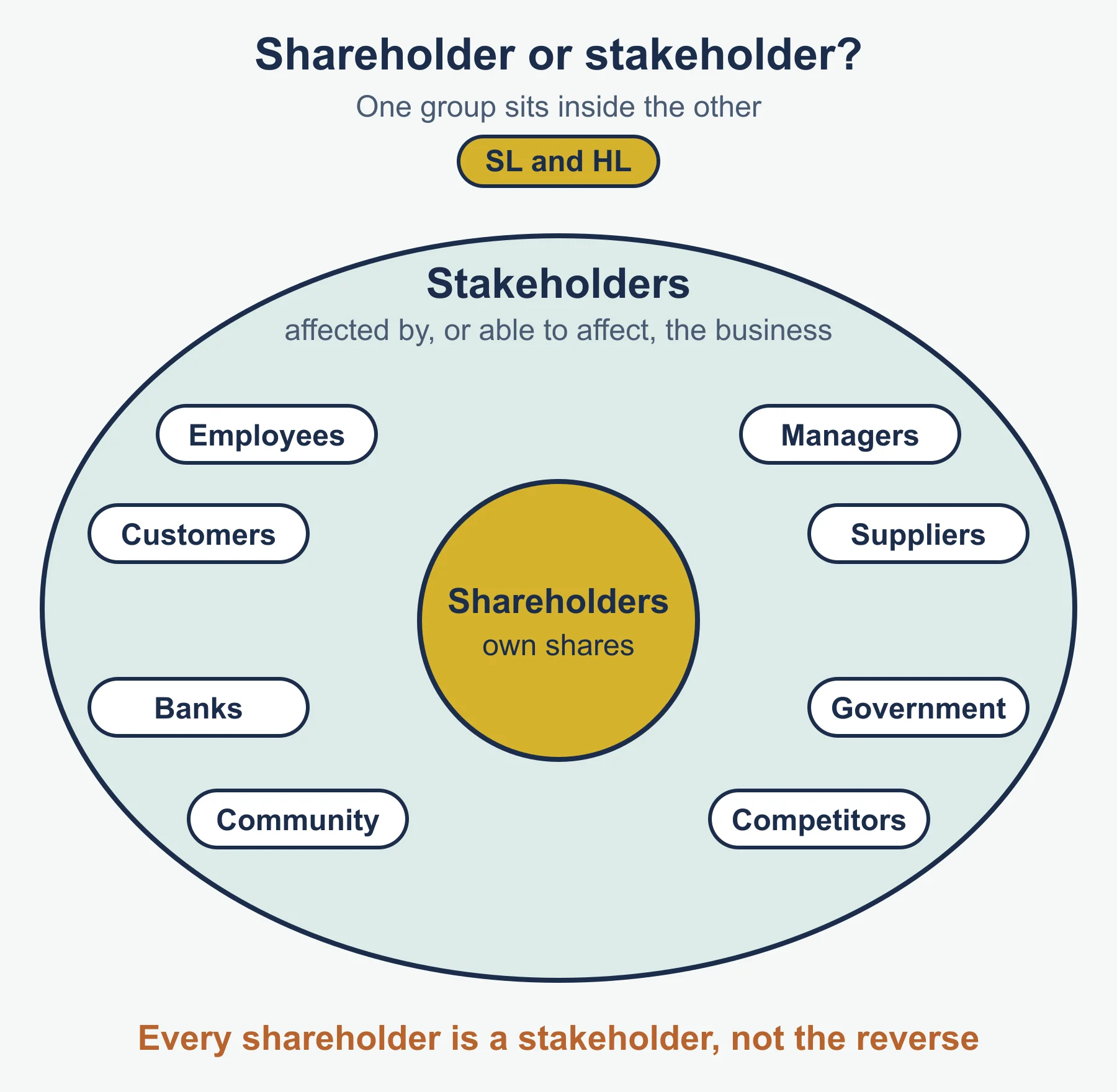
| Stakeholder | Any person or group that a business’s activities affect, or that can affect them |
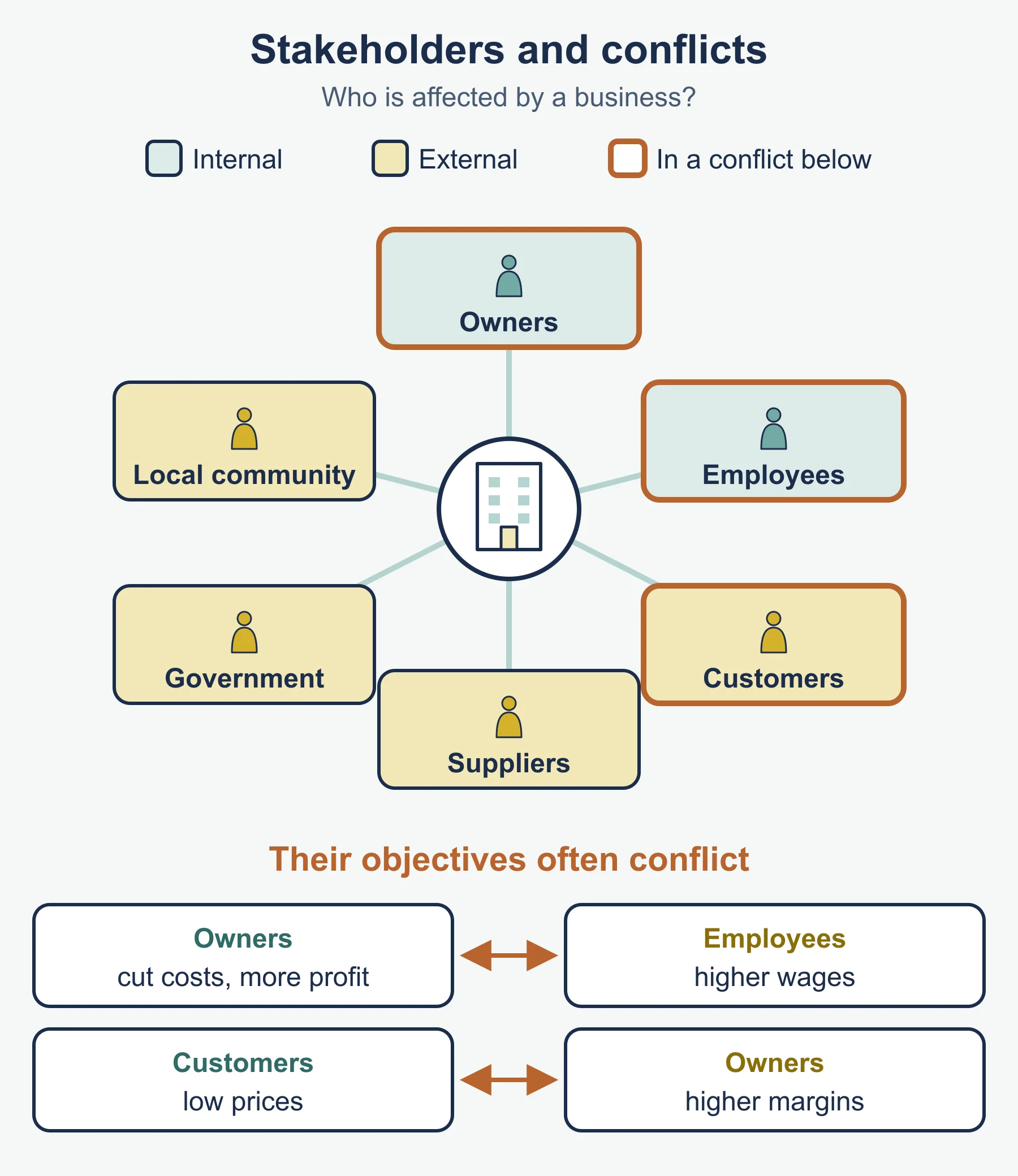
| Internal stakeholder | A stakeholder inside the organization, such as employees, managers and owners |
| External stakeholder | A stakeholder outside the organization, such as customers, suppliers, lenders, government, the local community, competitors and pressure groups |
| Shareholder | An owner of shares in a company. One type of stakeholder, not a synonym |
| Conflict between stakeholders | A situation where the interests of two groups cannot both be fully met |
| Interest | What a group wants from the business |
| Influence | What a group can do to affect the business |
Sorting stakeholders
Use this as a memory grid. The examples are standard, not an official list.
| Internal | External |
|---|---|
| Employees | Customers |
| Managers | Suppliers |
| Owners / shareholders (usual treatment) | Lenders (banks) |
| Government | |
| Local community | |
| Competitors | |
| Pressure groups |
Notes on the grid:
- Shareholders in a large publicly held company are sometimes placed in the external column because they rarely work in the business. State your choice and one reason.
- The guide’s description of ethics refers to the natural environment next to internal and external stakeholders. Treat it as an affected party that someone else speaks for.
- Lenders and suppliers are external, but have real influence through credit terms and prices.
Interest and influence at a glance
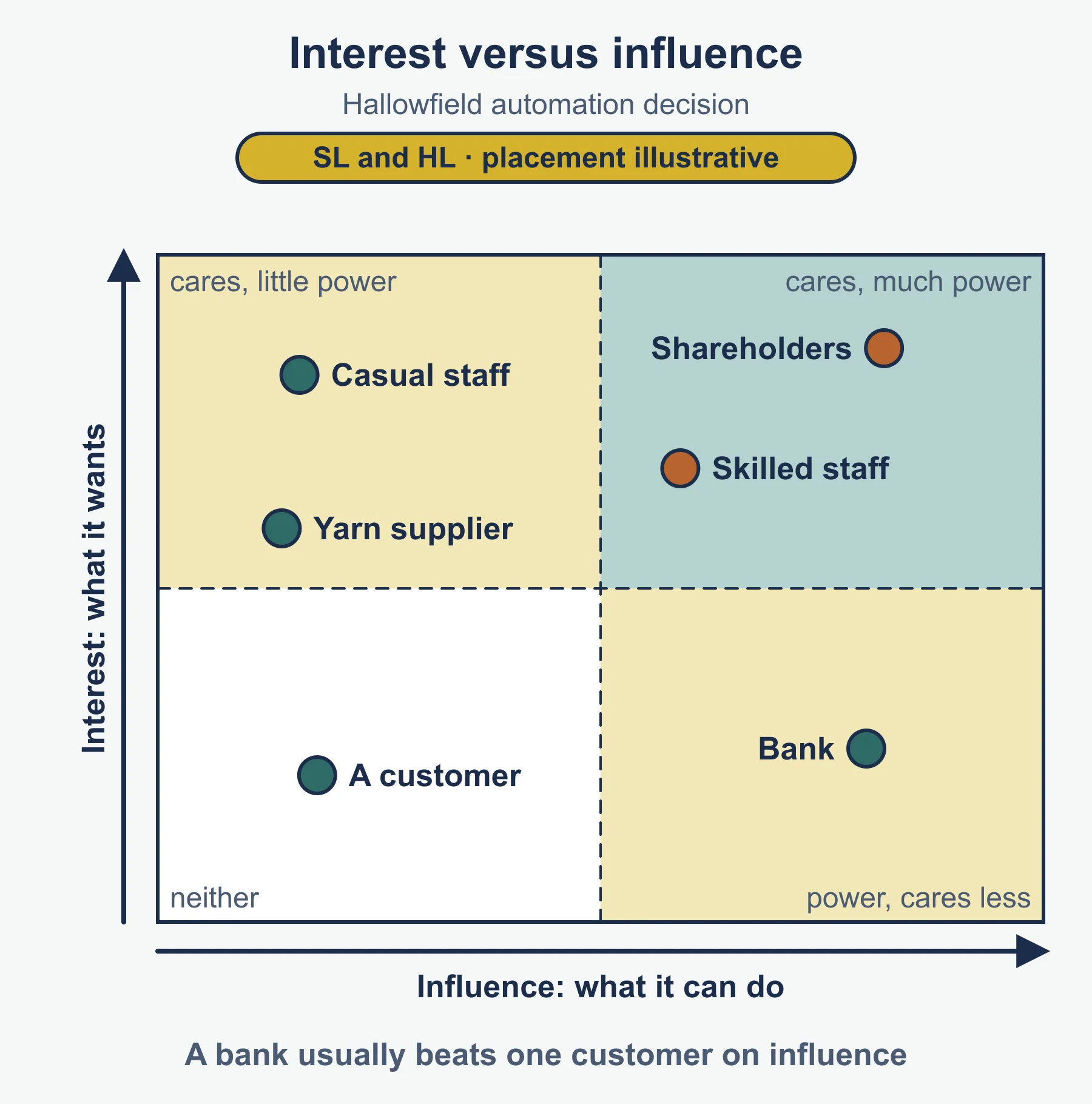
| Group | Typical interest | Typical power |
|---|---|---|
| Employees | Pay, security, conditions | Effort, quality, industrial action, leaving |
| Managers | Targets, pay, career | Decisions on resources |
| Shareholders | Dividends, share value | Votes, appointing directors, selling shares |
| Customers | Value, quality, ethics | Buying or switching |
| Suppliers | Orders, prompt payment | Price and delivery terms |
| Lenders | Repayment plus interest | Refusing or pricing further credit |
| Government | Taxes, law followed | Regulation and tax rates |
| Community | Jobs, low disruption | Complaints, protests, planning pressure |
| Competitors | Market share | Price cuts, copying, hiring staff |
| Pressure groups | A cause | Publicity, lobbying |
Typical conflicts (pairs to recall)
- Shareholders versus employees: dividends versus pay or bonuses.
- Shareholders versus customers: higher price and profit versus lower price and value.
- Managers versus owners: growth and status versus dividends and share value.
- Business versus suppliers: low prices and long credit versus higher prices and quick payment.
- Business versus community: jobs against noise, traffic or pollution.
- Business versus government: lower costs against taxes and rules.
- Short term versus long term: this year’s profit versus future research or training.
- Business versus the environment: cheaper methods versus harm.
Conflict can occur inside the internal group (shareholders and employees) as well as between internal and external groups.
Why change brings conflict
The guide’s suggested inquiry statement asks why change could bring conflict among stakeholders. Use this chain.
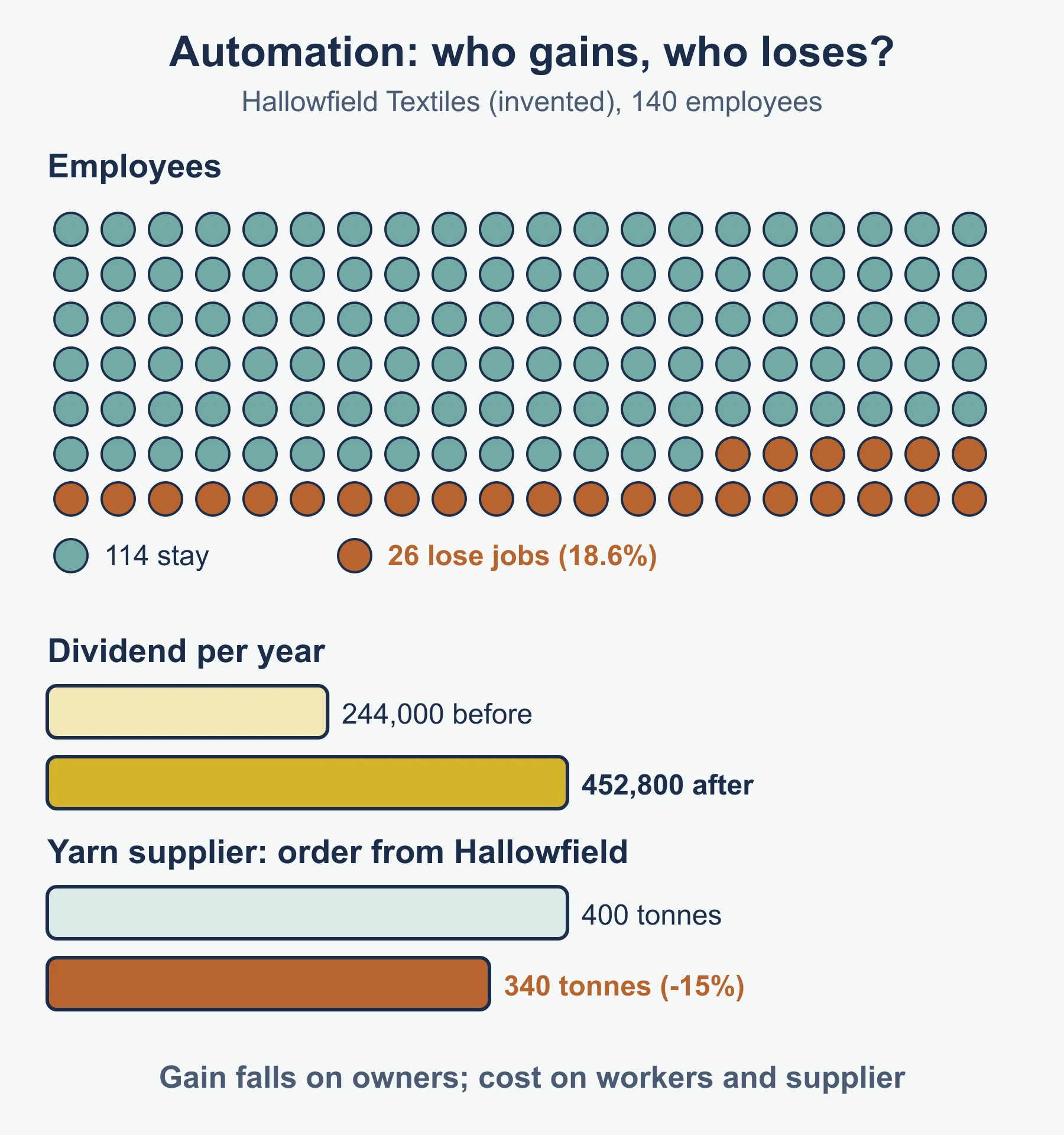
- A change (new technology, closure, relocation, merger, new supplier) shifts costs and benefits.
- Some groups gain; others lose, often with little notice.
- Losers resist or complain; winners support.
- Poor communication adds fear and conflict.
Method in steps: a stakeholder analysis answer
- Name the group in the case, using the business’s own details.
- State what the group wants.
- Show how the decision affects it (with a figure if available).
- Show what the group can do in response.
- Link to the opposing group and say who gains and loses.
- For discuss, evaluate, justify or recommend: weigh the sides and finish with a reasoned judgment. The guide classifies these command terms at AO3, so they ask for more than description.
Ways to respond to conflict
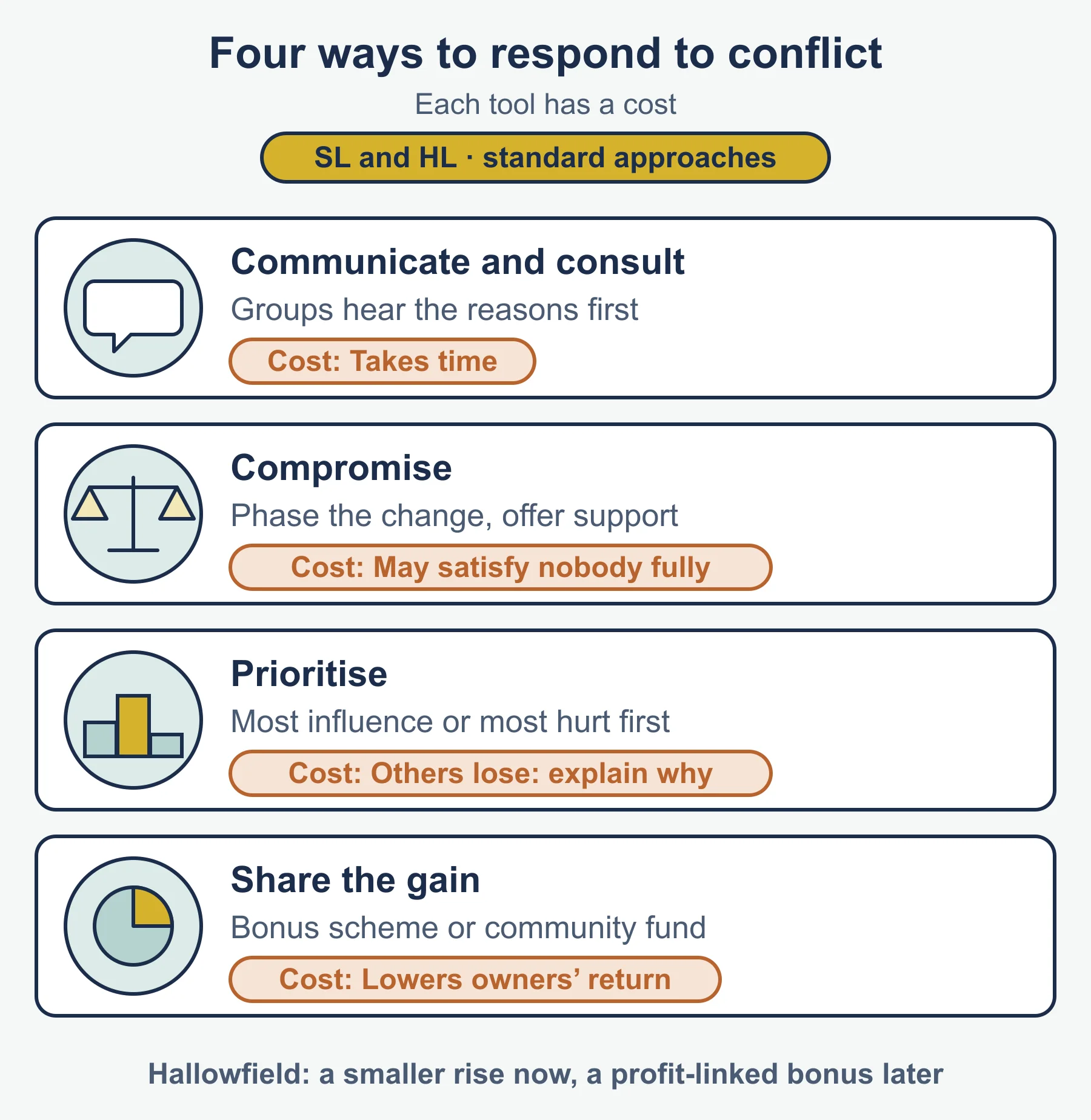
Standard approaches, not a syllabus list: communication and consultation, compromise (for example phasing a change), prioritizing a group and explaining why, and sharing gains (for example a bonus or community fund). Each has a cost, so a strong answer says what the cost is.
Small worked reminder
Pendrake Foods (invented) sells 90,000 pies a year at 4.50 each. It raises the price by 6% to cover the cost of better ingredients.
- New price = 4.50 × 1.06 = 4.77.
- Revenue with unchanged sales = 90,000 × 4.50 = 405,000 rising to 90,000 × 4.77 = 429,300, an increase of 24,300.
- Gain: the owners, if customers do not leave. Loss: customers who pay more. Mixed: the ingredient supplier, who gains orders.
- Conflict: owners and customers. Possible compromise: a small rise plus a loyalty discount.
The calculation assumes sales stay the same. In a real answer, say that sales may fall.
Must-know distinctions
- Stakeholder and shareholder. The first is any interested group. The second is a share owner only.
- Interest and influence. A group may care a lot and still be unable to change the outcome. Say both.
- Internal and external. Ask whether the group is part of the organization. Where the answer is arguable, argue it.
- Conflict of interest and conflict in action. Two groups can want opposite things without a visible dispute. A dispute appears when a group acts, for example by striking, complaining or switching supplier.
- Short-term and long-term effects. A cost cut may please owners now and upset customers or staff later.
A second reminder: weighing a conflict
Suppose Pendrake Foods can either keep the dividend or fund a staff training scheme, but not both. A balanced answer follows this pattern.
- Name the two groups: owners and employees.
- Give the case for training: skilled staff, fewer errors, lower turnover.
- Give the case for the dividend: owners’ return, and the share price if the company is listed.
- Say what each group could do if it loses: owners may sell shares; staff may leave.
- Judge. For example, back training if staff turnover is the larger risk, and say that you would revisit the dividend when profit rises.
The judgment matters more than the list. Without it, the answer stays at AO2 level and does not reach the evaluation that the AO3 command terms ask for.
Quick self-test
Try each question before you open the answers.
- State what is meant by a stakeholder.
- Identify two internal stakeholders of a bakery.
- Identify two external stakeholders of a bakery.
- Pendrake Foods has 60 employees and 9 leave when the site moves. Calculate the percentage of the workforce who leave.
- Distinguish a stakeholder from a shareholder.
- Explain one reason why shareholders and employees may disagree.
- Explain one reason why a local community may oppose a new factory.
- A supplier raises its price from 2.00 to 2.30 per kilo and Pendrake buys 40,000 kilos. Calculate the increase in annual cost and the percentage price rise.
- Suggest one way a business could reduce conflict when it introduces a change.
- A bank has lent a business 500,000 and the business has a weak year. State one action the bank, as a stakeholder, might take.
Answers
- Any person or group that the business’s activities affect, or that can affect them.
- Any two of: employees, managers, owners.
- Any two of: customers, suppliers, the bank, government, the local community, competitors, pressure groups.
- 9 ÷ 60 × 100 = 15%.
- A stakeholder is anyone affected by the business or able to affect it. A shareholder is an owner of shares in a company. Every shareholder is a stakeholder, but most stakeholders are not shareholders.
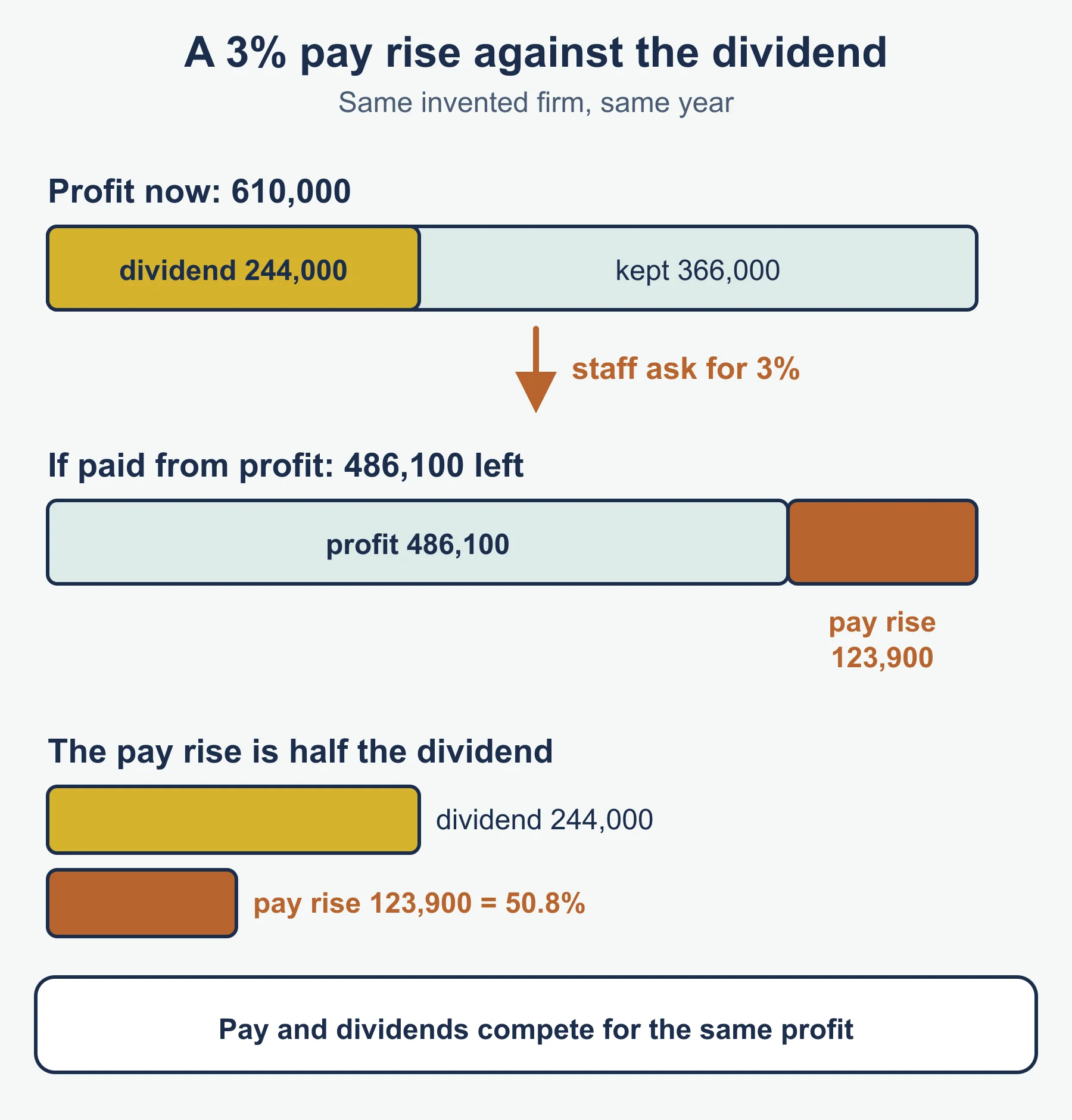
- Profit used for dividends is not available for pay, so owners may want to restrict pay rises, while employees may want a larger share.
- Noise, traffic or pollution may reduce quality of life, even if some jobs are created.
- Increase per kilo = 0.30, so extra cost = 0.30 × 40,000 = 12,000 per year. Percentage rise = 0.30 ÷ 2.00 × 100 = 15%.
- Consult affected groups before deciding, or phase the change in over time with support such as retraining.
- It might refuse more credit, ask for earlier repayment, or charge a higher rate on new borrowing.
Where marks are usually lost
- Writing a list of stakeholders with no tie to the particular business in the case.
- Using shareholder and stakeholder as if they were the same word.
- Stating that a group has an interest but not what it can do about it.
- Giving only owner-versus-worker conflicts and missing suppliers, lenders, the community and the environment.
- Leaving out figures given in the stem when asked to analyse.
- Treating a calculation result as an answer without saying who gains and who loses.
- Giving a recommendation with no reasoning or no acknowledgement of the downside.
- Describing the stakeholder groups at length when the question asks for judgment.
Examiner insights in the practice set give further pointers on how answers gain or lose credit.
Frequently asked questions
Are shareholders internal or external stakeholders? Owners and shareholders are usually treated as internal stakeholders. Shareholders in a large publicly held company are sometimes placed in the external column because they rarely work in the business, so state your choice and one reason.
What are typical stakeholder conflicts? Common pairs include shareholders against employees over dividends and pay, shareholders against customers over prices, managers against owners over growth and dividends, the business against suppliers over prices and credit, and the business against the local community over jobs versus noise or pollution.
Why does change bring conflict among stakeholders? A change such as new technology, a relocation or a merger shifts costs and benefits, so some groups gain while others lose, often with little notice. Poor communication adds fear and makes conflict worse.
How can a business reduce stakeholder conflict? Standard approaches include communication and consultation, compromise such as phasing a change, prioritizing the most affected or most influential group, and sharing the gain. Each has a cost, so a good answer weighs it.
Official syllabus
This page follows the Business management guide, first assessment 2024, published by the International Baccalaureate Organization, section 1.4 Stakeholders.
Get free revision emails (optional)
Occasional emails with practice questions, worked explanations and links to free resources for the qualification and subjects you choose. No spam, and you can unsubscribe from any email. The free tools on this site never need an email.
Related resources
-
Study guides
IB DP Business Management: What is a business? and Types of business entities
Study guide to IB DP Business Management sections 1.1 and 1.2: sectors, entrepreneurship, start-up challenges, and sole traders to NGOs.
Business · International Baccalaureate · IB
Read guide -
Practice questions
IB DP Business Management: What is a business? and Types of business entities – Practice Questions
Original IB DP Business Management practice questions with worked answers on sectors, entrepreneurship, start-ups, entity types and social enterprises.
Business · International Baccalaureate · IB
Try questions -
Revision notes
IB DP Business Management: What is a business? and Types of business entities – Revision Notes
Condensed IB DP Business Management revision notes for 1.1 and 1.2: sectors, entrepreneurship, start-up issues, entity types, social enterprises.
Business · International Baccalaureate · IB
Revise topic
Related articles
-
teaching
A Level tuition in Dubai: Cambridge or Pearson Edexcel International A Level?
Schools in Dubai and Abu Dhabi teach either Cambridge International AS & A Level or Pearson Edexcel International A Level. How the two are structured, why it matters for tuition, and how online classes from Lahore work.
9 October 2026
-
curriculum guides
Choosing subjects at IGCSE and A Level
How subject choices at 14 and 16 affect university options later, and how to keep pathways open without overloading a timetable.
28 July 2026
Studying this with a teacher
Working through Business IB?
This page is free and stays free. If you would rather be taught it, Marlbridge runs Business classes one-to-one, online in your own time zone. The first trial class is free. WhatsApp replies within an hour (8am–11pm Pakistan time, every day); email the same day.
IB Business teachers at Marlbridge

