
Revision Notes
IB DP Business Management: What is a business? and Types of business entities – Revision Notes
Condensed IB DP Business Management revision notes for 1.1 and 1.2: sectors, entrepreneurship, start-up issues, entity types, social enterprises.
- Subject
- Business
- Level
- IB
- Topic
- Unit 1: Introduction to business management
- Author
- Marlbridge Academic Team
- Updated
- Reviewed by
- Salman Ahmad (what this means)
Aligned to International Baccalaureate IB Diploma Programme Business (DP Business Management), First assessment 2024. Official specification .
Syllabus page (what it covers and how it is assessed): IB Diploma Programme Business.
Syllabus points this page covers
DP Business Management
- 1.1 What is a business?
- 1.2 Types of business entities
Found an error? Report a correction.
Need help with this topic? Request a free trial class for IB Diploma Programme Business (DP Business Management).
These are condensed notes for the IB Business management guide, first assessment 2024, sections 1.1 (What is a business?) and 1.2 (Types of business entities). The content is SL and HL, with no HL-only parts in these two sections. For full explanations and worked examples, read the study guide. Then test yourself with the practice questions.
Also useful: the IB DP Business Management hub, the printable checklist, and the free diagnostics.
The guide gives no formal definitions for these points. The definitions below are standard forms, so adapt the wording to the case in front of you.
1.1 What is a business?
Key terms
| Term | Standard-form meaning |
|---|---|
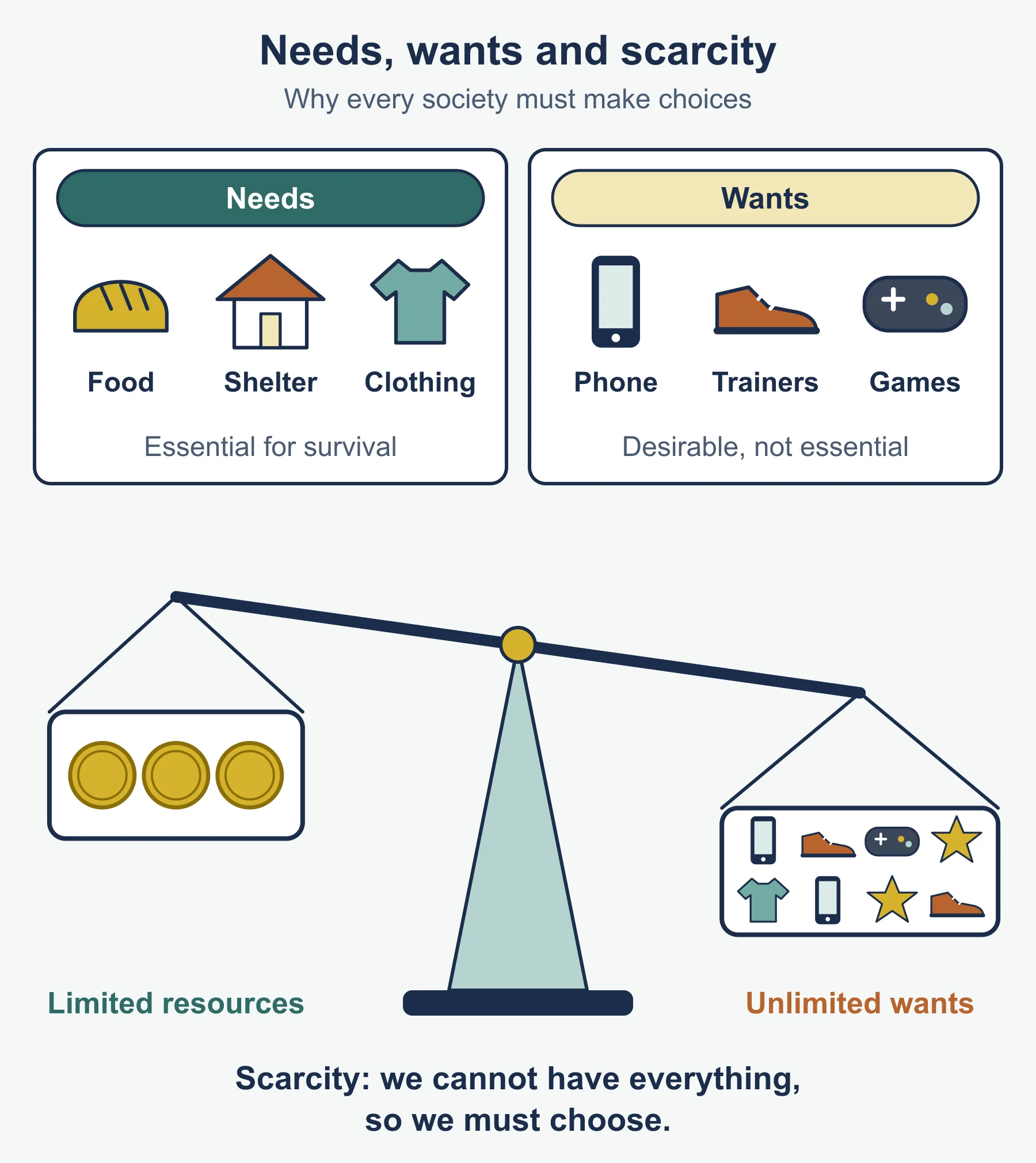
| Business | An organization that uses resources to produce goods or services that meet customers’ needs and wants |
| Need | Something required to live or function |
| Want | Something desired beyond a need |
| Goods | Tangible products |
| Services | Intangible activities done for customers |
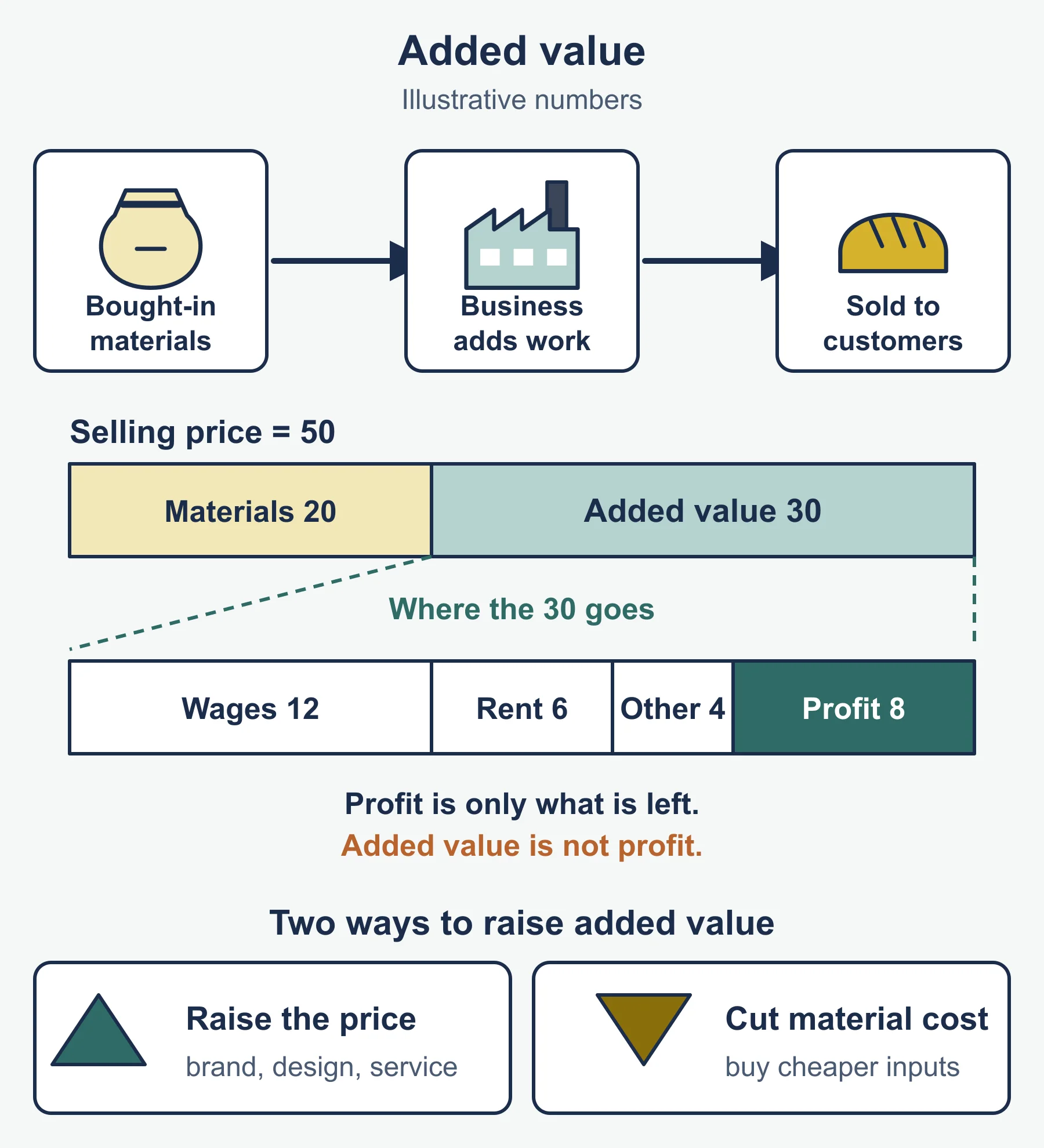
| Value added | Selling price of output minus the cost of inputs bought in |
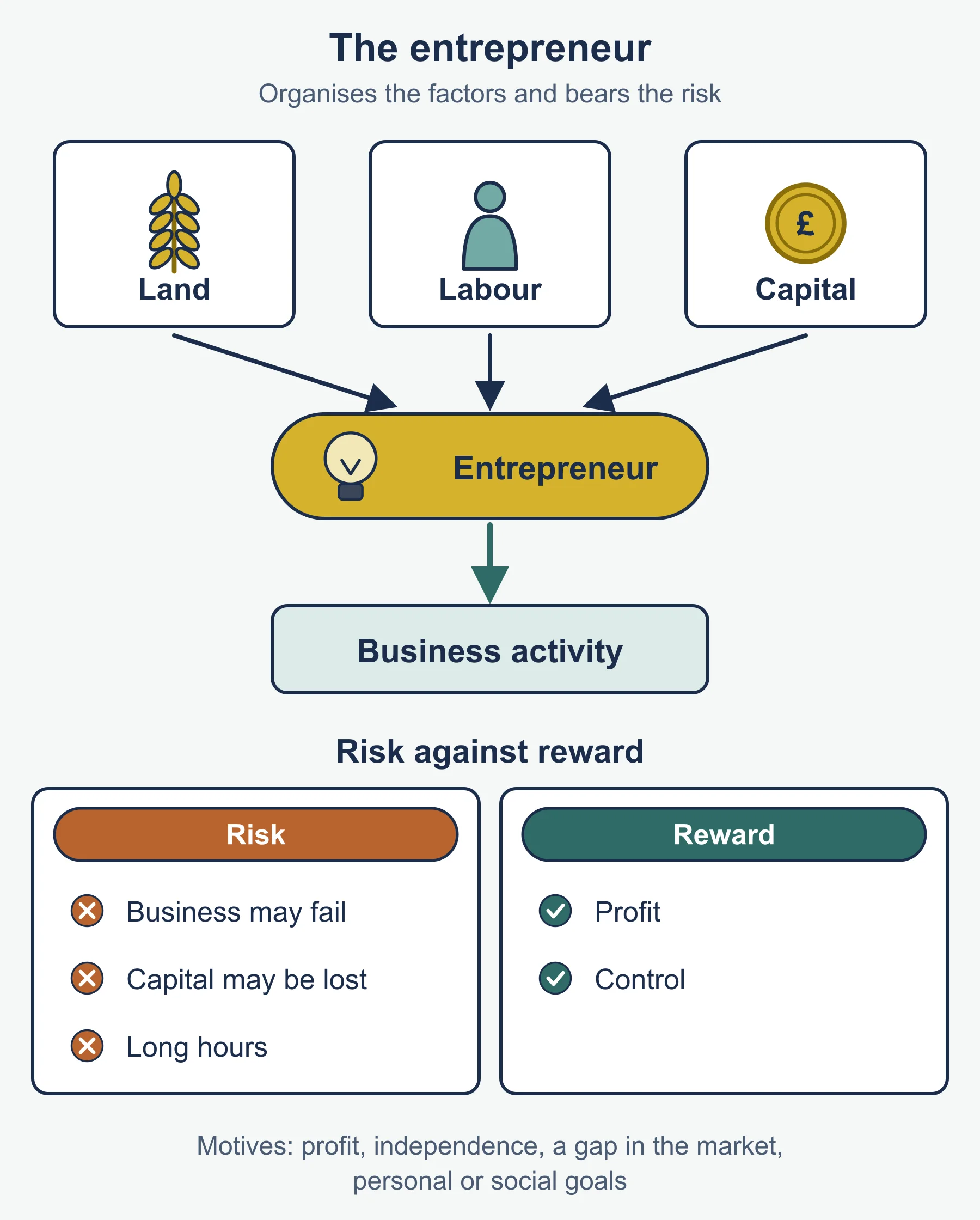
| Entrepreneur | A person who spots an opportunity, organizes resources and bears the risk |
| Social entrepreneur | An entrepreneur whose main purpose is a social or environmental one |
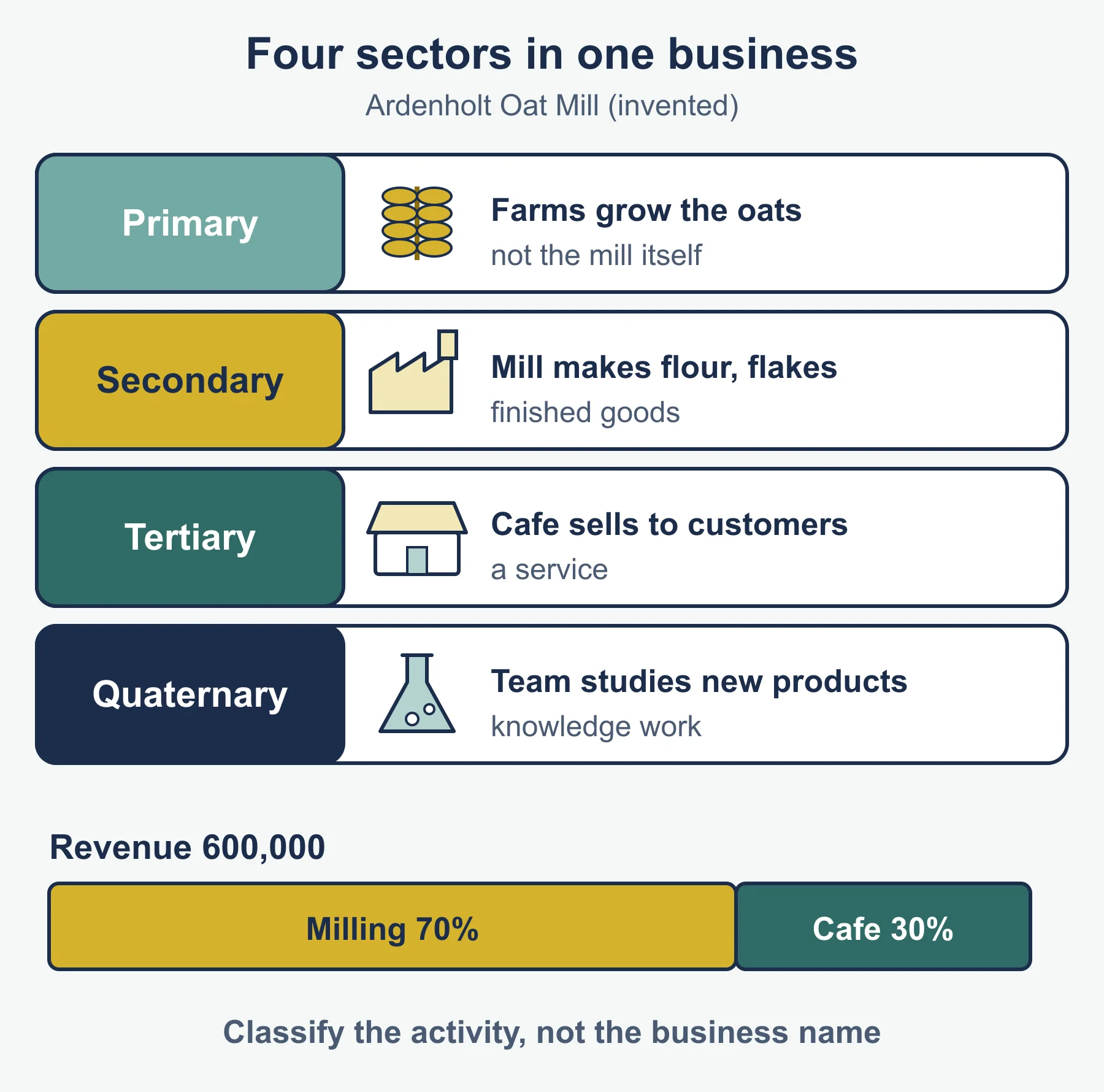
The four sectors at a glance
| Sector | Core idea | Memory hook | Examples |
|---|---|---|---|
| Primary | Take from nature | Raw | Quarrying, fishing, dairy farming |
| Secondary | Make or build | Make | Brick-making, car assembly, bread baking |
| Tertiary | Serve | Serve | Hairdressing, insurance, bus travel |
| Quaternary | Know and discover | Know | Software research, data analysis, drug discovery |
Method in steps: classify an activity
- Ask what the activity actually does, not what the firm is called.
- If it extracts or grows something natural, it is primary.
- If it changes materials into products, it is secondary.
- If the customer buys a service, it is tertiary.
- If it creates or applies knowledge and information, it is quaternary.
- If one firm does several things, classify each activity and say which is largest.
Small reminder. A printing firm, Lumenfold Print Studio (invented), has 72 staff. Of these, 18 work in an in-house design and software-research team. That team is 18 ÷ 72 × 100 = 25% of the staff, and its work is quaternary. The machine operators are secondary, and the front-desk customer team is tertiary.
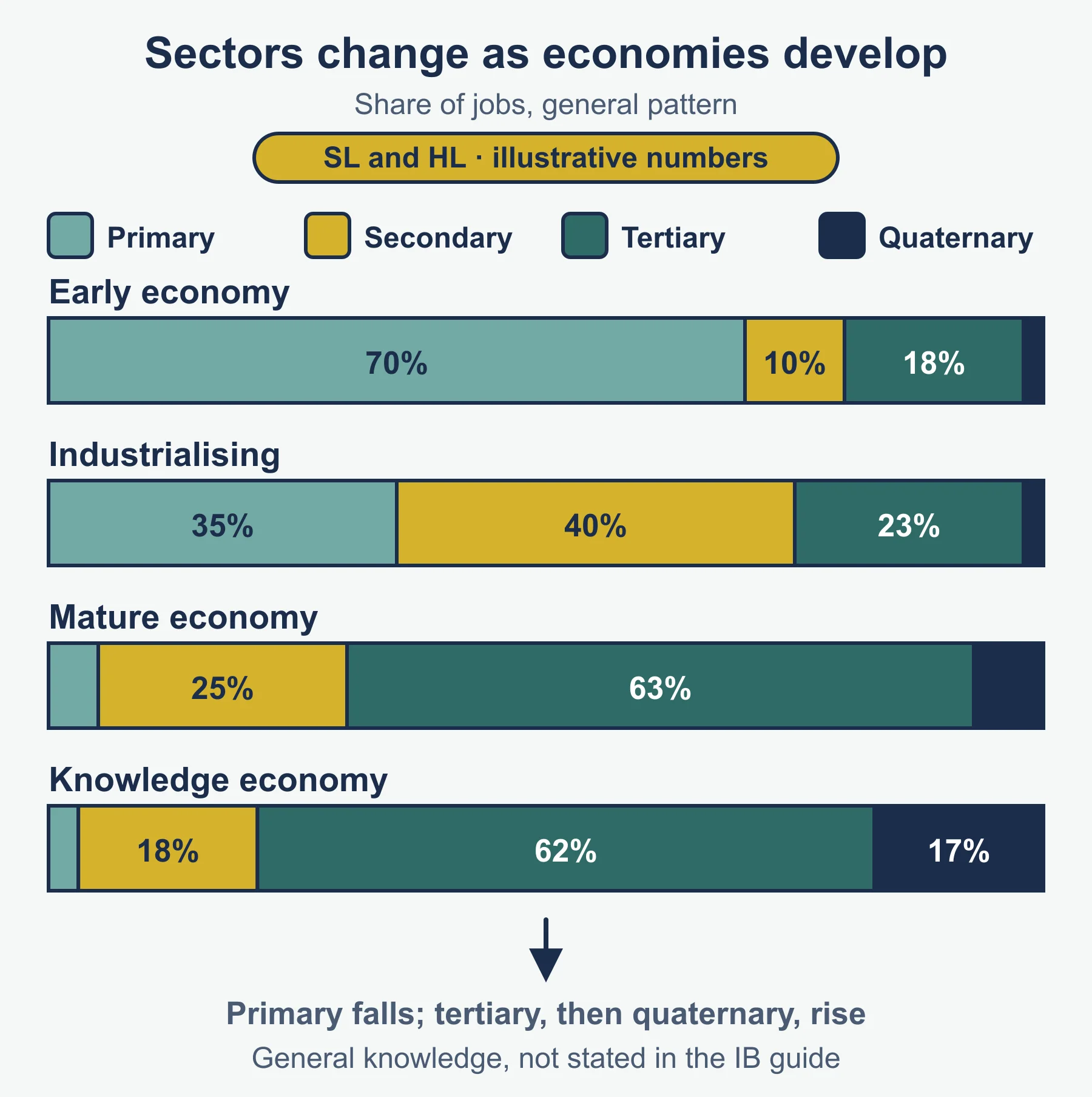
Sector change
This is general knowledge, not a point the guide makes. As economies develop, the share of employment and output often moves from primary to secondary to tertiary, with growth in quaternary. A business should watch this: labor supply, wages and customer demand all shift.
Entrepreneurship
- Typical traits: risk-taking, creativity, determination, spotting gaps in a market.
- Rewards: profit, independence, satisfaction. Risks: loss of savings, long hours.
- An entrepreneur starts and risks a venture; a manager runs it for the owners. In a tiny firm one person is both.
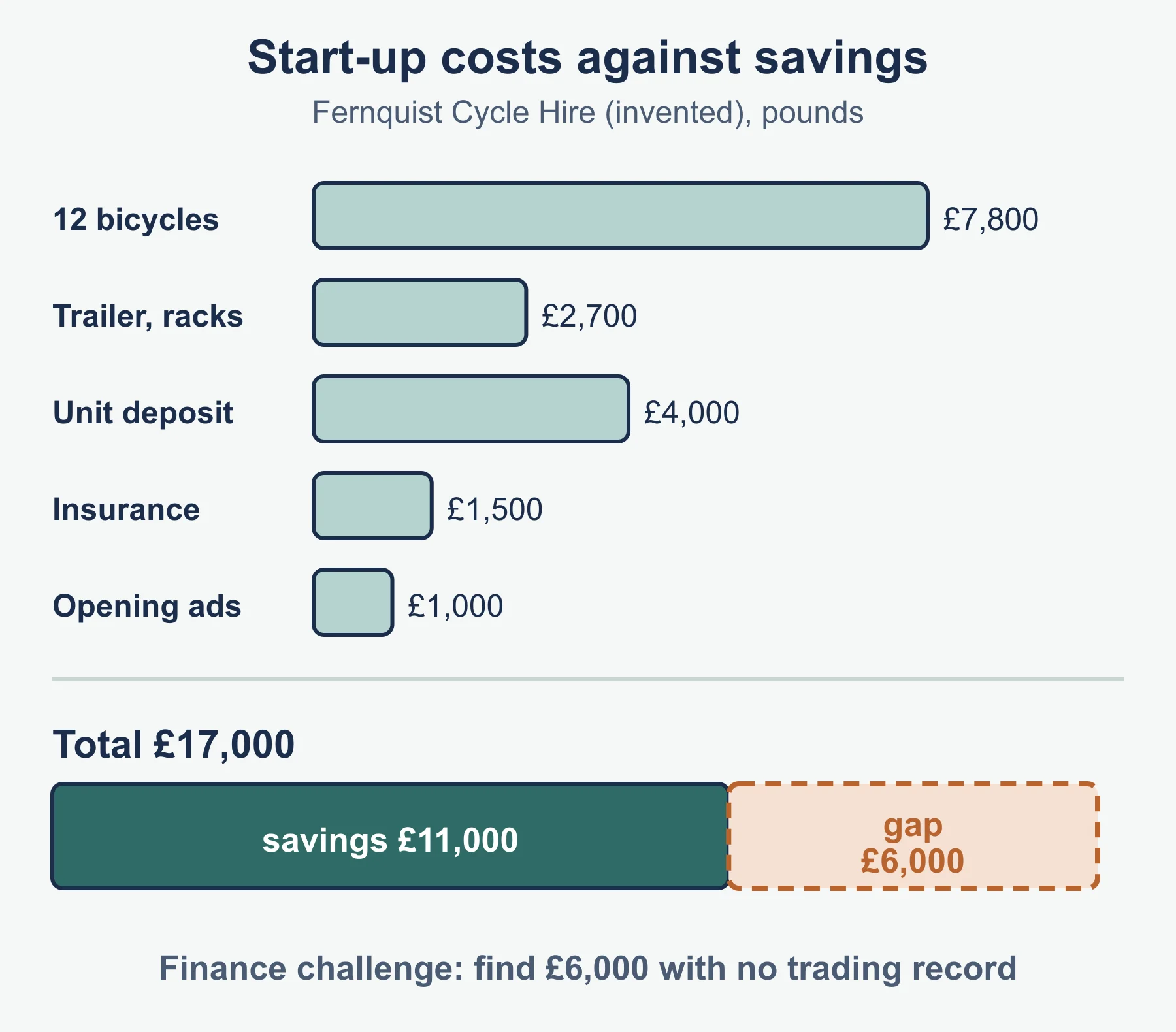
Starting up: challenges and opportunities
| Opportunities | Challenges |
|---|---|
| Keep the profit and make the decisions | Finance with no trading history |
| Fill a gap in the market | Negative cash flow early on |
| Move quickly and change plans | Strong competitors |
| Creative freedom | Long hours and personal risk |
| Possible growth or sale | Regulation, tax, finding staff and customers |
Method in steps: answer an AO2 start-up question
- Pick two or three factors that fit the case.
- Link each to a detail from the stem (a number, a location, a season).
- Explain the effect on the business, not just the fact.
- If asked to evaluate or justify, say which factor matters most and why.
1.2 Types of business entities
Private sector and public sector
| Private sector | Public sector | |
|---|---|---|
| Owned by | Individuals or private groups | The government (national or local) |
| Usual aim | Profit, sometimes with a social purpose | Provide a service to the public |
| Accountable to | Owners and customers | Government, taxpayers and voters |
Do not confuse this split with the four economic sectors in 1.1. They answer different questions: who owns it, versus what stage of production it covers.
Features of the four organization types
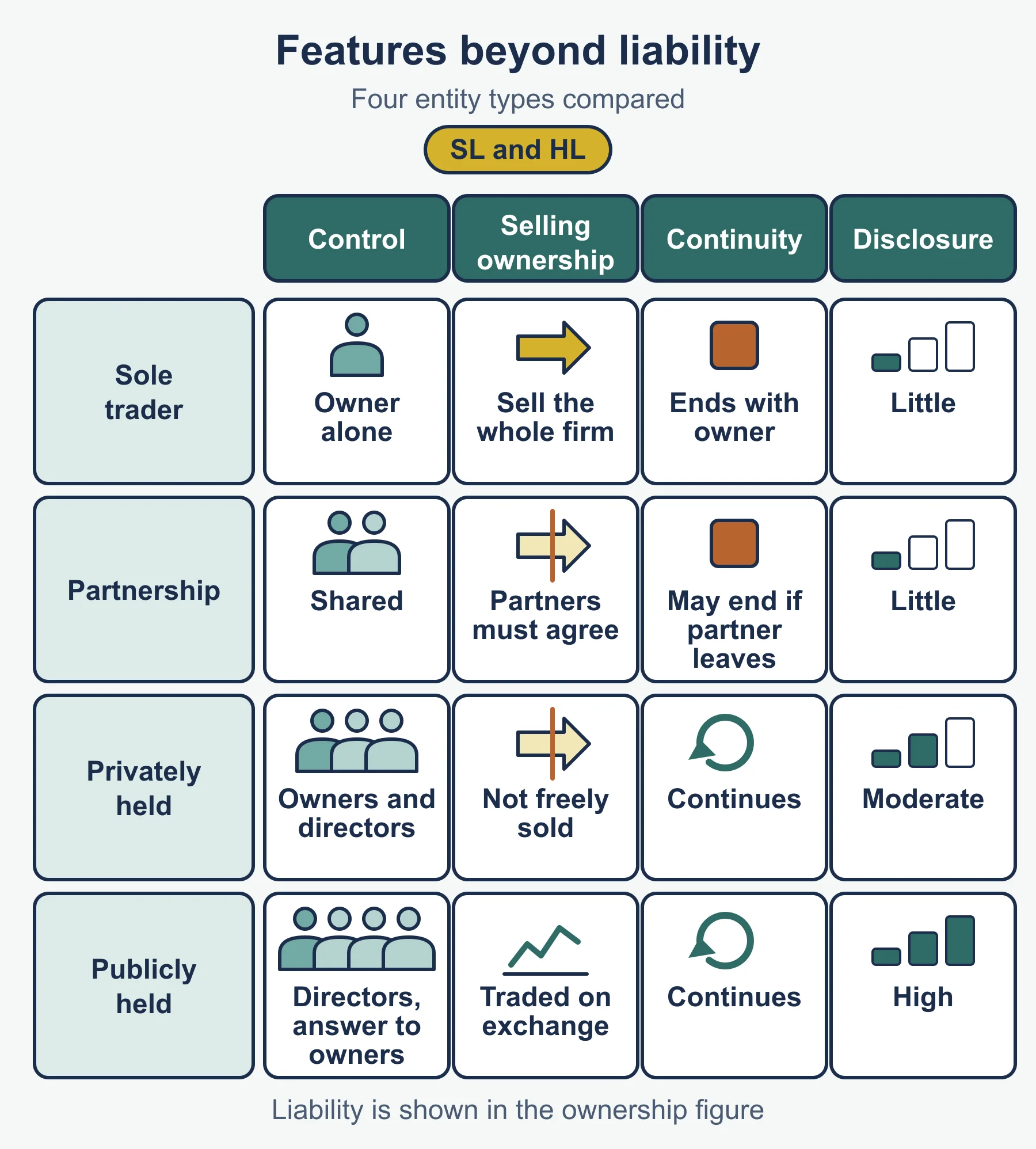
| Sole trader | Partnership | Privately held company | Publicly held company | |
|---|---|---|---|---|
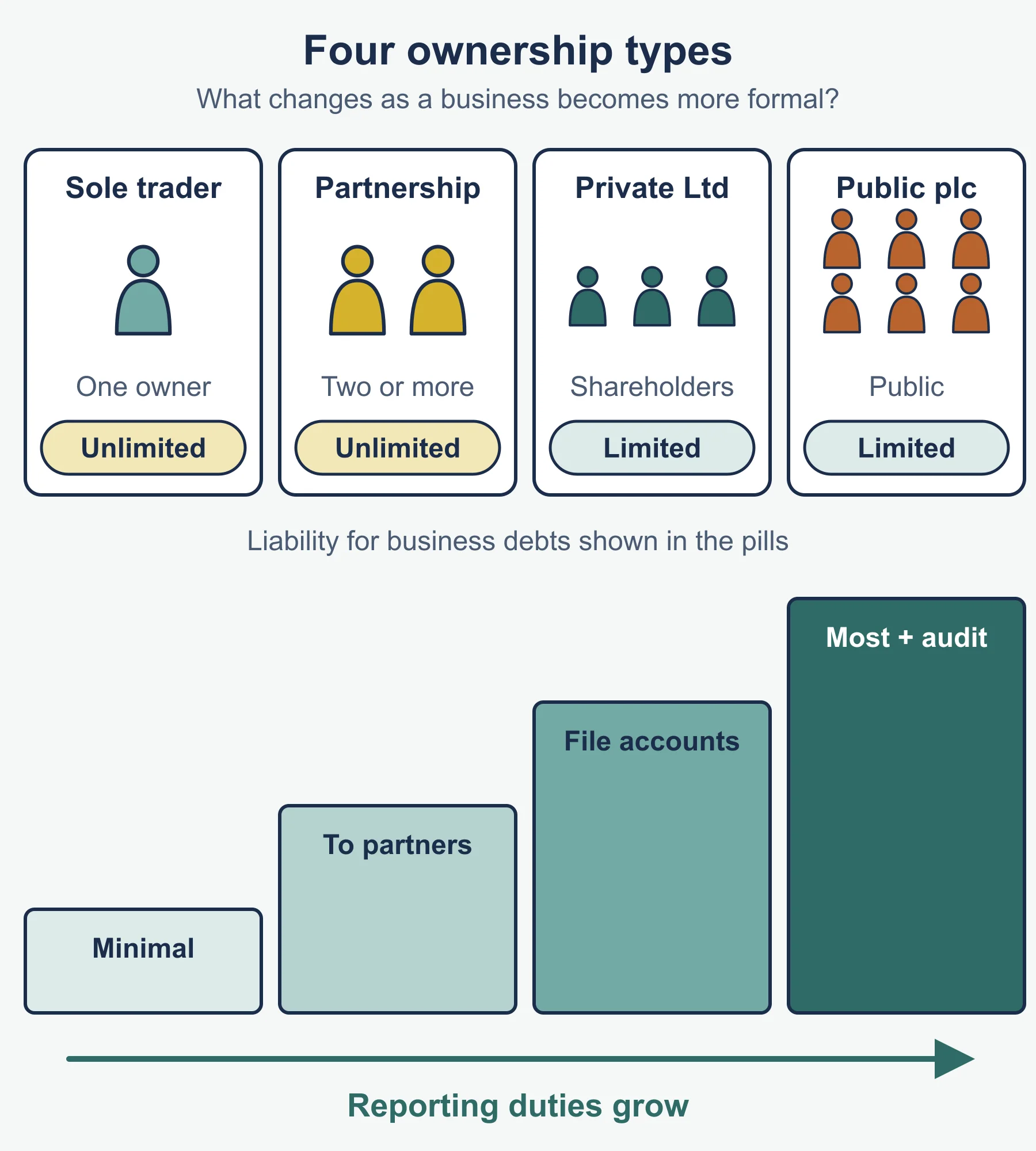
| Owners | One | Two or more | Few shareholders | Many shareholders |
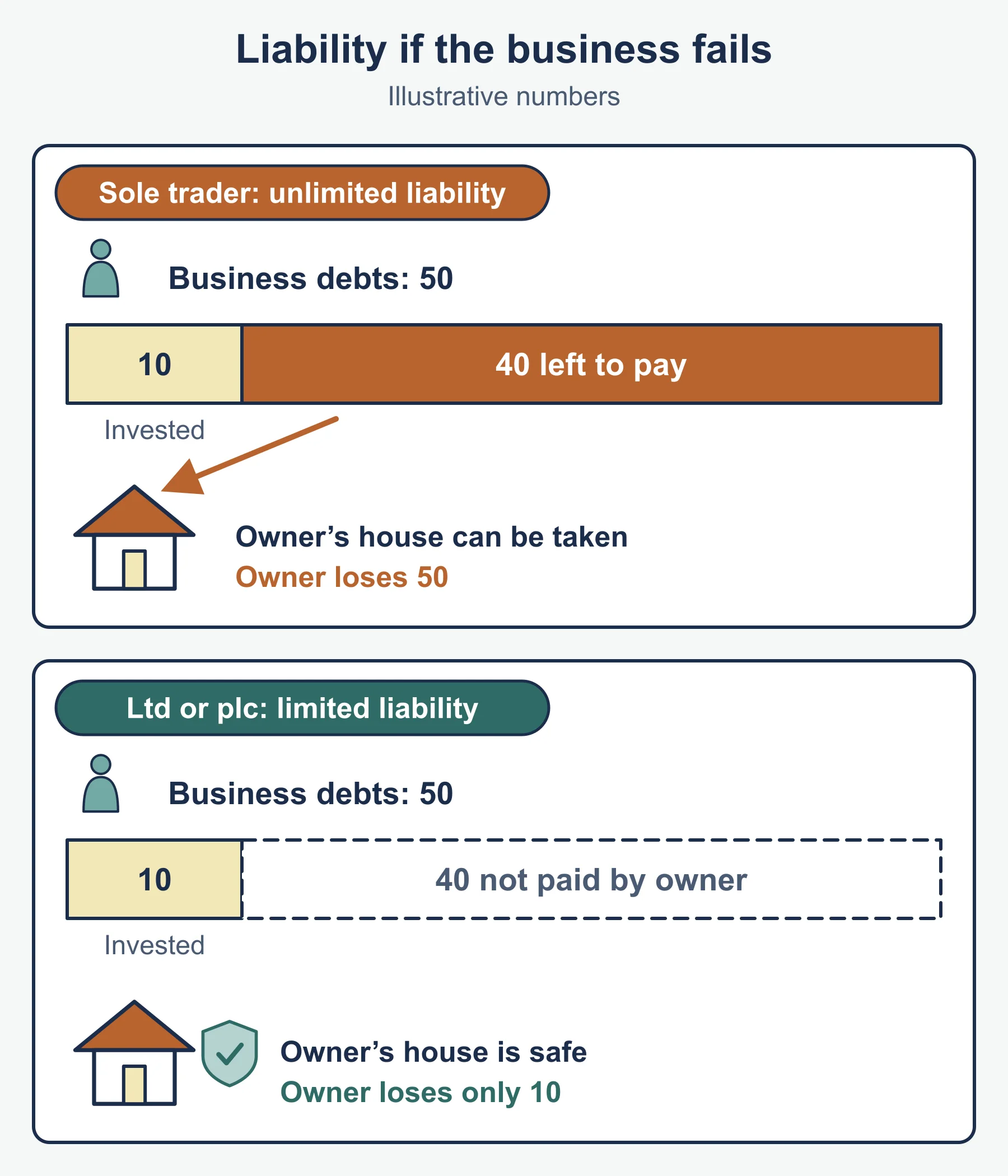
| Liability (general terms) | Unlimited | Unlimited | Limited | Limited |
| Finance | Savings, loans, retained profit | Partners’ capital, loans | Owners, private investors, loans | Share sales to the public, loans |
| Control | Owner alone | Shared | Directors and owners | Directors answering to shareholders |
| Ownership transfer | Sell the business | Usually needs agreement | Not freely sold to public | Shares traded openly |
| Disclosure | Low | Low | Moderate | High |
Legal rules vary by country. State that your features are general.
Small reminder. If a sole trader’s business owes £9,000 and its assets are worth £5,500, a shortfall of £3,500 is, in general terms, a personal liability for the owner. If the same firm were a limited company, the owner’s loss would, in general, be capped at the money put in.
Small reminder on ownership. A privately held company has 500 shares and the founder owns 300 (60%). If it issues 500 new shares to outside investors, the founder owns 300 ÷ 1,000 × 100 = 30%. Control falls even though the founder owns the same number of shares. That is dilution.
Social enterprises
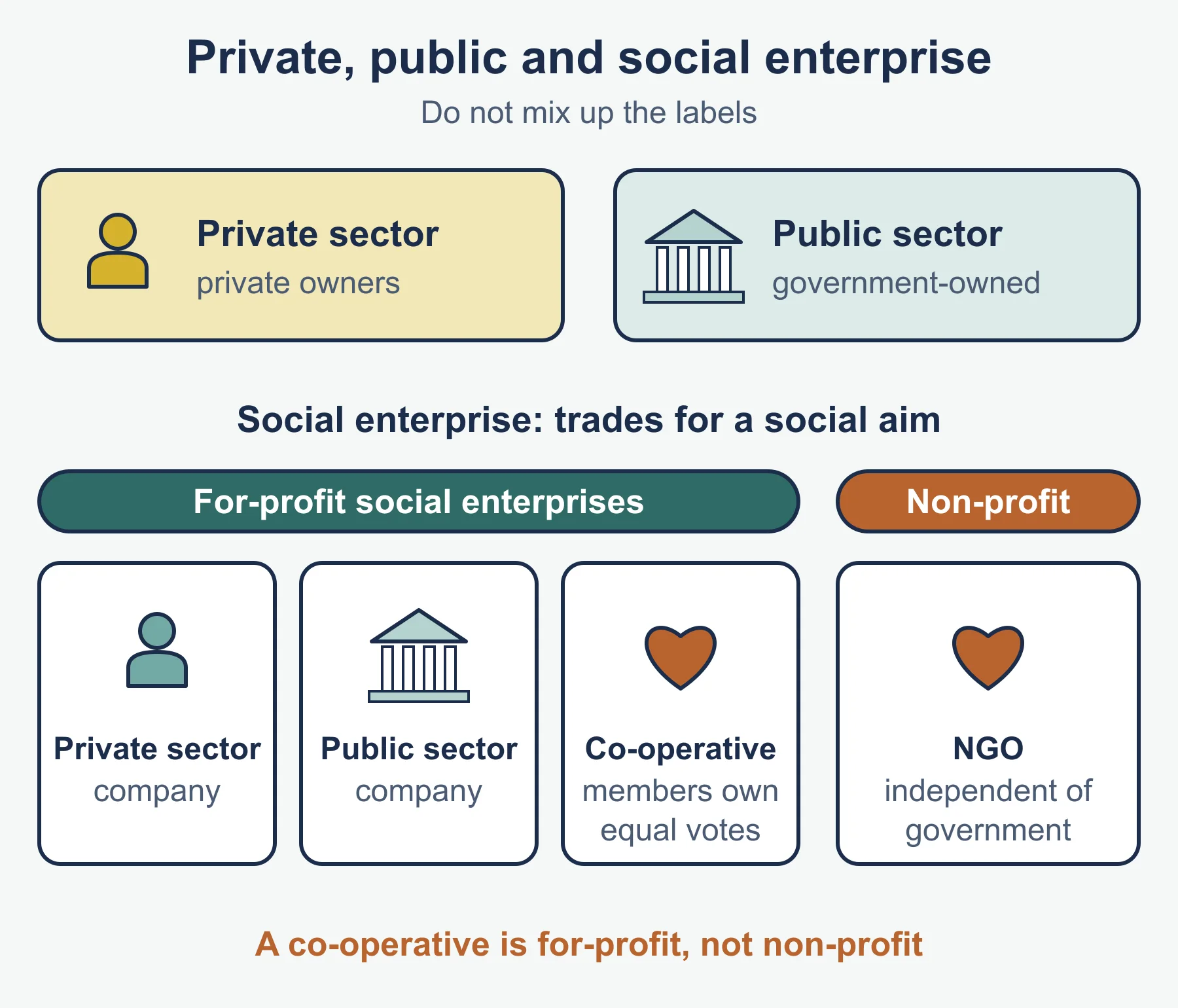
| Type | Group in the guide | Key features |
|---|---|---|
| Private sector company | For-profit | Privately owned; trades for profit while pursuing a stated social or environmental aim |
| Public sector company | For-profit | Government-owned; run like a business; serves a public aim |
| Cooperative | For-profit | Owned by members; usually one member, one vote; surplus shared or reinvested |
| NGO | Non-profit | Independent of government; funded by donations and grants; surplus kept for the mission |
Small reminder. In a cooperative with 50 members that votes with one vote each, a simple majority needs 26 votes. This is why no single member can dominate, unlike a shareholder with many shares in a company.
Must-know distinctions
- Private sector versus publicly held company: one is about ownership by private parties; the other is about shares being open to the public. A publicly held company is part of the private sector.
- Public sector company versus publicly held company: government-owned versus shares open to investors.
- Cooperative versus partnership: a cooperative is member-owned with a collective aim and often many members; a partnership has a small number of partners with unlimited liability in general terms.
- For-profit social enterprise versus NGO: the guide groups the first as for-profit and the NGO as non-profit.
Choosing an entity in a case study
Because the guide sets 1.2 features at AO3, expect to compare entities for a given situation. Use this short sequence.
- Note the size, the amount of finance needed and the owners’ appetite for risk.
- Pick the two entities that best fit and set their features side by side.
- Weigh them: liability, control, access to finance, disclosure and continuity.
- Reach a judgement and state a condition that would change it, for example a bigger funding need.
For command terms, the guide defines “evaluate” as weighing up strengths and limitations, “justify” as giving valid reasons or evidence for a conclusion, and “recommend” as presenting an advisable course of action with supporting reasons. Each needs a clear conclusion tied to the stem.
Quick self-test
- Name the four sectors in the order they are listed in the guide.
- State which sector a firm that develops software for hospitals belongs to.
- Define “entrepreneur” in one sentence.
- Give two challenges of starting a business.
- Distinguish the private sector from the public sector.
- Give one advantage and one disadvantage of being a sole trader.
- Three partners share a profit of £24,000 equally. How much does each receive?
- Identify the type of social enterprise owned and run by its members.
- Explain why an NGO is described as non-profit.
- Explain one way a privately held company differs from a publicly held company.
Answers
- Primary, secondary, tertiary, quaternary.
- Quaternary, because it is knowledge and information-based work.
- A person who identifies an opportunity, organizes resources to use it, and takes the risk of loss.
- Any two: raising finance, early cash flow, competition, regulation, long hours.
- Private sector: owned by private individuals or groups, usually for profit. Public sector: owned by government, usually to provide services.
- Advantage: keeps all profit and makes all decisions. Disadvantage: unlimited liability in general terms, and finance is limited to what one person can raise.
- £24,000 ÷ 3 = £8,000 each.
- A cooperative.
- It does not aim to make profit for owners; any surplus is used for its mission.
- A privately held company’s shares are not offered to the public, while a publicly held company’s shares can be bought and sold openly, giving it more access to capital but more disclosure.
Where marks are usually lost
- Listing the four sectors without linking an activity in the case to one of them.
- Classifying a firm by its name or product instead of by what its activities do.
- Using “public sector” and “publicly held” as if they were the same.
- Saying limited liability protects owners from all loss.
- Writing features of an entity with no reference to the case’s size, finance needs or risk.
- Giving a recommendation of an entity without a reasoned comparison with another.
- Treating a social enterprise as unable to earn a surplus. The guide lists for-profit forms.
- Answering “evaluate” or “justify” with a one-sided list and no conclusion.
Frequently asked questions
What is the difference between the public sector and a publicly held company? The public sector is made up of organizations owned and controlled by the government. A publicly held company is privately owned, but its shares are open to investors in general, so the two terms should never be used as if they were the same.
What is the difference between an entrepreneur and a manager? An entrepreneur starts and takes the risk of a venture, while a manager runs it for the owners. In a very small firm one person may do both.
Is a cooperative a non-profit organization? Not by definition. The IB guide places cooperatives among for-profit social enterprises; they are owned and run by members, and surplus is shared among members or reinvested.
How do you classify an activity into a sector? Classify by what the activity does, not by the firm’s name or product: taking from nature is primary, making goods is secondary, providing services is tertiary, and knowledge work is quaternary. One business can operate in several sectors.
Official syllabus
IB Diploma Programme Business management guide, first assessment 2024, published by the International Baccalaureate Organization. Sections 1.1 and 1.2 of Unit 1.
Get free revision emails (optional)
Occasional emails with practice questions, worked explanations and links to free resources for the qualification and subjects you choose. No spam, and you can unsubscribe from any email. The free tools on this site never need an email.
Related resources
-
Study guides
IB DP Business Management: Business objectives
Study guide to vision and mission statements, growth, profit, shareholder value, ethics, strategic and tactical aims and CSR in IB Business Management.
Business · International Baccalaureate · IB
Read guide -
Practice questions
IB DP Business Management: Business objectives – Practice Questions
Eleven original practice questions with worked answers on business objectives, strategic and tactical aims and CSR for IB Business Management 1.3.
Business · International Baccalaureate · IB
Try questions -
Revision notes
IB DP Business Management: Business objectives – Revision Notes
Condensed revision notes on vision and mission, business objectives, strategic versus tactical aims and CSR for IB DP Business Management section 1.3.
Business · International Baccalaureate · IB
Revise topic
Related articles
-
teaching
A Level tuition in Dubai: Cambridge or Pearson Edexcel International A Level?
Schools in Dubai and Abu Dhabi teach either Cambridge International AS & A Level or Pearson Edexcel International A Level. How the two are structured, why it matters for tuition, and how online classes from Lahore work.
9 October 2026
-
curriculum guides
Choosing subjects at IGCSE and A Level
How subject choices at 14 and 16 affect university options later, and how to keep pathways open without overloading a timetable.
28 July 2026
Studying this with a teacher
Working through Business IB?
This page is free and stays free. If you would rather be taught it, Marlbridge runs Business classes one-to-one, online in your own time zone. The first trial class is free. WhatsApp replies within an hour (8am–11pm Pakistan time, every day); email the same day.
IB Business teachers at Marlbridge

