
Study Guides
IB DP Business Management: Business objectives
Study guide to vision and mission statements, growth, profit, shareholder value, ethics, strategic and tactical aims and CSR in IB Business Management.
- Subject
- Business
- Level
- IB
- Topic
- Unit 1: Introduction to business management
- Author
- Marlbridge Academic Team
- Updated
- Reviewed by
- Salman Ahmad (what this means)
Aligned to International Baccalaureate IB Diploma Programme Business (DP Business Management), First assessment 2024. Official specification .
Syllabus page (what it covers and how it is assessed): IB Diploma Programme Business.
Syllabus points this page covers
DP Business Management
- 1.3 Business objectives
Found an error? Report a correction.
Need help with this topic? Request a free trial class for IB Diploma Programme Business (DP Business Management).
This guide covers section 1.3, Business objectives, of Unit 1 in the IB Business management guide (first assessment 2024). The content applies to both SL and HL; nothing in 1.3 is marked as HL only. It sits between 1.2 (types of business entity) and 1.4 (stakeholders), so many answers on objectives also lean on stakeholder ideas.
Use it with the revision notes and the practice questions. The course hub is at IB DP Business Management, the printable list is the syllabus checklist, and you can test yourself with the free diagnostics. For the wider course, see the syllabus guide.
What 1.3 asks you to know
| Content point | Depth of teaching in the guide | SL/HL |
|---|---|---|
| Vision statement and mission statement | AO2, application and analysis | SL and HL |
| Common business objectives, including growth, profit, protecting shareholder value and ethical objectives | AO2 | SL and HL |
| Strategic and tactical objectives | AO3, synthesis and evaluation | SL and HL |
| Corporate social responsibility (CSR) | AO3 | SL and HL |
The AO labels matter. Vision and mission statements and the common objectives are tested at the application and analysis level. Strategic versus tactical objectives and CSR sit at the synthesis and evaluation level, so expect to be asked to weigh something up, not only to describe it. The guide’s suggested inquiry statements for this unit include why business objectives might change over time, how CSR could affect business creativity, and how ethical behavior contributes to business sustainability. They are good prompts for thinking about the evaluation side.
Vision statement and mission statement
The guide lists both terms and gives no formal definitions, so the wording below is the standard form used in most textbooks.
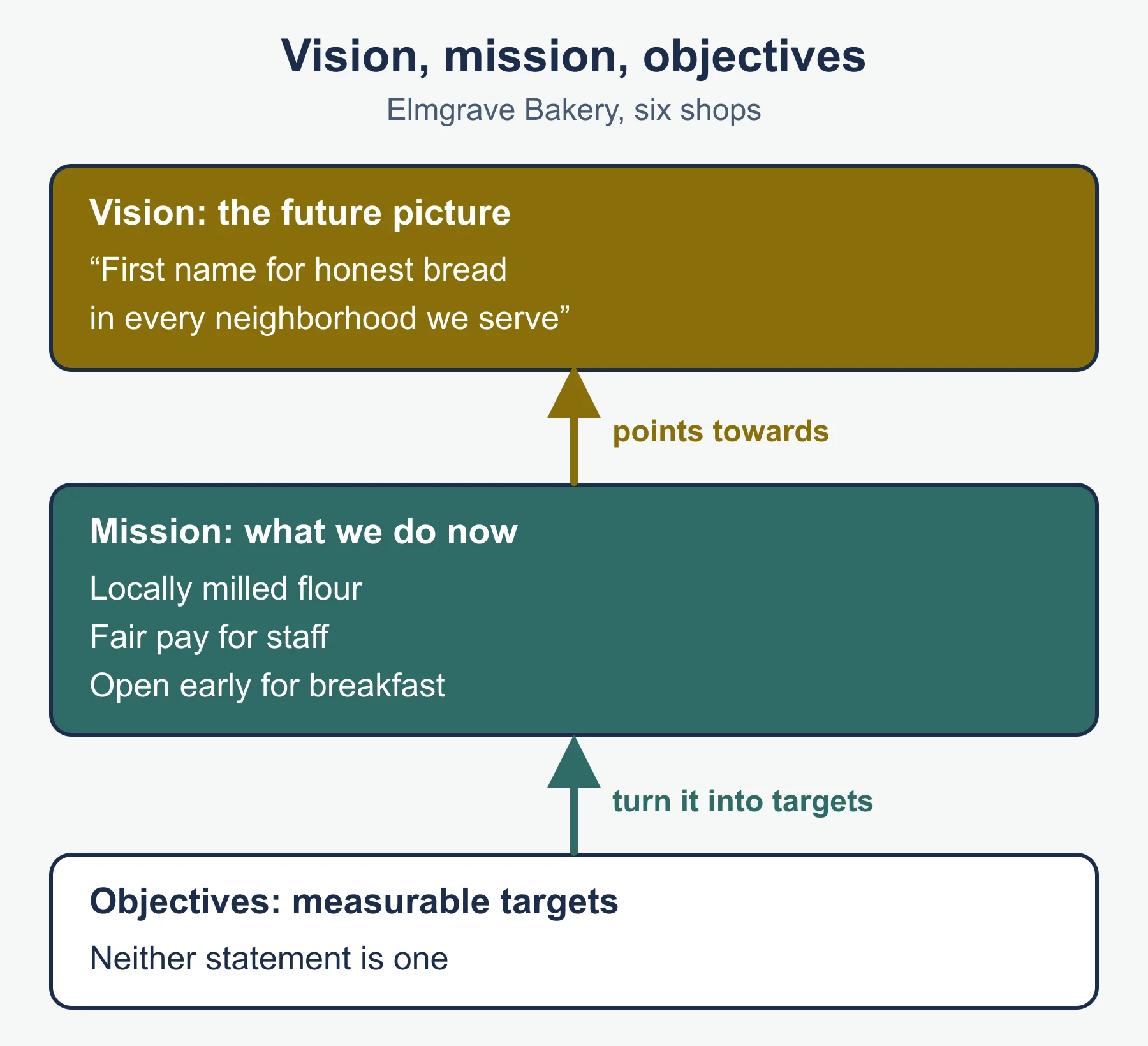
- A vision statement describes what the organization hopes to become or achieve in the long term. It points at a future picture and is meant to inspire.
- A mission statement describes what the organization does, who it serves and how it goes about it today. It is more practical than a vision and is closer to the day-to-day purpose.
Neither statement is itself an objective. Objectives are more specific and are often measurable. The statements give direction, and the objectives turn that direction into targets.
Example. Elmgrave Bakery is a family business with six shops.
- Vision: “To be the first name people think of for honest bread in every neighborhood we serve.”
- Mission: “We bake with locally milled flour, pay our staff fairly and open early so that fresh bread is on the table by breakfast.”
The vision looks forward and is hard to measure. The mission names the products, the approach and the customers.
Why have them at all? They can give staff a shared sense of purpose, help managers decide between competing options, signal values to customers and investors, and give a reference point against which later decisions can be judged. The weaknesses are just as testable. Statements can be vague, copied from competitors, ignored in practice or written to look good rather than to guide. A statement that says “we value our staff” while the firm cuts wages at every chance will not be believed. The guide’s theory of knowledge prompt asks whether a mission statement is worthless if its effects cannot be easily measured, and your answer can use this tension: the benefit is real but hard to isolate from other causes.
Common business objectives
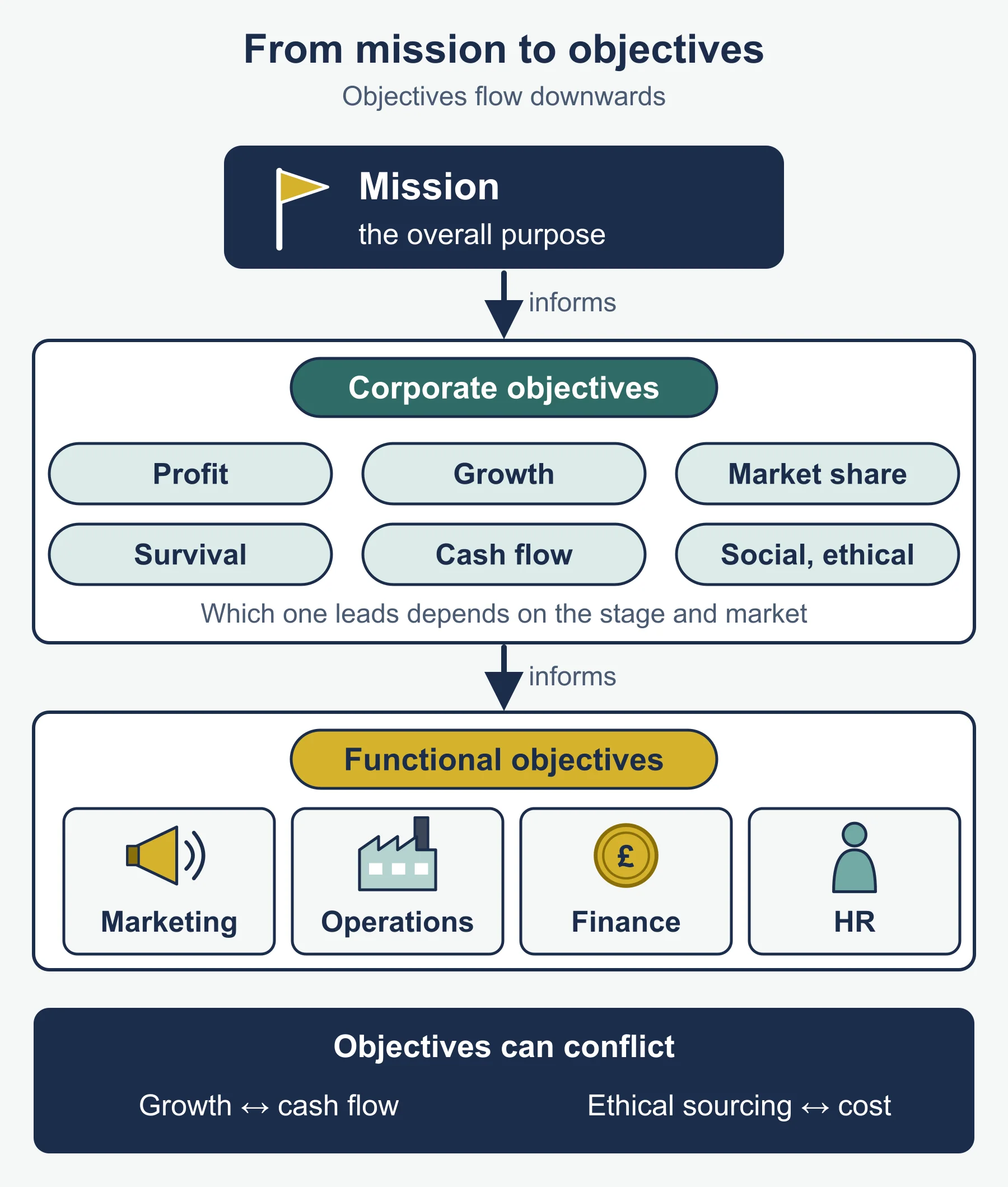
An objective is a specific aim that a business sets itself. Objectives give everyone a target, make performance measurable and help the business judge whether its decisions worked. The guide names four common ones.
Growth
Growth means getting bigger. It can be measured in several ways: sales revenue, number of employees, number of outlets, market share or the value of the business. The formula for percentage growth is the standard form:
percentage growth = (new value − old value) ÷ old value × 100
Reasons for choosing growth include economies of scale, a stronger position against competitors, spreading risk across more products or markets, and satisfying managers or owners who want a larger firm. The risks are cash-flow strain, loss of control and a drop in quality if expansion is too fast.
Profit
Profit is sales revenue minus costs. A business may aim for profit maximization, or for a satisfactory level of profit, or for a particular profit margin. Profit funds reinvestment, rewards owners and gives a cushion against bad years. Two businesses with the same profit can have very different margins, so say which measure you are using. The standard form of net profit margin is:
net profit margin = net profit ÷ sales revenue × 100
Profit is not the only target. A firm in its first years may accept low profit to win customers, and a social enterprise may count profit as a means and not the end.
Protecting shareholder value
Shareholder value is the worth of a company to the people who own its shares. It rises when the share price rises and when dividends are paid. A business that aims to protect shareholder value tries to keep the share price stable or growing and to keep dividends steady. This objective is most relevant to publicly held companies, whose shares are traded openly; the guide covers privately and publicly held companies in 1.2. A private business has owners too, but no daily share price, so the measure is less direct.
A simple way to see the effect on a shareholder is the return from holding a share for a year:
return = (closing price − opening price + dividend) ÷ opening price × 100
This is a standard illustration and not a formula the guide asks you to memorize.
Ethical objectives
Ethical objectives are aims about acting in line with moral principles, going beyond what the law demands. Examples are paying suppliers a fair price, avoiding misleading advertising, refusing to use materials from unsound sources, or treating staff and customers honestly. They may cost money in the short term, but they can build trust, protect reputation and attract staff and customers who share the values. They can also clash with other objectives, for example when the cheapest supplier does not meet the business’s standards.
Worked example 1: growth against profit
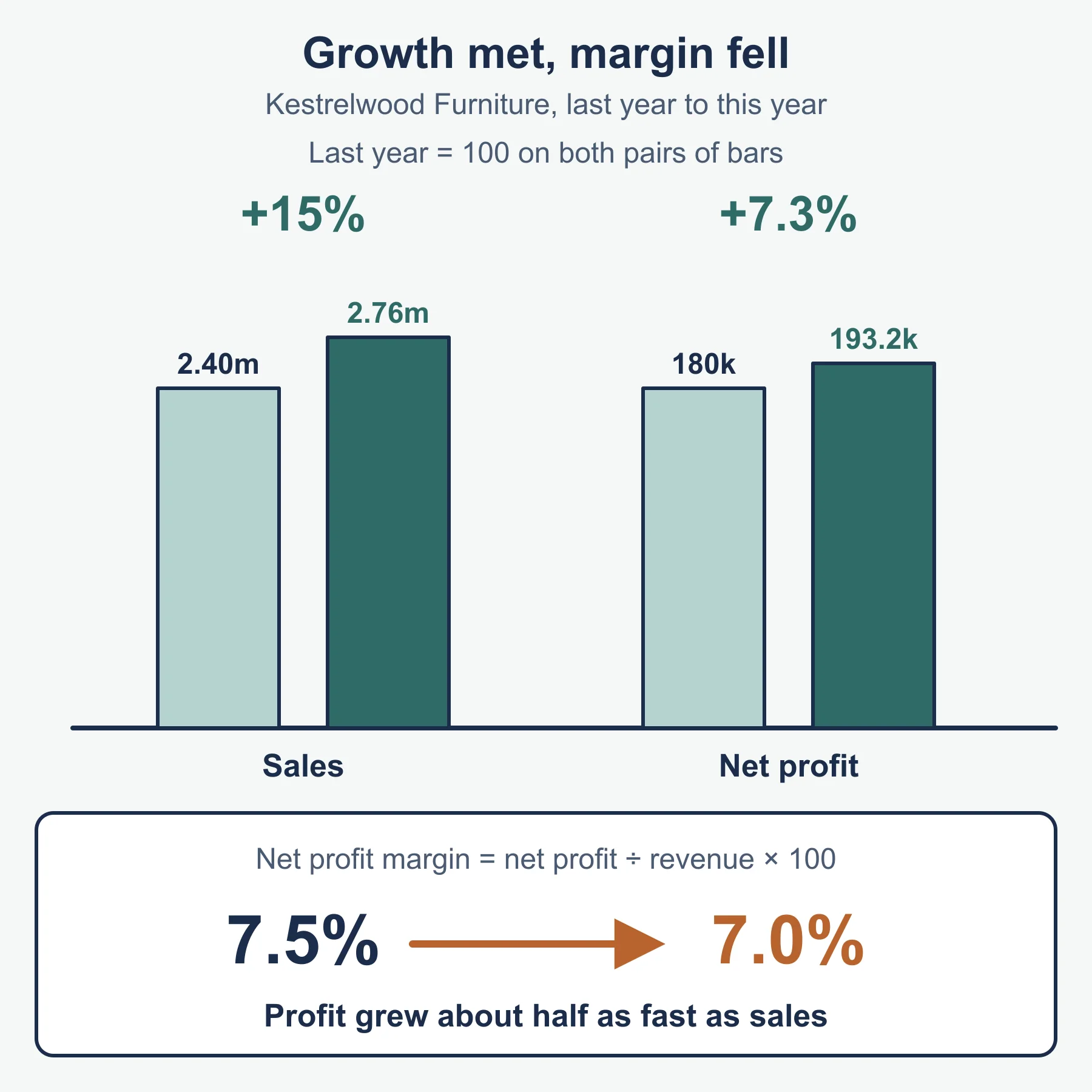
Kestrelwood Furniture sold USD 2.40 million of furniture last year and USD 2.76 million this year. Net profit was USD 180,000 last year and USD 193,200 this year. Its stated objective was to grow sales revenue by 15%.
Step 1, revenue growth: (2.76 − 2.40) ÷ 2.40 × 100 = 15%. The growth objective was met exactly.
Step 2, net profit margin last year: 180,000 ÷ 2,400,000 × 100 = 7.5%.
Step 3, net profit margin this year: 193,200 ÷ 2,760,000 × 100 = 7.0%.
Step 4, comment. Profit rose by about 7.3% in money terms, which is less than half the rate of sales growth, so the margin fell by half a percentage point. The business achieved its growth objective but at some cost to profitability. A balanced judgment would say whether the margin fall looks temporary (for example, new-store opening costs) or a sign that growth was bought with discounts. It would also say which objective the owners value more.
Worked example 2: shareholder value
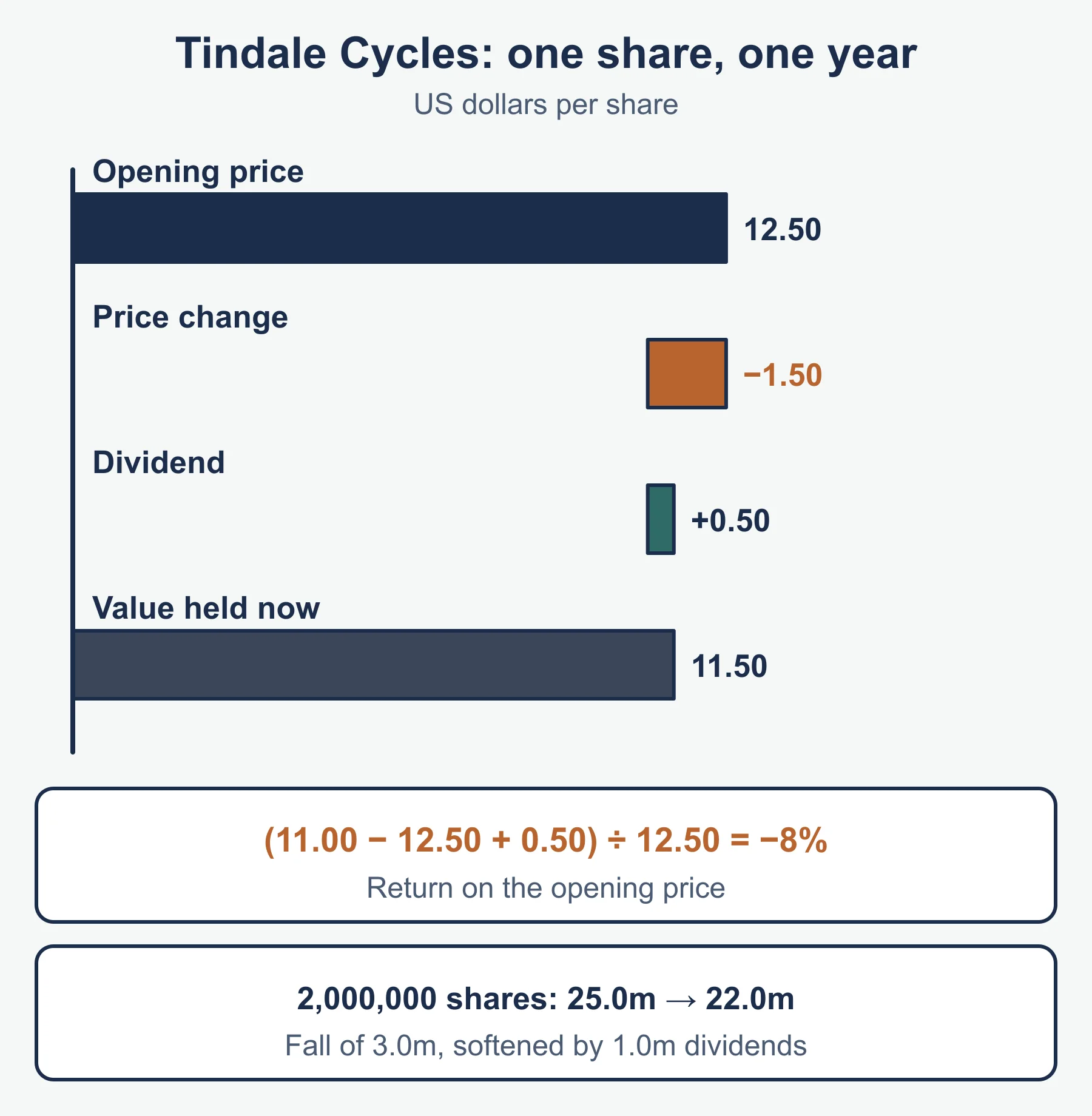
Tindale Cycles is a publicly held company with 2,000,000 shares. A share was worth USD 12.50 a year ago and is now USD 11.00. A dividend of USD 0.50 per share was paid during the year.
Return to a shareholder: (11.00 − 12.50 + 0.50) ÷ 12.50 × 100 = −8%.
The value of all shares, the market capitalization, fell from USD 25.0 million to USD 22.0 million, a fall of USD 3.0 million. The dividend of USD 1.0 million in total softened the loss but did not remove it. Managers aiming to protect shareholder value would have to explain the fall, perhaps by a profit warning, or by the whole market dropping. Without that context you cannot judge whether the managers or outside events were responsible.
Strategic and tactical objectives
The guide lists these at AO3, so you need to compare them and judge how they work together.
| Strategic objectives | Tactical objectives | |
|---|---|---|
| Time frame | Long term | Short to medium term |
| Scope | The whole organization | A department, product or project |
| Set by | Senior management or the board | Middle managers, within strategy |
| Purpose | Set the overall direction | Show how a strategic aim will be reached |
| Example | Become the market leader in the region within five years | Open two new shops this year and run an introductory discount |
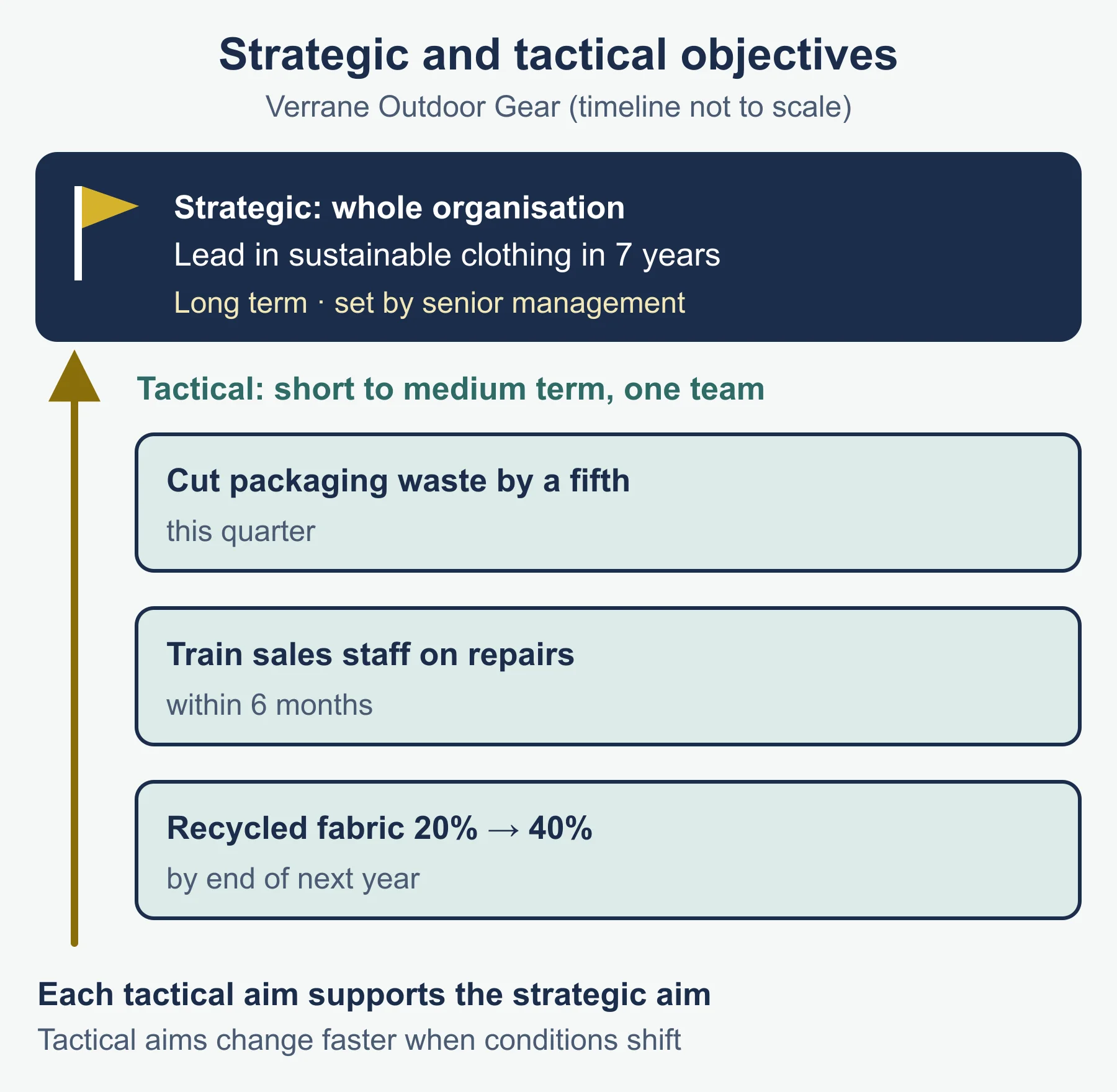
Tactical objectives should support the strategic one. If they do not, the business is busy but is not moving toward its aim. Tactical objectives are also easier to change when conditions shift, while a strategic objective changes only after a serious review. Strategic objectives are usually less certain, because they depend on conditions several years ahead.
Example. Verrane Outdoor Gear sets the strategic objective of becoming a leading maker of sustainable outdoor clothing within seven years. Tactical objectives follow: raise the share of recycled fabric used from 20% to 40% by the end of next year, train all sales staff on repair services within six months, and cut packaging waste by a fifth this quarter. Each is narrow, has a clear deadline and links to the main aim.
Evaluation point: tactical objectives help managers check progress and give staff clear targets, but a business that cares only about short-term targets can damage long-term aims, for example by cutting training to hit a quarterly cost target.
Corporate social responsibility (CSR)
Corporate social responsibility (CSR) is the view that a business owes something to society, the environment and its stakeholders, not only returns to its owners. A business that follows CSR looks at the effects of its decisions on its employees, customers, suppliers, local communities and the environment, and acts to limit harm and add benefit.
Ways a business can show CSR include reducing emissions and waste, paying fair wages, supporting local projects, sourcing materials responsibly and reporting openly on its social and environmental effects.
Arguments for CSR. It can improve reputation and brand loyalty, attract and keep staff, reduce the chance of costly scandals, and support long-term sustainability. It can also encourage creativity, because limits such as using less material push teams to find new designs and processes (this links to one of the guide’s suggested inquiry statements).
Arguments against, or limits.
- It can raise costs and cut profit or dividends in the short term.
- Some shareholders believe the main duty of managers is to the owners.
- Some firms use CSR language for marketing without real change, which risks a backlash if found out.
- Benefits are hard to measure and may arrive late.
For an evaluative answer, weigh costs against benefits, decide which matters more for the business in the case, and justify the choice. Strong answers also tie CSR back to the other objectives. A CSR policy can protect long-term profit and shareholder value, or conflict with them, depending on the business, its customers and the time frame.
Common errors
- Writing a mission statement and calling it an objective. Statements give direction; objectives are targets.
- Mixing up vision and mission. Vision is the future picture; mission is what the business does now and for whom.
- Saying that profit is the only objective of every business.
- Treating strategic as “important” and tactical as “unimportant”. The real difference is time frame and scope.
- Describing CSR in general terms without using the case. Name the stakeholder affected and the likely effect on cost or reputation.
- Giving a one-sided answer to an evaluation question. Weigh both sides, then decide.
Frequently asked questions
What is corporate social responsibility? Corporate social responsibility (CSR) is the view that a business owes something to society, the environment and its stakeholders, not only returns to its owners. Examples include reducing emissions and waste, paying fair wages and sourcing materials responsibly.
What are the arguments against CSR? CSR can raise costs and cut profit or dividends in the short term, some shareholders believe managers’ main duty is to the owners, some firms use CSR language without real change, and benefits are hard to measure.
What are ethical objectives? Ethical objectives are aims about acting in line with moral principles, going beyond what the law demands, such as paying suppliers a fair price or avoiding misleading advertising.
At what assessment level are strategic objectives and CSR tested in IB Business Management? The IB guide lists strategic and tactical objectives and CSR at AO3, synthesis and evaluation, while vision and mission statements and the common objectives sit at AO2, application and analysis.
Official syllabus
IB Diploma Programme Business management guide, first assessment 2024, published by the International Baccalaureate Organization. This page covers section 1.3, Business objectives.
Get free revision emails (optional)
Occasional emails with practice questions, worked explanations and links to free resources for the qualification and subjects you choose. No spam, and you can unsubscribe from any email. The free tools on this site never need an email.
Related resources
-
Practice questions
IB DP Business Management: Business objectives – Practice Questions
Eleven original practice questions with worked answers on business objectives, strategic and tactical aims and CSR for IB Business Management 1.3.
Business · International Baccalaureate · IB
Try questions -
Revision notes
IB DP Business Management: Business objectives – Revision Notes
Condensed revision notes on vision and mission, business objectives, strategic versus tactical aims and CSR for IB DP Business Management section 1.3.
Business · International Baccalaureate · IB
Revise topic -
Study guides
IB DP Business Management: Growth and evolution and Multinational companies (MNCs)
Study guide to IB DP Business Management sections 1.5 and 1.6: economies of scale, growth methods, franchising and the impact of MNCs on host countries.
Business · International Baccalaureate · IB
Read guide
Related articles
-
teaching
A Level tuition in Dubai: Cambridge or Pearson Edexcel International A Level?
Schools in Dubai and Abu Dhabi teach either Cambridge International AS & A Level or Pearson Edexcel International A Level. How the two are structured, why it matters for tuition, and how online classes from Lahore work.
9 October 2026
-
curriculum guides
Choosing subjects at IGCSE and A Level
How subject choices at 14 and 16 affect university options later, and how to keep pathways open without overloading a timetable.
28 July 2026
Studying this with a teacher
Working through Business IB?
This page is free and stays free. If you would rather be taught it, Marlbridge runs Business classes one-to-one, online in your own time zone. The first trial class is free. WhatsApp replies within an hour (8am–11pm Pakistan time, every day); email the same day.
IB Business teachers at Marlbridge

