
Revision Notes
IB DP Business Management: Business objectives – Revision Notes
Condensed revision notes on vision and mission, business objectives, strategic versus tactical aims and CSR for IB DP Business Management section 1.3.
- Subject
- Business
- Level
- IB
- Topic
- Unit 1: Introduction to business management
- Author
- Marlbridge Academic Team
- Updated
- Reviewed by
- Salman Ahmad (what this means)
Aligned to International Baccalaureate IB Diploma Programme Business (DP Business Management), First assessment 2024. Official specification .
Syllabus page (what it covers and how it is assessed): IB Diploma Programme Business.
Syllabus points this page covers
DP Business Management
- 1.3 Business objectives
Found an error? Report a correction.
Need help with this topic? Request a free trial class for IB Diploma Programme Business (DP Business Management).
These are condensed notes for section 1.3, Business objectives, in the IB Business management guide (first assessment 2024), for SL and HL. Full explanations and two worked examples are in the study guide. When you are ready to test yourself, use the practice questions, the syllabus checklist, the course hub and the free diagnostics.
The four content points at a glance
| Content point | Depth in the guide | One-line summary |
|---|---|---|
| Vision statement and mission statement | AO2 | Vision is the future picture; mission is present purpose |
| Common objectives: growth, profit, protecting shareholder value, ethical objectives | AO2 | What a business sets as targets |
| Strategic and tactical objectives | AO3 | Long-term direction versus shorter-term steps |
| Corporate social responsibility (CSR) | AO3 | Duties to society beyond making a profit |
Remember that AO3 means synthesis and evaluation: give a judgment, not just a list.
Vision and mission
| Vision statement | Mission statement | |
|---|---|---|
| Looks at | The future | The present |
| Answers | Where do we want to be? | What do we do, for whom, and how? |
| Tone | Aspirational | Practical |
| Measurable? | Rarely | Sometimes, partly |
The guide does not give formal definitions, so these are the standard forms.
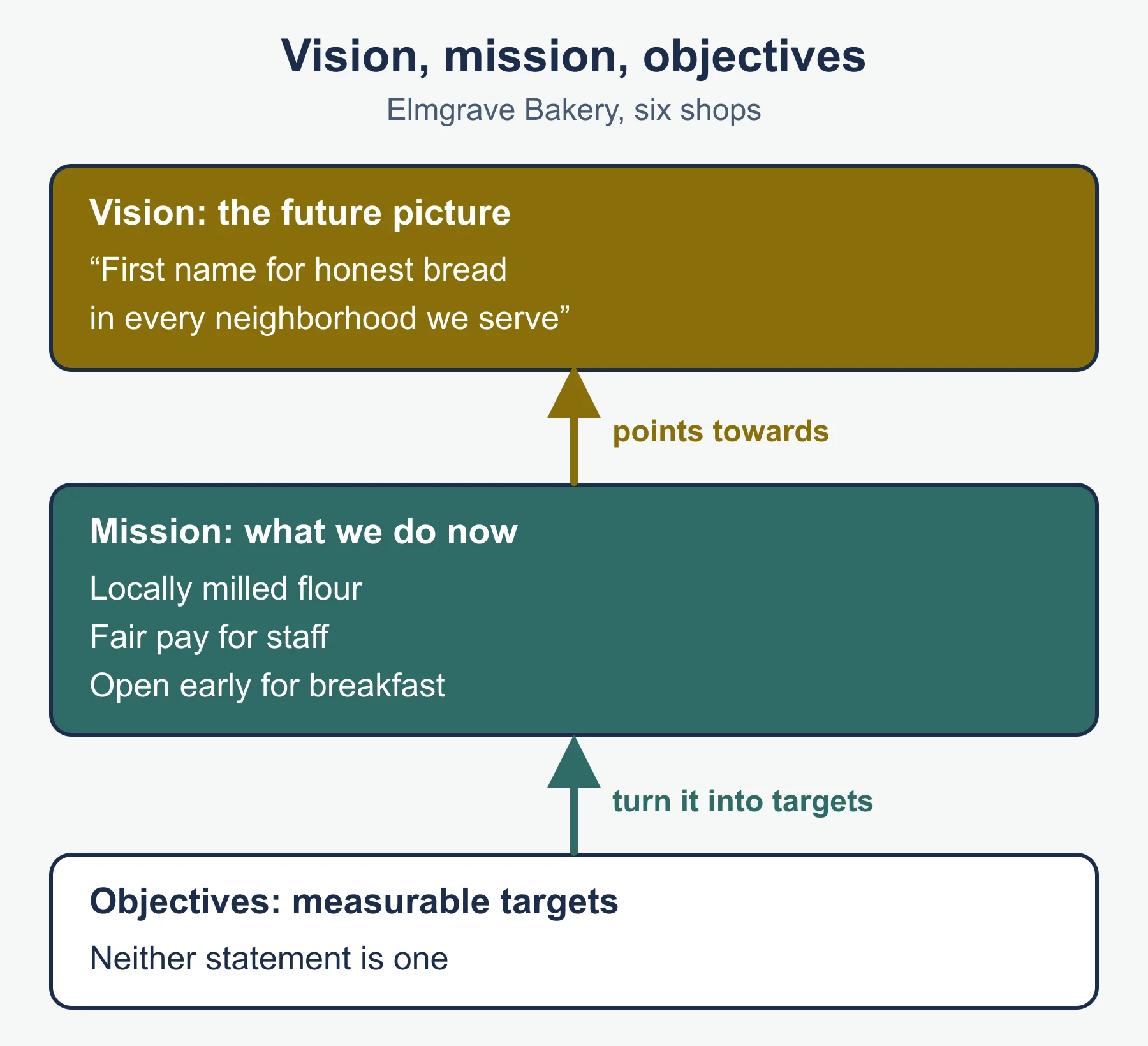
Why they help: shared direction for staff, a guide for decisions, a signal of values to customers and investors.
Why they can fail: too vague, copied from others, not followed in practice, written for show, and their effect is hard to measure.
Must-know distinction: a statement is not an objective. An objective is a specific target set to move toward the statement.
Common objectives
| Objective | What it means | Typical measure | Main benefit | Main risk |
|---|---|---|---|---|
| Growth | Becoming larger | Sales revenue, market share, staff numbers, outlets | Economies of scale, more power in the market, spread of risk | Cash-flow pressure, loss of control, falling quality |
| Profit | Revenue exceeds costs | Net profit, net profit margin | Funds reinvestment and rewards owners | Short-termism, cutting corners |
| Protecting shareholder value | Keeping the worth of shares and dividends stable or rising | Share price, dividends, market capitalization | Keeps investors confident and the cost of raising funds down | Pressure to please investors at the expense of other stakeholders |
| Ethical objectives | Acting on moral principles beyond the legal minimum | Policies, audits, supplier standards | Trust, reputation, loyal staff and customers | Higher costs, clashes with other objectives |
Formulas (standard forms)
| Measure | Formula |
|---|---|
| Percentage growth | (new − old) ÷ old × 100 |
| Net profit margin | net profit ÷ sales revenue × 100 |
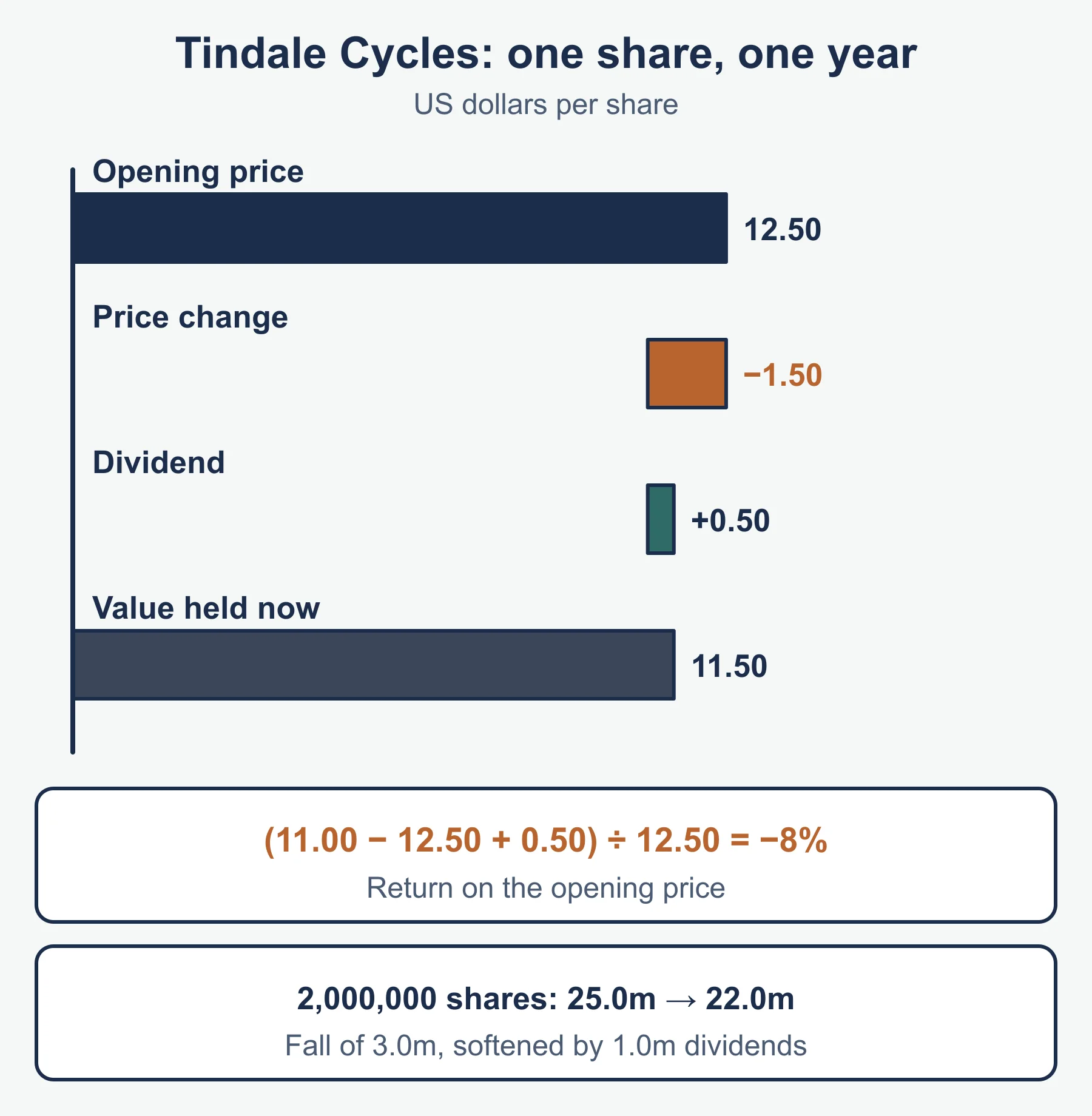
| Return on holding a share for a year | (closing price − opening price + dividend) ÷ opening price × 100 |
| Market capitalization | number of shares × share price |
The guide does not give these formulas for 1.3. They are the usual textbook forms, so state which one you use and show the working.
Method for a growth or profit calculation
- Write the formula.
- Substitute the figures from the stimulus, keeping units.
- Calculate and give a sensible rounding, with a percent sign or currency.
- Add one sentence saying what the figure means for the business.
Small worked reminder. A firm’s sales rise from 80 to 92 (thousand units). Growth = (92 − 80) ÷ 80 × 100 = 15%. A net profit of 45 on revenue of 600 gives a margin of 45 ÷ 600 × 100 = 7.5%.
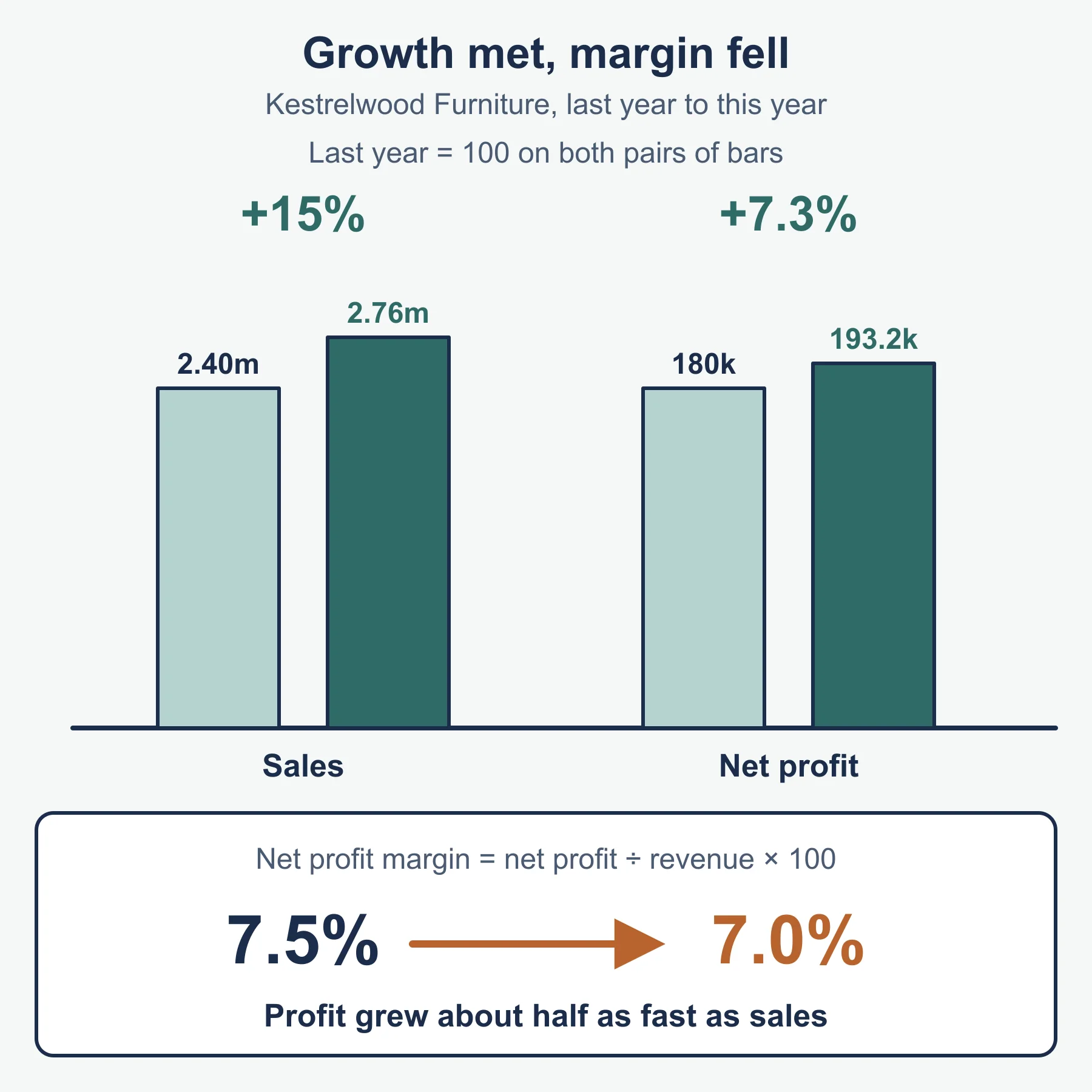
Growth and profit can pull apart
- Growth bought with discounts raises sales but squeezes the margin.
- Profit pushed up by cost cuts may harm quality, so growth stalls later.
- A new business often accepts low profit to build a customer base.
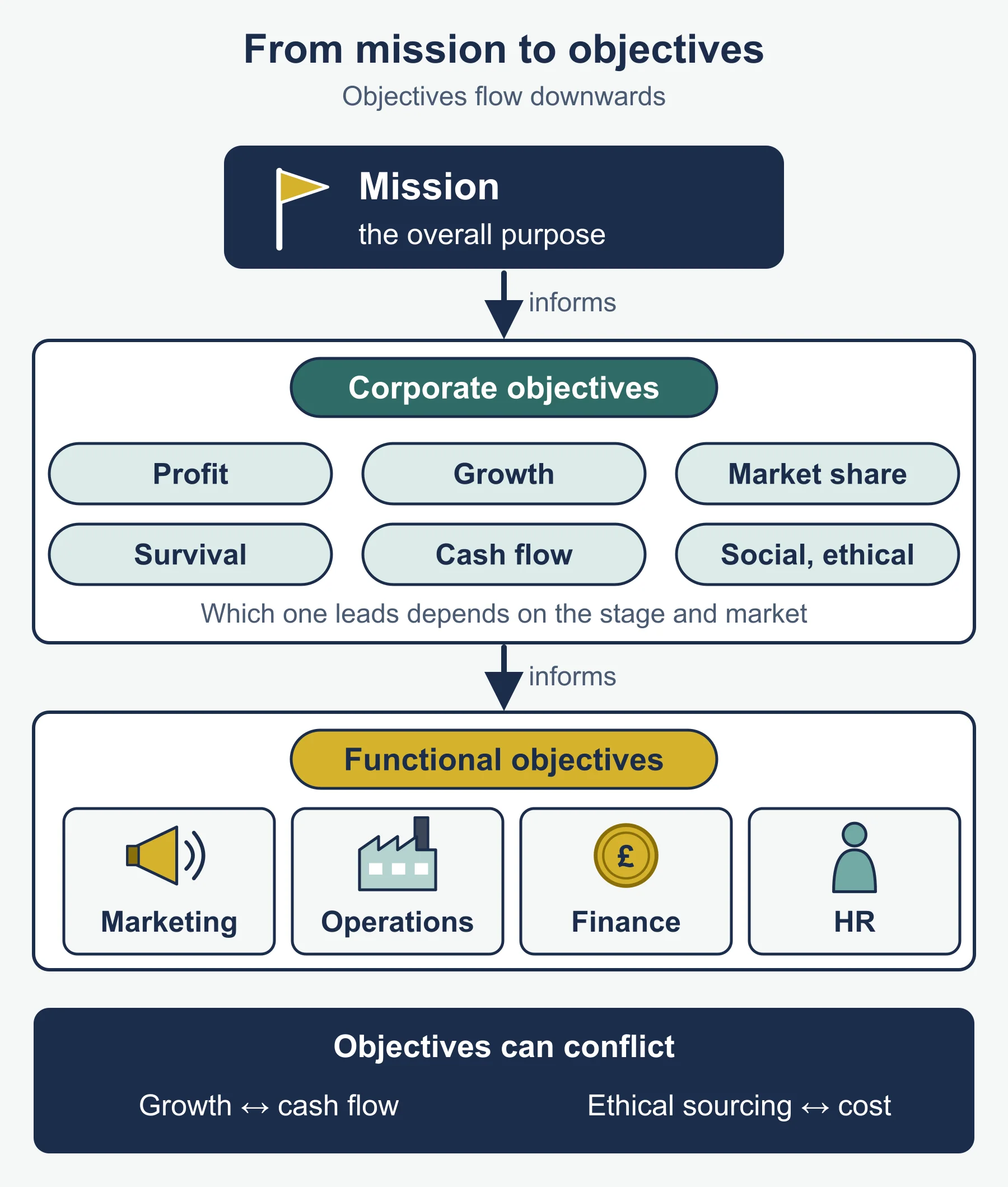
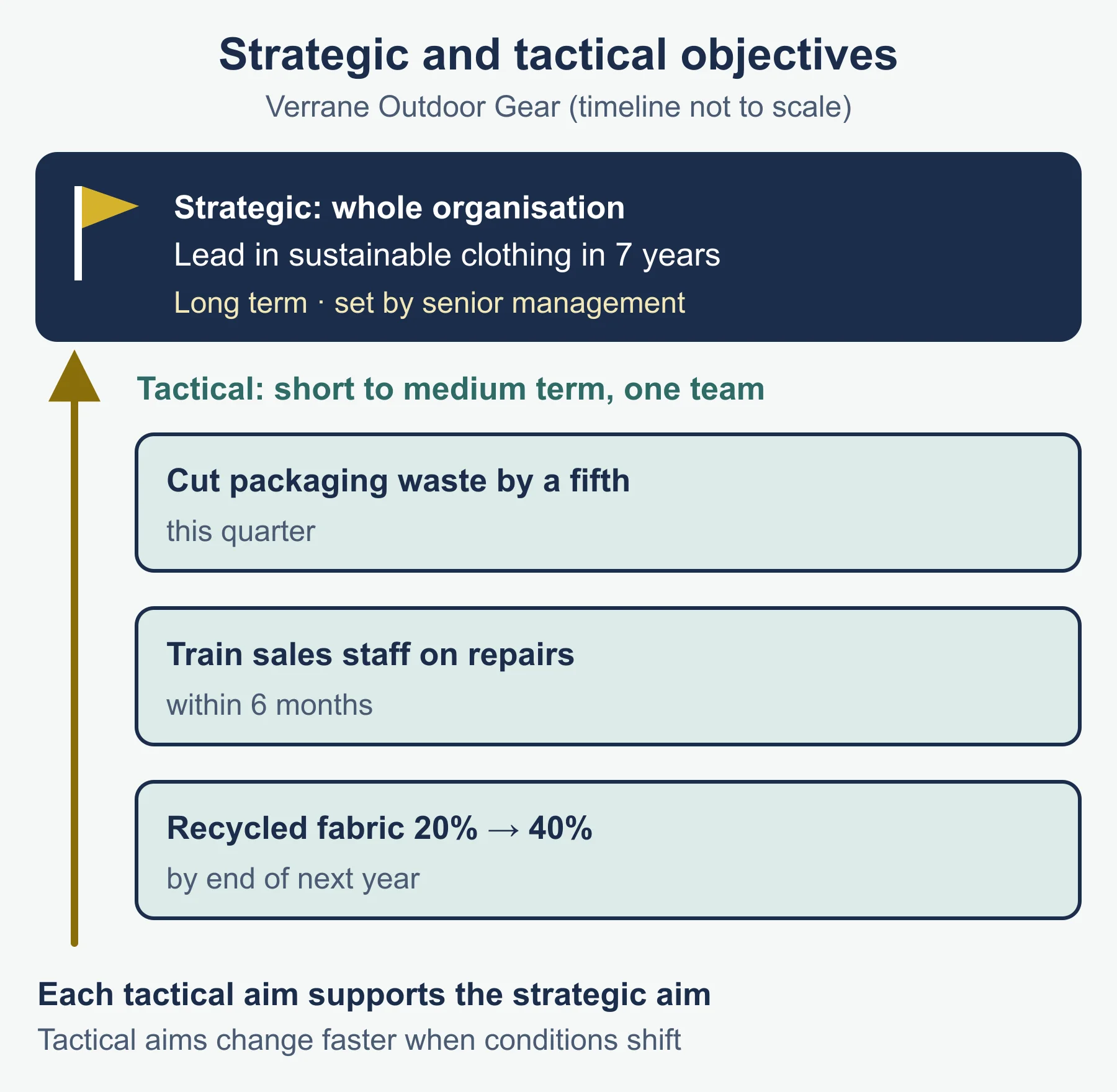
Strategic and tactical objectives
| Strategic | Tactical | |
|---|---|---|
| Time | Long term | Short to medium term |
| Scope | Whole organization | Department, product or project |
| Set by | Senior management, board | Middle managers |
| Role | Direction | Steps toward the direction |
| Flexibility | Reviewed rarely | Adjusted often |
Key links:
- Tactical objectives must support the strategic objective.
- If they do not, effort is spent without progress.
- Too much attention on short-run tactics can damage long-run strategy.
- If conditions change, strategic objectives may need revision. This links to the guide’s inquiry statement about why objectives might change over time.
Spotting the type in a question: look for a time frame (five years versus this quarter), the unit it applies to (whole firm versus one team) and whether it states a destination or an action.
CSR
Definition (standard form): the belief that a business has responsibilities to society and the environment, as well as to its owners, and takes those into account in its decisions.
| For | Against or limits |
|---|---|
| Better reputation and loyalty | Higher costs, lower short-term profit |
| Easier to attract and keep staff | Some owners prefer a focus on shareholder returns |
| Lower risk of scandal | Can be marketing with little real change |
| Supports long-term sustainability | Benefits are hard to measure and slow |
| May spur creativity (new materials, processes) | Different stakeholders want different things |
Linking points for evaluation:
- CSR links to ethical objectives: ethics is the principle, CSR is the broader approach.
- CSR can support or conflict with profit and shareholder value, depending on time frame.
- Name the stakeholder who gains or loses (see 1.4).
- The guide’s inquiry statements ask about CSR and creativity and about ethical behavior and sustainability.
Why objectives change
Objectives are not fixed. A business may revise them when:
- a new competitor or technology changes the market
- the economy slows, so growth targets become unrealistic
- ownership changes, for example when a private firm becomes publicly held and shareholder value gains weight
- stakeholders, such as customers or pressure groups, demand higher ethical or environmental standards
- the business matures and moves from a growth focus toward profit and steady dividends
In an evaluation answer, a sentence about how the objective may change over time, and what the business should do then, shows depth.
Command words in this section
| Command term | The guide’s glossary definition |
|---|---|
| Define | Give the precise meaning of a word, phrase, concept or physical quantity |
| State | Give a specific name, value or other brief answer without explanation or calculation |
| Identify | Provide an answer from a number of possibilities |
| Calculate | Obtain a numerical answer showing the relevant stages in the working |
| Explain | Give a detailed account including reasons or causes |
| Analyse | Break down in order to bring out the essential elements or structure |
| Evaluate | Make an appraisal by weighing up the strengths and limitations |
| Justify | Give valid reasons or evidence to support an answer or conclusion |
| Recommend | Present an advisable course of action with appropriate supporting evidence/reason in relation to a given situation, problem or issue |
Judging an evaluation answer
- Make a point and tie it to the case.
- Explain the effect with a link word (so, which means, therefore).
- Give the other side or a limit.
- Reach a judgment and say what it depends on, such as time frame, size of cost or the stakeholder’s power.
Quick self-test
- State one difference between a vision statement and a mission statement.
- Give two ways of measuring the growth of a business.
- A firm has sales of USD 250,000 last year and USD 280,000 this year. Calculate the percentage growth.
- A business made a net profit of USD 36,000 on sales revenue of USD 480,000. Calculate its net profit margin.
- Why is protecting shareholder value more directly relevant to a publicly held company?
- A share cost USD 20.00 a year ago and now costs USD 19.00. The dividend was USD 1.00. Calculate the return to the shareholder.
- Classify as strategic or tactical: “Reduce delivery times by a day by the end of this month.”
- Classify as strategic or tactical: “Become the leading supplier in three countries within ten years.”
- Give one example of an ethical objective.
- State two possible benefits and one possible drawback of CSR.
Answers
- A vision statement describes the future the organization wants; a mission statement describes what it does now, for whom and how.
- Any two of: sales revenue, market share, number of employees, number of outlets, value of the business.
- (280,000 − 250,000) ÷ 250,000 × 100 = 12%.
- 36,000 ÷ 480,000 × 100 = 7.5%.
- Its shares are traded openly, so a share price shows the market’s view daily and shareholders can easily sell if unhappy. A private firm has no such open price.
- (19.00 − 20.00 + 1.00) ÷ 20.00 × 100 = 0%. The dividend exactly offsets the fall in price.
- Tactical: short time frame, narrow scope.
- Strategic: long time frame, whole-business direction.
- For example, only buying from suppliers that treat their workers fairly, or refusing to advertise in a misleading way.
- Benefits: stronger reputation, easier recruitment, lower scandal risk. Drawback: higher costs that may reduce short-term profit.
Where marks are usually lost
- Calling a mission statement an objective, or swapping vision and mission.
- Saying “the objective is to make money” without naming profit, margin or growth and the measure.
- Showing a percentage with no working or no formula.
- Confusing the percentage change in profit with the profit margin.
- Describing strategic and tactical objectives in general terms without applying them to the business in the case.
- Treating CSR as only a cost, or only a benefit.
- Writing a list of points with no judgment at the end of an evaluation question.
- Leaving out the stakeholder: who gains, who loses.
- Ignoring the time frame when judging whether an objective is sensible.
Frequently asked questions
What is the difference between a vision statement and a mission statement? A vision statement describes what the organization hopes to become or achieve in the long term. A mission statement describes what it does now, who it serves and how it goes about it.
What is the difference between strategic and tactical objectives? Strategic objectives are long term, cover the whole organization and are set by senior management. Tactical objectives are short to medium term, cover a department, product or project and show how a strategic aim will be reached.
What is shareholder value? Shareholder value is the worth of a company to the people who own its shares. It rises when the share price rises and when dividends are paid.
Can growth and profit objectives conflict? Yes. A business can meet a sales growth target while its net profit margin falls, if costs rise faster than revenue.
Official syllabus
IB Diploma Programme Business management guide, first assessment 2024, published by the International Baccalaureate Organization. This page covers section 1.3, Business objectives.
Get free revision emails (optional)
Occasional emails with practice questions, worked explanations and links to free resources for the qualification and subjects you choose. No spam, and you can unsubscribe from any email. The free tools on this site never need an email.
Related resources
-
Study guides
IB DP Business Management: Growth and evolution and Multinational companies (MNCs)
Study guide to IB DP Business Management sections 1.5 and 1.6: economies of scale, growth methods, franchising and the impact of MNCs on host countries.
Business · International Baccalaureate · IB
Read guide -
Practice questions
IB DP Business Management: Growth and evolution and Multinational companies (MNCs) – Practice Questions
Original practice questions with worked answers for IB DP Business Management sections 1.5 and 1.6: scale, growth methods, franchising and MNCs.
Business · International Baccalaureate · IB
Try questions -
Revision notes
IB DP Business Management: Growth and evolution and Multinational companies (MNCs) – Revision Notes
Condensed revision notes for IB DP Business Management sections 1.5 and 1.6: scale, growth methods, staying small and the impact of MNCs on host countries.
Business · International Baccalaureate · IB
Revise topic
Related articles
-
teaching
A Level tuition in Dubai: Cambridge or Pearson Edexcel International A Level?
Schools in Dubai and Abu Dhabi teach either Cambridge International AS & A Level or Pearson Edexcel International A Level. How the two are structured, why it matters for tuition, and how online classes from Lahore work.
9 October 2026
-
curriculum guides
Choosing subjects at IGCSE and A Level
How subject choices at 14 and 16 affect university options later, and how to keep pathways open without overloading a timetable.
28 July 2026
Studying this with a teacher
Working through Business IB?
This page is free and stays free. If you would rather be taught it, Marlbridge runs Business classes one-to-one, online in your own time zone. The first trial class is free. WhatsApp replies within an hour (8am–11pm Pakistan time, every day); email the same day.
IB Business teachers at Marlbridge

